Definition
• A verb is often defined as a word
which shows action or state of
being. The verb is the heart of a
sentence - every sentence must
have a verb. Recognizing the verb
is often the most important step
in understanding the meaning of
a sentence.
Examples
• I washed the car yesterday.
• The dog ate my homework.
• John studies English and French.
• Lucy enjoys listening to music.
Company
LOGO Types Of Verb
 Verbs vary by type, and each type is
determined by the kinds of words that
follow it and the relationship those words
have with the verb itself. There are six
types: intransitive, transitive, infinitives, to-
be verbs, and two-place transitive (Vg-
verb give), and two-place transitive (Vc-
verb consider).
Intransitive Verbs
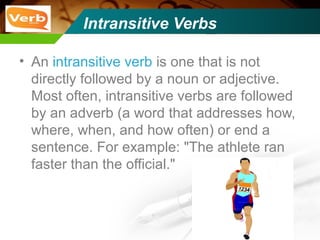
• An intransitive verb is one that is not
directly followed by a noun or adjective.
Most often, intransitive verbs are followed
by an adverb (a word that addresses how,
where, when, and how often) or end a
sentence. For example: "The athlete ran
faster than the official."
Linking Verbs
• A linking verb cannot be followed by an
adverb or end a sentence but instead
must be followed by a noun or adjective,
whether in a single word or phrase.
Common linking verbs include seem,
become, appear, look, and remain. For
example: "His mother looked worried."
Therefore, linking verbs 'link' the adverb to
the subject.
Transitive Verbs
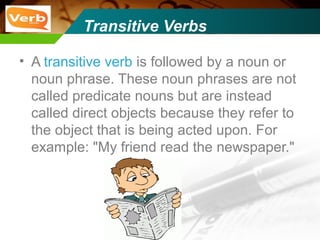
• A transitive verb is followed by a noun or
noun phrase. These noun phrases are not
called predicate nouns but are instead
called direct objects because they refer to
the object that is being acted upon. For
example: "My friend read the newspaper."
Two-Place Transitive: Vg Verbs
• Vg verbs (named after the verb give)
precede either two noun phrases or a
noun phrase and then a prepositional
phrase often led by to or for. For example:
"The players gave their teammates high
fives." "The players gave high fives to their
teammates."
Two-Place Transitive: Vc Verbs
• Vc verbs (named after the verb consider)
are followed by a noun phrase that serves
as a direct object and then a second noun
phrase, adjective, or infinitive phrase. The
second element (noun phrase, adjective,
or infinitive) is called a complement, which
completes a clause that would not
otherwise have the same meaning. For
example: "The young couple considers the
neighbors wealthy people."
To-Be Verbs
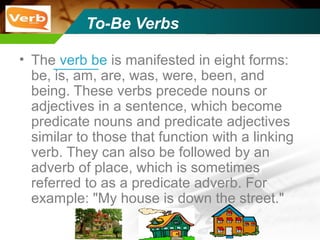
• The verb be is manifested in eight forms:
be, is, am, are, was, were, been, and
being. These verbs precede nouns or
adjectives in a sentence, which become
predicate nouns and predicate adjectives
similar to those that function with a linking
verb. They can also be followed by an
adverb of place, which is sometimes
referred to as a predicate adverb. For
example: "My house is down the street."
Voice
 The voice of a verb expresses whether
the subject of the verb is performing the
action of the verb or whether the action is
being performed on the subject. The two
most common voices are the active voice
(as in "I saw the car") and the passive
voice (as in "The car was seen by me" or
simply "The car was seen").
Submitted By :-
• Name – Nimish
• Class – IX
• Section – C
• Roll No. – 11

Verbs

  • 2.
    Definition • A verbis often defined as a word which shows action or state of being. The verb is the heart of a sentence - every sentence must have a verb. Recognizing the verb is often the most important step in understanding the meaning of a sentence.
  • 3.
    Examples • I washedthe car yesterday. • The dog ate my homework. • John studies English and French. • Lucy enjoys listening to music.
  • 4.
    Company LOGO Types OfVerb  Verbs vary by type, and each type is determined by the kinds of words that follow it and the relationship those words have with the verb itself. There are six types: intransitive, transitive, infinitives, to- be verbs, and two-place transitive (Vg- verb give), and two-place transitive (Vc- verb consider).
  • 5.
    Intransitive Verbs • Anintransitive verb is one that is not directly followed by a noun or adjective. Most often, intransitive verbs are followed by an adverb (a word that addresses how, where, when, and how often) or end a sentence. For example: "The athlete ran faster than the official."
  • 6.
    Linking Verbs • Alinking verb cannot be followed by an adverb or end a sentence but instead must be followed by a noun or adjective, whether in a single word or phrase. Common linking verbs include seem, become, appear, look, and remain. For example: "His mother looked worried." Therefore, linking verbs 'link' the adverb to the subject.
  • 7.
    Transitive Verbs • Atransitive verb is followed by a noun or noun phrase. These noun phrases are not called predicate nouns but are instead called direct objects because they refer to the object that is being acted upon. For example: "My friend read the newspaper."
  • 8.
    Two-Place Transitive: VgVerbs • Vg verbs (named after the verb give) precede either two noun phrases or a noun phrase and then a prepositional phrase often led by to or for. For example: "The players gave their teammates high fives." "The players gave high fives to their teammates."
  • 9.
    Two-Place Transitive: VcVerbs • Vc verbs (named after the verb consider) are followed by a noun phrase that serves as a direct object and then a second noun phrase, adjective, or infinitive phrase. The second element (noun phrase, adjective, or infinitive) is called a complement, which completes a clause that would not otherwise have the same meaning. For example: "The young couple considers the neighbors wealthy people."
  • 10.
    To-Be Verbs • Theverb be is manifested in eight forms: be, is, am, are, was, were, been, and being. These verbs precede nouns or adjectives in a sentence, which become predicate nouns and predicate adjectives similar to those that function with a linking verb. They can also be followed by an adverb of place, which is sometimes referred to as a predicate adverb. For example: "My house is down the street."
  • 11.
    Voice  The voiceof a verb expresses whether the subject of the verb is performing the action of the verb or whether the action is being performed on the subject. The two most common voices are the active voice (as in "I saw the car") and the passive voice (as in "The car was seen by me" or simply "The car was seen").
  • 12.
    Submitted By :- •Name – Nimish • Class – IX • Section – C • Roll No. – 11