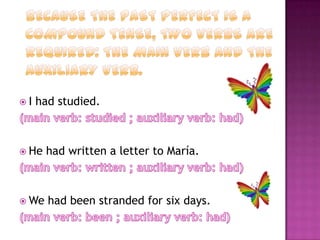
 I had studied.
 He had written a letter to María.
 We had been stranded for six days.
 I had studied.
 He had written a letter to María.
 We had been stranded for six days.
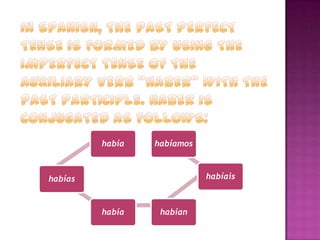
había
habías
había habían
habíais
habíamos
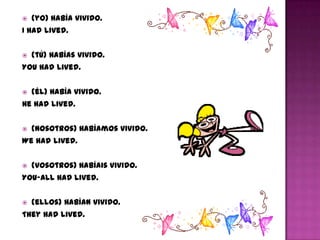
 (yo) Había vivido.
I had lived.
 (tú) Habías vivido.
You had lived.
 (él) Había vivido.
He had lived.
 (nosotros) Habíamos vivido.
We had lived.
 (vosotros) Habíais vivido.
You-all had lived.
 (ellos) Habían vivido.
They had lived.
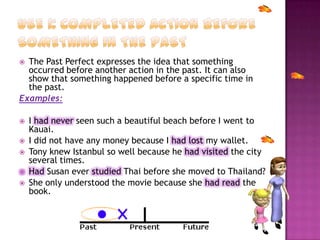
 The Past Perfect expresses the idea that something
occurred before another action in the past. It can also
show that something happened before a specific time in
the past.
Examples:
 I had never seen such a beautiful beach before I went to
Kauai.
 I did not have any money because I had lost my wallet.
 Tony knew Istanbul so well because he had visited the city
several times.
 Had Susan ever studied Thai before she moved to Thailand?
 She only understood the movie because she had read the
book.
 With Non-Continuous Verbs and some non-continuous uses
of Mixed Verbs, we use the Past Perfect to show that
something started in the past and continued up until
another action in the past.
Examples:
 We had had that car for ten years before it broke down.
 By the time Alex finished his studies, he had been in
London for over eight years.
 They felt bad about selling the house because they had
owned it for more than forty years.
Although the above use of Past Perfect is normally limited to
Non-Continuous Verbs and non-continuous uses of Mixed
Verbs, the words "live," "work," "teach," and "study" are
sometimes used in this way even though they are NOT Non-
Continuous Verbs.
 IMPORTANT Specific Times with the Past
Past perfect

Past perfect

  • 2.
     I hadstudied.  He had written a letter to María.  We had been stranded for six days.
  • 3.
     I hadstudied.  He had written a letter to María.  We had been stranded for six days.
  • 4.
  • 6.
     (yo) Habíavivido. I had lived.  (tú) Habías vivido. You had lived.  (él) Había vivido. He had lived.  (nosotros) Habíamos vivido. We had lived.  (vosotros) Habíais vivido. You-all had lived.  (ellos) Habían vivido. They had lived.
  • 8.
     The PastPerfect expresses the idea that something occurred before another action in the past. It can also show that something happened before a specific time in the past. Examples:  I had never seen such a beautiful beach before I went to Kauai.  I did not have any money because I had lost my wallet.  Tony knew Istanbul so well because he had visited the city several times.  Had Susan ever studied Thai before she moved to Thailand?  She only understood the movie because she had read the book.
  • 9.
     With Non-ContinuousVerbs and some non-continuous uses of Mixed Verbs, we use the Past Perfect to show that something started in the past and continued up until another action in the past. Examples:  We had had that car for ten years before it broke down.  By the time Alex finished his studies, he had been in London for over eight years.  They felt bad about selling the house because they had owned it for more than forty years. Although the above use of Past Perfect is normally limited to Non-Continuous Verbs and non-continuous uses of Mixed Verbs, the words "live," "work," "teach," and "study" are sometimes used in this way even though they are NOT Non- Continuous Verbs.  IMPORTANT Specific Times with the Past