Ana Catarina, Ana Cristina and Mariana
 
We use past simple for:    Actions that happened consecutively or one after the other in the past. Example: George woke up, got up, put on his clothes and went out.  Events which happened in the past and are now finished. Example: We went to Porto.  Regular or habitual actions in the past. Example: She travelled a lot when she was younger.
 
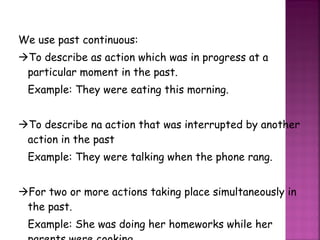
We use past continuous:  To describe as action which was in progress at a particular moment in the past. Example: They were eating this morning.  To describe na action that was interrupted by another action in the past Example: They were talking when the phone rang.  For two or more actions taking place simultaneously in the past. Example: She was doing her homeworks while her parents were cooking.
 
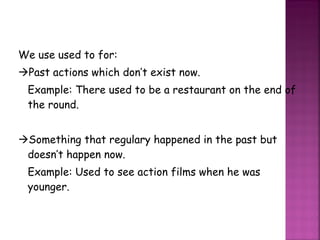
We use used to for:  Past actions which don’t exist now. Example: There used to be a restaurant on the end of the round.  Something that regulary happened in the past but doesn’t happen now. Example: Used to see action films when he was younger.
 
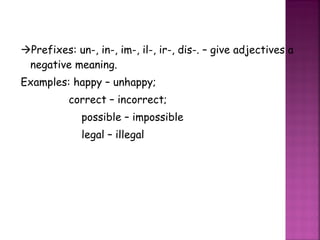
 Prefixes: un-, in-, im-, il-, ir-, dis-. – give adjectives a negative meaning. Examples: happy – unhappy;   correct – incorrect; possible – impossible legal – illegal
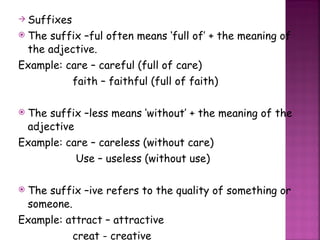
Suffixes The suffix –ful often means ‘full of’ + the meaning of the adjective. Example: care – careful (full of care)   faith – faithful (full of faith) The suffix –less means ‘without’ + the meaning of the adjective Example: care – careless (without care) Use – useless (without use) The suffix –ive refers to the quality of something or someone. Example: attract – attractive   creat - creative
 
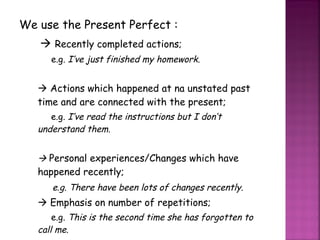
We use the Present Perfect :    Recently completed actions; e.g.  I’ve just finished my homework.    Actions which happened at na unstated past time and are connected with the present; e.g . I’ve read the instructions but I don’t understand them.    Personal experiences/Changes which have happened recently; e.g. There have been lots of changes recently.    Emphasis on number of repetitions; e.g.  This is the second time she has forgotten to call me.
 
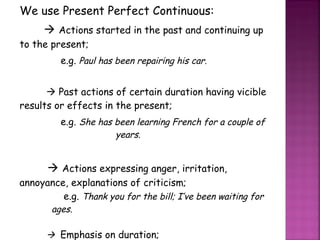
We use Present Perfect Continuous:    Actions started in the past and continuing up to the present; e.g.  Paul has been repairing his car.    Past actions of certain duration having vicible results or effects in the present; e.g.  She has been learning French for a couple of  years.    Actions expressing anger, irritation, annoyance, explanations of criticism; e.g.  Thank you for the bill; I’ve been waiting for  ages.    Emphasis on duration;   e.g.  How long have you been working here?
 
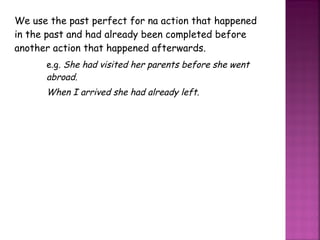
We use the past perfect for na action that happened in the past and had already been completed before another action that happened afterwards. e.g.  She had visited her parents before she went  abroad. When I arrived she had already left.
 
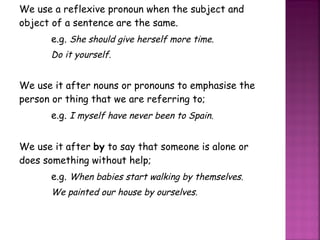
We use a reflexive pronoun when the subject and object of a sentence are the same. e.g.  She should give herself more time. Do it yourself. We use it after nouns or pronouns to emphasise the person or thing that we are referring to; e.g.  I myself have never been to Spain. We use it after  by  to say that someone is alone or does something without help; e.g.  When babies start walking by themselves. We painted our house by ourselves.
 
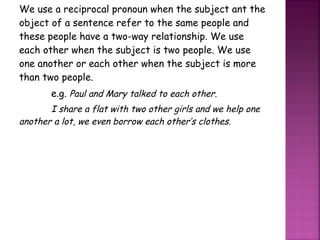
We use a reciprocal pronoun when the subject ant the object of a sentence refer to the same people and these people have a two-way relationship. We use each other when the subject is two people. We use one another or each other when the subject is more than two people. e.g.  Paul and Mary talked to each other. I share a flat with two other girls and we help one another a lot, we even borrow each other’s clothes.
 
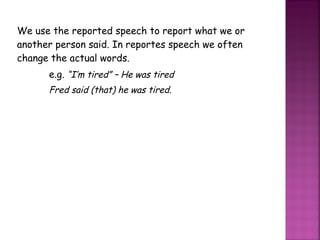
We use the reported speech to report what we or another person said. In reportes speech we often change the actual words. e.g.  “I’m tired” – He was tired Fred said (that) he was tired.
 
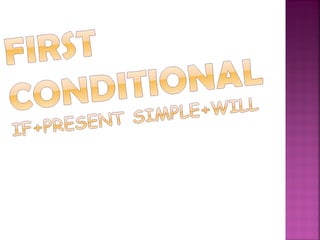
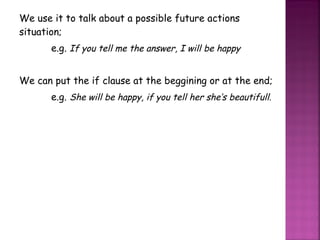
We use it to talk about a possible future actions situation; e.g.  If you tell me the answer, I will be happy We can put the if clause at the beggining or at the end; e.g.  She will be happy, if you tell her she’s beautifull.
 
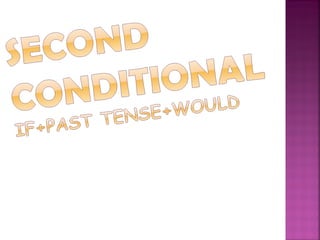
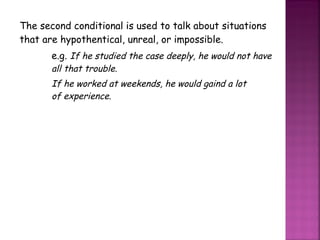
The second conditional is used to talk about situations that are hypothentical, unreal, or impossible. e.g.  If he studied the case deeply, he would not have  all that trouble. If he worked at weekends, he would gaind a lot  of experience.
 
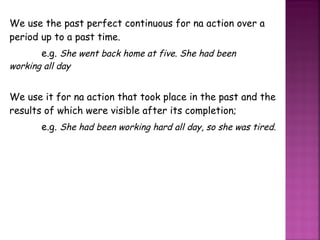
We use the past perfect continuous for na action over a period up to a past time. e.g.  She went back home at five. She had been  working all day We use it for na action that took place in the past and the results of which were visible after its completion; e.g.  She had been working hard all day, so she was tired.
 
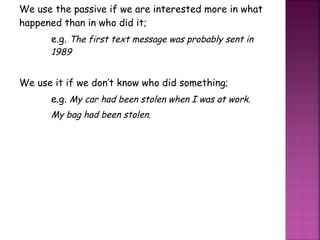
We use the passive if we are interested more in what happened than in who did it; e.g.  The first text message was probably sent in  1989 We use it if we don’t know who did something; e.g.  My car had been stolen when I was at work. My bag had been stolen.
 
Uses:    Predictions, hopes and fears; e.g.  Robots will do everything we need in the future.  Often with verbs not usually used in continuous forms; e.g.  I’ll see you tonight.    For offers, requests and promisses; e.g.  I’ll get you a glass of water.  To express determination; e.g.  I won’t phone you tonight.
 
We use BE GOING TO for plans and intentions; e.g.  I’m going to buy Bob Sinclar’s CD. I’m going to the shopping today.
 
We use the present continuous for arrangementes e.g.  Are you having a karaoke conteste Friday? I’m seeing Mr Smith at 3.30 tomorrow.

Gramatica ingles

  • 1.
    Ana Catarina, AnaCristina and Mariana
  • 2.
  • 3.
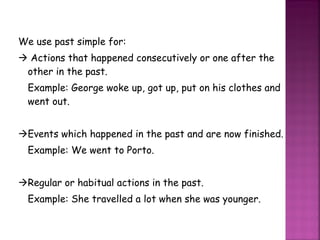
    We use pastsimple for:  Actions that happened consecutively or one after the other in the past. Example: George woke up, got up, put on his clothes and went out.  Events which happened in the past and are now finished. Example: We went to Porto.  Regular or habitual actions in the past. Example: She travelled a lot when she was younger.
  • 4.
  • 5.
    We use pastcontinuous:  To describe as action which was in progress at a particular moment in the past. Example: They were eating this morning.  To describe na action that was interrupted by another action in the past Example: They were talking when the phone rang.  For two or more actions taking place simultaneously in the past. Example: She was doing her homeworks while her parents were cooking.
  • 6.
  • 7.
    We use usedto for:  Past actions which don’t exist now. Example: There used to be a restaurant on the end of the round.  Something that regulary happened in the past but doesn’t happen now. Example: Used to see action films when he was younger.
  • 8.
  • 9.
     Prefixes: un-,in-, im-, il-, ir-, dis-. – give adjectives a negative meaning. Examples: happy – unhappy; correct – incorrect; possible – impossible legal – illegal
  • 10.
    Suffixes The suffix–ful often means ‘full of’ + the meaning of the adjective. Example: care – careful (full of care) faith – faithful (full of faith) The suffix –less means ‘without’ + the meaning of the adjective Example: care – careless (without care) Use – useless (without use) The suffix –ive refers to the quality of something or someone. Example: attract – attractive creat - creative
  • 11.
  • 12.
    We use thePresent Perfect :  Recently completed actions; e.g. I’ve just finished my homework.  Actions which happened at na unstated past time and are connected with the present; e.g . I’ve read the instructions but I don’t understand them.  Personal experiences/Changes which have happened recently; e.g. There have been lots of changes recently.  Emphasis on number of repetitions; e.g. This is the second time she has forgotten to call me.
  • 13.
  • 14.
    We use PresentPerfect Continuous:  Actions started in the past and continuing up to the present; e.g. Paul has been repairing his car.  Past actions of certain duration having vicible results or effects in the present; e.g. She has been learning French for a couple of years.  Actions expressing anger, irritation, annoyance, explanations of criticism; e.g. Thank you for the bill; I’ve been waiting for ages.  Emphasis on duration; e.g. How long have you been working here?
  • 15.
  • 16.
    We use thepast perfect for na action that happened in the past and had already been completed before another action that happened afterwards. e.g. She had visited her parents before she went abroad. When I arrived she had already left.
  • 17.
  • 18.
    We use areflexive pronoun when the subject and object of a sentence are the same. e.g. She should give herself more time. Do it yourself. We use it after nouns or pronouns to emphasise the person or thing that we are referring to; e.g. I myself have never been to Spain. We use it after by to say that someone is alone or does something without help; e.g. When babies start walking by themselves. We painted our house by ourselves.
  • 19.
  • 20.
    We use areciprocal pronoun when the subject ant the object of a sentence refer to the same people and these people have a two-way relationship. We use each other when the subject is two people. We use one another or each other when the subject is more than two people. e.g. Paul and Mary talked to each other. I share a flat with two other girls and we help one another a lot, we even borrow each other’s clothes.
  • 21.
  • 22.
    We use thereported speech to report what we or another person said. In reportes speech we often change the actual words. e.g. “I’m tired” – He was tired Fred said (that) he was tired.
  • 23.
  • 24.
    We use itto talk about a possible future actions situation; e.g. If you tell me the answer, I will be happy We can put the if clause at the beggining or at the end; e.g. She will be happy, if you tell her she’s beautifull.
  • 25.
  • 26.
    The second conditionalis used to talk about situations that are hypothentical, unreal, or impossible. e.g. If he studied the case deeply, he would not have all that trouble. If he worked at weekends, he would gaind a lot of experience.
  • 27.
  • 28.
    We use thepast perfect continuous for na action over a period up to a past time. e.g. She went back home at five. She had been working all day We use it for na action that took place in the past and the results of which were visible after its completion; e.g. She had been working hard all day, so she was tired.
  • 29.
  • 30.
    We use thepassive if we are interested more in what happened than in who did it; e.g. The first text message was probably sent in 1989 We use it if we don’t know who did something; e.g. My car had been stolen when I was at work. My bag had been stolen.
  • 31.
  • 32.
    Uses:  Predictions, hopes and fears; e.g. Robots will do everything we need in the future.  Often with verbs not usually used in continuous forms; e.g. I’ll see you tonight.  For offers, requests and promisses; e.g. I’ll get you a glass of water.  To express determination; e.g. I won’t phone you tonight.
  • 33.
  • 34.
    We use BEGOING TO for plans and intentions; e.g. I’m going to buy Bob Sinclar’s CD. I’m going to the shopping today.
  • 35.
  • 36.
    We use thepresent continuous for arrangementes e.g. Are you having a karaoke conteste Friday? I’m seeing Mr Smith at 3.30 tomorrow.