Dural Sinuses and Ventricles
Dr. Anudeep Singh
MBBS MD
Dural VenousSinuses
They are blood-filled spaces situated between the layers of the dura
mater.
• Has bidirectional flow.
• They are lined by endothelium.
• They have no valves.
They receive tributaries from:
• The brain
• The diploic veins of the skull;
• The orbit and
• The internal ear.
• Also from CSF.
Finally drain into the internal jugular vein.
DURAMATER
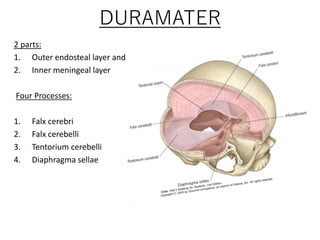
2 parts:
1. Outer endosteal layer and
2. Inner meningeal layer
Four Processes:
1. Falx cerebri
2. Falx cerebelli
3. Tentorium cerebelli
4. Diaphragma sellae
Group of sinuses
Upper group:
1. Superior sagittal sinus
2. Inferior sagittal sinus
3. Straight sinus
4. Confluence of sinuses
5. Transverse sinus
Lower group:
1. Cavernous sinus
2. Anterior intercavernous sinus
3. Posterior intercavernous sinus
4. Superior petrosal sinus
5. Inferior petrosal sinus
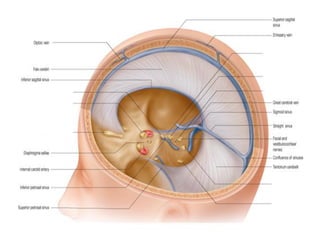
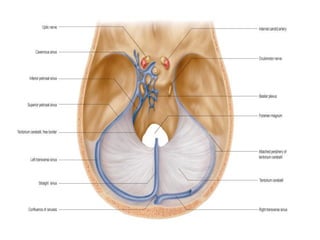
• Inferior sagittal sinus: Occupies the free lower margin of the falx cerebri. It runs
backward and joins the great cerebral vein to form the straight sinus.
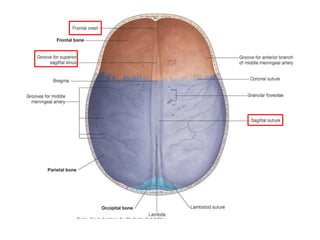
• Superior sagittal sinus: Occupies the upper fixed border of the falx cerebri. It runs
backward, at the internal occipital protuberance it deviates to one side (usually the
right ) and becomes continuous with the transverse sinus.
• Straight sinus: Present at the line of junction of the falx cerebri with the tentorium
cerebelli. It ends by turning to the left (sometimes to the right) to form the
transverse sinus.
• Occipital Sinus: Occupies attached margin of the falx cerebelli. Superiorly it drains
into the confluence of sinuses.
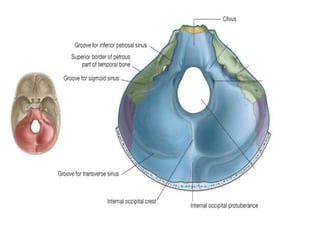
• Transverse Sinus: They are paired and begin at the internal occipital protuberance.
Each sinus occupies the attached margin of the tentorium cerebelli , grooving the
occipital bone and posteroinferior angle of the parietal bone. They end by turning
downward as the sigmoid sinuses.
• Superior and inferior petrosal sinuses: Are small and situated on the superior
and inferior borders of the petrous part of the temporal bone on each side.
Each superior sinus drains the cavernous sinus into the transverse sinus. Each
inferior sinus drains the cavernous sinus into the internal jugular vein.
• Confluence of sinuses: Present at internal occipital protuberance, is a junction
of occipital sinus, superior sagittal sinus and straight sinus.
• Sigmoid sinus: bilateral continuation of transverse sinus and drains into
internal jugular vein.
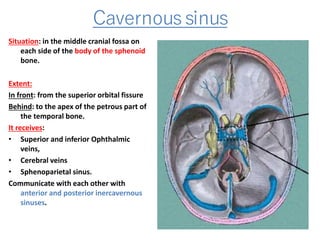
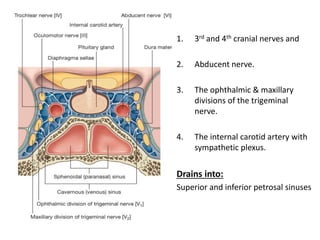
Cavernoussinus
Situation: in the middle cranial fossa on
each side of the body of the sphenoid
bone.
Extent:
In front: from the superior orbital fissure
Behind: to the apex of the petrous part of
the temporal bone.
It receives:
• Superior and inferior Ophthalmic
veins,
• Cerebral veins
• Sphenoparietal sinus.
Communicate with each other with
anterior and posterior inercavernous
sinuses.
1. 3rd and 4th cranial nerves and
2. Abducent nerve.
3. The ophthalmic & maxillary
divisions of the trigeminal
nerve.
4. The internal carotid artery with
sympathetic plexus.
Drains into:
Superior and inferior petrosal sinuses
Ventricular System
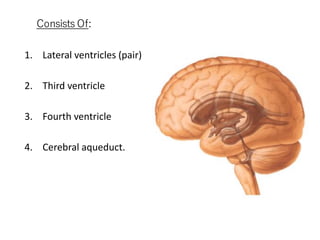
Consists Of:
1. Lateral ventricles (pair)
2. Third ventricle
3. Fourth ventricle
4. Cerebral aqueduct.
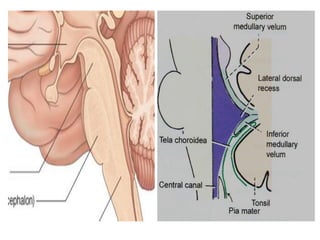
Fourth ventricle
Location:
Present between the brain stem (pons and medulla) anteriorly and cerebellum
posteriorly.
Roof:
Rostral part: Formed by the superior cerebellar peduncle and superior
medullary velum.
Caudal part: formed by piamater and ependyma.
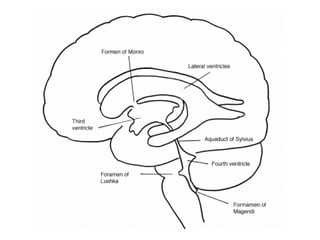
Communicates with subarachnoid space through a
Median aperture ( foramen of magendie) and
Two lateral apertures (foramen of luschka).
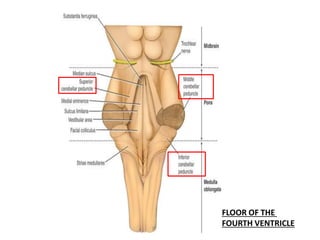
FLOOR OF THE
FOURTH VENTRICLE
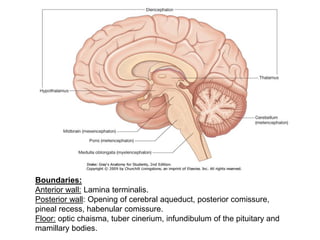
Boundaries:
Anterior wall: Lamina terminalis.
Posterior wall: Opening of cerebral aqueduct, posterior comissure,
pineal recess, habenular comissure.
Floor: optic chaisma, tuber cinerium, infundibulum of the pituitary and
mamillary bodies.
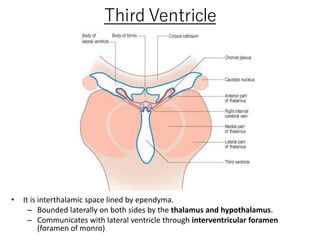
Third Ventricle
• It is interthalamic space lined by ependyma.
– Bounded laterally on both sides by the thalamus and hypothalamus.
– Communicates with lateral ventricle through interventricular foramen
(foramen of monro)
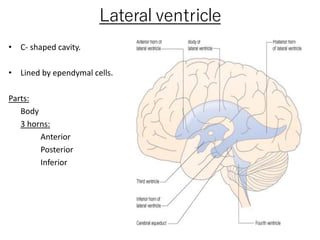
Lateral ventricle
• C- shaped cavity.
• Lined by ependymal cells.
Parts:
Body
3 horns:
Anterior
Posterior
Inferior
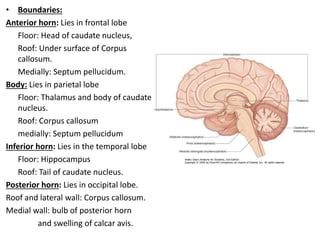
• Boundaries:
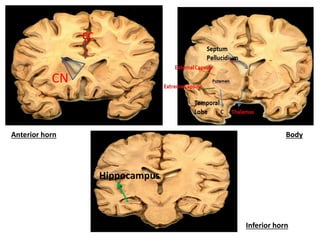
Anterior horn: Lies in frontal lobe
Floor: Head of caudate nucleus,
Roof: Under surface of Corpus
callosum.
Medially: Septum pellucidum.
Body: Lies in parietal lobe
Floor: Thalamus and body of caudate
nucleus.
Roof: Corpus callosum
medially: Septum pellucidum
Inferior horn: Lies in the temporal lobe
Floor: Hippocampus
Roof: Tail of caudate nucleus.
Posterior horn: Lies in occipital lobe.
Roof and lateral wall: Corpus callosum.
Medial wall: bulb of posterior horn
and swelling of calcar avis.
CC
CN
Hippocampus
Anterior horn Body
Inferior horn
CSF
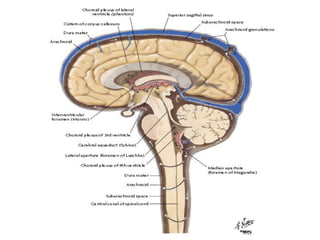
• Produced by choroid plexus.
• Choroid plexus is formed by the invagination of vascular piamater into
ventricular lumen.
• Formation: Both by active secretion and passive diffusion.
• Volume: 150 mL.
• Circulation:
Lateral ventricle ------- through interventricular foramen ---------to 3rd ventricle -
------- through aqueduct ------ to 4th ventricle -------- leaves through the
apertures of the fourth ventricle and enters the subarachnoid space.
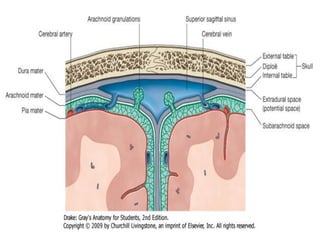
• Reabsorption: Into the dural venous sinuses.
The absorption occurs in the arachnoid villi.
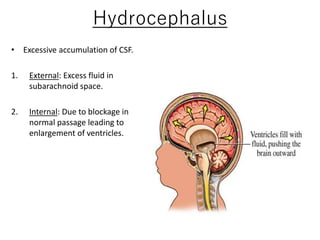
Hydrocephalus
• Excessive accumulation of CSF.
1. External: Excess fluid in
subarachnoid space.
2. Internal: Due to blockage in
normal passage leading to
enlargement of ventricles.
References
• Grays anatomy for students 2nd edition

Ventricles,csf and dural sinuses anudeep singh

  • 1.
    Dural Sinuses andVentricles Dr. Anudeep Singh MBBS MD
  • 2.
    Dural VenousSinuses They areblood-filled spaces situated between the layers of the dura mater. • Has bidirectional flow. • They are lined by endothelium. • They have no valves. They receive tributaries from: • The brain • The diploic veins of the skull; • The orbit and • The internal ear. • Also from CSF. Finally drain into the internal jugular vein.
  • 6.
    DURAMATER 2 parts: 1. Outerendosteal layer and 2. Inner meningeal layer Four Processes: 1. Falx cerebri 2. Falx cerebelli 3. Tentorium cerebelli 4. Diaphragma sellae
  • 7.
    Group of sinuses Uppergroup: 1. Superior sagittal sinus 2. Inferior sagittal sinus 3. Straight sinus 4. Confluence of sinuses 5. Transverse sinus Lower group: 1. Cavernous sinus 2. Anterior intercavernous sinus 3. Posterior intercavernous sinus 4. Superior petrosal sinus 5. Inferior petrosal sinus
  • 10.
    • Inferior sagittalsinus: Occupies the free lower margin of the falx cerebri. It runs backward and joins the great cerebral vein to form the straight sinus. • Superior sagittal sinus: Occupies the upper fixed border of the falx cerebri. It runs backward, at the internal occipital protuberance it deviates to one side (usually the right ) and becomes continuous with the transverse sinus. • Straight sinus: Present at the line of junction of the falx cerebri with the tentorium cerebelli. It ends by turning to the left (sometimes to the right) to form the transverse sinus. • Occipital Sinus: Occupies attached margin of the falx cerebelli. Superiorly it drains into the confluence of sinuses. • Transverse Sinus: They are paired and begin at the internal occipital protuberance. Each sinus occupies the attached margin of the tentorium cerebelli , grooving the occipital bone and posteroinferior angle of the parietal bone. They end by turning downward as the sigmoid sinuses.
  • 11.
    • Superior andinferior petrosal sinuses: Are small and situated on the superior and inferior borders of the petrous part of the temporal bone on each side. Each superior sinus drains the cavernous sinus into the transverse sinus. Each inferior sinus drains the cavernous sinus into the internal jugular vein. • Confluence of sinuses: Present at internal occipital protuberance, is a junction of occipital sinus, superior sagittal sinus and straight sinus. • Sigmoid sinus: bilateral continuation of transverse sinus and drains into internal jugular vein.
  • 12.
    Cavernoussinus Situation: in themiddle cranial fossa on each side of the body of the sphenoid bone. Extent: In front: from the superior orbital fissure Behind: to the apex of the petrous part of the temporal bone. It receives: • Superior and inferior Ophthalmic veins, • Cerebral veins • Sphenoparietal sinus. Communicate with each other with anterior and posterior inercavernous sinuses.
  • 13.
    1. 3rd and4th cranial nerves and 2. Abducent nerve. 3. The ophthalmic & maxillary divisions of the trigeminal nerve. 4. The internal carotid artery with sympathetic plexus. Drains into: Superior and inferior petrosal sinuses
  • 14.
  • 15.
    Consists Of: 1. Lateralventricles (pair) 2. Third ventricle 3. Fourth ventricle 4. Cerebral aqueduct.
  • 17.
    Fourth ventricle Location: Present betweenthe brain stem (pons and medulla) anteriorly and cerebellum posteriorly. Roof: Rostral part: Formed by the superior cerebellar peduncle and superior medullary velum. Caudal part: formed by piamater and ependyma. Communicates with subarachnoid space through a Median aperture ( foramen of magendie) and Two lateral apertures (foramen of luschka).
  • 19.
  • 20.
    Boundaries: Anterior wall: Laminaterminalis. Posterior wall: Opening of cerebral aqueduct, posterior comissure, pineal recess, habenular comissure. Floor: optic chaisma, tuber cinerium, infundibulum of the pituitary and mamillary bodies.
  • 21.
    Third Ventricle • Itis interthalamic space lined by ependyma. – Bounded laterally on both sides by the thalamus and hypothalamus. – Communicates with lateral ventricle through interventricular foramen (foramen of monro)
  • 22.
    Lateral ventricle • C-shaped cavity. • Lined by ependymal cells. Parts: Body 3 horns: Anterior Posterior Inferior
  • 23.
    • Boundaries: Anterior horn:Lies in frontal lobe Floor: Head of caudate nucleus, Roof: Under surface of Corpus callosum. Medially: Septum pellucidum. Body: Lies in parietal lobe Floor: Thalamus and body of caudate nucleus. Roof: Corpus callosum medially: Septum pellucidum Inferior horn: Lies in the temporal lobe Floor: Hippocampus Roof: Tail of caudate nucleus. Posterior horn: Lies in occipital lobe. Roof and lateral wall: Corpus callosum. Medial wall: bulb of posterior horn and swelling of calcar avis.
  • 24.
  • 25.
    CSF • Produced bychoroid plexus. • Choroid plexus is formed by the invagination of vascular piamater into ventricular lumen. • Formation: Both by active secretion and passive diffusion. • Volume: 150 mL. • Circulation: Lateral ventricle ------- through interventricular foramen ---------to 3rd ventricle - ------- through aqueduct ------ to 4th ventricle -------- leaves through the apertures of the fourth ventricle and enters the subarachnoid space. • Reabsorption: Into the dural venous sinuses. The absorption occurs in the arachnoid villi.
  • 28.
    Hydrocephalus • Excessive accumulationof CSF. 1. External: Excess fluid in subarachnoid space. 2. Internal: Due to blockage in normal passage leading to enlargement of ventricles.
  • 29.
    References • Grays anatomyfor students 2nd edition