Subject:- Applied Fluid Mechanics
Topic:- Ventilation Sustem
Guided by:- Prof. Manali Shah
Prof. Mamta Patel
Name Enrollment No.
Deshmukh Bhavik Hasmukhlal 151103106002
Kotila Jayveer Vanrajbhai 151103106008
Mistry Aditya Pramodbhai 151103106009
Pandya Dhrumil Dipakbhai 151103106010
Patel Nirmal Dalpatbhai 151103106012
ventilation
• The process of supply of fresh air and replenish
oxygen supply to occupied and unoccupied space
within building and other inhabited structures is called
ventilation.
Ventilation is necessary to:
1. Replenish the oxygen supply
2. Dilute carbon dioxide
3. Dilute odour, process emission
4. Provide air movement
5. Reduce humidity
6. Prevent the build up of potentially explosive vapour mixtures
Requirement of good ventilation:
1. It should admit sufficient quantity of fresh air and remove the requisite
contaminated air.
2. It should admit clean and humid air.
3. It should continuously change the air inside the room.
4. It should properly control the velocity &quantity of air inside the space.
5. The system should also control the temperature of the admitted air.
SYSTEM OF VENTILATION
1.Natural ventilation
2.Mechanical ventilation
1. Natural ventilation
It relies on the pressure of opening in the ventilated structure. In natural
ventilation the effect of two mechanisms that cause air exchange through
these opening based on temperature and pressure effects are very
important.
Change in the pressure over the surface of the building due to the effect
of the building and surrounding structures on the local air flow patterns,
leads to both driving and suction effects. The temperature difference
between the inside and outside of the building leads to density variations
and the stack effect.
Doors and window near the floor level, admits fresh air and ventilatiors
near the ceiling take out the vitiated air from a room. Fan lights of 30 cm
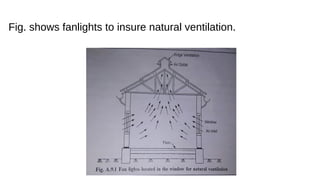
Fig. shows fanlights to insure natural ventilation.
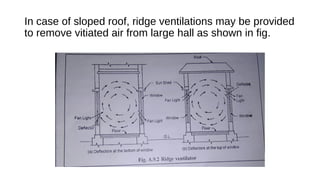
In case of sloped roof, ridge ventilations may be provided
to remove vitiated air from large hall as shown in fig.
2. Mechanical ventilation (Artificial ventilation)
Mechanical ventilation technique is suitable for energy controlled
buildings, those where sealing the building become necessary
for other reasons, e.g. acoustic pollution and buildings
incorporating processes generating contaminants.
Mechanical ventilation may be classified as,
1. vaccume system
2. propulsion system
3. air conditioning system
1. vaccume system
in this system exhaust fans or blowers are installed near the
ceiling to extract used up air from inside and though it outside.
Due to exhausting of warm air from the room will reduce causing
flow of fresh air inside the room.
2. Propulsion system
In this system fresh air is forced from outside by force fans and
vantiated air is thrown out by itself or by outlet exhaust fan. E.g.
air cooler at a window
3. air conditioning system
It is the process of controlling temperature, humidity and
distribution of air inside the building/room, with simultaneous
removal of dirt, bacteria and toxic matter from the inside air.
In polluted urban environment, natural ventilation and ordinary
mechanical ventilation system are not suitable. In such situations,
air- conditioning is the most suitable system.
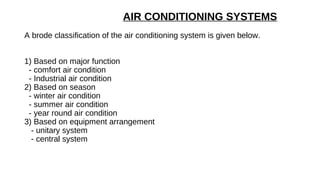
AIR CONDITIONING SYSTEMS
A brode classification of the air conditioning system is given below.
1) Based on major function
- comfort air condition
- Industrial air condition
2) Based on season
- winter air condition
- summer air condition
- year round air condition
3) Based on equipment arrangement
- unitary system
- central system
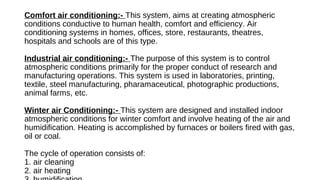
Comfort air conditioning:- This system, aims at creating atmospheric
conditions conductive to human health, comfort and efficiency. Air
conditioning systems in homes, offices, store, restaurants, theatres,
hospitals and schools are of this type.
Industrial air conditioning:- The purpose of this system is to control
atmospheric conditions primarily for the proper conduct of research and
manufacturing operations. This system is used in laboratories, printing,
textile, steel manufacturing, pharamaceutical, photographic productions,
animal farms, etc.
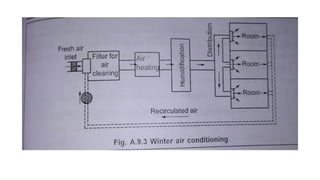
Winter air Conditioning:- This system are designed and installed indoor
atmospheric conditions for winter comfort and involve heating of the air and
humidification. Heating is accomplished by furnaces or boilers fired with gas,
oil or coal.
The cycle of operation consists of:
1. air cleaning
2. air heating
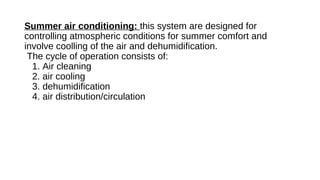
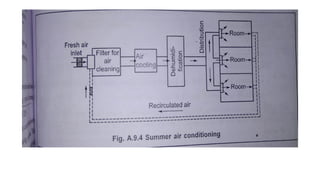
Summer air conditioning: this system are designed for
controlling atmospheric conditions for summer comfort and
involve coolling of the air and dehumidification.
The cycle of operation consists of:
1. Air cleaning
2. air cooling
3. dehumidification
4. air distribution/circulation
Year round air conditioning: These systems comprise heating
and cooling equipment with automatic controls to produce
condition for all time of year.
Unitary system: All the components of the unitary air
conditioning system are assembled in the factory itself. These
assembled units are usually installed in or immediately adjacent
to a zone or space to be conditioned.
Advantage of unitary system
1.the installation and assembly labour charges are less.
2. Zoning or extensive duct work is eliminated.
3. failure of the unit puts off conditioning in only one room where
the failure of the central plant offsets all the rooms to be served
4. Individual room temperature control is a specific feature of this
system.
THANK YOU

Applied Fluid Mechanics

  • 1.
    Subject:- Applied FluidMechanics Topic:- Ventilation Sustem Guided by:- Prof. Manali Shah Prof. Mamta Patel Name Enrollment No. Deshmukh Bhavik Hasmukhlal 151103106002 Kotila Jayveer Vanrajbhai 151103106008 Mistry Aditya Pramodbhai 151103106009 Pandya Dhrumil Dipakbhai 151103106010 Patel Nirmal Dalpatbhai 151103106012
  • 2.
    ventilation • The processof supply of fresh air and replenish oxygen supply to occupied and unoccupied space within building and other inhabited structures is called ventilation.
  • 3.
    Ventilation is necessaryto: 1. Replenish the oxygen supply 2. Dilute carbon dioxide 3. Dilute odour, process emission 4. Provide air movement 5. Reduce humidity 6. Prevent the build up of potentially explosive vapour mixtures Requirement of good ventilation: 1. It should admit sufficient quantity of fresh air and remove the requisite contaminated air. 2. It should admit clean and humid air. 3. It should continuously change the air inside the room. 4. It should properly control the velocity &quantity of air inside the space. 5. The system should also control the temperature of the admitted air.
  • 4.
    SYSTEM OF VENTILATION 1.Naturalventilation 2.Mechanical ventilation 1. Natural ventilation It relies on the pressure of opening in the ventilated structure. In natural ventilation the effect of two mechanisms that cause air exchange through these opening based on temperature and pressure effects are very important. Change in the pressure over the surface of the building due to the effect of the building and surrounding structures on the local air flow patterns, leads to both driving and suction effects. The temperature difference between the inside and outside of the building leads to density variations and the stack effect. Doors and window near the floor level, admits fresh air and ventilatiors near the ceiling take out the vitiated air from a room. Fan lights of 30 cm
  • 5.
    Fig. shows fanlightsto insure natural ventilation.
  • 6.
    In case ofsloped roof, ridge ventilations may be provided to remove vitiated air from large hall as shown in fig.
  • 7.
    2. Mechanical ventilation(Artificial ventilation) Mechanical ventilation technique is suitable for energy controlled buildings, those where sealing the building become necessary for other reasons, e.g. acoustic pollution and buildings incorporating processes generating contaminants. Mechanical ventilation may be classified as, 1. vaccume system 2. propulsion system 3. air conditioning system 1. vaccume system in this system exhaust fans or blowers are installed near the ceiling to extract used up air from inside and though it outside. Due to exhausting of warm air from the room will reduce causing flow of fresh air inside the room.
  • 8.
    2. Propulsion system Inthis system fresh air is forced from outside by force fans and vantiated air is thrown out by itself or by outlet exhaust fan. E.g. air cooler at a window 3. air conditioning system It is the process of controlling temperature, humidity and distribution of air inside the building/room, with simultaneous removal of dirt, bacteria and toxic matter from the inside air. In polluted urban environment, natural ventilation and ordinary mechanical ventilation system are not suitable. In such situations, air- conditioning is the most suitable system.
  • 9.
    AIR CONDITIONING SYSTEMS Abrode classification of the air conditioning system is given below. 1) Based on major function - comfort air condition - Industrial air condition 2) Based on season - winter air condition - summer air condition - year round air condition 3) Based on equipment arrangement - unitary system - central system
  • 10.
    Comfort air conditioning:-This system, aims at creating atmospheric conditions conductive to human health, comfort and efficiency. Air conditioning systems in homes, offices, store, restaurants, theatres, hospitals and schools are of this type. Industrial air conditioning:- The purpose of this system is to control atmospheric conditions primarily for the proper conduct of research and manufacturing operations. This system is used in laboratories, printing, textile, steel manufacturing, pharamaceutical, photographic productions, animal farms, etc. Winter air Conditioning:- This system are designed and installed indoor atmospheric conditions for winter comfort and involve heating of the air and humidification. Heating is accomplished by furnaces or boilers fired with gas, oil or coal. The cycle of operation consists of: 1. air cleaning 2. air heating
  • 12.
    Summer air conditioning:this system are designed for controlling atmospheric conditions for summer comfort and involve coolling of the air and dehumidification. The cycle of operation consists of: 1. Air cleaning 2. air cooling 3. dehumidification 4. air distribution/circulation
  • 14.
    Year round airconditioning: These systems comprise heating and cooling equipment with automatic controls to produce condition for all time of year. Unitary system: All the components of the unitary air conditioning system are assembled in the factory itself. These assembled units are usually installed in or immediately adjacent to a zone or space to be conditioned. Advantage of unitary system 1.the installation and assembly labour charges are less. 2. Zoning or extensive duct work is eliminated. 3. failure of the unit puts off conditioning in only one room where the failure of the central plant offsets all the rooms to be served 4. Individual room temperature control is a specific feature of this system.
  • 15.