Do Now
How would you describe how fast an
object is moving?
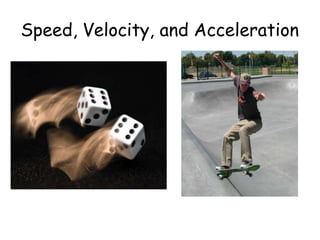
Speed, Velocity, and Acceleration
Goals:
• To investigate what is needed to describe
motion completely.
• To compare and contrast speed and
velocity.
• To learn about acceleration.
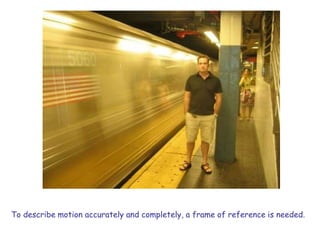
To describe motion accurately and completely, a frame of reference is needed.
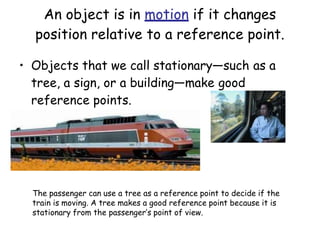
An object is in motion if it changes
position relative to a reference point.
• Objects that we call stationary—such as a
tree, a sign, or a building—make good
reference points.
The passenger can use a tree as a reference point to decide if the
train is moving. A tree makes a good reference point because it is
stationary from the passenger’s point of view.
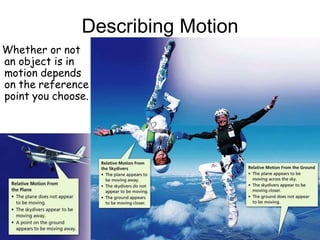
Describing Motion
Whether or not
an object is in
motion depends
on the reference
point you choose.
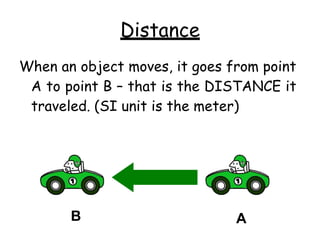
Distance
When an object moves, it goes from point
A to point B – that is the DISTANCE it
traveled. (SI unit is the meter)
A
B
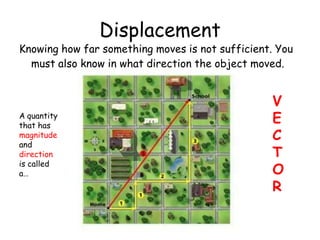
Displacement
Knowing how far something moves is not sufficient. You
must also know in what direction the object moved.
A quantity
that has
magnitude
and
direction
is called
a…
V
E
C
T
O
R
Speed
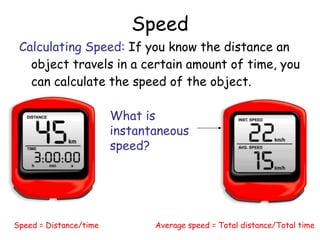
Calculating Speed: If you know the distance an
object travels in a certain amount of time, you
can calculate the speed of the object.
Speed = Distance/time Average speed = Total distance/Total time
What is
instantaneous
speed?
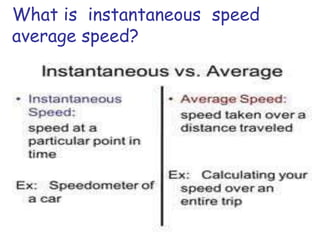
What is instantaneous speed
average speed?
Velocity
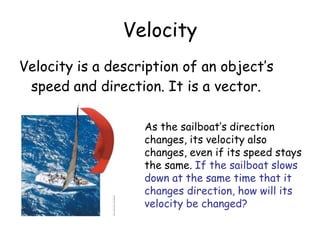
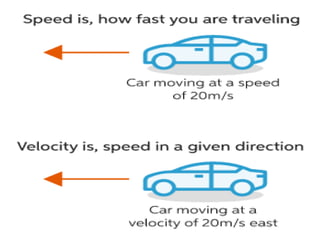
Velocity is a description of an object’s
speed and direction. It is a vector.
As the sailboat’s direction
changes, its velocity also
changes, even if its speed stays
the same. If the sailboat slows
down at the same time that it
changes direction, how will its
velocity be changed?
Speed v. Velocity
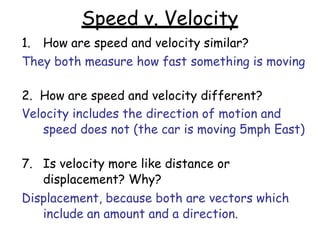
1. How are speed and velocity similar?
2. How are speed and velocity
different?)
3. Is velocity more like
distance or
displacement? Why?
Speed v. Velocity
1. How are speed and velocity similar?
They both measure how fast something is moving
2. How are speed and velocity different?
Velocity includes the direction of motion and
speed does not (the car is moving 5mph East)
7. Is velocity more like distance or
displacement? Why?
Displacement, because both are vectors which
include an amount and a direction.
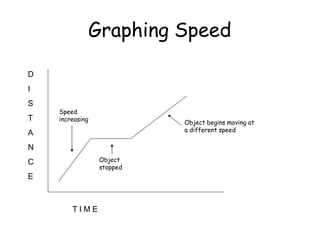
Graphing Speed
D
I
S
T
A
N
C
E
T I M E
Speed
increasing
Object
stopped
Object begins moving at
a different speed
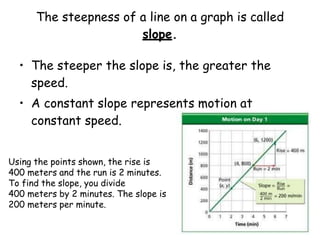
The steepness of a line on a graph is called
slope.
• The steeper the slope is, the greater the
speed.
• A constant slope represents motion at
constant speed.
Using the points shown, the rise is
400 meters and the run is 2 minutes.
To find the slope, you divide
400 meters by 2 minutes. The slope is
200 meters per minute.
Acceleration
Acceleration is the rate at which velocity
changes.
Acceleration can result from a change in
speed (increase or decrease), a change
in direction (back, forth, up, down left,
right), or changes in both. Like velocity,
acceleration is a vector.
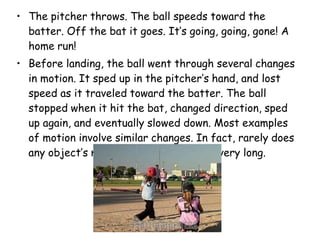
• The pitcher throws. The ball speeds toward the
batter. Off the bat it goes. It’s going, going, gone! A
home run!
• Before landing, the ball went through several changes
in motion. It sped up in the pitcher’s hand, and lost
speed as it traveled toward the batter. The ball
stopped when it hit the bat, changed direction, sped
up again, and eventually slowed down. Most examples
of motion involve similar changes. In fact, rarely does
any object’s motion stay the same for very long.
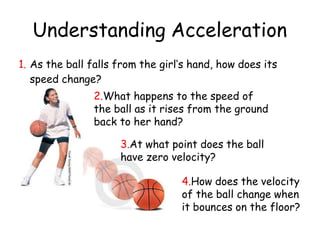
1. As the ball falls from the girl’s hand, how does its
speed change?
2.What happens to the speed of
the ball as it rises from the ground
back to her hand?
3.At what point does the ball
have zero velocity?
4.How does the velocity
of the ball change when
it bounces on the floor?
Understanding Acceleration
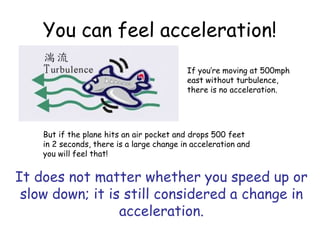
You can feel acceleration!
If you’re moving at 500mph
east without turbulence,
there is no acceleration.
But if the plane hits an air pocket and drops 500 feet
in 2 seconds, there is a large change in acceleration and
you will feel that!
It does not matter whether you speed up or
slow down; it is still considered a change in
acceleration.
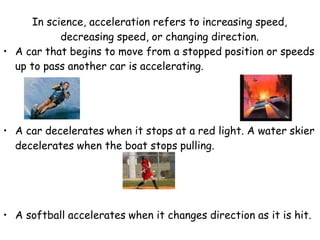
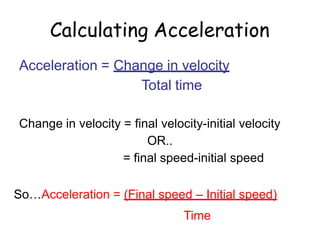
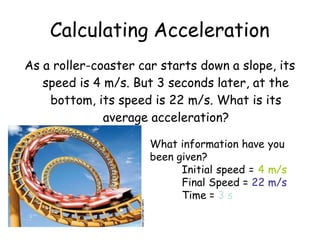
In science, acceleration refers to increasing speed,
decreasing speed, or changing direction.
• A car that begins to move from a stopped position or speeds
up to pass another car is accelerating.
• A car decelerates when it stops at a red light. A water skier
decelerates when the boat stops pulling.
• A softball accelerates when it changes direction as it is hit.
Calculating Acceleration
Acceleration = Change in velocity
Total time
Change in velocity = final velocity-initial velocity
OR..
= final speed-initial speed
So…Acceleration = (Final speed – Initial speed)
Time
Calculating Acceleration
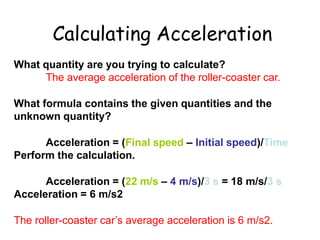
As a roller-coaster car starts down a slope, its
speed is 4 m/s. But 3 seconds later, at the
bottom, its speed is 22 m/s. What is its
average acceleration?
What information have you
been given?
Initial speed = 4 m/s
Final Speed = 22 m/s
Time = 3 s
What quantity are you trying to calculate?
The average acceleration of the roller-coaster car.
What formula contains the given quantities and the
unknown quantity?
Acceleration = (Final speed – Initial speed)/Time
Perform the calculation.
Acceleration = (22 m/s – 4 m/s)/3 s = 18 m/s/3 s
Acceleration = 6 m/s2
The roller-coaster car’s average acceleration is 6 m/s2.
Calculating Acceleration
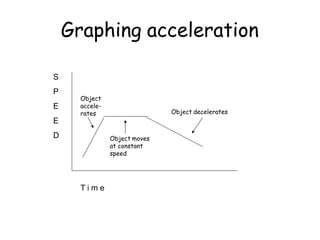
Graphing acceleration
S
P
E
E
D
T i m e
Object
accele-
rates
Object moves
at constant
speed
Object decelerates
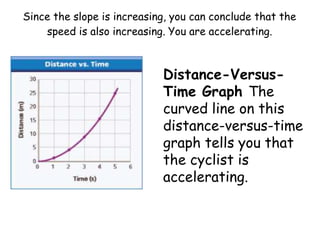
Since the slope is increasing, you can conclude that the
speed is also increasing. You are accelerating.
Distance-Versus-
Time Graph The
curved line on this
distance-versus-time
graph tells you that
the cyclist is
accelerating.

SPEED VELOCITY AND ACCELERATION.pptx

  • 1.
    Do Now How wouldyou describe how fast an object is moving?
  • 2.
  • 3.
    Goals: • To investigatewhat is needed to describe motion completely. • To compare and contrast speed and velocity. • To learn about acceleration.
  • 4.
    To describe motionaccurately and completely, a frame of reference is needed.
  • 5.
    An object isin motion if it changes position relative to a reference point. • Objects that we call stationary—such as a tree, a sign, or a building—make good reference points. The passenger can use a tree as a reference point to decide if the train is moving. A tree makes a good reference point because it is stationary from the passenger’s point of view.
  • 6.
    Describing Motion Whether ornot an object is in motion depends on the reference point you choose.
  • 7.
    Distance When an objectmoves, it goes from point A to point B – that is the DISTANCE it traveled. (SI unit is the meter) A B
  • 8.
    Displacement Knowing how farsomething moves is not sufficient. You must also know in what direction the object moved. A quantity that has magnitude and direction is called a… V E C T O R
  • 9.
    Speed Calculating Speed: Ifyou know the distance an object travels in a certain amount of time, you can calculate the speed of the object. Speed = Distance/time Average speed = Total distance/Total time What is instantaneous speed?
  • 10.
    What is instantaneousspeed average speed?
  • 11.
    Velocity Velocity is adescription of an object’s speed and direction. It is a vector. As the sailboat’s direction changes, its velocity also changes, even if its speed stays the same. If the sailboat slows down at the same time that it changes direction, how will its velocity be changed?
  • 12.
    Speed v. Velocity 1.How are speed and velocity similar? 2. How are speed and velocity different?) 3. Is velocity more like distance or displacement? Why?
  • 13.
    Speed v. Velocity 1.How are speed and velocity similar? They both measure how fast something is moving 2. How are speed and velocity different? Velocity includes the direction of motion and speed does not (the car is moving 5mph East) 7. Is velocity more like distance or displacement? Why? Displacement, because both are vectors which include an amount and a direction.
  • 15.
    Graphing Speed D I S T A N C E T IM E Speed increasing Object stopped Object begins moving at a different speed
  • 16.
    The steepness ofa line on a graph is called slope. • The steeper the slope is, the greater the speed. • A constant slope represents motion at constant speed. Using the points shown, the rise is 400 meters and the run is 2 minutes. To find the slope, you divide 400 meters by 2 minutes. The slope is 200 meters per minute.
  • 17.
    Acceleration Acceleration is therate at which velocity changes. Acceleration can result from a change in speed (increase or decrease), a change in direction (back, forth, up, down left, right), or changes in both. Like velocity, acceleration is a vector.
  • 18.
    • The pitcherthrows. The ball speeds toward the batter. Off the bat it goes. It’s going, going, gone! A home run! • Before landing, the ball went through several changes in motion. It sped up in the pitcher’s hand, and lost speed as it traveled toward the batter. The ball stopped when it hit the bat, changed direction, sped up again, and eventually slowed down. Most examples of motion involve similar changes. In fact, rarely does any object’s motion stay the same for very long.
  • 19.
    1. As theball falls from the girl’s hand, how does its speed change? 2.What happens to the speed of the ball as it rises from the ground back to her hand? 3.At what point does the ball have zero velocity? 4.How does the velocity of the ball change when it bounces on the floor? Understanding Acceleration
  • 20.
    You can feelacceleration! If you’re moving at 500mph east without turbulence, there is no acceleration. But if the plane hits an air pocket and drops 500 feet in 2 seconds, there is a large change in acceleration and you will feel that! It does not matter whether you speed up or slow down; it is still considered a change in acceleration.
  • 21.
    In science, accelerationrefers to increasing speed, decreasing speed, or changing direction. • A car that begins to move from a stopped position or speeds up to pass another car is accelerating. • A car decelerates when it stops at a red light. A water skier decelerates when the boat stops pulling. • A softball accelerates when it changes direction as it is hit.
  • 22.
    Calculating Acceleration Acceleration =Change in velocity Total time Change in velocity = final velocity-initial velocity OR.. = final speed-initial speed So…Acceleration = (Final speed – Initial speed) Time
  • 23.
    Calculating Acceleration As aroller-coaster car starts down a slope, its speed is 4 m/s. But 3 seconds later, at the bottom, its speed is 22 m/s. What is its average acceleration? What information have you been given? Initial speed = 4 m/s Final Speed = 22 m/s Time = 3 s
  • 24.
    What quantity areyou trying to calculate? The average acceleration of the roller-coaster car. What formula contains the given quantities and the unknown quantity? Acceleration = (Final speed – Initial speed)/Time Perform the calculation. Acceleration = (22 m/s – 4 m/s)/3 s = 18 m/s/3 s Acceleration = 6 m/s2 The roller-coaster car’s average acceleration is 6 m/s2. Calculating Acceleration
  • 25.
    Graphing acceleration S P E E D T im e Object accele- rates Object moves at constant speed Object decelerates
  • 26.
    Since the slopeis increasing, you can conclude that the speed is also increasing. You are accelerating. Distance-Versus- Time Graph The curved line on this distance-versus-time graph tells you that the cyclist is accelerating.