Computer Engineering and Intelligent Systems                                                            www.iiste.org
ISSN 2222-1719 (Paper) ISSN 2222-2863 (Online)
Vol 3, No.5, 2012


  Land Vehicle Tracking System Using Java on Android Platform
     Ramesh Chandra Gadri* Bhagyshree Alhat     Ankita Chavan Sujata Kamble      Reema Sonawane
     Computer Engineering Department, Pune University, MAE, Alandi Pune, Maharashtra 412105, India
                                     * coolramesh1988@gmail.com

Abstract
As urban living environment is becoming more and more complex, the road condition is becoming worse
because of heavy traffic, increase of traffic accidents and high ratio of empty vehicles. It increases the cost of
transportation and wastes time of vehicle movement. To solve such problems, a land vehicle tracking system has
been developed. A land vehicle tracking system determines the position of land rover with a terminal with
embedded GPS receiver or PCS phone and displays the position on a digital map. Recently, vehicle tracking
technologies have brought some breakthrough in these areas: commercial vehicle operations, fleet management,
dispatching, emergency rescue, hazard material monitoring, and security.
Keywords: Android, Java, Eclipse, GPS, AGPS, Land Vehicle Tracking, Internet.

1. Introduction
A vehicle tracking system combines the installation of an electronic device in a vehicle, or fleet of vehicles, with
purpose-designed computer software at least at one operational base to enable the owner or a third party to track
the vehicle's location, collecting data in the process from the field and deliver it to the base of operation. Modern
vehicle tracking systems commonly use GPS or GLONASS technology for locating the vehicle, but other types of
automatic vehicle location technology can also be used. Vehicle information can be viewed on electronic maps via
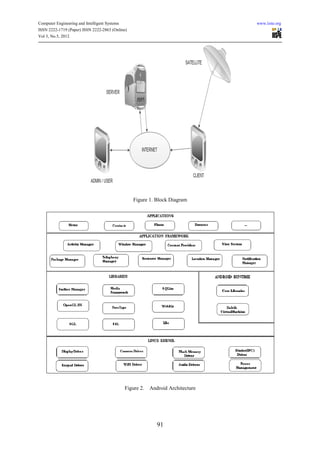
the Internet or specialized software. In case of our software the device that we are going to use is an android
phone and the vehicles will be watched by an administrator using a web application.

2. Objectives of the Proposed Project
We are going to use GPS for locating the position of vehicle. We will also find the speed of the vehicle in real
time to find whether a driver is adhering to the speed limits.
• We can track vehicles through android application using GPS to find out where a bus is using a web
    application which requires login of administrator.
• We can also find out speed and if driver breaks speed then we can fine them accordingly.
• Parents can also see the current location of their kids through real time update.
• When a stop comes we can intimate the administrator and the people sitting in bus to come in front for their
    stop.

3. Actual Working of Project
3.1 Client Mobile Module at Bus:
1. Create Bus account.
2. Collect Bus Data(like GPS location and speed of bus)
3. Post Bus Data.

3.2 Server Module:
1. Read Bus location API.
2. Save Bus Location API.
3. Create Bus API

3.3 Admin Mobile Application / Parent Mobile Application:
1. Select Bus Screen
2. Map view with live bus marker.
3. Set alert for bus reaching at particular location.

4. Android
ANDROID (Automated Numeration of Data Realized by Optimized Image Detection) Android is an operating
system for mobile devices such as Smartphone and tablet computers. It is developed by the Open Handset
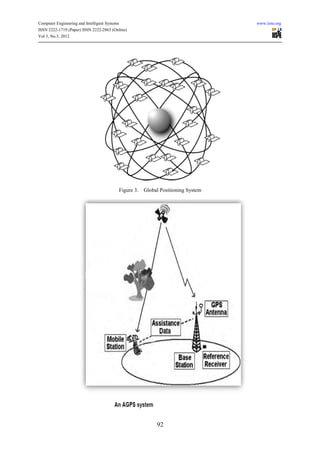
Alliance led by Google. Android consists of a kernel based on the Linux kernel, with middleware, libraries and


                                                        88
Computer Engineering and Intelligent Systems                                                           www.iiste.org
ISSN 2222-1719 (Paper) ISSN 2222-2863 (Online)
Vol 3, No.5, 2012

APIs written in C and application software running on an application framework which includes Java-compatible
libraries based on Apache Harmony. Android uses the Dalvik virtual machine with just-in-time compilation to
run Dalvik dex-code (Dalvik Executable), which is usually translated from Java bytecode.

4.1 ADT Plug-in for Eclipse
Android Development Tools (ADT) is a plug-in for the Eclipse IDE that is designed to give you a powerful,
integrated environment in which to build Android applications.ADT extends the capabilities of Eclipse to let you
quickly set up new Android projects, create an application UI, add components based on the Android Framework
API, debug your applications using the Android SDK tools, and even export signed (or unsigned) .apk files in
order to distribute your application. Developing in Eclipse with ADT is highly recommended and is the fastest
way to get started.

4.2 Android Open Source Project
The Android Open Source Project (AOSP) is led by Google, and is tasked with the maintenance and
development of Android. According to the project “The goal of the Android Open Source Project is to create a
successful real-world product that improves the mobile experience for end users.”AOSP also maintains the
Android Compatibility Program, defining an “Android compatible” device “as one that can run any application
written by third-party developers using the Android SDK and NDK”, to prevent incompatible Android
implementations.

4.3 Linux Kernel
Android’s kernel is based on the Linux kernel and has further architecture changes by Google outside the typical
Linux kernel development cycle. Android does not have a native X Window System nor does it support the full
set of standard GNU libraries, and this makes it difficult to port existing Linux applications or libraries to
Android. Certain features that Google contributed back to the Linux kernel, notably a power management feature
called wake locks, were rejected by mainline kernel developers, partly because kernel maintainers felt that
Google did not show any intent to maintain their own code.

5. Location Technology
Nowadays, a substantial number of smart phone have multimedia ability and geo-locating ability. While some
people may get confused with GPS and AGPS here we provide a brief background study about them.
5.1 Global Positioning System (GPS)
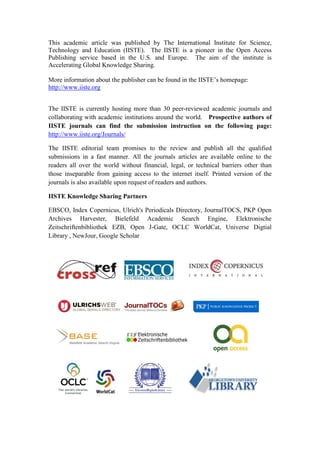
Global Positioning System is composed of satellites and GPS receivers.GPS receivers receive signals from the
satellites orbiting in space in 6 different planes 20 kilometers away from Earth (Porcino, 2001). There are 24
satellites orbiting in space at present originally owned by United States government for military purposes and are
now opened for commercial use. The GPS receiver installed in the mobile handsets will receive radio signals
from satellites and compare with the local duplication of geo data to calculate its actual location on Earth. To
increase the accuracy, data received from three satellites can perform the calculation of two- dimensional
location, including the longitude and latitude. For three- dimensional location information, consisting longitude,
latitude and altitude, data from at least 4 satellites are required.

5.2 Assisted Global Positioning System (AGPS)
AGPS is sometimes known as Aided Global Positioning System. As it stated, the positioning mechanism behind
it requires assistance data together with the satellites. (Karunanayake et al., 2007) illustrates an AGPS system in
brief. As mentioned by Karunanayake et all assistance data helps to increase sensitivity, so that allowing the
device to function well in non-line-of-sight (NLOS) signal environment, such as urban canyons and indoors.
Traditional GPS receivers are designed to function under line-of-sight (LOS) environment, therefore when there
are inadequate signals detected, AGPS can get help from assistance data. However, when there is no assistance
data from network, normally data are came from cellular network nowadays, AGPS architecture
allows GPS receivers to           work on solely so as to increase system flexibility.

6. Product Perspective
6.1 Overview
The system will be basically a project that consists of client part, server part and GPS part. Also will look at the
information’s of routes, drivers and give the most optimal options to the user. Moreover, user may see and search
the users’ and vehicles’ information in to the system repository. The most important component of our system is
GPS. The coordinates of the vehicles that incoming build up the system’s treatment. The purpose of this

                                                        89
Computer Engineering and Intelligent Systems                                                           www.iiste.org
ISSN 2222-1719 (Paper) ISSN 2222-2863 (Online)
Vol 3, No.5, 2012

document is to model and design the project with the requirements defined in the SRS document. We are going
to use GPS for locating the position of vehicle. Vehicle tracking systems are devices used for tracking location of
vehicles in real time.

6.2 Applications
• Vehicle tracking systems are commonly used by fleet operators for fleet management functions such as fleet
    tracking, routing, dispatch, on-board information and security.
• Vehicle tracking systems are also popular in consumer vehicles as a theft prevention and retrieval device.
    Police can simply follow the signal emitted by the tracking system and locate the stolen vehicle.
• Asset tracking: Companies needing to track valuable assets for insurance.
• Field service management: Companies with a field service workforce for services such as repair or
    maintenance, must be able to plan field workers’ time, schedule subsequent customer visits and be able to
    operate these departments efficiently.
• Field sales: Mobile sales professionals can access real-time locations.
• Trailer tracking: Haulage and Logistics companies often operate Lorries with detachable load carrying units.

7. Conclusion
Vehicle tracking system resulted in improving overall productivity with better fleet management that in turn offers
better return on your investments. Better scheduling or route planning can enable you handle larger jobs loads
within a particular time. Vehicle tracking both in case of personal as well as business purpose improves safety and
security, communication medium, performance monitoring and increases productivity. So in the coming year, it is
going to play a major role in our day-to-day living.

8. Acknowledgment
We would like to express our gratitude towards a number of people whose support and consideration has been an
invaluable asset during the course of this work

9. References
[1] Mi Hyun Eom, Eun Young Han and Hee Soon Chang. (2001), “Implementation of Internet-based
Land Vehicle Tracking System using Java”
[2] Chia-Chi Teng and Richard Helps. (2010), “Mobile Application Development: Essential New Directions
for IT”
[3] Agung Dewandaru, Abas M. Said and Abdul Nasir Matori. (2007), “A Novel Map-matching Algorithm to
Improve Vehicle Tracking System Accuracy”
[4] Feng Liu, Jan Sparbert and Christoph Stiller. (2008), “IMMPDA Vehicle Tracking System using
Asynchronous Sensor Fusion of Radar and Vision”


                                                       90
Computer Engineering and Intelligent Systems                                   www.iiste.org
ISSN 2222-1719 (Paper) ISSN 2222-2863 (Online)
Vol 3, No.5, 2012


                                                 Figure 1. Block Diagram


                                            Figure 2.   Android Architecture


                                                           91
Computer Engineering and Intelligent Systems                                     www.iiste.org
ISSN 2222-1719 (Paper) ISSN 2222-2863 (Online)
Vol 3, No.5, 2012


                                         Figure 3.   Global Positioning System


                                                          92
Computer Engineering and Intelligent Systems                                                        www.iiste.org
ISSN 2222-1719 (Paper) ISSN 2222-2863 (Online)
Vol 3, No.5, 2012

                                                   Figure 4. Assisted GPS

                                                 Table 2 Features of Android


Storage        SQLite, a lightweight relational database, is used for data storage purposes


             Android                     supports                  connectivity               technologies
Connectivity including GSM/EDGE, IDEN, CDMA, EV-DO, UMTS, Bluetooth, Wi-Fi (no                 connections
             through Proxy server[62] and no Ad hoc wireless network),[63] LTE, NFC and WiMAX.


Web            The web browser available in Android is based on the open-source WebKit layout engine, coupled
browser        with Chrome's V8 JavaScript engine. The browser scores a 93/100 on the Acid3 Test.


             While most Android applications are written in Java, there is no Java Virtual Machine in the
             platform and Java byte code is not executed. Java classes are compiled into Dalvik executables and
Java support run on Dalvik, a specialized virtual machine designed specifically for Android and optimized for
             battery-powered mobile devices with limited memory and CPU. J2ME support can be provided via
             third-party applications.


               Supports A2DP, AVRCP, sending files (OPP), accessing the phone book (PBAP), voice dialing
               and sending contacts between phones. Keyboard, mouse and joystick (HID) support is available
Bluetooth
               through manufacturer customizations and third-party applications. Full HID support is planned for
               Android 3.0 (Honeycomb).


Multitasking Multitasking of applications is available.


               Android supports tethering, which allows a phone to be used as a wireless/wired hotspot. Before
Tethering
               Android 2.2 this was supported by third-party applications or manufacturer customizations.


                                                             93
This academic article was published by The International Institute for Science,
Technology and Education (IISTE). The IISTE is a pioneer in the Open Access
Publishing service based in the U.S. and Europe. The aim of the institute is
Accelerating Global Knowledge Sharing.

More information about the publisher can be found in the IISTE’s homepage:
http://www.iiste.org


The IISTE is currently hosting more than 30 peer-reviewed academic journals and
collaborating with academic institutions around the world. Prospective authors of
IISTE journals can find the submission instruction on the following page:
http://www.iiste.org/Journals/

The IISTE editorial team promises to the review and publish all the qualified
submissions in a fast manner. All the journals articles are available online to the
readers all over the world without financial, legal, or technical barriers other than
those inseparable from gaining access to the internet itself. Printed version of the
journals is also available upon request of readers and authors.

IISTE Knowledge Sharing Partners

EBSCO, Index Copernicus, Ulrich's Periodicals Directory, JournalTOCS, PKP Open
Archives Harvester, Bielefeld Academic Search Engine, Elektronische
Zeitschriftenbibliothek EZB, Open J-Gate, OCLC WorldCat, Universe Digtial
Library , NewJour, Google Scholar

Land vehicle tracking system using java on android platform

  • 1.
    Computer Engineering andIntelligent Systems www.iiste.org ISSN 2222-1719 (Paper) ISSN 2222-2863 (Online) Vol 3, No.5, 2012 Land Vehicle Tracking System Using Java on Android Platform Ramesh Chandra Gadri* Bhagyshree Alhat Ankita Chavan Sujata Kamble Reema Sonawane Computer Engineering Department, Pune University, MAE, Alandi Pune, Maharashtra 412105, India * coolramesh1988@gmail.com Abstract As urban living environment is becoming more and more complex, the road condition is becoming worse because of heavy traffic, increase of traffic accidents and high ratio of empty vehicles. It increases the cost of transportation and wastes time of vehicle movement. To solve such problems, a land vehicle tracking system has been developed. A land vehicle tracking system determines the position of land rover with a terminal with embedded GPS receiver or PCS phone and displays the position on a digital map. Recently, vehicle tracking technologies have brought some breakthrough in these areas: commercial vehicle operations, fleet management, dispatching, emergency rescue, hazard material monitoring, and security. Keywords: Android, Java, Eclipse, GPS, AGPS, Land Vehicle Tracking, Internet. 1. Introduction A vehicle tracking system combines the installation of an electronic device in a vehicle, or fleet of vehicles, with purpose-designed computer software at least at one operational base to enable the owner or a third party to track the vehicle's location, collecting data in the process from the field and deliver it to the base of operation. Modern vehicle tracking systems commonly use GPS or GLONASS technology for locating the vehicle, but other types of automatic vehicle location technology can also be used. Vehicle information can be viewed on electronic maps via the Internet or specialized software. In case of our software the device that we are going to use is an android phone and the vehicles will be watched by an administrator using a web application. 2. Objectives of the Proposed Project We are going to use GPS for locating the position of vehicle. We will also find the speed of the vehicle in real time to find whether a driver is adhering to the speed limits. • We can track vehicles through android application using GPS to find out where a bus is using a web application which requires login of administrator. • We can also find out speed and if driver breaks speed then we can fine them accordingly. • Parents can also see the current location of their kids through real time update. • When a stop comes we can intimate the administrator and the people sitting in bus to come in front for their stop. 3. Actual Working of Project 3.1 Client Mobile Module at Bus: 1. Create Bus account. 2. Collect Bus Data(like GPS location and speed of bus) 3. Post Bus Data. 3.2 Server Module: 1. Read Bus location API. 2. Save Bus Location API. 3. Create Bus API 3.3 Admin Mobile Application / Parent Mobile Application: 1. Select Bus Screen 2. Map view with live bus marker. 3. Set alert for bus reaching at particular location. 4. Android ANDROID (Automated Numeration of Data Realized by Optimized Image Detection) Android is an operating system for mobile devices such as Smartphone and tablet computers. It is developed by the Open Handset Alliance led by Google. Android consists of a kernel based on the Linux kernel, with middleware, libraries and 88
  • 2.
    Computer Engineering andIntelligent Systems www.iiste.org ISSN 2222-1719 (Paper) ISSN 2222-2863 (Online) Vol 3, No.5, 2012 APIs written in C and application software running on an application framework which includes Java-compatible libraries based on Apache Harmony. Android uses the Dalvik virtual machine with just-in-time compilation to run Dalvik dex-code (Dalvik Executable), which is usually translated from Java bytecode. 4.1 ADT Plug-in for Eclipse Android Development Tools (ADT) is a plug-in for the Eclipse IDE that is designed to give you a powerful, integrated environment in which to build Android applications.ADT extends the capabilities of Eclipse to let you quickly set up new Android projects, create an application UI, add components based on the Android Framework API, debug your applications using the Android SDK tools, and even export signed (or unsigned) .apk files in order to distribute your application. Developing in Eclipse with ADT is highly recommended and is the fastest way to get started. 4.2 Android Open Source Project The Android Open Source Project (AOSP) is led by Google, and is tasked with the maintenance and development of Android. According to the project “The goal of the Android Open Source Project is to create a successful real-world product that improves the mobile experience for end users.”AOSP also maintains the Android Compatibility Program, defining an “Android compatible” device “as one that can run any application written by third-party developers using the Android SDK and NDK”, to prevent incompatible Android implementations. 4.3 Linux Kernel Android’s kernel is based on the Linux kernel and has further architecture changes by Google outside the typical Linux kernel development cycle. Android does not have a native X Window System nor does it support the full set of standard GNU libraries, and this makes it difficult to port existing Linux applications or libraries to Android. Certain features that Google contributed back to the Linux kernel, notably a power management feature called wake locks, were rejected by mainline kernel developers, partly because kernel maintainers felt that Google did not show any intent to maintain their own code. 5. Location Technology Nowadays, a substantial number of smart phone have multimedia ability and geo-locating ability. While some people may get confused with GPS and AGPS here we provide a brief background study about them. 5.1 Global Positioning System (GPS) Global Positioning System is composed of satellites and GPS receivers.GPS receivers receive signals from the satellites orbiting in space in 6 different planes 20 kilometers away from Earth (Porcino, 2001). There are 24 satellites orbiting in space at present originally owned by United States government for military purposes and are now opened for commercial use. The GPS receiver installed in the mobile handsets will receive radio signals from satellites and compare with the local duplication of geo data to calculate its actual location on Earth. To increase the accuracy, data received from three satellites can perform the calculation of two- dimensional location, including the longitude and latitude. For three- dimensional location information, consisting longitude, latitude and altitude, data from at least 4 satellites are required. 5.2 Assisted Global Positioning System (AGPS) AGPS is sometimes known as Aided Global Positioning System. As it stated, the positioning mechanism behind it requires assistance data together with the satellites. (Karunanayake et al., 2007) illustrates an AGPS system in brief. As mentioned by Karunanayake et all assistance data helps to increase sensitivity, so that allowing the device to function well in non-line-of-sight (NLOS) signal environment, such as urban canyons and indoors. Traditional GPS receivers are designed to function under line-of-sight (LOS) environment, therefore when there are inadequate signals detected, AGPS can get help from assistance data. However, when there is no assistance data from network, normally data are came from cellular network nowadays, AGPS architecture allows GPS receivers to work on solely so as to increase system flexibility. 6. Product Perspective 6.1 Overview The system will be basically a project that consists of client part, server part and GPS part. Also will look at the information’s of routes, drivers and give the most optimal options to the user. Moreover, user may see and search the users’ and vehicles’ information in to the system repository. The most important component of our system is GPS. The coordinates of the vehicles that incoming build up the system’s treatment. The purpose of this 89
  • 3.
    Computer Engineering andIntelligent Systems www.iiste.org ISSN 2222-1719 (Paper) ISSN 2222-2863 (Online) Vol 3, No.5, 2012 document is to model and design the project with the requirements defined in the SRS document. We are going to use GPS for locating the position of vehicle. Vehicle tracking systems are devices used for tracking location of vehicles in real time. 6.2 Applications • Vehicle tracking systems are commonly used by fleet operators for fleet management functions such as fleet tracking, routing, dispatch, on-board information and security. • Vehicle tracking systems are also popular in consumer vehicles as a theft prevention and retrieval device. Police can simply follow the signal emitted by the tracking system and locate the stolen vehicle. • Asset tracking: Companies needing to track valuable assets for insurance. • Field service management: Companies with a field service workforce for services such as repair or maintenance, must be able to plan field workers’ time, schedule subsequent customer visits and be able to operate these departments efficiently. • Field sales: Mobile sales professionals can access real-time locations. • Trailer tracking: Haulage and Logistics companies often operate Lorries with detachable load carrying units. 7. Conclusion Vehicle tracking system resulted in improving overall productivity with better fleet management that in turn offers better return on your investments. Better scheduling or route planning can enable you handle larger jobs loads within a particular time. Vehicle tracking both in case of personal as well as business purpose improves safety and security, communication medium, performance monitoring and increases productivity. So in the coming year, it is going to play a major role in our day-to-day living. 8. Acknowledgment We would like to express our gratitude towards a number of people whose support and consideration has been an invaluable asset during the course of this work 9. References [1] Mi Hyun Eom, Eun Young Han and Hee Soon Chang. (2001), “Implementation of Internet-based Land Vehicle Tracking System using Java” [2] Chia-Chi Teng and Richard Helps. (2010), “Mobile Application Development: Essential New Directions for IT” [3] Agung Dewandaru, Abas M. Said and Abdul Nasir Matori. (2007), “A Novel Map-matching Algorithm to Improve Vehicle Tracking System Accuracy” [4] Feng Liu, Jan Sparbert and Christoph Stiller. (2008), “IMMPDA Vehicle Tracking System using Asynchronous Sensor Fusion of Radar and Vision” 90
  • 4.
    Computer Engineering andIntelligent Systems www.iiste.org ISSN 2222-1719 (Paper) ISSN 2222-2863 (Online) Vol 3, No.5, 2012 Figure 1. Block Diagram Figure 2. Android Architecture 91
  • 5.
    Computer Engineering andIntelligent Systems www.iiste.org ISSN 2222-1719 (Paper) ISSN 2222-2863 (Online) Vol 3, No.5, 2012 Figure 3. Global Positioning System 92
  • 6.
    Computer Engineering andIntelligent Systems www.iiste.org ISSN 2222-1719 (Paper) ISSN 2222-2863 (Online) Vol 3, No.5, 2012 Figure 4. Assisted GPS Table 2 Features of Android Storage SQLite, a lightweight relational database, is used for data storage purposes Android supports connectivity technologies Connectivity including GSM/EDGE, IDEN, CDMA, EV-DO, UMTS, Bluetooth, Wi-Fi (no connections through Proxy server[62] and no Ad hoc wireless network),[63] LTE, NFC and WiMAX. Web The web browser available in Android is based on the open-source WebKit layout engine, coupled browser with Chrome's V8 JavaScript engine. The browser scores a 93/100 on the Acid3 Test. While most Android applications are written in Java, there is no Java Virtual Machine in the platform and Java byte code is not executed. Java classes are compiled into Dalvik executables and Java support run on Dalvik, a specialized virtual machine designed specifically for Android and optimized for battery-powered mobile devices with limited memory and CPU. J2ME support can be provided via third-party applications. Supports A2DP, AVRCP, sending files (OPP), accessing the phone book (PBAP), voice dialing and sending contacts between phones. Keyboard, mouse and joystick (HID) support is available Bluetooth through manufacturer customizations and third-party applications. Full HID support is planned for Android 3.0 (Honeycomb). Multitasking Multitasking of applications is available. Android supports tethering, which allows a phone to be used as a wireless/wired hotspot. Before Tethering Android 2.2 this was supported by third-party applications or manufacturer customizations. 93
  • 7.
    This academic articlewas published by The International Institute for Science, Technology and Education (IISTE). The IISTE is a pioneer in the Open Access Publishing service based in the U.S. and Europe. The aim of the institute is Accelerating Global Knowledge Sharing. More information about the publisher can be found in the IISTE’s homepage: http://www.iiste.org The IISTE is currently hosting more than 30 peer-reviewed academic journals and collaborating with academic institutions around the world. Prospective authors of IISTE journals can find the submission instruction on the following page: http://www.iiste.org/Journals/ The IISTE editorial team promises to the review and publish all the qualified submissions in a fast manner. All the journals articles are available online to the readers all over the world without financial, legal, or technical barriers other than those inseparable from gaining access to the internet itself. Printed version of the journals is also available upon request of readers and authors. IISTE Knowledge Sharing Partners EBSCO, Index Copernicus, Ulrich's Periodicals Directory, JournalTOCS, PKP Open Archives Harvester, Bielefeld Academic Search Engine, Elektronische Zeitschriftenbibliothek EZB, Open J-Gate, OCLC WorldCat, Universe Digtial Library , NewJour, Google Scholar