1
Air pollution by the emission of
polluting gases from vehicles.
The major
pollutants from vehicle emission.
Sensor framework
for air contamination observing.
Measure the level of pollutants
from the vehicles gas.
2
Background 3
• Each vehicle has its own discharge of gases.
• This emission from vehicles can’t be totally maintain a strategic
control limit.
• It is in like manner difficult to actualize the vehicle proprietors on
watching the soundness of their engines.
• According to this here we proposed another vehicle emission
examination and warning framework to help day by day checking of
engine wellbeing.
Motivation 4
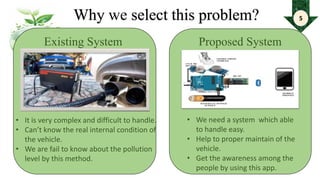
Why we select this problem?
Existing System Proposed System
• It is very complex and difficult to handle.
• Can’t know the real internal condition of
the vehicle.
• We are fail to know about the pollution
level by this method.
• We need a system which able
to handle easy.
• Help to proper maintain of the
vehicle.
• Get the awareness among the
people by using this app.
5
Research Questions
• How the major causes of air pollution that emanate from vehicle
exhaust emissions?
• How is inspection for vehicle exhaust emissions currently being done?
• How can IoT be used to measure the degree of pollutants in vehicle
exhaust emissions?
• How the Bluetooth adaptor convey the degree of pollutants from
vehicle exhaust emissions?
• How the system display the output?
6
• To increase the lifetime of the vehicle.
• To develop an electricity system with a display to mobile phone to view the details.
• To do necessary repairs to reduce emissions
• To reduce total emission of bad gases from vehicles to the environment.
• To prepare a pre-planned schedule of the vehicle repairing.
• To reduce regional problems, occur in government vehicle emission testing systems.
7Objectives
Steps 8
Communication
module
Processing
module
Sensing
module
1 2 3 4 5 6
Methodology 9
7
Approaches
Carbon Monoxide Hydro-Carbon
10
• We have considered one vehicle for the comparison analysis
of the vehicle with the constraint of “before service” and “after
service”.
Reference : International Journal Of Innovative Research in Computer and Communication Engineering
Flow Diagram 11
Gantt Chart 12
June
July
August
September
October
November
Timeline(2019-06-10 to 2019-09-14)
Conclusion
This framework
• Financially smart answer for vehicle discharge issue.
• Gives the CO and HC levels.
• Helps in minimizing the pollutants emission from the
vehicles.
• Helps day by day checking of engine wellbeing.
• .
13
Future Plan
• In future, this can applied to test for other types of fuels.
• help the traffic police to track and control vehicles with high emissions
through warning framework.
• Can applied to test other types of gases in emission from the vehicle.
• Calculate the penalty for the same type of high emitting vehicles according
to its type of consuming fuel
14
References
• [https://nevonprojects.com/web-based-project-ideas-topics/] Accessed June 15 2019.
• Act No 1295/11Part 1: Section (I) the National Environmental Act, No 47 Of 1980 regulation made by the Ministry
of Environment and Natural Resources.
• Act No 1557/14 Regulations made under section 32 of the national environmental Act, No. 47 of 1980.read with
section 23J and 23K of the act on 09 July 2008.
• Asif Faiz,Christopher S. Weaver and Michael P. Walsh, The World Bank Washington D.C,1996, Air Pollution from
Motor Vehicles Standards and Technologies for Controlling Emissions pp 1-24
• Steven H. Cadlea, Alberto Ayalab, Kevin N. Blackc, Carl R. Fulperd, R. Rob Grazee, Fred Minassianf, Hannah B.
Murrayg, Mani Natarajanh, Christopher J. Tennanti & Douglas R. Lawsonj(2006)- Real-World Vehicle Emissions: A
Summary of the Sixteenth Coordinating Research Council On-Road Vehicle Emissions Workshop, Journal of the Air
& Waste Management Association, Volume 57, Issue 2, Pp139 – 145
• Abtoff, J., Schuster H.C., and Langer, J. 1985. The trap oxidizers—an emission control technology for diesel
engines, Society of Automotive Engineers Paper 850015, Warrendale, Pa.
• Alson, J. (1985). EPA methanol vehicle emissions test programs, talk at EPA Region VI Methanol Workshop, May
1985, Dallas, Tex.
15
16

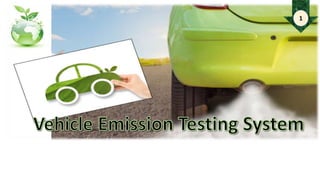
Vehicle Emission Testing System

  • 1.
  • 2.
    Air pollution bythe emission of polluting gases from vehicles. The major pollutants from vehicle emission. Sensor framework for air contamination observing. Measure the level of pollutants from the vehicles gas. 2
  • 3.
    Background 3 • Eachvehicle has its own discharge of gases. • This emission from vehicles can’t be totally maintain a strategic control limit. • It is in like manner difficult to actualize the vehicle proprietors on watching the soundness of their engines. • According to this here we proposed another vehicle emission examination and warning framework to help day by day checking of engine wellbeing.
  • 4.
  • 5.
    Why we selectthis problem? Existing System Proposed System • It is very complex and difficult to handle. • Can’t know the real internal condition of the vehicle. • We are fail to know about the pollution level by this method. • We need a system which able to handle easy. • Help to proper maintain of the vehicle. • Get the awareness among the people by using this app. 5
  • 6.
    Research Questions • Howthe major causes of air pollution that emanate from vehicle exhaust emissions? • How is inspection for vehicle exhaust emissions currently being done? • How can IoT be used to measure the degree of pollutants in vehicle exhaust emissions? • How the Bluetooth adaptor convey the degree of pollutants from vehicle exhaust emissions? • How the system display the output? 6
  • 7.
    • To increasethe lifetime of the vehicle. • To develop an electricity system with a display to mobile phone to view the details. • To do necessary repairs to reduce emissions • To reduce total emission of bad gases from vehicles to the environment. • To prepare a pre-planned schedule of the vehicle repairing. • To reduce regional problems, occur in government vehicle emission testing systems. 7Objectives
  • 8.
  • 9.
    1 2 34 5 6 Methodology 9 7
  • 10.
    Approaches Carbon Monoxide Hydro-Carbon 10 •We have considered one vehicle for the comparison analysis of the vehicle with the constraint of “before service” and “after service”. Reference : International Journal Of Innovative Research in Computer and Communication Engineering
  • 11.
  • 12.
  • 13.
    Conclusion This framework • Financiallysmart answer for vehicle discharge issue. • Gives the CO and HC levels. • Helps in minimizing the pollutants emission from the vehicles. • Helps day by day checking of engine wellbeing. • . 13
  • 14.
    Future Plan • Infuture, this can applied to test for other types of fuels. • help the traffic police to track and control vehicles with high emissions through warning framework. • Can applied to test other types of gases in emission from the vehicle. • Calculate the penalty for the same type of high emitting vehicles according to its type of consuming fuel 14
  • 15.
    References • [https://nevonprojects.com/web-based-project-ideas-topics/] AccessedJune 15 2019. • Act No 1295/11Part 1: Section (I) the National Environmental Act, No 47 Of 1980 regulation made by the Ministry of Environment and Natural Resources. • Act No 1557/14 Regulations made under section 32 of the national environmental Act, No. 47 of 1980.read with section 23J and 23K of the act on 09 July 2008. • Asif Faiz,Christopher S. Weaver and Michael P. Walsh, The World Bank Washington D.C,1996, Air Pollution from Motor Vehicles Standards and Technologies for Controlling Emissions pp 1-24 • Steven H. Cadlea, Alberto Ayalab, Kevin N. Blackc, Carl R. Fulperd, R. Rob Grazee, Fred Minassianf, Hannah B. Murrayg, Mani Natarajanh, Christopher J. Tennanti & Douglas R. Lawsonj(2006)- Real-World Vehicle Emissions: A Summary of the Sixteenth Coordinating Research Council On-Road Vehicle Emissions Workshop, Journal of the Air & Waste Management Association, Volume 57, Issue 2, Pp139 – 145 • Abtoff, J., Schuster H.C., and Langer, J. 1985. The trap oxidizers—an emission control technology for diesel engines, Society of Automotive Engineers Paper 850015, Warrendale, Pa. • Alson, J. (1985). EPA methanol vehicle emissions test programs, talk at EPA Region VI Methanol Workshop, May 1985, Dallas, Tex. 15
  • 16.