Vegetation Regions
   Chapter 2 Section 4
Students will explore
 Earth’s vegetation
 regions in order to
 explain the the
 relationship between
 climate and
 vegetation.
The Amazon Basin in Brazil and
  the islands of Indonesia are
examples of _________________.
Tropical Rainforest
   The trees are very tall and of a great variety of
    species. One rarely finds two trees of the same
    species growing close to one another.
   The vegetation is so dense that little light
    reaches the forest floor.
   Most of the plants are evergreen, not deciduous.
   The branches of the trees are festooned with
    vines.
New England and Northern Europe
   have____________________
Mid-Latitude (deciduous)
             Forest
 hardwood trees (e.g., beech, maple, oak,
  hickory) which are deciduous; that is, shed
  their leaves in the autumn.
 The number of different species is far
  more limited than in the jungle.
 Large stands dominated by a single
  species are common.
 Deer, raccoons, and salamanders are
  characteristic inhabitants.
___________ Forest
Coniferous Forest
 Colder parts of the mid-latitudes
 Trees have needles and seed cones
 Trees are evergreen
 Redwoods in California are one example
 Canada and Siberia, Russia are also
 examples of coniferous forest. 
Chaparral
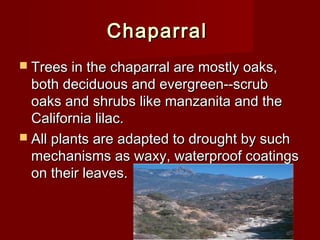
 Trees in the chaparral are mostly oaks,
  both deciduous and evergreen--scrub
  oaks and shrubs like manzanita and the
  California lilac.
 All plants are adapted to drought by such
  mechanisms as waxy, waterproof coatings
  on their leaves.
_______________________
 tropical areas close to the equator mostly
  grasses with scattered trees and shrubs
 has a wet season and dry season wildfires
  are common
 Most of southern Africa and parts of Brazil
  are savannas.
_________________________
 Two types, depending on rainfall: "tall
  grass" or "short grass"
 Cooler climates

 Wildfires are common

 Typical in the American Midwest.

 Also called "steppes" in central Asia
Desert Scrub
 cactus plants, specialized to store
  watercactus grow widely scattered due to
  little rain
 Arizona and parts of Pakistan are
  examples of desert scrub.
__________________
Alaska and Iceland are examples of
              tundra.
Tundra
 Climate is always cold.
 No trees.
 Short growing season.small plants,
  wildflowers, lichen (tiny, brightly colored
  plants)
 permafrost under the soil
Ice Cap


   Ice.
   Pure ice.
   Nothing but ice.
   This shot is from Greenland.
   How did that guy get there?
   Greenland and Antarctica are examples of ice
    cap.
Highland Climate
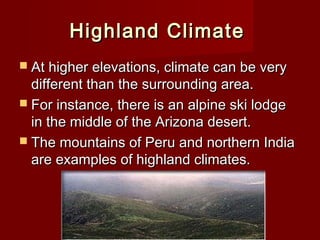
 At higher elevations, climate can be very
  different than the surrounding area.
 For instance, there is an alpine ski lodge
  in the middle of the Arizona desert.
 The mountains of Peru and northern India
  are examples of highland climates.
Vegetation Map
What have we learned?

Vegetation regions interactive

  • 1.
    Vegetation Regions Chapter 2 Section 4
  • 2.
    Students will explore Earth’s vegetation regions in order to explain the the relationship between climate and vegetation.
  • 3.
    The Amazon Basinin Brazil and the islands of Indonesia are examples of _________________.
  • 4.
    Tropical Rainforest  The trees are very tall and of a great variety of species. One rarely finds two trees of the same species growing close to one another.  The vegetation is so dense that little light reaches the forest floor.  Most of the plants are evergreen, not deciduous.  The branches of the trees are festooned with vines.
  • 5.
    New England andNorthern Europe have____________________
  • 6.
    Mid-Latitude (deciduous) Forest  hardwood trees (e.g., beech, maple, oak, hickory) which are deciduous; that is, shed their leaves in the autumn.  The number of different species is far more limited than in the jungle.  Large stands dominated by a single species are common.  Deer, raccoons, and salamanders are characteristic inhabitants.
  • 7.
  • 8.
    Coniferous Forest  Colderparts of the mid-latitudes  Trees have needles and seed cones  Trees are evergreen  Redwoods in California are one example  Canada and Siberia, Russia are also examples of coniferous forest. 
  • 9.
    Chaparral  Trees inthe chaparral are mostly oaks, both deciduous and evergreen--scrub oaks and shrubs like manzanita and the California lilac.  All plants are adapted to drought by such mechanisms as waxy, waterproof coatings on their leaves.
  • 10.
    _______________________  tropical areasclose to the equator mostly grasses with scattered trees and shrubs  has a wet season and dry season wildfires are common  Most of southern Africa and parts of Brazil are savannas.
  • 11.
    _________________________  Two types,depending on rainfall: "tall grass" or "short grass"  Cooler climates  Wildfires are common  Typical in the American Midwest.  Also called "steppes" in central Asia
  • 12.
    Desert Scrub  cactusplants, specialized to store watercactus grow widely scattered due to little rain  Arizona and parts of Pakistan are examples of desert scrub.
  • 13.
  • 14.
    Alaska and Icelandare examples of tundra.
  • 15.
    Tundra  Climate isalways cold.  No trees.  Short growing season.small plants, wildflowers, lichen (tiny, brightly colored plants)  permafrost under the soil
  • 16.
    Ice Cap  Ice.  Pure ice.  Nothing but ice.  This shot is from Greenland.  How did that guy get there?  Greenland and Antarctica are examples of ice cap.
  • 17.
    Highland Climate  Athigher elevations, climate can be very different than the surrounding area.  For instance, there is an alpine ski lodge in the middle of the Arizona desert.  The mountains of Peru and northern India are examples of highland climates.
  • 18.
  • 19.
    What have welearned?