PUERTO RICO
• Puerto Rico was once a Spanish colony.
• When the US defeated Spain in the Spanish-
  American War, Spain gave Puerto Rico to the US.
• Puerto Rico is part of the United States. Puerto
  Ricans are United States citizens.
• A citizen is an individual with certain rights and
  responsibilities under a particular government.
BUT PUERTO RICO IS NOT A STATE!

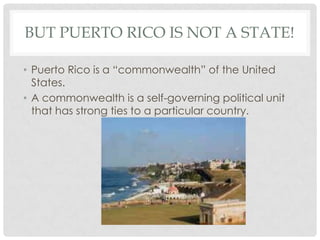
• Puerto Rico is a “commonwealth” of the United
  States.
• A commonwealth is a self-governing political unit
  that has strong ties to a particular country.
•   Puerto Ricans cannot vote in US elections.
•   They do not pay United States taxes.
•   They can and do serve in the US military.
•   Puerto Rico has its own lawmakers and constitution.
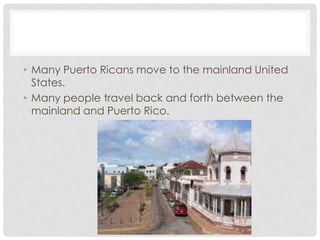
• Many Puerto Ricans move to the mainland United
  States.
• Many people travel back and forth between the
  mainland and Puerto Rico.
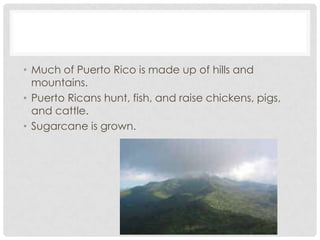
• Much of Puerto Rico is made up of hills and
  mountains.
• Puerto Ricans hunt, fish, and raise chickens, pigs,
  and cattle.
• Sugarcane is grown.
• As people travel back and forth, they bring customs
  and products with them.
• There is much influence from the US.
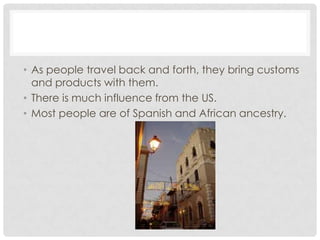
• Most people are of Spanish and African ancestry.
• Puerto Rican cities show influences of Spanish,
  Caribbean, and US mainland culture.
• About 75% of Puerto Ricans live in cities.
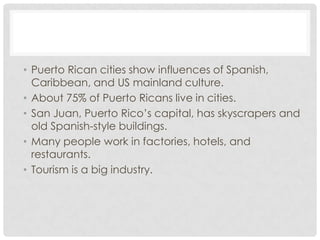
• San Juan, Puerto Rico’s capital, has skyscrapers and
  old Spanish-style buildings.
• Many people work in factories, hotels, and
  restaurants.
• Tourism is a big industry.
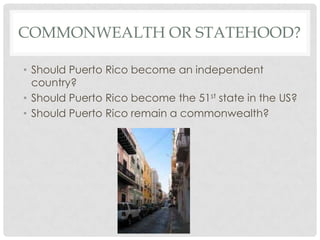
COMMONWEALTH OR STATEHOOD?

• Should Puerto Rico become an independent
  country?
• Should Puerto Rico become the 51st state in the US?
• Should Puerto Rico remain a commonwealth?
• Puerto Ricans have many disagreements over what
  the status of their islands should be.
• If Puerto Rico becomes a state, it will be the poorest
  state in the union.
• Puerto Ricans will be able to vote.
• Puerto Ricans will have to pay taxes.
• In the past twenty years, Puerto Ricans have voted
  not to become the 51st state.
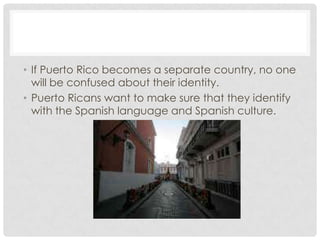
• If Puerto Rico becomes a separate country, no one
  will be confused about their identity.
• Puerto Ricans want to make sure that they identify
  with the Spanish language and Spanish culture.
BCR

• Identify the three choices that Puerto Rico has for its
  future. Use information from the text to support your
  answer.

Puerto rico

  • 1.
  • 2.
    • Puerto Ricowas once a Spanish colony. • When the US defeated Spain in the Spanish- American War, Spain gave Puerto Rico to the US. • Puerto Rico is part of the United States. Puerto Ricans are United States citizens. • A citizen is an individual with certain rights and responsibilities under a particular government.
  • 3.
    BUT PUERTO RICOIS NOT A STATE! • Puerto Rico is a “commonwealth” of the United States. • A commonwealth is a self-governing political unit that has strong ties to a particular country.
  • 4.
    Puerto Ricans cannot vote in US elections. • They do not pay United States taxes. • They can and do serve in the US military. • Puerto Rico has its own lawmakers and constitution.
  • 5.
    • Many PuertoRicans move to the mainland United States. • Many people travel back and forth between the mainland and Puerto Rico.
  • 6.
    • Much ofPuerto Rico is made up of hills and mountains. • Puerto Ricans hunt, fish, and raise chickens, pigs, and cattle. • Sugarcane is grown.
  • 7.
    • As peopletravel back and forth, they bring customs and products with them. • There is much influence from the US. • Most people are of Spanish and African ancestry.
  • 8.
    • Puerto Ricancities show influences of Spanish, Caribbean, and US mainland culture. • About 75% of Puerto Ricans live in cities. • San Juan, Puerto Rico’s capital, has skyscrapers and old Spanish-style buildings. • Many people work in factories, hotels, and restaurants. • Tourism is a big industry.
  • 9.
    COMMONWEALTH OR STATEHOOD? •Should Puerto Rico become an independent country? • Should Puerto Rico become the 51st state in the US? • Should Puerto Rico remain a commonwealth?
  • 10.
    • Puerto Ricanshave many disagreements over what the status of their islands should be. • If Puerto Rico becomes a state, it will be the poorest state in the union. • Puerto Ricans will be able to vote. • Puerto Ricans will have to pay taxes. • In the past twenty years, Puerto Ricans have voted not to become the 51st state.
  • 11.
    • If PuertoRico becomes a separate country, no one will be confused about their identity. • Puerto Ricans want to make sure that they identify with the Spanish language and Spanish culture.
  • 12.
    BCR • Identify thethree choices that Puerto Rico has for its future. Use information from the text to support your answer.