
GROWTH AND YIELD OF INDIVIDUAL TREES
FOREST STAND ,YIELD AND STAND TABLE
SUBMITTED TO—
ASST. PROF.Mrs SARITA BODALKAR
DEPARTMENT OF FORESTRY,IGKV
SUBMITTED BY-
AMIT PRAKASH NAYAK
MSC (Forestry) 1st year.
Course title:- Forest Biometry
Course no:- FOR- 502
CONTENTS
 INTRODUCTION
 DEFINITION PF GROWTH AND YIELD
 GROWTH IN TREES
 PHASES OF STAND DEVELOPMENT
 CLASSIFIACTION OF CROWN
 YIELD TABLE
 STAND TABLE
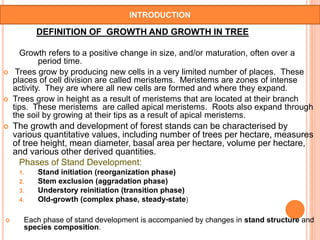
DEFINITION OF GROWTH AND GROWTH IN TREE
Growth refers to a positive change in size, and/or maturation, often over a
period time.
 Trees grow by producing new cells in a very limited number of places. These
places of cell division are called meristems. Meristems are zones of intense
activity. They are where all new cells are formed and where they expand.
 Trees grow in height as a result of meristems that are located at their branch
tips. These meristems are called apical meristems. Roots also expand through
the soil by growing at their tips as a result of apical meristems.
 The growth and development of forest stands can be characterised by
various quantitative values, including number of trees per hectare, measures
of tree height, mean diameter, basal area per hectare, volume per hectare,
and various other derived quantities.
Phases of Stand Development:
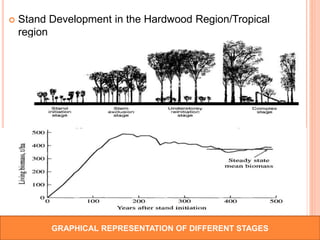
1. Stand initiation (reorganization phase)
2. Stem exclusion (aggradation phase)
3. Understory reinitiation (transition phase)
4. Old-growth (complex phase, steady-state)
 Each phase of stand development is accompanied by changes in stand structure and
species composition.
INTRODUCTION
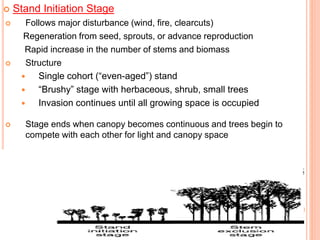
 Stand Initiation Stage
 Follows major disturbance (wind, fire, clearcuts)
Regeneration from seed, sprouts, or advance reproduction
Rapid increase in the number of stems and biomass
 Structure
 Single cohort (“even-aged”) stand
 “Brushy” stage with herbaceous, shrub, small trees
 Invasion continues until all growing space is occupied
 Stage ends when canopy becomes continuous and trees begin to
compete with each other for light and canopy space
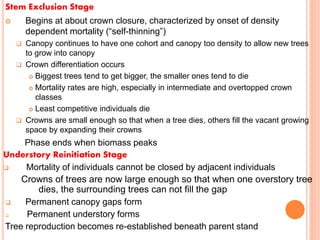
Stem Exclusion Stage
 Begins at about crown closure, characterized by onset of density
dependent mortality (“self-thinning”)
 Canopy continues to have one cohort and canopy too density to allow new trees
to grow into canopy
 Crown differentiation occurs
 Biggest trees tend to get bigger, the smaller ones tend to die
 Mortality rates are high, especially in intermediate and overtopped crown
classes
 Least competitive individuals die
 Crowns are small enough so that when a tree dies, others fill the vacant growing
space by expanding their crowns
Phase ends when biomass peaks
Understory Reinitiation Stage
 Mortality of individuals cannot be closed by adjacent individuals
Crowns of trees are now large enough so that when one overstory tree
dies, the surrounding trees can not fill the gap
 Permanent canopy gaps form
 Permanent understory forms
Tree reproduction becomes re-established beneath parent stand
Primary factors influencing species composition
• Understory light availability
• Species degree of shade tolerance
 Old-Growth (or Complex) Stage
 Natural mortality of large overstory trees produces irregular canopy gaps
 Mortality and recruitment and are in balance and biomass is stable
 Can mark transition from an even-aged to an uneven-aged stand
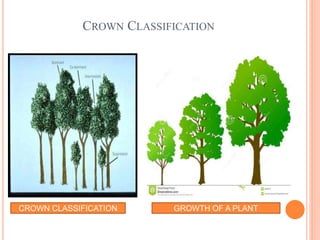
CROWN CLASSIFICATION
GROWTH OF A PLANTCROWN CLASSIFICATION
CROWN CLASSIFICATION
 Dominant Canopy-These are trees of upper most canopy.
Based on leading shoot they are classify into
-predominat trees
-Co dominat trees
 Codominant: Top of crown is at upper canopy height; receives full
top light, little from sides; medium-sized crown, usually somewhat
crowded on its sides. Often wide range around “average canopy”
tree.
 Intermediate: Top of crown is below the top of the general canopy;
receives some top light from directly above, none from the side;
conspicuously narrower, smaller and shorter than the average
crown.
 Overtopped: Crown entirely below some foliage of the upper
canopy; receives no direct top light; small, weak crown with low
vigor
 Stand Development in the Hardwood Region/Tropical
region
GRAPHICAL REPRESENTATION OF DIFFERENT STAGES
YIELD TABLE
It represent all esential data relating to the development of fully
stocked and regularly thinned even aged crop at periodic
intervals covering the greater part of life.
It contains following information ::
Pri mary data –it include volume of main crop,thinning crop ,final
yield and accumulated yield through thinning.
Secondary data-It includs crop average ,height,no of stems per
unit area ,crop basal area ,form factor MAI and CAI.
APPLICATION OF YIELD TABLE
 It is use to determination of site quality and factorial site quality
 Used to estimation of total yield/growing stock
 Used to determination of increment of stand.
 Uses to determination of rotation
 Used to guide silvicultural thinning by giving required
information
 Used to prepation of stock map.
PREPARATION OF YIELD TABLE
 After construction of top height/top age curve by site qualities,
sample plots are assignment according to quality classes.
 Crop age and mean crop basal area/ha is grouped separately
and averages is computed.
 From each quality class,the main crop data is grouped by
decade of age classes and the following averages are
computed
-basal area/ha
-number of trees per ha
-averages crop diameter
- average crop height
-Stem timber and small wood volume per ha
-Top age and top height
 The average for each age class are plotted against the average
crop age .similarly smooth curves for each site quality drawn
from these ,following information are calculated using defined
formulae
 Basal area per ha-Number of trees/ha multiply into average
basal area
 Crop volume area –Basal area/ha multiply to crop height
multiply to form factor
 The average value against each age deacde is read from the
curve and tabulated.
 The data for subsidiary crop is similarly curved and tabulated
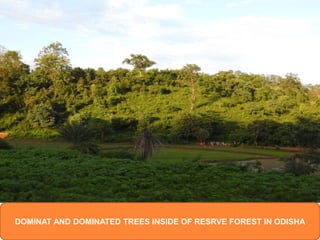
DOMINAT AND DOMINATED TREES INSIDE OF RESRVE FOREST IN ODISHA
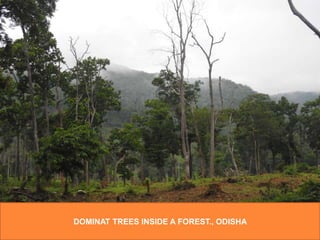
DOMINAT TREES INSIDE A FOREST., ODISHA
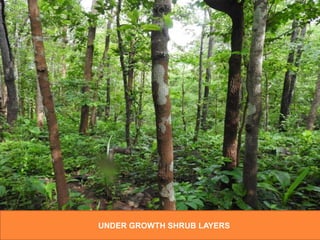
UNDER GROWTH SHRUB LAYERS
Stand table
It is a table showing the distribution of stem by diameter classes
for each of the series of crop diameter.
It covers following information
1.Percentage of tree over a given diameter in crops of various
diameters
2.Number of trees per hectar over a given diameter limit
3.Pefrcentage of total number of trees by 10cm diameter classes.
APPLICATIONS
To determine the financial value of crop
To prepare money yield table
METHOD S OF PREPARATION AND OBJETIVE
 Percentage of trees over a given diameter in crops of various
diameter.
 Number of trees per hectare over a given diameter limit.
 Percentage of total number of trees by 10 cm diameter classes.
 To help the various forest management activities
 To provide information such as range of diameter classes that is
removed at each thinning
 To facilitate conservation of yield table data into a local
standards by providing information on numbers of trees per unit
area under different diameter classes.
REFERENCES
 Forest management tables
 Yield models for forest management .
 The carbon content of trees
 www.forestry.gov.uk
 Handbook of Indian forestry(Manikandan and s. prabhu)
 Aakala T, Kuuluvainen T, Wallenius T, Kauhanen H (2009)
Contrasting patterns of tree mortality in late-successional
Picea abies stands in two areas of northern Fennoscandia.
J Veg Sci 20:1016–1026
THANK YOU

forest biometry

  • 1.
    GROWTH AND YIELDOF INDIVIDUAL TREES FOREST STAND ,YIELD AND STAND TABLE SUBMITTED TO— ASST. PROF.Mrs SARITA BODALKAR DEPARTMENT OF FORESTRY,IGKV SUBMITTED BY- AMIT PRAKASH NAYAK MSC (Forestry) 1st year. Course title:- Forest Biometry Course no:- FOR- 502
  • 2.
    CONTENTS  INTRODUCTION  DEFINITIONPF GROWTH AND YIELD  GROWTH IN TREES  PHASES OF STAND DEVELOPMENT  CLASSIFIACTION OF CROWN  YIELD TABLE  STAND TABLE
  • 3.
    DEFINITION OF GROWTHAND GROWTH IN TREE Growth refers to a positive change in size, and/or maturation, often over a period time.  Trees grow by producing new cells in a very limited number of places. These places of cell division are called meristems. Meristems are zones of intense activity. They are where all new cells are formed and where they expand.  Trees grow in height as a result of meristems that are located at their branch tips. These meristems are called apical meristems. Roots also expand through the soil by growing at their tips as a result of apical meristems.  The growth and development of forest stands can be characterised by various quantitative values, including number of trees per hectare, measures of tree height, mean diameter, basal area per hectare, volume per hectare, and various other derived quantities. Phases of Stand Development: 1. Stand initiation (reorganization phase) 2. Stem exclusion (aggradation phase) 3. Understory reinitiation (transition phase) 4. Old-growth (complex phase, steady-state)  Each phase of stand development is accompanied by changes in stand structure and species composition. INTRODUCTION
  • 4.
     Stand InitiationStage  Follows major disturbance (wind, fire, clearcuts) Regeneration from seed, sprouts, or advance reproduction Rapid increase in the number of stems and biomass  Structure  Single cohort (“even-aged”) stand  “Brushy” stage with herbaceous, shrub, small trees  Invasion continues until all growing space is occupied  Stage ends when canopy becomes continuous and trees begin to compete with each other for light and canopy space
  • 5.
    Stem Exclusion Stage Begins at about crown closure, characterized by onset of density dependent mortality (“self-thinning”)  Canopy continues to have one cohort and canopy too density to allow new trees to grow into canopy  Crown differentiation occurs  Biggest trees tend to get bigger, the smaller ones tend to die  Mortality rates are high, especially in intermediate and overtopped crown classes  Least competitive individuals die  Crowns are small enough so that when a tree dies, others fill the vacant growing space by expanding their crowns Phase ends when biomass peaks Understory Reinitiation Stage  Mortality of individuals cannot be closed by adjacent individuals Crowns of trees are now large enough so that when one overstory tree dies, the surrounding trees can not fill the gap  Permanent canopy gaps form  Permanent understory forms Tree reproduction becomes re-established beneath parent stand
  • 6.
    Primary factors influencingspecies composition • Understory light availability • Species degree of shade tolerance  Old-Growth (or Complex) Stage  Natural mortality of large overstory trees produces irregular canopy gaps  Mortality and recruitment and are in balance and biomass is stable  Can mark transition from an even-aged to an uneven-aged stand
  • 7.
    CROWN CLASSIFICATION GROWTH OFA PLANTCROWN CLASSIFICATION
  • 8.
    CROWN CLASSIFICATION  DominantCanopy-These are trees of upper most canopy. Based on leading shoot they are classify into -predominat trees -Co dominat trees  Codominant: Top of crown is at upper canopy height; receives full top light, little from sides; medium-sized crown, usually somewhat crowded on its sides. Often wide range around “average canopy” tree.  Intermediate: Top of crown is below the top of the general canopy; receives some top light from directly above, none from the side; conspicuously narrower, smaller and shorter than the average crown.  Overtopped: Crown entirely below some foliage of the upper canopy; receives no direct top light; small, weak crown with low vigor
  • 9.
     Stand Developmentin the Hardwood Region/Tropical region GRAPHICAL REPRESENTATION OF DIFFERENT STAGES
  • 10.
    YIELD TABLE It representall esential data relating to the development of fully stocked and regularly thinned even aged crop at periodic intervals covering the greater part of life. It contains following information :: Pri mary data –it include volume of main crop,thinning crop ,final yield and accumulated yield through thinning. Secondary data-It includs crop average ,height,no of stems per unit area ,crop basal area ,form factor MAI and CAI. APPLICATION OF YIELD TABLE  It is use to determination of site quality and factorial site quality  Used to estimation of total yield/growing stock  Used to determination of increment of stand.  Uses to determination of rotation  Used to guide silvicultural thinning by giving required information  Used to prepation of stock map.
  • 11.
    PREPARATION OF YIELDTABLE  After construction of top height/top age curve by site qualities, sample plots are assignment according to quality classes.  Crop age and mean crop basal area/ha is grouped separately and averages is computed.  From each quality class,the main crop data is grouped by decade of age classes and the following averages are computed -basal area/ha -number of trees per ha -averages crop diameter - average crop height -Stem timber and small wood volume per ha -Top age and top height
  • 12.
     The averagefor each age class are plotted against the average crop age .similarly smooth curves for each site quality drawn from these ,following information are calculated using defined formulae  Basal area per ha-Number of trees/ha multiply into average basal area  Crop volume area –Basal area/ha multiply to crop height multiply to form factor  The average value against each age deacde is read from the curve and tabulated.  The data for subsidiary crop is similarly curved and tabulated
  • 13.
    DOMINAT AND DOMINATEDTREES INSIDE OF RESRVE FOREST IN ODISHA
  • 14.
    DOMINAT TREES INSIDEA FOREST., ODISHA
  • 15.
  • 16.
    Stand table It isa table showing the distribution of stem by diameter classes for each of the series of crop diameter. It covers following information 1.Percentage of tree over a given diameter in crops of various diameters 2.Number of trees per hectar over a given diameter limit 3.Pefrcentage of total number of trees by 10cm diameter classes. APPLICATIONS To determine the financial value of crop To prepare money yield table
  • 17.
    METHOD S OFPREPARATION AND OBJETIVE  Percentage of trees over a given diameter in crops of various diameter.  Number of trees per hectare over a given diameter limit.  Percentage of total number of trees by 10 cm diameter classes.  To help the various forest management activities  To provide information such as range of diameter classes that is removed at each thinning  To facilitate conservation of yield table data into a local standards by providing information on numbers of trees per unit area under different diameter classes.
  • 18.
    REFERENCES  Forest managementtables  Yield models for forest management .  The carbon content of trees  www.forestry.gov.uk  Handbook of Indian forestry(Manikandan and s. prabhu)  Aakala T, Kuuluvainen T, Wallenius T, Kauhanen H (2009) Contrasting patterns of tree mortality in late-successional Picea abies stands in two areas of northern Fennoscandia. J Veg Sci 20:1016–1026 THANK YOU