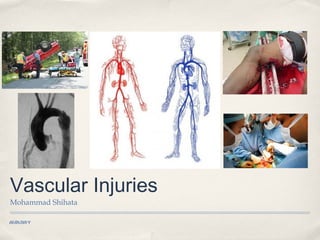
Vascular Injuries 
Mohammad Shihata 
02/01/2014
Objectives 
✤ Principles of trauma management 
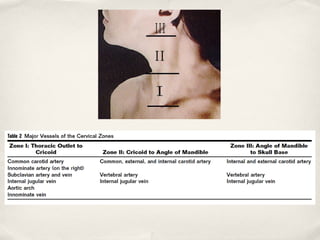
✤ Vascular zones of the body 
✤ Mechanisms of vascular trauma 
✤ Recognition of vascular injuries 
✤ Management of Vascular injuries
My ATLS App for smart phones and tablets
A, B, C, D, E 
Primary survey 
–A Airway maintenance with cervical spine 
protection 
–B Breathing and ventilation 
–C Circulation with hemorrhage control 
–D Disability : Neurological status 
–E Exposure/Environmental control : completely 
undress the patient,but prevent hypothermia
Resuscitation 
✤ Control Bleeding 
✤ Protect and maintain airway 
✤ Two large bore IVs for rapid infusion
Secondary survey 
Secondary survey does not begin until 
the primary survey (ABCDEs) is 
completed, resuscitative efforts are 
well established, and the patient is 
demonstrating normalization of vital 
functions.
Secondary Survey 
– Total patient evaluation 
• history : AMPLE 
• physical examination 
– Complete neurologic examination 
– Head and skull 
– Maxillofacial 
– Neck 
– Chest 
– Abdomen 
– Perineum/rectum/vagina 
– Musculoskeletal 
– Tubes and fingers in every orifice
“He Who wants to be a surgeon, should 
go to war” 
Hippocrates (460 - 377 BC)
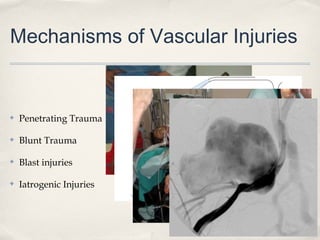
Mechanisms of Vascular Injuries 
✤ Penetrating Trauma 
✤ Blunt Trauma 
✤ Blast injuries 
✤ Iatrogenic Injuries
Ask yourself 
 IIss tthhiiss bblluunntt oorr ppeenneettrraattiinngg iinnjjuurryy ?? 
 IIss tthhiiss AArrtteerriiaall oorr VVeennoouuss iinnjjuurryy ?? 
 SShhoouulldd II ttaakkee tthhee ppaattiieenntt ttoo tthhee ooppeerraattiinngg rroooomm oorr ddoo ffuurrtthheerr 
iinnvveessttiiggaattiioonnss??
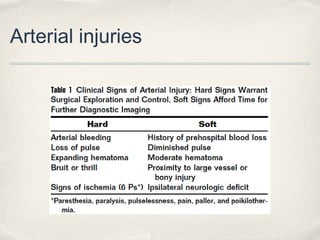
Arterial injuries
Venous Injuries 
✤ Low pressure 
✤ Dark blood 
✤ Non-expanding hematoma
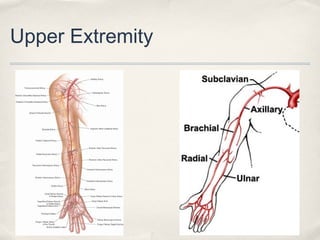
Upper Extremity
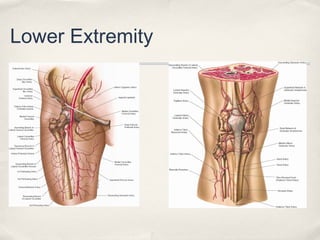
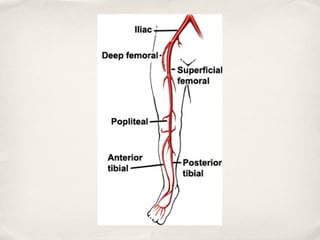
Lower Extremity
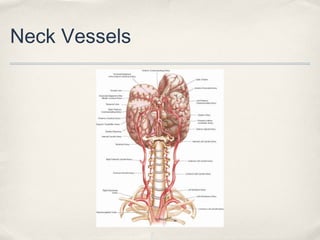
Neck Vessels
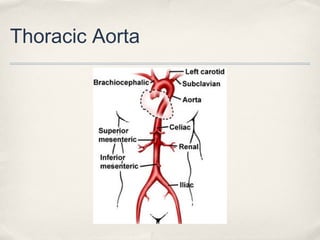
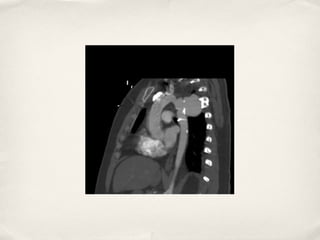
Thoracic Aorta
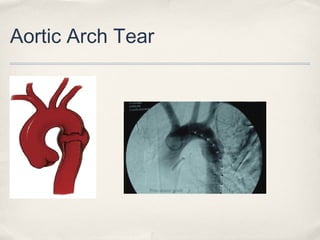
Aortic Arch Tear
Aortic Arch Transection 
✤ Common in deceleration ( blunt ) type injuries 
✤ Most common site is the ligamentum attachment ( isthmus) 
✤ Free rupture is incompatible with life 
✤ Contained rupture is associated with increased risk of free rupture 
✤ Usually associated with other life threatening injuries
Principles of Vascular Repairs 
✤ Know your anatomy ( Course, Feeding vessel, Run-off) 
✤ Adequate Exposure 
✤ Proximal and distal control 
✤ Tension free repair 
✤ Adjuncts (intra op tPA, Imaging, .....) 
✤ Assess the need for fasciotomy
Options for peripheral vascular 
repair 
No Transection 
✤ Primary Repair 
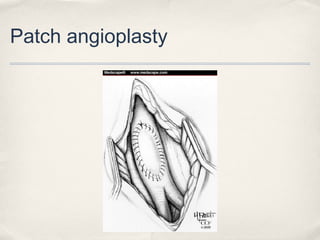
✤ Patch Angioplasty 
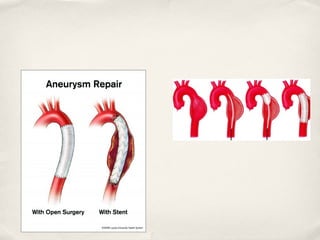
✤ Endovascular treatment 
Complete Transection 
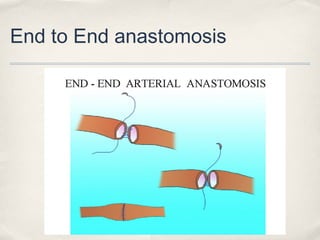
✤ Primary end to end anastomosis 
✤ Interposition graft 
✤ Bypass
Patch angioplasty
End to End anastomosis
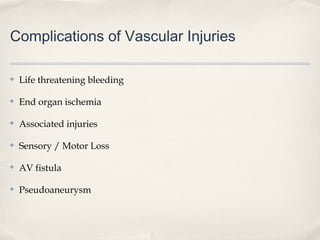
Complications of Vascular Injuries 
✤ Life threatening bleeding 
✤ End organ ischemia 
✤ Associated injuries 
✤ Sensory / Motor Loss 
✤ AV fistula 
✤ Pseudoaneurysm
Thank You

Vascular injuries

  • 1.
    Vascular Injuries MohammadShihata 02/01/2014
  • 2.
    Objectives ✤ Principlesof trauma management ✤ Vascular zones of the body ✤ Mechanisms of vascular trauma ✤ Recognition of vascular injuries ✤ Management of Vascular injuries
  • 4.
    My ATLS Appfor smart phones and tablets
  • 5.
    A, B, C,D, E Primary survey –A Airway maintenance with cervical spine protection –B Breathing and ventilation –C Circulation with hemorrhage control –D Disability : Neurological status –E Exposure/Environmental control : completely undress the patient,but prevent hypothermia
  • 6.
    Resuscitation ✤ ControlBleeding ✤ Protect and maintain airway ✤ Two large bore IVs for rapid infusion
  • 7.
    Secondary survey Secondarysurvey does not begin until the primary survey (ABCDEs) is completed, resuscitative efforts are well established, and the patient is demonstrating normalization of vital functions.
  • 8.
    Secondary Survey –Total patient evaluation • history : AMPLE • physical examination – Complete neurologic examination – Head and skull – Maxillofacial – Neck – Chest – Abdomen – Perineum/rectum/vagina – Musculoskeletal – Tubes and fingers in every orifice
  • 9.
    “He Who wantsto be a surgeon, should go to war” Hippocrates (460 - 377 BC)
  • 10.
    Mechanisms of VascularInjuries ✤ Penetrating Trauma ✤ Blunt Trauma ✤ Blast injuries ✤ Iatrogenic Injuries
  • 11.
    Ask yourself IIss tthhiiss bblluunntt oorr ppeenneettrraattiinngg iinnjjuurryy ??  IIss tthhiiss AArrtteerriiaall oorr VVeennoouuss iinnjjuurryy ??  SShhoouulldd II ttaakkee tthhee ppaattiieenntt ttoo tthhee ooppeerraattiinngg rroooomm oorr ddoo ffuurrtthheerr iinnvveessttiiggaattiioonnss??
  • 12.
  • 13.
    Venous Injuries ✤Low pressure ✤ Dark blood ✤ Non-expanding hematoma
  • 14.
  • 15.
  • 18.
  • 20.
  • 21.
  • 23.
    Aortic Arch Transection ✤ Common in deceleration ( blunt ) type injuries ✤ Most common site is the ligamentum attachment ( isthmus) ✤ Free rupture is incompatible with life ✤ Contained rupture is associated with increased risk of free rupture ✤ Usually associated with other life threatening injuries
  • 24.
    Principles of VascularRepairs ✤ Know your anatomy ( Course, Feeding vessel, Run-off) ✤ Adequate Exposure ✤ Proximal and distal control ✤ Tension free repair ✤ Adjuncts (intra op tPA, Imaging, .....) ✤ Assess the need for fasciotomy
  • 25.
    Options for peripheralvascular repair No Transection ✤ Primary Repair ✤ Patch Angioplasty ✤ Endovascular treatment Complete Transection ✤ Primary end to end anastomosis ✤ Interposition graft ✤ Bypass
  • 26.
  • 27.
    End to Endanastomosis
  • 29.
    Complications of VascularInjuries ✤ Life threatening bleeding ✤ End organ ischemia ✤ Associated injuries ✤ Sensory / Motor Loss ✤ AV fistula ✤ Pseudoaneurysm
  • 30.