CASE REPORTS 
Ex Vivo Bilateral Pulmonary 
Embolectomy for Donor Lungs 
Prior to Transplantation 
Mohammad Shihata, MD, Nitin Ghorpade, MD, 
Dale Lien, MD, and Dennis Modry, MD 
Division of Cardiac Surgery, University of Alberta Hospital, 
Edmonton, Alberta, Canada 
Pulmonary arterial embolic disease of donor lungs is a 
known entity. Its implications on the technicality, the 
perioperative management, and the outcome of lung 
transplantation depend on the extent of the embolic 
disease and the indicators of lung function at the time of 
procurement. We report a case of lung transplantation 
from a donor who was known to have significant acute 
pulmonary embolic disease and the perioperative man-agement 
used to optimize the outcome. 
(Ann Thorac Surg 2008;85:2110 –2) 
© 2008 by The Society of Thoracic Surgeons 
Liberalization of donor criteria has been increasingly 
practiced in an attempt to overcome the shortage in 
donor organs. In the current era, many donor organs with 
indicators showing good lung function would not fulfill 
all the classic prerequisites. In this case report we de-scribe 
the use of lungs from a donor who had significant 
pulmonary embolic disease that was underestimated 
during the pretransplantation workup. 
The patient is a 55-year-old man with end-stage emphy-sema. 
He was on home oxygen therapy and had severe 
physical disability due to shortness of breath at rest and 
minimal exertion, and hence was listed for lung 
transplantation. 
The donor was a previously healthy 46-year-old truck 
driver who had a sudden collapse at home and was 
resuscitated and transferred to a tertiary care center. 
Further investigations found that he had a large hemi-spherical 
cerebral infarction and severe cerebral edema. 
The cerebral infarction was believed to be secondary to a 
paradoxic embolic phenomenon. A transesophageal 
echocardiogram confirmed the presence of a patent fo-ramen 
ovale and demonstrated severe right ventricular 
dysfunction. The diagnosis of deep venous thrombosis 
and pulmonary embolization was confirmed. 
After 7 days of anticoagulation, the need for supple-mental 
oxygen therapy was significantly reduced and 
there was no evidence of a residual central or subseg-mental 
pulmonary embolus on a repeat computed to-mography 
scan of the chest. A repeat echocardiogram 
showed marked improvement of the right ventricular 
dimensions and contractility. There was no central ner-vous 
system recovery, however, and cerebral perfusion 
studies showed no cerebral flow. 
Once the brain death criteria were established, the lungs 
were assessed for possible organ donation. The result of the 
chest roentgenogram was normal, and a lung perfusion 
scan on day 8 after the initial presentation showed a small 
perfusion defect in the right lung. The donor had a partial 
pressure of oxygen of 378 on 100% oxygen, a positive 
end-expiratory pressure of 5 cm H2O, and a tidal volume of 
6 mL/kg. On the basis of the last imaging studies and the 
pulmonary functional indicators, the lungs were accepted 
for transplantation. At the time of procurement, the donor 
lungs were grossly normal, and there was no evidence of 
any particulate embolic washout when retrograde pneu-moplegia 
was administered. 
The transplantation was performed on cardiopulmo-nary 
bypass. Before implantation, it was apparent on 
direct inspection, once the pulmonary artery was di-vided, 
that both main pulmonary arteries had a substan-tial 
embolic burden extending to the segmental and 
subsegmental branches. 
At that time, the recipient was committed to receive the 
lungs after having bilateral pneumonectomies and medi-astinal 
dissection. The decision was made to perform 
bilateral pulmonary embolectomy and proceed with the 
implantation, bearing in mind the need to institute anti-coagulation 
therapy afterwards. Extraction of the central 
part of the clot was relatively easy, but there was a fair 
degree of clot organization in the more distal portions. 
We had to resort to a special type of suction catheters that 
we usually use for pulmonary endarterectomy, the 
Jamieson dissecting aspirator (MMA-7; Fehling Surgical 
Instruments Inc, Acworth, GA), to make sure that all 
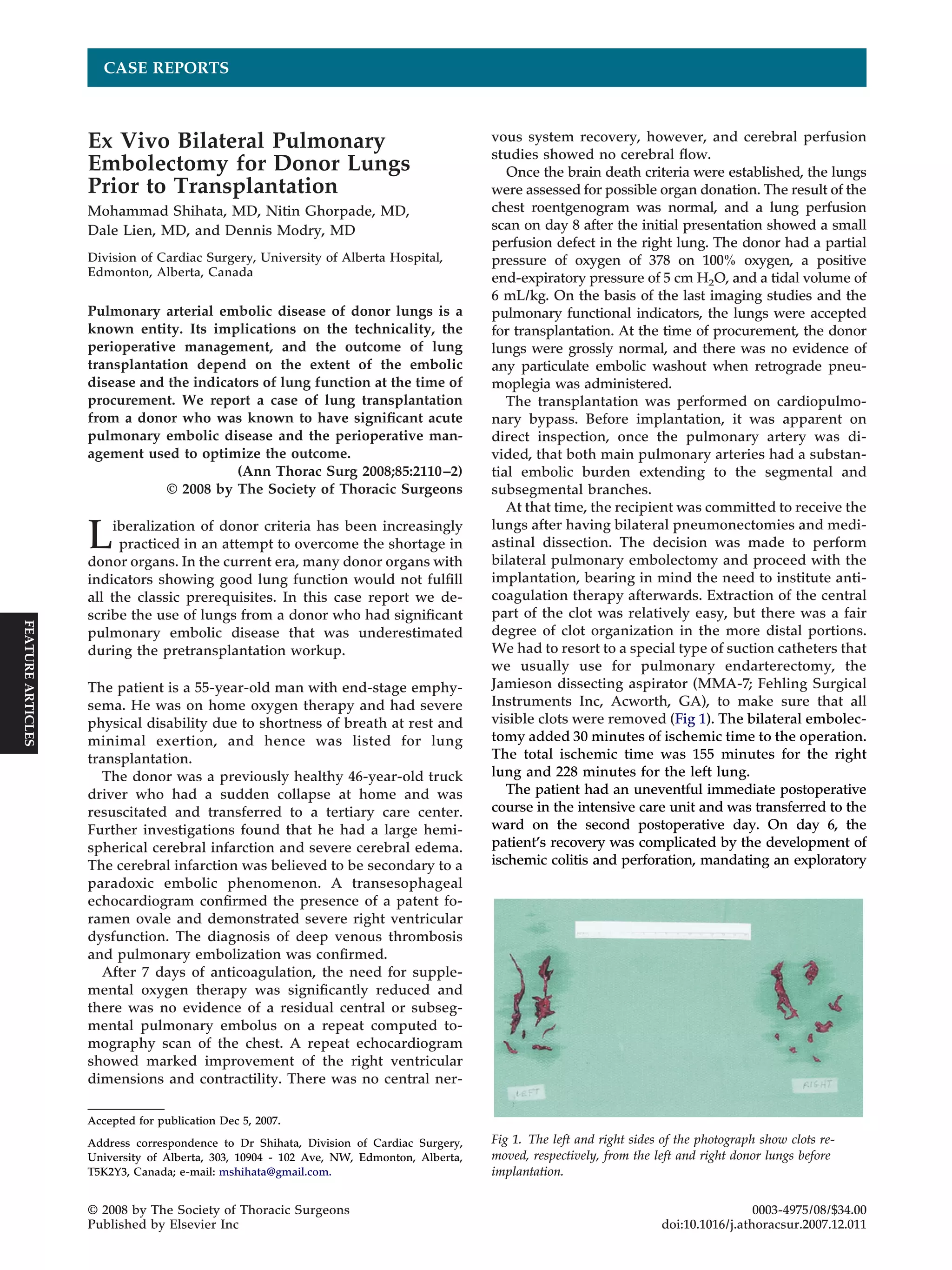
visible clots were removed (Fig 1). The bilateral embolec-tomy 
added 30 minutes of ischemic time to the operation. 
The total ischemic time was 155 minutes for the right 
lung and 228 minutes for the left lung. 
The patient had an uneventful immediate postoperative 
course in the intensive care unit and was transferred to the 
ward on the second postoperative day. On day 6, the 
patient’s recovery was complicated by the development of 
ischemic colitis and perforation, mandating an exploratory 
Accepted for publication Dec 5, 2007. 
Address correspondence to Dr Shihata, Division of Cardiac Surgery, 
University of Alberta, 303, 10904 - 102 Ave, NW, Edmonton, Alberta, 
T5K2Y3, Canada; e-mail: mshihata@gmail.com. 
Fig 1. The left and right sides of the photograph show clots re-moved, 
respectively, from the left and right donor lungs before 
implantation. 
© 2008 by The Society of Thoracic Surgeons 0003-4975/08/$34.00 
Published by Elsevier Inc doi:10.1016/j.athoracsur.2007.12.011 
FEATURE ARTICLES
Ann Thorac Surg CASE REPORT SHIHATA ET AL 2111 
2008;85:2110–2 PULMONARY EMBOLECTOMY IN DONOR LUNGS 
laparotomy, hemicolectomy, and formation of an ileos-tomy. 
Despite the additional septic and surgical stresses, 
prolonged intubation was not needed and he remained 
stable from the cardiopulmonary standpoint. He contin-ued 
to recover in a timely fashion and was discharged 
home on oral anticoagulation therapy. Before discharge, 
the result of his chest roentgenogram was within normal 
limits (Fig 2), and a lung perfusion scan showed minor 
residual defects in the right lung (Fig 3). 
Comment 
Lung transplantation has become the treatment of choice 
for end-stage lung disease caused by different underlying 
pathologic entities. The main limitation, however, re-mains 
the lack of enough donor organs. The exponential 
increase in the number of patients awaiting lung trans-plantation 
has not been met by an equivalent increase in 
the donor pool. Patients on the waiting lists for lung 
transplantation have an annual mortality rate of 20% 
according to some recent reports [1]. Other study groups 
reported a mortality rate of 50% for patients found 
suitable for lung transplantation from their underlying 
lung disease before an organ becomes available [2]. 
The concept of accepting marginal or extended donors 
has become a common practice in many of the busy 
transplant centers around the world [3]. Advocates of 
Fig 2. Chest roentgenograms taken (left) pre-operatively 
and (right) before discharge. 
using lungs from living donors, older donors, donors 
with history of smoking, non-heart-beating donors, or 
donors with reversible underlying lung pathologies have 
been increasingly reporting successful outcomes [4] that 
are comparable with outcomes expected when more rigid 
donor selection criteria are implemented [5]. 
The use of donor lungs from patients suspected or 
diagnosed to have variable degrees of pulmonary em-bolic 
disease at the time of brain death has been previ-ously 
reported in a few anecdotal cases [6]. Unexpected 
macroscopic donor-related pulmonary emboli were re-ported 
in as many as 38% of lung transplantations, and 
this was found to be associated with worse outcomes in 
terms of primary graft failure [7]. 
The use of pulmonary embolectomy at the time of lung 
transplantation has been previously reported in two 
separate case reports [8, 9]. The patient reported in this 
article is unique due to the substantial clot burden that 
was removed from as distal as the subsegmental pulmo-nary 
arteries and the amount of organization in portions 
of the clots, indicating a subacute process. That this 
problem was not fully appreciated at the time of the 
pretransplant workup is probably the reason the lungs 
were accepted for the transplantation. 
The excellent early outcome we had with this case has 
led us to a number of conclusions. First, the diagnosis of 
pulmonary embolism whenever suspected in a trans- 
Fig 3. Predischarge perfusion lung scan shows 
minor right middle and lower lobe perfusion 
defects. 
FEATURE ARTICLES
2112 CASE REPORT HAMAD ET AL Ann Thorac Surg 
COMPLETION SLEEVE BILOBECTOMY FOR BPF 2008;85:2112–4 
plant workup should be based on contrast imaging 
techniques. Second, the combination of antegrade and 
retrograde pneumoplegia is very useful in providing 
uniform lung protection. Furthermore, the absence of 
particulate or visible debris with retrograde flushing of 
the pulmonary veins is not completely reliable in ruling 
out pulmonary emboli, especially if any degree of clot 
organization is present. Careful inspection of the pulmo-nary 
arterial tree should always be performed before 
implantation. Finally, this result enforces the concept of 
liberalization of organ donor criteria in an attempt to 
overcome the confounding shortage of organs. This lib-eralization, 
however, should not be in violation of any of 
the functional or gas exchange indicators. 
References 
1. Fischer S, Gohrbandt B, Meyer A, Simon AR, Haverich A, 
Struber M. Should lungs from donors with severe acute pulmo-nary 
embolism be accepted for transplantation? The Hannover 
experience. J Thorac Cardiovasc Surg 2003;126:1641–3. 
2. Thabut G, Mal H, Cerrina J, et al. Influence of donor charac-teristics 
on outcome after lung transplantation: a multicenter 
study. J Heart Lung Transplant 2005;24:1347–53. 
3. Filosso PL, Turello D, Cavallo A, Ruffini E, Mancuso M, Oliaro 
A. Lung donors selection criteria: a review. J Cardiovasc Surg 
(Torino) 2006;47:361– 6. 
4. Pierre AF, Sekine Y, Hutcheon MA, Waddell TK, Keshavjee 
SH. Marginal donor lungs: a reassessment. J Thorac Cardio-vasc 
Surg 2002;123:421–7. 
5. Aigner C, Winkler G, Jaksch P, et al. Extended donor criteria 
for lung transplantation–a clinical reality. Eur J Cardiothorac 
Surg 2005;27:757– 61. 
6. Frenia D, Nathan SD, Ahmad S, et al. Successful lung trans-plantation 
from a donor with a saddle pulmonary embolus. 
J Heart Lung Transplant 2005;24:1137–9. 
7. Oto T, Rabinov M, Griffiths AP, et al. Unexpected donor 
pulmonary embolism affects early outcomes after lung trans-plantation: 
a major mechanism of primary graft failure? 
J Thorac Cardiovasc Surg 2005;130:1446. 
8. Nguyen DQ, Salerno CT, Bolman M 3rd, Park SJ. Pulmonary 
thromboembolectomy of donor lungs prior to lung transplan-tation. 
Ann Thorac Surg 1999;67:1787–9. 
9. Smith JA, Mohajeri M, Rabinov M, Esmore DS. Maldistribu-tion 
of pneumoplegia in pulmonary allografts secondary to 
post-traumatic pulmonary thromboembolism. J Heart Lung 
Transplant 1996;15:324 –5. 
A Completion Sleeve Bilobectomy 
for Nonstump Postlobectomy 
Bronchopleural Fistula 
Abdel-Mohsen Hamad, MD, Giuseppe Marulli, MD, 
Marco Schiavon, MD, and Federico Rea, MD 
Division of Thoracic Surgery, Department of Cardiologic, 
Thoracic and Vascular Sciences, University of Padua, Padova, 
Italy 
We present a novel approach for treatment of nonstump 
postlobectomy bronchial fistula. Our patient had right 
lower lobectomy for T3 N2 M0 adenocarcinoma. An 
increased air leak developed 8 days later, and bronchos-copy 
revealed the presence of a bronchial fistula. On 
reexploration, the bronchial stump was intact, and the 
membranous part of the bronchus intermedius was 
sloughed up to the opening of the upper lobe bronchus. 
A middle lobectomy with sleeve resection of the bron-chus 
intermedius and part of the right main bronchus 
was performed, and the upper lobe was reanastomosed to 
the right main bronchus. The patient’s postoperative 
course was uneventful, and follow-up bronchoscopy 
showed an intact healed anastomosis. 
(Ann Thorac Surg 2008;85:2112– 4) 
© 2008 by The Society of Thoracic Surgeons 
Bronchopleural fistula (BPF) is a relatively rare but 
feared complication of pulmonary resection. The 
incidence of BPF after lobectomy was reported to be 1.1% 
in a series of 1083 lobectomies [1], with higher incidence 
after lower lobectomies [2]. A BPF that occurs within 7 
days after operation is usually the result of a technical 
failure, but when the bronchial leak occurs later in the 
postoperative course, it may be caused by failure of 
healing. The management approach of BPF is challenging 
and includes both interventional bronchoscopic and sur-gical 
procedures. 
A 62-year-old man underwent en bloc resection of the 
right lower lobe and the posterior segments of the right 
sixth and seventh ribs with mediastinal lymphadenec-tomy 
for right lower-lobe non-small cell lung cancer 
(NSCLC). Air leakage increased on postoperative day 8, 
and the drained pleural fluid became cloudy. A broncho-scopic 
examination showed a large opening of the bron-chus 
intermedius. A roentgenogram showed he had a 
pneumothorax and atelectatic residual lung tissue. There 
was no fever or significant leucocytosis. Histopathologic 
diagnosis of the resected lobe was adenocarcinoma with 
metastasis to the 4R mediastinal lymph nodes (T3 N2 
M0). 
The patient underwent reoperation, and the bronchial 
suture line was intact. The membranous part of the 
bronchus intermedius was sloughed up to the origin of 
the upper lobe bronchus, resulting in large fistula with 
necrotic margin (Fig 1). We performed a middle lobec-tomy, 
with sleeve resection of the bronchus intermedius 
and part of the right main bronchus (Fig 2). The upper 
lobe bronchus was reanastomosed to the right main 
bronchus with running sutures. Four sutures of 4-0 
polydioxanone (Ethicon Inc, Somerville, NJ) suture were 
used, and each extended for one-quarter of the circum-ference 
of the anastomosis. Finally, all sutures were 
tightened and the adjacent limbs were each tied together. 
Decortication of the upper lobe and cleaning of the 
pleural space were done. 
The patient’s postoperative course after the second 
operation was uneventful. There was no air leak and the 
chest roentgenogram showed inflation of the upper lobe. 
A bronchoscopic examination 1 week later showed an 
Accepted for publication Nov 26, 2007. 
Address correspondence to Dr Rea, Division of Thoracic Surgery, Uni-versity 
of Padua, Via Giustiniani 2, Padova, 35128, Italy; e-mail: 
federico.rea@unipd.it. 
© 2008 by The Society of Thoracic Surgeons 0003-4975/08/$34.00 
Published by Elsevier Inc doi:10.1016/j.athoracsur.2007.11.062 
FEATURE ARTICLES

Embolectomy prior to lung transplant

  • 1.
    CASE REPORTS ExVivo Bilateral Pulmonary Embolectomy for Donor Lungs Prior to Transplantation Mohammad Shihata, MD, Nitin Ghorpade, MD, Dale Lien, MD, and Dennis Modry, MD Division of Cardiac Surgery, University of Alberta Hospital, Edmonton, Alberta, Canada Pulmonary arterial embolic disease of donor lungs is a known entity. Its implications on the technicality, the perioperative management, and the outcome of lung transplantation depend on the extent of the embolic disease and the indicators of lung function at the time of procurement. We report a case of lung transplantation from a donor who was known to have significant acute pulmonary embolic disease and the perioperative man-agement used to optimize the outcome. (Ann Thorac Surg 2008;85:2110 –2) © 2008 by The Society of Thoracic Surgeons Liberalization of donor criteria has been increasingly practiced in an attempt to overcome the shortage in donor organs. In the current era, many donor organs with indicators showing good lung function would not fulfill all the classic prerequisites. In this case report we de-scribe the use of lungs from a donor who had significant pulmonary embolic disease that was underestimated during the pretransplantation workup. The patient is a 55-year-old man with end-stage emphy-sema. He was on home oxygen therapy and had severe physical disability due to shortness of breath at rest and minimal exertion, and hence was listed for lung transplantation. The donor was a previously healthy 46-year-old truck driver who had a sudden collapse at home and was resuscitated and transferred to a tertiary care center. Further investigations found that he had a large hemi-spherical cerebral infarction and severe cerebral edema. The cerebral infarction was believed to be secondary to a paradoxic embolic phenomenon. A transesophageal echocardiogram confirmed the presence of a patent fo-ramen ovale and demonstrated severe right ventricular dysfunction. The diagnosis of deep venous thrombosis and pulmonary embolization was confirmed. After 7 days of anticoagulation, the need for supple-mental oxygen therapy was significantly reduced and there was no evidence of a residual central or subseg-mental pulmonary embolus on a repeat computed to-mography scan of the chest. A repeat echocardiogram showed marked improvement of the right ventricular dimensions and contractility. There was no central ner-vous system recovery, however, and cerebral perfusion studies showed no cerebral flow. Once the brain death criteria were established, the lungs were assessed for possible organ donation. The result of the chest roentgenogram was normal, and a lung perfusion scan on day 8 after the initial presentation showed a small perfusion defect in the right lung. The donor had a partial pressure of oxygen of 378 on 100% oxygen, a positive end-expiratory pressure of 5 cm H2O, and a tidal volume of 6 mL/kg. On the basis of the last imaging studies and the pulmonary functional indicators, the lungs were accepted for transplantation. At the time of procurement, the donor lungs were grossly normal, and there was no evidence of any particulate embolic washout when retrograde pneu-moplegia was administered. The transplantation was performed on cardiopulmo-nary bypass. Before implantation, it was apparent on direct inspection, once the pulmonary artery was di-vided, that both main pulmonary arteries had a substan-tial embolic burden extending to the segmental and subsegmental branches. At that time, the recipient was committed to receive the lungs after having bilateral pneumonectomies and medi-astinal dissection. The decision was made to perform bilateral pulmonary embolectomy and proceed with the implantation, bearing in mind the need to institute anti-coagulation therapy afterwards. Extraction of the central part of the clot was relatively easy, but there was a fair degree of clot organization in the more distal portions. We had to resort to a special type of suction catheters that we usually use for pulmonary endarterectomy, the Jamieson dissecting aspirator (MMA-7; Fehling Surgical Instruments Inc, Acworth, GA), to make sure that all visible clots were removed (Fig 1). The bilateral embolec-tomy added 30 minutes of ischemic time to the operation. The total ischemic time was 155 minutes for the right lung and 228 minutes for the left lung. The patient had an uneventful immediate postoperative course in the intensive care unit and was transferred to the ward on the second postoperative day. On day 6, the patient’s recovery was complicated by the development of ischemic colitis and perforation, mandating an exploratory Accepted for publication Dec 5, 2007. Address correspondence to Dr Shihata, Division of Cardiac Surgery, University of Alberta, 303, 10904 - 102 Ave, NW, Edmonton, Alberta, T5K2Y3, Canada; e-mail: mshihata@gmail.com. Fig 1. The left and right sides of the photograph show clots re-moved, respectively, from the left and right donor lungs before implantation. © 2008 by The Society of Thoracic Surgeons 0003-4975/08/$34.00 Published by Elsevier Inc doi:10.1016/j.athoracsur.2007.12.011 FEATURE ARTICLES
  • 2.
    Ann Thorac SurgCASE REPORT SHIHATA ET AL 2111 2008;85:2110–2 PULMONARY EMBOLECTOMY IN DONOR LUNGS laparotomy, hemicolectomy, and formation of an ileos-tomy. Despite the additional septic and surgical stresses, prolonged intubation was not needed and he remained stable from the cardiopulmonary standpoint. He contin-ued to recover in a timely fashion and was discharged home on oral anticoagulation therapy. Before discharge, the result of his chest roentgenogram was within normal limits (Fig 2), and a lung perfusion scan showed minor residual defects in the right lung (Fig 3). Comment Lung transplantation has become the treatment of choice for end-stage lung disease caused by different underlying pathologic entities. The main limitation, however, re-mains the lack of enough donor organs. The exponential increase in the number of patients awaiting lung trans-plantation has not been met by an equivalent increase in the donor pool. Patients on the waiting lists for lung transplantation have an annual mortality rate of 20% according to some recent reports [1]. Other study groups reported a mortality rate of 50% for patients found suitable for lung transplantation from their underlying lung disease before an organ becomes available [2]. The concept of accepting marginal or extended donors has become a common practice in many of the busy transplant centers around the world [3]. Advocates of Fig 2. Chest roentgenograms taken (left) pre-operatively and (right) before discharge. using lungs from living donors, older donors, donors with history of smoking, non-heart-beating donors, or donors with reversible underlying lung pathologies have been increasingly reporting successful outcomes [4] that are comparable with outcomes expected when more rigid donor selection criteria are implemented [5]. The use of donor lungs from patients suspected or diagnosed to have variable degrees of pulmonary em-bolic disease at the time of brain death has been previ-ously reported in a few anecdotal cases [6]. Unexpected macroscopic donor-related pulmonary emboli were re-ported in as many as 38% of lung transplantations, and this was found to be associated with worse outcomes in terms of primary graft failure [7]. The use of pulmonary embolectomy at the time of lung transplantation has been previously reported in two separate case reports [8, 9]. The patient reported in this article is unique due to the substantial clot burden that was removed from as distal as the subsegmental pulmo-nary arteries and the amount of organization in portions of the clots, indicating a subacute process. That this problem was not fully appreciated at the time of the pretransplant workup is probably the reason the lungs were accepted for the transplantation. The excellent early outcome we had with this case has led us to a number of conclusions. First, the diagnosis of pulmonary embolism whenever suspected in a trans- Fig 3. Predischarge perfusion lung scan shows minor right middle and lower lobe perfusion defects. FEATURE ARTICLES
  • 3.
    2112 CASE REPORTHAMAD ET AL Ann Thorac Surg COMPLETION SLEEVE BILOBECTOMY FOR BPF 2008;85:2112–4 plant workup should be based on contrast imaging techniques. Second, the combination of antegrade and retrograde pneumoplegia is very useful in providing uniform lung protection. Furthermore, the absence of particulate or visible debris with retrograde flushing of the pulmonary veins is not completely reliable in ruling out pulmonary emboli, especially if any degree of clot organization is present. Careful inspection of the pulmo-nary arterial tree should always be performed before implantation. Finally, this result enforces the concept of liberalization of organ donor criteria in an attempt to overcome the confounding shortage of organs. This lib-eralization, however, should not be in violation of any of the functional or gas exchange indicators. References 1. Fischer S, Gohrbandt B, Meyer A, Simon AR, Haverich A, Struber M. Should lungs from donors with severe acute pulmo-nary embolism be accepted for transplantation? The Hannover experience. J Thorac Cardiovasc Surg 2003;126:1641–3. 2. Thabut G, Mal H, Cerrina J, et al. Influence of donor charac-teristics on outcome after lung transplantation: a multicenter study. J Heart Lung Transplant 2005;24:1347–53. 3. Filosso PL, Turello D, Cavallo A, Ruffini E, Mancuso M, Oliaro A. Lung donors selection criteria: a review. J Cardiovasc Surg (Torino) 2006;47:361– 6. 4. Pierre AF, Sekine Y, Hutcheon MA, Waddell TK, Keshavjee SH. Marginal donor lungs: a reassessment. J Thorac Cardio-vasc Surg 2002;123:421–7. 5. Aigner C, Winkler G, Jaksch P, et al. Extended donor criteria for lung transplantation–a clinical reality. Eur J Cardiothorac Surg 2005;27:757– 61. 6. Frenia D, Nathan SD, Ahmad S, et al. Successful lung trans-plantation from a donor with a saddle pulmonary embolus. J Heart Lung Transplant 2005;24:1137–9. 7. Oto T, Rabinov M, Griffiths AP, et al. Unexpected donor pulmonary embolism affects early outcomes after lung trans-plantation: a major mechanism of primary graft failure? J Thorac Cardiovasc Surg 2005;130:1446. 8. Nguyen DQ, Salerno CT, Bolman M 3rd, Park SJ. Pulmonary thromboembolectomy of donor lungs prior to lung transplan-tation. Ann Thorac Surg 1999;67:1787–9. 9. Smith JA, Mohajeri M, Rabinov M, Esmore DS. Maldistribu-tion of pneumoplegia in pulmonary allografts secondary to post-traumatic pulmonary thromboembolism. J Heart Lung Transplant 1996;15:324 –5. A Completion Sleeve Bilobectomy for Nonstump Postlobectomy Bronchopleural Fistula Abdel-Mohsen Hamad, MD, Giuseppe Marulli, MD, Marco Schiavon, MD, and Federico Rea, MD Division of Thoracic Surgery, Department of Cardiologic, Thoracic and Vascular Sciences, University of Padua, Padova, Italy We present a novel approach for treatment of nonstump postlobectomy bronchial fistula. Our patient had right lower lobectomy for T3 N2 M0 adenocarcinoma. An increased air leak developed 8 days later, and bronchos-copy revealed the presence of a bronchial fistula. On reexploration, the bronchial stump was intact, and the membranous part of the bronchus intermedius was sloughed up to the opening of the upper lobe bronchus. A middle lobectomy with sleeve resection of the bron-chus intermedius and part of the right main bronchus was performed, and the upper lobe was reanastomosed to the right main bronchus. The patient’s postoperative course was uneventful, and follow-up bronchoscopy showed an intact healed anastomosis. (Ann Thorac Surg 2008;85:2112– 4) © 2008 by The Society of Thoracic Surgeons Bronchopleural fistula (BPF) is a relatively rare but feared complication of pulmonary resection. The incidence of BPF after lobectomy was reported to be 1.1% in a series of 1083 lobectomies [1], with higher incidence after lower lobectomies [2]. A BPF that occurs within 7 days after operation is usually the result of a technical failure, but when the bronchial leak occurs later in the postoperative course, it may be caused by failure of healing. The management approach of BPF is challenging and includes both interventional bronchoscopic and sur-gical procedures. A 62-year-old man underwent en bloc resection of the right lower lobe and the posterior segments of the right sixth and seventh ribs with mediastinal lymphadenec-tomy for right lower-lobe non-small cell lung cancer (NSCLC). Air leakage increased on postoperative day 8, and the drained pleural fluid became cloudy. A broncho-scopic examination showed a large opening of the bron-chus intermedius. A roentgenogram showed he had a pneumothorax and atelectatic residual lung tissue. There was no fever or significant leucocytosis. Histopathologic diagnosis of the resected lobe was adenocarcinoma with metastasis to the 4R mediastinal lymph nodes (T3 N2 M0). The patient underwent reoperation, and the bronchial suture line was intact. The membranous part of the bronchus intermedius was sloughed up to the origin of the upper lobe bronchus, resulting in large fistula with necrotic margin (Fig 1). We performed a middle lobec-tomy, with sleeve resection of the bronchus intermedius and part of the right main bronchus (Fig 2). The upper lobe bronchus was reanastomosed to the right main bronchus with running sutures. Four sutures of 4-0 polydioxanone (Ethicon Inc, Somerville, NJ) suture were used, and each extended for one-quarter of the circum-ference of the anastomosis. Finally, all sutures were tightened and the adjacent limbs were each tied together. Decortication of the upper lobe and cleaning of the pleural space were done. The patient’s postoperative course after the second operation was uneventful. There was no air leak and the chest roentgenogram showed inflation of the upper lobe. A bronchoscopic examination 1 week later showed an Accepted for publication Nov 26, 2007. Address correspondence to Dr Rea, Division of Thoracic Surgery, Uni-versity of Padua, Via Giustiniani 2, Padova, 35128, Italy; e-mail: federico.rea@unipd.it. © 2008 by The Society of Thoracic Surgeons 0003-4975/08/$34.00 Published by Elsevier Inc doi:10.1016/j.athoracsur.2007.11.062 FEATURE ARTICLES