1
Humility | Entrepreneurship | Teamwork & Respect for Individual | Deliver the Promise | Learning & Inner Excellence | Social Responsibility | Financial Prudence - Frugality
Module-1
Introduction and basic electrical properties of
MOS circuits
Presented by:
Dr. Vasudeva Bevara
Dept. of ECE
2
Humility | Entrepreneurship | Teamwork & Respect for Individual | Deliver the Promise | Learning & Inner Excellence | Social Responsibility | Financial Prudence - Frugality
Outline
• Introduction to VLSI Design Flow
• Introduction to IC technology
• Ids vs Vds Relationships
• Aspects of MOS transistor
• Threshold Voltage
• MOS transistor conductance
• Output Conductance
• Figure of Merit.
• Fabrication process:
• nMOS, pMOS and CMOS.
• Alternate pull up forms in inverter circuits
• Pull-up to Pull-down Ratio for nMOS inverter driven by another nMOS inverter
• basic current mirror
• CMOS Inverter
• Latch-up in CMOS circuits
3
Humility | Entrepreneurship | Teamwork & Respect for Individual | Deliver the Promise | Learning & Inner Excellence | Social Responsibility | Financial Prudence - Frugality
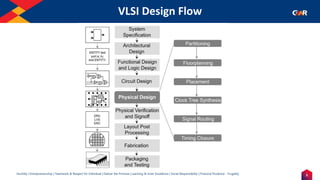
VLSI Design Flow
4
Humility | Entrepreneurship | Teamwork & Respect for Individual | Deliver the Promise | Learning & Inner Excellence | Social Responsibility | Financial Prudence - Frugality
IC Technology
Indentify the Image
What advantages do ICs have over discrete components?
➢ Size: Sub-micron, millimeter/nanometer.
➢ Speed and Power: Smaller size of IC components yields higher speed and lower power consumption due
to smaller parasitic resistances, capacitances and inductances.
Switching between ‘0’and ‘1’much faster on chip than between chips.
Lower power consumption => less heat => cheaper power supplies =>
reduced system cost.
➢ Integrated circuit manufacturing is versatile. Simply change the mask to change the design.
However, designing the layout (changing the masks) is usually the most time consuming task in IC
design.
5
Humility | Entrepreneurship | Teamwork & Respect for Individual | Deliver the Promise | Learning & Inner Excellence | Social Responsibility | Financial Prudence - Frugality
IC Technology
Indentify the Image
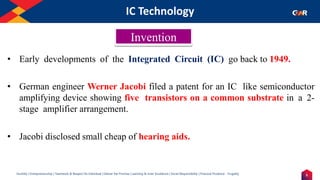
• Early developments of the Integrated Circuit (IC) go back to 1949.
• German engineer Werner Jacobi filed a patent for an IC like semiconductor
amplifying device showing five transistors on a common substrate in a 2-
stage amplifier arrangement.
• Jacobi disclosed small cheap of hearing aids.
Invention
6
Humility | Entrepreneurship | Teamwork & Respect for Individual | Deliver the Promise | Learning & Inner Excellence | Social Responsibility | Financial Prudence - Frugality
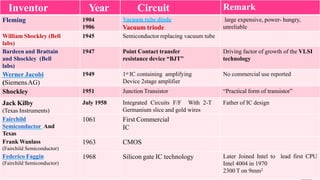
Inventor Year Circuit Remark
Fleming 1904
1906
Vacuum tube diode
Vacuum triode
large expensive, power- hungry,
unreliable
William Shockley (Bell
labs)
1945 Semiconductor replacing vacuum tube
Bardeen and Brattain
and Shockley (Bell
labs)
1947 Point Contact transfer
resistance device “BJT”
Driving factor of growth of the VLSI
technology
Werner Jacobi
(SiemensAG)
1949 1st IC containing amplifying
Device 2stage amplifier
No commercial use reported
Shockley 1951 Junction Transistor “Practical form of transistor”
Jack Kilby
(Texas Instruments)
July 1958 Integrated Circuits F/F With 2-T
Germanium slice and gold wires
Father of IC design
Fairchild
Semiconductor And
Texas
1061 First Commercial
IC
Frank Wanlass
(Fairchild Semiconductor)
1963 CMOS
Federico Faggin
(Fairchild Semiconductor)
1968 Silicon gate IC technology Later Joined Intel to lead first CPU
Intel 4004 in 1970
2300 T on 9mm2
7
Humility | Entrepreneurship | Teamwork & Respect for Individual | Deliver the Promise | Learning & Inner Excellence | Social Responsibility | Financial Prudence - Frugality
1965 - Moore's law
Indentify the Image
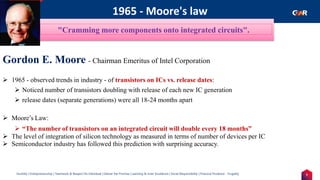
Gordon E. Moore - Chairman Emeritus of Intel Corporation
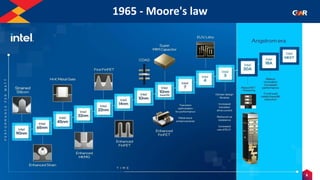
➢ 1965 - observed trends in industry - of transistors on ICs vs. release dates:
➢ Noticed number of transistors doubling with release of each new IC generation
➢ release dates (separate generations) were all 18-24 months apart
➢ Moore’s Law:
➢ “The number of transistors on an integrated circuit will double every 18 months”
➢ The level of integration of silicon technology as measured in terms of number of devices per IC
➢ Semiconductor industry has followed this prediction with surprising accuracy.
"Cramming more components onto integrated circuits".
8
Humility | Entrepreneurship | Teamwork & Respect for Individual | Deliver the Promise | Learning & Inner Excellence | Social Responsibility | Financial Prudence - Frugality
1965 - Moore's law
Indentify the Image
9
Humility | Entrepreneurship | Teamwork & Respect for Individual | Deliver the Promise | Learning & Inner Excellence | Social Responsibility | Financial Prudence - Frugality
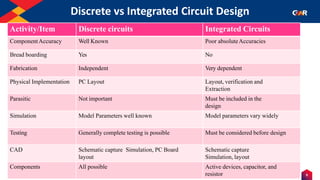
Discrete vs Integrated Circuit Design
Indentify the Image
Activity/Item Discrete circuits Integrated Circuits
ComponentAccuracy Well Known Poor absoluteAccuracies
Bread boarding Yes No
Fabrication Independent Very dependent
Physical Implementation PC Layout Layout, verification and
Extraction
Parasitic Not important Must be included in the
design
Simulation Model Parameters well known Model parameters vary widely
Testing Generally complete testing is possible Must be considered before design
CAD Schematic capture Simulation, PC Board
layout
Schematic capture
Simulation, layout
Components All possible Active devices, capacitor, and
resistor
10
Humility | Entrepreneurship | Teamwork & Respect for Individual | Deliver the Promise | Learning & Inner Excellence | Social Responsibility | Financial Prudence - Frugality
Indentify the Image
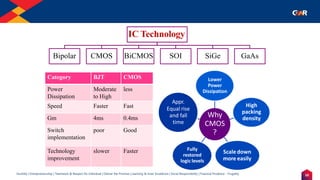
IC Technology
Bipolar CMOS BiCMOS SOI SiGe GaAs
Category BJT CMOS
Power
Dissipation
Moderate
to High
less
Speed Faster Fast
Gm 4ms 0.4ms
Switch
implementation
poor Good
Technology
improvement
slower Faster
Why
CMOS
?
Lower
Power
Dissipation
High
packing
density
Scale down
more easily
Fully
restored
logic levels
Appr.
Equal rise
and fall
time
11
Humility | Entrepreneurship | Teamwork & Respect for Individual | Deliver the Promise | Learning & Inner Excellence | Social Responsibility | Financial Prudence - Frugality
Indentify the Image
12
Humility | Entrepreneurship | Teamwork & Respect for Individual | Deliver the Promise | Learning & Inner Excellence | Social Responsibility | Financial Prudence - Frugality
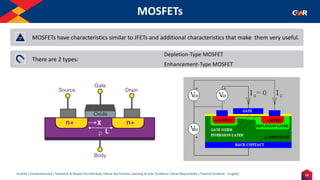
MOSFETs
Indentify the Image
MOSFETs have characteristics similar to JFETs and additional characteristics that make them very useful.
There are 2 types:
Depletion-Type MOSFET
Enhancement-Type MOSFET
13
Humility | Entrepreneurship | Teamwork & Respect for Individual | Deliver the Promise | Learning & Inner Excellence | Social Responsibility | Financial Prudence - Frugality
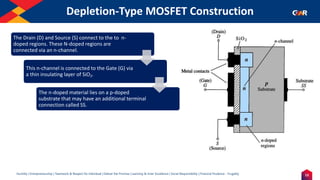
Depletion-Type MOSFET Construction
Indentify the Image
The Drain (D) and Source (S) connect to the to n-
doped regions. These N-doped regions are
connected via an n-channel.
This n-channel is connected to the Gate (G) via
a thin insulating layer of SiO2.
The n-doped material lies on a p-doped
substrate that may have an additional terminal
connection called SS.
14
Humility | Entrepreneurship | Teamwork & Respect for Individual | Deliver the Promise | Learning & Inner Excellence | Social Responsibility | Financial Prudence - Frugality
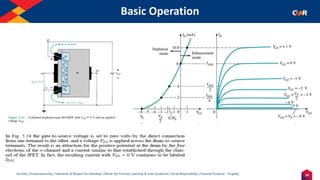
Basic Operation
Indentify the Image
15
Humility | Entrepreneurship | Teamwork & Respect for Individual | Deliver the Promise | Learning & Inner Excellence | Social Responsibility | Financial Prudence - Frugality
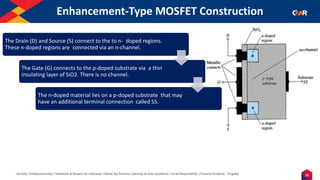
Enhancement-Type MOSFET Construction
Indentify the Image
The Drain (D) and Source (S) connect to the to n- doped regions.
These n-doped regions are connected via an n-channel.
The Gate (G) connects to the p-doped substrate via a thin
insulating layer of SiO2. There is no channel.
The n-doped material lies on a p-doped substrate that may
have an additional terminal connection called SS.
16
Humility | Entrepreneurship | Teamwork & Respect for Individual | Deliver the Promise | Learning & Inner Excellence | Social Responsibility | Financial Prudence - Frugality
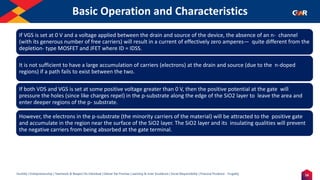
Basic Operation and Characteristics
Indentify the Image
If VGS is set at 0 V and a voltage applied between the drain and source of the device, the absence of an n- channel
(with its generous number of free carriers) will result in a current of effectively zero amperes— quite different from the
depletion- type MOSFET and JFET where ID = IDSS.
It is not sufficient to have a large accumulation of carriers (electrons) at the drain and source (due to the n-doped
regions) if a path fails to exist between the two.
If both VDS and VGS is set at some positive voltage greater than 0 V, then the positive potential at the gate will
pressure the holes (since like charges repel) in the p-substrate along the edge of the SiO2 layer to leave the area and
enter deeper regions of the p- substrate.
However, the electrons in the p-substrate (the minority carriers of the material) will be attracted to the positive gate
and accumulate in the region near the surface of the SiO2 layer. The SiO2 layer and its insulating qualities will prevent
the negative carriers from being absorbed at the gate terminal.
17
Humility | Entrepreneurship | Teamwork & Respect for Individual | Deliver the Promise | Learning & Inner Excellence | Social Responsibility | Financial Prudence - Frugality
Continued…
Indentify the Image
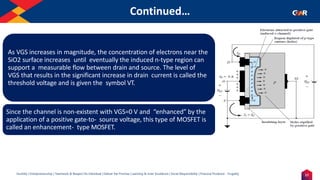
As VGS increases in magnitude, the concentration of electrons near the
SiO2 surface increases until eventually the induced n-type region can
support a measurable flow between drain and source. The level of
VGS that results in the significant increase in drain current is called the
threshold voltage and is given the symbol VT.
Since the channel is non-existent with VGS=0 V and “enhanced” by the
application of a positive gate-to- source voltage, this type of MOSFET is
called an enhancement- type MOSFET.
18
Humility | Entrepreneurship | Teamwork & Respect for Individual | Deliver the Promise | Learning & Inner Excellence | Social Responsibility | Financial Prudence - Frugality
Continued…
Indentify the Image
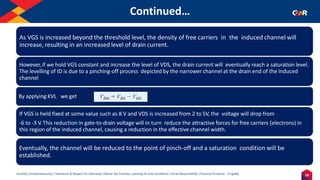
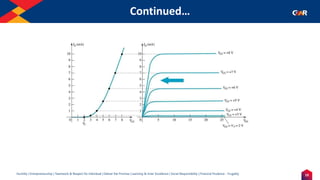
As VGS is increased beyond the threshold level, the density of free carriers in the induced channel will
increase, resulting in an increased level of drain current.
However, if we hold VGS constant and increase the level of VDS, the drain current will eventually reach a saturation level.
The levelling of ID is due to a pinching-off process depicted by the narrower channel at the drain end of the induced
channel
By applying KVL we get
If VGS is held fixed at some value such as 8 V and VDS is increased from 2 to 5V, the voltage will drop from
-6 to -3 V. This reduction in gate-to-drain voltage will in turn reduce the attractive forces for free carriers (electrons) in
this region of the induced channel, causing a reduction in the effective channel width.
Eventually, the channel will be reduced to the point of pinch-off and a saturation condition will be
established.
19
Humility | Entrepreneurship | Teamwork & Respect for Individual | Deliver the Promise | Learning & Inner Excellence | Social Responsibility | Financial Prudence - Frugality
Continued…
Indentify the Image
20
Humility | Entrepreneurship | Teamwork & Respect for Individual | Deliver the Promise | Learning & Inner Excellence | Social Responsibility | Financial Prudence - Frugality
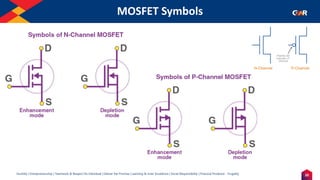
MOSFET Symbols
Indentify the Image
21
Humility | Entrepreneurship | Teamwork & Respect for Individual | Deliver the Promise | Learning & Inner Excellence | Social Responsibility | Financial Prudence - Frugality
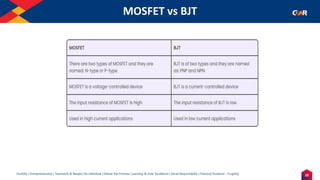
MOSFET vs BJT
Indentify the Image
MOSFET applications
• Radiofrequency applications use MOSFET amplifiers extensively.
• MOSFET behaves as a passive circuit element.
• Power MOSFETs can be used to regulate DC motors.
• MOSFETs are used in the design of the chopper circuit.
Advantages of MOSFET
• MOSFETs operate at greater efficiency at lower voltages.
• Absence of gate current results in high input impedance producing high switching speed.
Disadvantages of MOSFET
• MOSFETs are vulnerable to damage by electrostatic charges due to the thin oxide layer.
• Overload voltages make MOSFETs unstable.
22
Humility | Entrepreneurship | Teamwork & Respect for Individual | Deliver the Promise | Learning & Inner Excellence | Social Responsibility | Financial Prudence - Frugality
MOSFET vs BJT
Indentify the Image
23
Humility | Entrepreneurship | Teamwork & Respect for Individual | Deliver the Promise | Learning & Inner Excellence | Social Responsibility | Financial Prudence - Frugality
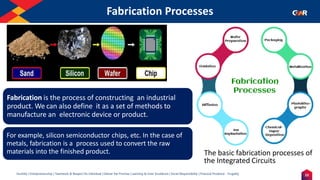
Fabrication Processes
Indentify the Image
Fabrication is the process of constructing an industrial
product. We can also define it as a set of methods to
manufacture an electronic device or product.
For example, silicon semiconductor chips, etc. In the case of
metals, fabrication is a process used to convert the raw
materials into the finished product. The basic fabrication processes of
the Integrated Circuits
24
Humility | Entrepreneurship | Teamwork & Respect for Individual | Deliver the Promise | Learning & Inner Excellence | Social Responsibility | Financial Prudence - Frugality
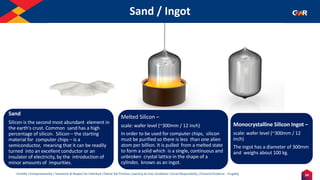
Sand / Ingot
Indentify the Image
Sand
Silicon is the second most abundant element in
the earth's crust. Common sand has a high
percentage of silicon. Silicon – the starting
material for computer chips – is a
semiconductor, meaning that it can be readily
turned into an excellent conductor or an
insulator of electricity, by the introduction of
minor amounts of impurities.
Melted Silicon –
scale: wafer level (~300mm / 12 inch)
In order to be used for computer chips, silicon
must be purified so there is less than one alien
atom per billion. It is pulled from a melted state
to form a solid which is a single, continuous and
unbroken crystal lattice in the shape of a
cylinder, known as an ingot.
Monocrystalline Silicon Ingot –
scale: wafer level (~300mm / 12
inch)
The ingot has a diameter of 300mm
and weighs about 100 kg.
25
Humility | Entrepreneurship | Teamwork & Respect for Individual | Deliver the Promise | Learning & Inner Excellence | Social Responsibility | Financial Prudence - Frugality
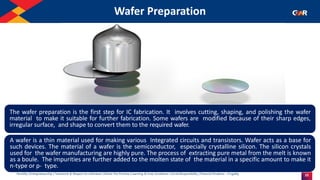
Wafer Preparation
Indentify the Image
The wafer preparation is the first step for IC fabrication. It involves cutting, shaping, and polishing the wafer
material to make it suitable for further fabrication. Some wafers are modified because of their sharp edges,
irregular surface, and shape to convert them to the required wafer.
A wafer is a thin material used for making various Integrated circuits and transistors. Wafer acts as a base for
such devices. The material of a wafer is the semiconductor, especially crystalline silicon. The silicon crystals
used for the wafer manufacturing are highly pure. The process of extracting pure metal from the melt is known
as a boule. The impurities are further added to the molten state of the material in a specific amount to make it
n-type or p- type.
26
Humility | Entrepreneurship | Teamwork & Respect for Individual | Deliver the Promise | Learning & Inner Excellence | Social Responsibility | Financial Prudence - Frugality
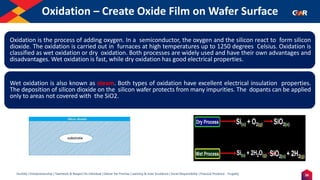
Oxidation – Create Oxide Film on Wafer Surface
Indentify the Image
Oxidation is the process of adding oxygen. In a semiconductor, the oxygen and the silicon react to form silicon
dioxide. The oxidation is carried out in furnaces at high temperatures up to 1250 degrees Celsius. Oxidation is
classified as wet oxidation or dry oxidation. Both processes are widely used and have their own advantages and
disadvantages. Wet oxidation is fast, while dry oxidation has good electrical properties.
Wet oxidation is also known as steam. Both types of oxidation have excellent electrical insulation properties.
The deposition of silicon dioxide on the silicon wafer protects from many impurities. The dopants can be applied
only to areas not covered with the SiO2.
27
Humility | Entrepreneurship | Teamwork & Respect for Individual | Deliver the Promise | Learning & Inner Excellence | Social Responsibility | Financial Prudence - Frugality
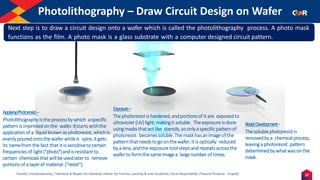
Photolithography – Draw Circuit Design on Wafer
Indentify the Image
ApplyingPhotoresist–
Photolithography is the processby which aspecific
patternis imprintedonthe wafer. Itstartswiththe
applicationof a liquidknown as photoresist, which is
evenlypouredontothewafer whileit spins.Itgets
its namefrom the fact that it is sensitiveto certain
frequencies of light(“photo”)andis resistant to
certain chemicalsthat will beusedlaterto remove
portionsof a layerof material (“resist”).
Exposure–
The photoresist is hardened, andportionsof it are exposed to
ultraviolet (UV)light, makingit soluble. The exposureis done
usingmasksthat actlike stencils,soonlyaspecificpattern of
photoresist becomessoluble.The maskhasanimageof the
patternthat needsto goonthe wafer;it is optically reduced
by a lens, andthe exposure tool steps and repeats acrossthe
wafer to formthe sameimagea largenumberof times.
ResistDevelopment–
The solublephotoresist is
removedby a chemical process,
leaving a photoresist pattern
determinedby what wasonthe
mask.
Next step is to draw a circuit design onto a wafer which is called the photolithography process. A photo mask
functions as the film. A photo mask is a glass substrate with a computer designed circuit pattern.
28
Humility | Entrepreneurship | Teamwork & Respect for Individual | Deliver the Promise | Learning & Inner Excellence | Social Responsibility | Financial Prudence - Frugality
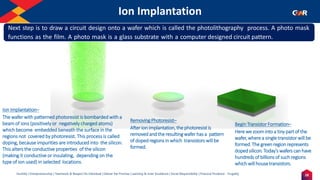
Ion Implantation
Indentify the Image
Ion Implantation–
The wafer with patterned photoresist is bombarded with a
beam of ions (positively or negatively charged atoms)
which become embedded beneath the surface in the
regions not covered by photoresist. This process is called
doping, because impurities are introduced into the silicon.
This alters the conductive properties of the silicon
(making it conductive or insulating, depending on the
type of ion used) in selected locations.
RemovingPhotoresist–
Afterion implantation, the photoresistis
removedandthe resulting wafer has a pattern
of dopedregions in which transistors will be
formed.
BeginTransistor Formation–
Here we zoominto a tiny part of the
wafer, where a singletransistor will be
formed. The greenregionrepresents
dopedsilicon. Today’s wafers canhave
hundreds of billions of suchregions
whichwill housetransistors.
Next step is to draw a circuit design onto a wafer which is called the photolithography process. A photo mask
functions as the film. A photo mask is a glass substrate with a computer designed circuit pattern.
29
Humility | Entrepreneurship | Teamwork & Respect for Individual | Deliver the Promise | Learning & Inner Excellence | Social Responsibility | Financial Prudence - Frugality
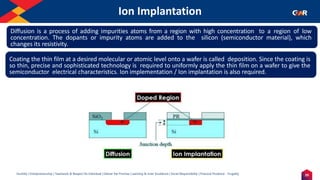
Ion Implantation
Indentify the Image
Diffusion is a process of adding impurities atoms from a region with high concentration to a region of low
concentration. The dopants or impurity atoms are added to the silicon (semiconductor material), which
changes its resistivity.
Coating the thin film at a desired molecular or atomic level onto a wafer is called deposition. Since the coating is
so thin, precise and sophisticated technology is required to uniformly apply the thin film on a wafer to give the
semiconductor electrical characteristics. Ion implementation / Ion implantation is also required.
30
Humility | Entrepreneurship | Teamwork & Respect for Individual | Deliver the Promise | Learning & Inner Excellence | Social Responsibility | Financial Prudence - Frugality
Etching – Remove Unnecessary Materials
Indentify the Image
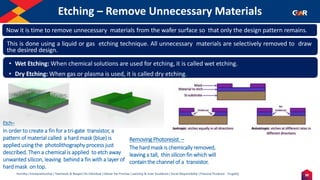
Etch–
In order to create a fin for a tri-gate transistor, a
pattern of material called a hard mask (blue) is
applied using the photolithography process just
described. Then a chemical is applied to etch away
unwanted silicon, leaving behind a fin with a layer of
hard mask on top.
Removing Photoresist –
The hard mask is chemically removed,
leaving a tall, thin silicon fin which will
contain the channel of a transistor.
Now it is time to remove unnecessary materials from the wafer surface so that only the design pattern remains.
• Wet Etching: When chemical solutions are used for etching, it is called wet etching.
• Dry Etching: When gas or plasma is used, it is called dry etching.
This is done using a liquid or gas etching technique. All unnecessary materials are selectively removed to draw
the desired design.
31
Humility | Entrepreneurship | Teamwork & Respect for Individual | Deliver the Promise | Learning & Inner Excellence | Social Responsibility | Financial Prudence - Frugality
Metal Deposition (Metallization)
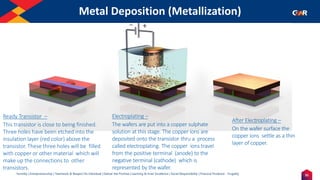
Ready Transistor –
This transistor is close to being finished.
Three holes have been etched into the
insulation layer (red color) above the
transistor. These three holes will be filled
with copper or other material which will
make up the connections to other
transistors.
Electroplating –
The wafers are put into a copper sulphate
solution at this stage. The copper ions are
deposited onto the transistor thru a process
called electroplating. The copper ions travel
from the positive terminal (anode) to the
negative terminal (cathode) which is
represented by the wafer.
After Electroplating –
On the wafer surface the
copper ions settle as a thin
layer of copper.
32
Humility | Entrepreneurship | Teamwork & Respect for Individual | Deliver the Promise | Learning & Inner Excellence | Social Responsibility | Financial Prudence - Frugality
Wafer Sort / Singulation
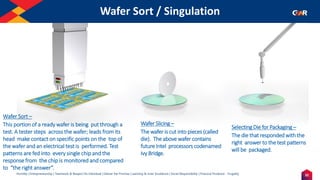
Wafer Sort –
This portion of a ready wafer is being put through a
test. A tester steps across the wafer; leads from its
head make contact on specific points on the top of
the wafer and an electrical test is performed. Test
patterns are fed into every single chip and the
response from the chip is monitored and compared
to “the right answer”.
Wafer Slicing –
The wafer is cut into pieces (called
die). The above wafer contains
future Intel processors codenamed
Ivy Bridge.
Selecting Die for Packaging –
The die that responded with the
right answer to the test patterns
will be packaged.
33
Humility | Entrepreneurship | Teamwork & Respect for Individual | Deliver the Promise | Learning & Inner Excellence | Social Responsibility | Financial Prudence - Frugality
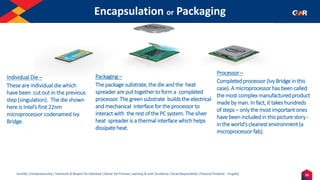
Encapsulation or Packaging
Individual Die –
These are individual die which
have been cut out in the previous
step (singulation). The die shown
here is Intel’s first 22nm
microprocessor codenamed Ivy
Bridge.
Packaging –
The package substrate, the die and the heat
spreader are put together to form a completed
processor. The green substrate builds the electrical
and mechanical interface for the processor to
interact with the rest of the PC system. The silver
heat spreader is a thermal interface which helps
dissipate heat.
Processor –
Completed processor (Ivy Bridge in this
case). A microprocessor has been called
the most complex manufactured product
made by man. In fact, it takes hundreds
of steps – only the most important ones
have been included in this picture story -
in the world's cleanest environment (a
microprocessor fab).
34
Humility | Entrepreneurship | Teamwork & Respect for Individual | Deliver the Promise | Learning & Inner Excellence | Social Responsibility | Financial Prudence - Frugality
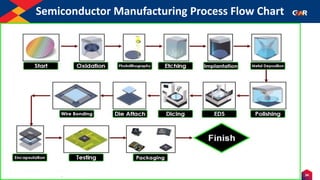
Semiconductor Manufacturing Process Flow Chart
35
Humility | Entrepreneurship | Teamwork & Respect for Individual | Deliver the Promise | Learning & Inner Excellence | Social Responsibility | Financial Prudence - Frugality
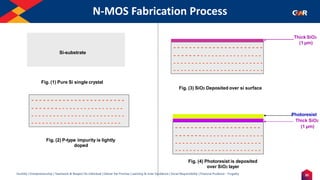
N-MOS Fabrication Process
Fig. (1) Pure Si single crystal
Si-substrate
Fig. (2) P-type impurity is lightly
doped
- - - - - - - - - - - - - - - - - - - - - - - -
- - - - - - - - - - - - - - - - - - - - - - - - -
- - - - - - - - - - - - - - - - - - - - - - - - - -
- - - - - - - - - - - - - - - - - - - - - - - - -
Fig. (3) SiO2 Deposited over si surface
Fig. (4) Photoresist is deposited
over SiO2 layer
Photoresist
Thick SiO2
(1 µm)
- - - - - - - - - - - - - - - - - - - - - -
- - - - - - - - - - - - - - - - - - - - - - - -
- - - - - - - - - - - - - - - - - - - - - - - -
- - - - - - - - - - - - - - - - - - - - - - - -
Thick SiO2
(1 µm)
- - - - - - - - - - - - - - - - - - - - - - -
- - - - - - - - - - - - - - - - - - - - - - - -
- - - - - - - - - - - - - - - - - - - - - - - - -
- - - - - - - - - - - - - - - - - - - - - - - - -
36
Humility | Entrepreneurship | Teamwork & Respect for Individual | Deliver the Promise | Learning & Inner Excellence | Social Responsibility | Financial Prudence - Frugality
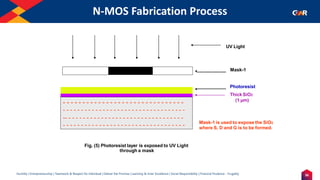
N-MOS Fabrication Process
Mask-1 is used to expose the SiO2
where S, D and G is to be formed.
Fig. (5) Photoresist layer is exposed to UV Light
through a mask
- - - - - - - - - - - - - - - - - - - - - - - - - - - - - - -
- - - - - - - - - - - - - - - - - - - - - - - - - - - - - - - - - -
-- - - - - - - - - - - - - - - - - - - - - - - - - - - - - - - - -
- - - - - - - - - - - - - - - - - - - - - - - - - - - - - - - - - -
Mask-1
Photoresist
Thick SiO2
(1 µm)
UV Light
37
Humility | Entrepreneurship | Teamwork & Respect for Individual | Deliver the Promise | Learning & Inner Excellence | Social Responsibility | Financial Prudence - Frugality
N-MOS Fabrication Process
Fig. (6) Etching [HF acid is used] will remove SiO2 layer
which is in direct contact with etching solution
Thick SiO2
(1 µm)
- - - - - - - - - - - - - - - - - - - - - - - - - - - - - - -
- - - - - - - - - - - - - - - - - - - - - - - - - - - - - - - - - -
-- - - - - - - - - - - - - - - - - - - - - - - - - - - - - - - - -
- - - - - - - - - - - - - - - - - - - - - - - - - - - - - - - - - -
Fig. (7) unpolymerised photoresist is also etched away
[using H2SO4]
- - - - - - - - - - - - - - - - - - - - - - - - - - - - - - -
- - - - - - - - - - - - - - - - - - - - - - - - - - - - - - - - - -
-- - - - - - - - - - - - - - - - - - - - - - - - - - - - - - - - -
- - - - - - - - - - - - - - - - - - - - - - - - - - - - - - - - - -
Thick SiO2
(1 µm)
38
Humility | Entrepreneurship | Teamwork & Respect for Individual | Deliver the Promise | Learning & Inner Excellence | Social Responsibility | Financial Prudence - Frugality
N-MOS Fabrication Process
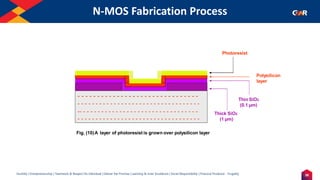
Fig. (10)A layer of photoresist is grown over polysilicon layer
Thick SiO2
(1 µm)
Thin SiO2
(0.1 µm)
Polysilicon
layer
Photoresist
- - - - - - - - - - - - - - - - - - - - - - - - - - - - - - -
- - - - - - - - - - - - - - - - - - - - - - - - - - - - - - - - - -
-- - - - - - - - - - - - - - - - - - - - - - - - - - - - - - - - -
- - - - - - - - - - - - - - - - - - - - - - - - - - - - - - - - - -
39
Humility | Entrepreneurship | Teamwork & Respect for Individual | Deliver the Promise | Learning & Inner Excellence | Social Responsibility | Financial Prudence - Frugality
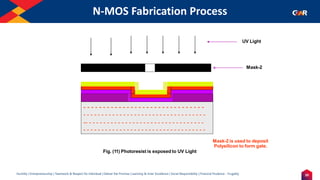
N-MOS Fabrication Process
Mask-2 is used to deposit
Polysilicon to form gate.
Fig. (11) Photoresist is exposed to UV Light
UV Light
Mask-2
- - - - - - - - - - - - - - - - - - - - - - - - - - - - - - -
- - - - - - - - - - - - - - - - - - - - - - - - - - - - - - - - - -
-- - - - - - - - - - - - - - - - - - - - - - - - - - - - - - - - -
- - - - - - - - - - - - - - - - - - - - - - - - - - - - - - - - - -
40
Humility | Entrepreneurship | Teamwork & Respect for Individual | Deliver the Promise | Learning & Inner Excellence | Social Responsibility | Financial Prudence - Frugality
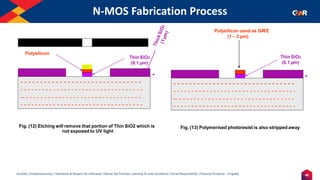
N-MOS Fabrication Process
Fig. (12) Etching will remove that portion of Thin SiO2 which is
not exposed to UV light
Thin SiO2
(0.1 µm)
Polysilicon
- - - - - - - - - - - - - - - - - - - - - - - - - - - - - - -
- - - - - - - - - - - - - - - - - - - - - - - - - - - - - - - - - -
-- - - - - - - - - - - - - - - - - - - - - - - - - - - - - - - - -
- - - - - - - - - - - - - - - - - - - - - - - - - - - - - - - - - -
Fig. (13) Polymerised photoresist is also stripped away
Thin SiO2
(0.1 µm)
Polysilicon used as GA
TE
(1 – 2 µm)
- - - - - - - - - - - - - - - - - - - - - - - - - - - - - - -
- - - - - - - - - - - - - - - - - - - - - - - - - - - - - - - - - -
-- - - - - - - - - - - - - - - - - - - - - - - - - - - - - - - - -
- - - - - - - - - - - - - - - - - - - - - - - - - - - - - - - - - -
41
Humility | Entrepreneurship | Teamwork & Respect for Individual | Deliver the Promise | Learning & Inner Excellence | Social Responsibility | Financial Prudence - Frugality
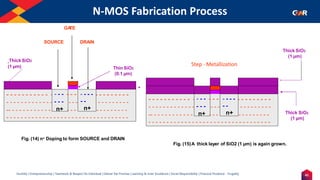
N-MOS Fabrication Process
Fig. (14) n+ Doping to form SOURCE and DRAIN
- - - - - - - - - - - - - - - - - - - -
- - - -
- - - -
- - - -
- - - -
- - - - -
- - - - -
- - - - - - - - -
- - - - - - - - -
- - - - - - - - - - - - - - - - - - - - - - - - - - - - - - - - - -
Thick SiO2
(1 µm) Thin SiO2
(0.1 µm)
- - - - - -
- - - - - - - - - - - - - - - - - - -
-- - - - - - - - - - - - n+ - - -
GA
TE
- - - -
- -
n+
SOURCE DRAIN
Fig. (15)A thick layer of SiO2 (1 µm) is again grown.
- - - - - - - - - - - - - - - - - - - -
- - - -
- - - -
- - - -
- - - -
- - - - -
- - - - -
- - - - - - - - -
- - - - - - - - -
- - - - - - - - - - - - - - - - - - - - - - - - - - - - - - - - - -
Thick SiO2
(1 µm)
- - - - - -
- - - - - - - - - - - - - - - - - - -
-- - - - - - - - - - - - n+ - - -
- - - -
- -
n+
Thick SiO2
(1 µm)
Step - Metallization
42
Humility | Entrepreneurship | Teamwork & Respect for Individual | Deliver the Promise | Learning & Inner Excellence | Social Responsibility | Financial Prudence - Frugality
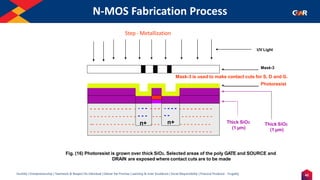
N-MOS Fabrication Process
Fig. (16) Photoresist is grown over thick SiO2. Selected areas of the poly GATE and SOURCE and
DRAIN are exposed where contact cuts are to be made
- - - - - - - - - - - - - - - - - - - -
- - - -
- - - -
- - - -
- - - -
- - - - -
- - - - -
- - - - - - - - -
- - - - - - - - -
- - - - - - - - - - - - - - - - - - - - - - - - - - - - - - - - - -
Thick SiO2
(1 µm)
- - - - - -
- - - - - - - - - - - - - - - - - - -
-- - - - - - - - - - - - n+ - - -
- - - -
- -
n+ Thick SiO2
(1 µm)
Mask-3
Mask-3 is used to make contact cuts for S, D and G.
Photoresist
UV Light
Step - Metallization
43
Humility | Entrepreneurship | Teamwork & Respect for Individual | Deliver the Promise | Learning & Inner Excellence | Social Responsibility | Financial Prudence - Frugality
N-MOS Fabrication Process
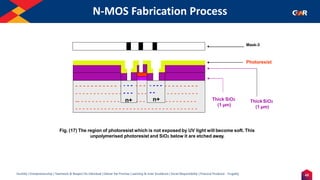
Fig. (17) The region of photoresist which is not exposed by UV light will become soft. This
unpolymerised photoresist and SiO2 below it are etched away.
- - - - - - - - - - - - - - - - - - - -
- - - -
- - - -
- - - -
- - - -
- - - - -
- - - - -
- - - - - - - - -
- - - - - - - - -
- - - - - - - - - - - - - - - - - - - - - - - - - - - - - - - - - -
Thick SiO2
(1 µm)
- - - - - -
- - - - - - - - - - - - - - - - - - -
-- - - - - - - - - - - - n+ - - -
- - - -
- -
n+ Thick SiO2
(1 µm)
Mask-3
Photoresist
44
Humility | Entrepreneurship | Teamwork & Respect for Individual | Deliver the Promise | Learning & Inner Excellence | Social Responsibility | Financial Prudence - Frugality
N-MOS Fabrication Process
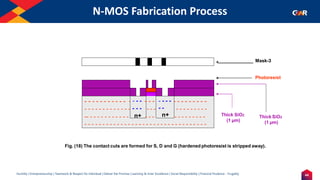
Fig. (18) The contact cuts are formed for S, D and G (hardened photoresist is stripped away).
- - - - - - - - - - - - - - - - - - - -
- - - -
- - - -
- - - -
- - - -
- - - - -
- - - - -
- - - - - - - - -
- - - - - - - - -
- - - - - - - - - - - - - - - - - - - - - - - - - - - - - - - - - -
Thick SiO2
(1 µm)
- - - - - -
- - - - - - - - - - - - - - - - - - -
-- - - - - - - - - - - - n+ - - -
- - - -
- -
n+ Thick SiO2
(1 µm)
Mask-3
Photoresist
45
Humility | Entrepreneurship | Teamwork & Respect for Individual | Deliver the Promise | Learning & Inner Excellence | Social Responsibility | Financial Prudence - Frugality
N-MOS Fabrication Process
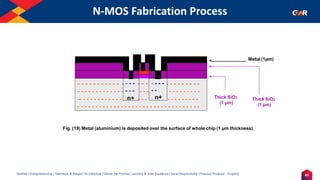
Fig. (19) Metal (aluminium) is deposited over the surface of whole chip (1 µm thickness).
- - - -
- - - -
- - - -
- - - -
- - - - -
- - - - -
- - - - - - - - -
- - - - - - - - -
- - - - - - - - - - - - - - - - - - - - - - - - - - - - - - - - - -
Thick SiO2
(1 µm)
- - - - - - - - - - - - - - - - - - - - - - - - - -
- - - - - - - - - - - - - - - - - - -
-- - - - - - - - - - - - n+ - - -
- - - -
- -
n+ Thick SiO2
(1 µm)
Metal (1µm)
46
Humility | Entrepreneurship | Teamwork & Respect for Individual | Deliver the Promise | Learning & Inner Excellence | Social Responsibility | Financial Prudence - Frugality
N-MOS Fabrication Process
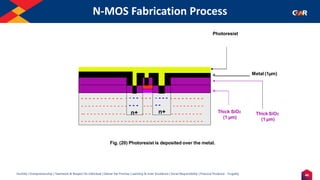
Fig. (20) Photoresist is deposited over the metal.
- - - - - - - - - - - - - - - - - - - -
- - - -
- - - -
- - - -
- - - -
- - - - -
- - - - -
- - - - - - - - -
- - - - - - - - -
- - - - - - - - - - - - - - - - - - - - - - - - - - - - - - - - - -
Thick SiO2
(1 µm)
- - - - - -
- - - - - - - - - - - - - - - - - - -
-- - - - - - - - - - - - n+ - - -
- - - -
- -
n+ Thick SiO2
(1 µm)
Metal (1µm)
Photoresist
47
Humility | Entrepreneurship | Teamwork & Respect for Individual | Deliver the Promise | Learning & Inner Excellence | Social Responsibility | Financial Prudence - Frugality
N-MOS Fabrication Process
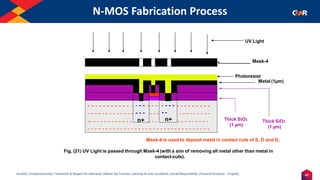
Mask-4 is used to deposit metal in contact cuts of S, D and G.
Fig. (21) UV Light is passed through Mask-4 (with a aim of removing all metal other than metal in
contact-cuts).
- - - - - - - - - - - - - - - - - - - -
- - - -
- - - -
- - - -
- - - -
- - - - -
- - - - -
- - - - - - - - -
- - - - - - - - -
- - - - - - - - - - - - - - - - - - - - - - - - - - - - - - - - - -
Thick SiO2
(1 µm)
- - - - - -
- - - - - - - - - - - - - - - - - - -
-- - - - - - - - - - - - n+ - - -
- - - -
- -
n+ Thick SiO2
(1 µm)
Mask-4
Photoresist
Metal (1µm)
UV Light
48
Humility | Entrepreneurship | Teamwork & Respect for Individual | Deliver the Promise | Learning & Inner Excellence | Social Responsibility | Financial Prudence - Frugality
N-MOS Fabrication Process
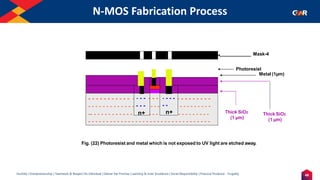
Fig. (22) Photoresist and metal which is not exposed to UV light are etched away.
- - - - - - - - - - - - - - - - - - - -
- - - -
- - - -
- - - -
- - - -
- - - - -
- - - - -
- - - - - - - - -
- - - - - - - - -
- - - - - - - - - - - - - - - - - - - - - - - - - - - - - - - - - -
Thick SiO2
(1 µm)
- - - - - -
- - - - - - - - - - - - - - - - - - -
-- - - - - - - - - - - - n+ - - -
- - - -
- -
n+ Thick SiO2
(1 µm)
Mask-4
Photoresist
Metal (1µm)
49
Humility | Entrepreneurship | Teamwork & Respect for Individual | Deliver the Promise | Learning & Inner Excellence | Social Responsibility | Financial Prudence - Frugality
N-MOS Fabrication Process
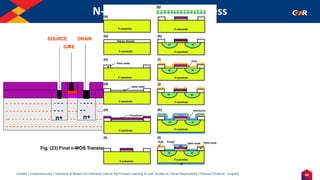
Fig. (23) Final n-MOS Transistor
- - - - - - - - - - - - - - - - - - - -
- - - -
- - - -
- - - -
- - - -
- - - - -
- - - - -
- - - - - - - - -
- - - - - - - - -
- - - - - - - - - - - - - - - - - - - - - - - - - - - - - - - - - -
- - - - - -
- - - - - - - - - - - - - - - - - - -
-- - - - - - - - - - - - n+ - - -
- - - -
- -
n+
SOURCE DRAIN
GA
TE
50
Humility | Entrepreneurship | Teamwork & Respect for Individual | Deliver the Promise | Learning & Inner Excellence | Social Responsibility | Financial Prudence - Frugality
P-MOS Fabrication Process
51
Humility | Entrepreneurship | Teamwork & Respect for Individual | Deliver the Promise | Learning & Inner Excellence | Social Responsibility | Financial Prudence - Frugality
CMOS (Complementary Metal Oxide Semiconductor)
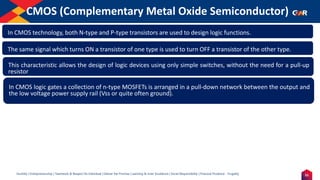
In CMOS technology, both N-type and P-type transistors are used to design logic functions.
In CMOS logic gates a collection of n-type MOSFETs is arranged in a pull-down network between the output and
the low voltage power supply rail (Vss or quite often ground).
The same signal which turns ON a transistor of one type is used to turn OFF a transistor of the other type.
This characteristic allows the design of logic devices using only simple switches, without the need for a pull-up
resistor
52
Humility | Entrepreneurship | Teamwork & Respect for Individual | Deliver the Promise | Learning & Inner Excellence | Social Responsibility | Financial Prudence - Frugality
CMOS Fabrication
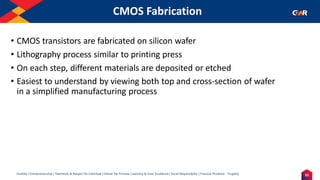
• CMOS transistors are fabricated on silicon wafer
• Lithography process similar to printing press
• On each step, different materials are deposited or etched
• Easiest to understand by viewing both top and cross-section of wafer
in a simplified manufacturing process
53
Humility | Entrepreneurship | Teamwork & Respect for Individual | Deliver the Promise | Learning & Inner Excellence | Social Responsibility | Financial Prudence - Frugality
Inverter Cross-section
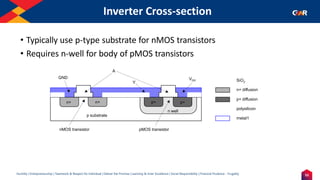
• Typically use p-type substrate for nMOS transistors
• Requires n-well for body of pMOS transistors
n+
p substrate
p+
n well
A
Y
GND VDD
n+ p+
SiO2
n+ diffusion
p+ diffusion
polysilicon
metal1
nMOS transistor pMOS transistor
54
Humility | Entrepreneurship | Teamwork & Respect for Individual | Deliver the Promise | Learning & Inner Excellence | Social Responsibility | Financial Prudence - Frugality
Well and Substrate Taps
n+
p substrate
p+
n well
Y
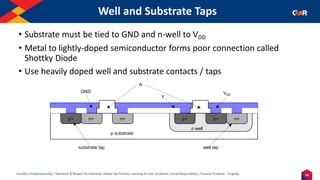
• Substrate must be tied to GND and n-well to VDD
• Metal to lightly-doped semiconductor forms poor connection called
Shottky Diode
• Use heavily doped well and substrate contacts / taps
A
GND VDD
n+
p+
substrate tap well tap
n+ p+
55
Humility | Entrepreneurship | Teamwork & Respect for Individual | Deliver the Promise | Learning & Inner Excellence | Social Responsibility | Financial Prudence - Frugality
Inverter Mask Set
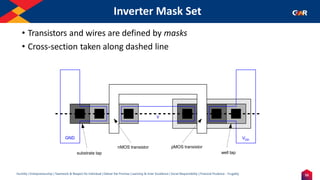
• Transistors and wires are defined by masks
• Cross-section taken along dashed line
GND VDD
Y
A
substrate tap well tap
nMOS transistor pMOS transistor
56
Humility | Entrepreneurship | Teamwork & Respect for Individual | Deliver the Promise | Learning & Inner Excellence | Social Responsibility | Financial Prudence - Frugality
Detailed Mask Views
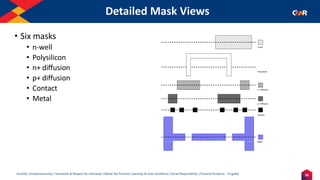
• Six masks
• n-well
• Polysilicon
• n+ diffusion
• p+ diffusion
• Contact
• Metal
Metal
Polysilicon
Contact
n+ Diffusion
p+ Diffusion
n well
57
Humility | Entrepreneurship | Teamwork & Respect for Individual | Deliver the Promise | Learning & Inner Excellence | Social Responsibility | Financial Prudence - Frugality
Fabrication Steps
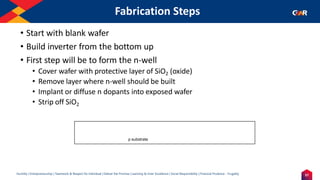
• Start with blank wafer
• Build inverter from the bottom up
• First step will be to form the n-well
• Cover wafer with protective layer of SiO2 (oxide)
• Remove layer where n-well should be built
• Implant or diffuse n dopants into exposed wafer
• Strip off SiO2
p substrate
58
Humility | Entrepreneurship | Teamwork & Respect for Individual | Deliver the Promise | Learning & Inner Excellence | Social Responsibility | Financial Prudence - Frugality
Oxidation & Photoresist
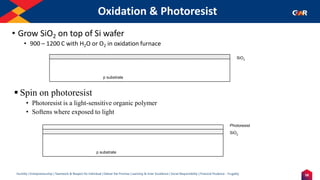
• Grow SiO2 on top of Si wafer
• 900 – 1200 C with H2O or O2 in oxidation furnace
p substrate
SiO2
▪ Spin on photoresist
• Photoresist is a light-sensitive organic polymer
• Softens where exposed to light
p substrate
SiO2
Photoresist
59
Humility | Entrepreneurship | Teamwork & Respect for Individual | Deliver the Promise | Learning & Inner Excellence | Social Responsibility | Financial Prudence - Frugality
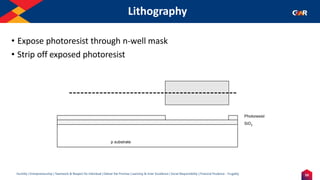
Lithography
p substrate
SiO2
Photoresist
• Expose photoresist through n-well mask
• Strip off exposed photoresist
60
Humility | Entrepreneurship | Teamwork & Respect for Individual | Deliver the Promise | Learning & Inner Excellence | Social Responsibility | Financial Prudence - Frugality
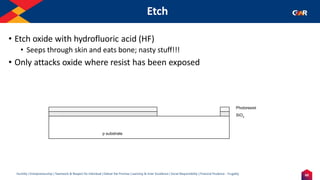
Etch
p substrate
SiO2
Photoresist
• Etch oxide with hydrofluoric acid (HF)
• Seeps through skin and eats bone; nasty stuff!!!
• Only attacks oxide where resist has been exposed
61
Humility | Entrepreneurship | Teamwork & Respect for Individual | Deliver the Promise | Learning & Inner Excellence | Social Responsibility | Financial Prudence - Frugality
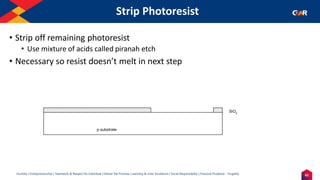
Strip Photoresist
• Strip off remaining photoresist
• Use mixture of acids called piranah etch
• Necessary so resist doesn’t melt in next step
p substrate
SiO2
62
Humility | Entrepreneurship | Teamwork & Respect for Individual | Deliver the Promise | Learning & Inner Excellence | Social Responsibility | Financial Prudence - Frugality
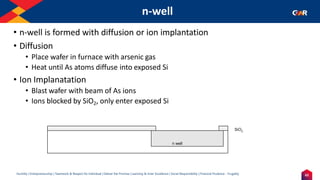
n-well
• n-well is formed with diffusion or ion implantation
• Diffusion
• Place wafer in furnace with arsenic gas
• Heat until As atoms diffuse into exposed Si
• Ion Implanatation
• Blast wafer with beam of As ions
• Ions blocked by SiO2, only enter exposed Si
n well
SiO2
63
Humility | Entrepreneurship | Teamwork & Respect for Individual | Deliver the Promise | Learning & Inner Excellence | Social Responsibility | Financial Prudence - Frugality
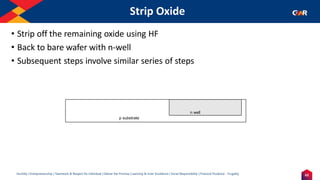
Strip Oxide
• Strip off the remaining oxide using HF
• Back to bare wafer with n-well
• Subsequent steps involve similar series of steps
p substrate
n well
64
Humility | Entrepreneurship | Teamwork & Respect for Individual | Deliver the Promise | Learning & Inner Excellence | Social Responsibility | Financial Prudence - Frugality
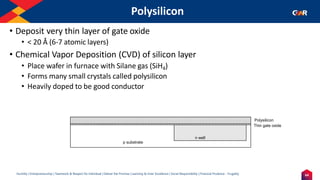
Polysilicon
• Deposit very thin layer of gate oxide
• < 20 Å (6-7 atomic layers)
• Chemical Vapor Deposition (CVD) of silicon layer
• Place wafer in furnace with Silane gas (SiH4)
• Forms many small crystals called polysilicon
• Heavily doped to be good conductor
Thin gate oxide
Polysilicon
p substrate
n well
65
Humility | Entrepreneurship | Teamwork & Respect for Individual | Deliver the Promise | Learning & Inner Excellence | Social Responsibility | Financial Prudence - Frugality
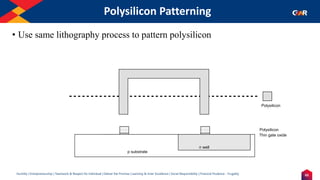
Polysilicon Patterning
• Use same lithography process to pattern polysilicon
Polysilicon
p substrate
Thin gate oxide
Polysilicon
n well
66
Humility | Entrepreneurship | Teamwork & Respect for Individual | Deliver the Promise | Learning & Inner Excellence | Social Responsibility | Financial Prudence - Frugality
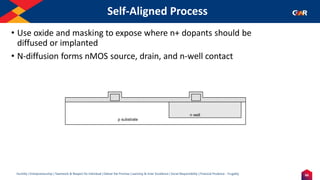
Self-Aligned Process
p substrate
n well
• Use oxide and masking to expose where n+ dopants should be
diffused or implanted
• N-diffusion forms nMOS source, drain, and n-well contact
67
Humility | Entrepreneurship | Teamwork & Respect for Individual | Deliver the Promise | Learning & Inner Excellence | Social Responsibility | Financial Prudence - Frugality
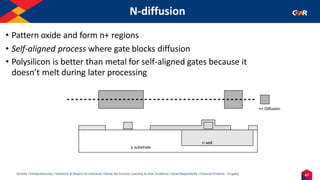
N-diffusion
p substrate
n well
n+ Diffusion
• Pattern oxide and form n+ regions
• Self-aligned process where gate blocks diffusion
• Polysilicon is better than metal for self-aligned gates because it
doesn’t melt during later processing
68
Humility | Entrepreneurship | Teamwork & Respect for Individual | Deliver the Promise | Learning & Inner Excellence | Social Responsibility | Financial Prudence - Frugality
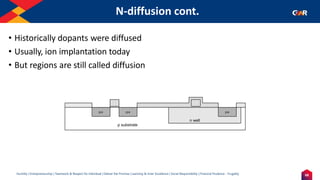
N-diffusion cont.
• Historically dopants were diffused
• Usually, ion implantation today
• But regions are still called diffusion
n well
p substrate
n+
n+ n+
69
Humility | Entrepreneurship | Teamwork & Respect for Individual | Deliver the Promise | Learning & Inner Excellence | Social Responsibility | Financial Prudence - Frugality
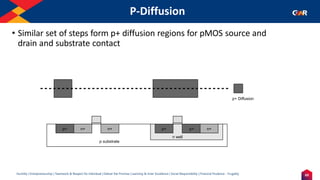
P-Diffusion
• Similar set of steps form p+ diffusion regions for pMOS source and
drain and substrate contact
p+ Diffusion
p substrate
n well
n+
n+ n+
p+
p+
p+
70
Humility | Entrepreneurship | Teamwork & Respect for Individual | Deliver the Promise | Learning & Inner Excellence | Social Responsibility | Financial Prudence - Frugality
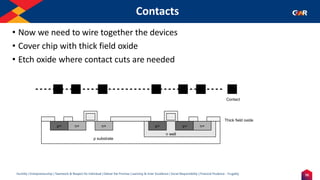
Contacts
• Now we need to wire together the devices
• Cover chip with thick field oxide
• Etch oxide where contact cuts are needed
p substrate
Thick field oxide
n well
n+
n+ n+
p+
p+
p+
Contact
71
Humility | Entrepreneurship | Teamwork & Respect for Individual | Deliver the Promise | Learning & Inner Excellence | Social Responsibility | Financial Prudence - Frugality
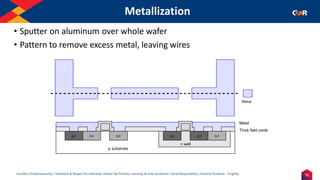
Metallization
• Sputter on aluminum over whole wafer
• Pattern to remove excess metal, leaving wires
p substrate
Metal
Thick field oxide
n well
n+
n+ n+
p+
p+
p+
Metal
72
Humility | Entrepreneurship | Teamwork & Respect for Individual | Deliver the Promise | Learning & Inner Excellence | Social Responsibility | Financial Prudence - Frugality
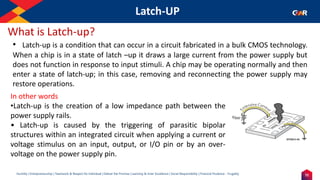
Latch-UP
What is Latch-up?
• Latch-up is a condition that can occur in a circuit fabricated in a bulk CMOS technology.
When a chip is in a state of latch –up it draws a large current from the power supply but
does not function in response to input stimuli. A chip may be operating normally and then
enter a state of latch-up; in this case, removing and reconnecting the power supply may
restore operations.
In other words
•Latch-up is the creation of a low impedance path between the
power supply rails.
• Latch-up is caused by the triggering of parasitic bipolar
structures within an integrated circuit when applying a current or
voltage stimulus on an input, output, or I/O pin or by an over-
voltage on the power supply pin.
73
Humility | Entrepreneurship | Teamwork & Respect for Individual | Deliver the Promise | Learning & Inner Excellence | Social Responsibility | Financial Prudence - Frugality
Latch-up in CMOS
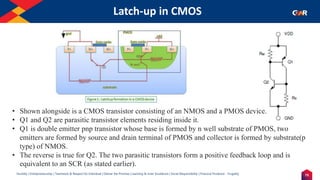
• Shown alongside is a CMOS transistor consisting of an NMOS and a PMOS device.
• Q1 and Q2 are parasitic transistor elements residing inside it.
• Q1 is double emitter pnp transistor whose base is formed by n well substrate of PMOS, two
emitters are formed by source and drain terminal of PMOS and collector is formed by substrate(p
type) of NMOS.
• The reverse is true for Q2. The two parasitic transistors form a positive feedback loop and is
equivalent to an SCR (as stated earlier).
74
Humility | Entrepreneurship | Teamwork & Respect for Individual | Deliver the Promise | Learning & Inner Excellence | Social Responsibility | Financial Prudence - Frugality
Techniques to minimize latchup sensitivity
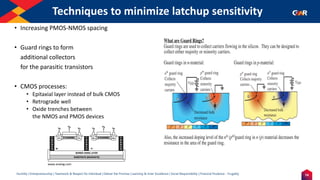
• Increasing PMOS-NMOS spacing
• Guard rings to form
additional collectors
for the parasitic transistors
• CMOS processes:
• Epitaxial layer instead of bulk CMOS
• Retrograde well
• Oxide trenches between
the NMOS and PMOS devices
www.analog.com
75
Thank you

Basic electrical properties of MOSFET circuits.pdf

  • 1.
    1 Humility | Entrepreneurship| Teamwork & Respect for Individual | Deliver the Promise | Learning & Inner Excellence | Social Responsibility | Financial Prudence - Frugality Module-1 Introduction and basic electrical properties of MOS circuits Presented by: Dr. Vasudeva Bevara Dept. of ECE
  • 2.
    2 Humility | Entrepreneurship| Teamwork & Respect for Individual | Deliver the Promise | Learning & Inner Excellence | Social Responsibility | Financial Prudence - Frugality Outline • Introduction to VLSI Design Flow • Introduction to IC technology • Ids vs Vds Relationships • Aspects of MOS transistor • Threshold Voltage • MOS transistor conductance • Output Conductance • Figure of Merit. • Fabrication process: • nMOS, pMOS and CMOS. • Alternate pull up forms in inverter circuits • Pull-up to Pull-down Ratio for nMOS inverter driven by another nMOS inverter • basic current mirror • CMOS Inverter • Latch-up in CMOS circuits
  • 3.
    3 Humility | Entrepreneurship| Teamwork & Respect for Individual | Deliver the Promise | Learning & Inner Excellence | Social Responsibility | Financial Prudence - Frugality VLSI Design Flow
  • 4.
    4 Humility | Entrepreneurship| Teamwork & Respect for Individual | Deliver the Promise | Learning & Inner Excellence | Social Responsibility | Financial Prudence - Frugality IC Technology Indentify the Image What advantages do ICs have over discrete components? ➢ Size: Sub-micron, millimeter/nanometer. ➢ Speed and Power: Smaller size of IC components yields higher speed and lower power consumption due to smaller parasitic resistances, capacitances and inductances. Switching between ‘0’and ‘1’much faster on chip than between chips. Lower power consumption => less heat => cheaper power supplies => reduced system cost. ➢ Integrated circuit manufacturing is versatile. Simply change the mask to change the design. However, designing the layout (changing the masks) is usually the most time consuming task in IC design.
  • 5.
    5 Humility | Entrepreneurship| Teamwork & Respect for Individual | Deliver the Promise | Learning & Inner Excellence | Social Responsibility | Financial Prudence - Frugality IC Technology Indentify the Image • Early developments of the Integrated Circuit (IC) go back to 1949. • German engineer Werner Jacobi filed a patent for an IC like semiconductor amplifying device showing five transistors on a common substrate in a 2- stage amplifier arrangement. • Jacobi disclosed small cheap of hearing aids. Invention
  • 6.
    6 Humility | Entrepreneurship| Teamwork & Respect for Individual | Deliver the Promise | Learning & Inner Excellence | Social Responsibility | Financial Prudence - Frugality Inventor Year Circuit Remark Fleming 1904 1906 Vacuum tube diode Vacuum triode large expensive, power- hungry, unreliable William Shockley (Bell labs) 1945 Semiconductor replacing vacuum tube Bardeen and Brattain and Shockley (Bell labs) 1947 Point Contact transfer resistance device “BJT” Driving factor of growth of the VLSI technology Werner Jacobi (SiemensAG) 1949 1st IC containing amplifying Device 2stage amplifier No commercial use reported Shockley 1951 Junction Transistor “Practical form of transistor” Jack Kilby (Texas Instruments) July 1958 Integrated Circuits F/F With 2-T Germanium slice and gold wires Father of IC design Fairchild Semiconductor And Texas 1061 First Commercial IC Frank Wanlass (Fairchild Semiconductor) 1963 CMOS Federico Faggin (Fairchild Semiconductor) 1968 Silicon gate IC technology Later Joined Intel to lead first CPU Intel 4004 in 1970 2300 T on 9mm2
  • 7.
    7 Humility | Entrepreneurship| Teamwork & Respect for Individual | Deliver the Promise | Learning & Inner Excellence | Social Responsibility | Financial Prudence - Frugality 1965 - Moore's law Indentify the Image Gordon E. Moore - Chairman Emeritus of Intel Corporation ➢ 1965 - observed trends in industry - of transistors on ICs vs. release dates: ➢ Noticed number of transistors doubling with release of each new IC generation ➢ release dates (separate generations) were all 18-24 months apart ➢ Moore’s Law: ➢ “The number of transistors on an integrated circuit will double every 18 months” ➢ The level of integration of silicon technology as measured in terms of number of devices per IC ➢ Semiconductor industry has followed this prediction with surprising accuracy. "Cramming more components onto integrated circuits".
  • 8.
    8 Humility | Entrepreneurship| Teamwork & Respect for Individual | Deliver the Promise | Learning & Inner Excellence | Social Responsibility | Financial Prudence - Frugality 1965 - Moore's law Indentify the Image
  • 9.
    9 Humility | Entrepreneurship| Teamwork & Respect for Individual | Deliver the Promise | Learning & Inner Excellence | Social Responsibility | Financial Prudence - Frugality Discrete vs Integrated Circuit Design Indentify the Image Activity/Item Discrete circuits Integrated Circuits ComponentAccuracy Well Known Poor absoluteAccuracies Bread boarding Yes No Fabrication Independent Very dependent Physical Implementation PC Layout Layout, verification and Extraction Parasitic Not important Must be included in the design Simulation Model Parameters well known Model parameters vary widely Testing Generally complete testing is possible Must be considered before design CAD Schematic capture Simulation, PC Board layout Schematic capture Simulation, layout Components All possible Active devices, capacitor, and resistor
  • 10.
    10 Humility | Entrepreneurship| Teamwork & Respect for Individual | Deliver the Promise | Learning & Inner Excellence | Social Responsibility | Financial Prudence - Frugality Indentify the Image IC Technology Bipolar CMOS BiCMOS SOI SiGe GaAs Category BJT CMOS Power Dissipation Moderate to High less Speed Faster Fast Gm 4ms 0.4ms Switch implementation poor Good Technology improvement slower Faster Why CMOS ? Lower Power Dissipation High packing density Scale down more easily Fully restored logic levels Appr. Equal rise and fall time
  • 11.
    11 Humility | Entrepreneurship| Teamwork & Respect for Individual | Deliver the Promise | Learning & Inner Excellence | Social Responsibility | Financial Prudence - Frugality Indentify the Image
  • 12.
    12 Humility | Entrepreneurship| Teamwork & Respect for Individual | Deliver the Promise | Learning & Inner Excellence | Social Responsibility | Financial Prudence - Frugality MOSFETs Indentify the Image MOSFETs have characteristics similar to JFETs and additional characteristics that make them very useful. There are 2 types: Depletion-Type MOSFET Enhancement-Type MOSFET
  • 13.
    13 Humility | Entrepreneurship| Teamwork & Respect for Individual | Deliver the Promise | Learning & Inner Excellence | Social Responsibility | Financial Prudence - Frugality Depletion-Type MOSFET Construction Indentify the Image The Drain (D) and Source (S) connect to the to n- doped regions. These N-doped regions are connected via an n-channel. This n-channel is connected to the Gate (G) via a thin insulating layer of SiO2. The n-doped material lies on a p-doped substrate that may have an additional terminal connection called SS.
  • 14.
    14 Humility | Entrepreneurship| Teamwork & Respect for Individual | Deliver the Promise | Learning & Inner Excellence | Social Responsibility | Financial Prudence - Frugality Basic Operation Indentify the Image
  • 15.
    15 Humility | Entrepreneurship| Teamwork & Respect for Individual | Deliver the Promise | Learning & Inner Excellence | Social Responsibility | Financial Prudence - Frugality Enhancement-Type MOSFET Construction Indentify the Image The Drain (D) and Source (S) connect to the to n- doped regions. These n-doped regions are connected via an n-channel. The Gate (G) connects to the p-doped substrate via a thin insulating layer of SiO2. There is no channel. The n-doped material lies on a p-doped substrate that may have an additional terminal connection called SS.
  • 16.
    16 Humility | Entrepreneurship| Teamwork & Respect for Individual | Deliver the Promise | Learning & Inner Excellence | Social Responsibility | Financial Prudence - Frugality Basic Operation and Characteristics Indentify the Image If VGS is set at 0 V and a voltage applied between the drain and source of the device, the absence of an n- channel (with its generous number of free carriers) will result in a current of effectively zero amperes— quite different from the depletion- type MOSFET and JFET where ID = IDSS. It is not sufficient to have a large accumulation of carriers (electrons) at the drain and source (due to the n-doped regions) if a path fails to exist between the two. If both VDS and VGS is set at some positive voltage greater than 0 V, then the positive potential at the gate will pressure the holes (since like charges repel) in the p-substrate along the edge of the SiO2 layer to leave the area and enter deeper regions of the p- substrate. However, the electrons in the p-substrate (the minority carriers of the material) will be attracted to the positive gate and accumulate in the region near the surface of the SiO2 layer. The SiO2 layer and its insulating qualities will prevent the negative carriers from being absorbed at the gate terminal.
  • 17.
    17 Humility | Entrepreneurship| Teamwork & Respect for Individual | Deliver the Promise | Learning & Inner Excellence | Social Responsibility | Financial Prudence - Frugality Continued… Indentify the Image As VGS increases in magnitude, the concentration of electrons near the SiO2 surface increases until eventually the induced n-type region can support a measurable flow between drain and source. The level of VGS that results in the significant increase in drain current is called the threshold voltage and is given the symbol VT. Since the channel is non-existent with VGS=0 V and “enhanced” by the application of a positive gate-to- source voltage, this type of MOSFET is called an enhancement- type MOSFET.
  • 18.
    18 Humility | Entrepreneurship| Teamwork & Respect for Individual | Deliver the Promise | Learning & Inner Excellence | Social Responsibility | Financial Prudence - Frugality Continued… Indentify the Image As VGS is increased beyond the threshold level, the density of free carriers in the induced channel will increase, resulting in an increased level of drain current. However, if we hold VGS constant and increase the level of VDS, the drain current will eventually reach a saturation level. The levelling of ID is due to a pinching-off process depicted by the narrower channel at the drain end of the induced channel By applying KVL we get If VGS is held fixed at some value such as 8 V and VDS is increased from 2 to 5V, the voltage will drop from -6 to -3 V. This reduction in gate-to-drain voltage will in turn reduce the attractive forces for free carriers (electrons) in this region of the induced channel, causing a reduction in the effective channel width. Eventually, the channel will be reduced to the point of pinch-off and a saturation condition will be established.
  • 19.
    19 Humility | Entrepreneurship| Teamwork & Respect for Individual | Deliver the Promise | Learning & Inner Excellence | Social Responsibility | Financial Prudence - Frugality Continued… Indentify the Image
  • 20.
    20 Humility | Entrepreneurship| Teamwork & Respect for Individual | Deliver the Promise | Learning & Inner Excellence | Social Responsibility | Financial Prudence - Frugality MOSFET Symbols Indentify the Image
  • 21.
    21 Humility | Entrepreneurship| Teamwork & Respect for Individual | Deliver the Promise | Learning & Inner Excellence | Social Responsibility | Financial Prudence - Frugality MOSFET vs BJT Indentify the Image MOSFET applications • Radiofrequency applications use MOSFET amplifiers extensively. • MOSFET behaves as a passive circuit element. • Power MOSFETs can be used to regulate DC motors. • MOSFETs are used in the design of the chopper circuit. Advantages of MOSFET • MOSFETs operate at greater efficiency at lower voltages. • Absence of gate current results in high input impedance producing high switching speed. Disadvantages of MOSFET • MOSFETs are vulnerable to damage by electrostatic charges due to the thin oxide layer. • Overload voltages make MOSFETs unstable.
  • 22.
    22 Humility | Entrepreneurship| Teamwork & Respect for Individual | Deliver the Promise | Learning & Inner Excellence | Social Responsibility | Financial Prudence - Frugality MOSFET vs BJT Indentify the Image
  • 23.
    23 Humility | Entrepreneurship| Teamwork & Respect for Individual | Deliver the Promise | Learning & Inner Excellence | Social Responsibility | Financial Prudence - Frugality Fabrication Processes Indentify the Image Fabrication is the process of constructing an industrial product. We can also define it as a set of methods to manufacture an electronic device or product. For example, silicon semiconductor chips, etc. In the case of metals, fabrication is a process used to convert the raw materials into the finished product. The basic fabrication processes of the Integrated Circuits
  • 24.
    24 Humility | Entrepreneurship| Teamwork & Respect for Individual | Deliver the Promise | Learning & Inner Excellence | Social Responsibility | Financial Prudence - Frugality Sand / Ingot Indentify the Image Sand Silicon is the second most abundant element in the earth's crust. Common sand has a high percentage of silicon. Silicon – the starting material for computer chips – is a semiconductor, meaning that it can be readily turned into an excellent conductor or an insulator of electricity, by the introduction of minor amounts of impurities. Melted Silicon – scale: wafer level (~300mm / 12 inch) In order to be used for computer chips, silicon must be purified so there is less than one alien atom per billion. It is pulled from a melted state to form a solid which is a single, continuous and unbroken crystal lattice in the shape of a cylinder, known as an ingot. Monocrystalline Silicon Ingot – scale: wafer level (~300mm / 12 inch) The ingot has a diameter of 300mm and weighs about 100 kg.
  • 25.
    25 Humility | Entrepreneurship| Teamwork & Respect for Individual | Deliver the Promise | Learning & Inner Excellence | Social Responsibility | Financial Prudence - Frugality Wafer Preparation Indentify the Image The wafer preparation is the first step for IC fabrication. It involves cutting, shaping, and polishing the wafer material to make it suitable for further fabrication. Some wafers are modified because of their sharp edges, irregular surface, and shape to convert them to the required wafer. A wafer is a thin material used for making various Integrated circuits and transistors. Wafer acts as a base for such devices. The material of a wafer is the semiconductor, especially crystalline silicon. The silicon crystals used for the wafer manufacturing are highly pure. The process of extracting pure metal from the melt is known as a boule. The impurities are further added to the molten state of the material in a specific amount to make it n-type or p- type.
  • 26.
    26 Humility | Entrepreneurship| Teamwork & Respect for Individual | Deliver the Promise | Learning & Inner Excellence | Social Responsibility | Financial Prudence - Frugality Oxidation – Create Oxide Film on Wafer Surface Indentify the Image Oxidation is the process of adding oxygen. In a semiconductor, the oxygen and the silicon react to form silicon dioxide. The oxidation is carried out in furnaces at high temperatures up to 1250 degrees Celsius. Oxidation is classified as wet oxidation or dry oxidation. Both processes are widely used and have their own advantages and disadvantages. Wet oxidation is fast, while dry oxidation has good electrical properties. Wet oxidation is also known as steam. Both types of oxidation have excellent electrical insulation properties. The deposition of silicon dioxide on the silicon wafer protects from many impurities. The dopants can be applied only to areas not covered with the SiO2.
  • 27.
    27 Humility | Entrepreneurship| Teamwork & Respect for Individual | Deliver the Promise | Learning & Inner Excellence | Social Responsibility | Financial Prudence - Frugality Photolithography – Draw Circuit Design on Wafer Indentify the Image ApplyingPhotoresist– Photolithography is the processby which aspecific patternis imprintedonthe wafer. Itstartswiththe applicationof a liquidknown as photoresist, which is evenlypouredontothewafer whileit spins.Itgets its namefrom the fact that it is sensitiveto certain frequencies of light(“photo”)andis resistant to certain chemicalsthat will beusedlaterto remove portionsof a layerof material (“resist”). Exposure– The photoresist is hardened, andportionsof it are exposed to ultraviolet (UV)light, makingit soluble. The exposureis done usingmasksthat actlike stencils,soonlyaspecificpattern of photoresist becomessoluble.The maskhasanimageof the patternthat needsto goonthe wafer;it is optically reduced by a lens, andthe exposure tool steps and repeats acrossthe wafer to formthe sameimagea largenumberof times. ResistDevelopment– The solublephotoresist is removedby a chemical process, leaving a photoresist pattern determinedby what wasonthe mask. Next step is to draw a circuit design onto a wafer which is called the photolithography process. A photo mask functions as the film. A photo mask is a glass substrate with a computer designed circuit pattern.
  • 28.
    28 Humility | Entrepreneurship| Teamwork & Respect for Individual | Deliver the Promise | Learning & Inner Excellence | Social Responsibility | Financial Prudence - Frugality Ion Implantation Indentify the Image Ion Implantation– The wafer with patterned photoresist is bombarded with a beam of ions (positively or negatively charged atoms) which become embedded beneath the surface in the regions not covered by photoresist. This process is called doping, because impurities are introduced into the silicon. This alters the conductive properties of the silicon (making it conductive or insulating, depending on the type of ion used) in selected locations. RemovingPhotoresist– Afterion implantation, the photoresistis removedandthe resulting wafer has a pattern of dopedregions in which transistors will be formed. BeginTransistor Formation– Here we zoominto a tiny part of the wafer, where a singletransistor will be formed. The greenregionrepresents dopedsilicon. Today’s wafers canhave hundreds of billions of suchregions whichwill housetransistors. Next step is to draw a circuit design onto a wafer which is called the photolithography process. A photo mask functions as the film. A photo mask is a glass substrate with a computer designed circuit pattern.
  • 29.
    29 Humility | Entrepreneurship| Teamwork & Respect for Individual | Deliver the Promise | Learning & Inner Excellence | Social Responsibility | Financial Prudence - Frugality Ion Implantation Indentify the Image Diffusion is a process of adding impurities atoms from a region with high concentration to a region of low concentration. The dopants or impurity atoms are added to the silicon (semiconductor material), which changes its resistivity. Coating the thin film at a desired molecular or atomic level onto a wafer is called deposition. Since the coating is so thin, precise and sophisticated technology is required to uniformly apply the thin film on a wafer to give the semiconductor electrical characteristics. Ion implementation / Ion implantation is also required.
  • 30.
    30 Humility | Entrepreneurship| Teamwork & Respect for Individual | Deliver the Promise | Learning & Inner Excellence | Social Responsibility | Financial Prudence - Frugality Etching – Remove Unnecessary Materials Indentify the Image Etch– In order to create a fin for a tri-gate transistor, a pattern of material called a hard mask (blue) is applied using the photolithography process just described. Then a chemical is applied to etch away unwanted silicon, leaving behind a fin with a layer of hard mask on top. Removing Photoresist – The hard mask is chemically removed, leaving a tall, thin silicon fin which will contain the channel of a transistor. Now it is time to remove unnecessary materials from the wafer surface so that only the design pattern remains. • Wet Etching: When chemical solutions are used for etching, it is called wet etching. • Dry Etching: When gas or plasma is used, it is called dry etching. This is done using a liquid or gas etching technique. All unnecessary materials are selectively removed to draw the desired design.
  • 31.
    31 Humility | Entrepreneurship| Teamwork & Respect for Individual | Deliver the Promise | Learning & Inner Excellence | Social Responsibility | Financial Prudence - Frugality Metal Deposition (Metallization) Ready Transistor – This transistor is close to being finished. Three holes have been etched into the insulation layer (red color) above the transistor. These three holes will be filled with copper or other material which will make up the connections to other transistors. Electroplating – The wafers are put into a copper sulphate solution at this stage. The copper ions are deposited onto the transistor thru a process called electroplating. The copper ions travel from the positive terminal (anode) to the negative terminal (cathode) which is represented by the wafer. After Electroplating – On the wafer surface the copper ions settle as a thin layer of copper.
  • 32.
    32 Humility | Entrepreneurship| Teamwork & Respect for Individual | Deliver the Promise | Learning & Inner Excellence | Social Responsibility | Financial Prudence - Frugality Wafer Sort / Singulation Wafer Sort – This portion of a ready wafer is being put through a test. A tester steps across the wafer; leads from its head make contact on specific points on the top of the wafer and an electrical test is performed. Test patterns are fed into every single chip and the response from the chip is monitored and compared to “the right answer”. Wafer Slicing – The wafer is cut into pieces (called die). The above wafer contains future Intel processors codenamed Ivy Bridge. Selecting Die for Packaging – The die that responded with the right answer to the test patterns will be packaged.
  • 33.
    33 Humility | Entrepreneurship| Teamwork & Respect for Individual | Deliver the Promise | Learning & Inner Excellence | Social Responsibility | Financial Prudence - Frugality Encapsulation or Packaging Individual Die – These are individual die which have been cut out in the previous step (singulation). The die shown here is Intel’s first 22nm microprocessor codenamed Ivy Bridge. Packaging – The package substrate, the die and the heat spreader are put together to form a completed processor. The green substrate builds the electrical and mechanical interface for the processor to interact with the rest of the PC system. The silver heat spreader is a thermal interface which helps dissipate heat. Processor – Completed processor (Ivy Bridge in this case). A microprocessor has been called the most complex manufactured product made by man. In fact, it takes hundreds of steps – only the most important ones have been included in this picture story - in the world's cleanest environment (a microprocessor fab).
  • 34.
    34 Humility | Entrepreneurship| Teamwork & Respect for Individual | Deliver the Promise | Learning & Inner Excellence | Social Responsibility | Financial Prudence - Frugality Semiconductor Manufacturing Process Flow Chart
  • 35.
    35 Humility | Entrepreneurship| Teamwork & Respect for Individual | Deliver the Promise | Learning & Inner Excellence | Social Responsibility | Financial Prudence - Frugality N-MOS Fabrication Process Fig. (1) Pure Si single crystal Si-substrate Fig. (2) P-type impurity is lightly doped - - - - - - - - - - - - - - - - - - - - - - - - - - - - - - - - - - - - - - - - - - - - - - - - - - - - - - - - - - - - - - - - - - - - - - - - - - - - - - - - - - - - - - - - - - - - - - - - - - - - Fig. (3) SiO2 Deposited over si surface Fig. (4) Photoresist is deposited over SiO2 layer Photoresist Thick SiO2 (1 µm) - - - - - - - - - - - - - - - - - - - - - - - - - - - - - - - - - - - - - - - - - - - - - - - - - - - - - - - - - - - - - - - - - - - - - - - - - - - - - - - - - - - - - - - - - - - - - - Thick SiO2 (1 µm) - - - - - - - - - - - - - - - - - - - - - - - - - - - - - - - - - - - - - - - - - - - - - - - - - - - - - - - - - - - - - - - - - - - - - - - - - - - - - - - - - - - - - - - - - - - - - - - - -
  • 36.
    36 Humility | Entrepreneurship| Teamwork & Respect for Individual | Deliver the Promise | Learning & Inner Excellence | Social Responsibility | Financial Prudence - Frugality N-MOS Fabrication Process Mask-1 is used to expose the SiO2 where S, D and G is to be formed. Fig. (5) Photoresist layer is exposed to UV Light through a mask - - - - - - - - - - - - - - - - - - - - - - - - - - - - - - - - - - - - - - - - - - - - - - - - - - - - - - - - - - - - - - - - - -- - - - - - - - - - - - - - - - - - - - - - - - - - - - - - - - - - - - - - - - - - - - - - - - - - - - - - - - - - - - - - - - - - - Mask-1 Photoresist Thick SiO2 (1 µm) UV Light
  • 37.
    37 Humility | Entrepreneurship| Teamwork & Respect for Individual | Deliver the Promise | Learning & Inner Excellence | Social Responsibility | Financial Prudence - Frugality N-MOS Fabrication Process Fig. (6) Etching [HF acid is used] will remove SiO2 layer which is in direct contact with etching solution Thick SiO2 (1 µm) - - - - - - - - - - - - - - - - - - - - - - - - - - - - - - - - - - - - - - - - - - - - - - - - - - - - - - - - - - - - - - - - - -- - - - - - - - - - - - - - - - - - - - - - - - - - - - - - - - - - - - - - - - - - - - - - - - - - - - - - - - - - - - - - - - - - - Fig. (7) unpolymerised photoresist is also etched away [using H2SO4] - - - - - - - - - - - - - - - - - - - - - - - - - - - - - - - - - - - - - - - - - - - - - - - - - - - - - - - - - - - - - - - - - -- - - - - - - - - - - - - - - - - - - - - - - - - - - - - - - - - - - - - - - - - - - - - - - - - - - - - - - - - - - - - - - - - - - Thick SiO2 (1 µm)
  • 38.
    38 Humility | Entrepreneurship| Teamwork & Respect for Individual | Deliver the Promise | Learning & Inner Excellence | Social Responsibility | Financial Prudence - Frugality N-MOS Fabrication Process Fig. (10)A layer of photoresist is grown over polysilicon layer Thick SiO2 (1 µm) Thin SiO2 (0.1 µm) Polysilicon layer Photoresist - - - - - - - - - - - - - - - - - - - - - - - - - - - - - - - - - - - - - - - - - - - - - - - - - - - - - - - - - - - - - - - - - -- - - - - - - - - - - - - - - - - - - - - - - - - - - - - - - - - - - - - - - - - - - - - - - - - - - - - - - - - - - - - - - - - - -
  • 39.
    39 Humility | Entrepreneurship| Teamwork & Respect for Individual | Deliver the Promise | Learning & Inner Excellence | Social Responsibility | Financial Prudence - Frugality N-MOS Fabrication Process Mask-2 is used to deposit Polysilicon to form gate. Fig. (11) Photoresist is exposed to UV Light UV Light Mask-2 - - - - - - - - - - - - - - - - - - - - - - - - - - - - - - - - - - - - - - - - - - - - - - - - - - - - - - - - - - - - - - - - - -- - - - - - - - - - - - - - - - - - - - - - - - - - - - - - - - - - - - - - - - - - - - - - - - - - - - - - - - - - - - - - - - - - -
  • 40.
    40 Humility | Entrepreneurship| Teamwork & Respect for Individual | Deliver the Promise | Learning & Inner Excellence | Social Responsibility | Financial Prudence - Frugality N-MOS Fabrication Process Fig. (12) Etching will remove that portion of Thin SiO2 which is not exposed to UV light Thin SiO2 (0.1 µm) Polysilicon - - - - - - - - - - - - - - - - - - - - - - - - - - - - - - - - - - - - - - - - - - - - - - - - - - - - - - - - - - - - - - - - - -- - - - - - - - - - - - - - - - - - - - - - - - - - - - - - - - - - - - - - - - - - - - - - - - - - - - - - - - - - - - - - - - - - - Fig. (13) Polymerised photoresist is also stripped away Thin SiO2 (0.1 µm) Polysilicon used as GA TE (1 – 2 µm) - - - - - - - - - - - - - - - - - - - - - - - - - - - - - - - - - - - - - - - - - - - - - - - - - - - - - - - - - - - - - - - - - -- - - - - - - - - - - - - - - - - - - - - - - - - - - - - - - - - - - - - - - - - - - - - - - - - - - - - - - - - - - - - - - - - - -
  • 41.
    41 Humility | Entrepreneurship| Teamwork & Respect for Individual | Deliver the Promise | Learning & Inner Excellence | Social Responsibility | Financial Prudence - Frugality N-MOS Fabrication Process Fig. (14) n+ Doping to form SOURCE and DRAIN - - - - - - - - - - - - - - - - - - - - - - - - - - - - - - - - - - - - - - - - - - - - - - - - - - - - - - - - - - - - - - - - - - - - - - - - - - - - - - - - - - - - - - - - - - - - - - - - - - Thick SiO2 (1 µm) Thin SiO2 (0.1 µm) - - - - - - - - - - - - - - - - - - - - - - - - - -- - - - - - - - - - - - n+ - - - GA TE - - - - - - n+ SOURCE DRAIN Fig. (15)A thick layer of SiO2 (1 µm) is again grown. - - - - - - - - - - - - - - - - - - - - - - - - - - - - - - - - - - - - - - - - - - - - - - - - - - - - - - - - - - - - - - - - - - - - - - - - - - - - - - - - - - - - - - - - - - - - - - - - - - Thick SiO2 (1 µm) - - - - - - - - - - - - - - - - - - - - - - - - - -- - - - - - - - - - - - n+ - - - - - - - - - n+ Thick SiO2 (1 µm) Step - Metallization
  • 42.
    42 Humility | Entrepreneurship| Teamwork & Respect for Individual | Deliver the Promise | Learning & Inner Excellence | Social Responsibility | Financial Prudence - Frugality N-MOS Fabrication Process Fig. (16) Photoresist is grown over thick SiO2. Selected areas of the poly GATE and SOURCE and DRAIN are exposed where contact cuts are to be made - - - - - - - - - - - - - - - - - - - - - - - - - - - - - - - - - - - - - - - - - - - - - - - - - - - - - - - - - - - - - - - - - - - - - - - - - - - - - - - - - - - - - - - - - - - - - - - - - - Thick SiO2 (1 µm) - - - - - - - - - - - - - - - - - - - - - - - - - -- - - - - - - - - - - - n+ - - - - - - - - - n+ Thick SiO2 (1 µm) Mask-3 Mask-3 is used to make contact cuts for S, D and G. Photoresist UV Light Step - Metallization
  • 43.
    43 Humility | Entrepreneurship| Teamwork & Respect for Individual | Deliver the Promise | Learning & Inner Excellence | Social Responsibility | Financial Prudence - Frugality N-MOS Fabrication Process Fig. (17) The region of photoresist which is not exposed by UV light will become soft. This unpolymerised photoresist and SiO2 below it are etched away. - - - - - - - - - - - - - - - - - - - - - - - - - - - - - - - - - - - - - - - - - - - - - - - - - - - - - - - - - - - - - - - - - - - - - - - - - - - - - - - - - - - - - - - - - - - - - - - - - - Thick SiO2 (1 µm) - - - - - - - - - - - - - - - - - - - - - - - - - -- - - - - - - - - - - - n+ - - - - - - - - - n+ Thick SiO2 (1 µm) Mask-3 Photoresist
  • 44.
    44 Humility | Entrepreneurship| Teamwork & Respect for Individual | Deliver the Promise | Learning & Inner Excellence | Social Responsibility | Financial Prudence - Frugality N-MOS Fabrication Process Fig. (18) The contact cuts are formed for S, D and G (hardened photoresist is stripped away). - - - - - - - - - - - - - - - - - - - - - - - - - - - - - - - - - - - - - - - - - - - - - - - - - - - - - - - - - - - - - - - - - - - - - - - - - - - - - - - - - - - - - - - - - - - - - - - - - - Thick SiO2 (1 µm) - - - - - - - - - - - - - - - - - - - - - - - - - -- - - - - - - - - - - - n+ - - - - - - - - - n+ Thick SiO2 (1 µm) Mask-3 Photoresist
  • 45.
    45 Humility | Entrepreneurship| Teamwork & Respect for Individual | Deliver the Promise | Learning & Inner Excellence | Social Responsibility | Financial Prudence - Frugality N-MOS Fabrication Process Fig. (19) Metal (aluminium) is deposited over the surface of whole chip (1 µm thickness). - - - - - - - - - - - - - - - - - - - - - - - - - - - - - - - - - - - - - - - - - - - - - - - - - - - - - - - - - - - - - - - - - - - - - - - - - - - - - - Thick SiO2 (1 µm) - - - - - - - - - - - - - - - - - - - - - - - - - - - - - - - - - - - - - - - - - - - - - -- - - - - - - - - - - - n+ - - - - - - - - - n+ Thick SiO2 (1 µm) Metal (1µm)
  • 46.
    46 Humility | Entrepreneurship| Teamwork & Respect for Individual | Deliver the Promise | Learning & Inner Excellence | Social Responsibility | Financial Prudence - Frugality N-MOS Fabrication Process Fig. (20) Photoresist is deposited over the metal. - - - - - - - - - - - - - - - - - - - - - - - - - - - - - - - - - - - - - - - - - - - - - - - - - - - - - - - - - - - - - - - - - - - - - - - - - - - - - - - - - - - - - - - - - - - - - - - - - - Thick SiO2 (1 µm) - - - - - - - - - - - - - - - - - - - - - - - - - -- - - - - - - - - - - - n+ - - - - - - - - - n+ Thick SiO2 (1 µm) Metal (1µm) Photoresist
  • 47.
    47 Humility | Entrepreneurship| Teamwork & Respect for Individual | Deliver the Promise | Learning & Inner Excellence | Social Responsibility | Financial Prudence - Frugality N-MOS Fabrication Process Mask-4 is used to deposit metal in contact cuts of S, D and G. Fig. (21) UV Light is passed through Mask-4 (with a aim of removing all metal other than metal in contact-cuts). - - - - - - - - - - - - - - - - - - - - - - - - - - - - - - - - - - - - - - - - - - - - - - - - - - - - - - - - - - - - - - - - - - - - - - - - - - - - - - - - - - - - - - - - - - - - - - - - - - Thick SiO2 (1 µm) - - - - - - - - - - - - - - - - - - - - - - - - - -- - - - - - - - - - - - n+ - - - - - - - - - n+ Thick SiO2 (1 µm) Mask-4 Photoresist Metal (1µm) UV Light
  • 48.
    48 Humility | Entrepreneurship| Teamwork & Respect for Individual | Deliver the Promise | Learning & Inner Excellence | Social Responsibility | Financial Prudence - Frugality N-MOS Fabrication Process Fig. (22) Photoresist and metal which is not exposed to UV light are etched away. - - - - - - - - - - - - - - - - - - - - - - - - - - - - - - - - - - - - - - - - - - - - - - - - - - - - - - - - - - - - - - - - - - - - - - - - - - - - - - - - - - - - - - - - - - - - - - - - - - Thick SiO2 (1 µm) - - - - - - - - - - - - - - - - - - - - - - - - - -- - - - - - - - - - - - n+ - - - - - - - - - n+ Thick SiO2 (1 µm) Mask-4 Photoresist Metal (1µm)
  • 49.
    49 Humility | Entrepreneurship| Teamwork & Respect for Individual | Deliver the Promise | Learning & Inner Excellence | Social Responsibility | Financial Prudence - Frugality N-MOS Fabrication Process Fig. (23) Final n-MOS Transistor - - - - - - - - - - - - - - - - - - - - - - - - - - - - - - - - - - - - - - - - - - - - - - - - - - - - - - - - - - - - - - - - - - - - - - - - - - - - - - - - - - - - - - - - - - - - - - - - - - - - - - - - - - - - - - - - - - - - - - - - - - - -- - - - - - - - - - - - n+ - - - - - - - - - n+ SOURCE DRAIN GA TE
  • 50.
    50 Humility | Entrepreneurship| Teamwork & Respect for Individual | Deliver the Promise | Learning & Inner Excellence | Social Responsibility | Financial Prudence - Frugality P-MOS Fabrication Process
  • 51.
    51 Humility | Entrepreneurship| Teamwork & Respect for Individual | Deliver the Promise | Learning & Inner Excellence | Social Responsibility | Financial Prudence - Frugality CMOS (Complementary Metal Oxide Semiconductor) In CMOS technology, both N-type and P-type transistors are used to design logic functions. In CMOS logic gates a collection of n-type MOSFETs is arranged in a pull-down network between the output and the low voltage power supply rail (Vss or quite often ground). The same signal which turns ON a transistor of one type is used to turn OFF a transistor of the other type. This characteristic allows the design of logic devices using only simple switches, without the need for a pull-up resistor
  • 52.
    52 Humility | Entrepreneurship| Teamwork & Respect for Individual | Deliver the Promise | Learning & Inner Excellence | Social Responsibility | Financial Prudence - Frugality CMOS Fabrication • CMOS transistors are fabricated on silicon wafer • Lithography process similar to printing press • On each step, different materials are deposited or etched • Easiest to understand by viewing both top and cross-section of wafer in a simplified manufacturing process
  • 53.
    53 Humility | Entrepreneurship| Teamwork & Respect for Individual | Deliver the Promise | Learning & Inner Excellence | Social Responsibility | Financial Prudence - Frugality Inverter Cross-section • Typically use p-type substrate for nMOS transistors • Requires n-well for body of pMOS transistors n+ p substrate p+ n well A Y GND VDD n+ p+ SiO2 n+ diffusion p+ diffusion polysilicon metal1 nMOS transistor pMOS transistor
  • 54.
    54 Humility | Entrepreneurship| Teamwork & Respect for Individual | Deliver the Promise | Learning & Inner Excellence | Social Responsibility | Financial Prudence - Frugality Well and Substrate Taps n+ p substrate p+ n well Y • Substrate must be tied to GND and n-well to VDD • Metal to lightly-doped semiconductor forms poor connection called Shottky Diode • Use heavily doped well and substrate contacts / taps A GND VDD n+ p+ substrate tap well tap n+ p+
  • 55.
    55 Humility | Entrepreneurship| Teamwork & Respect for Individual | Deliver the Promise | Learning & Inner Excellence | Social Responsibility | Financial Prudence - Frugality Inverter Mask Set • Transistors and wires are defined by masks • Cross-section taken along dashed line GND VDD Y A substrate tap well tap nMOS transistor pMOS transistor
  • 56.
    56 Humility | Entrepreneurship| Teamwork & Respect for Individual | Deliver the Promise | Learning & Inner Excellence | Social Responsibility | Financial Prudence - Frugality Detailed Mask Views • Six masks • n-well • Polysilicon • n+ diffusion • p+ diffusion • Contact • Metal Metal Polysilicon Contact n+ Diffusion p+ Diffusion n well
  • 57.
    57 Humility | Entrepreneurship| Teamwork & Respect for Individual | Deliver the Promise | Learning & Inner Excellence | Social Responsibility | Financial Prudence - Frugality Fabrication Steps • Start with blank wafer • Build inverter from the bottom up • First step will be to form the n-well • Cover wafer with protective layer of SiO2 (oxide) • Remove layer where n-well should be built • Implant or diffuse n dopants into exposed wafer • Strip off SiO2 p substrate
  • 58.
    58 Humility | Entrepreneurship| Teamwork & Respect for Individual | Deliver the Promise | Learning & Inner Excellence | Social Responsibility | Financial Prudence - Frugality Oxidation & Photoresist • Grow SiO2 on top of Si wafer • 900 – 1200 C with H2O or O2 in oxidation furnace p substrate SiO2 ▪ Spin on photoresist • Photoresist is a light-sensitive organic polymer • Softens where exposed to light p substrate SiO2 Photoresist
  • 59.
    59 Humility | Entrepreneurship| Teamwork & Respect for Individual | Deliver the Promise | Learning & Inner Excellence | Social Responsibility | Financial Prudence - Frugality Lithography p substrate SiO2 Photoresist • Expose photoresist through n-well mask • Strip off exposed photoresist
  • 60.
    60 Humility | Entrepreneurship| Teamwork & Respect for Individual | Deliver the Promise | Learning & Inner Excellence | Social Responsibility | Financial Prudence - Frugality Etch p substrate SiO2 Photoresist • Etch oxide with hydrofluoric acid (HF) • Seeps through skin and eats bone; nasty stuff!!! • Only attacks oxide where resist has been exposed
  • 61.
    61 Humility | Entrepreneurship| Teamwork & Respect for Individual | Deliver the Promise | Learning & Inner Excellence | Social Responsibility | Financial Prudence - Frugality Strip Photoresist • Strip off remaining photoresist • Use mixture of acids called piranah etch • Necessary so resist doesn’t melt in next step p substrate SiO2
  • 62.
    62 Humility | Entrepreneurship| Teamwork & Respect for Individual | Deliver the Promise | Learning & Inner Excellence | Social Responsibility | Financial Prudence - Frugality n-well • n-well is formed with diffusion or ion implantation • Diffusion • Place wafer in furnace with arsenic gas • Heat until As atoms diffuse into exposed Si • Ion Implanatation • Blast wafer with beam of As ions • Ions blocked by SiO2, only enter exposed Si n well SiO2
  • 63.
    63 Humility | Entrepreneurship| Teamwork & Respect for Individual | Deliver the Promise | Learning & Inner Excellence | Social Responsibility | Financial Prudence - Frugality Strip Oxide • Strip off the remaining oxide using HF • Back to bare wafer with n-well • Subsequent steps involve similar series of steps p substrate n well
  • 64.
    64 Humility | Entrepreneurship| Teamwork & Respect for Individual | Deliver the Promise | Learning & Inner Excellence | Social Responsibility | Financial Prudence - Frugality Polysilicon • Deposit very thin layer of gate oxide • < 20 Å (6-7 atomic layers) • Chemical Vapor Deposition (CVD) of silicon layer • Place wafer in furnace with Silane gas (SiH4) • Forms many small crystals called polysilicon • Heavily doped to be good conductor Thin gate oxide Polysilicon p substrate n well
  • 65.
    65 Humility | Entrepreneurship| Teamwork & Respect for Individual | Deliver the Promise | Learning & Inner Excellence | Social Responsibility | Financial Prudence - Frugality Polysilicon Patterning • Use same lithography process to pattern polysilicon Polysilicon p substrate Thin gate oxide Polysilicon n well
  • 66.
    66 Humility | Entrepreneurship| Teamwork & Respect for Individual | Deliver the Promise | Learning & Inner Excellence | Social Responsibility | Financial Prudence - Frugality Self-Aligned Process p substrate n well • Use oxide and masking to expose where n+ dopants should be diffused or implanted • N-diffusion forms nMOS source, drain, and n-well contact
  • 67.
    67 Humility | Entrepreneurship| Teamwork & Respect for Individual | Deliver the Promise | Learning & Inner Excellence | Social Responsibility | Financial Prudence - Frugality N-diffusion p substrate n well n+ Diffusion • Pattern oxide and form n+ regions • Self-aligned process where gate blocks diffusion • Polysilicon is better than metal for self-aligned gates because it doesn’t melt during later processing
  • 68.
    68 Humility | Entrepreneurship| Teamwork & Respect for Individual | Deliver the Promise | Learning & Inner Excellence | Social Responsibility | Financial Prudence - Frugality N-diffusion cont. • Historically dopants were diffused • Usually, ion implantation today • But regions are still called diffusion n well p substrate n+ n+ n+
  • 69.
    69 Humility | Entrepreneurship| Teamwork & Respect for Individual | Deliver the Promise | Learning & Inner Excellence | Social Responsibility | Financial Prudence - Frugality P-Diffusion • Similar set of steps form p+ diffusion regions for pMOS source and drain and substrate contact p+ Diffusion p substrate n well n+ n+ n+ p+ p+ p+
  • 70.
    70 Humility | Entrepreneurship| Teamwork & Respect for Individual | Deliver the Promise | Learning & Inner Excellence | Social Responsibility | Financial Prudence - Frugality Contacts • Now we need to wire together the devices • Cover chip with thick field oxide • Etch oxide where contact cuts are needed p substrate Thick field oxide n well n+ n+ n+ p+ p+ p+ Contact
  • 71.
    71 Humility | Entrepreneurship| Teamwork & Respect for Individual | Deliver the Promise | Learning & Inner Excellence | Social Responsibility | Financial Prudence - Frugality Metallization • Sputter on aluminum over whole wafer • Pattern to remove excess metal, leaving wires p substrate Metal Thick field oxide n well n+ n+ n+ p+ p+ p+ Metal
  • 72.
    72 Humility | Entrepreneurship| Teamwork & Respect for Individual | Deliver the Promise | Learning & Inner Excellence | Social Responsibility | Financial Prudence - Frugality Latch-UP What is Latch-up? • Latch-up is a condition that can occur in a circuit fabricated in a bulk CMOS technology. When a chip is in a state of latch –up it draws a large current from the power supply but does not function in response to input stimuli. A chip may be operating normally and then enter a state of latch-up; in this case, removing and reconnecting the power supply may restore operations. In other words •Latch-up is the creation of a low impedance path between the power supply rails. • Latch-up is caused by the triggering of parasitic bipolar structures within an integrated circuit when applying a current or voltage stimulus on an input, output, or I/O pin or by an over- voltage on the power supply pin.
  • 73.
    73 Humility | Entrepreneurship| Teamwork & Respect for Individual | Deliver the Promise | Learning & Inner Excellence | Social Responsibility | Financial Prudence - Frugality Latch-up in CMOS • Shown alongside is a CMOS transistor consisting of an NMOS and a PMOS device. • Q1 and Q2 are parasitic transistor elements residing inside it. • Q1 is double emitter pnp transistor whose base is formed by n well substrate of PMOS, two emitters are formed by source and drain terminal of PMOS and collector is formed by substrate(p type) of NMOS. • The reverse is true for Q2. The two parasitic transistors form a positive feedback loop and is equivalent to an SCR (as stated earlier).
  • 74.
    74 Humility | Entrepreneurship| Teamwork & Respect for Individual | Deliver the Promise | Learning & Inner Excellence | Social Responsibility | Financial Prudence - Frugality Techniques to minimize latchup sensitivity • Increasing PMOS-NMOS spacing • Guard rings to form additional collectors for the parasitic transistors • CMOS processes: • Epitaxial layer instead of bulk CMOS • Retrograde well • Oxide trenches between the NMOS and PMOS devices www.analog.com
  • 75.