Variations in menstrual cycle
Dr. AG Mairiga
Dept of Obst & Gynaecol, CMS
University of Maiduguri, Maiduguri
Normal Menstrual Cycle
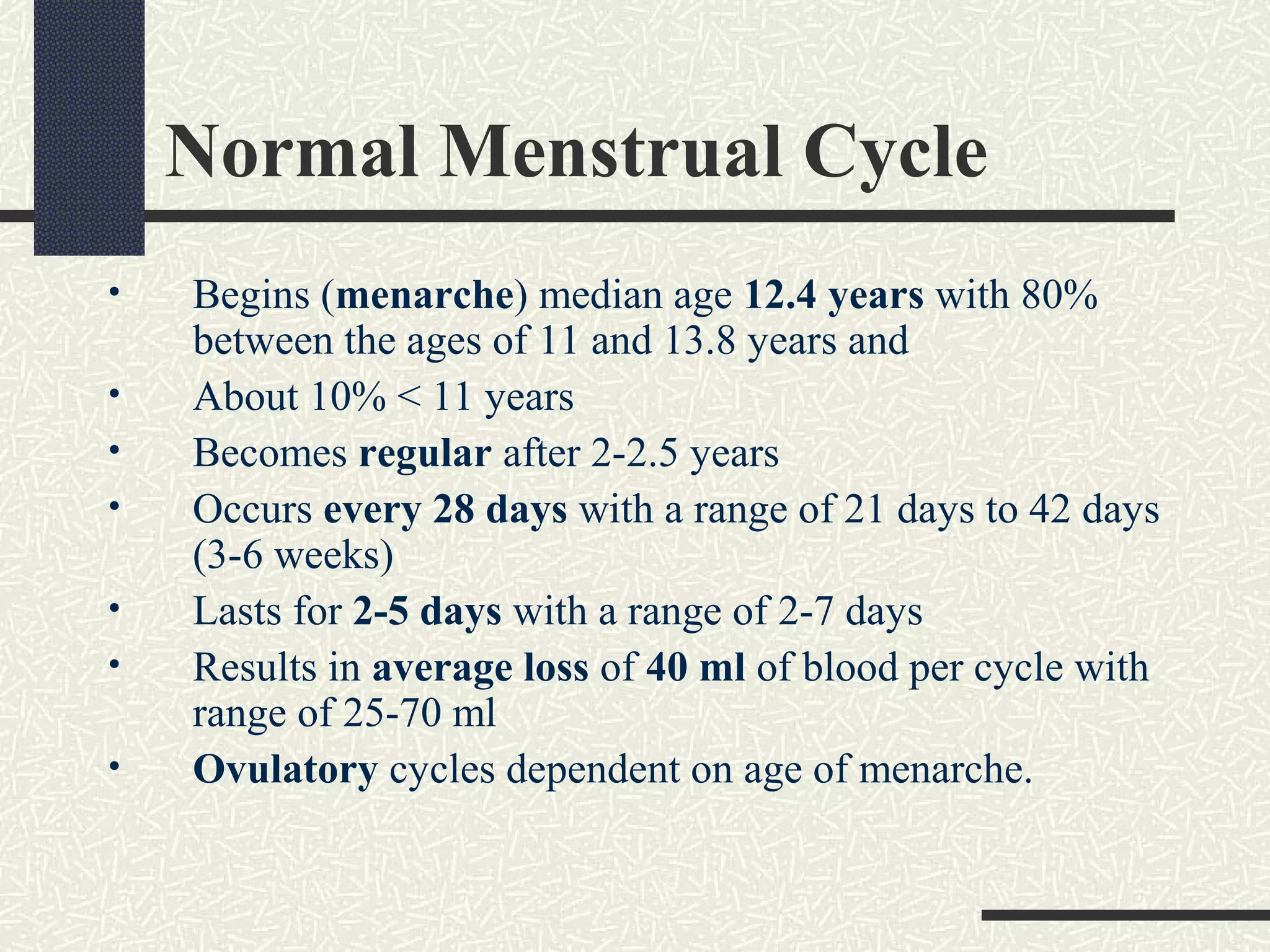
• Begins (menarche) median age 12.4 years with 80%
between the ages of 11 and 13.8 years and
• About 10% < 11 years
• Becomes regular after 2-2.5 years
• Occurs every 28 days with a range of 21 days to 42 days
(3-6 weeks)
• Lasts for 2-5 days with a range of 2-7 days
• Results in average loss of 40 ml of blood per cycle with
range of 25-70 ml
• Ovulatory cycles dependent on age of menarche.
Menstrual Irregularities
This abnormality of menstruation can mean
many variations. But can be grouped into:
1. Variations in frequency:
2. Variations in amount
3. Variations in amount and duration
Menstrual Irregularities
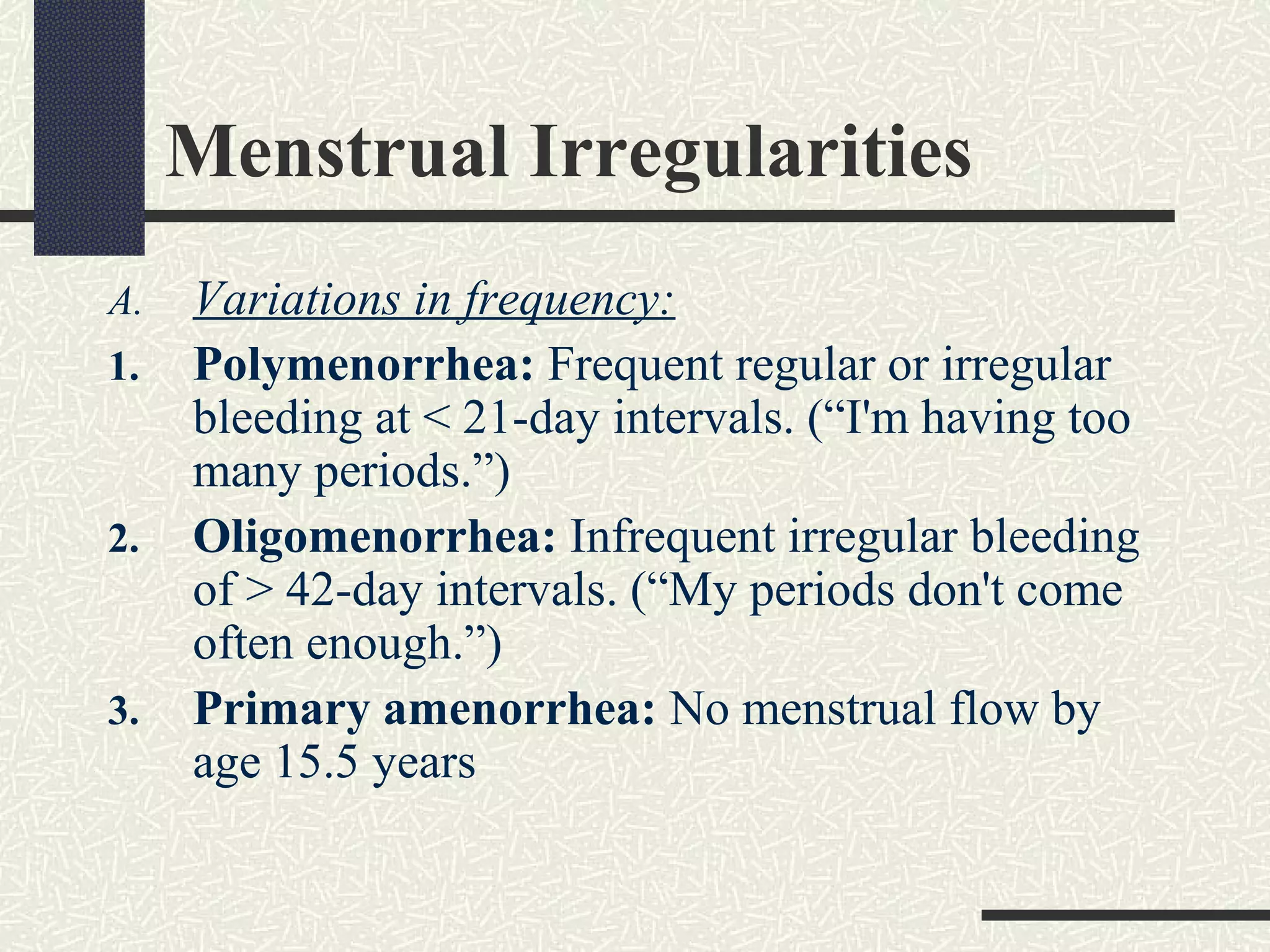
A. Variations in frequency:
1. Polymenorrhea: Frequent regular or irregular
bleeding at < 21-day intervals. (“I'm having too
many periods.”)
2. Oligomenorrhea: Infrequent irregular bleeding
of > 42-day intervals. (“My periods don't come
often enough.”)
3. Primary amenorrhea: No menstrual flow by
age 15.5 years
Menstrual Irregularities
4. Secondary amenorrhea: Absence of
vaginal bleeding for > 3 months. (“I
haven't had a period in months.”)
Menstrual Irregularities
B. Variations in amount and duration:
1. Metrorrhagia: Intermenstrual irregular bleeding
between regular periods. (“I'm bleeding between my
periods.”)
• Menorrhagia: Excessive amount and increased duration
uterine bleeding occurring regularly. (“My periods are
too long and too heavy and come too often.”)
• Dysfunctional uterine bleeding: Prolonged excessive
menstrual bleeding associated with irregular periods
usually due to anovulation in adolescence. (“I've been
bleeding for 3 straight weeks.”)
Menstrual Irregularities
C. Variations in amount:
1. Hypomenorrhea: Decreased menstrual
flow occurring at regular intervals. (“My
periods are too light.”)
2. Hypermenorrhea: Profuse menstrual
flow of normal duration and occurring at
regular intervals. (“My periods are too
heavy.”)
Prevalence and risksPrevalence and risks
9-30% of reproductive-aged women have
menstrual irregularities requiring medical
evaluation.
Regular vigorous exercise is associated with
decreased estrogen levels in the blood.
Any risk factor that may alter endocrine control
(e.g. stress, endocrine disruptor) can result in
cycle irregularities.
Causes
Menstrual period changes are usually a
symptom of endocrine imbalance.
Changes in the amount or timing of
hormones released by the thyroid, adrenal
and pituitary glands, or hypothalmus may
cause the ovary to delay or skip ovulation.
Potential causes of Menstrual variations
Miscalculation.
Stress.
The hormones that control menstruation are
sensitive to stress whether domestic, occupational
or social.
Excessive weight loss.
Eating disorders. These include the psychiatric
diseases anorexia and bulimia.
Excessive exercise..
Potential causes of Menstrual variations
Medications. Birth control pills are a good
example.
Medical and surgical diseases of the pelvic
organs.
- such as polycystic ovarian syndrome.
Menopause. When menopause approaches,
women may have some missed cycles.
Causes of Polymenorrhoea
stress,
excessive exercise,
medications
perimenopause.
polycystic ovarian disease.
PID
STIs esp. Clamydia and Gonorrhoea
Causes of Metrorrhagia
Cervical polyps.
endometritis (infection of the uterus)
Birth control pills (oral contraceptives).
Sometimes an identifiable
Benign causes of menorrhagia
Uterine fibroids (benign tumors of smooth muscle
tissue),
endometrial polyps (tiny benign growths that
protrude into the womb)
adenomyosis (the presence of uterine lining tissue
within the muscular wall of the uterus),
intrauterine devices (IUD's),
underactive thyroid function (hypothyroidism),
Causes of menorrhagia
an autoimmune disorder systemic lupus
erythematosus,
blood clotting disorders such as inherited bleeding
disorders
Drugs , especially those that interfere with blood
clotting.
. Rarely, menorrhagia can be a sign of endometrial
cancer or endometrial hyperplasia ( 40yrs)˃
Dysfunctional Uterine Bleeding
Dysfunctional uterine bleeding (DUB) is
defined as abnormal uterine bleeding in the
absence of organic disease. Dysfunctional
uterine bleeding is the most common cause
of abnormal vaginal bleeding during a
woman's reproductive years
Dysfunctional Uterine Bleeding (DUB)
A. Pathogenesis
1. Lack of positive feedback response by the
hypothalamic pituitary system to estrogen
2. Unopposed estrogen effect of the endometrium
3. No dominant follicle with uncontrolled growth and
atresia of many follicles, resulting in fluctuation of
circulating estrogens
4. Endometrial shedding dependent on amount of
proliferative endometrium present
5. Without ovulation, imbalance of the ratio of
prostaglandins (PGs) produced with the PGF2
(vasoconstrictor) and PGE (vasodilator)
Dysfunctional Uterine Bleeding (DUB)
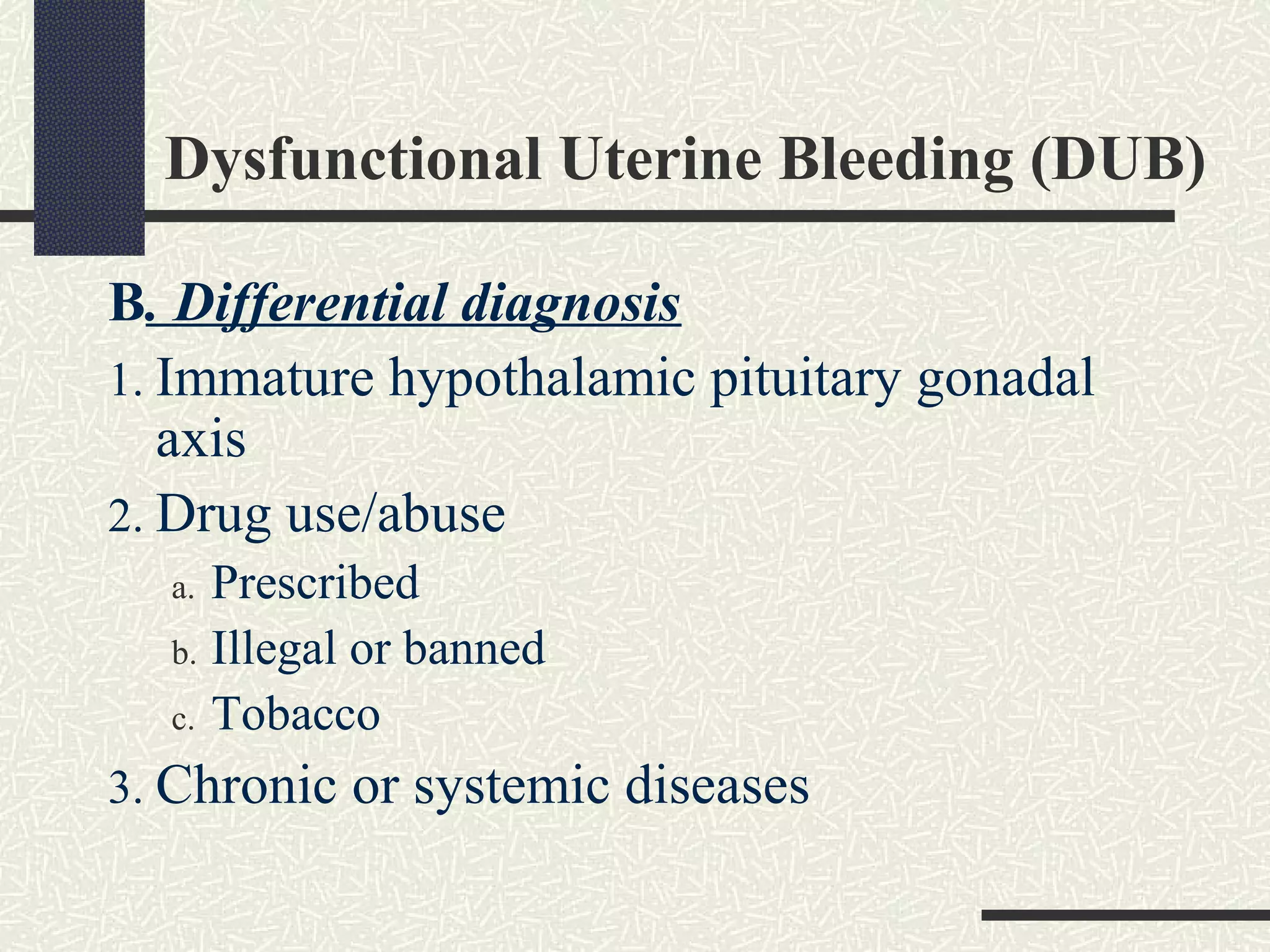
B. Differential diagnosis
1. Immature hypothalamic pituitary gonadal
axis
2. Drug use/abuse
a. Prescribed
b. Illegal or banned
c. Tobacco
3. Chronic or systemic diseases
Dysfunctional Uterine Bleeding (DUB)
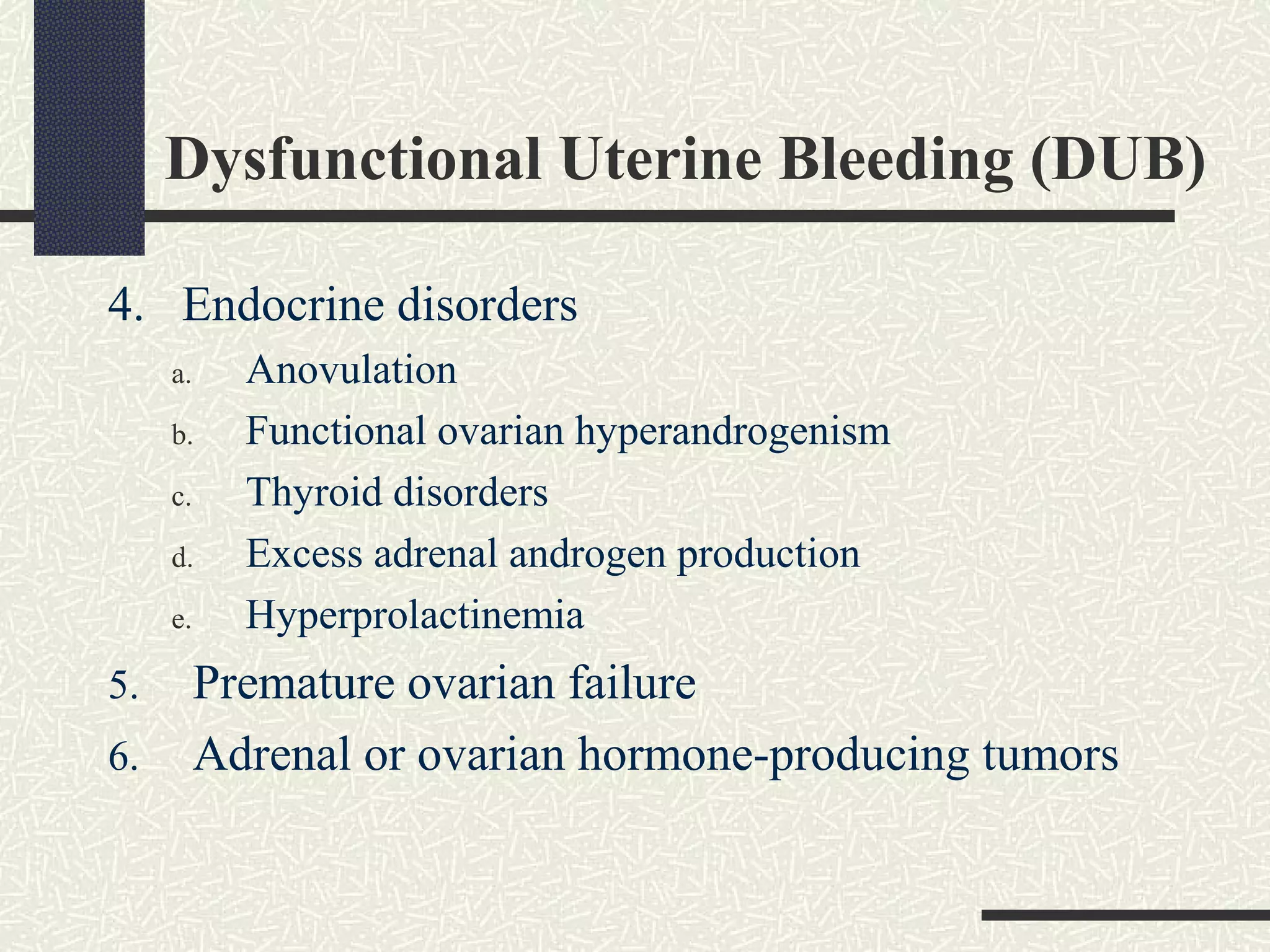
4. Endocrine disorders
a. Anovulation
b. Functional ovarian hyperandrogenism
c. Thyroid disorders
d. Excess adrenal androgen production
e. Hyperprolactinemia
5. Premature ovarian failure
6. Adrenal or ovarian hormone-producing tumors
Treatment
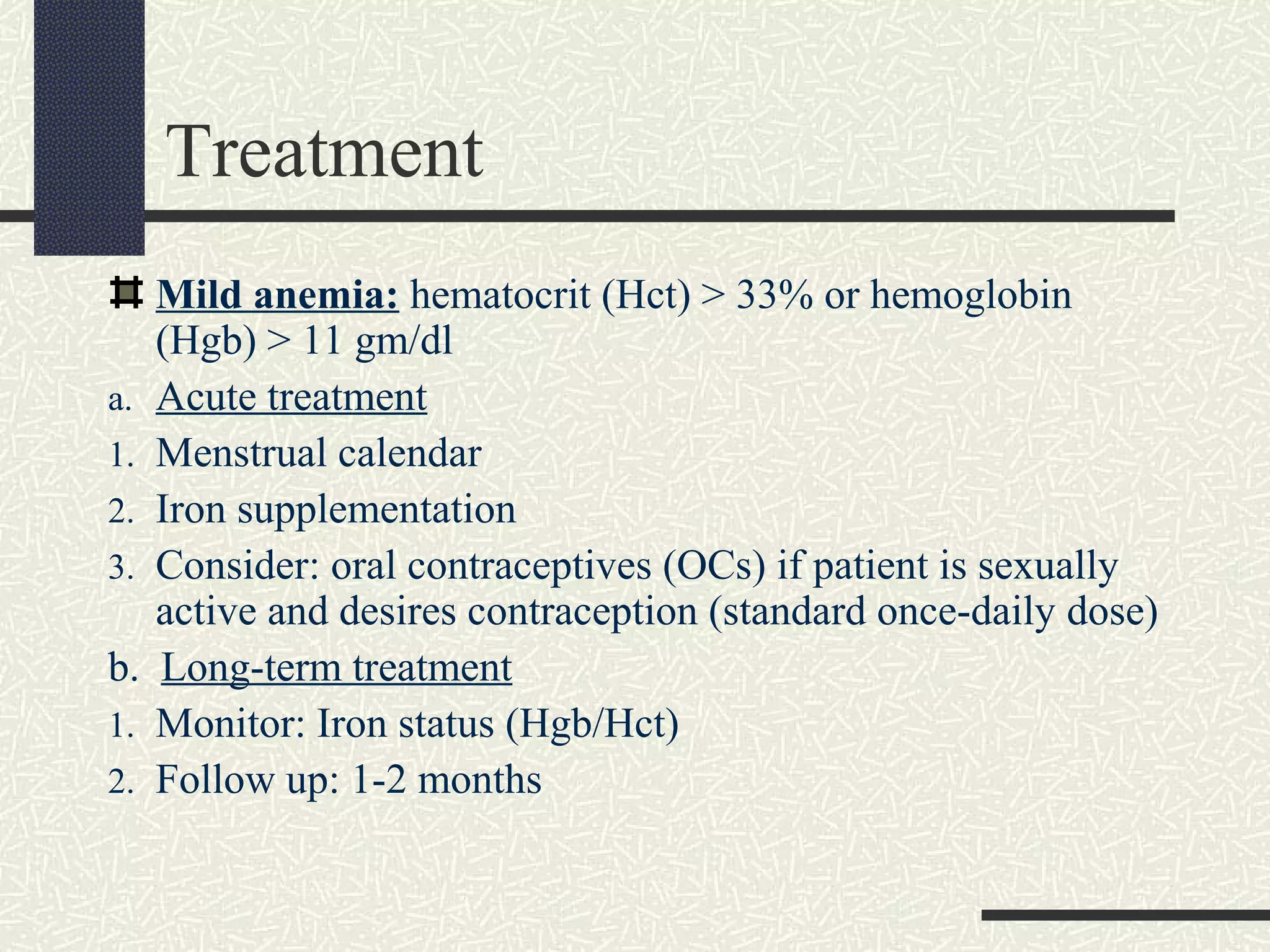
Mild anemia: hematocrit (Hct) > 33% or hemoglobin
(Hgb) > 11 gm/dl
a. Acute treatment
1. Menstrual calendar
2. Iron supplementation
3. Consider: oral contraceptives (OCs) if patient is sexually
active and desires contraception (standard once-daily dose)
b. Long-term treatment
1. Monitor: Iron status (Hgb/Hct)
2. Follow up: 1-2 months
Treatment
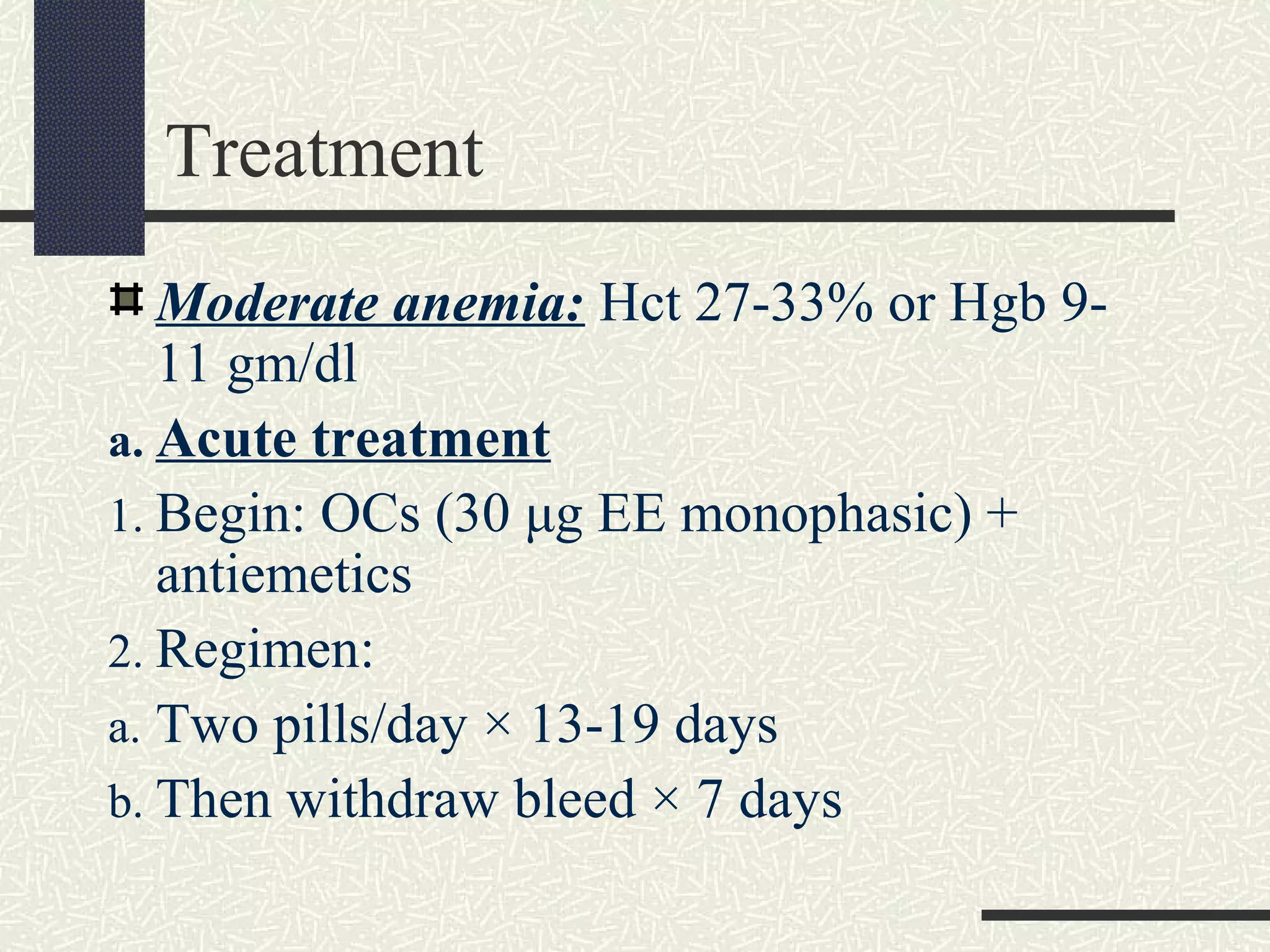
Moderate anemia: Hct 27-33% or Hgb 9-
11 gm/dl
a. Acute treatment
1. Begin: OCs (30 μg EE monophasic) +
antiemetics
2. Regimen:
a. Two pills/day × 13-19 days
b. Then withdraw bleed × 7 days
Treatment
b. Long-term treatment
1. OCs cycle for 3 months.
2. Begin OCs one pill a day the Sunday after
withdrawal bleeding begins.
3. Length of use dependent on resolution of
anemia. Iron supplementation.
4. Monitor: Iron status
5. Follow up: 2-3 weeks and every 3 months
Treatment
Severe anemia: Hct < 27% or Hgb < 9 gm/dl (or
dropping).
If Hgb < 7 gm/dl and actively bleeding, consider
admission to hospital for conjugated estrogens, 25
mg IV every 4-6 hours IV × 24 hours while
simultaneously beginning OCs.
Blood transfusion may be indicated after
hydration, when it becomes apparent anemia is
more profound.
Treatment
a. Acute treatment--If not actively bleeding, Hgb is
between 7 and 9 gm/dl, and orthostatics as measured by
heart rate and blood pressure are negative, initial
treatment may be limited to two pills a day for the next 2-
3 weeks, followed by a withdrawal bleed.
1. Begin: OCs (30 μg EE monophasic) + antiemetics
a. 4 pills/day × 4 days
b. 3 pills/day × 4 days
c. 2 pills/day × 13-19 days
d. Withdrawal bleeding × 7 days
Treatment
b. Long-term treatment
1. Cycle with OCs, one pill a day starting the
Sunday after withdrawal bleeding begins
2. Length of OC use dependent on resolution
of anemia. Iron supplementation.
3. Monitor: Iron status
4. Follow up: 2-3 weeks and every 3 months

Variations in menstrual cycle mbbs lectures.-1

  • 1.
    Variations in menstrualcycle Dr. AG Mairiga Dept of Obst & Gynaecol, CMS University of Maiduguri, Maiduguri
  • 2.
    Normal Menstrual Cycle •Begins (menarche) median age 12.4 years with 80% between the ages of 11 and 13.8 years and • About 10% < 11 years • Becomes regular after 2-2.5 years • Occurs every 28 days with a range of 21 days to 42 days (3-6 weeks) • Lasts for 2-5 days with a range of 2-7 days • Results in average loss of 40 ml of blood per cycle with range of 25-70 ml • Ovulatory cycles dependent on age of menarche.
  • 3.
    Menstrual Irregularities This abnormalityof menstruation can mean many variations. But can be grouped into: 1. Variations in frequency: 2. Variations in amount 3. Variations in amount and duration
  • 4.
    Menstrual Irregularities A. Variationsin frequency: 1. Polymenorrhea: Frequent regular or irregular bleeding at < 21-day intervals. (“I'm having too many periods.”) 2. Oligomenorrhea: Infrequent irregular bleeding of > 42-day intervals. (“My periods don't come often enough.”) 3. Primary amenorrhea: No menstrual flow by age 15.5 years
  • 5.
    Menstrual Irregularities 4. Secondaryamenorrhea: Absence of vaginal bleeding for > 3 months. (“I haven't had a period in months.”)
  • 6.
    Menstrual Irregularities B. Variationsin amount and duration: 1. Metrorrhagia: Intermenstrual irregular bleeding between regular periods. (“I'm bleeding between my periods.”) • Menorrhagia: Excessive amount and increased duration uterine bleeding occurring regularly. (“My periods are too long and too heavy and come too often.”) • Dysfunctional uterine bleeding: Prolonged excessive menstrual bleeding associated with irregular periods usually due to anovulation in adolescence. (“I've been bleeding for 3 straight weeks.”)
  • 7.
    Menstrual Irregularities C. Variationsin amount: 1. Hypomenorrhea: Decreased menstrual flow occurring at regular intervals. (“My periods are too light.”) 2. Hypermenorrhea: Profuse menstrual flow of normal duration and occurring at regular intervals. (“My periods are too heavy.”)
  • 8.
    Prevalence and risksPrevalenceand risks 9-30% of reproductive-aged women have menstrual irregularities requiring medical evaluation. Regular vigorous exercise is associated with decreased estrogen levels in the blood. Any risk factor that may alter endocrine control (e.g. stress, endocrine disruptor) can result in cycle irregularities.
  • 9.
    Causes Menstrual period changesare usually a symptom of endocrine imbalance. Changes in the amount or timing of hormones released by the thyroid, adrenal and pituitary glands, or hypothalmus may cause the ovary to delay or skip ovulation.
  • 10.
    Potential causes ofMenstrual variations Miscalculation. Stress. The hormones that control menstruation are sensitive to stress whether domestic, occupational or social. Excessive weight loss. Eating disorders. These include the psychiatric diseases anorexia and bulimia. Excessive exercise..
  • 11.
    Potential causes ofMenstrual variations Medications. Birth control pills are a good example. Medical and surgical diseases of the pelvic organs. - such as polycystic ovarian syndrome. Menopause. When menopause approaches, women may have some missed cycles.
  • 12.
    Causes of Polymenorrhoea stress, excessiveexercise, medications perimenopause. polycystic ovarian disease. PID STIs esp. Clamydia and Gonorrhoea
  • 13.
    Causes of Metrorrhagia Cervicalpolyps. endometritis (infection of the uterus) Birth control pills (oral contraceptives). Sometimes an identifiable
  • 14.
    Benign causes ofmenorrhagia Uterine fibroids (benign tumors of smooth muscle tissue), endometrial polyps (tiny benign growths that protrude into the womb) adenomyosis (the presence of uterine lining tissue within the muscular wall of the uterus), intrauterine devices (IUD's), underactive thyroid function (hypothyroidism),
  • 15.
    Causes of menorrhagia anautoimmune disorder systemic lupus erythematosus, blood clotting disorders such as inherited bleeding disorders Drugs , especially those that interfere with blood clotting. . Rarely, menorrhagia can be a sign of endometrial cancer or endometrial hyperplasia ( 40yrs)˃
  • 16.
    Dysfunctional Uterine Bleeding Dysfunctionaluterine bleeding (DUB) is defined as abnormal uterine bleeding in the absence of organic disease. Dysfunctional uterine bleeding is the most common cause of abnormal vaginal bleeding during a woman's reproductive years
  • 17.
    Dysfunctional Uterine Bleeding(DUB) A. Pathogenesis 1. Lack of positive feedback response by the hypothalamic pituitary system to estrogen 2. Unopposed estrogen effect of the endometrium 3. No dominant follicle with uncontrolled growth and atresia of many follicles, resulting in fluctuation of circulating estrogens 4. Endometrial shedding dependent on amount of proliferative endometrium present 5. Without ovulation, imbalance of the ratio of prostaglandins (PGs) produced with the PGF2 (vasoconstrictor) and PGE (vasodilator)
  • 18.
    Dysfunctional Uterine Bleeding(DUB) B. Differential diagnosis 1. Immature hypothalamic pituitary gonadal axis 2. Drug use/abuse a. Prescribed b. Illegal or banned c. Tobacco 3. Chronic or systemic diseases
  • 19.
    Dysfunctional Uterine Bleeding(DUB) 4. Endocrine disorders a. Anovulation b. Functional ovarian hyperandrogenism c. Thyroid disorders d. Excess adrenal androgen production e. Hyperprolactinemia 5. Premature ovarian failure 6. Adrenal or ovarian hormone-producing tumors
  • 20.
    Treatment Mild anemia: hematocrit(Hct) > 33% or hemoglobin (Hgb) > 11 gm/dl a. Acute treatment 1. Menstrual calendar 2. Iron supplementation 3. Consider: oral contraceptives (OCs) if patient is sexually active and desires contraception (standard once-daily dose) b. Long-term treatment 1. Monitor: Iron status (Hgb/Hct) 2. Follow up: 1-2 months
  • 21.
    Treatment Moderate anemia: Hct27-33% or Hgb 9- 11 gm/dl a. Acute treatment 1. Begin: OCs (30 μg EE monophasic) + antiemetics 2. Regimen: a. Two pills/day × 13-19 days b. Then withdraw bleed × 7 days
  • 22.
    Treatment b. Long-term treatment 1.OCs cycle for 3 months. 2. Begin OCs one pill a day the Sunday after withdrawal bleeding begins. 3. Length of use dependent on resolution of anemia. Iron supplementation. 4. Monitor: Iron status 5. Follow up: 2-3 weeks and every 3 months
  • 23.
    Treatment Severe anemia: Hct< 27% or Hgb < 9 gm/dl (or dropping). If Hgb < 7 gm/dl and actively bleeding, consider admission to hospital for conjugated estrogens, 25 mg IV every 4-6 hours IV × 24 hours while simultaneously beginning OCs. Blood transfusion may be indicated after hydration, when it becomes apparent anemia is more profound.
  • 24.
    Treatment a. Acute treatment--Ifnot actively bleeding, Hgb is between 7 and 9 gm/dl, and orthostatics as measured by heart rate and blood pressure are negative, initial treatment may be limited to two pills a day for the next 2- 3 weeks, followed by a withdrawal bleed. 1. Begin: OCs (30 μg EE monophasic) + antiemetics a. 4 pills/day × 4 days b. 3 pills/day × 4 days c. 2 pills/day × 13-19 days d. Withdrawal bleeding × 7 days
  • 25.
    Treatment b. Long-term treatment 1.Cycle with OCs, one pill a day starting the Sunday after withdrawal bleeding begins 2. Length of OC use dependent on resolution of anemia. Iron supplementation. 3. Monitor: Iron status 4. Follow up: 2-3 weeks and every 3 months