On the 16th of January, Google announced that mainstream
sale of Google Glass to consumers would cease and, although
they say the project isn’t dead, it does mean that one of the
most ambitious wearable tech projects has just taken a long
step back. So what might Google’s move mean?
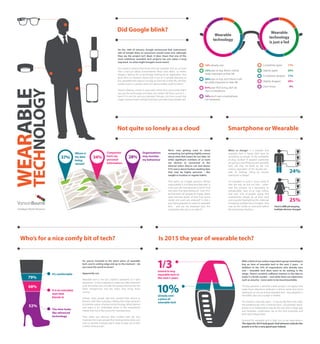
Our research showed that those who see wearable tech as no more
than a fad just about outnumbered those who didn’t, so there’s
already a feeling this is technology looking for an application. And
given that our research shows that 9 out of 10 people planning to
buy wearable tech expect it to play an vital role in their life, will they
readily invest in a product that isn’t demonstrably useful to them?
There’s a feeling current in some parts of the tech community that if
you put the technology out there, the market will find a use for it –
even if it’s not the one you intended. Perhaps, this time round, that
magic moment hasn’t arrived. And that’s precisely what Google saw.
Did Google blink?
Not quite so lonely as a cloud
Who’s for a nice comfy bit of tech? Is 2015 the year of wearable tech?
Smartphone or Wearable
WEARABLE
TECHNOLOGY
We’re now getting used to cloud
computing, but getting slightly uneasy
about what that means for our data. So
while significant numbers of us want
our devices to connected to the
internet when they’re out and about,
41% worry about hackers stealing data
that may be highly personal – like
weight or location or regular habits.
That opens up a bigger question: Whose
responsibility is it to keep that data safe? Is
it the user, the manufacturer or both? And
who does that data belong to? Even if it’s
anonymised will people be happy about
quite intimate details of their lives being
stored and used and analysed? Is that a
pact we’re prepared to make for wearable
tech - and are we prepared trust the
companies who ask us to make it?
So, you’ve invested in the latest piece of wearable
tech, you’re cutting edge and up to the moment – do
you want the world to know?
Apparently not.
Wearable tech is not yet a fashion statement or a tech
statement – in fact it appears to make very little statement
at all. And when you consider the queues that form for the
latest smartphones and the kudos they bring, that’s
curious.
Indeed, more people said they wanted their device to
blend in with their everyday clothing than they wanted it
to look like a piece of advanced technology. When fashion
and status is an undeniable driver in the smartphone
market that has to be a worry for manufacturers.
Then when you discover that comfort rates are very
important for more people than looking techie does, you
have to wonder if people aren’t ready to step out of their
comfort zone just yet…
With a third of our online respondent group intending to
buy an item of wearable tech in the next 2 years - in
addition to the 10% of respondents who already own
one – wearable tech does seem to be waiting in the
wings. There’s certainly sufficient interest in the idea to
make it a fertile market – and while there are objections
such as security - none seem to be insurmountable.
The big question is whether a killer product can appear and
make those objections irrelevant. It almost seems that we’re
waiting for an excuse to buy wearable tech - that adoption is
inevitable, that just a nudge is needed.
The market is still wide open – it may be Big Tech who make
the breakthrough with a multi-function, cloud-based, block-
buster, or an independent may do the trick with a cheap app
and hardware combination we at first find irresistible and
then slyly indispensible.
Demand for wearable tech is high, but so are expectations.
The signs for 2015 look good. And whoever unlocks the
puzzle is in for a very good year indeed.
37% 34% 28%
Where is
my data
being
stored?
Companies
have my
personal
information
Organisations
may monitor
my behaviour
intend to buy
wearable tech in
the next 2 years
already own
a piece of
wearable tech
1/3
10%
Wearable
technology
is just a fad
Wearable
technology
10% already own
12% plan to buy, think it will be
vitally important to their life
20% plan to buy, don’t think it will
be vitally important to their life
41% plan NOT to buy, BUT do
own a smartphone
16% don’t own a smartphone,
not interested
Completely agree 17%
Slightly agree 29%
Completely disagree 17%
Slightly disagree 28%
Don’t Know 9%
It’s comfortable
It is an everyday
item that
blends in
The item looks
like advanced
technology
52%
68%
79%
Who’s in charge? Is it possible that
wearable tech is being held back by
something as prosaic as the availability
of plug sockets? If people’s wardrobes
are going to start filling up with wearable
tech, will they be faced by the 21st
century equivalent of the laundry bin -
piles of clothing sitting by sockets
waiting for a charge?
For wearable to work it must surely fit
with the way we live our lives – other-
wise the promise of it becoming an
indispensible ‘part of us’ rings hollow.
And with 31% of people saying that
smartphones already do all they need
and a quarter highlighting the challenge
of keeping multiple items charged - that
may be the hurdle to overcome before
the mainstream beckons.
24%
25%
I find it difficult keeping
multiple devices charged

Vanson Bourne Key Findings: Wearable Tech

  • 1.
    On the 16thof January, Google announced that mainstream sale of Google Glass to consumers would cease and, although they say the project isn’t dead, it does mean that one of the most ambitious wearable tech projects has just taken a long step back. So what might Google’s move mean? Our research showed that those who see wearable tech as no more than a fad just about outnumbered those who didn’t, so there’s already a feeling this is technology looking for an application. And given that our research shows that 9 out of 10 people planning to buy wearable tech expect it to play an vital role in their life, will they readily invest in a product that isn’t demonstrably useful to them? There’s a feeling current in some parts of the tech community that if you put the technology out there, the market will find a use for it – even if it’s not the one you intended. Perhaps, this time round, that magic moment hasn’t arrived. And that’s precisely what Google saw. Did Google blink? Not quite so lonely as a cloud Who’s for a nice comfy bit of tech? Is 2015 the year of wearable tech? Smartphone or Wearable WEARABLE TECHNOLOGY We’re now getting used to cloud computing, but getting slightly uneasy about what that means for our data. So while significant numbers of us want our devices to connected to the internet when they’re out and about, 41% worry about hackers stealing data that may be highly personal – like weight or location or regular habits. That opens up a bigger question: Whose responsibility is it to keep that data safe? Is it the user, the manufacturer or both? And who does that data belong to? Even if it’s anonymised will people be happy about quite intimate details of their lives being stored and used and analysed? Is that a pact we’re prepared to make for wearable tech - and are we prepared trust the companies who ask us to make it? So, you’ve invested in the latest piece of wearable tech, you’re cutting edge and up to the moment – do you want the world to know? Apparently not. Wearable tech is not yet a fashion statement or a tech statement – in fact it appears to make very little statement at all. And when you consider the queues that form for the latest smartphones and the kudos they bring, that’s curious. Indeed, more people said they wanted their device to blend in with their everyday clothing than they wanted it to look like a piece of advanced technology. When fashion and status is an undeniable driver in the smartphone market that has to be a worry for manufacturers. Then when you discover that comfort rates are very important for more people than looking techie does, you have to wonder if people aren’t ready to step out of their comfort zone just yet… With a third of our online respondent group intending to buy an item of wearable tech in the next 2 years - in addition to the 10% of respondents who already own one – wearable tech does seem to be waiting in the wings. There’s certainly sufficient interest in the idea to make it a fertile market – and while there are objections such as security - none seem to be insurmountable. The big question is whether a killer product can appear and make those objections irrelevant. It almost seems that we’re waiting for an excuse to buy wearable tech - that adoption is inevitable, that just a nudge is needed. The market is still wide open – it may be Big Tech who make the breakthrough with a multi-function, cloud-based, block- buster, or an independent may do the trick with a cheap app and hardware combination we at first find irresistible and then slyly indispensible. Demand for wearable tech is high, but so are expectations. The signs for 2015 look good. And whoever unlocks the puzzle is in for a very good year indeed. 37% 34% 28% Where is my data being stored? Companies have my personal information Organisations may monitor my behaviour intend to buy wearable tech in the next 2 years already own a piece of wearable tech 1/3 10% Wearable technology is just a fad Wearable technology 10% already own 12% plan to buy, think it will be vitally important to their life 20% plan to buy, don’t think it will be vitally important to their life 41% plan NOT to buy, BUT do own a smartphone 16% don’t own a smartphone, not interested Completely agree 17% Slightly agree 29% Completely disagree 17% Slightly disagree 28% Don’t Know 9% It’s comfortable It is an everyday item that blends in The item looks like advanced technology 52% 68% 79% Who’s in charge? Is it possible that wearable tech is being held back by something as prosaic as the availability of plug sockets? If people’s wardrobes are going to start filling up with wearable tech, will they be faced by the 21st century equivalent of the laundry bin - piles of clothing sitting by sockets waiting for a charge? For wearable to work it must surely fit with the way we live our lives – other- wise the promise of it becoming an indispensible ‘part of us’ rings hollow. And with 31% of people saying that smartphones already do all they need and a quarter highlighting the challenge of keeping multiple items charged - that may be the hurdle to overcome before the mainstream beckons. 24% 25% I find it difficult keeping multiple devices charged