COMPETENCY-BASED
SALARY + REWARD
STRUCTURE
Training Session and Workshop

Kenny Ong


            http://totallyunrelatedrandomanddebatable.blogspot.com/
Intro


• Day Care Center


       http://totallyunrelatedrandomanddebatable.blogspot.com/
Part A
HRM STRATEGY AND
REWARD STRATEGY

         http://totallyunrelatedrandomanddebatable.blogspot.com/
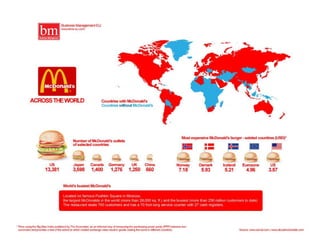
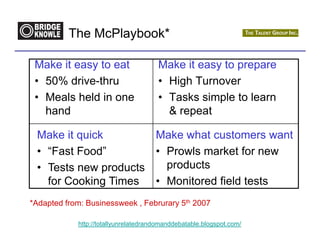
The McPlaybook*

 Make it easy to eat                   Make it easy to prepare
 • 50% drive-thru                      • High Turnover
 • Meals held in one                   • Tasks simple to learn
   hand                                  & repeat

 Make it quick        Make what customers want
 • “Fast Food”        • Prowls market for new
 • Tests new products   products
   for Cooking Times • Monitored field tests
*Adapted from: Businessweek , Februrary 5th 2007

            http://totallyunrelatedrandomanddebatable.blogspot.com/
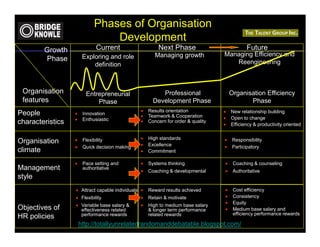
Phases of Organisation
                             Development
        Growth            Current                     Next Phase                          Future
                    Exploring and role              Managing growth            Managing Efficiency and
        Phase                                                                     Reengineering
                        definition


 Organisation         Entrepreneurial                 Professional                 Organisation Efficiency
 features                 Phase                    Development Phase                      Phase
                                              • Results orientation            • New relationship building
People            • Innovation                • Teamwork & Cooperation
                  • Enthusiastic                                               • Open to change
characteristics                               • Concern for order & quality
                                                                               • Efficiency & productivity oriented

                                              • High standards
Organisation      • Flexibility
                                              • Excellence
                                                                               • Responsibility
                  • Quick decision making                                      • Participatory
climate                                       • Commitment

                  • Pace setting and          • Systems thinking               • Coaching & counseling
Management          authoritative
                                              • Coaching & developmental       • Authoritative
style
                  • Attract capable individuals • Reward results achieved      •    Cost efficiency
                  • Flexibility                 • Retain & motivate            •    Consistency
                                                                               •    Equity
                  • Variable base salary &      • High to medium base salary
Objectives of       effectiveness related         & longer term performance    •    Medium base salary and
                    performance rewards           related rewards                   efficiency performance rewards
HR policies
                   http://totallyunrelatedrandomanddebatable.blogspot.com/
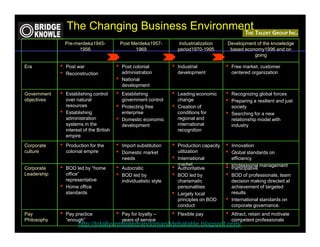
The Changing Business Environment
                 Pre-merdeka1945-              Post Merdeka1957-            Industrialization    Development of the knowledge
                       1956                          1969                  period1970-1995        based economy1996 and on
                                                                                                            going

Era          •   Post war                  •   Post colonial           •   Industrial            •   Free market, customer
             •   Reconstruction                administration              development               centered organization
                                           •   National
                                               development
Government   •   Establishing control      •   Establishing            •   Leading economic      •   Recognizing global forces
objectives       over natural                  government control          change                •   Preparing a resilient and just
                 resources                 •   Protecting free         •   Creation of               society
             •   Establishing                  enterprise                  conditions for        •   Searching for a new
                 administration            •   Domestic economic           regional and              relationship model with
                 systems in the                development                 international             industry
                 interest of the British                                   recognition
                 empire

Corporate    •   Production for the        •   Import substitution     •   Production capacity   •   Innovation
culture          colonial empire           •   Domestic market             utilization           •   Global standards on
                                               needs                   •   International             efficiency

Corporate    •   BOD led by “home          •   Autocratic              •
                                                                           market
                                                                           Authoritative
                                                                                                 •
                                                                                                 •   Professional management
                                                                                                     Participative
Leadership       office”                   •   BOD led by              •   BOD led by            •   BOD of professionals, team
                 representative                individualistic style       charismatic               decision making directed at
             •   Home office                                               personalities             achievement of targeted
                 standards                                             •   Largely local             results
                                                                           principles on BOD     •   International standards on
                                                                           conduct                   corporate governance.
Pay          •   Pay practice              •   Pay for loyalty –       •   Flexible pay          •   Attract, retain and motivate
Philosophy       “enough”                      years of service                                      competent professionals
                       http://totallyunrelatedrandomanddebatable.blogspot.com/
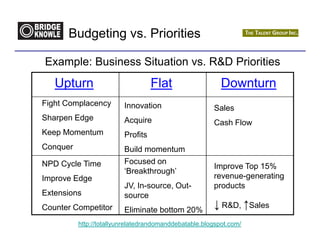
Budgeting vs. Priorities

Example: Business Situation vs. R&D Priorities
   Upturn                          Flat                   Downturn
Fight Complacency        Innovation                    Sales
Sharpen Edge             Acquire                       Cash Flow
Keep Momentum            Profits
Conquer                  Build momentum
NPD Cycle Time           Focused on
                                                       Improve Top 15%
                         ‘Breakthrough’
Improve Edge                                           revenue-generating
                         JV, In-source, Out-           products
Extensions               source
Counter Competitor       Eliminate bottom 20%
                                                       ↓ R&D, ↑Sales
          http://totallyunrelatedrandomanddebatable.blogspot.com/
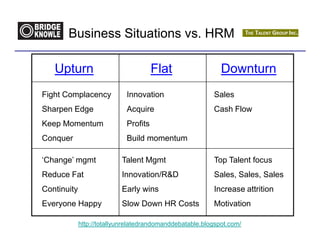
Business Situations vs. HRM

   Upturn                              Flat                  Downturn
Fight Complacency            Innovation                   Sales
Sharpen Edge                 Acquire                      Cash Flow
Keep Momentum                Profits
Conquer                      Build momentum

‘Change’ mgmt              Talent Mgmt                    Top Talent focus
Reduce Fat                 Innovation/R&D                 Sales, Sales, Sales
Continuity                 Early wins                     Increase attrition
Everyone Happy             Slow Down HR Costs             Motivation

             http://totallyunrelatedrandomanddebatable.blogspot.com/
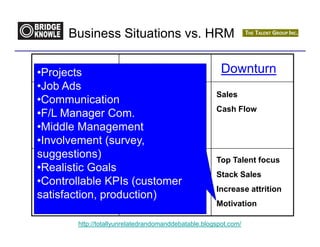
Business Situations vs. HRM

     Upturn
 •Projects                 Flat                          Downturn
 •Job Ads
 Fight Complacency  Innovation                         Sales
 •Communication
 Sharpen Edge       Acquire                            Cash Flow
 •F/L Manager Com.
 Keep Momentum      Profits
 •Middle Management
 Conquer
 •Involvement (survey, momentum
                    Build

 suggestions)
‘Change’ mgmt      Talent Mgmt                         Top Talent focus
 •Realistic Goals
Reduce Fat         Stack R&D                           Stack Sales
 •Controllable KPIs (customer
Continuity         Early wins                          Increase attrition
 satisfaction, production)
Everyone Happy          Slow Down HR Costs             Motivation

         http://totallyunrelatedrandomanddebatable.blogspot.com/
Staff Attraction & Retention
THE BATTLE FOR TALENT


      http://totallyunrelatedrandomanddebatable.blogspot.com/
Intro:


“Cow don’t drink water cannot
    push cow head down”


    http://totallyunrelatedrandomanddebatable.blogspot.com/
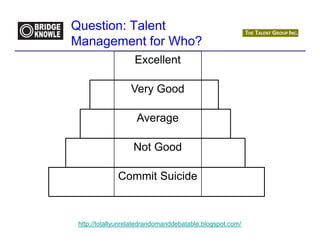
Question: Talent
Management for Who?
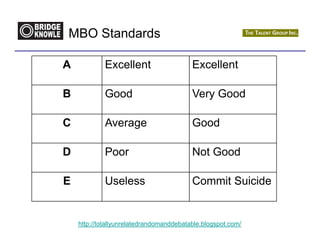
                    Excellent

                  Very Good

                    Average

                   Not Good

              Commit Suicide


 http://totallyunrelatedrandomanddebatable.blogspot.com/
Before we start…

1. Who designs your Talent
   Management programs?
2. Are you in the Talent Pool?
3. Do you qualify?
4. “It takes a crook to catch a crook”


       http://totallyunrelatedrandomanddebatable.blogspot.com/
Talent Segmentation

• Who are your Talents?


  : A Talent for others does not
 mean a Talent for you


        http://totallyunrelatedrandomanddebatable.blogspot.com/
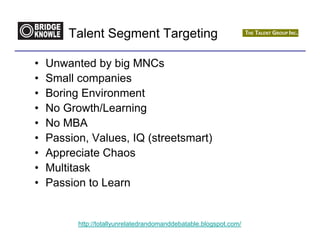
Talent Segment Targeting

•   Unwanted by big MNCs
•   Small companies
•   Boring Environment
•   No Growth/Learning
•   No MBA
•   Passion, Values, IQ (streetsmart)
•   Appreciate Chaos
•   Multitask
•   Passion to Learn


          http://totallyunrelatedrandomanddebatable.blogspot.com/
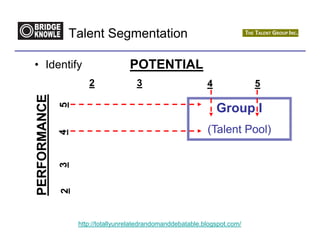
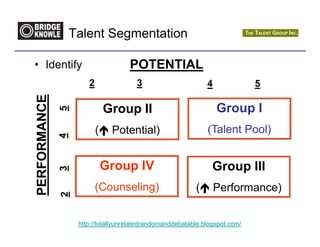
Talent Segmentation

• Identify                          POTENTIAL
                      2               3                       4              5
PERFORMANCE
              5


                                                                  Group I
                                                              (Talent Pool)
              4
              3
              2


                   http://totallyunrelatedrandomanddebatable.blogspot.com/
Talent Segmentation

• Identify                          POTENTIAL
                      2               3                       4              5
PERFORMANCE


                              Group II                            Group I
              5


                          (    Potential)                     (Talent Pool)
              4


                              Group IV                          Group III
              3


                          (Counseling)                    (       Performance)
              2


                   http://totallyunrelatedrandomanddebatable.blogspot.com/
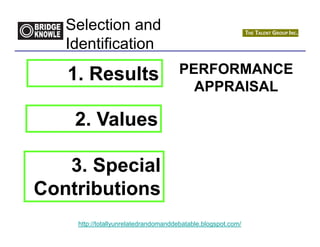
Selection and
   Identification
   1. Results                         PERFORMANCE
                                        APPRAISAL

    2. Values

   3. Special
Contributions
    http://totallyunrelatedrandomanddebatable.blogspot.com/
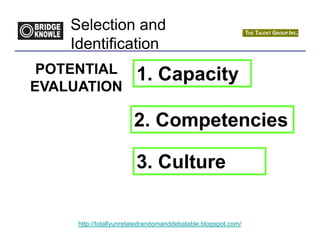
Selection and
    Identification
 POTENTIAL              1. Capacity
EVALUATION

                       2. Competencies

                        3. Culture

     http://totallyunrelatedrandomanddebatable.blogspot.com/
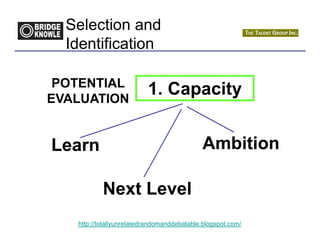
Selection and
  Identification

 POTENTIAL
EVALUATION
                          1. Capacity


Learn                                       Ambition

           Next Level
   http://totallyunrelatedrandomanddebatable.blogspot.com/
Selection and
   Identification

  POTENTIAL
 EVALUATION
                         2. Competencies


Competent                                     Pressure

   Reliable/Consistent
    http://totallyunrelatedrandomanddebatable.blogspot.com/
Selection and
   Identification

  POTENTIAL
 EVALUATION
                          3. Culture


Demonstrate                                  Influence

               Improve
    http://totallyunrelatedrandomanddebatable.blogspot.com/
Exercise


Define ‘Performance’                  Define ‘Potential’


         http://totallyunrelatedrandomanddebatable.blogspot.com/
Exercise

• Exercise:
1. Factors for Performance Appraisal
2. Factors for Potential Appraisal


        http://totallyunrelatedrandomanddebatable.blogspot.com/
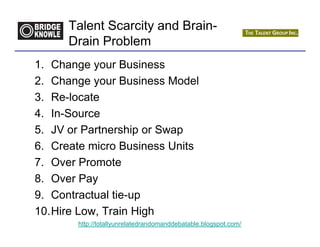
Talent Scarcity and Brain-
      Drain Problem
1. Change your Business
2. Change your Business Model
3. Re-locate
4. In-Source
5. JV or Partnership or Swap
6. Create micro Business Units
7. Over Promote
8. Over Pay
9. Contractual tie-up
10.Hire Low, Train High
       http://totallyunrelatedrandomanddebatable.blogspot.com/
SALARY & BENEFITS: HOW IT
FITS INTO THE BIGGER
SCHEME OF THINGS


   http://totallyunrelatedrandomanddebatable.blogspot.com/
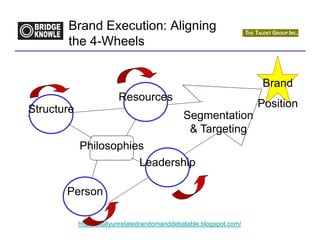
Brand Execution: Aligning
       the 4-Wheels


                                                                       Brand
                         Resources
Structure                                                             Position
                                               Segmentation
                                                & Targeting
            Philosophies
                       Leadership

       Person

            http://totallyunrelatedrandomanddebatable.blogspot.com/
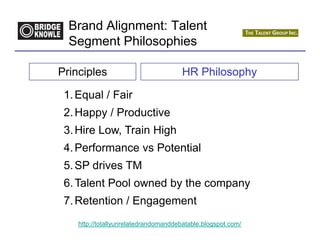
Brand Alignment: Talent
  Segment Philosophies

Principles                             HR Philosophy

 1. Equal / Fair
 2. Happy / Productive
 3. Hire Low, Train High
 4. Performance vs Potential
 5. SP drives TM
 6. Talent Pool owned by the company
 7. Retention / Engagement
    http://totallyunrelatedrandomanddebatable.blogspot.com/
Brand Alignment: Demographics
  Segment Philosophies?

Principles                             HR Philosophy


    http://totallyunrelatedrandomanddebatable.blogspot.com/
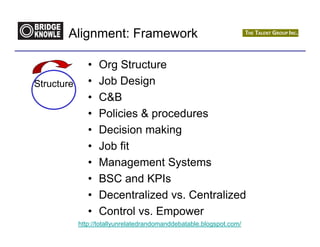
Alignment: Framework

               •   Org Structure
Structure      •   Job Design
               •   C&B
               •   Policies & procedures
               •   Decision making
               •   Job fit
               •   Management Systems
               •   BSC and KPIs
               •   Decentralized vs. Centralized
               •   Control vs. Empower
            http://totallyunrelatedrandomanddebatable.blogspot.com/
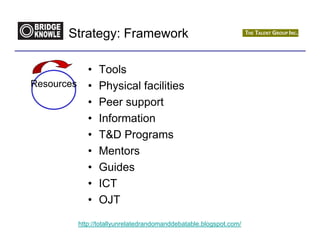
Strategy: Framework

          •   Tools
Resources •   Physical facilities
          •   Peer support
          •   Information
          •   T&D Programs
          •   Mentors
          •   Guides
          •   ICT
          •   OJT
        http://totallyunrelatedrandomanddebatable.blogspot.com/
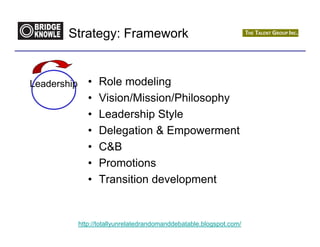
Strategy: Framework


Leadership      •   Role modeling
                •   Vision/Mission/Philosophy
                •   Leadership Style
                •   Delegation & Empowerment
                •   C&B
                •   Promotions
                •   Transition development


             http://totallyunrelatedrandomanddebatable.blogspot.com/
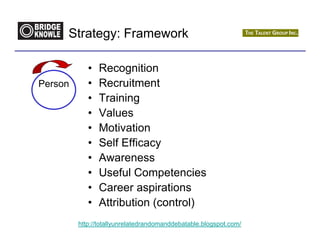
Strategy: Framework

            •   Recognition
Person      •   Recruitment
            •   Training
            •   Values
            •   Motivation
            •   Self Efficacy
            •   Awareness
            •   Useful Competencies
            •   Career aspirations
            •   Attribution (control)
         http://totallyunrelatedrandomanddebatable.blogspot.com/
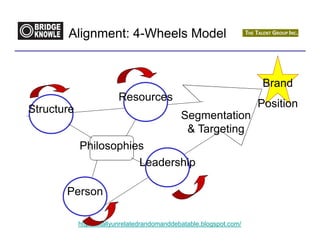
Alignment: 4-Wheels Model


                                                                       Brand
                         Resources
Structure                                                             Position
                                              Segmentation
                                               & Targeting
            Philosophies
                       Leadership

       Person

            http://totallyunrelatedrandomanddebatable.blogspot.com/
• Exercise: Use the 4-wheels to determine
  corporate alignment needs


        http://totallyunrelatedrandomanddebatable.blogspot.com/
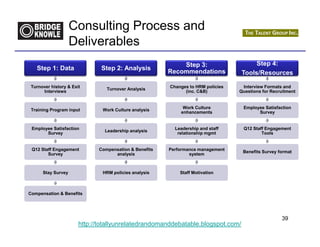
Consulting Process and
                    Deliverables
                                                            Step 3:                     Step 4:
   Step 1: Data               Step 2: Analysis
                                                        Recommendations            Tools/Resources

 Turnover history & Exit                                Changes to HRM policies    Interview Formats and
                                 Turnover Analysis
      Interviews                                              (inc. C&B)          Questions for Recruitment


                                                             Work Culture          Employee Satisfaction
 Training Program input        Work Culture analysis
                                                            enhancements                 Survey


 Employee Satisfaction                                    Leadership and staff     Q12 Staff Engagement
                                Leadership analysis
       Survey                                              relationship mgmt               Tools


 Q12 Staff Engagement         Compensation & Benefits   Performance management
                                                                                   Benefits Survey format
        Survey                      analysis                    system


      Stay Survey              HRM policies analysis        Staff Motivation


Compensation & Benefits


                                                                                                    39
                       http://totallyunrelatedrandomanddebatable.blogspot.com/
Part B
SALARY & BENEFITS


         http://totallyunrelatedrandomanddebatable.blogspot.com/
OPTIMIZING COMPENSATION
& BENEFITS

   http://totallyunrelatedrandomanddebatable.blogspot.com/
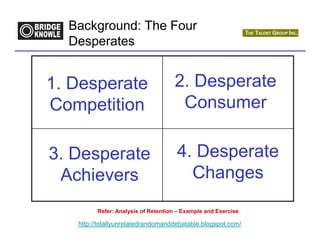
Background: The Four
  Desperates


1. Desperate                        2. Desperate
Competition                          Consumer

3. Desperate                         4. Desperate
 Achievers                             Changes
         Refer: Analysis of Retention – Example and Exercise

   http://totallyunrelatedrandomanddebatable.blogspot.com/
• Exercise: Define your Talent issues, limited to
  the most critical 4 aspects.


        http://totallyunrelatedrandomanddebatable.blogspot.com/
Principles and Objectives

   Principles                          Company’s Needs


1. Succession Planning of Key Leaders –
   Founding Directors (perpetual business theory)
2. Retention of Key Staff – especially younger
   ones
3. Transform into a Performance-based
   organization


       http://totallyunrelatedrandomanddebatable.blogspot.com/
Principles and Objectives

Principles                             HR Philosophy


 1. Equal / Fair
 2. Happy / Productive
 3. Hire Low, Train High
 4. Performance vs Potential
 5. Retention / Engagement


    http://totallyunrelatedrandomanddebatable.blogspot.com/
• Exercise: Define your Company-HRM Objectives
  and HRM Philosophies.


       http://totallyunrelatedrandomanddebatable.blogspot.com/
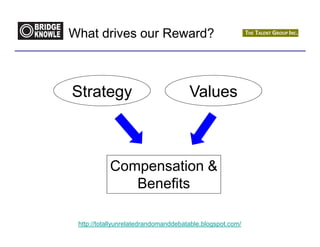
What drives our Reward?


Strategy                              Values


           Compensation &
              Benefits

 http://totallyunrelatedrandomanddebatable.blogspot.com/
Before we proceed…

Reality #1

                   Cash is King


      http://totallyunrelatedrandomanddebatable.blogspot.com/
Before we proceed…

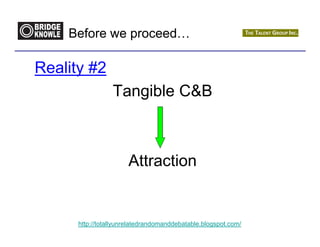
Reality #2
                 Tangible C&B


                      Attraction


      http://totallyunrelatedrandomanddebatable.blogspot.com/
Before we proceed…

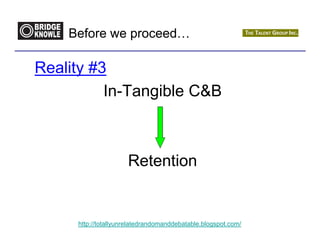
Reality #3
          In-Tangible C&B


                     Retention


     http://totallyunrelatedrandomanddebatable.blogspot.com/
Before we proceed…

Reality #4
          In-Tangible C&B


            Tipping Point for
           Attraction/Retention

     http://totallyunrelatedrandomanddebatable.blogspot.com/
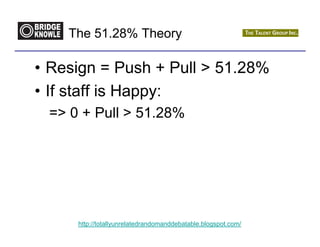
The 51.28% Theory

• Resign = Push + Pull > 51.28%
• If staff is Happy:
 => 0 + Pull > 51.28%


     http://totallyunrelatedrandomanddebatable.blogspot.com/
• Exercise: What “Values” drive your Talent
  Management strategies?

• How will these Values impact your HR and C&B
  policies?


        http://totallyunrelatedrandomanddebatable.blogspot.com/
Branding and Positioning:


“You don’t attract who you want.
    You attract who you are”
                                       John Maxwell


      http://totallyunrelatedrandomanddebatable.blogspot.com/
What to Pay?

•   Pay for Service
•   Pay for Job
•   Pay for Competency
•   Pay for Performance


        http://totallyunrelatedrandomanddebatable.blogspot.com/
Performance and Incentives

1. Internal Equity
  1. Internal Job Rates
  2. Performance differentials


2. External Competitiveness
  1. External Job Rates - Benchmarking
  2. Demand & Supply


       http://totallyunrelatedrandomanddebatable.blogspot.com/
What’s the Difference?

• Increment

• Bonus

• Promotion

      Exercise: How does your company
            define the difference?

       http://totallyunrelatedrandomanddebatable.blogspot.com/
How to choose a durian


   http://totallyunrelatedrandomanddebatable.blogspot.com/
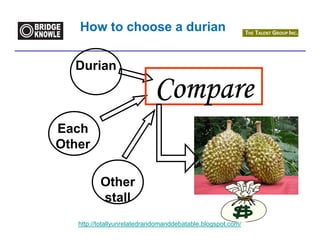
How to choose a durian

  Durian

                            Compare
Each
Other

          Other
          stall
   http://totallyunrelatedrandomanddebatable.blogspot.com/
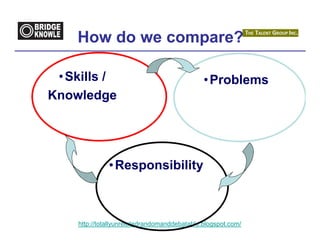
How do we compare?

 • Skills /                                   • Problems
Knowledge


              • Responsibility


    http://totallyunrelatedrandomanddebatable.blogspot.com/
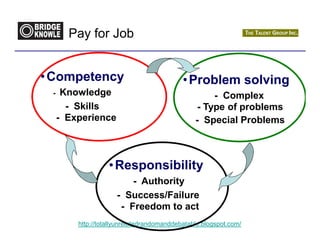
Pay for Job


• Competency                                • Problem solving
 -    Knowledge                                      - Complex
       - Skills                                  - Type of problems
     - Experience                               - Special Problems


                   • Responsibility
                          - Authority
                      - Success/Failure
                       - Freedom to act
         http://totallyunrelatedrandomanddebatable.blogspot.com/
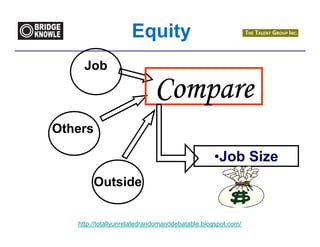
Equity
     Job

                            Compare
Others

                                                •Job Size
        Outside


   http://totallyunrelatedrandomanddebatable.blogspot.com/
What to Pay?

•   Pay for Service
•   Pay for Job
•   Pay for Competency
•   Pay for Performance


         Exercise: Which ones does your
             company use for Pay?

         http://totallyunrelatedrandomanddebatable.blogspot.com/
Pay For SERVICE


http://totallyunrelatedrandomanddebatable.blogspot.com/
“He has 20 years experience:
  1 year of bad experience
     repeated 20 times”


    http://totallyunrelatedrandomanddebatable.blogspot.com/
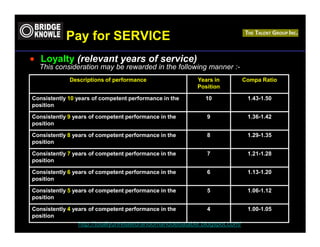
Pay for SERVICE
• Loyalty (relevant years of service)
  This consideration may be rewarded in the following manner :-
             Descriptions of performance                Years in          Compa Ratio
                                                        Position

Consistently 10 years of competent performance in the     10               1.43-1.50
position

Consistently 9 years of competent performance in the       9               1.36-1.42
position

Consistently 8 years of competent performance in the       8               1.29-1.35
position

Consistently 7 years of competent performance in the       7               1.21-1.28
position

Consistently 6 years of competent performance in the       6               1.13-1.20
position

Consistently 5 years of competent performance in the       5               1.06-1.12
position

Consistently 4 years of competent performance in the       4               1.00-1.05
position
                http://totallyunrelatedrandomanddebatable.blogspot.com/
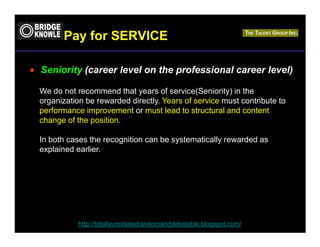
Pay for SERVICE

• Seniority (career level on the professional career level)

  We do not recommend that years of service(Seniority) in the
  organization be rewarded directly. Years of service must contribute to
  performance improvement or must lead to structural and content
  change of the position.

  In both cases the recognition can be systematically rewarded as
  explained earlier.


             http://totallyunrelatedrandomanddebatable.blogspot.com/
Pay For JOB


http://totallyunrelatedrandomanddebatable.blogspot.com/
Documentation
JOB DESIGN


    http://totallyunrelatedrandomanddebatable.blogspot.com/
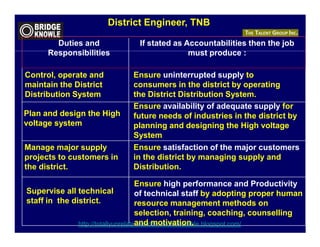
District Engineer, TNB

        Duties and              If stated as Accountabilities then the job
      Responsibilities                        must produce :

Control, operate and           Ensure uninterrupted supply to
maintain the District          consumers in the district by operating
Distribution System            the District Distribution System.
                               Ensure availability of adequate supply for
Plan and design the High       future needs of industries in the district by
voltage system                 planning and designing the High voltage
                               System
Manage major supply            Ensure satisfaction of the major customers
projects to customers in       in the district by managing supply and
the district.                  Distribution.

                                     Ensure high performance and Productivity
Supervise all technical              of technical staff by adopting proper human
staff in the district.               resource management methods on
                                     selection, training, coaching, counselling
                                     and motivation.
               http://totallyunrelatedrandomanddebatable.blogspot.com/
Results Driven


     Activity vs.
    Accountability


http://totallyunrelatedrandomanddebatable.blogspot.com/
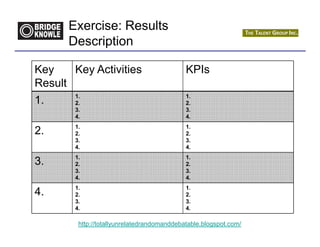
Exercise: Results
      Description

Key    Key Activities                       KPIs
Result
       1.                                   1.
1.     2.                                   2.
       3.                                   3.
       4.                                   4.
       1.                                   1.
2.     2.                                   2.
       3.                                   3.
       4.                                   4.
       1.                                   1.
3.     2.                                   2.
       3.                                   3.
       4.                                   4.
       1.                                   1.
4.     2.                                   2.
       3.                                   3.
       4.                                   4.

        http://totallyunrelatedrandomanddebatable.blogspot.com/
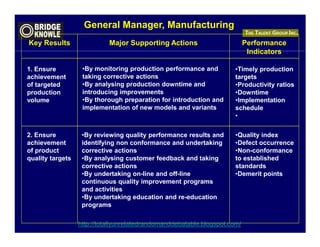
General Manager, Manufacturing
Key Results                 Major Supporting Actions                        Performance
                                                                             Indicators

1. Ensure          •By monitoring production performance and           •Timely production
achievement        taking corrective actions                           targets
of targeted        •By analysing production downtime and               •Productivity ratios
production         introducing improvements                            •Downtime
volume             •By thorough preparation for introduction and       •Implementation
                   implementation of new models and variants           schedule
                                                                       •


2. Ensure          •By reviewing quality performance results and       •Quality index
achievement        identifying non conformance and undertaking         •Defect occurrence
of product         corrective actions                                  •Non-conformance
quality targets    •By analysing customer feedback and taking          to established
                   corrective actions                                  standards
                   •By undertaking on-line and off-line                •Demerit points
                   continuous quality improvement programs
                   and activities
                   •By undertaking education and re-education
                   programs

                  http://totallyunrelatedrandomanddebatable.blogspot.com/
General Manager, Manufacturing
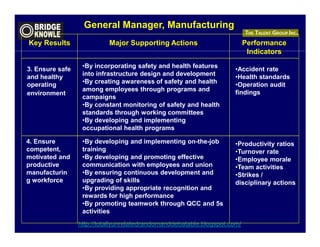
Key Results                Major Supporting Actions                        Performance
                                                                            Indicators

3. Ensure safe    •By incorporating safety and health features        •Accident rate
and healthy       into infrastructure design and development          •Health standards
operating         •By creating awareness of safety and health         •Operation audit
                  among employees through programs and                findings
environment
                  campaigns
                  •By constant monitoring of safety and health
                  standards through working committees
                  •By developing and implementing
                  occupational health programs

4. Ensure         •By developing and implementing on-the-job          •Productivity ratios
competent,        training                                            •Turnover rate
motivated and     •By developing and promoting effective              •Employee morale
productive        communication with employees and union              •Team activities
manufacturin      •By ensuring continuous development and             •Strikes /
g workforce       upgrading of skills                                 disciplinary actions
                  •By providing appropriate recognition and
                  rewards for high performance
                  •By promoting teamwork through QCC and 5s
                  activities
                 http://totallyunrelatedrandomanddebatable.blogspot.com/
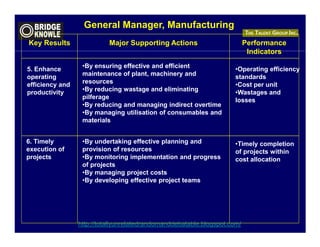
General Manager, Manufacturing
Key Results                Major Supporting Actions                        Performance
                                                                            Indicators

5. Enhance        •By ensuring effective and efficient                •Operating efficiency
operating         maintenance of plant, machinery and                 standards
efficiency and    resources                                           •Cost per unit
productivity      •By reducing wastage and eliminating                •Wastages and
                  pilferage                                           losses
                  •By reducing and managing indirect overtime
                  •By managing utilisation of consumables and
                  materials


6. Timely         •By undertaking effective planning and              •Timely completion
execution of      provision of resources                              of projects within
projects          •By monitoring implementation and progress          cost allocation
                  of projects
                  •By managing project costs
                  •By developing effective project teams


                 http://totallyunrelatedrandomanddebatable.blogspot.com/
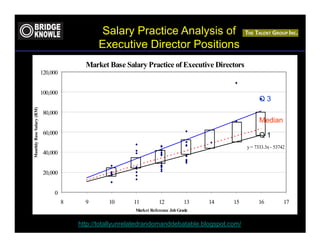
Salary Practice Analysis of
                                               Executive Director Positions
                                           Market Base Salary Practice of Executive Directors
                           120,000


                           100,000
                                                                                                         Q3
Monthly Base Salary (RM)


                            80,000
                                                                                                         Median
                            60,000                                                                       Q1
                                                                                                   y = 7333.3x - 53742
                            40,000


                            20,000


                                0
                                     8     9       10      11          12           13   14   15        16           17
                                                            Market Reference Job Grade


                                         http://totallyunrelatedrandomanddebatable.blogspot.com/
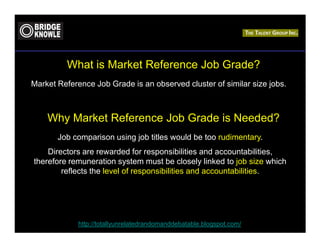
What is Market Reference Job Grade?
Market Reference Job Grade is an observed cluster of similar size jobs.


    Why Market Reference Job Grade is Needed?
       Job comparison using job titles would be too rudimentary.
    Directors are rewarded for responsibilities and accountabilities,
therefore remuneration system must be closely linked to job size which
        reflects the level of responsibilities and accountabilities.


             http://totallyunrelatedrandomanddebatable.blogspot.com/
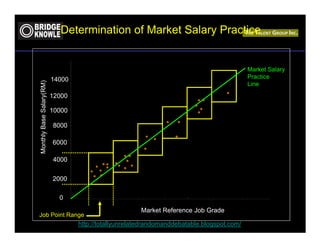
Determination of Market Salary Practice


                                                                                            Market Salary
                          14000                                                             Practice
Monthly Base Salary(RM)


                                                                                            Line
                          12000

                          10000

                          8000

                          6000

                          4000

                          2000

                            0
                                                       Market Reference Job Grade
Job Point Range
                                  http://totallyunrelatedrandomanddebatable.blogspot.com/
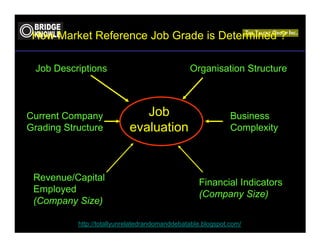
How Market Reference Job Grade is Determined ?

 Job Descriptions                               Organisation Structure


Current Company                Job                            Business
Grading Structure           evaluation                        Complexity


 Revenue/Capital
                                                   Financial Indicators
 Employed
                                                   (Company Size)
 (Company Size)

           http://totallyunrelatedrandomanddebatable.blogspot.com/
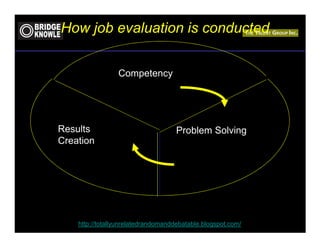
How job evaluation is conducted


                 Competency


Results                              Problem Solving
Creation


    http://totallyunrelatedrandomanddebatable.blogspot.com/
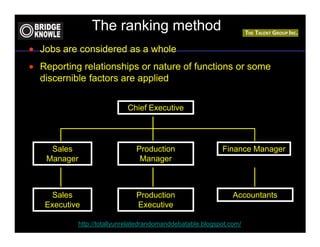
The ranking method
• Jobs are considered as a whole
• Reporting relationships or nature of functions or some
  discernible factors are applied


                           Chief Executive


     Sales                    Production                   Finance Manager
    Manager                    Manager


    Sales                     Production                       Accountants
   Executive                  Executive

           http://totallyunrelatedrandomanddebatable.blogspot.com/
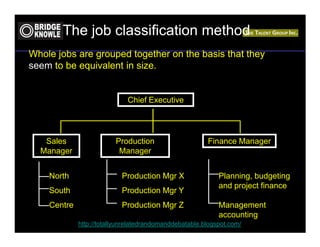
The job classification method
Whole jobs are grouped together on the basis that they
seem to be equivalent in size.


                             Chief Executive


   Sales                 Production                     Finance Manager
  Manager                 Manager


    North                  Production Mgr X                 Planning, budgeting
                                                            and project finance
    South                  Production Mgr Y
    Centre                 Production Mgr Z                 Management
                                                            accounting
             http://totallyunrelatedrandomanddebatable.blogspot.com/
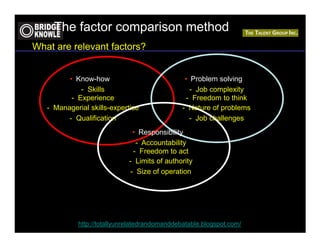
The factor comparison method
What are relevant factors?


         • Know-how                             • Problem solving
             - Skills                             - Job complexity
          - Experience                           - Freedom to think
   - Managerial skills-expertise               - Nature of problems
         - Qualification                          - Job challenges
                               • Responsibility
                                - Accountability
                               - Freedom to act
                             - Limits of authority
                              - Size of operation


            http://totallyunrelatedrandomanddebatable.blogspot.com/
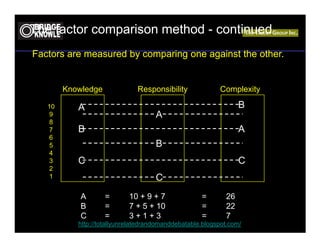
The factor comparison method - continued
Factors are measured by comparing one against the other.


        Knowledge              Responsibility             Complexity

   10      A                                                     B
    9                                A
    8
    7      B                                                     A
    6
    5                                B
    4
    3      C                                                     C
    2
    1                                C
            A       =       10 + 9 + 7              =       26
            B       =       7 + 5 + 10              =       22
            C       =       3+1+3                   =       7
           http://totallyunrelatedrandomanddebatable.blogspot.com/
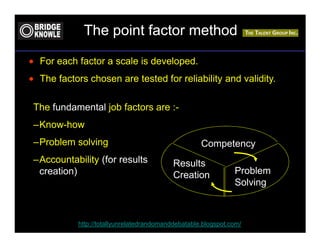
The point factor method

• For each factor a scale is developed.
• The factors chosen are tested for reliability and validity.

 The fundamental job factors are :-
 –Know-how
 –Problem solving                                    Competency
 –Accountability (for results               Results
  creation)                                 Creation            Problem
                                                                Solving


            http://totallyunrelatedrandomanddebatable.blogspot.com/
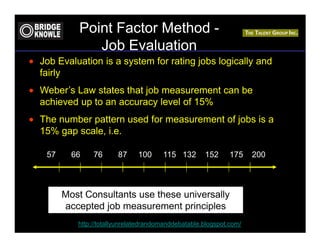
Point Factor Method -
                Job Evaluation
• Job Evaluation is a system for rating jobs logically and
  fairly
• Weber’s Law states that job measurement can be
  achieved up to an accuracy level of 15%
• The number pattern used for measurement of jobs is a
  15% gap scale, i.e.

    57     66    76      87     100     115 132       152      175    200


         Most Consultants use these universally
         accepted job measurement principles
            http://totallyunrelatedrandomanddebatable.blogspot.com/
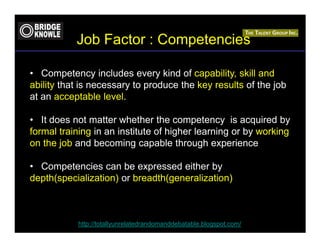
Job Factor : Competencies

• Competency includes every kind of capability, skill and
ability that is necessary to produce the key results of the job
at an acceptable level.

• It does not matter whether the competency is acquired by
formal training in an institute of higher learning or by working
on the job and becoming capable through experience

• Competencies can be expressed either by
depth(specialization) or breadth(generalization)


           http://totallyunrelatedrandomanddebatable.blogspot.com/
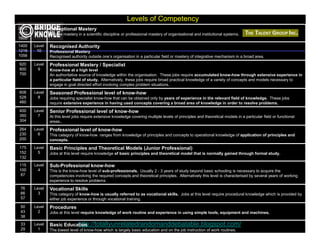
Levels of Competency
2112   Level   Exceptional Mastery
1840    11     Unique mastery in a scientific discipline or professional mastery of organisational and institutional systems.
1600
1400   Level   Recognised Authority
1216    10     Professional Mastery
1056           Recognised authority outside one’s organisation in a particular field or mastery of integrative mechanism in a broad area.
920    Level   Professional Mastery / Specialist
800      9     Know-how at a high level
700            An authoritative source of knowledge within the organisation. These jobs require accumulated know-how through extensive experience in
               a particular field of study. Alternatively, these jobs require broad practical knowledge of a variety of concepts and models necessary to
               engage in goal directed effort involving complex problem situations.
608    Level   Seasoned Professional level of know-how
528      8     Jobs requiring specialist know-how that can be obtained only by years of experience in the relevant field of knowledge. These jobs
460            require extensive experience in having used concepts covering a broad area of knowledge in order to resolve problems.
400    Level   Senior Professional level of know-how
350      7     At this level jobs require extensive knowledge covering multiple levels of principles and theoretical models in a particular field or functional
304            areas..
264    Level   Professional level of know-how
230      6     This category of know-how ranges from knowledge of principles and concepts to operational knowledge of application of principles and
200            concepts.
175    Level   Basic Principles and Theoretical Models (Junior Professional)
152      5     Jobs at this level require knowledge of basic principles and theoretical model that is normally gained through formal study.
132
115    Level   Sub-Professional know-how
100      4     This is the know-how level of sub-professionals. Usually 2 - 3 years of study beyond basic schooling is necessary to acquire the
 87            competencies involving the required concepts and theoretical principles. Alternatively this level is characterised by several years of working
               experience to resolve problems
76     Level   Vocational Skills
66       3     This category of know-how is usually referred to as vocational skills. Jobs at this level require procedural knowledge which is provided by
57             either job experience or through vocational training.
50     Level   Procedures
43       2     Jobs at this level require knowledge of work routine and experience in using simple tools, equipment and machines.
38
33     Level              http://totallyunrelatedrandomanddebatable.blogspot.com/
               Basic Education
29       1     The lowest level of know-how which is largely basic education and on the job instruction of work routines.
25
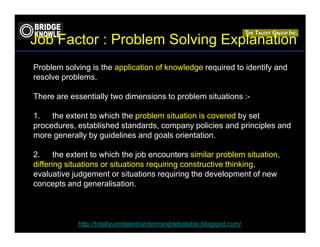
Job Factor : Problem Solving Explanation
Problem solving is the application of knowledge required to identify and
resolve problems.

There are essentially two dimensions to problem situations :-

1.   the extent to which the problem situation is covered by set
procedures, established standards, company policies and principles and
more generally by guidelines and goals orientation.

2.     the extent to which the job encounters similar problem situation,
differing situations or situations requiring constructive thinking,
evaluative judgement or situations requiring the development of new
concepts and generalisation.


             http://totallyunrelatedrandomanddebatable.blogspot.com/
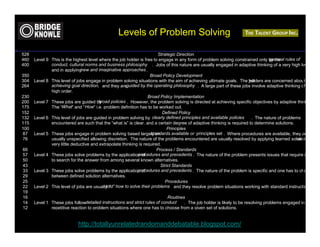
Levels of Problem Solving

528                                                                    Strategic Direction
460   Level 9 This is the highest level where the job holder is free to engage in any form of problem solving constrained only by the rules of
                                                                                                                                general
400           conduct, cultural norms and business philosophy . Jobs of this nature are usually engaged in adaptive thinking of a very high leve
              and in applyingnew and imaginative approaches .
350                                                                Broad Policy Development
304   Level 8 This level of jobs engage in problem solving situations with the aim of achieving ultimate goals. The holders are concerned about
                                                                                                                     job
264           achieving goal direction, and they areguided by the operating philosophy . A large part of these jobs involve adaptive thinking of a
              high order.
230                                                               Broad Policy Implementation
200   Level 7 These jobs are guided by broad policies . However, the problem solving is directed at achieving specific objectives by adaptive thinkin
175           The “What” and “ How” i.e. problem definition has to be worked out.
152                                                                       Defined Policy
132   Level 6 This level of jobs are guided in problem solving by clearly defined principles and available policies    . The nature of problems
115           encountered are such that the “what is” is clear, and a certain degree of adaptive thinking is required to determine solutions.
100                                                                         Principles
87    Level 5 These jobs engage in problem solving based largely onstandards available or principles set . Where procedures are available, they are
76            usually unspecified allowing discretion. The nature of the problems encountered are usually resolved by applying learned solutions
                                                                                                                                              re
              very little deductive and extrapolate thinking is required.
66                                                                     Process / Standards
57                                                          procedures and precedents . The nature of the problem presents issues that require on
      Level 4 These jobs solve problems by the application of
50            to search for the answer from among several known alternatives.
43                                                                       Strict Standards
33                                                          procedures and precedents . The nature of the problem is specific and one has to choo
      Level 3 These jobs solve problems by the application of
29            between defined solution alternatives.
25                                                                         Procedures
22    Level 2 This level of jobs are usually “ how to solve their problems and they resolve problem situations working with standard instruction
                                           told”
19
16                                                                          Routines
14    Level 1 These jobs followdetailed instructions and strict rules of conduct    . The job holder is likely to be resolving problems engaged in
12            repetitive reaction to problem situations where one has to choose from a given set of solutions.


                            http://totallyunrelatedrandomanddebatable.blogspot.com/
Job Factor : Results
              Creation Explanation

This is the element of the job that can be best described as “the
accountability for actions and for the consequence of actions taken”.

The more freedom there is in the job to take actions and the more impact
the job has on end results the greater the Results creation element.

For example, the job of a General Manager of a business unit can be
considered as having more impact on end results than the job of a
Department Manager of the business unit.


            http://totallyunrelatedrandomanddebatable.blogspot.com/
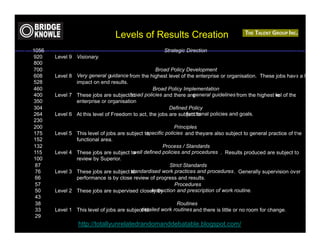
Levels of Results Creation
1056                                                    Strategic Direction
920    Level 9 Visionary.
800
700                                                Broad Policy Development
608    Level 8 Very general guidance from the highest level of the enterprise or organisation. These jobs have a hig
528            impact on end results.
460                                               Broad Policy Implementation
400    Level 7 These jobs are subjectbroad policies and there are
                                       to                          general guidelines from the highest vel of the
                                                                                                       le
350            enterprise or organisation
304                                                      Defined Policy
264                                                             functional policies and goals.
       Level 6 At this level of Freedom to act, the jobs are subject to
230
200                                                           Principles
175    Level 5                                   specific policies and theyare also subject to general practice of the
                 This level of jobs are subject to
152              functional area.
132                                                      Process / Standards
115    Level 4   These jobs are subject to well defined policies and procedures . Results produced are subject to
100              review by Superior.
 87                                                         Strict Standards
 76    Level 3   These jobs are subject standardised work practices and procedures . Generally supervision over
                                          to
 66              performance is by close review of progress and results.
 57                                                           Procedures
 50    Level 2                                     instruction and prescription of work routine.
                 These jobs are supervised closely by
 43
 38                                                         Routines
 33                                         detailed work routines and there is little or no room for change.
       Level 1 This level of jobs are subject to
 29
                 http://totallyunrelatedrandomanddebatable.blogspot.com/
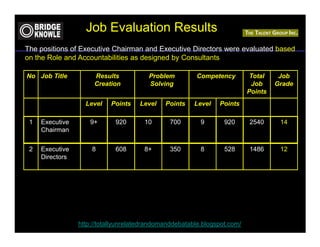
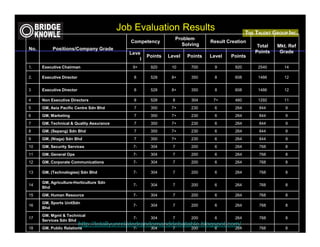
Job Evaluation Results
The positions of Executive Chairman and Executive Directors were evaluated based
on the Role and Accountabilities as designed by Consultants

No Job Title          Results           Problem         Competency          Total    Job
                      Creation          Solving                              Job    Grade
                                                                           Points
                   Level    Points   Level    Points    Level   Points

 1   Executive       9+      920       10      700        9       920      2540      14
     Chairman

 2   Executive       8       608       8+      350        8       528      1486      12
     Directors


                 http://totallyunrelatedrandomanddebatable.blogspot.com/
Job Evaluation Results
                                                                   Problem
                                             Competency                         Result Creation
                                                                     Solving                       Total   Mkt. Ref
No.        Positions/Company Grade
                                            Leve                                                  Points    Grade
                                                    Points   Level     Points   Level   Points
                                                l
1.    Executive Chairman                     9+      920      10         700      9       920      2540       14

2.    Executive Director                      8      528      8+         350      8       608      1486       12


3     Executive Director                      8      528      8+         350      8       608      1486       12

4     Non Executive Directors                 8      528       8         304     7+       460      1292       11
5     GM, Asia Pacific Centre Sdn Bhd         7      350      7+         230      6       264      844        9
6     GM, Marketing                           7      350      7+         230      6       264      844        9
7     GM, Technical & Quality Assurance       7      350      7+         230      6       264      844        9
8     GM, (Sepang) Sdn Bhd                    7      350      7+         230      6       264      844        9
9     GM, (Niaga) Sdn Bhd                     7      350      7+         230      6       264      844        9
10    GM, Security Services                  7-      304       7         200      6       264      768        8
11    GM, General Ops                        7-      304       7         200      6       264      768        8
12    GM, Corporate Communications           7-      304       7         200      6       264      768        8

13    GM, (Technologies) Sdn Bhd             7-      304       7         200      6       264      768        8

      GM, Agriculture-Horticulture Sdn
14                                           7-      304       7         200      6       264      768        8
      Bhd
15    GM, Human Resource                     7-      304       7         200      6       264      768        8
      GM, Sports UnitSdn
16                                           7-      304       7         200      6       264      768        8
      Bhd
      GM, Mgmt & Technical
17                                           7-      304       7         200      6       264      768        8
      Services Sdn Bhd
                           http://totallyunrelatedrandomanddebatable.blogspot.com/
18    GM, Public Relations                   7-      304       7         200      6       264      768        8
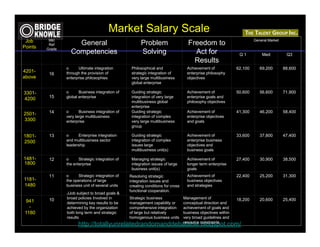
Market Salary Scale
 Job      Mkt                                                                                                            General Market
Points
          Ref        General                             Problem                     Freedom to
         Grade
                   Competencies                          Solving                       Act for                   Q1          Med           Q3
                                                                                       Results
                 o      Ultimate integration        Philosophical and                Achievement of             62,100      69,200        88,600
4201-            through the provision of           strategic integration of         enterprise philosophy
          16
above            enterprise philosophies            very large multibusiness         objectives
                                                    global enterprise

3301-            o      Business integration of     Guiding strategic                Achievement of             50,600      56,600        71,900
4200      15     global enterprise                  integration of very large        enterprise goals and
                                                    multibusiness global             philosophy objectives
                                                    enterprise
          14     o      Business integration of     Guiding strategic                Achievement of             41,300      46,200        58,400
2501-
                 very large multibusiness           integration of complex           enterprise objectives
3300             enterprise                         very large multibusiness         and goals
                                                    group

1801-     13     o      Enterprise integration      Guiding strategic                Achievement of             33,600      37,800        47,400
2500             and multibusiness sector           integration of complex           enterprise business
                 leadership                         issues large                     objectives and
                                                    multibusiness unit(s)            business goals

1481-     12     o      Strategic integration of    Managing strategic               Achievement of             27,400      30,900        38,500
1800             the enterprise                     integration issues of large      longer term enterprise
                                                    business unit(s)                 goals
          11     o      Strategic integration of   Resolving strategic               Achievement of             22,400      25,200        31,300
1181-            the operations of large           integration issues and            business objectives
1480             business unit of several units    creating conditions for cross     and strategies
                                                   functional cooperation.
                 JJob subject to broad goals &
          10     broad policies Involved in        Strategic business              Management of                18,200      20,600        25,400
941              determining key results to be     management capability or        conceptual direction and
  -              achieved by the organization      comprehensive integration       achievement of goals and
1180             both long term and strategic      of large but relatively         business objectives within
                 results                           homogenous business units       very broad guidelines and
                                                                                   resource constraints
                        http://totallyunrelatedrandomanddebatable.blogspot.com/
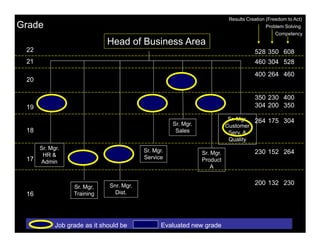
Results Creation (Freedom to Act)
Grade                                                                                        Problem Solving
                                                                                                Competency
                              Head of Business Area
 22                                                                                    528 350 608
 21                                                                                    460 304 528
                                                                                       400 264 460
 20

                                                                                       350 230 400
 19                                                                                    304 200 350

                                                                            Sr. Mgr. 264 175 304
                                                     Sr. Mgr.              Customer
 18                                                   Sales                 Serv. &
                                                                            Quality
      Sr. Mgr.                            Sr. Mgr.
       HR &                                                     Sr. Mgr.               230 152 264
 17                                       Service               Product
      Admin
                                                                    A


                              Snr. Mgr.                                                200 132 230
                  Sr. Mgr,
 16               Training      Dist.


            Job grade as it should be            Evaluated new grade
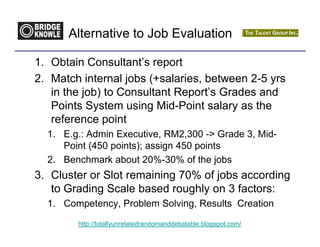
Alternative to Job Evaluation

1. Obtain Consultant’s report
2. Match internal jobs (+salaries, between 2-5 yrs
   in the job) to Consultant Report’s Grades and
   Points System using Mid-Point salary as the
   reference point
  1. E.g.: Admin Executive, RM2,300 -> Grade 3, Mid-
     Point (450 points); assign 450 points
  2. Benchmark about 20%-30% of the jobs
3. Cluster or Slot remaining 70% of jobs according
   to Grading Scale based roughly on 3 factors:
  1. Competency, Problem Solving, Results Creation
        http://totallyunrelatedrandomanddebatable.blogspot.com/
Pay For PERFORMANCE


http://totallyunrelatedrandomanddebatable.blogspot.com/
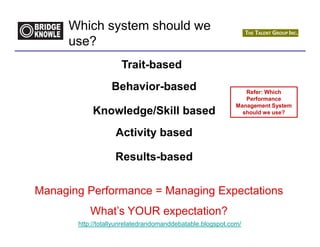
Which system should we
      use?
                     Trait-based
                  Behavior-based                               Refer: Which
                                                               Performance
                                                            Management System
           Knowledge/Skill based                              should we use?


                   Activity based

                   Results-based


Managing Performance = Managing Expectations
           What’s YOUR expectation?
       http://totallyunrelatedrandomanddebatable.blogspot.com/
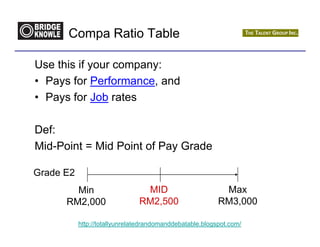
Compa Ratio Table

Use this if your company:
• Pays for Performance, and
• Pays for Job rates

Def:
Mid-Point = Mid Point of Pay Grade

Grade E2
        Min                     MID                        Max
      RM2,000                  RM2,500                    RM3,000

           http://totallyunrelatedrandomanddebatable.blogspot.com/
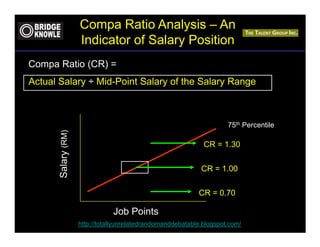
Compa Ratio Analysis – An
                     Indicator of Salary Position
Compa Ratio (CR) =
Actual Salary ÷ Mid-Point Salary of the Salary Range


                                                                       75th Percentile
       Salary (RM)


                                                               CR = 1.30

                                                              CR = 1.00

                                                             CR = 0.70

                                Job Points
                     http://totallyunrelatedrandomanddebatable.blogspot.com/
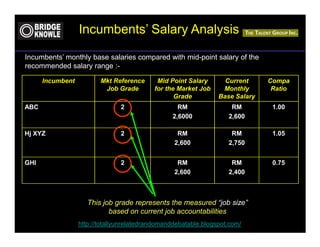
Incumbents’ Salary Analysis

Incumbents’ monthly base salaries compared with mid-point salary of the
recommended salary range :-

      Incumbent          Mkt Reference      Mid Point Salary       Current     Compa
                          Job Grade        for the Market Job     Monthly       Ratio
                                                  Grade          Base Salary
ABC                             2                  RM                RM         1.00
                                                 2,6000             2,600

Hj XYZ                          2                  RM                RM         1.05
                                                  2,600             2,750


GHI                             2                  RM                RM         0.75
                                                  2,600             2,400


                     This job grade represents the measured “job size”
                            based on current job accountabilities
                  http://totallyunrelatedrandomanddebatable.blogspot.com/
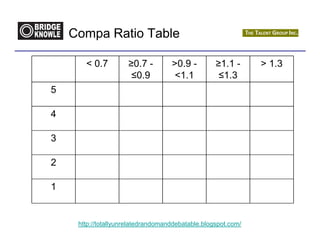
Compa Ratio Table

       < 0.7         ≥0.7 -         >0.9 -         ≥1.1 -      > 1.3
                      ≤0.9           <1.1           ≤1.3
5

4

3

2

1


     http://totallyunrelatedrandomanddebatable.blogspot.com/
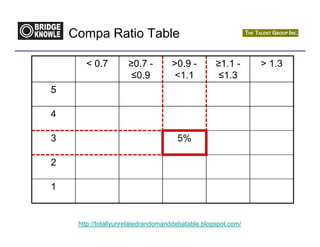
Compa Ratio Table

       < 0.7         ≥0.7 -         >0.9 -         ≥1.1 -      > 1.3
                      ≤0.9           <1.1           ≤1.3
5

4

3                                     5%

2

1


     http://totallyunrelatedrandomanddebatable.blogspot.com/
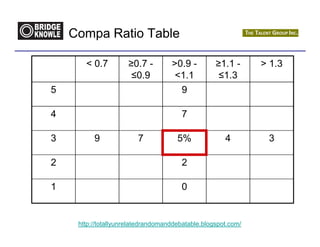
Compa Ratio Table

       < 0.7         ≥0.7 -         >0.9 -         ≥1.1 -      > 1.3
                      ≤0.9           <1.1           ≤1.3
5                                      9

4                                      7

3         9              7            5%              4         3

2                                      2

1                                      0


     http://totallyunrelatedrandomanddebatable.blogspot.com/
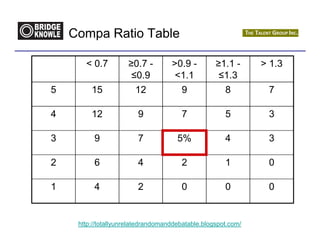
Compa Ratio Table

       < 0.7         ≥0.7 -         >0.9 -         ≥1.1 -      > 1.3
                      ≤0.9           <1.1           ≤1.3
5        15             12             9              8         7

4        12              9             7              5         3

3         9              7            5%              4         3

2         6              4             2              1         0

1         4              2             0              0         0


     http://totallyunrelatedrandomanddebatable.blogspot.com/
• Exercise:
• Determine your pay grades and salary points
  (internal or external benchmark?)
• Draw your Compa Ratio Table


        http://totallyunrelatedrandomanddebatable.blogspot.com/
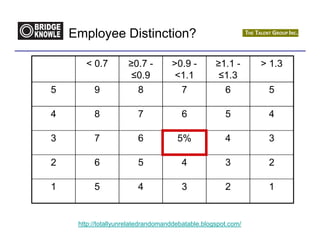
Employee Distinction?

       < 0.7         ≥0.7 -         >0.9 -         ≥1.1 -      > 1.3
                      ≤0.9           <1.1           ≤1.3
5         9              8             7              6         5

4         8              7             6              5         4

3         7              6            5%              4         3

2         6              5             4              3         2

1         5              4             3              2         1


     http://totallyunrelatedrandomanddebatable.blogspot.com/
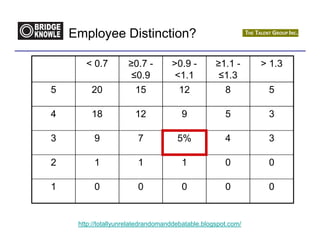
Employee Distinction?

       < 0.7         ≥0.7 -         >0.9 -         ≥1.1 -      > 1.3
                      ≤0.9           <1.1           ≤1.3
5        20             15             12             8         5

4        18             12             9              5         3

3         9              7            5%              4         3

2         1              1             1              0         0

1         0              0             0              0         0


     http://totallyunrelatedrandomanddebatable.blogspot.com/
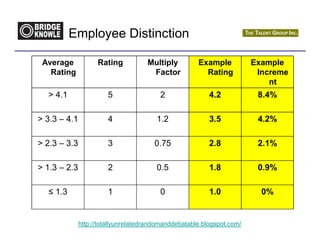
Employee Distinction

 Average            Rating           Multiply         Example           Example
   Rating                             Factor            Rating           Increme
                                                                            nt
  > 4.1                 5                2                4.2            8.4%

> 3.3 – 4.1             4               1.2               3.5            4.2%

> 2.3 – 3.3             3              0.75               2.8            2.1%

> 1.3 – 2.3             2               0.5               1.8            0.9%

  ≤ 1.3                 1                0                1.0             0%


              http://totallyunrelatedrandomanddebatable.blogspot.com/
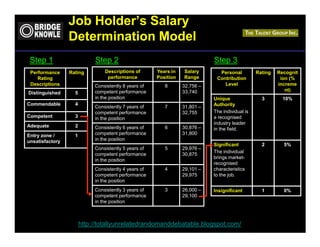
Job Holder’s Salary
                 Determination Model
 Step 1                     Step 2                                          Step 3
 Performance     Rating         Descriptions of       Years in   Salary       Personal          Rating   Recognit
    Rating                       performance          Position   Range       Contribution                 ion (%
 Descriptions               Consistently 8 years of      8       32,756 –       Level                    increme
                            competent performance                33,740                                     nt)
Distinguished      5
                            in the position                                 Unique                3        10%
Commendable        4                                                        Authority
                            Consistently 7 years of      7       31,801 –
                            competent performance                32,755     The individual is
Competent          3        in the position                                 a recognised
                                                                            industry leader
Adequate           2        Consistently 6 years of      6       30,876 –   in the field.
Entry zone /       1        competent performance                31,800
unsatisfactory              in the position
                                                                            Significant           2        5%
                            Consistently 5 years of      5       29,976 –
                                                                            The individual
                            competent performance                30,875
                                                                            brings market-
                            in the position
                                                                            recognised
                            Consistently 4 years of      4       29,101 –   characteristics
                            competent performance                29,975     to the job.
                            in the position
                            Consistently 3 years of      3       26,000 –   Insignificant         1        0%
                            competent performance                29,100
                            in the position


                       http://totallyunrelatedrandomanddebatable.blogspot.com/
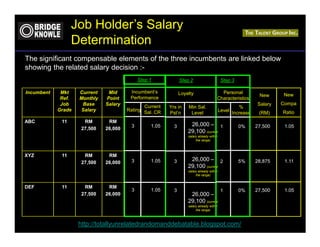
Job Holder’s Salary
                  Determination
The significant compensable elements of the three incumbents are linked below
showing the related salary decision :-
                                            Step 1            Step 2                      Step 3

Incumbent    Mkt    Current    Mid      Incumbent’s           Loyalty                   Personal
                                                                                                         New     New
             Ref.   Monthly   Point     Performance                                   Characteristics
             Job     Base     Salary                                                                    Salary   Compa
                                              Current   Yrs in    Min Sal.                     %
            Grade   Salary             Rating Sal. CR                                 Level Increase             Ratio
                                                        Pst’n      Level                                 (RM)
ABC          11       RM       RM
                                        3        1.05     3        26,000 – 1                      0%   27,500    1.05
                     27,500   26,000
                                                                  29,100 (current
                                                                  salary already within
                                                                       the range)


XYZ          11       RM       RM
                                        3        1.05     3        26,000 – 2                      5%   28,875    1.11
                     27,500   26,000
                                                                  29,100 (current
                                                                  salary already within
                                                                       the range)


DEF          11       RM       RM
                                        3        1.05     3                               1        0%   27,500    1.05
                     27,500   26,000                               26,000 –
                                                                  29,100 (current
                                                                  salary already within
                                                                       the range)


                    http://totallyunrelatedrandomanddebatable.blogspot.com/
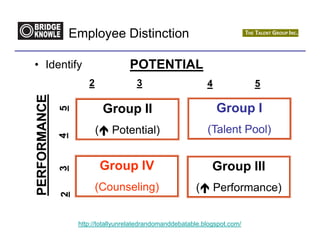
Employee Distinction

• Identify                          POTENTIAL
                      2               3                       4              5
PERFORMANCE


                              Group II                            Group I
              5


                          (    Potential)                     (Talent Pool)
              4


                              Group IV                          Group III
              3


                          (Counseling)                    (       Performance)
              2


                   http://totallyunrelatedrandomanddebatable.blogspot.com/
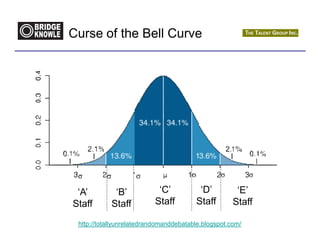
Curse of the Bell Curve


 ‘A’         ‘B’           ‘C’           ‘D’          ‘E’
Staff       Staff         Staff         Staff        Staff

 http://totallyunrelatedrandomanddebatable.blogspot.com/
Pay For COMPETENCIES


http://totallyunrelatedrandomanddebatable.blogspot.com/
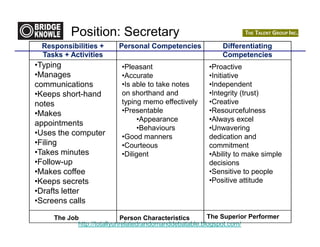
Position: Secretary
 Responsibilities +      Personal Competencies            Differentiating
 Tasks + Activities                                       Competencies
•Typing                   •Pleasant                   •Proactive
•Manages                  •Accurate                   •Initiative
communications            •Is able to take notes      •Independent
•Keeps short-hand         on shorthand and            •Integrity (trust)
notes                     typing memo effectively     •Creative
•Makes                    •Presentable                •Resourcefulness
                               •Appearance            •Always excel
appointments
                               •Behaviours            •Unwavering
•Uses the computer        •Good manners               dedication and
•Filing                   •Courteous                  commitment
•Takes minutes            •Diligent                   •Ability to make simple
•Follow-up                                            decisions
•Makes coffee                                         •Sensitive to people
•Keeps secrets                                        •Positive attitude
•Drafts letter
•Screens calls

    The Job                 Person Characteristics     The Superior Performer
           http://totallyunrelatedrandomanddebatable.blogspot.com/
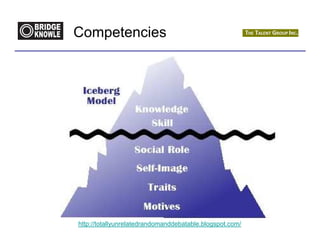
Competencies


http://totallyunrelatedrandomanddebatable.blogspot.com/
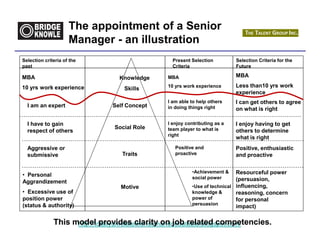
The appointment of a Senior
                     Manager - an illustration
Selection criteria of the                       Present Selection         Selection Criteria for the
past                                            Criteria                  Future

MBA                             Knowledge     MBA                         MBA

10 yrs work experience                        10 yrs work experience      Less than10 yrs work
                                  Skills
                                                                          experience
                                              I am able to help others    I can get others to agree
  I am an expert              Self Concept    in doing things right       on what is right

  I have to gain                              I enjoy contributing as a   I enjoy having to get
                               Social Role    team player to what is
  respect of others                                                       others to determine
                                              right
                                                                          what is right
  Aggressive or                                  Positive and             Positive, enthusiastic
  submissive                     Traits          proactive                and proactive

                                                        •Achievement &    Resourceful power
• Personal                                              social power
Aggrandizement                                                            (persuasion,
                                 Motive                 •Use of technical influencing,
• Excessive use of                                      knowledge &       reasoning, concern
position power                                          power of          for personal
(status & authority)                                    persuasion
                                                                          impact)

              This model provides clarity on job related competencies.
                    http://totallyunrelatedrandomanddebatable.blogspot.com/
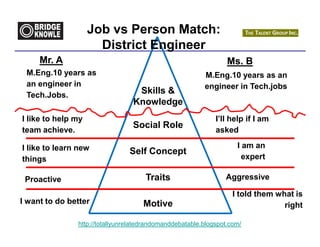
Job vs Person Match:
                      District Engineer
     Mr. A                                                       Ms. B
 M.Eng.10 years as                                       M.Eng.10 years as an
 an engineer in                                          engineer in Tech.jobs
 Tech.Jobs.
                                  Skills &
                                 Knowledge
I like to help my                                            I’ll help if I am
team achieve.
                                 Social Role                 asked

I like to learn new                                                 I am an
                                Self Concept
things                                                                expert

 Proactive                           Traits                     Aggressive

                                                                   I told them what is
I want to do better                 Motive                                       right

               http://totallyunrelatedrandomanddebatable.blogspot.com/
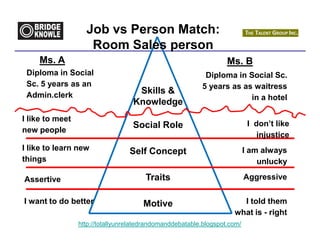
Job vs Person Match:
                    Room Sales person
    Ms. A                                                          Ms. B
 Diploma in Social                                         Diploma in Social Sc.
 Sc. 5 years as an                                        5 years as as waitress
 Admin.clerk
                                    Skills &
                                                                       in a hotel
                                   Knowledge
I like to meet
                                   Social Role                              I don’t like
new people
                                                                               injustice
I like to learn new               Self Concept                             I am always
things                                                                         unlucky

Assertive                              Traits                              Aggressive

I want to do better                   Motive                           I told them
                                                                     what is - right
                 http://totallyunrelatedrandomanddebatable.blogspot.com/
Superstar Competency
      Model

• Exercise: Develop Your Own “Superstar”
  Competency Model


        http://totallyunrelatedrandomanddebatable.blogspot.com/
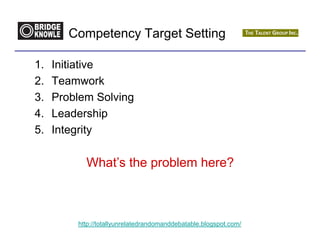
Competency Target Setting

1.   Initiative
2.   Teamwork
3.   Problem Solving
4.   Leadership
5.   Integrity

           What’s the problem here?


         http://totallyunrelatedrandomanddebatable.blogspot.com/
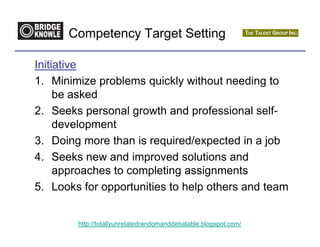
Competency Target Setting

Initiative
1. Minimize problems quickly without needing to
     be asked
2. Seeks personal growth and professional self-
     development
3. Doing more than is required/expected in a job
4. Seeks new and improved solutions and
     approaches to completing assignments
5. Looks for opportunities to help others and team


        http://totallyunrelatedrandomanddebatable.blogspot.com/
• Exercise: Competency Dictionary

• (Refer to Workbook for examples)


        http://totallyunrelatedrandomanddebatable.blogspot.com/
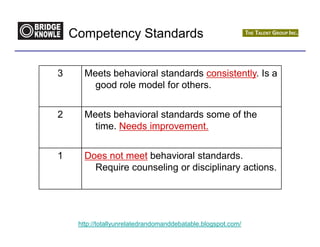
Competency Standards


3      Meets behavioral standards consistently. Is a
         good role model for others.


2      Meets behavioral standards some of the
         time. Needs improvement.


1      Does not meet behavioral standards.
         Require counseling or disciplinary actions.


     http://totallyunrelatedrandomanddebatable.blogspot.com/
Exercise: Competency
Standards


 http://totallyunrelatedrandomanddebatable.blogspot.com/
• The Specialist Career Ladder


        http://totallyunrelatedrandomanddebatable.blogspot.com/
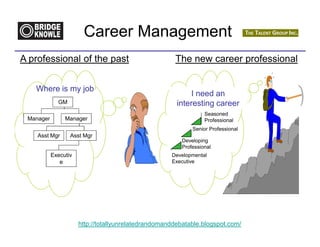
Career Management
A professional of the past                            The new career professional


   Where is my job
                                                            I need an
             GM                                        interesting career
                                                                 Seasoned
 Manager        Manager                                          Professional
                                                            Senior Professional
    Asst Mgr      Asst Mgr
                                                        Developing
                                                        Professional
           Executiv                                  Developmental
              e                                      Executive


                      http://totallyunrelatedrandomanddebatable.blogspot.com/
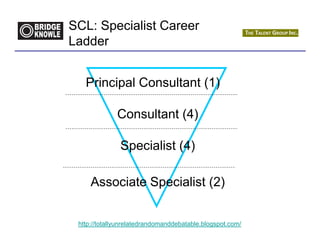
SCL: Specialist Career
Ladder


   Principal Consultant (1)

              Consultant (4)

               Specialist (4)

     Associate Specialist (2)


 http://totallyunrelatedrandomanddebatable.blogspot.com/
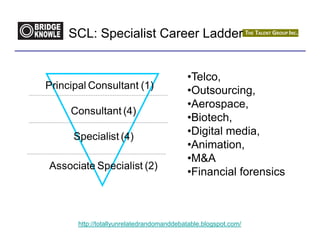
SCL: Specialist Career Ladder


                                           •Telco,
Principal Consultant (1)                   •Outsourcing,
                                           •Aerospace,
     Consultant (4)
                                           •Biotech,
      Specialist (4)                       •Digital media,
                                           •Animation,
                                           •M&A
Associate Specialist (2)
                                           •Financial forensics


       http://totallyunrelatedrandomanddebatable.blogspot.com/
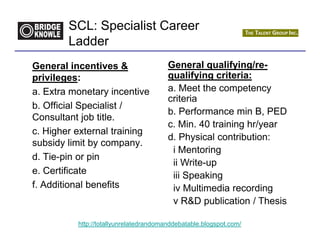
SCL: Specialist Career
        Ladder
General incentives &                    General qualifying/re-
privileges:                             qualifying criteria:
a. Extra monetary incentive             a. Meet the competency
                                        criteria
b. Official Specialist /
                                        b. Performance min B, PED
Consultant job title.
                                        c. Min. 40 training hr/year
c. Higher external training
                                        d. Physical contribution:
subsidy limit by company.
                                         i Mentoring
d. Tie-pin or pin
                                         ii Write-up
e. Certificate                           iii Speaking
f. Additional benefits                   iv Multimedia recording
                                         v R&D publication / Thesis

          http://totallyunrelatedrandomanddebatable.blogspot.com/
Part B-2
SALARY STRUCTURES AND
SALARY SURVEYS

      http://totallyunrelatedrandomanddebatable.blogspot.com/
• Refer to Benchmarking and Surveys (Workbook)


       http://totallyunrelatedrandomanddebatable.blogspot.com/
Options to Develop Salary
      Structure
1. Self – using JE System
  1. -> match Job Points ranges to Consultant’s scale
  2. Better internal equity, not externally competitive


2. Adopt Consultant’s structure
  1. -> match internal jobs to new structure
  2. Bad internal equity, externally competitive


         http://totallyunrelatedrandomanddebatable.blogspot.com/
Salary Structures

1. Narrow Band – 40%-60% between min/max
2. Broad Band– 100%-200% between min/max
3. Specialist Ladder


       http://totallyunrelatedrandomanddebatable.blogspot.com/
Broad Band
Pros                                   Cons
1. Streamlines Hierarchy               1. No Awareness of
2. Facilitates Internal                   External Market Rates
   Movement                            2. May Lead to Inequities
3. Managers have greater               3. Lack of Cost Controls
   latitude to pay what they           4. Severe reduction in
   want to an employee                    opportunities for
                                          promotions


          http://totallyunrelatedrandomanddebatable.blogspot.com/
Part B-3
VARIABLE AND INCENTIVE
SCHEMES

      http://totallyunrelatedrandomanddebatable.blogspot.com/
Incentive Scheme Design

  Agenda
  1. Objective
  2. Situation Analysis
  3. Target Areas to be improved
  4. Current Incentive
  5. Recommended KPIs
  6. Proposed Incentive Scheme
  7. Improving Performance


http://totallyunrelatedrandomanddebatable.blogspot.com/
Objective?


1. What are you trying to achieve?
2. How to measure?
3. What is the Gap?


          http://totallyunrelatedrandomanddebatable.blogspot.com/
Target group?
The following positions are eligible to participate in this
scheme:


            http://totallyunrelatedrandomanddebatable.blogspot.com/
Situation Analysis?

1. Retention?
2. Working environment?
3. The current basic pay?
4. Teamwork?
5. Supervision/Leadership style?
6. Attitude?
7. Turnover issues?
8. Absenteeism?


        http://totallyunrelatedrandomanddebatable.blogspot.com/
Target areas to be improved?


1. Increase/Decrease the basic pay?
2. Fixed costs?
3. Incentives tied to… ??
4. Absenteeism?
5. Quality improvement?
6. Easily understood by employee?


       http://totallyunrelatedrandomanddebatable.blogspot.com/
Current incentives?


http://totallyunrelatedrandomanddebatable.blogspot.com/
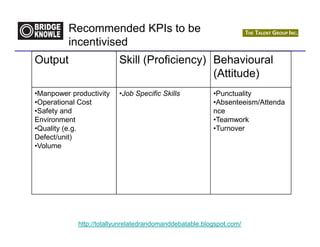
Recommended KPIs to be
         incentivised
Output                   Skill (Proficiency) Behavioural
                                             (Attitude)
•Manpower productivity   •Job Specific Skills            •Punctuality
•Operational Cost                                        •Absenteeism/Attenda
•Safety and                                              nce
Environment                                              •Teamwork
•Quality (e.g.                                           •Turnover
Defect/unit)
•Volume


            http://totallyunrelatedrandomanddebatable.blogspot.com/
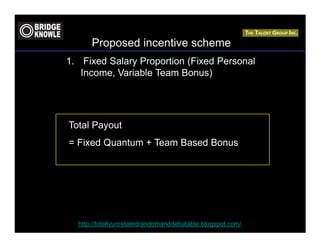
Proposed incentive scheme
1. Fixed Salary Proportion (Fixed Personal
   Income, Variable Team Bonus)


Total Payout
= Fixed Quantum + Team Based Bonus


  http://totallyunrelatedrandomanddebatable.blogspot.com/
Proposed incentive scheme
1. Fixed Salary Proportion (Fixed Personal Income, Variable
   Team Bonus)

Example:
1. Budgeted incentive = 5.8 months of basic payroll
2. Fixed Quantum = 0.4 months (for example) [4.8 mths ÷12]
3. Monthly Total Payout = Basic Pay + Fixed Quantum
                             = RM500 + 0.4 months
                             = RM500 + RM200
                             = RM700
4. Amount available for bonus         = 5.8 months - 4.8 months
                                         = 1.0 month


           http://totallyunrelatedrandomanddebatable.blogspot.com/
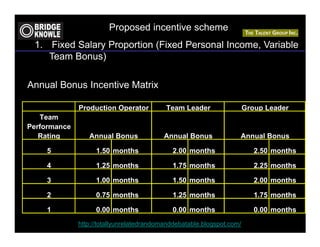
Proposed incentive scheme
 1. Fixed Salary Proportion (Fixed Personal Income, Variable
    Team Bonus)

Annual Bonus Incentive Matrix

              Production Operator          Team Leader                  Group Leader
   Team
Performance
   Rating        Annual Bonus             Annual Bonus              Annual Bonus

     5              1.50 months              2.00 months                   2.50 months

     4              1.25 months              1.75 months                   2.25 months

     3              1.00 months              1.50 months                   2.00 months

     2              0.75 months              1.25 months                   1.75 months

     1              0.00 months              0.00 months                   0.00 months
              http://totallyunrelatedrandomanddebatable.blogspot.com/
Proposed incentive scheme
2. Two-tier Multiplier (Variable Personal Income,
   Variable Team Bonus)
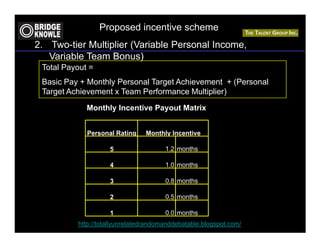
 Total Payout =
 Basic Pay + Monthly Personal Target Achievement + (Personal
 Target Achievement x Team Performance Multiplier)

             Monthly Incentive Payout Matrix


             Personal Rating    Monthly Incentive

                    5                  1.2 months

                    4                  1.0 months

                    3                  0.8 months

                    2                  0.5 months

                    1                  0.0 months
          http://totallyunrelatedrandomanddebatable.blogspot.com/
Proposed incentive scheme
  2. Two-tier Multiplier (Variable Personal Income,
     Variable Team Bonus)

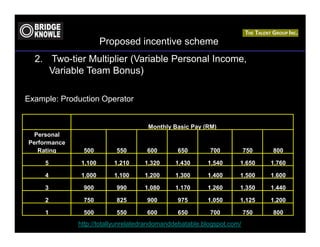
Example: Production Operator


                                     Monthly Basic Pay (RM)
  Personal
Performance
   Rating      500        550        600       650        700           750   800

     5         1,100      1,210     1,320     1,430      1,540      1,650     1,760

     4         1,000      1,100     1,200     1,300      1,400      1,500     1,600

     3         900        990       1,080     1,170      1,260      1,350     1,440

     2         750        825        900       975       1,050      1,125     1,200

     1         500        550        600       650        700           750   800
              http://totallyunrelatedrandomanddebatable.blogspot.com/
Proposed incentive scheme
 2. Two-tier Multiplier (Variable Personal Income,
    Variable Team Bonus)

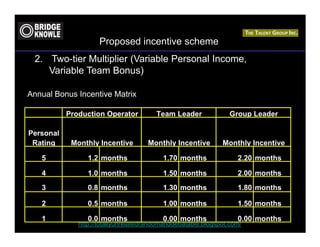
Annual Bonus Incentive Matrix

           Production Operator          Team Leader              Group Leader

Personal
 Rating     Monthly Incentive        Monthly Incentive        Monthly Incentive

   5             1.2 months               1.70 months              2.20 months

   4             1.0 months               1.50 months              2.00 months
   3             0.8 months               1.30 months              1.80 months

   2             0.5 months               1.00 months              1.50 months

   1             0.0 months               0.00 months              0.00 months
              http://totallyunrelatedrandomanddebatable.blogspot.com/
Proposed incentive scheme
2.                          Two-tier Multiplier (Variable Personal Income, Variable Team Bonus)


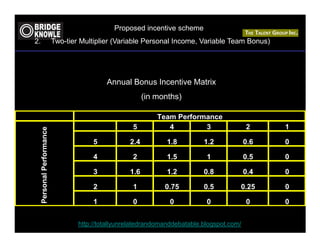
                                             Annual Bonus Incentive Matrix
                                                           (in months)

                                                               Team Performance
                                                      5           4        3                  2     1
     Personal Performance


                                         5           2.4          1.8         1.2             0.6   0

                                         4            2           1.5          1              0.5   0

                                         3           1.6          1.2         0.8             0.4   0

                                         2            1          0.75         0.5         0.25      0

                                         1            0           0            0              0     0


                                    http://totallyunrelatedrandomanddebatable.blogspot.com/
Proposed incentive scheme
   3.   Team Ratio Plan (Team-based Income, No Annual Bonus)


   Total Payout =
   Basic Pay + Monthly Incentive Payout (No Annual Bonus)


Monthly Incentive Payout Matrix
                 Production Staff           Team Leader             Group Leader
 Team Rating    Monthly Incentive         Monthly Incentive        Monthly Incentive

        5            2.00 months               2.25 months                2.50 months

        4            1.50 months               1.75 months                2.00 months

        3            1.20 months               1.45 months                1.70 months

        2            0.75 months               1.00 months                1.25 months

        1            0.00 months               0.00 months                0.00 months

                http://totallyunrelatedrandomanddebatable.blogspot.com/
Proposed incentive scheme
    3.   Team Ratio Plan (Team-based Income, No Annual Bonus)


Example: Production Operator


                                       Monthly Basic Pay (RM)
   Team
Performance
   Rating       500        550         600        650         700          750     800

     5         1,500      1,650       1,800       1,950      2,100         2,250   2,400

     4         1,250      1,375       1,500       1,625      1,750         1,875   2,000

     3         1,100      1,210       1,320       1,430      1,540         1,650   1,760

     2          875        963        1,050       1,138      1,225         1,313   1,400

     1          500        550         600        650         700          750     800
                 http://totallyunrelatedrandomanddebatable.blogspot.com/
Improving Performance
Performance                Intervention Methods                  Effectiveness of
Improvement Area                                                 Direct Incentive
                                                                 Measures
Skill Deficiency           •Off site Training                             Yes
                           •Job redesign
                           •On-the-job training
                           •Process Redesign


Performance Punishing      •Review performance management                 No
                           processes
                           •Study on supervision style of Team
                           Leader
                           •Remove punishment
Non-performance            •Proper performance monitoring                 No
rewarding                  process
                           •Arrange positive consequence


Coordination &             •Communication of clear direction             Partly
Teamwork                   and goals
                           •Shared Accountabilities
                           •Focus on Team Competencies

Behavioural                •Communication of clear behavioural           Partly
                           indicators
                           •Focus on Behavioural
                           •Coaching and Counselling
Supervision Style          •Leadership styles of team leaders     Yes but not for team
                           •Regular tracking on morale of team         members
                           members
• Refer Sales incentive design examples


        http://totallyunrelatedrandomanddebatable.blogspot.com/
Dangers of Direct Incentives

1.  lessen internal motivation,
2.  switch to mercenary mode,
3.  do something and do not do something else,
4.  bribe and fraud culture,
5.  easier for competitors to recruit,
6.  lessen teamwork & helpful culture,
7.  less and less impact for same value,
8.  mockery of base salary and employment
    contract,
9. rebellion from non-incentivised staff,
10. end up incentivising everyone for everything?,
        http://totallyunrelatedrandomanddebatable.blogspot.com/
Non-Monetary Rewards
    and Benefits


 http://totallyunrelatedrandomanddebatable.blogspot.com/
Reminder…

Reality #1

                   Cash is King


      http://totallyunrelatedrandomanddebatable.blogspot.com/
Reminder …

Reality #2
                 Tangible C&B


                      Attraction


      http://totallyunrelatedrandomanddebatable.blogspot.com/
Reminder …

Reality #3
          In-Tangible C&B


                     Retention


     http://totallyunrelatedrandomanddebatable.blogspot.com/
Reminder …

Reality #4
          In-Tangible C&B


            Tipping Point for
           Attraction/Retention

     http://totallyunrelatedrandomanddebatable.blogspot.com/
Benefits Analysis and Comparison


  http://totallyunrelatedrandomanddebatable.blogspot.com/
Total Remuneration Composition

                                Total Remuneration Composition for Executive Director & Executive Chairman                     Average Annual
                                                                                                                             Total Remuneration
                                                                                                                                 Value (RM)
Market Reference Job Grade


                                                     45%                   6%                     49%
                             12 - 16                                                                                           RM 1,016,000


                                                     46%                        12%                   42%
                             10 - 11                                                                                            RM 535,000


                                   0%   10%    20%         30%   40%      50%         60%   70%     80%         90%   100%

                                                                       Percentage

                                               Base Salary       Fixed Cash Allowance        Benefits-in-kind

                                           http://totallyunrelatedrandomanddebatable.blogspot.com/
• Refer Benefits comparison Table


        http://totallyunrelatedrandomanddebatable.blogspot.com/
Fixed Cash Allowances

                 Market Practice on Fixed Cash Allowance for Executive Director and Executive Chairman
1


Contractual/Regular Bonus                                                                             54%
2


             Director Fees                                         31%             These Board of
                                                                                   Directors related
3


          Board Allowance                     15%                                  Allowances/Fees are
                                                                                   not a common practice
                                                                                   among the Companies
4


       Attendant Allowance                                23%
                                                                                   as Base Salary is
                                                                                   provided.
5


        Housing Allowance                                                    38%
6


       Transport Allowance                                23%
7


    Entertainment Allowance                   15%
8


    Cost of Living Allowance         8%
9


         Other Allowances                     15%


                             0%       10%           20%         30%          40%             50%            60%
                                                            % of Companies


                        http://totallyunrelatedrandomanddebatable.blogspot.com/
Benefits-in-Kind

                                                                         Benefits-in-kindPracticefo E
                                                                                                   r xecutiv D
                                                                                                            e irectoran E
                                                                                                                       d xecutiv C anP
                                                                                                                                e hairm ositions

                                                               Increm  ent                                                                                            98%
16 15 14 13 12 11 10 9 8 7 6 5 4 3 2 1


                                               StockOption/Profit Sharing                  16%
                                                          Additional E PF                                                                          70%
                                                      R ent Schem
                                                       etirem            e                                  30%
                                                                  Gratuity                      20%
                                                        M benefits
                                                           edical                                                                                                      100%
                                         G Personal A
                                          roup         ccident Insurance                                                                                  80%
                                                    G L Insurance
                                                     roup ife                                                                                      70%
                                                        C panyH
                                                          om         ouse                       20%
                                                           D estichelp
                                                             om                                             30%
                                                            B G
                                                              ody uards                   15%
                                                           H ousingL  oan                                         35%
                                                           C panyC
                                                             om         ar                                                                                             100%
                                                                C L
                                                                  ar oan                              25%
                                                       C M bership
                                                         lub em                                                                                                        100%
                                                          L Passage
                                                           eave                                                                                                       98%

                                                                         0%        10%      20%        30%         40%    50%       60%       70%        80%    90%   100%

                                                               http://totallyunrelatedrandomanddebatable.blogspot.com/
The 51.28% Theory

• Resign = Push + Pull > 51.28%
• If staff is Happy:
 => 0 + Pull > 51.28%


     http://totallyunrelatedrandomanddebatable.blogspot.com/
Retention


                  Retention


Experience                Swing                                 Ex

                                                        Oppose


      http://totallyunrelatedrandomanddebatable.blogspot.com/
Retention 1: Experience


Loyalty = Experience vs. Expectations


   Solution Strategy: Talent
   Management Plan


      http://totallyunrelatedrandomanddebatable.blogspot.com/
Loyalty 1: Experience
  • Talent
                                            P/P Grid, SP Table,
    Management Plan
                                            PDP, Premium,
                            Selection
P/P Grid, Q12,
PA, SDP, SP
    Evaluation           Philosophy                   Development
                                                           OJT, Mentoring,
                                                           Big-5, LP, PDP,
                            Motivation                     SDP, Projects,

          Q12, C&B, ACDP, SCL,
          Transfers, Events, Recognition
           http://totallyunrelatedrandomanddebatable.blogspot.com/
Loyalty 2: Swing


Loyalty = Best alternative at the current
 moment until I find another alternative


   Solution Strategy: Improve your
   Talent Management Plan, Try Your
   Best, or Live with It

       http://totallyunrelatedrandomanddebatable.blogspot.com/
Loyalty 2: Swing

Swing Talents are “loyal” because:
• Individual Relationships
• Convenience (at that point in time)
• Contractually tied-up
• Direct Incentives*
• No better alternative
• Subordinates
• No known alternative
• CV friendly

        http://totallyunrelatedrandomanddebatable.blogspot.com/
Post-Recession


                  Retention


Experience                Swing                                 Ex

                                                        Oppose
                Post-Recession

      http://totallyunrelatedrandomanddebatable.blogspot.com/
Swing Loyalty: Try Your
        Best…
1.   Over Promote                      9. “Position” the
2.   Loans                                competition
3.   Spot Bonuses                      10.Sell the Dream
4.   Block recruiters                  11.Give them a Best
5.   The Spouse                           Friend
6.   Toys                              12.Internal Trainer
7.   Glorified Titles
8.   Forced Ambassador


         http://totallyunrelatedrandomanddebatable.blogspot.com/
Talent Strategy: C&B

1. Eliminate Staff Awards              8. Additional Profit Sharing
2. Eliminate Staff Trips                   points for TP
3. Eliminate HOD trips                 9. ↑ Pay for Performers,
4. Remove Salary structure                 ↓ pay for Non-
   limitations for TP                      Performers
5. Premium Group Pay                   10. Additional % during
                                           annual increments
6. Year-round
   promotions/increment                11. Special Allowances
7. Spot Bonus Pool                     12. SCL Allowances
                                       13. Flexitime


         http://totallyunrelatedrandomanddebatable.blogspot.com/
• Exercise: What ‘Caring’ C&B policies do you
  have to attract and retain talent?


        http://totallyunrelatedrandomanddebatable.blogspot.com/
Values Driven C&B

1.   Performance
2.   Differentiation
3.   Caring
4.   Non-tangibles & Segmentation


        http://totallyunrelatedrandomanddebatable.blogspot.com/
Demographic Segmentation
        - General

                 Veterans (Pre-Boomers)
                       1934-1945


       Gen Y
                                                         Boomers
(Millennials, Netster)
                                                        1945-1960
       1980+


                  Gen X (Cusper, Buster)

                       1960 - 1980
          http://totallyunrelatedrandomanddebatable.blogspot.com/
Demographic Segmentation
       - others

1.   Women, Working Mothers
2.   Youtube generation
3.   Working retired
4.   Social Activists
5.   Work/Life balancers
6.   Industry (ICT, Advertising, Engineer,
     Accounting, Lawyer, etc.)

         http://totallyunrelatedrandomanddebatable.blogspot.com/
What needs work?

                 High                     Fun place to work
                                                                         Training
                         For people like me                              Opportunities
Target Segment
 Importance to


                                      Attractive Location
                                                                       Familiarity
                                                                       with Tasks
                                            Innovative
                                            company
                                                                    Career
                                                                    Opportunities
                           Overseas
                           Opportunities
                                                                           High Salary
                 Low
                             Weak                                                 Strong
                                             Current Attractions
                        http://totallyunrelatedrandomanddebatable.blogspot.com/
What needs work?

                 High                     Fun place to work
                                                                         Training
                         For people like me                              Opportunities
Target Segment
 Importance to


                                      Attractive Location
                                                                       Familiarity
                                                                       with Tasks
                                            Innovative
                                            company
                                                                    Career
                                                                    Opportunities
                           Overseas
                           Opportunities
                                                                           High Salary
                 Low
                             Weak                                                 Strong
                                             Current Attractions
                        http://totallyunrelatedrandomanddebatable.blogspot.com/
Caring (1/2)

                     Staff
            Loans/ Discounts
                             Uniform
           Subsidies
 Lactation                                         Allowance/
  Room                                                COLA

Extensive                 Caring                    Subsidized
 Training                                             Lunch

                                                 Free
     Flexitime
                                                Carpark
              Work/Life
                                     SRC
               Balance
  http://totallyunrelatedrandomanddebatable.blogspot.com/
Caring (2/2)


          Add.     Internal
                             Transfer/
        Maternity Selection
                            Secondment
          Leave
  Free IT                           Paternity
  Classes                            Leave

Discount                  Caring                        Van
  PnB                                                Transport
 & OOP                                                 (KTM)
   Emergency               Sub. Yoga/
     Loan Study &          Line Dance
                   Library &
             Exam
                   Magazines
             Leave
  http://totallyunrelatedrandomanddebatable.blogspot.com/
For Starting Up…

        High
Importance to

  Segment
   Target


         Low


                http://totallyunrelatedrandomanddebatable.blogspot.com/
For Starting Up…


      Weak                                                 Strong
                      Current Brand
 http://totallyunrelatedrandomanddebatable.blogspot.com/
Part C
INTANGIBLE BENEFITS &
STAFF MOTIVATION

         http://totallyunrelatedrandomanddebatable.blogspot.com/
Employer Branding
ATTRACTING AND
POSITIONING

     http://totallyunrelatedrandomanddebatable.blogspot.com/
The real goal of Marketing and
           Branding
  Understanding our role in the whole
          scheme of things


   http://totallyunrelatedrandomanddebatable.blogspot.com/
• Exercise: Why do we need ‘Branding’?


        http://totallyunrelatedrandomanddebatable.blogspot.com/
What is the purpose of
    Marketing & Branding?
Ultimate Objective of Marketing:
“Get more people, to buy more
things, more frequently, at higher
prices.”

“Retention and Loyalty are useless if
No Conversion is happening.”

                                Sergio Zyman
     http://totallyunrelatedrandomanddebatable.blogspot.com/
What is the purpose of
    Marketing & Branding?

“Retention and Loyalty are useless if
No Conversion is happening.”

“Communication is useless if No
Conversion is happening.”


      http://totallyunrelatedrandomanddebatable.blogspot.com/
What is the Objective?

1.Comm = Relationship (something
  like Dating)

2.Comm ≠ Media glitz
3.Comm ≠ ATL/BTL/BwTL/ArTL/FTL
4.Comm ≠ CSR
5.Comm = Get more people, to buy
  more, more frequently, at higher
  prices

     http://totallyunrelatedrandomanddebatable.blogspot.com/
Intro


“Retention and Loyalty are useless if
No Conversion is happening.”


“Retention and Loyalty are useless if
No Performance is happening.”


      http://totallyunrelatedrandomanddebatable.blogspot.com/
Intro

Loyalty is misleading…

• Heavy Consumption ≠ Loyalty
• Loyalty ≠ Heavy Consumption

• Good Performance ≠ Retention
• Retention ≠ Good Performance
     http://totallyunrelatedrandomanddebatable.blogspot.com/
So… are we in business for
 Retention or Performance?


   http://totallyunrelatedrandomanddebatable.blogspot.com/
Corporate & Employer Brand


Corporate
 Brand


   Right Type
   of People
                                               Employer
                                                Brand

 http://totallyunrelatedrandomanddebatable.blogspot.com/
Why Employer Branding?


                                1.Attract
Employer                        2.Retain
 Branding                       3.Motivate
                                4.Focus

    http://totallyunrelatedrandomanddebatable.blogspot.com/
Components of Branding

    Positioning, Execution, and
          Communication


http://totallyunrelatedrandomanddebatable.blogspot.com/
Components of Branding


                 Positioning


                  Execution


             Communication

 http://totallyunrelatedrandomanddebatable.blogspot.com/
Brand Positioning

Segmentation, Targeting, Basics,
       Differentiators


http://totallyunrelatedrandomanddebatable.blogspot.com/
Positioning


“Hope is not a strategy”
                                    John Maxwell


  http://totallyunrelatedrandomanddebatable.blogspot.com/
Positioning

• For who? – Segmentation, Targeting
• Your Offer?
• Key Differentiator?


      http://totallyunrelatedrandomanddebatable.blogspot.com/
Two Types of Segmentation
    for HRM

1. Demographic segmentation
2. Talent segmentation


     http://totallyunrelatedrandomanddebatable.blogspot.com/
Recruitments of Gen X and Gen Y
UNDERSTANDING
DEMOGRAPHICS

     http://totallyunrelatedrandomanddebatable.blogspot.com/
Demographic Segmentation
        - General

                 Veterans (Pre-Boomers)
                       1934-1945


       Gen Y
                                                         Boomers
(Millennials, Netster)
                                                        1945-1960
       1980+


                  Gen X (Cusper, Buster)
                       1960 - 1980
          http://totallyunrelatedrandomanddebatable.blogspot.com/
Generational Differences In
     The Workplace

• Now 4 Generations in the workplace
• Events and conditions each of us experience during
  our formative years help define who we are and
  how we view the world.
• Each Generation has different value systems –
  Values drive behavior.
• We need to understand each other so we can value
  what each generation brings to the team.
• In 10 years, 40% of current workforce will retire.


       http://totallyunrelatedrandomanddebatable.blogspot.com/
Generational Thoughts

•   X&Y act first, evaluate later – they know more than older
    generations knew at their age. Thrive in speed and chaos. May
    think about having multiple careers.
     – May not Actively Listen to Builders & Boomers, missing
        valuable info.
•   Builders & Boomers – paid their dues, have vast experience &
    knowledge.
     – May question how much X&Y know, undervalue their quick
        decision-making, don’t think of them as colleagues and
        collaborators because assume they’re inexperienced.
     – May think X&Y are too impatient –quick to throw out tried &
        true strategies .
•   Loyalty to Co. – Builders & Boomers may value; X&Y may not
•   Challenge Authority – Builders & Boomers may not, X&Y may.
•   Work Life Balance: Builders & Boomers may do without, X&Y
    may not do without.

           http://totallyunrelatedrandomanddebatable.blogspot.com/
Generational Thoughts

• Builders may see Boomers as self absorbed
  & prone to sharing too much info.
• Boomers may see Builders as dictatorial and
  rigid.
• Y may view X as too cynical and negative.
• X may view Y as too spoiled and self-
  absorbed.
• X may view Boomers as being too Politic –
  say right thing to right person.


     http://totallyunrelatedrandomanddebatable.blogspot.com/
What Bonds Generations
All Generations want:

Work-Life Balance – flexible hours, fewer hours
• Younger Generations – may be less ambitious in
  traditional terms, less willing to make tradeoffs - family
  focus.
• Boomers – want time for hobbies or fitness, care for
  aging parents, family, start own business.
Timely, Constructive Feedback
Sense of Community with Others
Effective Projects and Meetings
Use their Talents
Enhance their Skills
          http://totallyunrelatedrandomanddebatable.blogspot.com/
Things Research Says
       Gens Want to be Valued for
• Builders: “Your experience is respected – It’s valuable
  to hear what’s worked in the past.”
• Boomers: “You are valuable & worthy. Your
  contribution is unique and important to our success.”
• Xers: “Let’s explore some options outside the box –
  your technical expertise and is a big asset.”
• Y’s: “You will be collaborating with other bright,
  creative people – you have really rescued this
  situation with your commitment.”


         http://totallyunrelatedrandomanddebatable.blogspot.com/
What All Generations
        Need to Do
Seek balance between
• building on traditional procedures and
• supporting flexibility and creativity
  to effectively blend the generations work ethics.
• Allow choices
• Openly explore ideas
• Value different points of view
• Encourage active listening
• Share expertise
• Share recognition and appreciation
• Value hard work
• Build in humor and fun into learning.
• Accommodate the needs and values of all generations.

          http://totallyunrelatedrandomanddebatable.blogspot.com/
What Generation’s
  Next?

The Millenniums – They
 are in secondary school
 right now…coming out
 soon…in about 10 years
 or so

                                                              213
    http://totallyunrelatedrandomanddebatable.blogspot.com/
Demographic Segmentation
       - others

1.   Women, Working Mothers
2.   Youtube generation
3.   Working retired
4.   Social Activists
5.   Work/Life balancers
6.   Industry (ICT, Advertising, Engineer,
     Accounting, Lawyer, etc.)

         http://totallyunrelatedrandomanddebatable.blogspot.com/
Exercise: Who is your target?


Company Segmentation                 Employer Segmentation


        http://totallyunrelatedrandomanddebatable.blogspot.com/
Exercise: Employer
       Segmentation
                                      What do you know about
Who are your Targets?                 them?


         http://totallyunrelatedrandomanddebatable.blogspot.com/
Employer Branding
WHAT NEEDS WORK?


     http://totallyunrelatedrandomanddebatable.blogspot.com/
Basics & Differentiators


                                              Differen
Segments                                       tiators
                 Targets
                                               Basics
                                               Targets


     http://totallyunrelatedrandomanddebatable.blogspot.com/
Demographic Segment:
    Example Exercise
1. Gen Y                                        Refer:
                                                • GEN Y ranking of
2. ICT                                            job considerations
                                                • 10 non-monetary
3. Women                                          benefits to attract
                                                  and retain top
                                                  developers


      http://totallyunrelatedrandomanddebatable.blogspot.com/
What needs work?

                 High                     Fun place to work
                                                                         Training
                         For people like me                              Opportunities
Target Segment
 Importance to


                                      Attractive Location
                                                                       Familiarity
                                                                       with Tasks
                                            Innovative
                                            company
                                                                    Career
                                                                    Opportunities
                           Expected
                           success of
                           application                                     High Salary
                 Low
                             Weak                                                 Strong
                                                Current Brand
                        http://totallyunrelatedrandomanddebatable.blogspot.com/
What needs work?

                 High                     Fun place to work
                                                                         Training
                         For people like me                              Opportunities
Target Segment
 Importance to


                                      Attractive Location
                                                                       Familiarity
                                                                       with Tasks
                                            Innovative
                                            company
                                                                    Career
                                                                    Opportunities
                           Expected
                           success of
                           application                                     High Salary
                 Low
                             Weak                                                 Strong
                                                Current Brand
                        http://totallyunrelatedrandomanddebatable.blogspot.com/
For Starting Up…

        High
Importance to

  Segment
   Target


         Low


                http://totallyunrelatedrandomanddebatable.blogspot.com/
For Starting Up…


      Weak                                                 Strong
                      Current Brand
 http://totallyunrelatedrandomanddebatable.blogspot.com/
Activity Grid to determine
      HRM priorities
Increase (↑)                        Create (+)
What are features/                  What are features/
  activities/services to              activities/services to
  increase?                           introduce?


Reduce (↓)                          Eliminate (-)
What are features/                  What are features/
  activities/services to              activities/services to
  reduce?                             eliminate?


        http://totallyunrelatedrandomanddebatable.blogspot.com/
Exercise: Activity Grid

Increase (↑)                       Create (+)


Reduce (↓)                         Eliminate (-)


       http://totallyunrelatedrandomanddebatable.blogspot.com/
Part D
THE TALENT & PERFORMANCE
MANAGEMENT SYSTEM

         http://totallyunrelatedrandomanddebatable.blogspot.com/
Talent & Performance
         Management
                                            P/P Grid, SP Table,
                                            PDP, Premium,
                            Selection
P/P Grid, Q12,
PA, SDP, SP
    Evaluation           Philosophy                   Development
                                                           OJT, Mentoring,
                                                           Big-5, LP, PDP,
                            Motivation                     SDP, Projects,

          Q12, C&B, ACDP, SCL,
          Transfers, Events, Recognition
           http://totallyunrelatedrandomanddebatable.blogspot.com/
Why do we hate Performance
       Appraisals?


 http://totallyunrelatedrandomanddebatable.blogspot.com/
Complaints about
    Performance Appraisals
  As an                 As an                           Mgmt/HR
Appraisee              Appraisor


      http://totallyunrelatedrandomanddebatable.blogspot.com/
Complaints about
        Performance Appraisals
    As an Appraisee
•   Bias
•   Different Standards
•   Surprise
•   Subjective
•   No linkage*
•   No differentiation
•   Secretive
•   No follow up
•   No control
          http://totallyunrelatedrandomanddebatable.blogspot.com/
Complaints about
        Performance Appraisals
    As an Appraiser
•   Cannot remember
•   Tedious
•   Subjective
•   Right targets
•   Scoring Competencies*
•   Defensive staff
•   No $$ to differentiate
•   Prejudices
•   Results or Activities
          http://totallyunrelatedrandomanddebatable.blogspot.com/
Complaints about
        Performance Appraisals
    Mgmt/HR
•   Flexible or Control?
•   MBO or Character?
•   Best Practice or Fit Culture?
•   Backward or Forward?
•   Quarterly Results or Long-term?
•   No $$ to differentiate*
•   Perfect System, Bad performance
•   Recency and Halo effects
•   Untrained Appraisers
          http://totallyunrelatedrandomanddebatable.blogspot.com/
Complaints about Performance
     Appraisals - Summary

1. Process problem
2. Form problem
3. People problem


      http://totallyunrelatedrandomanddebatable.blogspot.com/
What’s the Difference?


Performance Appraisal                 Performance Management


         http://totallyunrelatedrandomanddebatable.blogspot.com/
Coaching & Counseling


Month 1                  Month 2-11                            Month 12
Performance                                                  Performance
Planning                             ?                       Appraisal


          http://totallyunrelatedrandomanddebatable.blogspot.com/
What is the OBJECTIVE of a
      Performance Management
      System?
• What is the ultimate objective of a Performance
  Management System?
• ‘Performance’ – achievement,
• ‘Management’ – controllable, improvement
• ‘System’ – predictable outcome, autorun

Summary?
• A Predictable process to Improve Controllable
  Achievements

        http://totallyunrelatedrandomanddebatable.blogspot.com/
What’s In Between Planning
and Execution?
                   Business Model

                         BSC

                          KPIs

                Budgeting + Planning

Performance Management System

                     Differentiation

                 Talent Management

             Succession Planning (Business
                          Continuity)
 http://totallyunrelatedrandomanddebatable.blogspot.com/
What is the OBJECTIVE?

 Business Model
     Strategy
                                          Business Strategy
  BSC and KPIs
                                          Execution
Budgeting + Planning

         Performance Management System

                                          Differentiation

     Talent                           Talent Management
Management
                               Succession Planning (Business
                                        Continuity)
  http://totallyunrelatedrandomanddebatable.blogspot.com/
Intro

• Performance Management
  System = Business Plan
  Implementation
• Succession Planning = Business
  Continuity Planning
• Talent Management = Sustainable
  Business Performance
  Management
      http://totallyunrelatedrandomanddebatable.blogspot.com/
Sources of Goals and KPIs

• Exercise: List down the sources of Goals and
  KPIs available in your company:
  – E.g. Job Description (RDQ)


        http://totallyunrelatedrandomanddebatable.blogspot.com/
MBO – Sources of KRAs
       and KPIs, Targets
1.   Department Scorecard [E3],
2.   Employee’s Job Description,
3.   Department SOP,
4.   Department Quality Objectives,
5.   Corrective Action Requests (CAR),
6.   Preventive Action Requests (PAR), or
7.   Special Projects relevant to the
     employee.

         http://totallyunrelatedrandomanddebatable.blogspot.com/
Basics of the Balanced Scorecard


   http://totallyunrelatedrandomanddebatable.blogspot.com/
Reminder: Why BSC?

     • Reason 1: Balanced
     • Reason 2: Cause-and-Effect


www.myCNI.com.my http://totallyunrelatedrandomanddebatable.blogspot.com/ www.OOBEY.com
Cause and Effect
 Financial
                   Revenue          Cost            Margin     Cash Flow         Asset

Customers                                  Satisfaction

      Base              Share Gain           Positioning      Adjacent            New
    Retention                                                  Market           Business


Internal Process
                                                                                Investment
                      Operational            Product         Customer
                                                                                  Strategy
                      Excellence            Leadership       Intimacy


Learning & Growth

       Competencies                  Information Systems                  Motivation,
                                                                         empowerment,
                                                                           alignment
                   http://totallyunrelatedrandomanddebatable.blogspot.com/
Cause and Effect: An
               Example
Financial                              Revenue Growth
                Market Value                                        Productivity

Customers /
Distributors      Products/              Channel               Target
                  Services              Strategies             Markets


Internal         Supplier &            Department                   External
Process          Alliances             Operations                 Involvement


Learning &                              Technology
Growth          Human                                              Information &
               Resources                 Systems &                  Intelligence
                                         Processes
                http://totallyunrelatedrandomanddebatable.blogspot.com/
Example: 1st Level BSC &
             KPIs
Financial       Profit after Tax. Revenue. Cash-to-cash cycle. Operating
                cash flow

Customers /     Customer Complaints. Customer Acquisition Rate. Product
Distributors    Availability. Product Quality & Service. Renewal Annual
                Subscription. Distributor Rank Achievement. No. of Active
                Distributor. No. DC/Regional Sales. Distributor with commission


               Customer Database Availability. Accuracy of Forecast Planning.
Internal
               Continuous Improvement. Response Time to Customer Needs.
Process        Perfect Order Fulfillment. Inventory Turnover. Number of Effective
               Sponsoring Program. On Time Delivery. No. of Effective Training.
               Number of Effective A&P

               % of staff evaluated on Core Competency Framework. % of staff
Learning &     with Career Development Plans. No. of training hours completed
Growth         per staff. % of staff with access to strategic information. Q12
               Index. % staff evaluated on Culture alignment
               http://totallyunrelatedrandomanddebatable.blogspot.com/
Leading and Lagging KPIs


http://totallyunrelatedrandomanddebatable.blogspot.com/
Cause and Effect


Goal:                                  What are my
                                       Vital Signs?
Healthy!
                                       •Blood
                                       Pressure?
                                       •Temperature?
                                       •Cholesterol?
                                       •Fever?
                                       •Chest Pain?
                                       •Dizziness?
   http://totallyunrelatedrandomanddebatable.blogspot.com/
Cause and Effect


  Also known as:
Leading vs. Lagging
     Indicators

   http://totallyunrelatedrandomanddebatable.blogspot.com/
Exercise: Leading vs. Lagging


Lagging?                                Leading?
•   Monthly Sales
•   Customer Retention
•   Project success
•   Event attendance
•   ARPU
•   Customer Satisfaction
•   Dealer Satisfaction


           http://totallyunrelatedrandomanddebatable.blogspot.com/
Cause & Effect: Strategy

Financial                                      Customer
“To satisfy our                                “Who are our target
stakeholders, what                             customers?
Financial objectives must                      What is our value
we accomplish?”                                proposition?”


Learning & Growth                           Internal Process
“What capabilities and tools                “To satisfy our customers, in
do our employees require to                 which internal business
help them execute our                       processes must we excel?"
strategy?

           http://totallyunrelatedrandomanddebatable.blogspot.com/
Top Performers and the ‘No
   Contribution’ Problem

                 Historical, Outcome, Results, 1st
Lagging          Level, Usually Financial or
                 tangible, Quarterly and Annually


                 Current, Indicators, Drivers, 2nd
Leading          Level onwards, usually non-
                 financial or intangible, Weekly,
                 Monthly and Quarterly


    http://totallyunrelatedrandomanddebatable.blogspot.com/
Developing ‘Driver’ KPIs


                 Customer Retention %                  Lagging, 1st Level


                  Customer Satisfaction
                                                       Leading, 2nd Level
                  Index

On time delivery
Time to market for new products
                                                       Leading, 3rd Level
TNA %                                                  onwards
Defect levels, warranty claims

          http://totallyunrelatedrandomanddebatable.blogspot.com/
What is the Objective?

                ‘Do-or-Die’ KPIs for CNI
• Revenue
• ARPU

• Sponsoring
• Retention

• Commission Plan (BDP)
• Product
• Corporate Image


        http://totallyunrelatedrandomanddebatable.blogspot.com/
• Exercise: What are the Key 1st Level KPIs for
  your Industry?


        http://totallyunrelatedrandomanddebatable.blogspot.com/
• Exercise: Developing your own Leading and
  Lagging KPIs


        http://totallyunrelatedrandomanddebatable.blogspot.com/
B2B/B2G BSC Matching
                Customer/Client/
                Government BSC
   Financial
                  Revenue           Cost         Margin     Cash Flow        Asset

  Customers                            Satisfaction
                                                                                                               Your BSC
        Base            Share Gain         Positioning     Adjacent           New
      Retention                                             Market          Business
                                                                                         Financial
                                                                                                        Revenue           Cost         Margin     Cash Flow        Asset

     Internal
     Process                                                                            Customers                            Satisfaction
                                                                           Investment
                      Operational           Product       Customer
                                                                             Strategy
                      Excellence           Leadership     Intimacy                            Base            Share Gain         Positioning     Adjacent           New
                                                                                            Retention                                             Market          Business
  Learning & Growth

         Competencies                  Information                    Motivation,          Internal
                                         Systems                     empowerment,          Process
                                                                                                                                                                 Investment
                                                                       alignment                            Operational           Product       Customer
                                                                                                                                                                   Strategy
                                                                                                            Excellence           Leadership     Intimacy


                                                                                        Learning & Growth


1. Draw your ‘customer’s’ BSC                                                                  Competencies                  Information
                                                                                                                               Systems
                                                                                                                                                            Motivation,
                                                                                                                                                           empowerment,
                                                                                                                                                             alignment


2. Match their CP/IP with your CP
3. Identify IPs that support/conflict

                                    http://totallyunrelatedrandomanddebatable.blogspot.com/
Performance Standards


http://totallyunrelatedrandomanddebatable.blogspot.com/
MBO Standards

A            Excellent

B            Good

C            Average

D            Poor

E            Useless


    http://totallyunrelatedrandomanddebatable.blogspot.com/
MBO Standards

A            Excellent

B            Good

C            Average                      Good

D            Poor

E            Useless


    http://totallyunrelatedrandomanddebatable.blogspot.com/
MBO Standards

A            Excellent                    Excellent

B            Good                         Very Good

C            Average                      Good

D            Poor                         Not Good

E            Useless                      Commit Suicide


    http://totallyunrelatedrandomanddebatable.blogspot.com/
MBO Standards

A      Excellent            Consistently achieved 4 for 3
                              quarters
B      Very Good Higher than planned results

C      Good                 Achieved Planned Results


D      Not Good             Did not fully meet planned
                              results
E      Commit               Unacceptable performance
        Suicide
            Refer: Priority, Targets and Standards
     http://totallyunrelatedrandomanddebatable.blogspot.com/
Rating Scale
            .H 5HVXOWV                      .3,V                   2EMHFWLYHV
(QVXUH WKH DFKLHYHPHQW RI FXUUHQW    3URGXFWLRQ        PLOOLRQ NLORJUDP RI 3URGXFW $
SURGXFWLRQ WDUJHWV ZLWKLQ FRVW       WDUJHWVILJXUHV     :LWKLQ EXGJHWHG IDFWRU FRVW
VSHFLILFDWLRQ E UHJXODUO           9DULDQFH LQ       LH 50 PLOOLRQ
PRQLWRULQJ SURGXFWLRQ UHSRUWV DQG    RSHUDWLQJ H[SHQVH
GLUHFWLQJ FRUUHFWLYH DFWLRQ ZKHUH    EXGJHW
QHFHVVDU

        5                 ≥ 105 million kilo of A


        4            98 million kilo of A


        3            95 million kilo of A


        2            94 million kilo of A


       1                  % 93 million kilo of A
                  http://totallyunrelatedrandomanddebatable.blogspot.com/
Performance Planning: KPIs
      and Critical Goals


• Refer Workbook: Performance Planning
  Worksheet


       http://totallyunrelatedrandomanddebatable.blogspot.com/
Performance Planning and KPIs:
Cascading from Company-Department-
             Individual


     http://totallyunrelatedrandomanddebatable.blogspot.com/
E3 – Department BSC

 Financial Perspective

  Goals          Measures              Targets           CAPEX         OPEX
Quality

Innovation

On Time
Delivery


             http://totallyunrelatedrandomanddebatable.blogspot.com/
Individual Performance

 1.0 Key        2.0          3.0     4.0 Merit*         5.0 Rating         6.0
 Results      Goals      Achievem                         (Merit x      Appraiser
Area (Max      and        ents and                       Weight)          Overall
    6)       Targets     Efforts for                                   Comments
              for Q1         Q1                                        / Feedback


             http://totallyunrelatedrandomanddebatable.blogspot.com/
Cascading

Customer Perspective

  Goals        Strategies            Targets            Direct       Indirect
Base                                                      Mkt
Retention
Share Gain                                                Mkt

New                                                       BD
Business


           http://totallyunrelatedrandomanddebatable.blogspot.com/
E3 – Department BSC

Customer Perspective –
Marketing Department
  Goals       Strategies            Targets           CAPEX         OPEX
Base
Retention
Share Gain


                                                             Budgeting

          http://totallyunrelatedrandomanddebatable.blogspot.com/
Individual MBO

                                                           Re: Base
 Employee A – Marketing Executive                          Retention
  KRAs             Action             Targets           Weight        Score
                   Plans                                 (%)
Class A
Customer
Retention
Class B
Customer
Retention
Competition
Crossovers
            http://totallyunrelatedrandomanddebatable.blogspot.com/
Start Up

      The end of the Beginning


http://totallyunrelatedrandomanddebatable.blogspot.com/
The Wish List

1.   Health and Wellness
2.   Work/Life Balance
3.   Mobility
4.   Innovation


        http://totallyunrelatedrandomanddebatable.blogspot.com/
For Starting Up…

1.   Get the Business Strategy right
2.   Link CB to Strategy (e.g. BSC)
3.   Clarify the CB Philosophy
4.   Strengthen Performance Management System
5.   Redirect Funds ($$)
6.   Design simple processes
7.   Develop and Reward focused on Talent groups
8.   Communicate throughout


         http://totallyunrelatedrandomanddebatable.blogspot.com/
Problem with CB…


“Good news for stockholders
  can be bad news for other
       stakeholders.”
    Gregory Miller, Assoc. Prof., Harvard Business School.


     http://totallyunrelatedrandomanddebatable.blogspot.com/
In the end…

• Great Wall of China
  – humans are the weakest link
  – bad treatment of staff will lead to weak link i.e.
    easier to bribe, easier to con, etc;
  – bad treatment examples: insulting, lose face,
    broken promises, no dignity, public criticism,
    restructure without communication


        http://totallyunrelatedrandomanddebatable.blogspot.com/
Other thoughts…

1. Big matters/Small                  5. Flat Structure?
   Matters                            6. The Jerk Boss
2. Differentiate of Die               7. All aspects
3. Define “Talent”                    8. Hire Strict
4. No “Jerk” rule


        http://totallyunrelatedrandomanddebatable.blogspot.com/
Summary

        Segmented  Targeted
Attraction, Retention and Succession


                  STARS™


      http://totallyunrelatedrandomanddebatable.blogspot.com/
End Notes

      The end of the Beginning


http://totallyunrelatedrandomanddebatable.blogspot.com/
Are your employees willing to die for you?


      http://totallyunrelatedrandomanddebatable.blogspot.com/
• 31 people died and 28 were
                     Taj Mumbai, 2008                                    hurt
                                                                       • 1,200 and 1,500 guests
                                                                         escaped
                                                                       • 11 Taj Mumbai employees
                                                                         died rescuing guests
                                                                       • Restaurant and banquet staff
                                                                         rushed people to safe
                                                                         locations such as kitchens
                                                                         and basements.
                                                                       • Telephone operators stayed
                                                                         at their posts, alerting guests
    Taj Mahal Palace, Mumbai                                             to lock doors and not step
        November 26, 2008                                                out.
                                                                       • Kitchen staff formed human
                                                                         shields to protect guests
Harvard Business Review, December 2011                                   during evacuation attempts
“The Ordinary Heroes of the Taj” by Rohit Deshpandé and Anjali Raina


                          http://totallyunrelatedrandomanddebatable.blogspot.com/
Taj Mumbai, 2008

• Seek fresh recruits rather than                   •           Train workers for 18 months, not
  lateral hires.                                                just 12.
• Hire from small towns and                         •           Ensure that employees can deal
  semiurban areas, not metros.                                  with guests without consulting a
• Recruit from high schools and                                 supervisor.
  second-tier business schools                      •           Teach people to improvise rather
  rather than colleges and premier                              than do things by the book.
  B-schools.                                        •           Insist that employees place
• Induct managers who seek a                                    guests’ interests over the
  single-company career and will be                             company’s.
  hands-on.                                         •           Have incumbent managers, not
• Focus more on hiring people with                              consultants, conduct training.
  integrity and devotion to duty than               •           Use timely recognition, not
  on acquiring those with talent and                            money, as reward.
  skills.        Harvard Business Review, December 2011
                     “The Ordinary Heroes of the Taj” by Rohit Deshpandé and Anjali Raina
                    http://totallyunrelatedrandomanddebatable.blogspot.com/
Thank You.
              soft copy of slides:
http://totallyunrelatedrandomanddebatable.
                blogspot.com/

Bridge Knowle - Salary and Reward Structures (Training and Workshop)

  • 1.
    COMPETENCY-BASED SALARY + REWARD STRUCTURE TrainingSession and Workshop Kenny Ong http://totallyunrelatedrandomanddebatable.blogspot.com/
  • 2.
    Intro • Day CareCenter http://totallyunrelatedrandomanddebatable.blogspot.com/
  • 3.
    Part A HRM STRATEGYAND REWARD STRATEGY http://totallyunrelatedrandomanddebatable.blogspot.com/
  • 7.
    The McPlaybook* Makeit easy to eat Make it easy to prepare • 50% drive-thru • High Turnover • Meals held in one • Tasks simple to learn hand & repeat Make it quick Make what customers want • “Fast Food” • Prowls market for new • Tests new products products for Cooking Times • Monitored field tests *Adapted from: Businessweek , Februrary 5th 2007 http://totallyunrelatedrandomanddebatable.blogspot.com/
  • 8.
    Phases of Organisation Development Growth Current Next Phase Future Exploring and role Managing growth Managing Efficiency and Phase Reengineering definition Organisation Entrepreneurial Professional Organisation Efficiency features Phase Development Phase Phase • Results orientation • New relationship building People • Innovation • Teamwork & Cooperation • Enthusiastic • Open to change characteristics • Concern for order & quality • Efficiency & productivity oriented • High standards Organisation • Flexibility • Excellence • Responsibility • Quick decision making • Participatory climate • Commitment • Pace setting and • Systems thinking • Coaching & counseling Management authoritative • Coaching & developmental • Authoritative style • Attract capable individuals • Reward results achieved • Cost efficiency • Flexibility • Retain & motivate • Consistency • Equity • Variable base salary & • High to medium base salary Objectives of effectiveness related & longer term performance • Medium base salary and performance rewards related rewards efficiency performance rewards HR policies http://totallyunrelatedrandomanddebatable.blogspot.com/
  • 9.
    The Changing BusinessEnvironment Pre-merdeka1945- Post Merdeka1957- Industrialization Development of the knowledge 1956 1969 period1970-1995 based economy1996 and on going Era • Post war • Post colonial • Industrial • Free market, customer • Reconstruction administration development centered organization • National development Government • Establishing control • Establishing • Leading economic • Recognizing global forces objectives over natural government control change • Preparing a resilient and just resources • Protecting free • Creation of society • Establishing enterprise conditions for • Searching for a new administration • Domestic economic regional and relationship model with systems in the development international industry interest of the British recognition empire Corporate • Production for the • Import substitution • Production capacity • Innovation culture colonial empire • Domestic market utilization • Global standards on needs • International efficiency Corporate • BOD led by “home • Autocratic • market Authoritative • • Professional management Participative Leadership office” • BOD led by • BOD led by • BOD of professionals, team representative individualistic style charismatic decision making directed at • Home office personalities achievement of targeted standards • Largely local results principles on BOD • International standards on conduct corporate governance. Pay • Pay practice • Pay for loyalty – • Flexible pay • Attract, retain and motivate Philosophy “enough” years of service competent professionals http://totallyunrelatedrandomanddebatable.blogspot.com/
  • 10.
    Budgeting vs. Priorities Example:Business Situation vs. R&D Priorities Upturn Flat Downturn Fight Complacency Innovation Sales Sharpen Edge Acquire Cash Flow Keep Momentum Profits Conquer Build momentum NPD Cycle Time Focused on Improve Top 15% ‘Breakthrough’ Improve Edge revenue-generating JV, In-source, Out- products Extensions source Counter Competitor Eliminate bottom 20% ↓ R&D, ↑Sales http://totallyunrelatedrandomanddebatable.blogspot.com/
  • 11.
    Business Situations vs.HRM Upturn Flat Downturn Fight Complacency Innovation Sales Sharpen Edge Acquire Cash Flow Keep Momentum Profits Conquer Build momentum ‘Change’ mgmt Talent Mgmt Top Talent focus Reduce Fat Innovation/R&D Sales, Sales, Sales Continuity Early wins Increase attrition Everyone Happy Slow Down HR Costs Motivation http://totallyunrelatedrandomanddebatable.blogspot.com/
  • 12.
    Business Situations vs.HRM Upturn •Projects Flat Downturn •Job Ads Fight Complacency Innovation Sales •Communication Sharpen Edge Acquire Cash Flow •F/L Manager Com. Keep Momentum Profits •Middle Management Conquer •Involvement (survey, momentum Build suggestions) ‘Change’ mgmt Talent Mgmt Top Talent focus •Realistic Goals Reduce Fat Stack R&D Stack Sales •Controllable KPIs (customer Continuity Early wins Increase attrition satisfaction, production) Everyone Happy Slow Down HR Costs Motivation http://totallyunrelatedrandomanddebatable.blogspot.com/
  • 13.
    Staff Attraction &Retention THE BATTLE FOR TALENT http://totallyunrelatedrandomanddebatable.blogspot.com/
  • 14.
    Intro: “Cow don’t drinkwater cannot push cow head down” http://totallyunrelatedrandomanddebatable.blogspot.com/
  • 15.
    Question: Talent Management forWho? Excellent Very Good Average Not Good Commit Suicide http://totallyunrelatedrandomanddebatable.blogspot.com/
  • 16.
    Before we start… 1.Who designs your Talent Management programs? 2. Are you in the Talent Pool? 3. Do you qualify? 4. “It takes a crook to catch a crook” http://totallyunrelatedrandomanddebatable.blogspot.com/
  • 17.
    Talent Segmentation • Whoare your Talents? : A Talent for others does not mean a Talent for you http://totallyunrelatedrandomanddebatable.blogspot.com/
  • 18.
    Talent Segment Targeting • Unwanted by big MNCs • Small companies • Boring Environment • No Growth/Learning • No MBA • Passion, Values, IQ (streetsmart) • Appreciate Chaos • Multitask • Passion to Learn http://totallyunrelatedrandomanddebatable.blogspot.com/
  • 19.
    Talent Segmentation • Identify POTENTIAL 2 3 4 5 PERFORMANCE 5 Group I (Talent Pool) 4 3 2 http://totallyunrelatedrandomanddebatable.blogspot.com/
  • 20.
    Talent Segmentation • Identify POTENTIAL 2 3 4 5 PERFORMANCE Group II Group I 5 ( Potential) (Talent Pool) 4 Group IV Group III 3 (Counseling) ( Performance) 2 http://totallyunrelatedrandomanddebatable.blogspot.com/
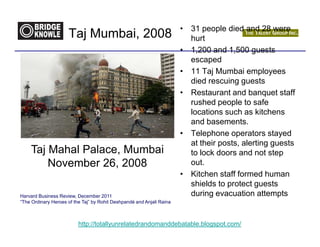
  • 21.
    Selection and Identification 1. Results PERFORMANCE APPRAISAL 2. Values 3. Special Contributions http://totallyunrelatedrandomanddebatable.blogspot.com/
  • 22.
    Selection and Identification POTENTIAL 1. Capacity EVALUATION 2. Competencies 3. Culture http://totallyunrelatedrandomanddebatable.blogspot.com/
  • 23.
    Selection and Identification POTENTIAL EVALUATION 1. Capacity Learn Ambition Next Level http://totallyunrelatedrandomanddebatable.blogspot.com/
  • 24.
    Selection and Identification POTENTIAL EVALUATION 2. Competencies Competent Pressure Reliable/Consistent http://totallyunrelatedrandomanddebatable.blogspot.com/
  • 25.
    Selection and Identification POTENTIAL EVALUATION 3. Culture Demonstrate Influence Improve http://totallyunrelatedrandomanddebatable.blogspot.com/
  • 26.
    Exercise Define ‘Performance’ Define ‘Potential’ http://totallyunrelatedrandomanddebatable.blogspot.com/
  • 27.
    Exercise • Exercise: 1. Factorsfor Performance Appraisal 2. Factors for Potential Appraisal http://totallyunrelatedrandomanddebatable.blogspot.com/
  • 28.
    Talent Scarcity andBrain- Drain Problem 1. Change your Business 2. Change your Business Model 3. Re-locate 4. In-Source 5. JV or Partnership or Swap 6. Create micro Business Units 7. Over Promote 8. Over Pay 9. Contractual tie-up 10.Hire Low, Train High http://totallyunrelatedrandomanddebatable.blogspot.com/
  • 29.
    SALARY & BENEFITS:HOW IT FITS INTO THE BIGGER SCHEME OF THINGS http://totallyunrelatedrandomanddebatable.blogspot.com/
  • 30.
    Brand Execution: Aligning the 4-Wheels Brand Resources Structure Position Segmentation & Targeting Philosophies Leadership Person http://totallyunrelatedrandomanddebatable.blogspot.com/
  • 31.
    Brand Alignment: Talent Segment Philosophies Principles HR Philosophy 1. Equal / Fair 2. Happy / Productive 3. Hire Low, Train High 4. Performance vs Potential 5. SP drives TM 6. Talent Pool owned by the company 7. Retention / Engagement http://totallyunrelatedrandomanddebatable.blogspot.com/
  • 32.
    Brand Alignment: Demographics Segment Philosophies? Principles HR Philosophy http://totallyunrelatedrandomanddebatable.blogspot.com/
  • 33.
    Alignment: Framework • Org Structure Structure • Job Design • C&B • Policies & procedures • Decision making • Job fit • Management Systems • BSC and KPIs • Decentralized vs. Centralized • Control vs. Empower http://totallyunrelatedrandomanddebatable.blogspot.com/
  • 34.
    Strategy: Framework • Tools Resources • Physical facilities • Peer support • Information • T&D Programs • Mentors • Guides • ICT • OJT http://totallyunrelatedrandomanddebatable.blogspot.com/
  • 35.
    Strategy: Framework Leadership • Role modeling • Vision/Mission/Philosophy • Leadership Style • Delegation & Empowerment • C&B • Promotions • Transition development http://totallyunrelatedrandomanddebatable.blogspot.com/
  • 36.
    Strategy: Framework • Recognition Person • Recruitment • Training • Values • Motivation • Self Efficacy • Awareness • Useful Competencies • Career aspirations • Attribution (control) http://totallyunrelatedrandomanddebatable.blogspot.com/
  • 37.
    Alignment: 4-Wheels Model Brand Resources Structure Position Segmentation & Targeting Philosophies Leadership Person http://totallyunrelatedrandomanddebatable.blogspot.com/
  • 38.
    • Exercise: Usethe 4-wheels to determine corporate alignment needs http://totallyunrelatedrandomanddebatable.blogspot.com/
  • 39.
    Consulting Process and Deliverables Step 3: Step 4: Step 1: Data Step 2: Analysis Recommendations Tools/Resources Turnover history & Exit Changes to HRM policies Interview Formats and Turnover Analysis Interviews (inc. C&B) Questions for Recruitment Work Culture Employee Satisfaction Training Program input Work Culture analysis enhancements Survey Employee Satisfaction Leadership and staff Q12 Staff Engagement Leadership analysis Survey relationship mgmt Tools Q12 Staff Engagement Compensation & Benefits Performance management Benefits Survey format Survey analysis system Stay Survey HRM policies analysis Staff Motivation Compensation & Benefits 39 http://totallyunrelatedrandomanddebatable.blogspot.com/
  • 40.
    Part B SALARY &BENEFITS http://totallyunrelatedrandomanddebatable.blogspot.com/
  • 41.
    OPTIMIZING COMPENSATION & BENEFITS http://totallyunrelatedrandomanddebatable.blogspot.com/
  • 42.
    Background: The Four Desperates 1. Desperate 2. Desperate Competition Consumer 3. Desperate 4. Desperate Achievers Changes Refer: Analysis of Retention – Example and Exercise http://totallyunrelatedrandomanddebatable.blogspot.com/
  • 43.
    • Exercise: Defineyour Talent issues, limited to the most critical 4 aspects. http://totallyunrelatedrandomanddebatable.blogspot.com/
  • 44.
    Principles and Objectives Principles Company’s Needs 1. Succession Planning of Key Leaders – Founding Directors (perpetual business theory) 2. Retention of Key Staff – especially younger ones 3. Transform into a Performance-based organization http://totallyunrelatedrandomanddebatable.blogspot.com/
  • 45.
    Principles and Objectives Principles HR Philosophy 1. Equal / Fair 2. Happy / Productive 3. Hire Low, Train High 4. Performance vs Potential 5. Retention / Engagement http://totallyunrelatedrandomanddebatable.blogspot.com/
  • 46.
    • Exercise: Defineyour Company-HRM Objectives and HRM Philosophies. http://totallyunrelatedrandomanddebatable.blogspot.com/
  • 47.
    What drives ourReward? Strategy Values Compensation & Benefits http://totallyunrelatedrandomanddebatable.blogspot.com/
  • 48.
    Before we proceed… Reality#1 Cash is King http://totallyunrelatedrandomanddebatable.blogspot.com/
  • 49.
    Before we proceed… Reality#2 Tangible C&B Attraction http://totallyunrelatedrandomanddebatable.blogspot.com/
  • 50.
    Before we proceed… Reality#3 In-Tangible C&B Retention http://totallyunrelatedrandomanddebatable.blogspot.com/
  • 51.
    Before we proceed… Reality#4 In-Tangible C&B Tipping Point for Attraction/Retention http://totallyunrelatedrandomanddebatable.blogspot.com/
  • 52.
    The 51.28% Theory •Resign = Push + Pull > 51.28% • If staff is Happy: => 0 + Pull > 51.28% http://totallyunrelatedrandomanddebatable.blogspot.com/
  • 53.
    • Exercise: What“Values” drive your Talent Management strategies? • How will these Values impact your HR and C&B policies? http://totallyunrelatedrandomanddebatable.blogspot.com/
  • 54.
    Branding and Positioning: “Youdon’t attract who you want. You attract who you are” John Maxwell http://totallyunrelatedrandomanddebatable.blogspot.com/
  • 55.
    What to Pay? • Pay for Service • Pay for Job • Pay for Competency • Pay for Performance http://totallyunrelatedrandomanddebatable.blogspot.com/
  • 56.
    Performance and Incentives 1.Internal Equity 1. Internal Job Rates 2. Performance differentials 2. External Competitiveness 1. External Job Rates - Benchmarking 2. Demand & Supply http://totallyunrelatedrandomanddebatable.blogspot.com/
  • 57.
    What’s the Difference? •Increment • Bonus • Promotion Exercise: How does your company define the difference? http://totallyunrelatedrandomanddebatable.blogspot.com/
  • 58.
    How to choosea durian http://totallyunrelatedrandomanddebatable.blogspot.com/
  • 59.
    How to choosea durian Durian Compare Each Other Other stall http://totallyunrelatedrandomanddebatable.blogspot.com/
  • 60.
    How do wecompare? • Skills / • Problems Knowledge • Responsibility http://totallyunrelatedrandomanddebatable.blogspot.com/
  • 61.
    Pay for Job •Competency • Problem solving - Knowledge - Complex - Skills - Type of problems - Experience - Special Problems • Responsibility - Authority - Success/Failure - Freedom to act http://totallyunrelatedrandomanddebatable.blogspot.com/
  • 62.
    Equity Job Compare Others •Job Size Outside http://totallyunrelatedrandomanddebatable.blogspot.com/
  • 63.
    What to Pay? • Pay for Service • Pay for Job • Pay for Competency • Pay for Performance Exercise: Which ones does your company use for Pay? http://totallyunrelatedrandomanddebatable.blogspot.com/
  • 64.
  • 65.
    “He has 20years experience: 1 year of bad experience repeated 20 times” http://totallyunrelatedrandomanddebatable.blogspot.com/
  • 66.
    Pay for SERVICE •Loyalty (relevant years of service) This consideration may be rewarded in the following manner :- Descriptions of performance Years in Compa Ratio Position Consistently 10 years of competent performance in the 10 1.43-1.50 position Consistently 9 years of competent performance in the 9 1.36-1.42 position Consistently 8 years of competent performance in the 8 1.29-1.35 position Consistently 7 years of competent performance in the 7 1.21-1.28 position Consistently 6 years of competent performance in the 6 1.13-1.20 position Consistently 5 years of competent performance in the 5 1.06-1.12 position Consistently 4 years of competent performance in the 4 1.00-1.05 position http://totallyunrelatedrandomanddebatable.blogspot.com/
  • 67.
    Pay for SERVICE •Seniority (career level on the professional career level) We do not recommend that years of service(Seniority) in the organization be rewarded directly. Years of service must contribute to performance improvement or must lead to structural and content change of the position. In both cases the recognition can be systematically rewarded as explained earlier. http://totallyunrelatedrandomanddebatable.blogspot.com/
  • 68.
  • 69.
    Documentation JOB DESIGN http://totallyunrelatedrandomanddebatable.blogspot.com/
  • 70.
    District Engineer, TNB Duties and If stated as Accountabilities then the job Responsibilities must produce : Control, operate and Ensure uninterrupted supply to maintain the District consumers in the district by operating Distribution System the District Distribution System. Ensure availability of adequate supply for Plan and design the High future needs of industries in the district by voltage system planning and designing the High voltage System Manage major supply Ensure satisfaction of the major customers projects to customers in in the district by managing supply and the district. Distribution. Ensure high performance and Productivity Supervise all technical of technical staff by adopting proper human staff in the district. resource management methods on selection, training, coaching, counselling and motivation. http://totallyunrelatedrandomanddebatable.blogspot.com/
  • 71.
    Results Driven Activity vs. Accountability http://totallyunrelatedrandomanddebatable.blogspot.com/
  • 72.
    Exercise: Results Description Key Key Activities KPIs Result 1. 1. 1. 2. 2. 3. 3. 4. 4. 1. 1. 2. 2. 2. 3. 3. 4. 4. 1. 1. 3. 2. 2. 3. 3. 4. 4. 1. 1. 4. 2. 2. 3. 3. 4. 4. http://totallyunrelatedrandomanddebatable.blogspot.com/
  • 73.
    General Manager, Manufacturing KeyResults Major Supporting Actions Performance Indicators 1. Ensure •By monitoring production performance and •Timely production achievement taking corrective actions targets of targeted •By analysing production downtime and •Productivity ratios production introducing improvements •Downtime volume •By thorough preparation for introduction and •Implementation implementation of new models and variants schedule • 2. Ensure •By reviewing quality performance results and •Quality index achievement identifying non conformance and undertaking •Defect occurrence of product corrective actions •Non-conformance quality targets •By analysing customer feedback and taking to established corrective actions standards •By undertaking on-line and off-line •Demerit points continuous quality improvement programs and activities •By undertaking education and re-education programs http://totallyunrelatedrandomanddebatable.blogspot.com/
  • 74.
    General Manager, Manufacturing KeyResults Major Supporting Actions Performance Indicators 3. Ensure safe •By incorporating safety and health features •Accident rate and healthy into infrastructure design and development •Health standards operating •By creating awareness of safety and health •Operation audit among employees through programs and findings environment campaigns •By constant monitoring of safety and health standards through working committees •By developing and implementing occupational health programs 4. Ensure •By developing and implementing on-the-job •Productivity ratios competent, training •Turnover rate motivated and •By developing and promoting effective •Employee morale productive communication with employees and union •Team activities manufacturin •By ensuring continuous development and •Strikes / g workforce upgrading of skills disciplinary actions •By providing appropriate recognition and rewards for high performance •By promoting teamwork through QCC and 5s activities http://totallyunrelatedrandomanddebatable.blogspot.com/
  • 75.
    General Manager, Manufacturing KeyResults Major Supporting Actions Performance Indicators 5. Enhance •By ensuring effective and efficient •Operating efficiency operating maintenance of plant, machinery and standards efficiency and resources •Cost per unit productivity •By reducing wastage and eliminating •Wastages and pilferage losses •By reducing and managing indirect overtime •By managing utilisation of consumables and materials 6. Timely •By undertaking effective planning and •Timely completion execution of provision of resources of projects within projects •By monitoring implementation and progress cost allocation of projects •By managing project costs •By developing effective project teams http://totallyunrelatedrandomanddebatable.blogspot.com/
  • 76.
    Salary Practice Analysisof Executive Director Positions Market Base Salary Practice of Executive Directors 120,000 100,000 Q3 Monthly Base Salary (RM) 80,000 Median 60,000 Q1 y = 7333.3x - 53742 40,000 20,000 0 8 9 10 11 12 13 14 15 16 17 Market Reference Job Grade http://totallyunrelatedrandomanddebatable.blogspot.com/
  • 77.
    What is MarketReference Job Grade? Market Reference Job Grade is an observed cluster of similar size jobs. Why Market Reference Job Grade is Needed? Job comparison using job titles would be too rudimentary. Directors are rewarded for responsibilities and accountabilities, therefore remuneration system must be closely linked to job size which reflects the level of responsibilities and accountabilities. http://totallyunrelatedrandomanddebatable.blogspot.com/
  • 78.
    Determination of MarketSalary Practice Market Salary 14000 Practice Monthly Base Salary(RM) Line 12000 10000 8000 6000 4000 2000 0 Market Reference Job Grade Job Point Range http://totallyunrelatedrandomanddebatable.blogspot.com/
  • 79.
    How Market ReferenceJob Grade is Determined ? Job Descriptions Organisation Structure Current Company Job Business Grading Structure evaluation Complexity Revenue/Capital Financial Indicators Employed (Company Size) (Company Size) http://totallyunrelatedrandomanddebatable.blogspot.com/
  • 80.
    How job evaluationis conducted Competency Results Problem Solving Creation http://totallyunrelatedrandomanddebatable.blogspot.com/
  • 81.
    The ranking method •Jobs are considered as a whole • Reporting relationships or nature of functions or some discernible factors are applied Chief Executive Sales Production Finance Manager Manager Manager Sales Production Accountants Executive Executive http://totallyunrelatedrandomanddebatable.blogspot.com/
  • 82.
    The job classificationmethod Whole jobs are grouped together on the basis that they seem to be equivalent in size. Chief Executive Sales Production Finance Manager Manager Manager North Production Mgr X Planning, budgeting and project finance South Production Mgr Y Centre Production Mgr Z Management accounting http://totallyunrelatedrandomanddebatable.blogspot.com/
  • 83.
    The factor comparisonmethod What are relevant factors? • Know-how • Problem solving - Skills - Job complexity - Experience - Freedom to think - Managerial skills-expertise - Nature of problems - Qualification - Job challenges • Responsibility - Accountability - Freedom to act - Limits of authority - Size of operation http://totallyunrelatedrandomanddebatable.blogspot.com/
  • 84.
    The factor comparisonmethod - continued Factors are measured by comparing one against the other. Knowledge Responsibility Complexity 10 A B 9 A 8 7 B A 6 5 B 4 3 C C 2 1 C A = 10 + 9 + 7 = 26 B = 7 + 5 + 10 = 22 C = 3+1+3 = 7 http://totallyunrelatedrandomanddebatable.blogspot.com/
  • 85.
    The point factormethod • For each factor a scale is developed. • The factors chosen are tested for reliability and validity. The fundamental job factors are :- –Know-how –Problem solving Competency –Accountability (for results Results creation) Creation Problem Solving http://totallyunrelatedrandomanddebatable.blogspot.com/
  • 86.
    Point Factor Method- Job Evaluation • Job Evaluation is a system for rating jobs logically and fairly • Weber’s Law states that job measurement can be achieved up to an accuracy level of 15% • The number pattern used for measurement of jobs is a 15% gap scale, i.e. 57 66 76 87 100 115 132 152 175 200 Most Consultants use these universally accepted job measurement principles http://totallyunrelatedrandomanddebatable.blogspot.com/
  • 87.
    Job Factor :Competencies • Competency includes every kind of capability, skill and ability that is necessary to produce the key results of the job at an acceptable level. • It does not matter whether the competency is acquired by formal training in an institute of higher learning or by working on the job and becoming capable through experience • Competencies can be expressed either by depth(specialization) or breadth(generalization) http://totallyunrelatedrandomanddebatable.blogspot.com/
  • 88.
    Levels of Competency 2112 Level Exceptional Mastery 1840 11 Unique mastery in a scientific discipline or professional mastery of organisational and institutional systems. 1600 1400 Level Recognised Authority 1216 10 Professional Mastery 1056 Recognised authority outside one’s organisation in a particular field or mastery of integrative mechanism in a broad area. 920 Level Professional Mastery / Specialist 800 9 Know-how at a high level 700 An authoritative source of knowledge within the organisation. These jobs require accumulated know-how through extensive experience in a particular field of study. Alternatively, these jobs require broad practical knowledge of a variety of concepts and models necessary to engage in goal directed effort involving complex problem situations. 608 Level Seasoned Professional level of know-how 528 8 Jobs requiring specialist know-how that can be obtained only by years of experience in the relevant field of knowledge. These jobs 460 require extensive experience in having used concepts covering a broad area of knowledge in order to resolve problems. 400 Level Senior Professional level of know-how 350 7 At this level jobs require extensive knowledge covering multiple levels of principles and theoretical models in a particular field or functional 304 areas.. 264 Level Professional level of know-how 230 6 This category of know-how ranges from knowledge of principles and concepts to operational knowledge of application of principles and 200 concepts. 175 Level Basic Principles and Theoretical Models (Junior Professional) 152 5 Jobs at this level require knowledge of basic principles and theoretical model that is normally gained through formal study. 132 115 Level Sub-Professional know-how 100 4 This is the know-how level of sub-professionals. Usually 2 - 3 years of study beyond basic schooling is necessary to acquire the 87 competencies involving the required concepts and theoretical principles. Alternatively this level is characterised by several years of working experience to resolve problems 76 Level Vocational Skills 66 3 This category of know-how is usually referred to as vocational skills. Jobs at this level require procedural knowledge which is provided by 57 either job experience or through vocational training. 50 Level Procedures 43 2 Jobs at this level require knowledge of work routine and experience in using simple tools, equipment and machines. 38 33 Level http://totallyunrelatedrandomanddebatable.blogspot.com/ Basic Education 29 1 The lowest level of know-how which is largely basic education and on the job instruction of work routines. 25
  • 89.
    Job Factor :Problem Solving Explanation Problem solving is the application of knowledge required to identify and resolve problems. There are essentially two dimensions to problem situations :- 1. the extent to which the problem situation is covered by set procedures, established standards, company policies and principles and more generally by guidelines and goals orientation. 2. the extent to which the job encounters similar problem situation, differing situations or situations requiring constructive thinking, evaluative judgement or situations requiring the development of new concepts and generalisation. http://totallyunrelatedrandomanddebatable.blogspot.com/
  • 90.
    Levels of ProblemSolving 528 Strategic Direction 460 Level 9 This is the highest level where the job holder is free to engage in any form of problem solving constrained only by the rules of general 400 conduct, cultural norms and business philosophy . Jobs of this nature are usually engaged in adaptive thinking of a very high leve and in applyingnew and imaginative approaches . 350 Broad Policy Development 304 Level 8 This level of jobs engage in problem solving situations with the aim of achieving ultimate goals. The holders are concerned about job 264 achieving goal direction, and they areguided by the operating philosophy . A large part of these jobs involve adaptive thinking of a high order. 230 Broad Policy Implementation 200 Level 7 These jobs are guided by broad policies . However, the problem solving is directed at achieving specific objectives by adaptive thinkin 175 The “What” and “ How” i.e. problem definition has to be worked out. 152 Defined Policy 132 Level 6 This level of jobs are guided in problem solving by clearly defined principles and available policies . The nature of problems 115 encountered are such that the “what is” is clear, and a certain degree of adaptive thinking is required to determine solutions. 100 Principles 87 Level 5 These jobs engage in problem solving based largely onstandards available or principles set . Where procedures are available, they are 76 usually unspecified allowing discretion. The nature of the problems encountered are usually resolved by applying learned solutions re very little deductive and extrapolate thinking is required. 66 Process / Standards 57 procedures and precedents . The nature of the problem presents issues that require on Level 4 These jobs solve problems by the application of 50 to search for the answer from among several known alternatives. 43 Strict Standards 33 procedures and precedents . The nature of the problem is specific and one has to choo Level 3 These jobs solve problems by the application of 29 between defined solution alternatives. 25 Procedures 22 Level 2 This level of jobs are usually “ how to solve their problems and they resolve problem situations working with standard instruction told” 19 16 Routines 14 Level 1 These jobs followdetailed instructions and strict rules of conduct . The job holder is likely to be resolving problems engaged in 12 repetitive reaction to problem situations where one has to choose from a given set of solutions. http://totallyunrelatedrandomanddebatable.blogspot.com/
  • 91.
    Job Factor :Results Creation Explanation This is the element of the job that can be best described as “the accountability for actions and for the consequence of actions taken”. The more freedom there is in the job to take actions and the more impact the job has on end results the greater the Results creation element. For example, the job of a General Manager of a business unit can be considered as having more impact on end results than the job of a Department Manager of the business unit. http://totallyunrelatedrandomanddebatable.blogspot.com/
  • 92.
    Levels of ResultsCreation 1056 Strategic Direction 920 Level 9 Visionary. 800 700 Broad Policy Development 608 Level 8 Very general guidance from the highest level of the enterprise or organisation. These jobs have a hig 528 impact on end results. 460 Broad Policy Implementation 400 Level 7 These jobs are subjectbroad policies and there are to general guidelines from the highest vel of the le 350 enterprise or organisation 304 Defined Policy 264 functional policies and goals. Level 6 At this level of Freedom to act, the jobs are subject to 230 200 Principles 175 Level 5 specific policies and theyare also subject to general practice of the This level of jobs are subject to 152 functional area. 132 Process / Standards 115 Level 4 These jobs are subject to well defined policies and procedures . Results produced are subject to 100 review by Superior. 87 Strict Standards 76 Level 3 These jobs are subject standardised work practices and procedures . Generally supervision over to 66 performance is by close review of progress and results. 57 Procedures 50 Level 2 instruction and prescription of work routine. These jobs are supervised closely by 43 38 Routines 33 detailed work routines and there is little or no room for change. Level 1 This level of jobs are subject to 29 http://totallyunrelatedrandomanddebatable.blogspot.com/
  • 93.
    Job Evaluation Results Thepositions of Executive Chairman and Executive Directors were evaluated based on the Role and Accountabilities as designed by Consultants No Job Title Results Problem Competency Total Job Creation Solving Job Grade Points Level Points Level Points Level Points 1 Executive 9+ 920 10 700 9 920 2540 14 Chairman 2 Executive 8 608 8+ 350 8 528 1486 12 Directors http://totallyunrelatedrandomanddebatable.blogspot.com/
  • 94.
    Job Evaluation Results Problem Competency Result Creation Solving Total Mkt. Ref No. Positions/Company Grade Leve Points Grade Points Level Points Level Points l 1. Executive Chairman 9+ 920 10 700 9 920 2540 14 2. Executive Director 8 528 8+ 350 8 608 1486 12 3 Executive Director 8 528 8+ 350 8 608 1486 12 4 Non Executive Directors 8 528 8 304 7+ 460 1292 11 5 GM, Asia Pacific Centre Sdn Bhd 7 350 7+ 230 6 264 844 9 6 GM, Marketing 7 350 7+ 230 6 264 844 9 7 GM, Technical & Quality Assurance 7 350 7+ 230 6 264 844 9 8 GM, (Sepang) Sdn Bhd 7 350 7+ 230 6 264 844 9 9 GM, (Niaga) Sdn Bhd 7 350 7+ 230 6 264 844 9 10 GM, Security Services 7- 304 7 200 6 264 768 8 11 GM, General Ops 7- 304 7 200 6 264 768 8 12 GM, Corporate Communications 7- 304 7 200 6 264 768 8 13 GM, (Technologies) Sdn Bhd 7- 304 7 200 6 264 768 8 GM, Agriculture-Horticulture Sdn 14 7- 304 7 200 6 264 768 8 Bhd 15 GM, Human Resource 7- 304 7 200 6 264 768 8 GM, Sports UnitSdn 16 7- 304 7 200 6 264 768 8 Bhd GM, Mgmt & Technical 17 7- 304 7 200 6 264 768 8 Services Sdn Bhd http://totallyunrelatedrandomanddebatable.blogspot.com/ 18 GM, Public Relations 7- 304 7 200 6 264 768 8
  • 95.
    Market Salary Scale Job Mkt General Market Points Ref General Problem Freedom to Grade Competencies Solving Act for Q1 Med Q3 Results o Ultimate integration Philosophical and Achievement of 62,100 69,200 88,600 4201- through the provision of strategic integration of enterprise philosophy 16 above enterprise philosophies very large multibusiness objectives global enterprise 3301- o Business integration of Guiding strategic Achievement of 50,600 56,600 71,900 4200 15 global enterprise integration of very large enterprise goals and multibusiness global philosophy objectives enterprise 14 o Business integration of Guiding strategic Achievement of 41,300 46,200 58,400 2501- very large multibusiness integration of complex enterprise objectives 3300 enterprise very large multibusiness and goals group 1801- 13 o Enterprise integration Guiding strategic Achievement of 33,600 37,800 47,400 2500 and multibusiness sector integration of complex enterprise business leadership issues large objectives and multibusiness unit(s) business goals 1481- 12 o Strategic integration of Managing strategic Achievement of 27,400 30,900 38,500 1800 the enterprise integration issues of large longer term enterprise business unit(s) goals 11 o Strategic integration of Resolving strategic Achievement of 22,400 25,200 31,300 1181- the operations of large integration issues and business objectives 1480 business unit of several units creating conditions for cross and strategies functional cooperation. JJob subject to broad goals & 10 broad policies Involved in Strategic business Management of 18,200 20,600 25,400 941 determining key results to be management capability or conceptual direction and - achieved by the organization comprehensive integration achievement of goals and 1180 both long term and strategic of large but relatively business objectives within results homogenous business units very broad guidelines and resource constraints http://totallyunrelatedrandomanddebatable.blogspot.com/
  • 96.
    Results Creation (Freedomto Act) Grade Problem Solving Competency Head of Business Area 22 528 350 608 21 460 304 528 400 264 460 20 350 230 400 19 304 200 350 Sr. Mgr. 264 175 304 Sr. Mgr. Customer 18 Sales Serv. & Quality Sr. Mgr. Sr. Mgr. HR & Sr. Mgr. 230 152 264 17 Service Product Admin A Snr. Mgr. 200 132 230 Sr. Mgr, 16 Training Dist. Job grade as it should be Evaluated new grade
  • 97.
    Alternative to JobEvaluation 1. Obtain Consultant’s report 2. Match internal jobs (+salaries, between 2-5 yrs in the job) to Consultant Report’s Grades and Points System using Mid-Point salary as the reference point 1. E.g.: Admin Executive, RM2,300 -> Grade 3, Mid- Point (450 points); assign 450 points 2. Benchmark about 20%-30% of the jobs 3. Cluster or Slot remaining 70% of jobs according to Grading Scale based roughly on 3 factors: 1. Competency, Problem Solving, Results Creation http://totallyunrelatedrandomanddebatable.blogspot.com/
  • 98.
  • 99.
    Which system shouldwe use? Trait-based Behavior-based Refer: Which Performance Management System Knowledge/Skill based should we use? Activity based Results-based Managing Performance = Managing Expectations What’s YOUR expectation? http://totallyunrelatedrandomanddebatable.blogspot.com/
  • 100.
    Compa Ratio Table Usethis if your company: • Pays for Performance, and • Pays for Job rates Def: Mid-Point = Mid Point of Pay Grade Grade E2 Min MID Max RM2,000 RM2,500 RM3,000 http://totallyunrelatedrandomanddebatable.blogspot.com/
  • 101.
    Compa Ratio Analysis– An Indicator of Salary Position Compa Ratio (CR) = Actual Salary ÷ Mid-Point Salary of the Salary Range 75th Percentile Salary (RM) CR = 1.30 CR = 1.00 CR = 0.70 Job Points http://totallyunrelatedrandomanddebatable.blogspot.com/
  • 102.
    Incumbents’ Salary Analysis Incumbents’monthly base salaries compared with mid-point salary of the recommended salary range :- Incumbent Mkt Reference Mid Point Salary Current Compa Job Grade for the Market Job Monthly Ratio Grade Base Salary ABC 2 RM RM 1.00 2,6000 2,600 Hj XYZ 2 RM RM 1.05 2,600 2,750 GHI 2 RM RM 0.75 2,600 2,400 This job grade represents the measured “job size” based on current job accountabilities http://totallyunrelatedrandomanddebatable.blogspot.com/
  • 103.
    Compa Ratio Table < 0.7 ≥0.7 - >0.9 - ≥1.1 - > 1.3 ≤0.9 <1.1 ≤1.3 5 4 3 2 1 http://totallyunrelatedrandomanddebatable.blogspot.com/
  • 104.
    Compa Ratio Table < 0.7 ≥0.7 - >0.9 - ≥1.1 - > 1.3 ≤0.9 <1.1 ≤1.3 5 4 3 5% 2 1 http://totallyunrelatedrandomanddebatable.blogspot.com/
  • 105.
    Compa Ratio Table < 0.7 ≥0.7 - >0.9 - ≥1.1 - > 1.3 ≤0.9 <1.1 ≤1.3 5 9 4 7 3 9 7 5% 4 3 2 2 1 0 http://totallyunrelatedrandomanddebatable.blogspot.com/
  • 106.
    Compa Ratio Table < 0.7 ≥0.7 - >0.9 - ≥1.1 - > 1.3 ≤0.9 <1.1 ≤1.3 5 15 12 9 8 7 4 12 9 7 5 3 3 9 7 5% 4 3 2 6 4 2 1 0 1 4 2 0 0 0 http://totallyunrelatedrandomanddebatable.blogspot.com/
  • 107.
    • Exercise: • Determineyour pay grades and salary points (internal or external benchmark?) • Draw your Compa Ratio Table http://totallyunrelatedrandomanddebatable.blogspot.com/
  • 108.
    Employee Distinction? < 0.7 ≥0.7 - >0.9 - ≥1.1 - > 1.3 ≤0.9 <1.1 ≤1.3 5 9 8 7 6 5 4 8 7 6 5 4 3 7 6 5% 4 3 2 6 5 4 3 2 1 5 4 3 2 1 http://totallyunrelatedrandomanddebatable.blogspot.com/
  • 109.
    Employee Distinction? < 0.7 ≥0.7 - >0.9 - ≥1.1 - > 1.3 ≤0.9 <1.1 ≤1.3 5 20 15 12 8 5 4 18 12 9 5 3 3 9 7 5% 4 3 2 1 1 1 0 0 1 0 0 0 0 0 http://totallyunrelatedrandomanddebatable.blogspot.com/
  • 110.
    Employee Distinction Average Rating Multiply Example Example Rating Factor Rating Increme nt > 4.1 5 2 4.2 8.4% > 3.3 – 4.1 4 1.2 3.5 4.2% > 2.3 – 3.3 3 0.75 2.8 2.1% > 1.3 – 2.3 2 0.5 1.8 0.9% ≤ 1.3 1 0 1.0 0% http://totallyunrelatedrandomanddebatable.blogspot.com/
  • 111.
    Job Holder’s Salary Determination Model Step 1 Step 2 Step 3 Performance Rating Descriptions of Years in Salary Personal Rating Recognit Rating performance Position Range Contribution ion (% Descriptions Consistently 8 years of 8 32,756 – Level increme competent performance 33,740 nt) Distinguished 5 in the position Unique 3 10% Commendable 4 Authority Consistently 7 years of 7 31,801 – competent performance 32,755 The individual is Competent 3 in the position a recognised industry leader Adequate 2 Consistently 6 years of 6 30,876 – in the field. Entry zone / 1 competent performance 31,800 unsatisfactory in the position Significant 2 5% Consistently 5 years of 5 29,976 – The individual competent performance 30,875 brings market- in the position recognised Consistently 4 years of 4 29,101 – characteristics competent performance 29,975 to the job. in the position Consistently 3 years of 3 26,000 – Insignificant 1 0% competent performance 29,100 in the position http://totallyunrelatedrandomanddebatable.blogspot.com/
  • 112.
    Job Holder’s Salary Determination The significant compensable elements of the three incumbents are linked below showing the related salary decision :- Step 1 Step 2 Step 3 Incumbent Mkt Current Mid Incumbent’s Loyalty Personal New New Ref. Monthly Point Performance Characteristics Job Base Salary Salary Compa Current Yrs in Min Sal. % Grade Salary Rating Sal. CR Level Increase Ratio Pst’n Level (RM) ABC 11 RM RM 3 1.05 3 26,000 – 1 0% 27,500 1.05 27,500 26,000 29,100 (current salary already within the range) XYZ 11 RM RM 3 1.05 3 26,000 – 2 5% 28,875 1.11 27,500 26,000 29,100 (current salary already within the range) DEF 11 RM RM 3 1.05 3 1 0% 27,500 1.05 27,500 26,000 26,000 – 29,100 (current salary already within the range) http://totallyunrelatedrandomanddebatable.blogspot.com/
  • 113.
    Employee Distinction • Identify POTENTIAL 2 3 4 5 PERFORMANCE Group II Group I 5 ( Potential) (Talent Pool) 4 Group IV Group III 3 (Counseling) ( Performance) 2 http://totallyunrelatedrandomanddebatable.blogspot.com/
  • 114.
    Curse of theBell Curve ‘A’ ‘B’ ‘C’ ‘D’ ‘E’ Staff Staff Staff Staff Staff http://totallyunrelatedrandomanddebatable.blogspot.com/
  • 115.
  • 116.
    Position: Secretary Responsibilities+ Personal Competencies Differentiating Tasks + Activities Competencies •Typing •Pleasant •Proactive •Manages •Accurate •Initiative communications •Is able to take notes •Independent •Keeps short-hand on shorthand and •Integrity (trust) notes typing memo effectively •Creative •Makes •Presentable •Resourcefulness •Appearance •Always excel appointments •Behaviours •Unwavering •Uses the computer •Good manners dedication and •Filing •Courteous commitment •Takes minutes •Diligent •Ability to make simple •Follow-up decisions •Makes coffee •Sensitive to people •Keeps secrets •Positive attitude •Drafts letter •Screens calls The Job Person Characteristics The Superior Performer http://totallyunrelatedrandomanddebatable.blogspot.com/
  • 118.
  • 119.
    The appointment ofa Senior Manager - an illustration Selection criteria of the Present Selection Selection Criteria for the past Criteria Future MBA Knowledge MBA MBA 10 yrs work experience 10 yrs work experience Less than10 yrs work Skills experience I am able to help others I can get others to agree I am an expert Self Concept in doing things right on what is right I have to gain I enjoy contributing as a I enjoy having to get Social Role team player to what is respect of others others to determine right what is right Aggressive or Positive and Positive, enthusiastic submissive Traits proactive and proactive •Achievement & Resourceful power • Personal social power Aggrandizement (persuasion, Motive •Use of technical influencing, • Excessive use of knowledge & reasoning, concern position power power of for personal (status & authority) persuasion impact) This model provides clarity on job related competencies. http://totallyunrelatedrandomanddebatable.blogspot.com/
  • 120.
    Job vs PersonMatch: District Engineer Mr. A Ms. B M.Eng.10 years as M.Eng.10 years as an an engineer in engineer in Tech.jobs Tech.Jobs. Skills & Knowledge I like to help my I’ll help if I am team achieve. Social Role asked I like to learn new I am an Self Concept things expert Proactive Traits Aggressive I told them what is I want to do better Motive right http://totallyunrelatedrandomanddebatable.blogspot.com/
  • 121.
    Job vs PersonMatch: Room Sales person Ms. A Ms. B Diploma in Social Diploma in Social Sc. Sc. 5 years as an 5 years as as waitress Admin.clerk Skills & in a hotel Knowledge I like to meet Social Role I don’t like new people injustice I like to learn new Self Concept I am always things unlucky Assertive Traits Aggressive I want to do better Motive I told them what is - right http://totallyunrelatedrandomanddebatable.blogspot.com/
  • 122.
    Superstar Competency Model • Exercise: Develop Your Own “Superstar” Competency Model http://totallyunrelatedrandomanddebatable.blogspot.com/
  • 123.
    Competency Target Setting 1. Initiative 2. Teamwork 3. Problem Solving 4. Leadership 5. Integrity What’s the problem here? http://totallyunrelatedrandomanddebatable.blogspot.com/
  • 124.
    Competency Target Setting Initiative 1.Minimize problems quickly without needing to be asked 2. Seeks personal growth and professional self- development 3. Doing more than is required/expected in a job 4. Seeks new and improved solutions and approaches to completing assignments 5. Looks for opportunities to help others and team http://totallyunrelatedrandomanddebatable.blogspot.com/
  • 125.
    • Exercise: CompetencyDictionary • (Refer to Workbook for examples) http://totallyunrelatedrandomanddebatable.blogspot.com/
  • 126.
    Competency Standards 3 Meets behavioral standards consistently. Is a good role model for others. 2 Meets behavioral standards some of the time. Needs improvement. 1 Does not meet behavioral standards. Require counseling or disciplinary actions. http://totallyunrelatedrandomanddebatable.blogspot.com/
  • 127.
  • 128.
    • The SpecialistCareer Ladder http://totallyunrelatedrandomanddebatable.blogspot.com/
  • 129.
    Career Management A professionalof the past The new career professional Where is my job I need an GM interesting career Seasoned Manager Manager Professional Senior Professional Asst Mgr Asst Mgr Developing Professional Executiv Developmental e Executive http://totallyunrelatedrandomanddebatable.blogspot.com/
  • 130.
    SCL: Specialist Career Ladder Principal Consultant (1) Consultant (4) Specialist (4) Associate Specialist (2) http://totallyunrelatedrandomanddebatable.blogspot.com/
  • 131.
    SCL: Specialist CareerLadder •Telco, Principal Consultant (1) •Outsourcing, •Aerospace, Consultant (4) •Biotech, Specialist (4) •Digital media, •Animation, •M&A Associate Specialist (2) •Financial forensics http://totallyunrelatedrandomanddebatable.blogspot.com/
  • 132.
    SCL: Specialist Career Ladder General incentives & General qualifying/re- privileges: qualifying criteria: a. Extra monetary incentive a. Meet the competency criteria b. Official Specialist / b. Performance min B, PED Consultant job title. c. Min. 40 training hr/year c. Higher external training d. Physical contribution: subsidy limit by company. i Mentoring d. Tie-pin or pin ii Write-up e. Certificate iii Speaking f. Additional benefits iv Multimedia recording v R&D publication / Thesis http://totallyunrelatedrandomanddebatable.blogspot.com/
  • 133.
    Part B-2 SALARY STRUCTURESAND SALARY SURVEYS http://totallyunrelatedrandomanddebatable.blogspot.com/
  • 134.
    • Refer toBenchmarking and Surveys (Workbook) http://totallyunrelatedrandomanddebatable.blogspot.com/
  • 135.
    Options to DevelopSalary Structure 1. Self – using JE System 1. -> match Job Points ranges to Consultant’s scale 2. Better internal equity, not externally competitive 2. Adopt Consultant’s structure 1. -> match internal jobs to new structure 2. Bad internal equity, externally competitive http://totallyunrelatedrandomanddebatable.blogspot.com/
  • 136.
    Salary Structures 1. NarrowBand – 40%-60% between min/max 2. Broad Band– 100%-200% between min/max 3. Specialist Ladder http://totallyunrelatedrandomanddebatable.blogspot.com/
  • 137.
    Broad Band Pros Cons 1. Streamlines Hierarchy 1. No Awareness of 2. Facilitates Internal External Market Rates Movement 2. May Lead to Inequities 3. Managers have greater 3. Lack of Cost Controls latitude to pay what they 4. Severe reduction in want to an employee opportunities for promotions http://totallyunrelatedrandomanddebatable.blogspot.com/
  • 138.
    Part B-3 VARIABLE ANDINCENTIVE SCHEMES http://totallyunrelatedrandomanddebatable.blogspot.com/
  • 139.
    Incentive Scheme Design Agenda 1. Objective 2. Situation Analysis 3. Target Areas to be improved 4. Current Incentive 5. Recommended KPIs 6. Proposed Incentive Scheme 7. Improving Performance http://totallyunrelatedrandomanddebatable.blogspot.com/
  • 140.
    Objective? 1. What areyou trying to achieve? 2. How to measure? 3. What is the Gap? http://totallyunrelatedrandomanddebatable.blogspot.com/
  • 141.
    Target group? The followingpositions are eligible to participate in this scheme: http://totallyunrelatedrandomanddebatable.blogspot.com/
  • 142.
    Situation Analysis? 1. Retention? 2.Working environment? 3. The current basic pay? 4. Teamwork? 5. Supervision/Leadership style? 6. Attitude? 7. Turnover issues? 8. Absenteeism? http://totallyunrelatedrandomanddebatable.blogspot.com/
  • 143.
    Target areas tobe improved? 1. Increase/Decrease the basic pay? 2. Fixed costs? 3. Incentives tied to… ?? 4. Absenteeism? 5. Quality improvement? 6. Easily understood by employee? http://totallyunrelatedrandomanddebatable.blogspot.com/
  • 144.
  • 145.
    Recommended KPIs tobe incentivised Output Skill (Proficiency) Behavioural (Attitude) •Manpower productivity •Job Specific Skills •Punctuality •Operational Cost •Absenteeism/Attenda •Safety and nce Environment •Teamwork •Quality (e.g. •Turnover Defect/unit) •Volume http://totallyunrelatedrandomanddebatable.blogspot.com/
  • 146.
    Proposed incentive scheme 1.Fixed Salary Proportion (Fixed Personal Income, Variable Team Bonus) Total Payout = Fixed Quantum + Team Based Bonus http://totallyunrelatedrandomanddebatable.blogspot.com/
  • 147.
    Proposed incentive scheme 1.Fixed Salary Proportion (Fixed Personal Income, Variable Team Bonus) Example: 1. Budgeted incentive = 5.8 months of basic payroll 2. Fixed Quantum = 0.4 months (for example) [4.8 mths ÷12] 3. Monthly Total Payout = Basic Pay + Fixed Quantum = RM500 + 0.4 months = RM500 + RM200 = RM700 4. Amount available for bonus = 5.8 months - 4.8 months = 1.0 month http://totallyunrelatedrandomanddebatable.blogspot.com/
  • 148.
    Proposed incentive scheme 1. Fixed Salary Proportion (Fixed Personal Income, Variable Team Bonus) Annual Bonus Incentive Matrix Production Operator Team Leader Group Leader Team Performance Rating Annual Bonus Annual Bonus Annual Bonus 5 1.50 months 2.00 months 2.50 months 4 1.25 months 1.75 months 2.25 months 3 1.00 months 1.50 months 2.00 months 2 0.75 months 1.25 months 1.75 months 1 0.00 months 0.00 months 0.00 months http://totallyunrelatedrandomanddebatable.blogspot.com/
  • 149.
    Proposed incentive scheme 2.Two-tier Multiplier (Variable Personal Income, Variable Team Bonus) Total Payout = Basic Pay + Monthly Personal Target Achievement + (Personal Target Achievement x Team Performance Multiplier) Monthly Incentive Payout Matrix Personal Rating Monthly Incentive 5 1.2 months 4 1.0 months 3 0.8 months 2 0.5 months 1 0.0 months http://totallyunrelatedrandomanddebatable.blogspot.com/
  • 150.
    Proposed incentive scheme 2. Two-tier Multiplier (Variable Personal Income, Variable Team Bonus) Example: Production Operator Monthly Basic Pay (RM) Personal Performance Rating 500 550 600 650 700 750 800 5 1,100 1,210 1,320 1,430 1,540 1,650 1,760 4 1,000 1,100 1,200 1,300 1,400 1,500 1,600 3 900 990 1,080 1,170 1,260 1,350 1,440 2 750 825 900 975 1,050 1,125 1,200 1 500 550 600 650 700 750 800 http://totallyunrelatedrandomanddebatable.blogspot.com/
  • 151.
    Proposed incentive scheme 2. Two-tier Multiplier (Variable Personal Income, Variable Team Bonus) Annual Bonus Incentive Matrix Production Operator Team Leader Group Leader Personal Rating Monthly Incentive Monthly Incentive Monthly Incentive 5 1.2 months 1.70 months 2.20 months 4 1.0 months 1.50 months 2.00 months 3 0.8 months 1.30 months 1.80 months 2 0.5 months 1.00 months 1.50 months 1 0.0 months 0.00 months 0.00 months http://totallyunrelatedrandomanddebatable.blogspot.com/
  • 152.
    Proposed incentive scheme 2. Two-tier Multiplier (Variable Personal Income, Variable Team Bonus) Annual Bonus Incentive Matrix (in months) Team Performance 5 4 3 2 1 Personal Performance 5 2.4 1.8 1.2 0.6 0 4 2 1.5 1 0.5 0 3 1.6 1.2 0.8 0.4 0 2 1 0.75 0.5 0.25 0 1 0 0 0 0 0 http://totallyunrelatedrandomanddebatable.blogspot.com/
  • 153.
    Proposed incentive scheme 3. Team Ratio Plan (Team-based Income, No Annual Bonus) Total Payout = Basic Pay + Monthly Incentive Payout (No Annual Bonus) Monthly Incentive Payout Matrix Production Staff Team Leader Group Leader Team Rating Monthly Incentive Monthly Incentive Monthly Incentive 5 2.00 months 2.25 months 2.50 months 4 1.50 months 1.75 months 2.00 months 3 1.20 months 1.45 months 1.70 months 2 0.75 months 1.00 months 1.25 months 1 0.00 months 0.00 months 0.00 months http://totallyunrelatedrandomanddebatable.blogspot.com/
  • 154.
    Proposed incentive scheme 3. Team Ratio Plan (Team-based Income, No Annual Bonus) Example: Production Operator Monthly Basic Pay (RM) Team Performance Rating 500 550 600 650 700 750 800 5 1,500 1,650 1,800 1,950 2,100 2,250 2,400 4 1,250 1,375 1,500 1,625 1,750 1,875 2,000 3 1,100 1,210 1,320 1,430 1,540 1,650 1,760 2 875 963 1,050 1,138 1,225 1,313 1,400 1 500 550 600 650 700 750 800 http://totallyunrelatedrandomanddebatable.blogspot.com/
  • 155.
    Improving Performance Performance Intervention Methods Effectiveness of Improvement Area Direct Incentive Measures Skill Deficiency •Off site Training Yes •Job redesign •On-the-job training •Process Redesign Performance Punishing •Review performance management No processes •Study on supervision style of Team Leader •Remove punishment Non-performance •Proper performance monitoring No rewarding process •Arrange positive consequence Coordination & •Communication of clear direction Partly Teamwork and goals •Shared Accountabilities •Focus on Team Competencies Behavioural •Communication of clear behavioural Partly indicators •Focus on Behavioural •Coaching and Counselling Supervision Style •Leadership styles of team leaders Yes but not for team •Regular tracking on morale of team members members
  • 156.
    • Refer Salesincentive design examples http://totallyunrelatedrandomanddebatable.blogspot.com/
  • 157.
    Dangers of DirectIncentives 1. lessen internal motivation, 2. switch to mercenary mode, 3. do something and do not do something else, 4. bribe and fraud culture, 5. easier for competitors to recruit, 6. lessen teamwork & helpful culture, 7. less and less impact for same value, 8. mockery of base salary and employment contract, 9. rebellion from non-incentivised staff, 10. end up incentivising everyone for everything?, http://totallyunrelatedrandomanddebatable.blogspot.com/
  • 158.
    Non-Monetary Rewards and Benefits http://totallyunrelatedrandomanddebatable.blogspot.com/
  • 159.
    Reminder… Reality #1 Cash is King http://totallyunrelatedrandomanddebatable.blogspot.com/
  • 160.
    Reminder … Reality #2 Tangible C&B Attraction http://totallyunrelatedrandomanddebatable.blogspot.com/
  • 161.
    Reminder … Reality #3 In-Tangible C&B Retention http://totallyunrelatedrandomanddebatable.blogspot.com/
  • 162.
    Reminder … Reality #4 In-Tangible C&B Tipping Point for Attraction/Retention http://totallyunrelatedrandomanddebatable.blogspot.com/
  • 163.
    Benefits Analysis andComparison http://totallyunrelatedrandomanddebatable.blogspot.com/
  • 164.
    Total Remuneration Composition Total Remuneration Composition for Executive Director & Executive Chairman Average Annual Total Remuneration Value (RM) Market Reference Job Grade 45% 6% 49% 12 - 16 RM 1,016,000 46% 12% 42% 10 - 11 RM 535,000 0% 10% 20% 30% 40% 50% 60% 70% 80% 90% 100% Percentage Base Salary Fixed Cash Allowance Benefits-in-kind http://totallyunrelatedrandomanddebatable.blogspot.com/
  • 165.
    • Refer Benefitscomparison Table http://totallyunrelatedrandomanddebatable.blogspot.com/
  • 166.
    Fixed Cash Allowances Market Practice on Fixed Cash Allowance for Executive Director and Executive Chairman 1 Contractual/Regular Bonus 54% 2 Director Fees 31% These Board of Directors related 3 Board Allowance 15% Allowances/Fees are not a common practice among the Companies 4 Attendant Allowance 23% as Base Salary is provided. 5 Housing Allowance 38% 6 Transport Allowance 23% 7 Entertainment Allowance 15% 8 Cost of Living Allowance 8% 9 Other Allowances 15% 0% 10% 20% 30% 40% 50% 60% % of Companies http://totallyunrelatedrandomanddebatable.blogspot.com/
  • 167.
    Benefits-in-Kind Benefits-in-kindPracticefo E r xecutiv D e irectoran E d xecutiv C anP e hairm ositions Increm ent 98% 16 15 14 13 12 11 10 9 8 7 6 5 4 3 2 1 StockOption/Profit Sharing 16% Additional E PF 70% R ent Schem etirem e 30% Gratuity 20% M benefits edical 100% G Personal A roup ccident Insurance 80% G L Insurance roup ife 70% C panyH om ouse 20% D estichelp om 30% B G ody uards 15% H ousingL oan 35% C panyC om ar 100% C L ar oan 25% C M bership lub em 100% L Passage eave 98% 0% 10% 20% 30% 40% 50% 60% 70% 80% 90% 100% http://totallyunrelatedrandomanddebatable.blogspot.com/
  • 168.
    The 51.28% Theory •Resign = Push + Pull > 51.28% • If staff is Happy: => 0 + Pull > 51.28% http://totallyunrelatedrandomanddebatable.blogspot.com/
  • 169.
    Retention Retention Experience Swing Ex Oppose http://totallyunrelatedrandomanddebatable.blogspot.com/
  • 170.
    Retention 1: Experience Loyalty= Experience vs. Expectations Solution Strategy: Talent Management Plan http://totallyunrelatedrandomanddebatable.blogspot.com/
  • 171.
    Loyalty 1: Experience • Talent P/P Grid, SP Table, Management Plan PDP, Premium, Selection P/P Grid, Q12, PA, SDP, SP Evaluation Philosophy Development OJT, Mentoring, Big-5, LP, PDP, Motivation SDP, Projects, Q12, C&B, ACDP, SCL, Transfers, Events, Recognition http://totallyunrelatedrandomanddebatable.blogspot.com/
  • 172.
    Loyalty 2: Swing Loyalty= Best alternative at the current moment until I find another alternative Solution Strategy: Improve your Talent Management Plan, Try Your Best, or Live with It http://totallyunrelatedrandomanddebatable.blogspot.com/
  • 173.
    Loyalty 2: Swing SwingTalents are “loyal” because: • Individual Relationships • Convenience (at that point in time) • Contractually tied-up • Direct Incentives* • No better alternative • Subordinates • No known alternative • CV friendly http://totallyunrelatedrandomanddebatable.blogspot.com/
  • 174.
    Post-Recession Retention Experience Swing Ex Oppose Post-Recession http://totallyunrelatedrandomanddebatable.blogspot.com/
  • 175.
    Swing Loyalty: TryYour Best… 1. Over Promote 9. “Position” the 2. Loans competition 3. Spot Bonuses 10.Sell the Dream 4. Block recruiters 11.Give them a Best 5. The Spouse Friend 6. Toys 12.Internal Trainer 7. Glorified Titles 8. Forced Ambassador http://totallyunrelatedrandomanddebatable.blogspot.com/
  • 176.
    Talent Strategy: C&B 1.Eliminate Staff Awards 8. Additional Profit Sharing 2. Eliminate Staff Trips points for TP 3. Eliminate HOD trips 9. ↑ Pay for Performers, 4. Remove Salary structure ↓ pay for Non- limitations for TP Performers 5. Premium Group Pay 10. Additional % during annual increments 6. Year-round promotions/increment 11. Special Allowances 7. Spot Bonus Pool 12. SCL Allowances 13. Flexitime http://totallyunrelatedrandomanddebatable.blogspot.com/
  • 177.
    • Exercise: What‘Caring’ C&B policies do you have to attract and retain talent? http://totallyunrelatedrandomanddebatable.blogspot.com/
  • 178.
    Values Driven C&B 1. Performance 2. Differentiation 3. Caring 4. Non-tangibles & Segmentation http://totallyunrelatedrandomanddebatable.blogspot.com/
  • 179.
    Demographic Segmentation - General Veterans (Pre-Boomers) 1934-1945 Gen Y Boomers (Millennials, Netster) 1945-1960 1980+ Gen X (Cusper, Buster) 1960 - 1980 http://totallyunrelatedrandomanddebatable.blogspot.com/
  • 180.
    Demographic Segmentation - others 1. Women, Working Mothers 2. Youtube generation 3. Working retired 4. Social Activists 5. Work/Life balancers 6. Industry (ICT, Advertising, Engineer, Accounting, Lawyer, etc.) http://totallyunrelatedrandomanddebatable.blogspot.com/
  • 181.
    What needs work? High Fun place to work Training For people like me Opportunities Target Segment Importance to Attractive Location Familiarity with Tasks Innovative company Career Opportunities Overseas Opportunities High Salary Low Weak Strong Current Attractions http://totallyunrelatedrandomanddebatable.blogspot.com/
  • 182.
    What needs work? High Fun place to work Training For people like me Opportunities Target Segment Importance to Attractive Location Familiarity with Tasks Innovative company Career Opportunities Overseas Opportunities High Salary Low Weak Strong Current Attractions http://totallyunrelatedrandomanddebatable.blogspot.com/
  • 183.
    Caring (1/2) Staff Loans/ Discounts Uniform Subsidies Lactation Allowance/ Room COLA Extensive Caring Subsidized Training Lunch Free Flexitime Carpark Work/Life SRC Balance http://totallyunrelatedrandomanddebatable.blogspot.com/
  • 184.
    Caring (2/2) Add. Internal Transfer/ Maternity Selection Secondment Leave Free IT Paternity Classes Leave Discount Caring Van PnB Transport & OOP (KTM) Emergency Sub. Yoga/ Loan Study & Line Dance Library & Exam Magazines Leave http://totallyunrelatedrandomanddebatable.blogspot.com/
  • 185.
    For Starting Up… High Importance to Segment Target Low http://totallyunrelatedrandomanddebatable.blogspot.com/
  • 186.
    For Starting Up… Weak Strong Current Brand http://totallyunrelatedrandomanddebatable.blogspot.com/
  • 187.
    Part C INTANGIBLE BENEFITS& STAFF MOTIVATION http://totallyunrelatedrandomanddebatable.blogspot.com/
  • 188.
    Employer Branding ATTRACTING AND POSITIONING http://totallyunrelatedrandomanddebatable.blogspot.com/
  • 189.
    The real goalof Marketing and Branding Understanding our role in the whole scheme of things http://totallyunrelatedrandomanddebatable.blogspot.com/
  • 190.
    • Exercise: Whydo we need ‘Branding’? http://totallyunrelatedrandomanddebatable.blogspot.com/
  • 191.
    What is thepurpose of Marketing & Branding? Ultimate Objective of Marketing: “Get more people, to buy more things, more frequently, at higher prices.” “Retention and Loyalty are useless if No Conversion is happening.” Sergio Zyman http://totallyunrelatedrandomanddebatable.blogspot.com/
  • 192.
    What is thepurpose of Marketing & Branding? “Retention and Loyalty are useless if No Conversion is happening.” “Communication is useless if No Conversion is happening.” http://totallyunrelatedrandomanddebatable.blogspot.com/
  • 193.
    What is theObjective? 1.Comm = Relationship (something like Dating) 2.Comm ≠ Media glitz 3.Comm ≠ ATL/BTL/BwTL/ArTL/FTL 4.Comm ≠ CSR 5.Comm = Get more people, to buy more, more frequently, at higher prices http://totallyunrelatedrandomanddebatable.blogspot.com/
  • 194.
    Intro “Retention and Loyaltyare useless if No Conversion is happening.” “Retention and Loyalty are useless if No Performance is happening.” http://totallyunrelatedrandomanddebatable.blogspot.com/
  • 195.
    Intro Loyalty is misleading… •Heavy Consumption ≠ Loyalty • Loyalty ≠ Heavy Consumption • Good Performance ≠ Retention • Retention ≠ Good Performance http://totallyunrelatedrandomanddebatable.blogspot.com/
  • 196.
    So… are wein business for Retention or Performance? http://totallyunrelatedrandomanddebatable.blogspot.com/
  • 197.
    Corporate & EmployerBrand Corporate Brand Right Type of People Employer Brand http://totallyunrelatedrandomanddebatable.blogspot.com/
  • 198.
    Why Employer Branding? 1.Attract Employer 2.Retain Branding 3.Motivate 4.Focus http://totallyunrelatedrandomanddebatable.blogspot.com/
  • 199.
    Components of Branding Positioning, Execution, and Communication http://totallyunrelatedrandomanddebatable.blogspot.com/
  • 200.
    Components of Branding Positioning Execution Communication http://totallyunrelatedrandomanddebatable.blogspot.com/
  • 201.
    Brand Positioning Segmentation, Targeting,Basics, Differentiators http://totallyunrelatedrandomanddebatable.blogspot.com/
  • 202.
    Positioning “Hope is nota strategy” John Maxwell http://totallyunrelatedrandomanddebatable.blogspot.com/
  • 203.
    Positioning • For who?– Segmentation, Targeting • Your Offer? • Key Differentiator? http://totallyunrelatedrandomanddebatable.blogspot.com/
  • 204.
    Two Types ofSegmentation for HRM 1. Demographic segmentation 2. Talent segmentation http://totallyunrelatedrandomanddebatable.blogspot.com/
  • 205.
    Recruitments of GenX and Gen Y UNDERSTANDING DEMOGRAPHICS http://totallyunrelatedrandomanddebatable.blogspot.com/
  • 206.
    Demographic Segmentation - General Veterans (Pre-Boomers) 1934-1945 Gen Y Boomers (Millennials, Netster) 1945-1960 1980+ Gen X (Cusper, Buster) 1960 - 1980 http://totallyunrelatedrandomanddebatable.blogspot.com/
  • 207.
    Generational Differences In The Workplace • Now 4 Generations in the workplace • Events and conditions each of us experience during our formative years help define who we are and how we view the world. • Each Generation has different value systems – Values drive behavior. • We need to understand each other so we can value what each generation brings to the team. • In 10 years, 40% of current workforce will retire. http://totallyunrelatedrandomanddebatable.blogspot.com/
  • 208.
    Generational Thoughts • X&Y act first, evaluate later – they know more than older generations knew at their age. Thrive in speed and chaos. May think about having multiple careers. – May not Actively Listen to Builders & Boomers, missing valuable info. • Builders & Boomers – paid their dues, have vast experience & knowledge. – May question how much X&Y know, undervalue their quick decision-making, don’t think of them as colleagues and collaborators because assume they’re inexperienced. – May think X&Y are too impatient –quick to throw out tried & true strategies . • Loyalty to Co. – Builders & Boomers may value; X&Y may not • Challenge Authority – Builders & Boomers may not, X&Y may. • Work Life Balance: Builders & Boomers may do without, X&Y may not do without. http://totallyunrelatedrandomanddebatable.blogspot.com/
  • 209.
    Generational Thoughts • Buildersmay see Boomers as self absorbed & prone to sharing too much info. • Boomers may see Builders as dictatorial and rigid. • Y may view X as too cynical and negative. • X may view Y as too spoiled and self- absorbed. • X may view Boomers as being too Politic – say right thing to right person. http://totallyunrelatedrandomanddebatable.blogspot.com/
  • 210.
    What Bonds Generations AllGenerations want: Work-Life Balance – flexible hours, fewer hours • Younger Generations – may be less ambitious in traditional terms, less willing to make tradeoffs - family focus. • Boomers – want time for hobbies or fitness, care for aging parents, family, start own business. Timely, Constructive Feedback Sense of Community with Others Effective Projects and Meetings Use their Talents Enhance their Skills http://totallyunrelatedrandomanddebatable.blogspot.com/
  • 211.
    Things Research Says Gens Want to be Valued for • Builders: “Your experience is respected – It’s valuable to hear what’s worked in the past.” • Boomers: “You are valuable & worthy. Your contribution is unique and important to our success.” • Xers: “Let’s explore some options outside the box – your technical expertise and is a big asset.” • Y’s: “You will be collaborating with other bright, creative people – you have really rescued this situation with your commitment.” http://totallyunrelatedrandomanddebatable.blogspot.com/
  • 212.
    What All Generations Need to Do Seek balance between • building on traditional procedures and • supporting flexibility and creativity to effectively blend the generations work ethics. • Allow choices • Openly explore ideas • Value different points of view • Encourage active listening • Share expertise • Share recognition and appreciation • Value hard work • Build in humor and fun into learning. • Accommodate the needs and values of all generations. http://totallyunrelatedrandomanddebatable.blogspot.com/
  • 213.
    What Generation’s Next? The Millenniums – They are in secondary school right now…coming out soon…in about 10 years or so 213 http://totallyunrelatedrandomanddebatable.blogspot.com/
  • 214.
    Demographic Segmentation - others 1. Women, Working Mothers 2. Youtube generation 3. Working retired 4. Social Activists 5. Work/Life balancers 6. Industry (ICT, Advertising, Engineer, Accounting, Lawyer, etc.) http://totallyunrelatedrandomanddebatable.blogspot.com/
  • 215.
    Exercise: Who isyour target? Company Segmentation Employer Segmentation http://totallyunrelatedrandomanddebatable.blogspot.com/
  • 216.
    Exercise: Employer Segmentation What do you know about Who are your Targets? them? http://totallyunrelatedrandomanddebatable.blogspot.com/
  • 217.
    Employer Branding WHAT NEEDSWORK? http://totallyunrelatedrandomanddebatable.blogspot.com/
  • 218.
    Basics & Differentiators Differen Segments tiators Targets Basics Targets http://totallyunrelatedrandomanddebatable.blogspot.com/
  • 219.
    Demographic Segment: Example Exercise 1. Gen Y Refer: • GEN Y ranking of 2. ICT job considerations • 10 non-monetary 3. Women benefits to attract and retain top developers http://totallyunrelatedrandomanddebatable.blogspot.com/
  • 220.
    What needs work? High Fun place to work Training For people like me Opportunities Target Segment Importance to Attractive Location Familiarity with Tasks Innovative company Career Opportunities Expected success of application High Salary Low Weak Strong Current Brand http://totallyunrelatedrandomanddebatable.blogspot.com/
  • 221.
    What needs work? High Fun place to work Training For people like me Opportunities Target Segment Importance to Attractive Location Familiarity with Tasks Innovative company Career Opportunities Expected success of application High Salary Low Weak Strong Current Brand http://totallyunrelatedrandomanddebatable.blogspot.com/
  • 222.
    For Starting Up… High Importance to Segment Target Low http://totallyunrelatedrandomanddebatable.blogspot.com/
  • 223.
    For Starting Up… Weak Strong Current Brand http://totallyunrelatedrandomanddebatable.blogspot.com/
  • 224.
    Activity Grid todetermine HRM priorities Increase (↑) Create (+) What are features/ What are features/ activities/services to activities/services to increase? introduce? Reduce (↓) Eliminate (-) What are features/ What are features/ activities/services to activities/services to reduce? eliminate? http://totallyunrelatedrandomanddebatable.blogspot.com/
  • 225.
    Exercise: Activity Grid Increase(↑) Create (+) Reduce (↓) Eliminate (-) http://totallyunrelatedrandomanddebatable.blogspot.com/
  • 226.
    Part D THE TALENT& PERFORMANCE MANAGEMENT SYSTEM http://totallyunrelatedrandomanddebatable.blogspot.com/
  • 227.
    Talent & Performance Management P/P Grid, SP Table, PDP, Premium, Selection P/P Grid, Q12, PA, SDP, SP Evaluation Philosophy Development OJT, Mentoring, Big-5, LP, PDP, Motivation SDP, Projects, Q12, C&B, ACDP, SCL, Transfers, Events, Recognition http://totallyunrelatedrandomanddebatable.blogspot.com/
  • 228.
    Why do wehate Performance Appraisals? http://totallyunrelatedrandomanddebatable.blogspot.com/
  • 229.
    Complaints about Performance Appraisals As an As an Mgmt/HR Appraisee Appraisor http://totallyunrelatedrandomanddebatable.blogspot.com/
  • 230.
    Complaints about Performance Appraisals As an Appraisee • Bias • Different Standards • Surprise • Subjective • No linkage* • No differentiation • Secretive • No follow up • No control http://totallyunrelatedrandomanddebatable.blogspot.com/
  • 231.
    Complaints about Performance Appraisals As an Appraiser • Cannot remember • Tedious • Subjective • Right targets • Scoring Competencies* • Defensive staff • No $$ to differentiate • Prejudices • Results or Activities http://totallyunrelatedrandomanddebatable.blogspot.com/
  • 232.
    Complaints about Performance Appraisals Mgmt/HR • Flexible or Control? • MBO or Character? • Best Practice or Fit Culture? • Backward or Forward? • Quarterly Results or Long-term? • No $$ to differentiate* • Perfect System, Bad performance • Recency and Halo effects • Untrained Appraisers http://totallyunrelatedrandomanddebatable.blogspot.com/
  • 233.
    Complaints about Performance Appraisals - Summary 1. Process problem 2. Form problem 3. People problem http://totallyunrelatedrandomanddebatable.blogspot.com/
  • 234.
    What’s the Difference? PerformanceAppraisal Performance Management http://totallyunrelatedrandomanddebatable.blogspot.com/
  • 235.
    Coaching & Counseling Month1 Month 2-11 Month 12 Performance Performance Planning ? Appraisal http://totallyunrelatedrandomanddebatable.blogspot.com/
  • 236.
    What is theOBJECTIVE of a Performance Management System? • What is the ultimate objective of a Performance Management System? • ‘Performance’ – achievement, • ‘Management’ – controllable, improvement • ‘System’ – predictable outcome, autorun Summary? • A Predictable process to Improve Controllable Achievements http://totallyunrelatedrandomanddebatable.blogspot.com/
  • 237.
    What’s In BetweenPlanning and Execution? Business Model BSC KPIs Budgeting + Planning Performance Management System Differentiation Talent Management Succession Planning (Business Continuity) http://totallyunrelatedrandomanddebatable.blogspot.com/
  • 238.
    What is theOBJECTIVE? Business Model Strategy Business Strategy BSC and KPIs Execution Budgeting + Planning Performance Management System Differentiation Talent Talent Management Management Succession Planning (Business Continuity) http://totallyunrelatedrandomanddebatable.blogspot.com/
  • 239.
    Intro • Performance Management System = Business Plan Implementation • Succession Planning = Business Continuity Planning • Talent Management = Sustainable Business Performance Management http://totallyunrelatedrandomanddebatable.blogspot.com/
  • 240.
    Sources of Goalsand KPIs • Exercise: List down the sources of Goals and KPIs available in your company: – E.g. Job Description (RDQ) http://totallyunrelatedrandomanddebatable.blogspot.com/
  • 241.
    MBO – Sourcesof KRAs and KPIs, Targets 1. Department Scorecard [E3], 2. Employee’s Job Description, 3. Department SOP, 4. Department Quality Objectives, 5. Corrective Action Requests (CAR), 6. Preventive Action Requests (PAR), or 7. Special Projects relevant to the employee. http://totallyunrelatedrandomanddebatable.blogspot.com/
  • 242.
    Basics of theBalanced Scorecard http://totallyunrelatedrandomanddebatable.blogspot.com/
  • 243.
    Reminder: Why BSC? • Reason 1: Balanced • Reason 2: Cause-and-Effect www.myCNI.com.my http://totallyunrelatedrandomanddebatable.blogspot.com/ www.OOBEY.com
  • 244.
    Cause and Effect Financial Revenue Cost Margin Cash Flow Asset Customers Satisfaction Base Share Gain Positioning Adjacent New Retention Market Business Internal Process Investment Operational Product Customer Strategy Excellence Leadership Intimacy Learning & Growth Competencies Information Systems Motivation, empowerment, alignment http://totallyunrelatedrandomanddebatable.blogspot.com/
  • 245.
    Cause and Effect:An Example Financial Revenue Growth Market Value Productivity Customers / Distributors Products/ Channel Target Services Strategies Markets Internal Supplier & Department External Process Alliances Operations Involvement Learning & Technology Growth Human Information & Resources Systems & Intelligence Processes http://totallyunrelatedrandomanddebatable.blogspot.com/
  • 246.
    Example: 1st LevelBSC & KPIs Financial Profit after Tax. Revenue. Cash-to-cash cycle. Operating cash flow Customers / Customer Complaints. Customer Acquisition Rate. Product Distributors Availability. Product Quality & Service. Renewal Annual Subscription. Distributor Rank Achievement. No. of Active Distributor. No. DC/Regional Sales. Distributor with commission Customer Database Availability. Accuracy of Forecast Planning. Internal Continuous Improvement. Response Time to Customer Needs. Process Perfect Order Fulfillment. Inventory Turnover. Number of Effective Sponsoring Program. On Time Delivery. No. of Effective Training. Number of Effective A&P % of staff evaluated on Core Competency Framework. % of staff Learning & with Career Development Plans. No. of training hours completed Growth per staff. % of staff with access to strategic information. Q12 Index. % staff evaluated on Culture alignment http://totallyunrelatedrandomanddebatable.blogspot.com/
  • 247.
    Leading and LaggingKPIs http://totallyunrelatedrandomanddebatable.blogspot.com/
  • 248.
    Cause and Effect Goal: What are my Vital Signs? Healthy! •Blood Pressure? •Temperature? •Cholesterol? •Fever? •Chest Pain? •Dizziness? http://totallyunrelatedrandomanddebatable.blogspot.com/
  • 249.
    Cause and Effect Also known as: Leading vs. Lagging Indicators http://totallyunrelatedrandomanddebatable.blogspot.com/
  • 250.
    Exercise: Leading vs.Lagging Lagging? Leading? • Monthly Sales • Customer Retention • Project success • Event attendance • ARPU • Customer Satisfaction • Dealer Satisfaction http://totallyunrelatedrandomanddebatable.blogspot.com/
  • 251.
    Cause & Effect:Strategy Financial Customer “To satisfy our “Who are our target stakeholders, what customers? Financial objectives must What is our value we accomplish?” proposition?” Learning & Growth Internal Process “What capabilities and tools “To satisfy our customers, in do our employees require to which internal business help them execute our processes must we excel?" strategy? http://totallyunrelatedrandomanddebatable.blogspot.com/
  • 252.
    Top Performers andthe ‘No Contribution’ Problem Historical, Outcome, Results, 1st Lagging Level, Usually Financial or tangible, Quarterly and Annually Current, Indicators, Drivers, 2nd Leading Level onwards, usually non- financial or intangible, Weekly, Monthly and Quarterly http://totallyunrelatedrandomanddebatable.blogspot.com/
  • 253.
    Developing ‘Driver’ KPIs Customer Retention % Lagging, 1st Level Customer Satisfaction Leading, 2nd Level Index On time delivery Time to market for new products Leading, 3rd Level TNA % onwards Defect levels, warranty claims http://totallyunrelatedrandomanddebatable.blogspot.com/
  • 254.
    What is theObjective? ‘Do-or-Die’ KPIs for CNI • Revenue • ARPU • Sponsoring • Retention • Commission Plan (BDP) • Product • Corporate Image http://totallyunrelatedrandomanddebatable.blogspot.com/
  • 255.
    • Exercise: Whatare the Key 1st Level KPIs for your Industry? http://totallyunrelatedrandomanddebatable.blogspot.com/
  • 256.
    • Exercise: Developingyour own Leading and Lagging KPIs http://totallyunrelatedrandomanddebatable.blogspot.com/
  • 257.
    B2B/B2G BSC Matching Customer/Client/ Government BSC Financial Revenue Cost Margin Cash Flow Asset Customers Satisfaction Your BSC Base Share Gain Positioning Adjacent New Retention Market Business Financial Revenue Cost Margin Cash Flow Asset Internal Process Customers Satisfaction Investment Operational Product Customer Strategy Excellence Leadership Intimacy Base Share Gain Positioning Adjacent New Retention Market Business Learning & Growth Competencies Information Motivation, Internal Systems empowerment, Process Investment alignment Operational Product Customer Strategy Excellence Leadership Intimacy Learning & Growth 1. Draw your ‘customer’s’ BSC Competencies Information Systems Motivation, empowerment, alignment 2. Match their CP/IP with your CP 3. Identify IPs that support/conflict http://totallyunrelatedrandomanddebatable.blogspot.com/
  • 258.
  • 259.
    MBO Standards A Excellent B Good C Average D Poor E Useless http://totallyunrelatedrandomanddebatable.blogspot.com/
  • 260.
    MBO Standards A Excellent B Good C Average Good D Poor E Useless http://totallyunrelatedrandomanddebatable.blogspot.com/
  • 261.
    MBO Standards A Excellent Excellent B Good Very Good C Average Good D Poor Not Good E Useless Commit Suicide http://totallyunrelatedrandomanddebatable.blogspot.com/
  • 262.
    MBO Standards A Excellent Consistently achieved 4 for 3 quarters B Very Good Higher than planned results C Good Achieved Planned Results D Not Good Did not fully meet planned results E Commit Unacceptable performance Suicide Refer: Priority, Targets and Standards http://totallyunrelatedrandomanddebatable.blogspot.com/
  • 263.
    Rating Scale .H 5HVXOWV .3,V 2EMHFWLYHV (QVXUH WKH DFKLHYHPHQW RI FXUUHQW 3URGXFWLRQ PLOOLRQ NLORJUDP RI 3URGXFW $ SURGXFWLRQ WDUJHWV ZLWKLQ FRVW WDUJHWVILJXUHV :LWKLQ EXGJHWHG IDFWRU FRVW VSHFLILFDWLRQ E UHJXODUO 9DULDQFH LQ LH 50 PLOOLRQ PRQLWRULQJ SURGXFWLRQ UHSRUWV DQG RSHUDWLQJ H[SHQVH GLUHFWLQJ FRUUHFWLYH DFWLRQ ZKHUH EXGJHW QHFHVVDU 5 ≥ 105 million kilo of A 4 98 million kilo of A 3 95 million kilo of A 2 94 million kilo of A 1 % 93 million kilo of A http://totallyunrelatedrandomanddebatable.blogspot.com/
  • 264.
    Performance Planning: KPIs and Critical Goals • Refer Workbook: Performance Planning Worksheet http://totallyunrelatedrandomanddebatable.blogspot.com/
  • 265.
    Performance Planning andKPIs: Cascading from Company-Department- Individual http://totallyunrelatedrandomanddebatable.blogspot.com/
  • 266.
    E3 – DepartmentBSC Financial Perspective Goals Measures Targets CAPEX OPEX Quality Innovation On Time Delivery http://totallyunrelatedrandomanddebatable.blogspot.com/
  • 267.
    Individual Performance 1.0Key 2.0 3.0 4.0 Merit* 5.0 Rating 6.0 Results Goals Achievem (Merit x Appraiser Area (Max and ents and Weight) Overall 6) Targets Efforts for Comments for Q1 Q1 / Feedback http://totallyunrelatedrandomanddebatable.blogspot.com/
  • 268.
    Cascading Customer Perspective Goals Strategies Targets Direct Indirect Base Mkt Retention Share Gain Mkt New BD Business http://totallyunrelatedrandomanddebatable.blogspot.com/
  • 269.
    E3 – DepartmentBSC Customer Perspective – Marketing Department Goals Strategies Targets CAPEX OPEX Base Retention Share Gain Budgeting http://totallyunrelatedrandomanddebatable.blogspot.com/
  • 270.
    Individual MBO Re: Base Employee A – Marketing Executive Retention KRAs Action Targets Weight Score Plans (%) Class A Customer Retention Class B Customer Retention Competition Crossovers http://totallyunrelatedrandomanddebatable.blogspot.com/
  • 271.
    Start Up The end of the Beginning http://totallyunrelatedrandomanddebatable.blogspot.com/
  • 272.
    The Wish List 1. Health and Wellness 2. Work/Life Balance 3. Mobility 4. Innovation http://totallyunrelatedrandomanddebatable.blogspot.com/
  • 273.
    For Starting Up… 1. Get the Business Strategy right 2. Link CB to Strategy (e.g. BSC) 3. Clarify the CB Philosophy 4. Strengthen Performance Management System 5. Redirect Funds ($$) 6. Design simple processes 7. Develop and Reward focused on Talent groups 8. Communicate throughout http://totallyunrelatedrandomanddebatable.blogspot.com/
  • 274.
    Problem with CB… “Goodnews for stockholders can be bad news for other stakeholders.” Gregory Miller, Assoc. Prof., Harvard Business School. http://totallyunrelatedrandomanddebatable.blogspot.com/
  • 275.
    In the end… •Great Wall of China – humans are the weakest link – bad treatment of staff will lead to weak link i.e. easier to bribe, easier to con, etc; – bad treatment examples: insulting, lose face, broken promises, no dignity, public criticism, restructure without communication http://totallyunrelatedrandomanddebatable.blogspot.com/
  • 276.
    Other thoughts… 1. Bigmatters/Small 5. Flat Structure? Matters 6. The Jerk Boss 2. Differentiate of Die 7. All aspects 3. Define “Talent” 8. Hire Strict 4. No “Jerk” rule http://totallyunrelatedrandomanddebatable.blogspot.com/
  • 277.
    Summary Segmented Targeted Attraction, Retention and Succession STARS™ http://totallyunrelatedrandomanddebatable.blogspot.com/
  • 278.
    End Notes The end of the Beginning http://totallyunrelatedrandomanddebatable.blogspot.com/
  • 279.
    Are your employeeswilling to die for you? http://totallyunrelatedrandomanddebatable.blogspot.com/
  • 280.
    • 31 peopledied and 28 were Taj Mumbai, 2008 hurt • 1,200 and 1,500 guests escaped • 11 Taj Mumbai employees died rescuing guests • Restaurant and banquet staff rushed people to safe locations such as kitchens and basements. • Telephone operators stayed at their posts, alerting guests Taj Mahal Palace, Mumbai to lock doors and not step November 26, 2008 out. • Kitchen staff formed human shields to protect guests Harvard Business Review, December 2011 during evacuation attempts “The Ordinary Heroes of the Taj” by Rohit Deshpandé and Anjali Raina http://totallyunrelatedrandomanddebatable.blogspot.com/
  • 281.
    Taj Mumbai, 2008 •Seek fresh recruits rather than • Train workers for 18 months, not lateral hires. just 12. • Hire from small towns and • Ensure that employees can deal semiurban areas, not metros. with guests without consulting a • Recruit from high schools and supervisor. second-tier business schools • Teach people to improvise rather rather than colleges and premier than do things by the book. B-schools. • Insist that employees place • Induct managers who seek a guests’ interests over the single-company career and will be company’s. hands-on. • Have incumbent managers, not • Focus more on hiring people with consultants, conduct training. integrity and devotion to duty than • Use timely recognition, not on acquiring those with talent and money, as reward. skills. Harvard Business Review, December 2011 “The Ordinary Heroes of the Taj” by Rohit Deshpandé and Anjali Raina http://totallyunrelatedrandomanddebatable.blogspot.com/
  • 283.
    Thank You. soft copy of slides: http://totallyunrelatedrandomanddebatable. blogspot.com/