THE COACH’S TOOLKIT | 30
Values Clarification Exercise
Values are who we are. Not who we would like to be, not who we think we should
be, but who we are in our lives, right now. Another way to put it is that values repre-
sent our unique and individual essence, our ultimate and most fulfilling form of ex-
pressing and relating. Our values serve as a compass pointing out what it means to
be true to oneself. When we honor our values on a regular and consistent basis, life
is good and fulfilling.
As coaches, we know how beneficial it can be for clients when they are clear
about their own values. Important life decisions are easier to make and outcomes
are more fulfilling when the decisions are viewed through a matrix of well-understood
personal values. However, the process of clarifying values is often difficult for clients.
It frequently makes people intellectualize and fantasize, whereas you want them to
look into their lives and uncover the values that are already there, in their day-to-day
actions and interactions. That’s one of the reasons selecting values from a list sel-
dom works: the list becomes an opportunity to vote on the most desirable or socially
acceptable values, rather than serving as a mechanism to identify who we are. Se-
lecting values from a list reinforces the intellectual urge to figure it out and get the
words right. Clients’ values are observable; they live in the world. Thus, they won’t
benefit from picking their values from a list. The coach’s job is to assist clients in
viewing their lives in such a way that values are revealed.
Sometimes clients can’t seem to get a perspective on their values. Coaching
works well in such cases because the coach can ask questions and provide scenarios
that take clients into their lives rather than into their heads. Values clarification
coaching allows clients to examine and articulate their values in a safe yet coura-
geous environment. The exact wording will matter to the client in the long run, but
what is most important in the short run is that the approximate label for the value
resonate with the client. As a practical matter for coaches, values clarification is
enormously helpful in learning to know clients, and in helping clients know them-
selves. Coaches and clients use values to help facilitate fulfilling choices, to strate-
gize appropriate actions, and to recognize situations in which values are an issue.
Many clients nevertheless struggle with finding the right words. They are con-
strained because they feel they have to find the perfect word and the value has
much more emotional meaning than the definition of a single word allows. In fact,
each individual has his or her own unique meaning for each value. We may have
different meanings even though we use the same word. Earlier, we mentioned
Co-Active Coaching (2nd ed.) © 2007 by Laura Whitworth, Karen Kimsey-House, Henry Kimsey-House, and Phillip Sandahl. Permission
is hereby granted to reproduce this page for client use. Duplication for any other use, including resale, is a violation of copyright law.
THE COACH’S TOOLKIT | 30
techniques that can minimize vocabulary anxiety. The first tip is to use a pencil with
an eraser. Clients often experience a sense of reluctance when values have to be
written in ink. The coach can emphasize the advantages of using a pencil so the
client realizes that it is not important to get it right the first time. The second tip
when doing values clarification is to use several words together to form a string de-
scribing the value. Separating the words with slash marks makes the string easier
to read. For example:
Integrity/Honesty/Walk-the-talk
Integrity/Whole/Congruent
Leadership/Empower/Collaborative
Leadership/Decisive/Powerful
When creating the values string, ask the client to place the most significant
term at the beginning, such as “Integrity” and “Leadership” in the examples above.
Point out that it may take several months to come up with a fairly complete list of
values. Since values show up over time in our lives, it is unlikely that we will be able
to capture them accurately and completely in one sitting. Values that are fully de-
fined and elaborated on become a powerful tool in pointing clients toward fulfilling
choices as they approach a major crossroads or get off track.
The coach facilitates the process of identifying values by proposing various sce-
narios to the client. The following scenarios will give you a place to start. Experiment
with these and continue to explore other methods for allowing clients to see their
values.
A Peak Moment in Time
Ask the client to identify special, peak moments when life was especially rewarding
or poignant. It’s important that the time frame be quite limited—a “moment”—or
there will be too much in the experience to allow the client to pinpoint specific val-
ues. When the client has a specific moment in mind, start probing: “What was hap-
pening?” “Who was present and what was going on?” “What were the values that
were being honored in that moment?” Acknowledge what you are hearing and keep
probing, periodically testing words to see what values resonate for this client. “That
sounds important.” “Is there a value of accomplishment or achievement in that ex-
perience?” or “You light up when you describe that day. It sounds like you were
Co-Active Coaching (2nd ed.) © 2007 by Laura Whitworth, Karen Kimsey-House, Henry Kimsey-House, and Phillip Sandahl. Permission
is hereby granted to reproduce this page for client use. Duplication for any other use, including resale, is a violation of copyright law.
Values Clarification Exercise cont’d
THE COACH’S TOOLKIT | 30
honoring a value around nature and a value of connection. Does that sound right?”
There will be a stronger response when the words ring true. Ask the client to expand
on the first word. “What does ‘accomplishment’ mean to you?” “What words elabo-
rate on your value of connection?” Keep looking at peak moments, seeking experi-
ences the client found particularly rich and fulfilling.
Suppressed Values
Another way to isolate values is to go to the opposite extreme, looking at times
when a client was angry, frustrated, or upset. This will often lead to identification of
a value that was being suppressed. First, have the client name the feelings and cir-
cumstances around the upset; then flip it over and look for the opposite of those
feelings. For example, the client might say, “I felt trapped, backed into a corner. I had
no choices.” The coach might then say, “Trapped, cornered, without choice. If we flip
that over, it sounds like there might be a value around freedom or options or choice.
Does that sound right?” For the coach, it’s not so important that the vocabulary be
right—it’s important that the words feel right to the client. To further illustrate, the
coach might say, “So you felt frustrated when they kept spinning their wheels, doing
the same thing over and over again? Is the other side of that a value for creativity or
innovation?”
Many of us have created our lives in such a way that we automatically and eas-
ily honor many of our values without even being aware that we are doing so. There-
fore we may not recognize them as values until something gets in the way. The key
here is to point out to the client that every upset or moment of distress is likely to
signal that a value is being suppressed.
Must-Haves
Another way for clients to identify their values is to look at what they must have in
their lives. Try it yourself. Beyond the physical requirements of food, shelter, and
community, what must you have in your life in order to be fulfilled? Must you have a
form of creative self-expression? Must you have adventure and excitement in your
life? Must you have partnership and collaboration? Must you be moving toward a
sense of accomplishment or success or be surrounded with natural beauty? An un-
derlying question for the process is What are the values you absolutely must honor—or
part of you dies?
Co-Active Coaching (2nd ed.) © 2007 by Laura Whitworth, Karen Kimsey-House, Henry Kimsey-House, and Phillip Sandahl. Permission
is hereby granted to reproduce this page for client use. Duplication for any other use, including resale, is a violation of copyright law.
Values Clarification Exercise cont’d
THE COACH’S TOOLKIT | 30
Obsessive Expression
We are all capable of obsessive behavior—insisting on honoring a value, inflating it
into a demand rather than a form of self-expression. You’ve probably had an experi-
ence like this in your own life, such as when your roommate’s value of orderliness
became an obsessive demand for perfection. Our friends and families often do us a
service by pointing out the obsessive expression of our values: “You are so control-
ling!” “All you think about is your students.” “You want all the attention.” These
statements might point toward a value of personal power/leadership, of learning/
growth, and of recognition/acknowledgment. Have your clients examine those times
when they take certain values to the extreme. “What is it that people say about you?
What do you say about yourself?” “What is it that people tease you about or that
drives them crazy?” There are important values here that have mutated for some
reason. Look for the value, and don’t focus on the mutation.
The Values-Based Decision Matrix
One of the most potent tools for making fulfilling life choices is the Values-Based
Decision Matrix. This matrix is launched during the initial values clarification
process. (Please note that the listing of values may take several months to com-
plete.) After you and the client have brainstormed a list of values, ask the client to
rank the top ten values in priority order. Then ask the client to score his or her sense
of satisfaction—the degree to which he or she is honoring each value—using a scale
of 0 to 10. Most clients find this exercise very revealing, and they are often shocked
at what they learn about themselves. Generally, the coach pays particular attention
when a client indicates that a score is below 7. This is a likely place for coaching,
since low scores mean the client might be putting up with an intolerable situation.
The coach may want to revisit this process from time to time to keep the client
grounded in his or her sense of self.
Over the years, we have noted that when things are going particularly well in a
client’s life, the scores typically are high. When the client is struggling or is at a low
point, the values matrix can help determine where corrective action is needed.
When a client is facing a major decision, such as whether to make a job change or
start a new business, or even to have a child, the Values-Based Decision Matrix can
be particularly revealing. Ask the client to score his or her values today. Next, ask
the client to project out two months, a year, or sometime in the future: “Imagine that
Co-Active Coaching (2nd ed.) © 2007 by Laura Whitworth, Karen Kimsey-House, Henry Kimsey-House, and Phillip Sandahl. Permission
is hereby granted to reproduce this page for client use. Duplication for any other use, including resale, is a violation of copyright law.
Values Clarification Exercise cont’d
THE COACH’S TOOLKIT | 30
you did make the change. Anticipate and write down what your scores would be if
you did. Next, imagine that you did not make the change and record those scores.”
This exercise will provide the client with useful insight about making a fulfilling
choice.
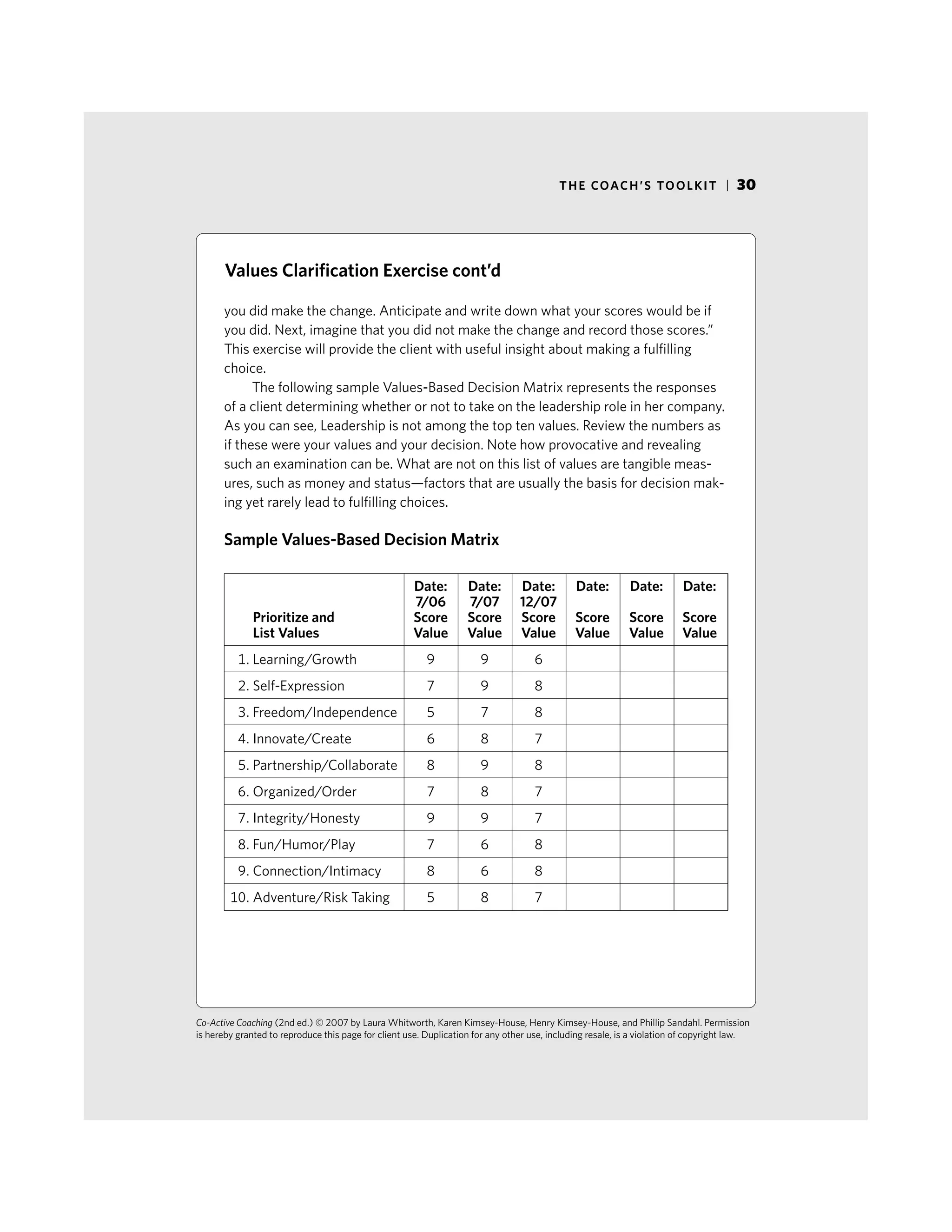
The following sample Values-Based Decision Matrix represents the responses
of a client determining whether or not to take on the leadership role in her company.
As you can see, Leadership is not among the top ten values. Review the numbers as
if these were your values and your decision. Note how provocative and revealing
such an examination can be. What are not on this list of values are tangible meas-
ures, such as money and status—factors that are usually the basis for decision mak-
ing yet rarely lead to fulfilling choices.
Sample Values-Based Decision Matrix
Co-Active Coaching (2nd ed.) © 2007 by Laura Whitworth, Karen Kimsey-House, Henry Kimsey-House, and Phillip Sandahl. Permission
is hereby granted to reproduce this page for client use. Duplication for any other use, including resale, is a violation of copyright law.
Values Clarification Exercise cont’d
Date: Date: Date: Date: Date: Date:
7/06 7/07 12/07
Prioritize and Score Score Score Score Score Score
List Values Value Value Value Value Value Value
1. Learning/Growth 9 9 6
2. Self-Expression 7 9 8
3. Freedom/Independence 5 7 8
4. Innovate/Create 6 8 7
5. Partnership/Collaborate 8 9 8
6. Organized/Order 7 8 7
7. Integrity/Honesty 9 9 7
8. Fun/Humor/Play 7 6 8
9. Connection/Intimacy 8 6 8
10. Adventure/Risk Taking 5 8 7
THE COACH’S TOOLKIT | 30
Additional Forms
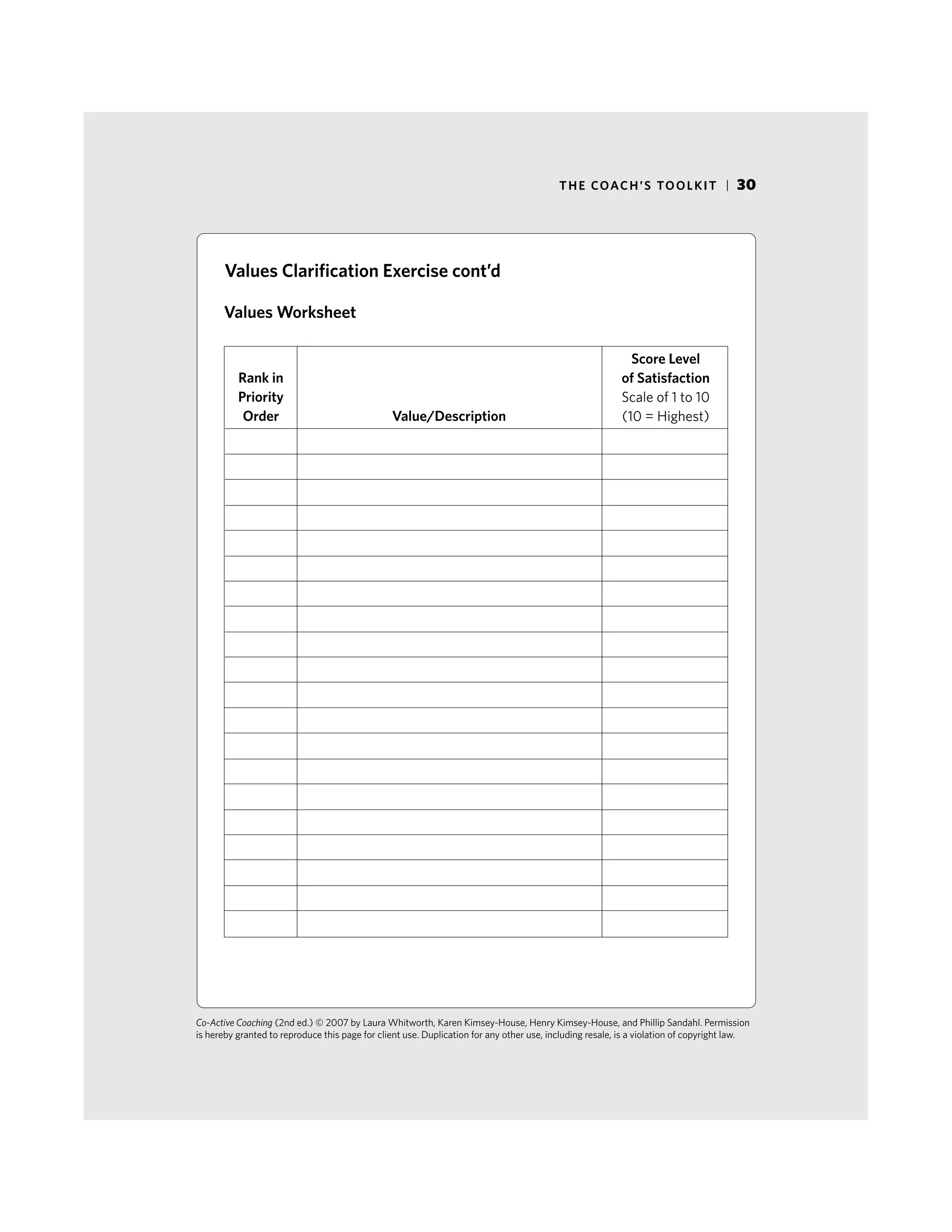
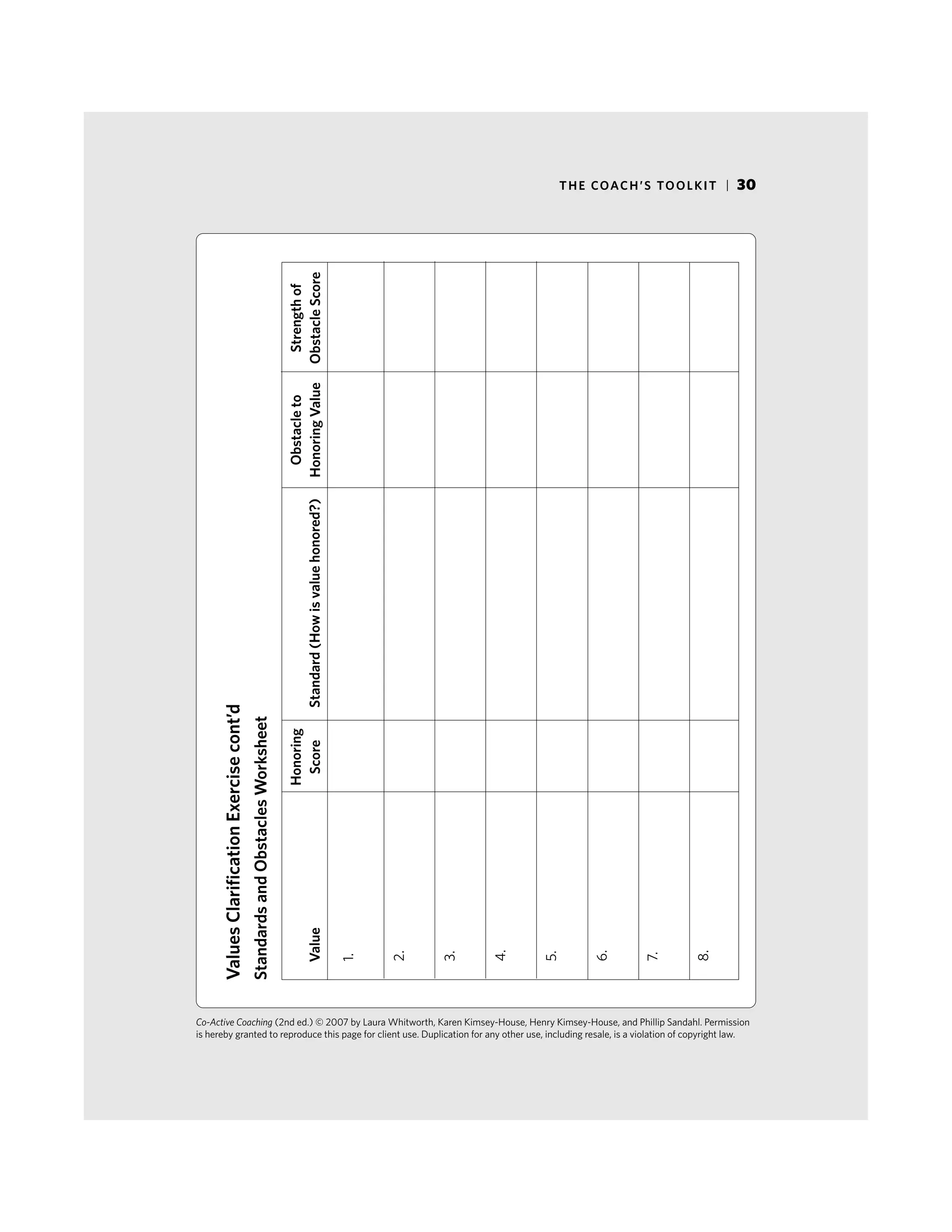
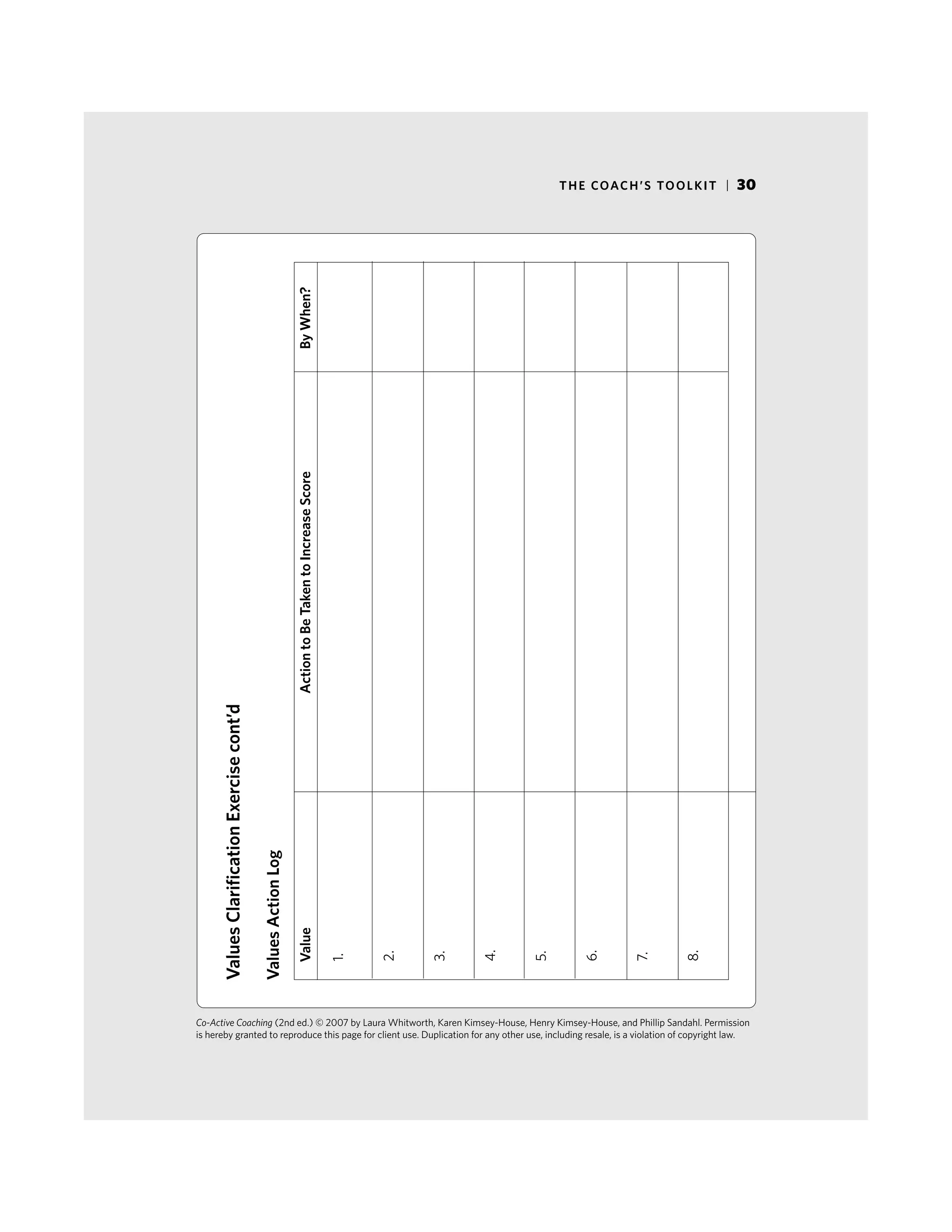
Three additional forms that can be used when working with values are included in
this section. They are the Values Worksheet (p. 251), to assist the client in identify-
ing values; the Standards and Obstacles Worksheet (p. 252), to help with establish-
ing standards and obstacles for honoring values; and the Values Action Log (p. 253),
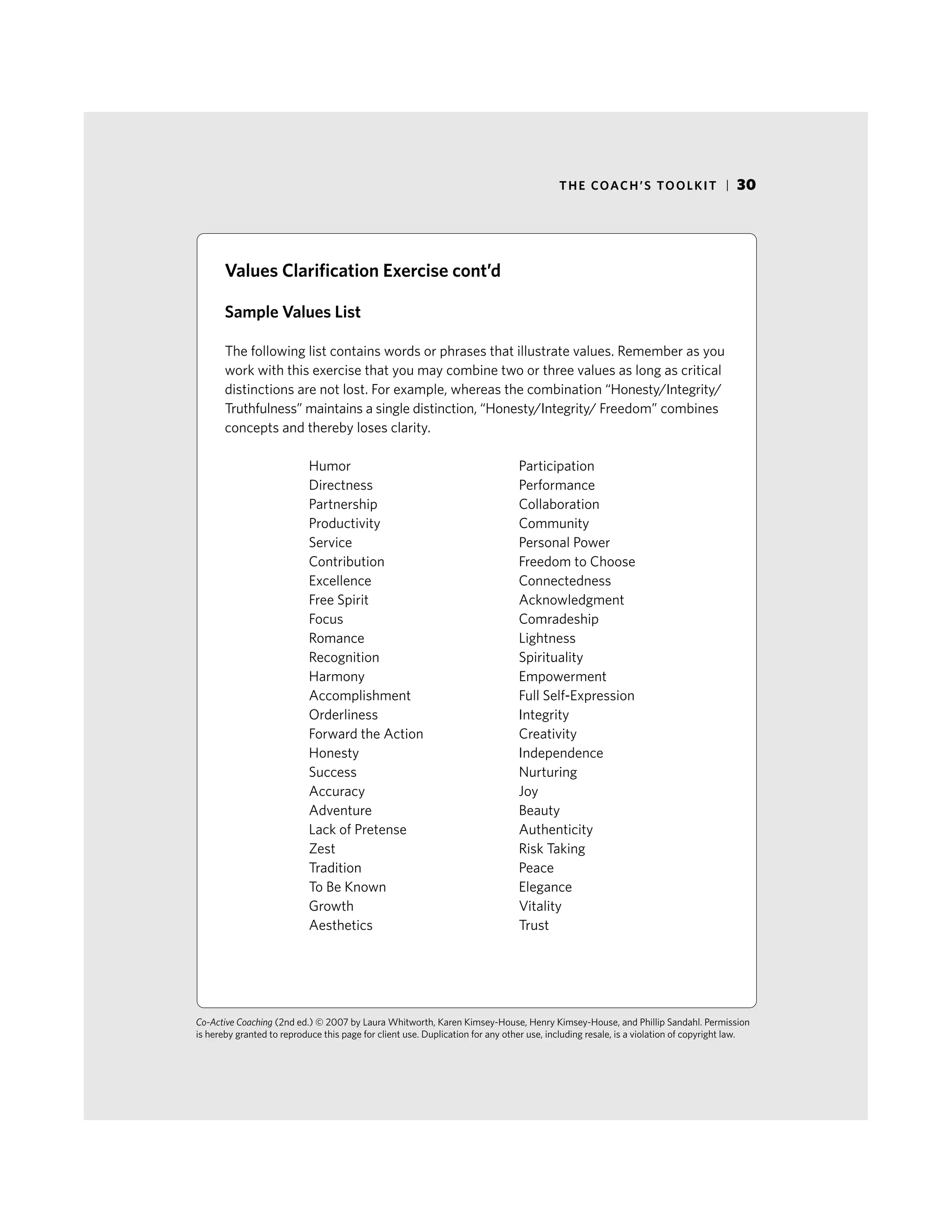
to assist in creating values-based action plans. The sample list of values (p. 254) is
to be held by the coach and not provided to the client. When we are on the spot, we
often forget values; using the list enables the coach to prompt clients about their
values—especially when the coach senses that a client may be negating or overlook-
ing some obvious value, such as spirituality or humor.
Co-Active Coaching (2nd ed.) © 2007 by Laura Whitworth, Karen Kimsey-House, Henry Kimsey-House, and Phillip Sandahl. Permission
is hereby granted to reproduce this page for client use. Duplication for any other use, including resale, is a violation of copyright law.
Values Clarification Exercise cont’d
THE COACH’S TOOLKIT | 30
Co-Active Coaching (2nd ed.) © 2007 by Laura Whitworth, Karen Kimsey-House, Henry Kimsey-House, and Phillip Sandahl. Permission
is hereby granted to reproduce this page for client use. Duplication for any other use, including resale, is a violation of copyright law.
Values Worksheet
Values Clarification Exercise cont’d
Rank in
Priority
Order
Score Level
of Satisfaction
Scale of 1 to 10
(10 = Highest)Value/Description
Co-Active Coaching (2nd ed.) © 2007 by Laura Whitworth, Karen Kimsey-House, Henry Kimsey-House, and Phillip Sandahl. Permission
is hereby granted to reproduce this page for client use. Duplication for any other use, including resale, is a violation of copyright law.
StandardsandObstaclesWorksheet
ValuesClarificationExercisecont’d
Value
Honoring
ScoreStandard(Howisvaluehonored?)
Obstacleto
HonoringValue
Strengthof
ObstacleScore
1.
2.
3.
4.
5.
6.
7.
8.
THE COACH’S TOOLKIT | 30
Co-Active Coaching (2nd ed.) © 2007 by Laura Whitworth, Karen Kimsey-House, Henry Kimsey-House, and Phillip Sandahl. Permission
is hereby granted to reproduce this page for client use. Duplication for any other use, including resale, is a violation of copyright law.
ValuesActionLog
ValuesClarificationExercisecont’d
ValueActiontoBeTakentoIncreaseScoreByWhen?
1.
2.
3.
4.
5.
6.
7.
8.
THE COACH’S TOOLKIT | 30
Co-Active Coaching (2nd ed.) © 2007 by Laura Whitworth, Karen Kimsey-House, Henry Kimsey-House, and Phillip Sandahl. Permission
is hereby granted to reproduce this page for client use. Duplication for any other use, including resale, is a violation of copyright law.
Sample Values List
The following list contains words or phrases that illustrate values. Remember as you
work with this exercise that you may combine two or three values as long as critical
distinctions are not lost. For example, whereas the combination “Honesty/Integrity/
Truthfulness” maintains a single distinction, “Honesty/Integrity/ Freedom” combines
concepts and thereby loses clarity.
Humor Participation
Directness Performance
Partnership Collaboration
Productivity Community
Service Personal Power
Contribution Freedom to Choose
Excellence Connectedness
Free Spirit Acknowledgment
Focus Comradeship
Romance Lightness
Recognition Spirituality
Harmony Empowerment
Accomplishment Full Self-Expression
Orderliness Integrity
Forward the Action Creativity
Honesty Independence
Success Nurturing
Accuracy Joy
Adventure Beauty
Lack of Pretense Authenticity
Zest Risk Taking
Tradition Peace
To Be Known Elegance
Growth Vitality
Aesthetics Trust
Values Clarification Exercise cont’d
THE COACH’S TOOLKIT | 30
Keep Looking
Because values are such an important part of the way clients order their lives and
make choices, it is essential to continue to look at this area. Values could conceiv-
ably be examined in every coaching call—either to help make a choice or to clarify
and reinforce a course of action: What is the value that would be honored if you did
that? When your clients honor their values, three things happen: one, they add ad-
ditional fuel to the motivation fire and help build steam for action; two, they under-
mine the work of the Saboteur because action based on values is more powerful
than the Saboteur’s reasons for not taking action or for taking some other course
of action; and three, they have fulfilling lives.
Co-Active Coaching (2nd ed.) © 2007 by Laura Whitworth, Karen Kimsey-House, Henry Kimsey-House, and Phillip Sandahl. Permission
is hereby granted to reproduce this page for client use. Duplication for any other use, including resale, is a violation of copyright law.
Values Clarification Exercise cont’d

Values Clarification Exercise by Coaching Logic

  • 1.
    THE COACH’S TOOLKIT| 30 Values Clarification Exercise Values are who we are. Not who we would like to be, not who we think we should be, but who we are in our lives, right now. Another way to put it is that values repre- sent our unique and individual essence, our ultimate and most fulfilling form of ex- pressing and relating. Our values serve as a compass pointing out what it means to be true to oneself. When we honor our values on a regular and consistent basis, life is good and fulfilling. As coaches, we know how beneficial it can be for clients when they are clear about their own values. Important life decisions are easier to make and outcomes are more fulfilling when the decisions are viewed through a matrix of well-understood personal values. However, the process of clarifying values is often difficult for clients. It frequently makes people intellectualize and fantasize, whereas you want them to look into their lives and uncover the values that are already there, in their day-to-day actions and interactions. That’s one of the reasons selecting values from a list sel- dom works: the list becomes an opportunity to vote on the most desirable or socially acceptable values, rather than serving as a mechanism to identify who we are. Se- lecting values from a list reinforces the intellectual urge to figure it out and get the words right. Clients’ values are observable; they live in the world. Thus, they won’t benefit from picking their values from a list. The coach’s job is to assist clients in viewing their lives in such a way that values are revealed. Sometimes clients can’t seem to get a perspective on their values. Coaching works well in such cases because the coach can ask questions and provide scenarios that take clients into their lives rather than into their heads. Values clarification coaching allows clients to examine and articulate their values in a safe yet coura- geous environment. The exact wording will matter to the client in the long run, but what is most important in the short run is that the approximate label for the value resonate with the client. As a practical matter for coaches, values clarification is enormously helpful in learning to know clients, and in helping clients know them- selves. Coaches and clients use values to help facilitate fulfilling choices, to strate- gize appropriate actions, and to recognize situations in which values are an issue. Many clients nevertheless struggle with finding the right words. They are con- strained because they feel they have to find the perfect word and the value has much more emotional meaning than the definition of a single word allows. In fact, each individual has his or her own unique meaning for each value. We may have different meanings even though we use the same word. Earlier, we mentioned Co-Active Coaching (2nd ed.) © 2007 by Laura Whitworth, Karen Kimsey-House, Henry Kimsey-House, and Phillip Sandahl. Permission is hereby granted to reproduce this page for client use. Duplication for any other use, including resale, is a violation of copyright law.
  • 2.
    THE COACH’S TOOLKIT| 30 techniques that can minimize vocabulary anxiety. The first tip is to use a pencil with an eraser. Clients often experience a sense of reluctance when values have to be written in ink. The coach can emphasize the advantages of using a pencil so the client realizes that it is not important to get it right the first time. The second tip when doing values clarification is to use several words together to form a string de- scribing the value. Separating the words with slash marks makes the string easier to read. For example: Integrity/Honesty/Walk-the-talk Integrity/Whole/Congruent Leadership/Empower/Collaborative Leadership/Decisive/Powerful When creating the values string, ask the client to place the most significant term at the beginning, such as “Integrity” and “Leadership” in the examples above. Point out that it may take several months to come up with a fairly complete list of values. Since values show up over time in our lives, it is unlikely that we will be able to capture them accurately and completely in one sitting. Values that are fully de- fined and elaborated on become a powerful tool in pointing clients toward fulfilling choices as they approach a major crossroads or get off track. The coach facilitates the process of identifying values by proposing various sce- narios to the client. The following scenarios will give you a place to start. Experiment with these and continue to explore other methods for allowing clients to see their values. A Peak Moment in Time Ask the client to identify special, peak moments when life was especially rewarding or poignant. It’s important that the time frame be quite limited—a “moment”—or there will be too much in the experience to allow the client to pinpoint specific val- ues. When the client has a specific moment in mind, start probing: “What was hap- pening?” “Who was present and what was going on?” “What were the values that were being honored in that moment?” Acknowledge what you are hearing and keep probing, periodically testing words to see what values resonate for this client. “That sounds important.” “Is there a value of accomplishment or achievement in that ex- perience?” or “You light up when you describe that day. It sounds like you were Co-Active Coaching (2nd ed.) © 2007 by Laura Whitworth, Karen Kimsey-House, Henry Kimsey-House, and Phillip Sandahl. Permission is hereby granted to reproduce this page for client use. Duplication for any other use, including resale, is a violation of copyright law. Values Clarification Exercise cont’d
  • 3.
    THE COACH’S TOOLKIT| 30 honoring a value around nature and a value of connection. Does that sound right?” There will be a stronger response when the words ring true. Ask the client to expand on the first word. “What does ‘accomplishment’ mean to you?” “What words elabo- rate on your value of connection?” Keep looking at peak moments, seeking experi- ences the client found particularly rich and fulfilling. Suppressed Values Another way to isolate values is to go to the opposite extreme, looking at times when a client was angry, frustrated, or upset. This will often lead to identification of a value that was being suppressed. First, have the client name the feelings and cir- cumstances around the upset; then flip it over and look for the opposite of those feelings. For example, the client might say, “I felt trapped, backed into a corner. I had no choices.” The coach might then say, “Trapped, cornered, without choice. If we flip that over, it sounds like there might be a value around freedom or options or choice. Does that sound right?” For the coach, it’s not so important that the vocabulary be right—it’s important that the words feel right to the client. To further illustrate, the coach might say, “So you felt frustrated when they kept spinning their wheels, doing the same thing over and over again? Is the other side of that a value for creativity or innovation?” Many of us have created our lives in such a way that we automatically and eas- ily honor many of our values without even being aware that we are doing so. There- fore we may not recognize them as values until something gets in the way. The key here is to point out to the client that every upset or moment of distress is likely to signal that a value is being suppressed. Must-Haves Another way for clients to identify their values is to look at what they must have in their lives. Try it yourself. Beyond the physical requirements of food, shelter, and community, what must you have in your life in order to be fulfilled? Must you have a form of creative self-expression? Must you have adventure and excitement in your life? Must you have partnership and collaboration? Must you be moving toward a sense of accomplishment or success or be surrounded with natural beauty? An un- derlying question for the process is What are the values you absolutely must honor—or part of you dies? Co-Active Coaching (2nd ed.) © 2007 by Laura Whitworth, Karen Kimsey-House, Henry Kimsey-House, and Phillip Sandahl. Permission is hereby granted to reproduce this page for client use. Duplication for any other use, including resale, is a violation of copyright law. Values Clarification Exercise cont’d
  • 4.
    THE COACH’S TOOLKIT| 30 Obsessive Expression We are all capable of obsessive behavior—insisting on honoring a value, inflating it into a demand rather than a form of self-expression. You’ve probably had an experi- ence like this in your own life, such as when your roommate’s value of orderliness became an obsessive demand for perfection. Our friends and families often do us a service by pointing out the obsessive expression of our values: “You are so control- ling!” “All you think about is your students.” “You want all the attention.” These statements might point toward a value of personal power/leadership, of learning/ growth, and of recognition/acknowledgment. Have your clients examine those times when they take certain values to the extreme. “What is it that people say about you? What do you say about yourself?” “What is it that people tease you about or that drives them crazy?” There are important values here that have mutated for some reason. Look for the value, and don’t focus on the mutation. The Values-Based Decision Matrix One of the most potent tools for making fulfilling life choices is the Values-Based Decision Matrix. This matrix is launched during the initial values clarification process. (Please note that the listing of values may take several months to com- plete.) After you and the client have brainstormed a list of values, ask the client to rank the top ten values in priority order. Then ask the client to score his or her sense of satisfaction—the degree to which he or she is honoring each value—using a scale of 0 to 10. Most clients find this exercise very revealing, and they are often shocked at what they learn about themselves. Generally, the coach pays particular attention when a client indicates that a score is below 7. This is a likely place for coaching, since low scores mean the client might be putting up with an intolerable situation. The coach may want to revisit this process from time to time to keep the client grounded in his or her sense of self. Over the years, we have noted that when things are going particularly well in a client’s life, the scores typically are high. When the client is struggling or is at a low point, the values matrix can help determine where corrective action is needed. When a client is facing a major decision, such as whether to make a job change or start a new business, or even to have a child, the Values-Based Decision Matrix can be particularly revealing. Ask the client to score his or her values today. Next, ask the client to project out two months, a year, or sometime in the future: “Imagine that Co-Active Coaching (2nd ed.) © 2007 by Laura Whitworth, Karen Kimsey-House, Henry Kimsey-House, and Phillip Sandahl. Permission is hereby granted to reproduce this page for client use. Duplication for any other use, including resale, is a violation of copyright law. Values Clarification Exercise cont’d
  • 5.
    THE COACH’S TOOLKIT| 30 you did make the change. Anticipate and write down what your scores would be if you did. Next, imagine that you did not make the change and record those scores.” This exercise will provide the client with useful insight about making a fulfilling choice. The following sample Values-Based Decision Matrix represents the responses of a client determining whether or not to take on the leadership role in her company. As you can see, Leadership is not among the top ten values. Review the numbers as if these were your values and your decision. Note how provocative and revealing such an examination can be. What are not on this list of values are tangible meas- ures, such as money and status—factors that are usually the basis for decision mak- ing yet rarely lead to fulfilling choices. Sample Values-Based Decision Matrix Co-Active Coaching (2nd ed.) © 2007 by Laura Whitworth, Karen Kimsey-House, Henry Kimsey-House, and Phillip Sandahl. Permission is hereby granted to reproduce this page for client use. Duplication for any other use, including resale, is a violation of copyright law. Values Clarification Exercise cont’d Date: Date: Date: Date: Date: Date: 7/06 7/07 12/07 Prioritize and Score Score Score Score Score Score List Values Value Value Value Value Value Value 1. Learning/Growth 9 9 6 2. Self-Expression 7 9 8 3. Freedom/Independence 5 7 8 4. Innovate/Create 6 8 7 5. Partnership/Collaborate 8 9 8 6. Organized/Order 7 8 7 7. Integrity/Honesty 9 9 7 8. Fun/Humor/Play 7 6 8 9. Connection/Intimacy 8 6 8 10. Adventure/Risk Taking 5 8 7
  • 6.
    THE COACH’S TOOLKIT| 30 Additional Forms Three additional forms that can be used when working with values are included in this section. They are the Values Worksheet (p. 251), to assist the client in identify- ing values; the Standards and Obstacles Worksheet (p. 252), to help with establish- ing standards and obstacles for honoring values; and the Values Action Log (p. 253), to assist in creating values-based action plans. The sample list of values (p. 254) is to be held by the coach and not provided to the client. When we are on the spot, we often forget values; using the list enables the coach to prompt clients about their values—especially when the coach senses that a client may be negating or overlook- ing some obvious value, such as spirituality or humor. Co-Active Coaching (2nd ed.) © 2007 by Laura Whitworth, Karen Kimsey-House, Henry Kimsey-House, and Phillip Sandahl. Permission is hereby granted to reproduce this page for client use. Duplication for any other use, including resale, is a violation of copyright law. Values Clarification Exercise cont’d
  • 7.
    THE COACH’S TOOLKIT| 30 Co-Active Coaching (2nd ed.) © 2007 by Laura Whitworth, Karen Kimsey-House, Henry Kimsey-House, and Phillip Sandahl. Permission is hereby granted to reproduce this page for client use. Duplication for any other use, including resale, is a violation of copyright law. Values Worksheet Values Clarification Exercise cont’d Rank in Priority Order Score Level of Satisfaction Scale of 1 to 10 (10 = Highest)Value/Description
  • 8.
    Co-Active Coaching (2nded.) © 2007 by Laura Whitworth, Karen Kimsey-House, Henry Kimsey-House, and Phillip Sandahl. Permission is hereby granted to reproduce this page for client use. Duplication for any other use, including resale, is a violation of copyright law. StandardsandObstaclesWorksheet ValuesClarificationExercisecont’d Value Honoring ScoreStandard(Howisvaluehonored?) Obstacleto HonoringValue Strengthof ObstacleScore 1. 2. 3. 4. 5. 6. 7. 8. THE COACH’S TOOLKIT | 30
  • 9.
    Co-Active Coaching (2nded.) © 2007 by Laura Whitworth, Karen Kimsey-House, Henry Kimsey-House, and Phillip Sandahl. Permission is hereby granted to reproduce this page for client use. Duplication for any other use, including resale, is a violation of copyright law. ValuesActionLog ValuesClarificationExercisecont’d ValueActiontoBeTakentoIncreaseScoreByWhen? 1. 2. 3. 4. 5. 6. 7. 8. THE COACH’S TOOLKIT | 30
  • 10.
    THE COACH’S TOOLKIT| 30 Co-Active Coaching (2nd ed.) © 2007 by Laura Whitworth, Karen Kimsey-House, Henry Kimsey-House, and Phillip Sandahl. Permission is hereby granted to reproduce this page for client use. Duplication for any other use, including resale, is a violation of copyright law. Sample Values List The following list contains words or phrases that illustrate values. Remember as you work with this exercise that you may combine two or three values as long as critical distinctions are not lost. For example, whereas the combination “Honesty/Integrity/ Truthfulness” maintains a single distinction, “Honesty/Integrity/ Freedom” combines concepts and thereby loses clarity. Humor Participation Directness Performance Partnership Collaboration Productivity Community Service Personal Power Contribution Freedom to Choose Excellence Connectedness Free Spirit Acknowledgment Focus Comradeship Romance Lightness Recognition Spirituality Harmony Empowerment Accomplishment Full Self-Expression Orderliness Integrity Forward the Action Creativity Honesty Independence Success Nurturing Accuracy Joy Adventure Beauty Lack of Pretense Authenticity Zest Risk Taking Tradition Peace To Be Known Elegance Growth Vitality Aesthetics Trust Values Clarification Exercise cont’d
  • 11.
    THE COACH’S TOOLKIT| 30 Keep Looking Because values are such an important part of the way clients order their lives and make choices, it is essential to continue to look at this area. Values could conceiv- ably be examined in every coaching call—either to help make a choice or to clarify and reinforce a course of action: What is the value that would be honored if you did that? When your clients honor their values, three things happen: one, they add ad- ditional fuel to the motivation fire and help build steam for action; two, they under- mine the work of the Saboteur because action based on values is more powerful than the Saboteur’s reasons for not taking action or for taking some other course of action; and three, they have fulfilling lives. Co-Active Coaching (2nd ed.) © 2007 by Laura Whitworth, Karen Kimsey-House, Henry Kimsey-House, and Phillip Sandahl. Permission is hereby granted to reproduce this page for client use. Duplication for any other use, including resale, is a violation of copyright law. Values Clarification Exercise cont’d