ODI DRAFT
REGULATIONS
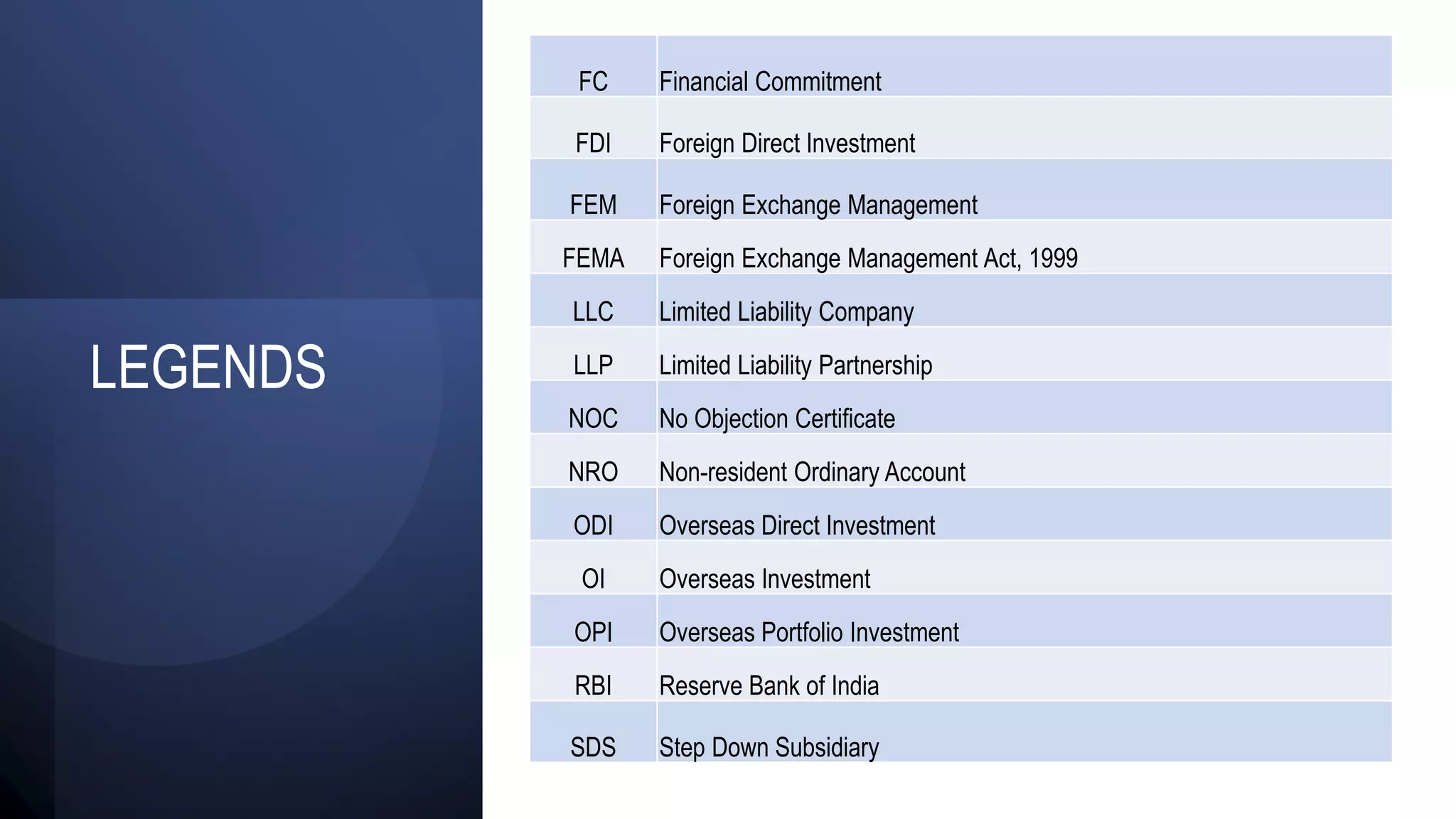
LEGENDS
FC Financial Commitment
FDI Foreign Direct Investment
FEM Foreign Exchange Management
FEMA Foreign Exchange Management Act, 1999
LLC Limited Liability Company
LLP Limited Liability Partnership
NOC No Objection Certificate
NRO Non-resident Ordinary Account
ODI Overseas Direct Investment
OI Overseas Investment
OPI Overseas Portfolio Investment
RBI Reserve Bank of India
SDS Step Down Subsidiary
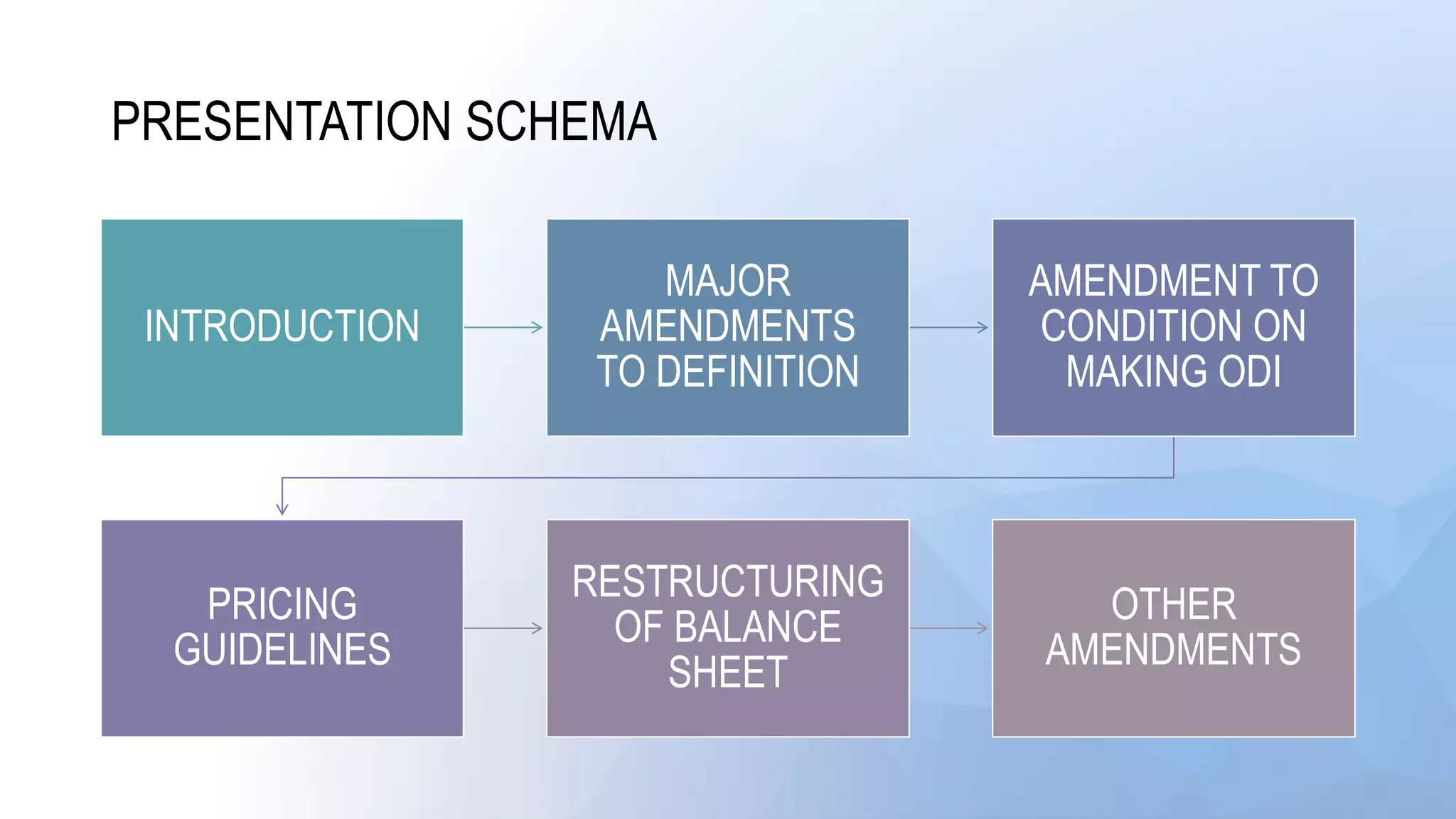
PRESENTATION SCHEMA
INTRODUCTION
MAJOR
AMENDMENTS
TO DEFINITION
AMENDMENT TO
CONDITION ON
MAKING ODI
PRICING
GUIDELINES
RESTRUCTURING
OF BALANCE
SHEET
OTHER
AMENDMENTS
INTRODUCTION
INTRODUCTION
Objective
With a view to further liberalize
and to promote ease of doing business,
decided to rationalize the existing
overseas investment.
Draft Regulations
Foreign Exchange Management (Non-
Instruments - Overseas Investment)
Foreign Exchange Management
Investment) Regulations, 2021.
MAJOR
AMENDMENTS
TO DEFINITIONS
DEFINITION
OF ODI
The definition has been amended to include
two major aspects:
(i) Investment in 10% or more of the paid up
equity capital of a listed entity; and
(ii) where person acquires control either
directly or indirectly.
The definition also clarifies that once an
investment has qualified as ODI, it shall remain
as an ODI even if the percentage requirement
(as in the case investment in listed company)
falls below the required 10% or if control is
lost.
DEFINITION
OF OPI
OPI has now been defined to provide clarity.
Investment upto 10% in listed foreign securities
which are Listed on a recognized stock exchange
outside India would come under the ambit of
OPI. It also includes units of Exchange traded
Funds that are listed.
When this definition is read in conjunction with
the ODI definition, it is clear that investment
would qualify as OPI only upto an aggregate
investment of 10% in the same entity. Once the
10% limit is crossed, they would automatically
qualify as ODI and not OPIs.
DEFINITION OF CONTROL
“Control” has been defined to include the following:
(i) right to appoint majority directors
(ii) control management
(iii) control policy decisions
by person or persons, individually or in concert, directly or indirectly.
The definition further goes on to include control by virtue of shareholding, management rights,
shareholders rights, voting rights that entitle > 10% voting rights.
DEFINITION
OF FOREIGN
ENTITY
The definition of Foreign Entity is severely restricted
to include only 'incorporated and registered' entities.
This condition, would restrict ODI in entities which
are not incorporated like LLC’s / LLP’s which are
formed and registered but not incorporated.
The definition under the draft regulations once
notified, would also be applicable to the existing
investments but the transition provision is provided.
No fresh investments would be permitted after a
period of 6 months from the date of notification
unless the structure of the Foreign Entity is changed
in compliance with the new definition.
DEFINITION OF
SDS AND
DISINVESTMENT
• “SDS” means any step down entity in which
the Foreign Entity has investment (in case
of unlisted entity) and in case of listed
entity, the investment shall be more than
10%.
SDS
• "Disinvestment" means transfer by way of
sale of right, title or possession of equity
capital acquired under these rules and
includes liquidation thereof.
Disinvestment
AMENDMENTS
TO
INVESTMENT
CONDITIONS
This Photo by Unknown Author is licensed under CC BY-NC-ND
BONAFIED BUSINESS ACTIVITY
Extant Regulation 6(2)(ii) stipulated a
condition of overseas entity to be
engaged in ‘”Bonafide Business Activity”.
However, Bonafide Business Activity was
not defined.
Under the draft Rule 4 of FEM (Nondebt
Instrument - OI) Rules, 2021, an
explanation has been added to define
“Bonafide Business Activity”. It shall mean
any business activity legally permissible
both in India and host jurisdiction.”
REQUIREMENT OF NOC
Where a Person Resident in India making any Financial Commitment or undertaking disinvestment of
such financial commitment has an account appearing as a Special Mention Account- category 1/
Special Mention Account- category 2 /Non-Performing Asset (NPA)/wilful defaulter, or is under
investigation by investigative agencies in India, then an NOC shall be obtained from the lender
bank(s)/regulatory body/investigative agency concerned before making Financial Commitment or
undertaking Disinvestment of such Financial Commitment.
PRICING GUIDELINE
In case where no specific pricing guideline under the regulations, the
following general pricing guidelines would be applicable:
In case of listed foreign securities, the price worked out in accordance
with the concerned stock exchanges of the host country;
In case of OI other than listed foreign securities, the price should be
within 5 percent range of the fair value arrived on an arm’s length basis
as per any internationally accepted pricing methodology for valuation
RESTRUCTURING
OF BALANCE
SHEET
An Indian Entity which has made ODI in a Foreign
Entity, may permit restructuring of the balance sheet
by such Foreign Entity, which has been incurring losses
for the previous two years as evidenced by its last
audited balance sheet.
The maximum limit of write off of upto 25% has been
reduced to 10% with an additional cap of USD 10
million.
Registered Valuer’s report is also now required for
restructuring the balance sheet.
AMENDMENTS
MADE IN THE
CONDITIONS
FOR ODI BY AN
INDIAN ENTITY
(SCHEDULE – I)
Financial Service Activities
• The condition pertaining to complying with the
prudential norms relating to capital adequacy has been
done away with.
Overseas Technology Fund (OTF)
• Listed Indian Entity having Net Worth of Rs. 500 crores
or more, may make ODI in an OTF for the purpose of
investing in overseas technology startups with the only
condition that it has made profits in three preceding
financial years and has not made investments from
borrowed funds.
Limit of Financial Commitment
• Under the proposed draft regulations, the limit to
calculate 400% of the Net Worth shall not include
capitalization of the retained earnings by the Indian
entity.
CONDITIONS
FOR OPI BY AN
INDIAN ENTITY
(SCHEDULE – II)
Only the following Indian Entities are
permitted to make an OPI:
• Listed Indian company upto 50% of its Net Worth.
• Indian software exporter – only upto 25% of its export
value.
AMENDMENTS
MADE IN THE
CONDITIONS
FOR ODI BY
RESIDENT
INDIVIDUAL
(SCHEDULE –
III)
• Proviso to para 1 in Schedule III has been inserted
clearly specifying that LRS limits shall not apply to
any investment made from RFC account. However,
other conditions shall apply
Investment from RFC account:
• OPI investments have specifically been included
and allowed to be made by Individuals.
OPI Investment:
• In case of ODI investment, it is mandatory to
acquire control to be classified as ODI.
ODI investment requirement:
OTHER
AMENDMENTS
ROUND TRIPPING
The draft regulations permits person resident in India to
invest in a foreign entity which has invested into India either
before the Investment or after the Investment except in
cases where it is for tax evasion or tax avoidance.
In other words, Round tripping is permitted if the same is not
for tax avoidance.
OTHER AMENDMENTS
Reporting in case of outbound
investments is now divided into
Form FC and Form OPI for
Financial Commitment and for
Overseas Portfolio Investments
as the name suggests.
Additionally, a software exporter
has now been allowed to receive
foreign security up to 25% of the
value of exports made to a
foreign software company
irrespective of whether such
company is listed or not.
Thank You!
Scan the QR Code to Join our
Research Group on WhatsApp
Scan the QR Code to explore more
Research from our Website
DVS Advisors LLP
India-Singapore-London-Dubai-Malaysia-Africa
www.dvsca.com
Copyrights © 2021 DVS Advisors LLP

ODI DRAFT REGULATIONS

  • 1.
  • 2.
    LEGENDS FC Financial Commitment FDIForeign Direct Investment FEM Foreign Exchange Management FEMA Foreign Exchange Management Act, 1999 LLC Limited Liability Company LLP Limited Liability Partnership NOC No Objection Certificate NRO Non-resident Ordinary Account ODI Overseas Direct Investment OI Overseas Investment OPI Overseas Portfolio Investment RBI Reserve Bank of India SDS Step Down Subsidiary
  • 3.
    PRESENTATION SCHEMA INTRODUCTION MAJOR AMENDMENTS TO DEFINITION AMENDMENTTO CONDITION ON MAKING ODI PRICING GUIDELINES RESTRUCTURING OF BALANCE SHEET OTHER AMENDMENTS
  • 4.
  • 5.
    INTRODUCTION Objective With a viewto further liberalize and to promote ease of doing business, decided to rationalize the existing overseas investment. Draft Regulations Foreign Exchange Management (Non- Instruments - Overseas Investment) Foreign Exchange Management Investment) Regulations, 2021.
  • 6.
  • 7.
    DEFINITION OF ODI The definitionhas been amended to include two major aspects: (i) Investment in 10% or more of the paid up equity capital of a listed entity; and (ii) where person acquires control either directly or indirectly. The definition also clarifies that once an investment has qualified as ODI, it shall remain as an ODI even if the percentage requirement (as in the case investment in listed company) falls below the required 10% or if control is lost.
  • 8.
    DEFINITION OF OPI OPI hasnow been defined to provide clarity. Investment upto 10% in listed foreign securities which are Listed on a recognized stock exchange outside India would come under the ambit of OPI. It also includes units of Exchange traded Funds that are listed. When this definition is read in conjunction with the ODI definition, it is clear that investment would qualify as OPI only upto an aggregate investment of 10% in the same entity. Once the 10% limit is crossed, they would automatically qualify as ODI and not OPIs.
  • 9.
    DEFINITION OF CONTROL “Control”has been defined to include the following: (i) right to appoint majority directors (ii) control management (iii) control policy decisions by person or persons, individually or in concert, directly or indirectly. The definition further goes on to include control by virtue of shareholding, management rights, shareholders rights, voting rights that entitle > 10% voting rights.
  • 10.
    DEFINITION OF FOREIGN ENTITY The definitionof Foreign Entity is severely restricted to include only 'incorporated and registered' entities. This condition, would restrict ODI in entities which are not incorporated like LLC’s / LLP’s which are formed and registered but not incorporated. The definition under the draft regulations once notified, would also be applicable to the existing investments but the transition provision is provided. No fresh investments would be permitted after a period of 6 months from the date of notification unless the structure of the Foreign Entity is changed in compliance with the new definition.
  • 11.
    DEFINITION OF SDS AND DISINVESTMENT •“SDS” means any step down entity in which the Foreign Entity has investment (in case of unlisted entity) and in case of listed entity, the investment shall be more than 10%. SDS • "Disinvestment" means transfer by way of sale of right, title or possession of equity capital acquired under these rules and includes liquidation thereof. Disinvestment
  • 12.
    AMENDMENTS TO INVESTMENT CONDITIONS This Photo byUnknown Author is licensed under CC BY-NC-ND
  • 13.
    BONAFIED BUSINESS ACTIVITY ExtantRegulation 6(2)(ii) stipulated a condition of overseas entity to be engaged in ‘”Bonafide Business Activity”. However, Bonafide Business Activity was not defined. Under the draft Rule 4 of FEM (Nondebt Instrument - OI) Rules, 2021, an explanation has been added to define “Bonafide Business Activity”. It shall mean any business activity legally permissible both in India and host jurisdiction.”
  • 14.
    REQUIREMENT OF NOC Wherea Person Resident in India making any Financial Commitment or undertaking disinvestment of such financial commitment has an account appearing as a Special Mention Account- category 1/ Special Mention Account- category 2 /Non-Performing Asset (NPA)/wilful defaulter, or is under investigation by investigative agencies in India, then an NOC shall be obtained from the lender bank(s)/regulatory body/investigative agency concerned before making Financial Commitment or undertaking Disinvestment of such Financial Commitment.
  • 15.
    PRICING GUIDELINE In casewhere no specific pricing guideline under the regulations, the following general pricing guidelines would be applicable: In case of listed foreign securities, the price worked out in accordance with the concerned stock exchanges of the host country; In case of OI other than listed foreign securities, the price should be within 5 percent range of the fair value arrived on an arm’s length basis as per any internationally accepted pricing methodology for valuation
  • 16.
    RESTRUCTURING OF BALANCE SHEET An IndianEntity which has made ODI in a Foreign Entity, may permit restructuring of the balance sheet by such Foreign Entity, which has been incurring losses for the previous two years as evidenced by its last audited balance sheet. The maximum limit of write off of upto 25% has been reduced to 10% with an additional cap of USD 10 million. Registered Valuer’s report is also now required for restructuring the balance sheet.
  • 17.
    AMENDMENTS MADE IN THE CONDITIONS FORODI BY AN INDIAN ENTITY (SCHEDULE – I) Financial Service Activities • The condition pertaining to complying with the prudential norms relating to capital adequacy has been done away with. Overseas Technology Fund (OTF) • Listed Indian Entity having Net Worth of Rs. 500 crores or more, may make ODI in an OTF for the purpose of investing in overseas technology startups with the only condition that it has made profits in three preceding financial years and has not made investments from borrowed funds. Limit of Financial Commitment • Under the proposed draft regulations, the limit to calculate 400% of the Net Worth shall not include capitalization of the retained earnings by the Indian entity.
  • 18.
    CONDITIONS FOR OPI BYAN INDIAN ENTITY (SCHEDULE – II) Only the following Indian Entities are permitted to make an OPI: • Listed Indian company upto 50% of its Net Worth. • Indian software exporter – only upto 25% of its export value.
  • 19.
    AMENDMENTS MADE IN THE CONDITIONS FORODI BY RESIDENT INDIVIDUAL (SCHEDULE – III) • Proviso to para 1 in Schedule III has been inserted clearly specifying that LRS limits shall not apply to any investment made from RFC account. However, other conditions shall apply Investment from RFC account: • OPI investments have specifically been included and allowed to be made by Individuals. OPI Investment: • In case of ODI investment, it is mandatory to acquire control to be classified as ODI. ODI investment requirement:
  • 20.
  • 21.
    ROUND TRIPPING The draftregulations permits person resident in India to invest in a foreign entity which has invested into India either before the Investment or after the Investment except in cases where it is for tax evasion or tax avoidance. In other words, Round tripping is permitted if the same is not for tax avoidance.
  • 22.
    OTHER AMENDMENTS Reporting incase of outbound investments is now divided into Form FC and Form OPI for Financial Commitment and for Overseas Portfolio Investments as the name suggests. Additionally, a software exporter has now been allowed to receive foreign security up to 25% of the value of exports made to a foreign software company irrespective of whether such company is listed or not.
  • 23.
    Thank You! Scan theQR Code to Join our Research Group on WhatsApp Scan the QR Code to explore more Research from our Website DVS Advisors LLP India-Singapore-London-Dubai-Malaysia-Africa www.dvsca.com Copyrights © 2021 DVS Advisors LLP