

CUSTOMS DUTY   ON   BRANDED GOODS   By  V.KAPILA SHREE
INTRODUCTION   Customs Duties are probably the oldest form of taxation in India. It originated in 1786, when the britishers formed the 1 st  Board of Revenue in Calcutta. Customs law regulates the Import and Export of goods by restricting, forbidding or imposing duties. Customs Duty is a tariff levied on goods imported or exported. The levy of custom duty brings into its perview the issues of intellectual property (IP) like: Patents Trademarks Copyrights while importing goods. The Constitution of India stipulates that no tax shall be levied or collected, except by authority of law. The law for levy and collection of Customs Duties is the Customs Act, 1962 and the Customs Tariff Act, 1975.
VALUATION OF GOODS FOR THE PURPOSE OF ASSESSMENT   The imposition of the customs duty in India follows the ad valorem tax system Which necessities ascertaining the customs value on which the ad valorem rate can be applied. This is said to be in conformity with the provisions of Article VII of The General Agreement on Tariffs and Trade 1994 (GATT). Customs Duty is payable as a percentage of ‘Value’ often called ‘ Assessable Value’. The term Value may be either  ‘ Value’  as defined under section 14(1) of the Customs Act,1962; or Tariff Value prescribed under section 14(2) of the Customs Act,1962 The provisions of section 14(1) apply for both imported and exported goods.
SECTION 14  - CUSTOMS ACT, 1962 Value of imported/export goods shall be: Transaction value i.e. Price actually paid or payable for the goods Sold for export to India For delivery at the time & place of importation Where the buyer & seller are not related Price is the sole consideration for the sale
CUSTOMS VALUATION METHOD   (DETERMINATION OF PRICE OF IMPORTED GOODS)    RULE S 1988 The above Rule lays down 6 methods of valuation of imported goods. They are as follows: Transaction Value  This method is based on the valuation factors, of the various elements, which should be added while determining the customs value. Transaction Value of Identical goods This is based on the previously determined transaction value of identical  goods, as defined in the Valuation Rules, imported at or about the same time. Transaction Value of Similar Goods This is based on the transaction value of Similar goods imported at or about the same time.
Deductive Value Method This is calculated based on the selling price of imported goods or identical/similar goods in India after deducting selling expenses, margin profit, duties and taxes. Computed Value Method The computed value is arrived at from the cost of materials used in production of imported goods, cost of fabrication or other processing charges at the country of production , profit and general expenses, and other dutiable factors as may be applicable. Fall Back Method These include flexible application of previous valuation methods in a manner consistent with the provisions of section 14(1) of the Customs Act,1962.
CUSTOMS VALUATION METHOD   (DETERMINATION OF PRICE OF IMPORTED GOODS)    RULES 1988 RULE 9(1)(b): The value, apportioned as appropriate, of the following goods and services where supplied directly or indirectly by the buyer free of charge or at reduced cost for use in connection with the production and sale for export of imported goods, to the extent that such value has not been included in the price actually paid or payable, namely:-  materials, components, parts and similar items incorporated in the imported goods;  (ii) tools, dies, moulds and similar items used in the production of the Imported goods;  (iii) materials consumed in the production of the imported goods;  (iv) engineering, development, art work, design work, and plans and sketches undertaken elsewhere than in India and necessary for  the production of the imported goods;
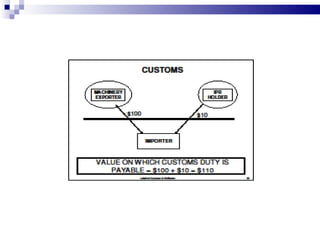
RULE 9 (C) : Royalties and licence fees related to the imported goods that the buyer is required to pay, directly or indirectly, as a condition of the sale of the goods being valued, to the extent that such royalties and fees are not included in the price actually paid or payable. Exceptions: Determining Customs Value Charges for the right to reproduce the imported goods not added to the price actually paid or payable for the imported goods in determining the customs value.
 
Payments made by buyer for the right to distribute or re – sell the imported goods shall not be added to the price actually paid or payable for the imported goods. Relevant Cases Laws: State Bank of India  –  VS –  Collector of Customs, Bombay (2000) 115 ELT 597(SC) Supreme Court held that the cost of software is not mentioned separately, only the license fee was mentioned, licensee fee paid for countrywide use cannot be considered as reproduction charges. The court observed that reproduction and use are separate things and the transaction value is to be seen as a whole. Hence, the license fee charged for the countrywide use is part of the transaction value and therefore the SBI is not entitled for refund of the duty paid.
BPL DISPLAY DEVICES LTD – VS – COMMR OF CUSTOMS    (2002) 142 ELT A284 (SC) Held that the cost of drawings, designs, and know-how fees is includible in the assessable value of imports. Whether it is termed as royalty, licensee fee or ‘ technology fee’ is immaterial, the importer is liable for payment of duty. ANDHRA PETROCHEMICALS – VS – COMMR (1997) 90 ELT 275 (SC) Supreme Court held that it is immaterial whether supply of machinery, transfer of technical know-how and drawings are referred under different contracts, the fact to be looked into is whether it is a single package deal or not. JINDHAL PHOTO FILMS – VS – COMMR OF CUSTOMS, BOMBAY (2002) 141 ELT 2002 (CEGAT) It was held that license fee related to know-how embedded in the machine has to be added to assessable value.
CONCLUSION When only equipment is imported without importing technical know-how, there arise no IP issue while ascertaining the price of  the imported goods for the purpose of customs valuation. However, if agreements exists for transfer of know-how or other forms of IP along with the imported goods, the issue of arriving at the valuation of such goods in combination with the value of IP arises
THANKING YOU

Customs duty on branded goods

  • 1.
    CUSTOMS DUTY ON BRANDED GOODS By V.KAPILA SHREE
  • 2.
    INTRODUCTION Customs Duties are probably the oldest form of taxation in India. It originated in 1786, when the britishers formed the 1 st Board of Revenue in Calcutta. Customs law regulates the Import and Export of goods by restricting, forbidding or imposing duties. Customs Duty is a tariff levied on goods imported or exported. The levy of custom duty brings into its perview the issues of intellectual property (IP) like: Patents Trademarks Copyrights while importing goods. The Constitution of India stipulates that no tax shall be levied or collected, except by authority of law. The law for levy and collection of Customs Duties is the Customs Act, 1962 and the Customs Tariff Act, 1975.
  • 3.
    VALUATION OF GOODSFOR THE PURPOSE OF ASSESSMENT The imposition of the customs duty in India follows the ad valorem tax system Which necessities ascertaining the customs value on which the ad valorem rate can be applied. This is said to be in conformity with the provisions of Article VII of The General Agreement on Tariffs and Trade 1994 (GATT). Customs Duty is payable as a percentage of ‘Value’ often called ‘ Assessable Value’. The term Value may be either ‘ Value’ as defined under section 14(1) of the Customs Act,1962; or Tariff Value prescribed under section 14(2) of the Customs Act,1962 The provisions of section 14(1) apply for both imported and exported goods.
  • 4.
    SECTION 14 - CUSTOMS ACT, 1962 Value of imported/export goods shall be: Transaction value i.e. Price actually paid or payable for the goods Sold for export to India For delivery at the time & place of importation Where the buyer & seller are not related Price is the sole consideration for the sale
  • 5.
    CUSTOMS VALUATION METHOD (DETERMINATION OF PRICE OF IMPORTED GOODS) RULE S 1988 The above Rule lays down 6 methods of valuation of imported goods. They are as follows: Transaction Value This method is based on the valuation factors, of the various elements, which should be added while determining the customs value. Transaction Value of Identical goods This is based on the previously determined transaction value of identical goods, as defined in the Valuation Rules, imported at or about the same time. Transaction Value of Similar Goods This is based on the transaction value of Similar goods imported at or about the same time.
  • 6.
    Deductive Value MethodThis is calculated based on the selling price of imported goods or identical/similar goods in India after deducting selling expenses, margin profit, duties and taxes. Computed Value Method The computed value is arrived at from the cost of materials used in production of imported goods, cost of fabrication or other processing charges at the country of production , profit and general expenses, and other dutiable factors as may be applicable. Fall Back Method These include flexible application of previous valuation methods in a manner consistent with the provisions of section 14(1) of the Customs Act,1962.
  • 7.
    CUSTOMS VALUATION METHOD (DETERMINATION OF PRICE OF IMPORTED GOODS) RULES 1988 RULE 9(1)(b): The value, apportioned as appropriate, of the following goods and services where supplied directly or indirectly by the buyer free of charge or at reduced cost for use in connection with the production and sale for export of imported goods, to the extent that such value has not been included in the price actually paid or payable, namely:- materials, components, parts and similar items incorporated in the imported goods; (ii) tools, dies, moulds and similar items used in the production of the Imported goods; (iii) materials consumed in the production of the imported goods; (iv) engineering, development, art work, design work, and plans and sketches undertaken elsewhere than in India and necessary for the production of the imported goods;
  • 8.
    RULE 9 (C): Royalties and licence fees related to the imported goods that the buyer is required to pay, directly or indirectly, as a condition of the sale of the goods being valued, to the extent that such royalties and fees are not included in the price actually paid or payable. Exceptions: Determining Customs Value Charges for the right to reproduce the imported goods not added to the price actually paid or payable for the imported goods in determining the customs value.
  • 9.
  • 10.
    Payments made bybuyer for the right to distribute or re – sell the imported goods shall not be added to the price actually paid or payable for the imported goods. Relevant Cases Laws: State Bank of India – VS – Collector of Customs, Bombay (2000) 115 ELT 597(SC) Supreme Court held that the cost of software is not mentioned separately, only the license fee was mentioned, licensee fee paid for countrywide use cannot be considered as reproduction charges. The court observed that reproduction and use are separate things and the transaction value is to be seen as a whole. Hence, the license fee charged for the countrywide use is part of the transaction value and therefore the SBI is not entitled for refund of the duty paid.
  • 11.
    BPL DISPLAY DEVICESLTD – VS – COMMR OF CUSTOMS (2002) 142 ELT A284 (SC) Held that the cost of drawings, designs, and know-how fees is includible in the assessable value of imports. Whether it is termed as royalty, licensee fee or ‘ technology fee’ is immaterial, the importer is liable for payment of duty. ANDHRA PETROCHEMICALS – VS – COMMR (1997) 90 ELT 275 (SC) Supreme Court held that it is immaterial whether supply of machinery, transfer of technical know-how and drawings are referred under different contracts, the fact to be looked into is whether it is a single package deal or not. JINDHAL PHOTO FILMS – VS – COMMR OF CUSTOMS, BOMBAY (2002) 141 ELT 2002 (CEGAT) It was held that license fee related to know-how embedded in the machine has to be added to assessable value.
  • 12.
    CONCLUSION When onlyequipment is imported without importing technical know-how, there arise no IP issue while ascertaining the price of the imported goods for the purpose of customs valuation. However, if agreements exists for transfer of know-how or other forms of IP along with the imported goods, the issue of arriving at the valuation of such goods in combination with the value of IP arises
  • 13.