Assessment under GST
What is an Assessment
• “the act of judging or deciding the amount, value, quality, or importance of
something, or the judgment or decision that is made” - Cambridge Dictionary
• “Assessment” means determination of tax liability under this Act and
includes self-assessment, re-assessment, provisional assessment, summary
assessment and best judgment assessment - Sec 2(11) of CGST Act
Types of Assessment
• Self Assessment
• Provisional Assessment
• Re-assessment/ Scrutiny Assessment
• Best Judgement Assessment
• Summary Assessment
Self Assessment
• Every registered person shall self-assess the taxes payable under this Act and
furnish a return for each tax period as specified under section 39.
• Filing of a return implies self-assessment GSTR
4
GSTR
3/ 3B
GSTR
5
GSTR 6
GSTR
10
GSTR
7/ 8
Provisional Assessment
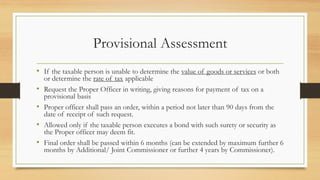
• If the taxable person is unable to determine the value of goods or services or both
or determine the rate of tax applicable
• Request the Proper Officer in writing, giving reasons for payment of tax on a
provisional basis
• Proper officer shall pass an order, within a period not later than 90 days from the
date of receipt of such request.
• Allowed only if the taxable person executes a bond with such surety or security as
the Proper officer may deem fit.
• Final order shall be passed within 6 months (can be extended by maximum further 6
months by Additional/ Joint Commissioner or further 4 years by Commissioner).
Provisional Assessment
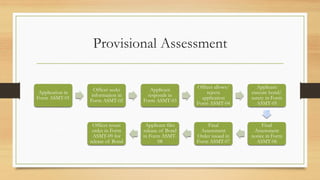
Application in
Form ASMT-01
Officer seeks
information in
Form ASMT-02
Applicant
responds in
Form ASMT-03
Officer allows/
rejects
application
Form ASMT-04
Applicant
execute bond/
surety in Form
ASMT-05
Final
Assessment
notice in Form
ASMT-06
Final
Assessment
Order issued in
Form ASMT-07
Applicant files
release of Bond
in Form ASMT-
08
Officer issues
order in Form
ASMT-09 for
release of Bond
Interest
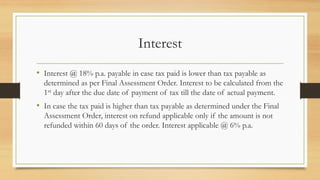
• Interest @ 18% p.a. payable in case tax paid is lower than tax payable as
determined as per Final Assessment Order. Interest to be calculated from the
1st day after the due date of payment of tax till the date of actual payment.
• In case the tax paid is higher than tax payable as determined under the Final
Assessment Order, interest on refund applicable only if the amount is not
refunded within 60 days of the order. Interest applicable @ 6% p.a.
Scrutiny Assessment
• Returns filed u/s 39 to be scrutinised by the Proper Officer
• Discrepancies noticed to be served in Form ASMT-10
• Taxpayer to pay the amount in demand or revert in Form ASMT-11 with
proper explanations, within 30 days of the notice.
• In case of satisfactory revert, Proper Officer to revert in Form ASMT-12
• In case no satisfactory revert received with 30 days (or extension, if any), or
if the taxpayer doesn’t take corrective actions, Proper Officer to initiate
provisions of Audit, Inspection or Demand and Recovery under the Act.
Best Judgement Assessment
• Non filers
• Non submission of Monthly and/or Annual Return even after serving Notice
• Proper Officer to proceed with assessment of liability on best of his judgement in
Form ASMT-13
• Limitation period – 5 years from the due date of furnishing annual return for the FY to
which the tax relates to.
• If the registered person furnishes valid return within 30 days from the date of serving
the ‘best judgement’ assessment order, the order is deemed to have been withdrawn.
However, liability relating to interest and late fee shall continue.
Best Judgement Assessment
• Others
• Liable for registration but not registered/ Registration cancelled u/s 29(2)
• Proper Officer to issue Notice in Form ASMT-14 seeking details and explanations, to
be reverted within 15 days
• Proper Officer to proceed with assessment of liability on best of his judgement in
Form ASMT-15
• Limitation period – 5 years from the due date of furnishing annual return for the FY to
which the tax relates to.
Summary Assessment
• Proper Officer, with prior permission of Additional/ Joint Commissioner, may
proceed to assess the tax liability and issue Assessment Order.
• Order, in Form ASMT-16, can be invoked only if there are sufficient grounds that
any delay may adversely affect the interest of Government.
• If the person to whom such liability pertains is not identifiable, the person-in-
charge of the goods shall be deemed to be the taxable person.
• Taxable person may, within 30 days, file application in Form ASMT-17 for
withdrawal of the Order to the Additional/ Joint Commissioner
• Order of withdrawal of Order or rejection of the application shall be
communicated in Form ASMT-18
Summing Up
Self assess tax liabilities, pay tax and file returns
Self Assessment
If you are unsure of Value of Supply and/ or Rate of
Tax, ask the OfficerProvisional Assessment
Officer checks your returns for correctness and inform
discrepancies, if anyScrutiny Assessment
Officer assesses liabilities in case of non filers and “tax
evaders”Best Judgement Assessment
Fast track assessment, usually ex-parte, in cases where
there is a potential risk of “default”Summary Assessment
Thank You
Manmohan Daga | Daga & Associates | +919804199500 | mmdaga@hotmail.com

Assessment under GST Regime

  • 1.
  • 2.
    What is anAssessment • “the act of judging or deciding the amount, value, quality, or importance of something, or the judgment or decision that is made” - Cambridge Dictionary • “Assessment” means determination of tax liability under this Act and includes self-assessment, re-assessment, provisional assessment, summary assessment and best judgment assessment - Sec 2(11) of CGST Act
  • 3.
    Types of Assessment •Self Assessment • Provisional Assessment • Re-assessment/ Scrutiny Assessment • Best Judgement Assessment • Summary Assessment
  • 4.
    Self Assessment • Everyregistered person shall self-assess the taxes payable under this Act and furnish a return for each tax period as specified under section 39. • Filing of a return implies self-assessment GSTR 4 GSTR 3/ 3B GSTR 5 GSTR 6 GSTR 10 GSTR 7/ 8
  • 5.
    Provisional Assessment • Ifthe taxable person is unable to determine the value of goods or services or both or determine the rate of tax applicable • Request the Proper Officer in writing, giving reasons for payment of tax on a provisional basis • Proper officer shall pass an order, within a period not later than 90 days from the date of receipt of such request. • Allowed only if the taxable person executes a bond with such surety or security as the Proper officer may deem fit. • Final order shall be passed within 6 months (can be extended by maximum further 6 months by Additional/ Joint Commissioner or further 4 years by Commissioner).
  • 6.
    Provisional Assessment Application in FormASMT-01 Officer seeks information in Form ASMT-02 Applicant responds in Form ASMT-03 Officer allows/ rejects application Form ASMT-04 Applicant execute bond/ surety in Form ASMT-05 Final Assessment notice in Form ASMT-06 Final Assessment Order issued in Form ASMT-07 Applicant files release of Bond in Form ASMT- 08 Officer issues order in Form ASMT-09 for release of Bond
  • 7.
    Interest • Interest @18% p.a. payable in case tax paid is lower than tax payable as determined as per Final Assessment Order. Interest to be calculated from the 1st day after the due date of payment of tax till the date of actual payment. • In case the tax paid is higher than tax payable as determined under the Final Assessment Order, interest on refund applicable only if the amount is not refunded within 60 days of the order. Interest applicable @ 6% p.a.
  • 8.
    Scrutiny Assessment • Returnsfiled u/s 39 to be scrutinised by the Proper Officer • Discrepancies noticed to be served in Form ASMT-10 • Taxpayer to pay the amount in demand or revert in Form ASMT-11 with proper explanations, within 30 days of the notice. • In case of satisfactory revert, Proper Officer to revert in Form ASMT-12 • In case no satisfactory revert received with 30 days (or extension, if any), or if the taxpayer doesn’t take corrective actions, Proper Officer to initiate provisions of Audit, Inspection or Demand and Recovery under the Act.
  • 9.
    Best Judgement Assessment •Non filers • Non submission of Monthly and/or Annual Return even after serving Notice • Proper Officer to proceed with assessment of liability on best of his judgement in Form ASMT-13 • Limitation period – 5 years from the due date of furnishing annual return for the FY to which the tax relates to. • If the registered person furnishes valid return within 30 days from the date of serving the ‘best judgement’ assessment order, the order is deemed to have been withdrawn. However, liability relating to interest and late fee shall continue.
  • 10.
    Best Judgement Assessment •Others • Liable for registration but not registered/ Registration cancelled u/s 29(2) • Proper Officer to issue Notice in Form ASMT-14 seeking details and explanations, to be reverted within 15 days • Proper Officer to proceed with assessment of liability on best of his judgement in Form ASMT-15 • Limitation period – 5 years from the due date of furnishing annual return for the FY to which the tax relates to.
  • 11.
    Summary Assessment • ProperOfficer, with prior permission of Additional/ Joint Commissioner, may proceed to assess the tax liability and issue Assessment Order. • Order, in Form ASMT-16, can be invoked only if there are sufficient grounds that any delay may adversely affect the interest of Government. • If the person to whom such liability pertains is not identifiable, the person-in- charge of the goods shall be deemed to be the taxable person. • Taxable person may, within 30 days, file application in Form ASMT-17 for withdrawal of the Order to the Additional/ Joint Commissioner • Order of withdrawal of Order or rejection of the application shall be communicated in Form ASMT-18
  • 12.
    Summing Up Self assesstax liabilities, pay tax and file returns Self Assessment If you are unsure of Value of Supply and/ or Rate of Tax, ask the OfficerProvisional Assessment Officer checks your returns for correctness and inform discrepancies, if anyScrutiny Assessment Officer assesses liabilities in case of non filers and “tax evaders”Best Judgement Assessment Fast track assessment, usually ex-parte, in cases where there is a potential risk of “default”Summary Assessment
  • 13.
    Thank You Manmohan Daga| Daga & Associates | +919804199500 | mmdaga@hotmail.com