VALS Project
One year after
Thematic Cluster Meeting “Knowledge Alliances”
November 7th, 2014
540054-LLP-L-2013-1-ES-ERASMUS-EKA
Dr. Francisco José García Peñalvo
fgarcia@usal.es / @frangp
GRIAL Research Group
University of Salamanca
What is the VALS Project?
•  Virtual Alliances for Learning Society (VALS – Ref. 540054-LLP-
L-2013-1-ES-ERASMUS-EKA)
•  European project for building knowledge alliances between
Universities and Companies across Europe with the aim of facing
real business problems through an open innovation approach based
on using and developing open software solutions
•  Supported by
•  European Union. Lifelong Learning Programme (Sub-Programme Erasmus-
Knowledge Alliances)
•  Duration: November 2013 – October 2015
•  Total amount: 533.337€
540054-LLP-L-2013-1-ES-ERASMUS-EKA
http://virtualalliances.eu/
VALS Consor tium
•  University of Salamanca / GRIAL, SIPPE (Spain)
•  OpenDirective LLP (United Kingdom)
•  RayCom B.V. (The Netherlands)
•  University of Bolton (United Kingdom)
•  University of Udine (Italy)
•  University of Cyprus (Cyprus)
•  Mindshock S.L. (Spain)
•  Oxford University - OSS Watch (United Kingdom)
540054-LLP-L-2013-1-ES-ERASMUS-EKA
VALS procedures
•  Knowledge alliances among the entities (both from
Academic and Business)
•  The most interestingVALS innovation is about the
definition of a system of virtual placements for students
in companies
•  Entrepreneurship skills promotion
•  Definition of new teaching / learning methods
•  Development of the Semester of Code
540054-LLP-L-2013-1-ES-ERASMUS-EKA
Semester of Code
Semester in which one the students have their
placements in companies and foundations related to
open software
Virtual placements (telework)
Involved academic tutors (from the universities) and
mentors (from the businesses)
540054-LLP-L-2013-1-ES-ERASMUS-EKA
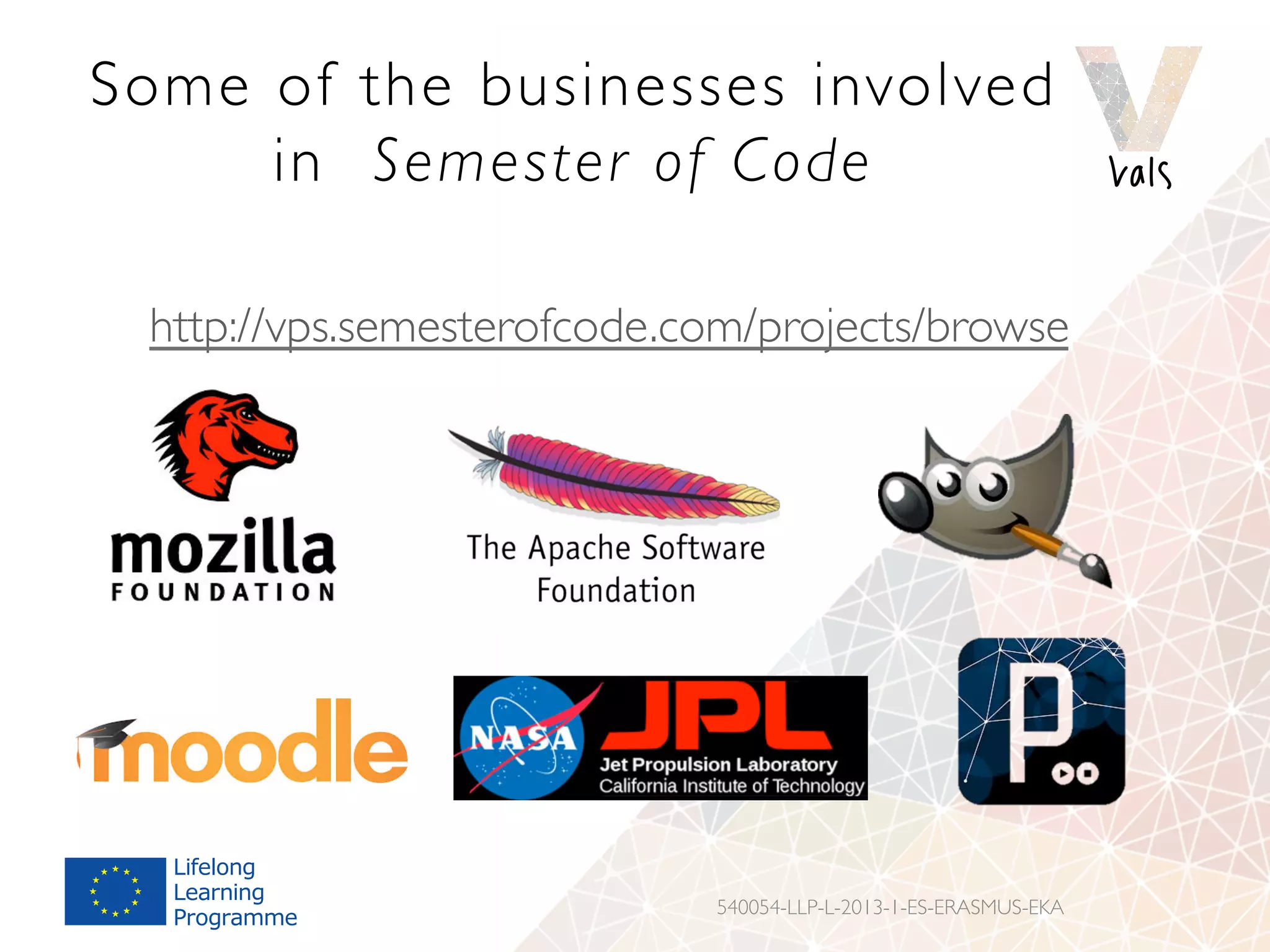
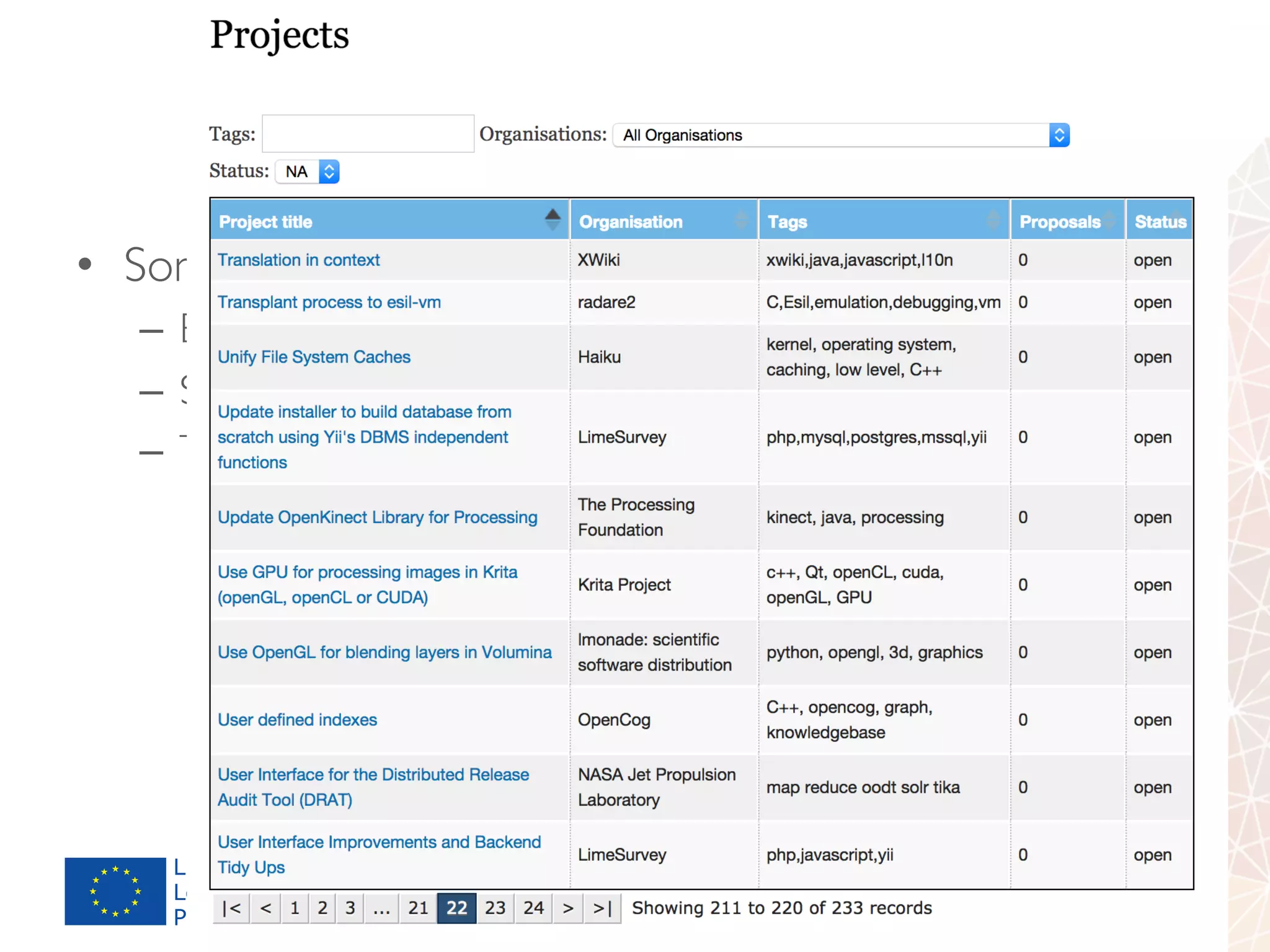
Some of the businesses involved
in Semester of Code
http://vps.semesterofcode.com/projects/browse
540054-LLP-L-2013-1-ES-ERASMUS-EKA
Kinds of projects submitted
to VALS
•  Real problems of the participant companies and
foundations
•  The student proposes an approach to solve the
problem
•  The proposed approach will be implemented during
the Semester of Code
540054-LLP-L-2013-1-ES-ERASMUS-EKA
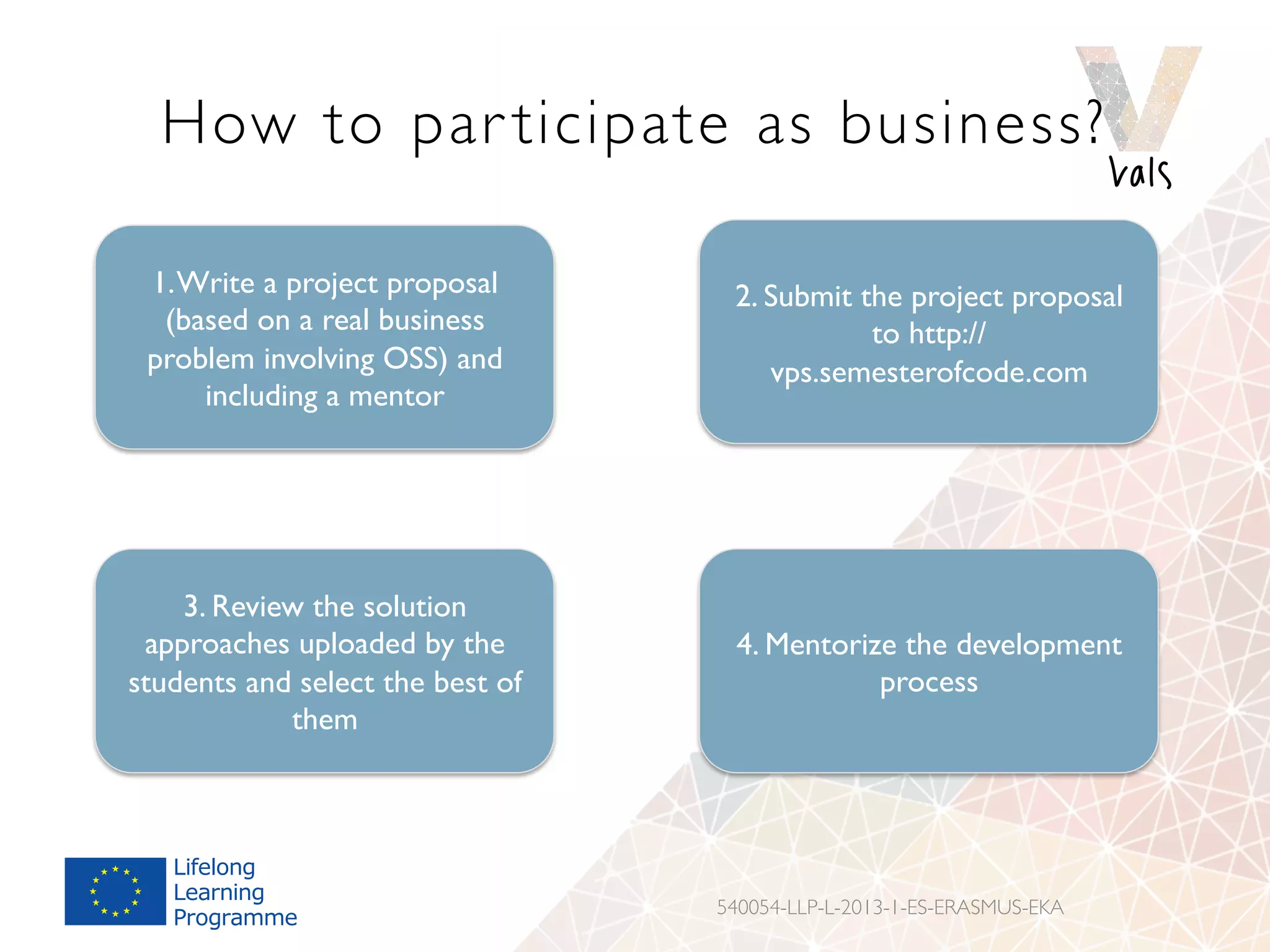
How to par ticipate as business?
540054-LLP-L-2013-1-ES-ERASMUS-EKA
1.Write a project proposal
(based on a real business
problem involving OSS) and
including a mentor
2. Submit the project proposal
to http://
vps.semesterofcode.com
3. Review the solution
approaches uploaded by the
students and select the best of
them
4. Mentorize the development
process
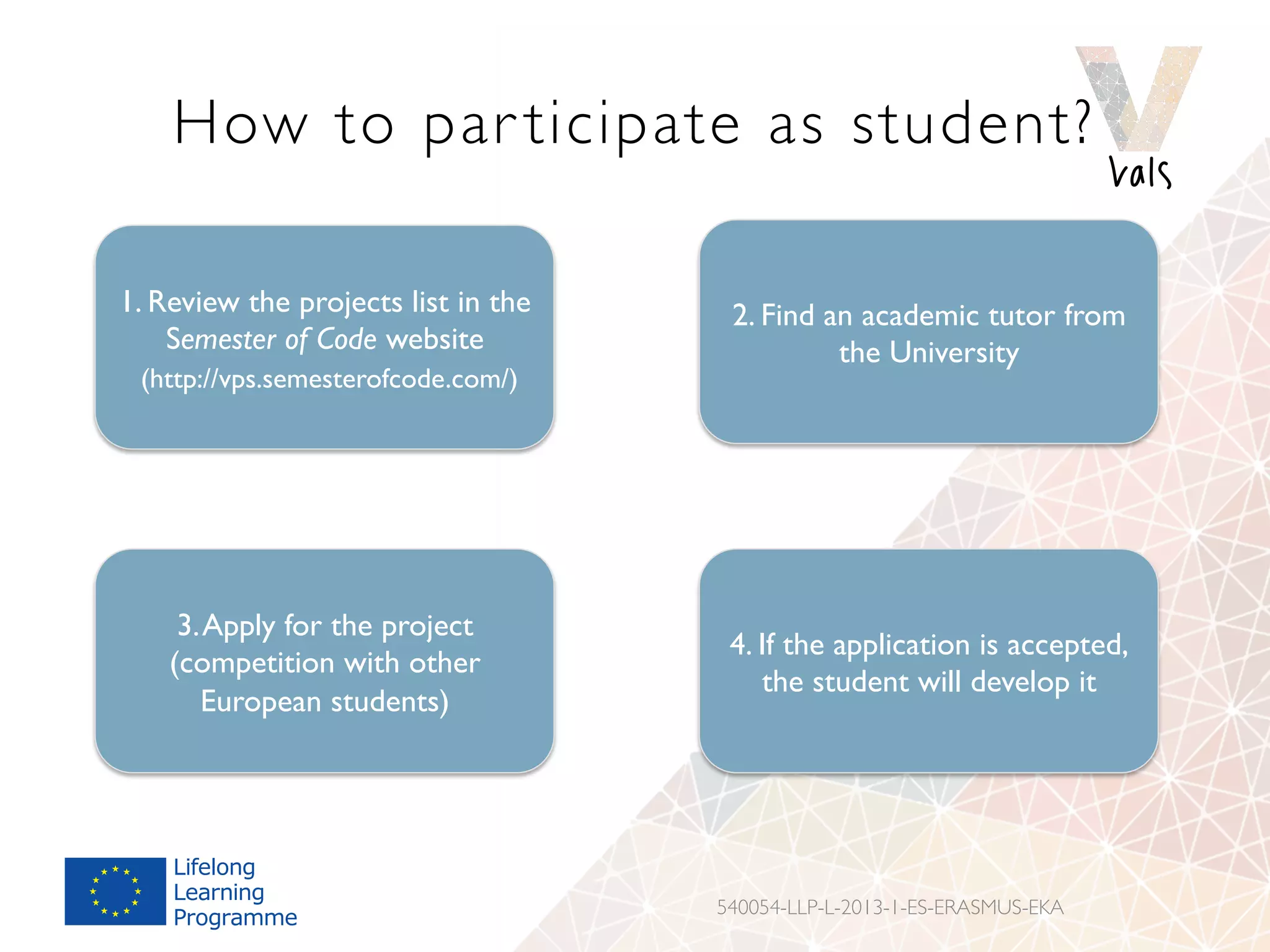
How to par ticipate as student?
540054-LLP-L-2013-1-ES-ERASMUS-EKA
1. Review the projects list in the
Semester of Code website
(http://vps.semesterofcode.com/)
2. Find an academic tutor from
the University
3.Apply for the project
(competition with other
European students)
4. If the application is accepted,
the student will develop it
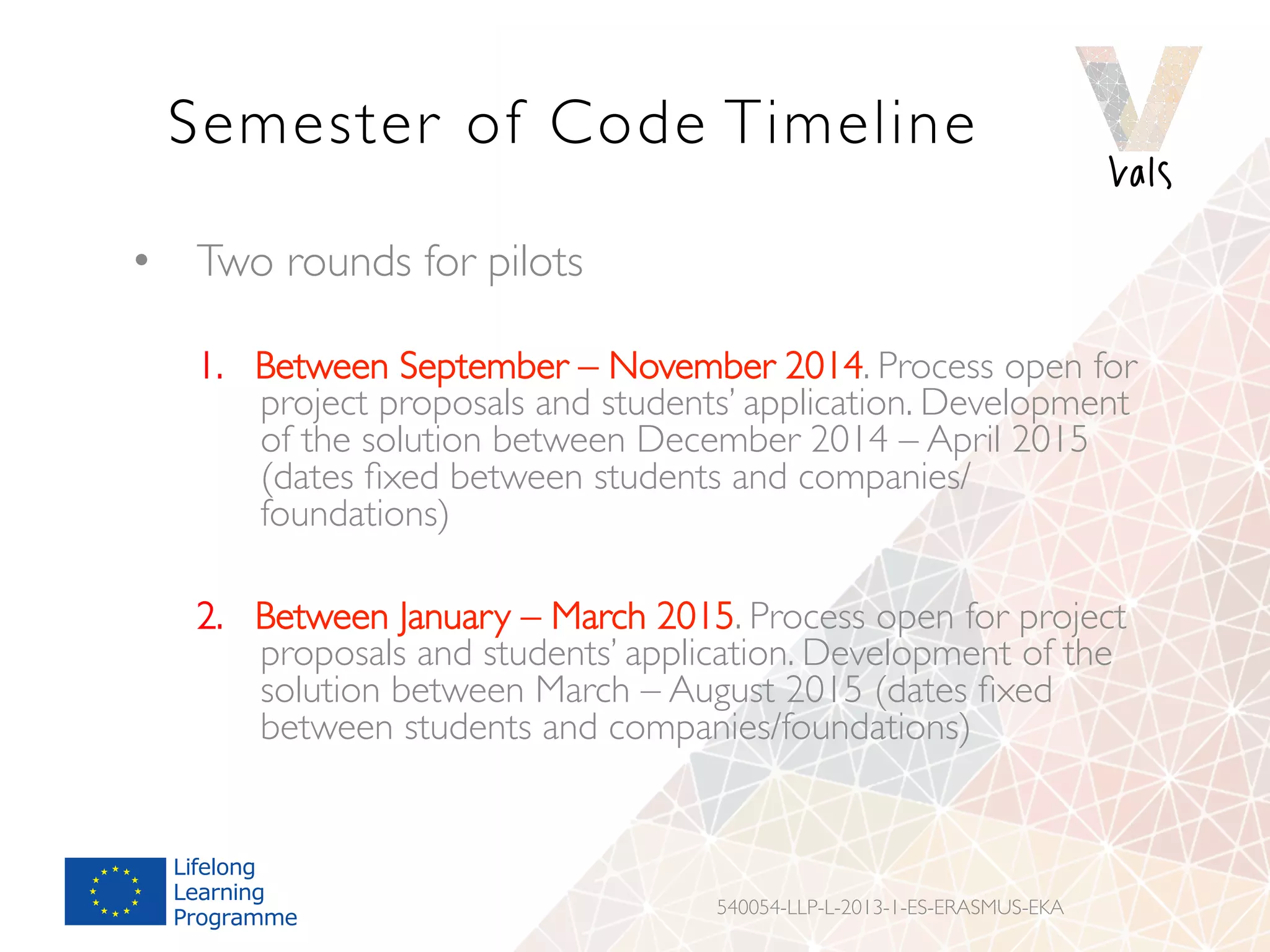
Semester of Code Timeline
540054-LLP-L-2013-1-ES-ERASMUS-EKA
•  Two rounds for pilots
1.  Between September – November 2014. Process open for
project proposals and students’ application. Development
of the solution between December 2014 – April 2015
(dates fixed between students and companies/
foundations)
2.  Between January – March 2015. Process open for project
proposals and students’ application. Development of the
solution between March – August 2015 (dates fixed
between students and companies/foundations)
540054-LLP-L-2013-1-ES-ERASMUS-EKA
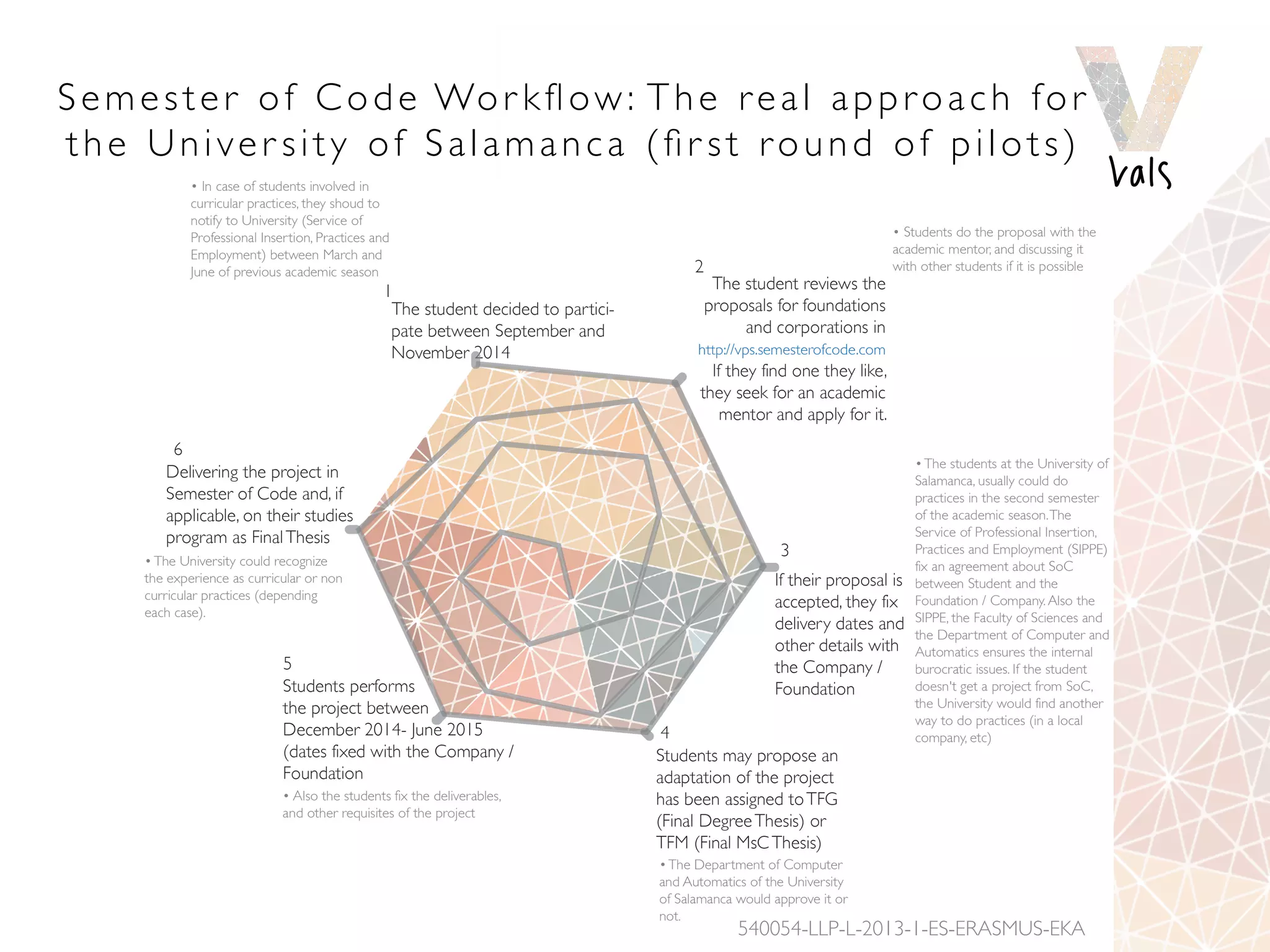
Semester of Code Wor kflow: The real approach for
the Univer sity of Salamanca (fir st round of pilots)
540054-LLP-L-2013-1-ES-ERASMUS-EKA
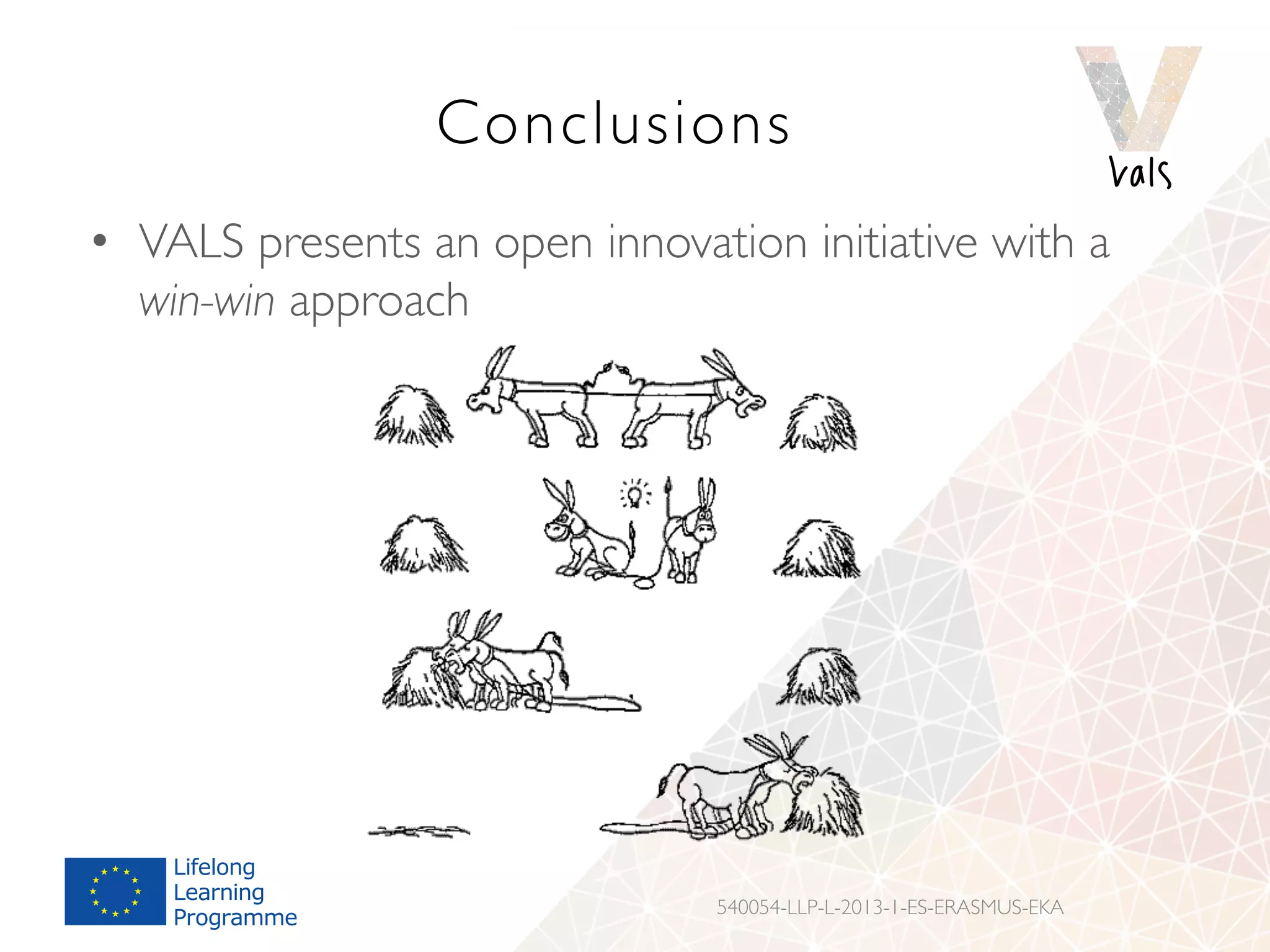
Conclusions
•  VALS presents an open innovation initiative with a
win-win approach
540054-LLP-L-2013-1-ES-ERASMUS-EKA
Conclusions
•  Students
•  Professional experience in the real business context
•  Contacts in the software industry that can facilitate the start
of their professional career
•  Personal experience due to operate in an international
context
•  Academic rewards
540054-LLP-L-2013-1-ES-ERASMUS-EKA
Conclusions
•  University
•  New methods for teaching and assessment
•  Long-term Knowledge Alliances with the industry in an
international context
•  Possibility of importing successful practices from Business to
the University
•  Offering real innovative possibilities to students with a great
cost / benefit ratio in a crisis
540054-LLP-L-2013-1-ES-ERASMUS-EKA
Conclusions
•  Business
•  Find talent directly in Universities
•  Knowledge Alliance with the Universities
•  Possibility of transfer knowledge from the University to the
Company
540054-LLP-L-2013-1-ES-ERASMUS-EKA
Conclusions
•  Society
•  Reduction of the gap between University and Business
•  Better professional qualification obtained under equal
opportunities in a time of crisis
540054-LLP-L-2013-1-ES-ERASMUS-EKA
Discussion
What exactly does VALS intend to
achieve
•  VALS pursues a knowledge alliance between HE
institutions and Companies that allows students have
placements related to real projects in business all
around Europe using telework practices, that’s mean
without to expend money to travel and subsist
•  Main target groups
–  Informatics students (university level)
–  Open source related companies and foundations
–  Universities
540054-LLP-L-2013-1-ES-ERASMUS-EKA
Discussion
What exactly does VALS intend to
achieve
•  Main activities
–  Workflow definition for the placements management
–  Setting up a platform for workflow support
–  Contacting with companies to offer virtual placements
–  Contacting with universities to be involved inVALS
–  DisseminatingVALS procedures to the students to engage
them
540054-LLP-L-2013-1-ES-ERASMUS-EKA
Discussion
Issues and challenges
•  Administrative processes in the universities are very
strict, especially regarding schedules, and are not shared
by all the universities all over Europe
•  Schedules and workload in companies are not always
compatible with universities ones and students’
planning
–  Ad hoc adapting and making more flexible the administrative
processes in the universities (it depends on each university
and the people involved in)
–  Defining a two-round piloting procedure (inside theVALS
scope)
540054-LLP-L-2013-1-ES-ERASMUS-EKA
Discussion
Issues and challenges
•  University tutors engagement
–  Personal relationships
–  Altruistic behaviours
540054-LLP-L-2013-1-ES-ERASMUS-EKA
Discussion
Issues and challenges
•  Students engagement
–  They need time to includeVALS activities with their own plans
(short term plans are not usually compliant with the most of the
students’ reality)
–  TheVALS benefits must include academic rewards (credits
recognition for the placements, reusing the work done for their
final degree works, and so on)
–  The fear of English communication, workload, effort done in the
proposal definition and other different excuses
•  Presentation several of the project including open placement definitions
in the platform
•  Flexibilizing the administrative procedures in the universities
•  Taking into account all the possible and available academic rewards
•  Involving more universities
540054-LLP-L-2013-1-ES-ERASMUS-EKA
Discussion
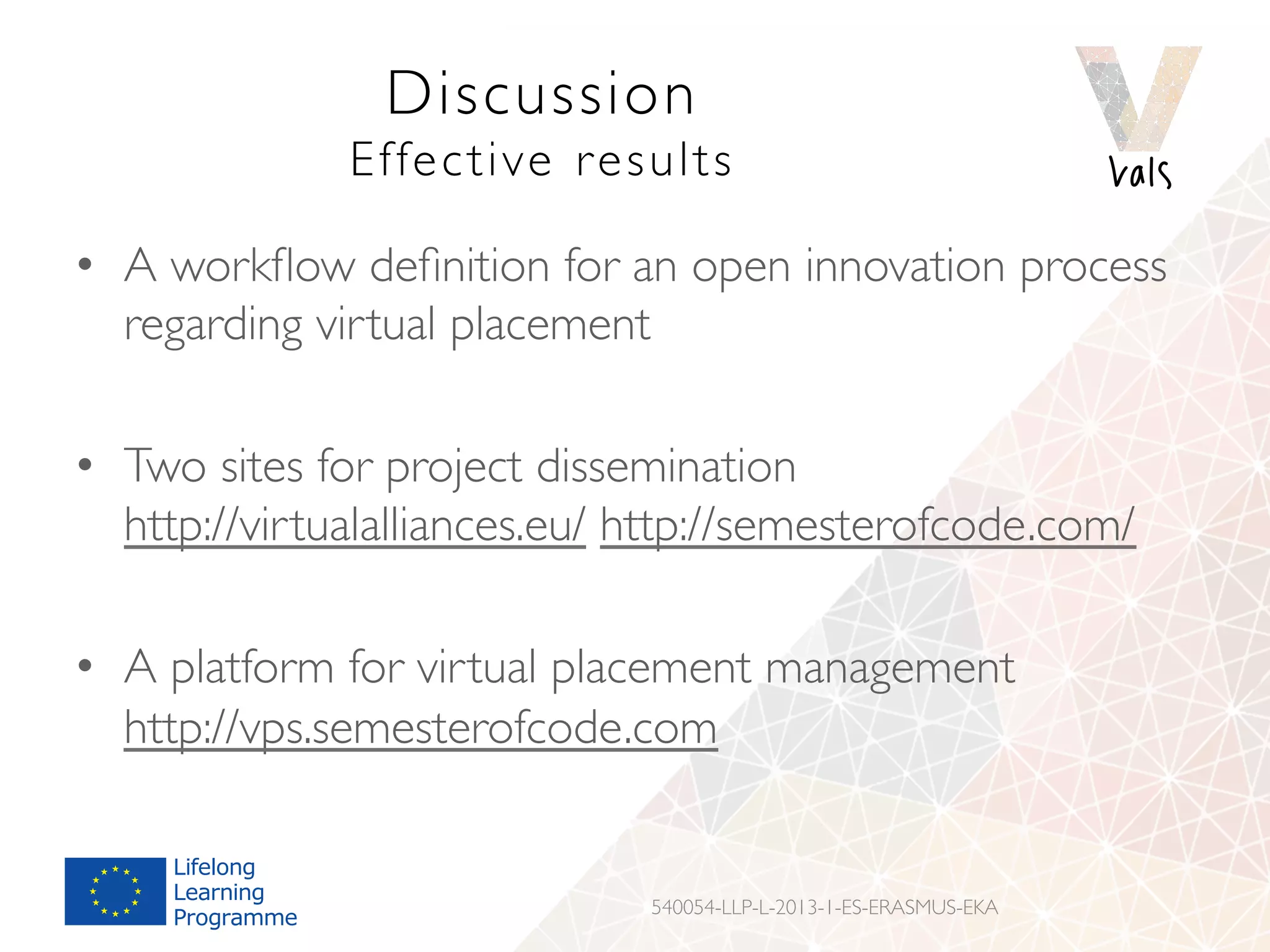
Effective results
•  A workflow definition for an open innovation process
regarding virtual placement
•  Two sites for project dissemination
http://virtualalliances.eu/ http://semesterofcode.com/
•  A platform for virtual placement management
http://vps.semesterofcode.com
540054-LLP-L-2013-1-ES-ERASMUS-EKA
Discussion
Effective results
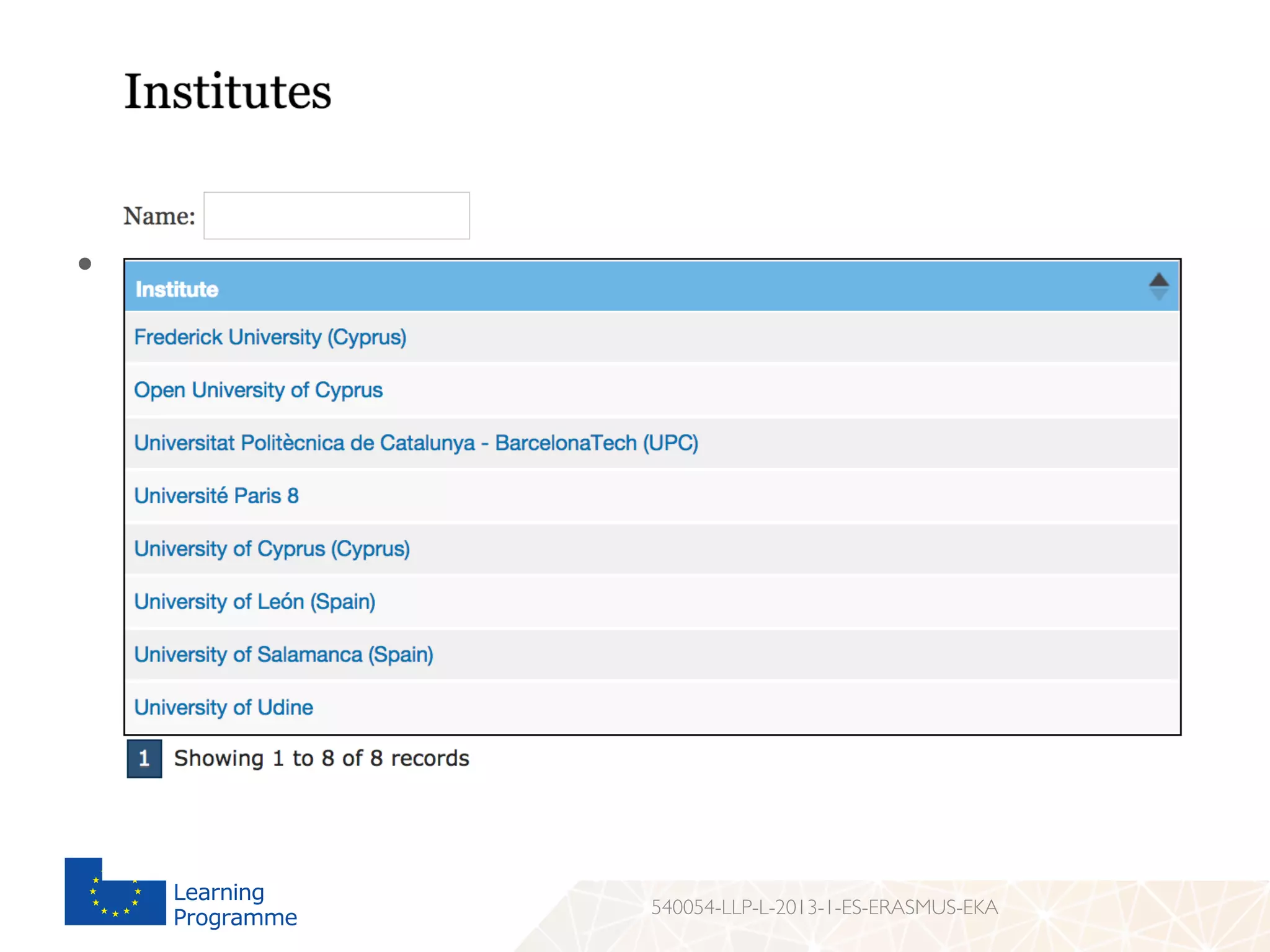
•  Some participation data (November 4th, 2014)
–  Eight universities
540054-LLP-L-2013-1-ES-ERASMUS-EKA
Discussion
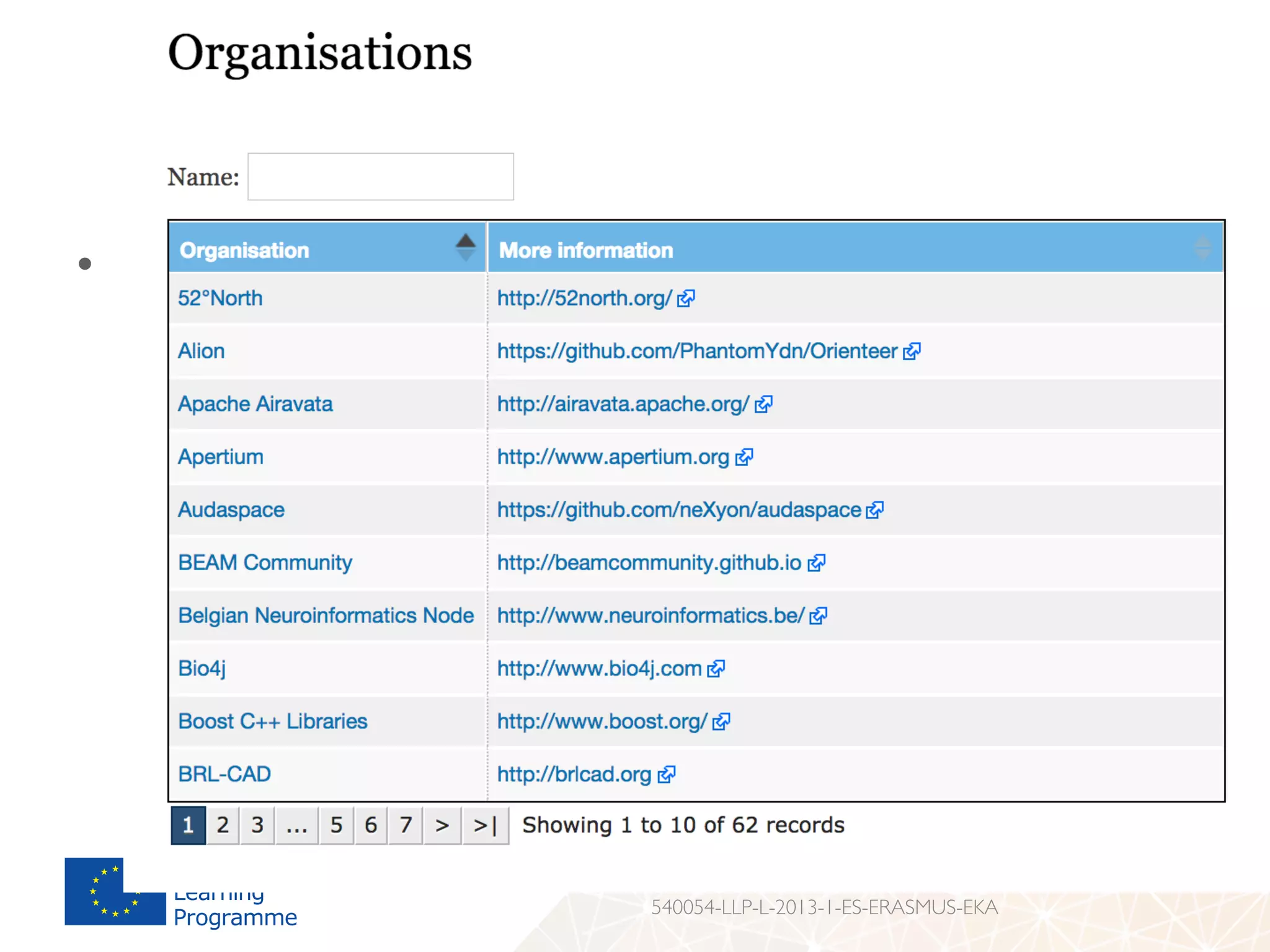
Effective results
•  Some participation data (November 4th, 2014)
–  Eight universities
–  Sixty-two companies
540054-LLP-L-2013-1-ES-ERASMUS-EKA
Discussion
Effective results
•  Some participation data (November 4th, 2014)
–  Eight universities
–  Sixty-two companies
–  Two-hundred and thirty-three placement proposals
540054-LLP-L-2013-1-ES-ERASMUS-EKA
Discussion
The par tnership
•  VALS partners represent more or less at 50% HE
institutions and Companies
•  Companies are in charge to involve OSS companies and
foundations (and some of them propose placements)
•  Universities are in charge to engage students and invite
more universities
•  The cooperation inside of theVALS partnership is fine,
however balancing realities and rhythms of HE and
companies is not easy, especially once others are involved
in the Semester of Code process
540054-LLP-L-2013-1-ES-ERASMUS-EKA
Discussion
The future
•  University managers likeVALS proposal
•  Companies rely onVALS ideas (62 at least)
•  Students think thatVALS is an amazing opportunity
540054-LLP-L-2013-1-ES-ERASMUS-EKA
BUT
•  University is slow in reaction
•  Companies want having results immediately
•  Students need to internalizeVALS new opportunities
Discussion
The future
•  These kinds of innovative processes that involve both
Academia and Business need time enough to settle
•  The setting up procedures are especially hard
•  However, the potential and the benefits ofVALS will
be easily a reality if we have the chance of going
further of a couple of pilots and we establish a
permanent flow of placements offering and application
demand
540054-LLP-L-2013-1-ES-ERASMUS-EKA
Some publications
540054-LLP-L-2013-1-ES-ERASMUS-EKA
•  García-Peñalvo, F.J., Álvarez Navia, I., García Bermejo, J.R., Conde González, M.Á., García-Holgado,A.,
Zangrando,V., Seoane Pardo,A.M., Cruz-Benito, J., Lee, S., Elferink, R.,Veenendaal, E., Zondergeld, S.,
Griffiths, D., Sharples, P., Sherlock, D., DeToni,A., Battistella, C.,Tonizza, G., De Zan, G., Papadopoulos, G.,
Kapitsaki, G.,Achilleos,A., Mettouris, C., Cheung, S., Guerrero, Z., He, E.,Alier Forment, M., Mayol, E.,
Casany, M.J.,Wilson, S., Wilson, R.,  Johnson, M., (2013). VALS: Virtual Alliances for Learning Society. In
F. J. García-Peñalvo,A. García-Holgado  J. Cruz-Benito (Eds.), Proceedings of the TEEM’13 Track on
Knowledge Society Related Projects (pp. 19-26). Salamanca, Spain: Grupo GRIAL. ISBN:
978-84-616-7041-3
•  García-Peñalvo, F.J., Cruz-Benito, J., Griffiths, D., Sharples, P.,Willson, S., Johnson, M., Papadopoulos, G.A.,
Achilleos,A.P.,Alier, M., Galanis, N., Conde, M.Á., Pessot, E., Elferink, R.,Veenendaal, E.,  Lee, S.(2014).
Developing win-win solutions for virtual placements in informatics:TheVALS case. In F. J. García-Peñalvo
(Ed.), Proceedings of the Second International Conference on Technological Ecosystem for Enhancing
Multiculturality (TEEM’14) (pp. 733-738). NewYork, USA:ACM. DOI:
http://dx.doi.org/10.1145/2669711.2669982. ISBN: 978-1-4503-2896-8
•  García-Peñalvo, F. J., Cruz-Benito, J., Conde, M. Á., Griffiths, D. (2014)Virtual placements for informatics
students in open source business across Europe. In 2014 IEEE Frontiers in Education Conference
Proceedings (October 22-25, 2014 Madrid, Spain). (pp. 2551-2555) IEEE. ISBN: 978-1-4799-3921-3. IEEE
Catalog Number: CFP14FIE-ART. USB version, IEEE Catalog Number: CFP14FIE-USB
More info
•  http://virtualalliances.eu/
•  http://semesterofcode.com/
•  http://vps.semesterofcode.com
•  http://grial.usal.es
Contact
Dr. Francisco José García Peñalvo
GRIAL Research Group, Faculty of
Sciences, Department of Computers
and Automatics
Plaza de los Caídos, S/N
37008 Salamanca (España)
(+34) 923294500 (ext. 1302)
fgarcia@usal.es
This presentation reflects only the author‘s view and that the Agency and the
Commission are not responsible for any use that may be made of the
information it contains
540054-LLP-L-2013-1-ES-ERASMUS-EKA
VALS Project
One year after
Thematic Cluster Meeting “Knowledge Alliances”
November 7th, 2014
540054-LLP-L-2013-1-ES-ERASMUS-EKA
Dr. Francisco José García Peñalvo
fgarcia@usal.es / @frangp
GRIAL Research Group
University of Salamanca

VALS Project - One year after

  • 1.
    VALS Project One yearafter Thematic Cluster Meeting “Knowledge Alliances” November 7th, 2014 540054-LLP-L-2013-1-ES-ERASMUS-EKA Dr. Francisco José García Peñalvo fgarcia@usal.es / @frangp GRIAL Research Group University of Salamanca
  • 2.
    What is theVALS Project? •  Virtual Alliances for Learning Society (VALS – Ref. 540054-LLP- L-2013-1-ES-ERASMUS-EKA) •  European project for building knowledge alliances between Universities and Companies across Europe with the aim of facing real business problems through an open innovation approach based on using and developing open software solutions •  Supported by •  European Union. Lifelong Learning Programme (Sub-Programme Erasmus- Knowledge Alliances) •  Duration: November 2013 – October 2015 •  Total amount: 533.337€ 540054-LLP-L-2013-1-ES-ERASMUS-EKA http://virtualalliances.eu/
  • 3.
    VALS Consor tium • University of Salamanca / GRIAL, SIPPE (Spain) •  OpenDirective LLP (United Kingdom) •  RayCom B.V. (The Netherlands) •  University of Bolton (United Kingdom) •  University of Udine (Italy) •  University of Cyprus (Cyprus) •  Mindshock S.L. (Spain) •  Oxford University - OSS Watch (United Kingdom) 540054-LLP-L-2013-1-ES-ERASMUS-EKA
  • 4.
    VALS procedures •  Knowledgealliances among the entities (both from Academic and Business) •  The most interestingVALS innovation is about the definition of a system of virtual placements for students in companies •  Entrepreneurship skills promotion •  Definition of new teaching / learning methods •  Development of the Semester of Code 540054-LLP-L-2013-1-ES-ERASMUS-EKA
  • 5.
    Semester of Code Semesterin which one the students have their placements in companies and foundations related to open software Virtual placements (telework) Involved academic tutors (from the universities) and mentors (from the businesses) 540054-LLP-L-2013-1-ES-ERASMUS-EKA
  • 6.
    Some of thebusinesses involved in Semester of Code http://vps.semesterofcode.com/projects/browse 540054-LLP-L-2013-1-ES-ERASMUS-EKA
  • 7.
    Kinds of projectssubmitted to VALS •  Real problems of the participant companies and foundations •  The student proposes an approach to solve the problem •  The proposed approach will be implemented during the Semester of Code 540054-LLP-L-2013-1-ES-ERASMUS-EKA
  • 8.
    How to participate as business? 540054-LLP-L-2013-1-ES-ERASMUS-EKA 1.Write a project proposal (based on a real business problem involving OSS) and including a mentor 2. Submit the project proposal to http:// vps.semesterofcode.com 3. Review the solution approaches uploaded by the students and select the best of them 4. Mentorize the development process
  • 9.
    How to participate as student? 540054-LLP-L-2013-1-ES-ERASMUS-EKA 1. Review the projects list in the Semester of Code website (http://vps.semesterofcode.com/) 2. Find an academic tutor from the University 3.Apply for the project (competition with other European students) 4. If the application is accepted, the student will develop it
  • 10.
    Semester of CodeTimeline 540054-LLP-L-2013-1-ES-ERASMUS-EKA •  Two rounds for pilots 1.  Between September – November 2014. Process open for project proposals and students’ application. Development of the solution between December 2014 – April 2015 (dates fixed between students and companies/ foundations) 2.  Between January – March 2015. Process open for project proposals and students’ application. Development of the solution between March – August 2015 (dates fixed between students and companies/foundations)
  • 11.
    540054-LLP-L-2013-1-ES-ERASMUS-EKA Semester of CodeWor kflow: The real approach for the Univer sity of Salamanca (fir st round of pilots) 540054-LLP-L-2013-1-ES-ERASMUS-EKA
  • 12.
    Conclusions •  VALS presentsan open innovation initiative with a win-win approach 540054-LLP-L-2013-1-ES-ERASMUS-EKA
  • 13.
    Conclusions •  Students •  Professionalexperience in the real business context •  Contacts in the software industry that can facilitate the start of their professional career •  Personal experience due to operate in an international context •  Academic rewards 540054-LLP-L-2013-1-ES-ERASMUS-EKA
  • 14.
    Conclusions •  University •  Newmethods for teaching and assessment •  Long-term Knowledge Alliances with the industry in an international context •  Possibility of importing successful practices from Business to the University •  Offering real innovative possibilities to students with a great cost / benefit ratio in a crisis 540054-LLP-L-2013-1-ES-ERASMUS-EKA
  • 15.
    Conclusions •  Business •  Findtalent directly in Universities •  Knowledge Alliance with the Universities •  Possibility of transfer knowledge from the University to the Company 540054-LLP-L-2013-1-ES-ERASMUS-EKA
  • 16.
    Conclusions •  Society •  Reductionof the gap between University and Business •  Better professional qualification obtained under equal opportunities in a time of crisis 540054-LLP-L-2013-1-ES-ERASMUS-EKA
  • 17.
    Discussion What exactly doesVALS intend to achieve •  VALS pursues a knowledge alliance between HE institutions and Companies that allows students have placements related to real projects in business all around Europe using telework practices, that’s mean without to expend money to travel and subsist •  Main target groups –  Informatics students (university level) –  Open source related companies and foundations –  Universities 540054-LLP-L-2013-1-ES-ERASMUS-EKA
  • 18.
    Discussion What exactly doesVALS intend to achieve •  Main activities –  Workflow definition for the placements management –  Setting up a platform for workflow support –  Contacting with companies to offer virtual placements –  Contacting with universities to be involved inVALS –  DisseminatingVALS procedures to the students to engage them 540054-LLP-L-2013-1-ES-ERASMUS-EKA
  • 19.
    Discussion Issues and challenges • Administrative processes in the universities are very strict, especially regarding schedules, and are not shared by all the universities all over Europe •  Schedules and workload in companies are not always compatible with universities ones and students’ planning –  Ad hoc adapting and making more flexible the administrative processes in the universities (it depends on each university and the people involved in) –  Defining a two-round piloting procedure (inside theVALS scope) 540054-LLP-L-2013-1-ES-ERASMUS-EKA
  • 20.
    Discussion Issues and challenges • University tutors engagement –  Personal relationships –  Altruistic behaviours 540054-LLP-L-2013-1-ES-ERASMUS-EKA
  • 21.
    Discussion Issues and challenges • Students engagement –  They need time to includeVALS activities with their own plans (short term plans are not usually compliant with the most of the students’ reality) –  TheVALS benefits must include academic rewards (credits recognition for the placements, reusing the work done for their final degree works, and so on) –  The fear of English communication, workload, effort done in the proposal definition and other different excuses •  Presentation several of the project including open placement definitions in the platform •  Flexibilizing the administrative procedures in the universities •  Taking into account all the possible and available academic rewards •  Involving more universities 540054-LLP-L-2013-1-ES-ERASMUS-EKA
  • 22.
    Discussion Effective results •  Aworkflow definition for an open innovation process regarding virtual placement •  Two sites for project dissemination http://virtualalliances.eu/ http://semesterofcode.com/ •  A platform for virtual placement management http://vps.semesterofcode.com 540054-LLP-L-2013-1-ES-ERASMUS-EKA
  • 23.
    Discussion Effective results •  Someparticipation data (November 4th, 2014) –  Eight universities 540054-LLP-L-2013-1-ES-ERASMUS-EKA
  • 24.
    Discussion Effective results •  Someparticipation data (November 4th, 2014) –  Eight universities –  Sixty-two companies 540054-LLP-L-2013-1-ES-ERASMUS-EKA
  • 25.
    Discussion Effective results •  Someparticipation data (November 4th, 2014) –  Eight universities –  Sixty-two companies –  Two-hundred and thirty-three placement proposals 540054-LLP-L-2013-1-ES-ERASMUS-EKA
  • 26.
    Discussion The par tnership • VALS partners represent more or less at 50% HE institutions and Companies •  Companies are in charge to involve OSS companies and foundations (and some of them propose placements) •  Universities are in charge to engage students and invite more universities •  The cooperation inside of theVALS partnership is fine, however balancing realities and rhythms of HE and companies is not easy, especially once others are involved in the Semester of Code process 540054-LLP-L-2013-1-ES-ERASMUS-EKA
  • 27.
    Discussion The future •  Universitymanagers likeVALS proposal •  Companies rely onVALS ideas (62 at least) •  Students think thatVALS is an amazing opportunity 540054-LLP-L-2013-1-ES-ERASMUS-EKA BUT •  University is slow in reaction •  Companies want having results immediately •  Students need to internalizeVALS new opportunities
  • 28.
    Discussion The future •  Thesekinds of innovative processes that involve both Academia and Business need time enough to settle •  The setting up procedures are especially hard •  However, the potential and the benefits ofVALS will be easily a reality if we have the chance of going further of a couple of pilots and we establish a permanent flow of placements offering and application demand 540054-LLP-L-2013-1-ES-ERASMUS-EKA
  • 29.
    Some publications 540054-LLP-L-2013-1-ES-ERASMUS-EKA •  García-Peñalvo,F.J., Álvarez Navia, I., García Bermejo, J.R., Conde González, M.Á., García-Holgado,A., Zangrando,V., Seoane Pardo,A.M., Cruz-Benito, J., Lee, S., Elferink, R.,Veenendaal, E., Zondergeld, S., Griffiths, D., Sharples, P., Sherlock, D., DeToni,A., Battistella, C.,Tonizza, G., De Zan, G., Papadopoulos, G., Kapitsaki, G.,Achilleos,A., Mettouris, C., Cheung, S., Guerrero, Z., He, E.,Alier Forment, M., Mayol, E., Casany, M.J.,Wilson, S., Wilson, R., Johnson, M., (2013). VALS: Virtual Alliances for Learning Society. In F. J. García-Peñalvo,A. García-Holgado J. Cruz-Benito (Eds.), Proceedings of the TEEM’13 Track on Knowledge Society Related Projects (pp. 19-26). Salamanca, Spain: Grupo GRIAL. ISBN: 978-84-616-7041-3 •  García-Peñalvo, F.J., Cruz-Benito, J., Griffiths, D., Sharples, P.,Willson, S., Johnson, M., Papadopoulos, G.A., Achilleos,A.P.,Alier, M., Galanis, N., Conde, M.Á., Pessot, E., Elferink, R.,Veenendaal, E., Lee, S.(2014). Developing win-win solutions for virtual placements in informatics:TheVALS case. In F. J. García-Peñalvo (Ed.), Proceedings of the Second International Conference on Technological Ecosystem for Enhancing Multiculturality (TEEM’14) (pp. 733-738). NewYork, USA:ACM. DOI: http://dx.doi.org/10.1145/2669711.2669982. ISBN: 978-1-4503-2896-8 •  García-Peñalvo, F. J., Cruz-Benito, J., Conde, M. Á., Griffiths, D. (2014)Virtual placements for informatics students in open source business across Europe. In 2014 IEEE Frontiers in Education Conference Proceedings (October 22-25, 2014 Madrid, Spain). (pp. 2551-2555) IEEE. ISBN: 978-1-4799-3921-3. IEEE Catalog Number: CFP14FIE-ART. USB version, IEEE Catalog Number: CFP14FIE-USB
  • 30.
    More info •  http://virtualalliances.eu/ • http://semesterofcode.com/ •  http://vps.semesterofcode.com •  http://grial.usal.es Contact Dr. Francisco José García Peñalvo GRIAL Research Group, Faculty of Sciences, Department of Computers and Automatics Plaza de los Caídos, S/N 37008 Salamanca (España) (+34) 923294500 (ext. 1302) fgarcia@usal.es This presentation reflects only the author‘s view and that the Agency and the Commission are not responsible for any use that may be made of the information it contains 540054-LLP-L-2013-1-ES-ERASMUS-EKA
  • 31.
    VALS Project One yearafter Thematic Cluster Meeting “Knowledge Alliances” November 7th, 2014 540054-LLP-L-2013-1-ES-ERASMUS-EKA Dr. Francisco José García Peñalvo fgarcia@usal.es / @frangp GRIAL Research Group University of Salamanca