Presentation of VALS project within
an Erasmus+ mobility framework
ISEP, Porto, Portugal
July 23rd, 2015
540054-LLP-L-2013-1-ES-ERASMUS-EKA
Dr. Francisco José García Peñalvo
fgarcia@usal.es / @frangp
Departament of Computers and Automatics
GRIAL Research Group
University of Salamanca
Vir tual Alliances for Learning
Society (VALS)
•  European project for building knowledge alliances between
Universities and Companies across Europe with the aim of facing
real business problems through an open innovation approach based
on using and developing open software solutions through virtual
placements in worldwide Companies and Foundations.
•  Supported by
•  European Union. Lifelong Learning Programme (Sub-Programme Erasmus-
Knowledge Alliances)
•  Duration: November 2013 – October 2015
•  Total amount: 533.337€
540054-LLP-L-2013-1-ES-ERASMUS-EKA
http://virtualalliances.eu/
VALS Consor tium
•  University of Salamanca / GRIAL, SIPPE (Spain)
•  OpenDirective LLP (United Kingdom)
•  RayCom B.V. (Netherlands)
•  University of Bolton (United Kingdom)
•  University of Udine (Italy)
•  University of Cyprus (Cyprus)
•  Mindshock S.L. (Spain)
•  Oxford University - OSS Watch (United Kingdom)
540054-LLP-L-2013-1-ES-ERASMUS-EKA
VALS procedures
•  Knowledge alliances among the entities (both academic
and business)
•  The most interestingVALS innovation is about the
definition of a system of virtual placements for students
in companies
•  Entrepreneurship skills promotion
•  Definition of new teaching / learning methods
•  Development of the Semester of Code
540054-LLP-L-2013-1-ES-ERASMUS-EKA
Semester of Code
Semester in which one the students have their
placements in companies and foundations related to
open software
Virtual placements (telework)
Involved academic tutors (from the universities) and
mentors (from the businesses)
540054-LLP-L-2013-1-ES-ERASMUS-EKA
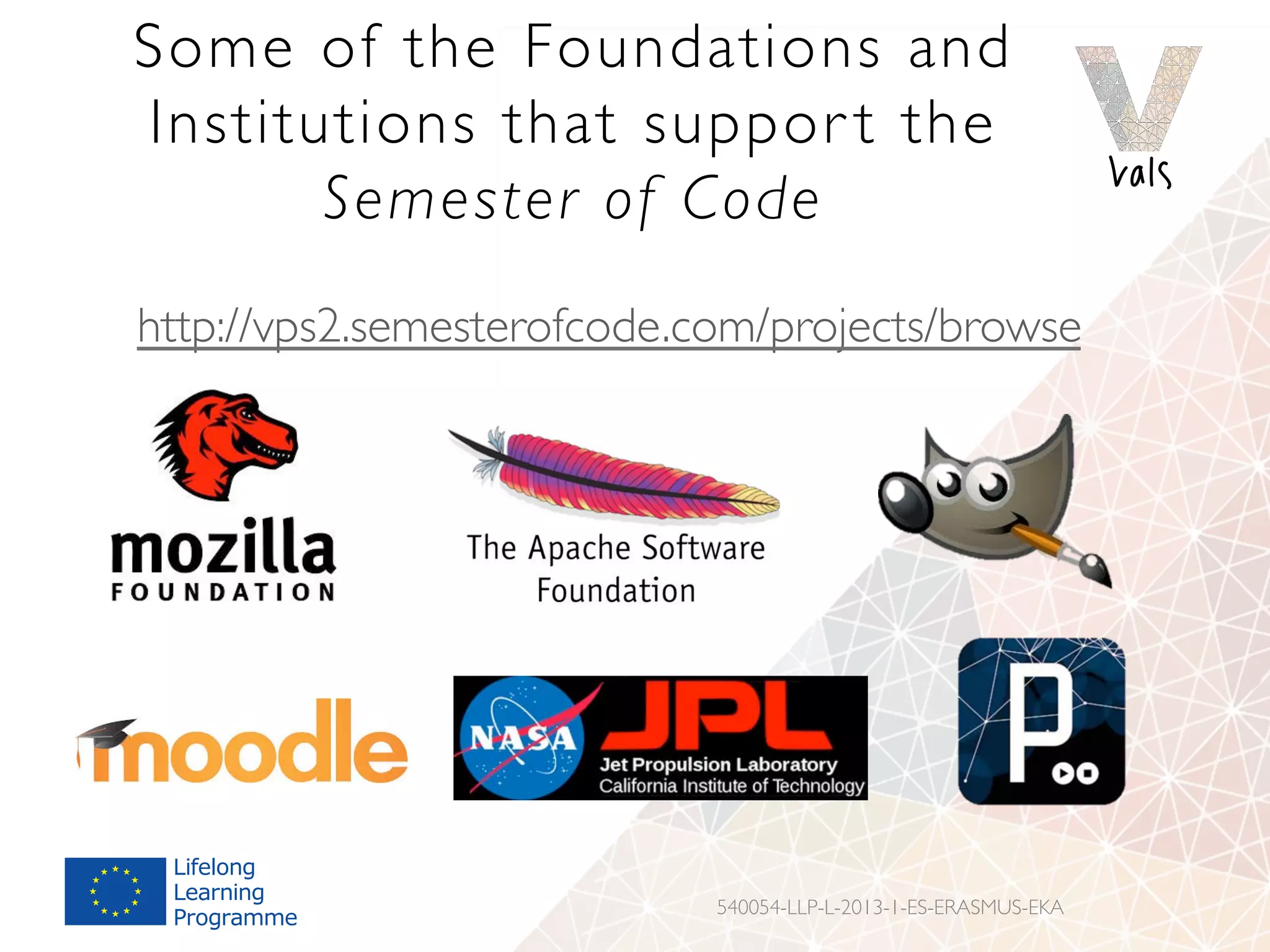
Some of the Foundations and
Institutions that suppor t the
Semester of Code
http://vps2.semesterofcode.com/projects/browse
540054-LLP-L-2013-1-ES-ERASMUS-EKA
VALS projects nature
•  Real problems of the participant companies and
foundations
•  The student proposes an approach to solve the
problem
•  The proposed approach will be implemented during
the Semester of Code
540054-LLP-L-2013-1-ES-ERASMUS-EKA
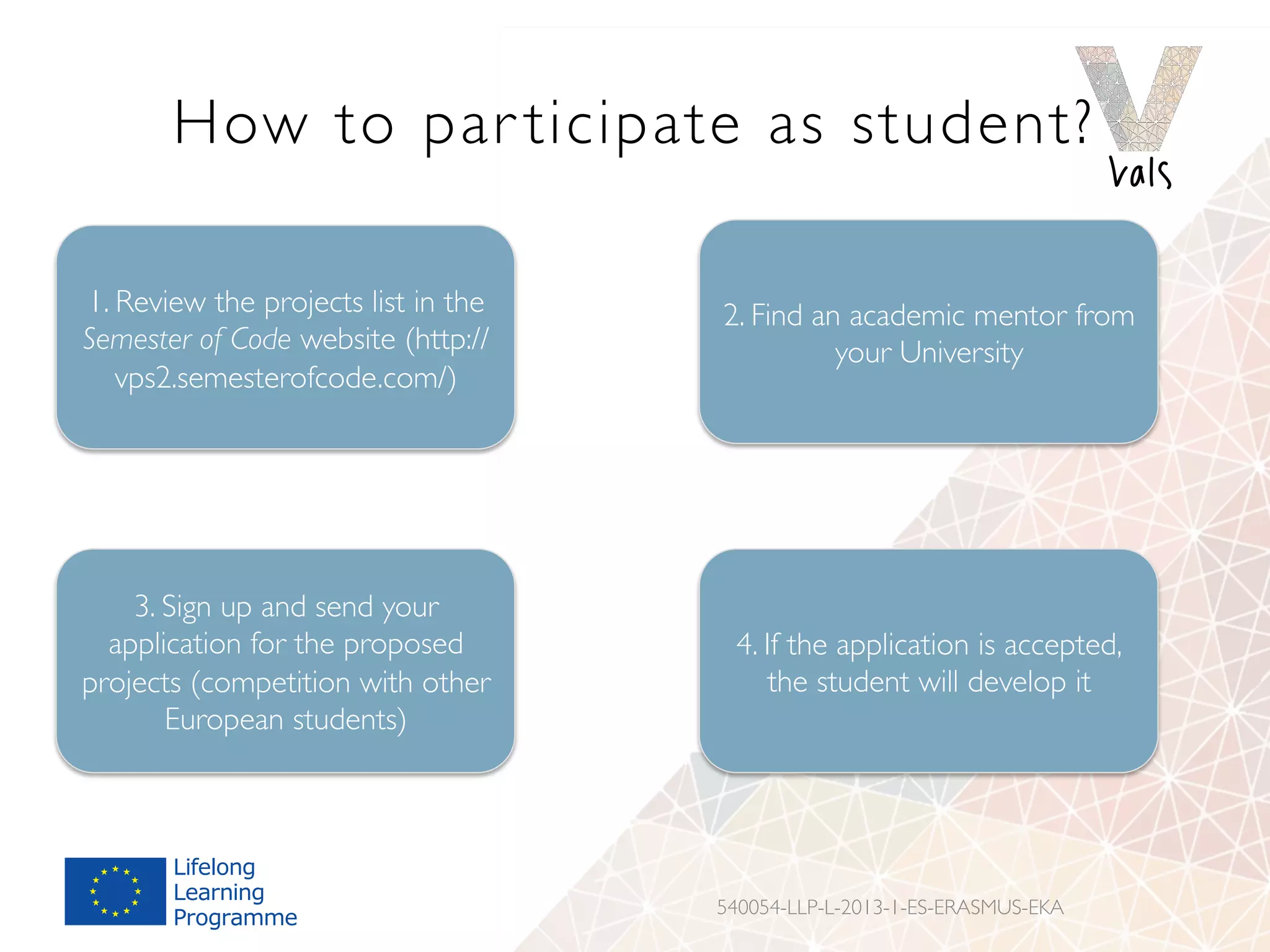
How to par ticipate as student?
540054-LLP-L-2013-1-ES-ERASMUS-EKA
1. Review the projects list in the
Semester of Code website (http://
vps2.semesterofcode.com/)
2. Find an academic mentor from
your University
3. Sign up and send your
application for the proposed
projects (competition with other
European students)
4. If the application is accepted,
the student will develop it
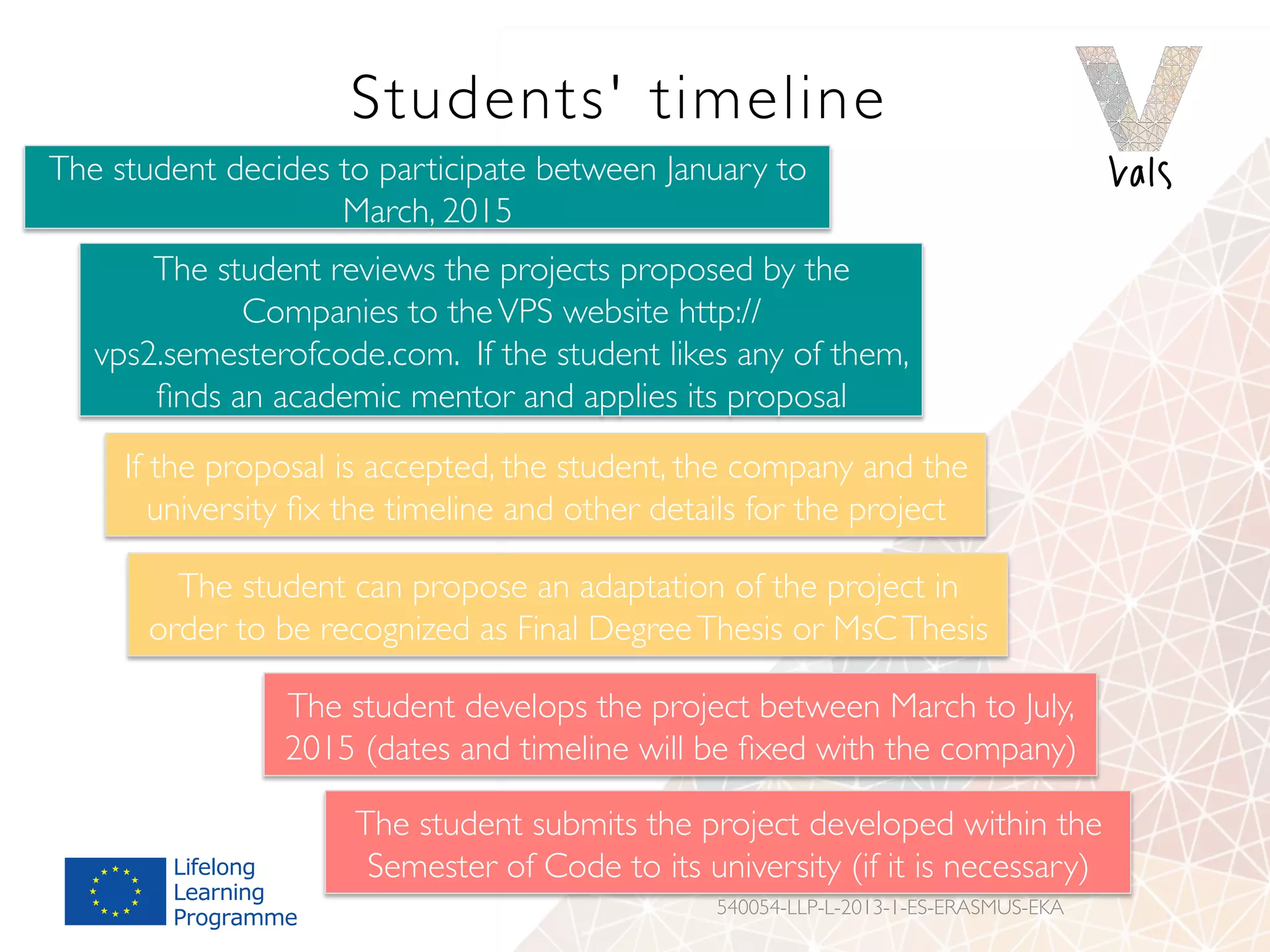
Students' timeline
540054-LLP-L-2013-1-ES-ERASMUS-EKA
The student decides to participate between January to
March, 2015
The student reviews the projects proposed by the
Companies to theVPS website http://
vps2.semesterofcode.com. If the student likes any of them,
finds an academic mentor and applies its proposal
If the proposal is accepted, the student, the company and the
university fix the timeline and other details for the project
The student can propose an adaptation of the project in
order to be recognized as Final DegreeThesis or MsCThesis
The student develops the project between March to July,
2015 (dates and timeline will be fixed with the company)
The student submits the project developed within the
Semester of Code to its university (if it is necessary)
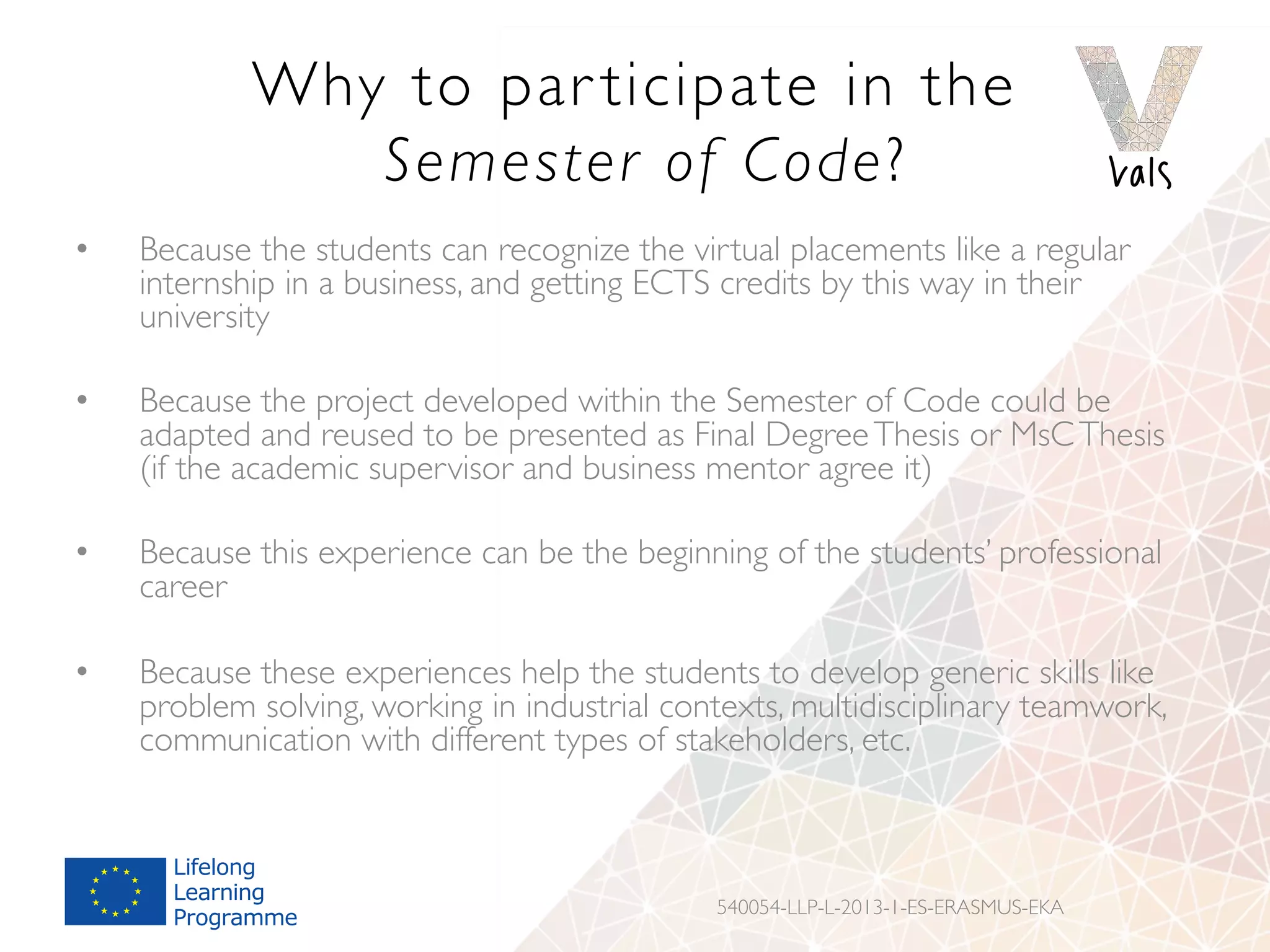
Why to par ticipate in the
Semester of Code?
•  Because the students can recognize the virtual placements like a regular
internship in a business, and getting ECTS credits by this way in their
university
•  Because the project developed within the Semester of Code could be
adapted and reused to be presented as Final DegreeThesis or MsCThesis
(if the academic supervisor and business mentor agree it)
•  Because this experience can be the beginning of the students’ professional
career
•  Because these experiences help the students to develop generic skills like
problem solving, working in industrial contexts, multidisciplinary teamwork,
communication with different types of stakeholders, etc.
540054-LLP-L-2013-1-ES-ERASMUS-EKA
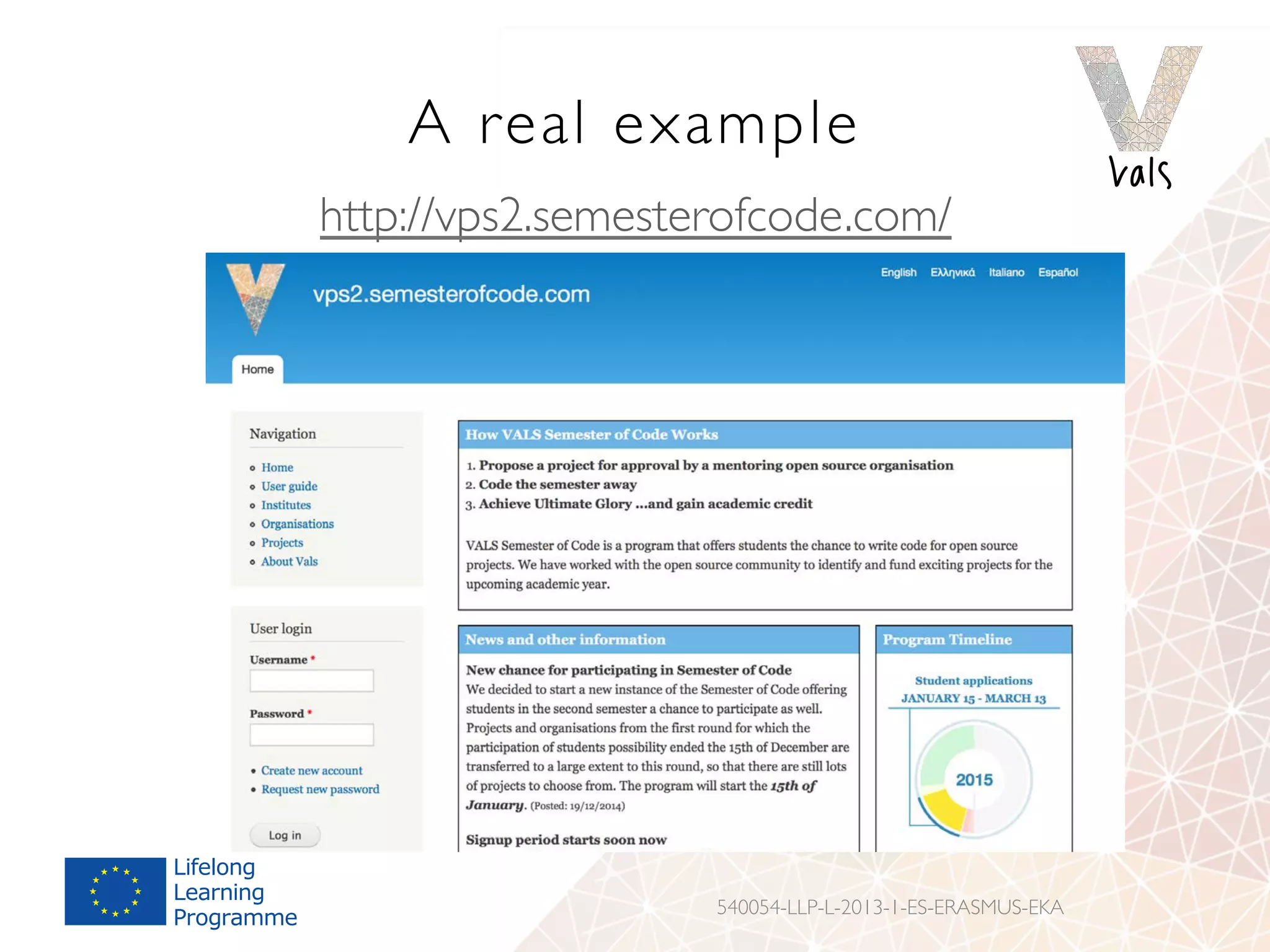
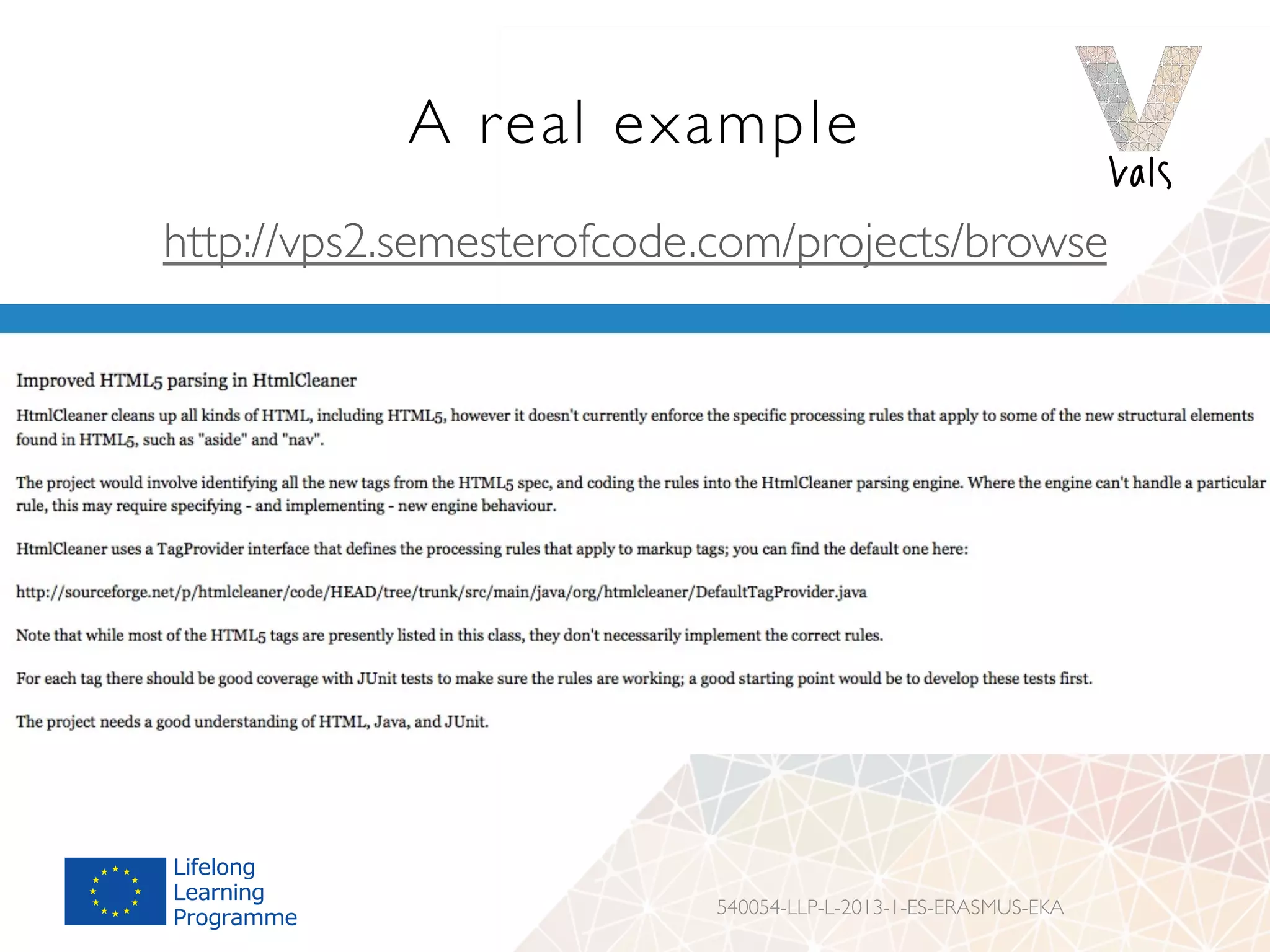
A real example
http://vps2.semesterofcode.com/
540054-LLP-L-2013-1-ES-ERASMUS-EKA
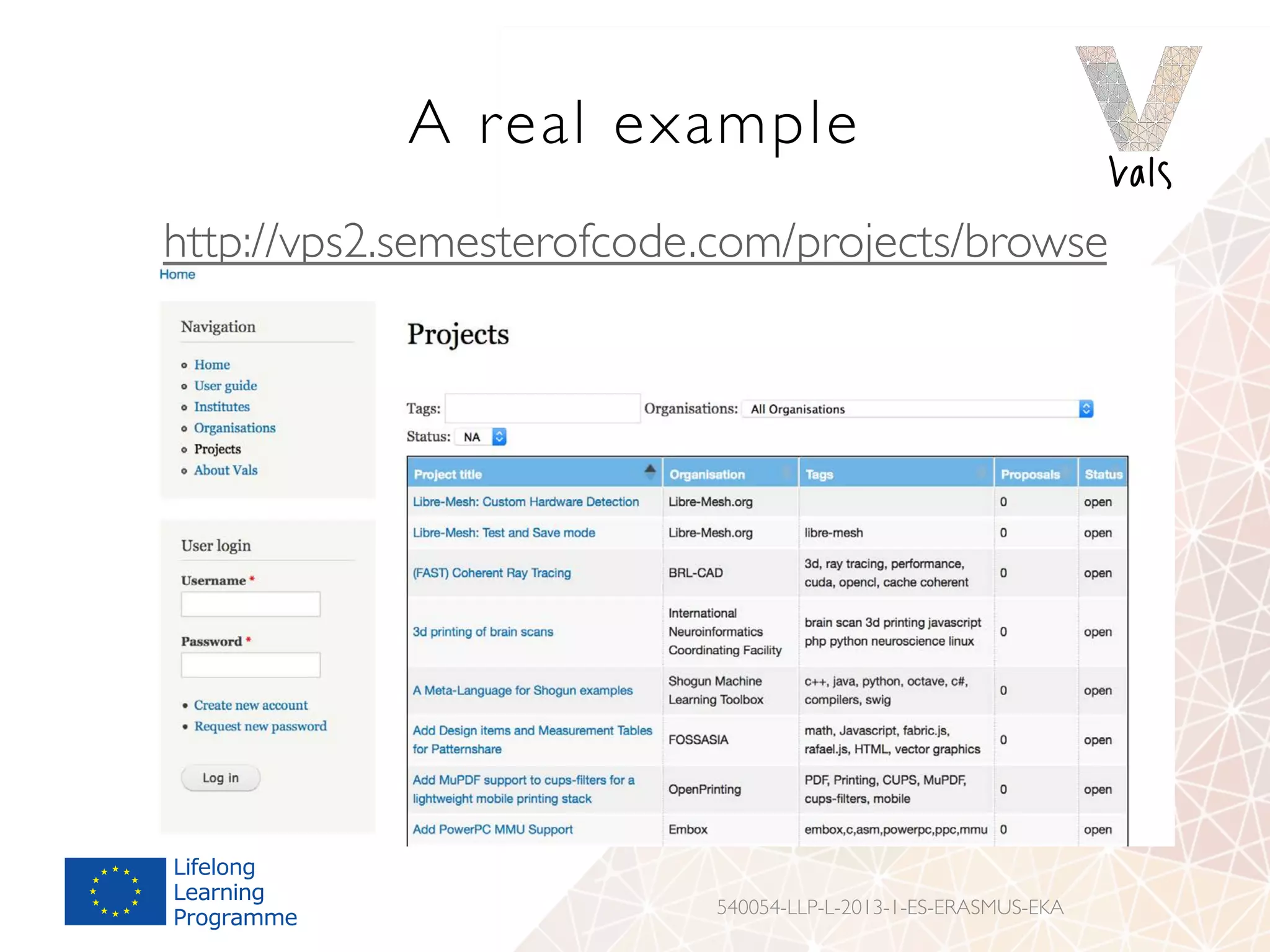
A real example
http://vps2.semesterofcode.com/projects/browse
540054-LLP-L-2013-1-ES-ERASMUS-EKA
A real example
http://vps2.semesterofcode.com/projects/browse
540054-LLP-L-2013-1-ES-ERASMUS-EKA
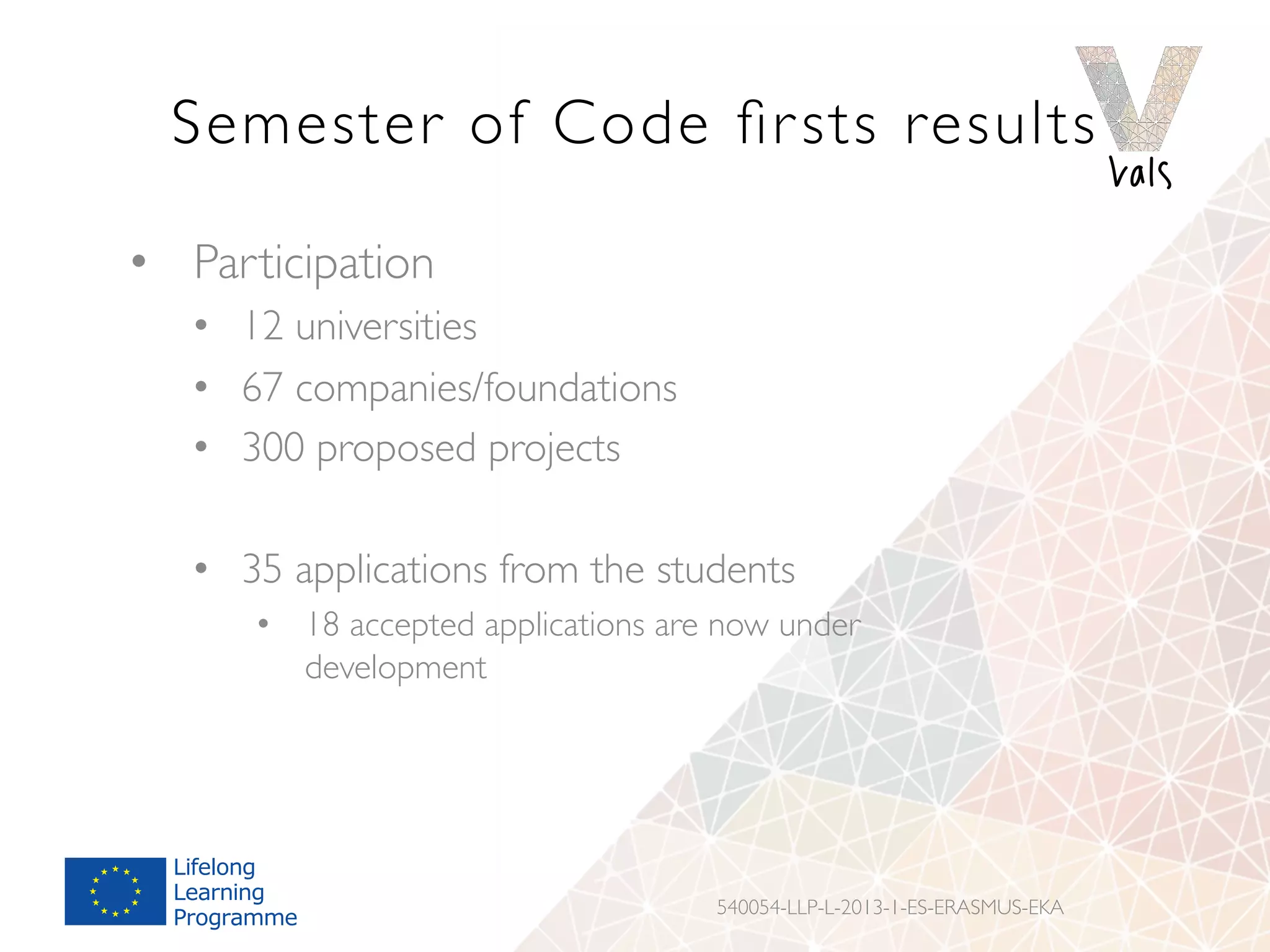
Semester of Code firsts results
•  Participation
•  12 universities
•  67 companies/foundations
•  300 proposed projects
•  35 applications from the students
•  18 accepted applications are now under
development
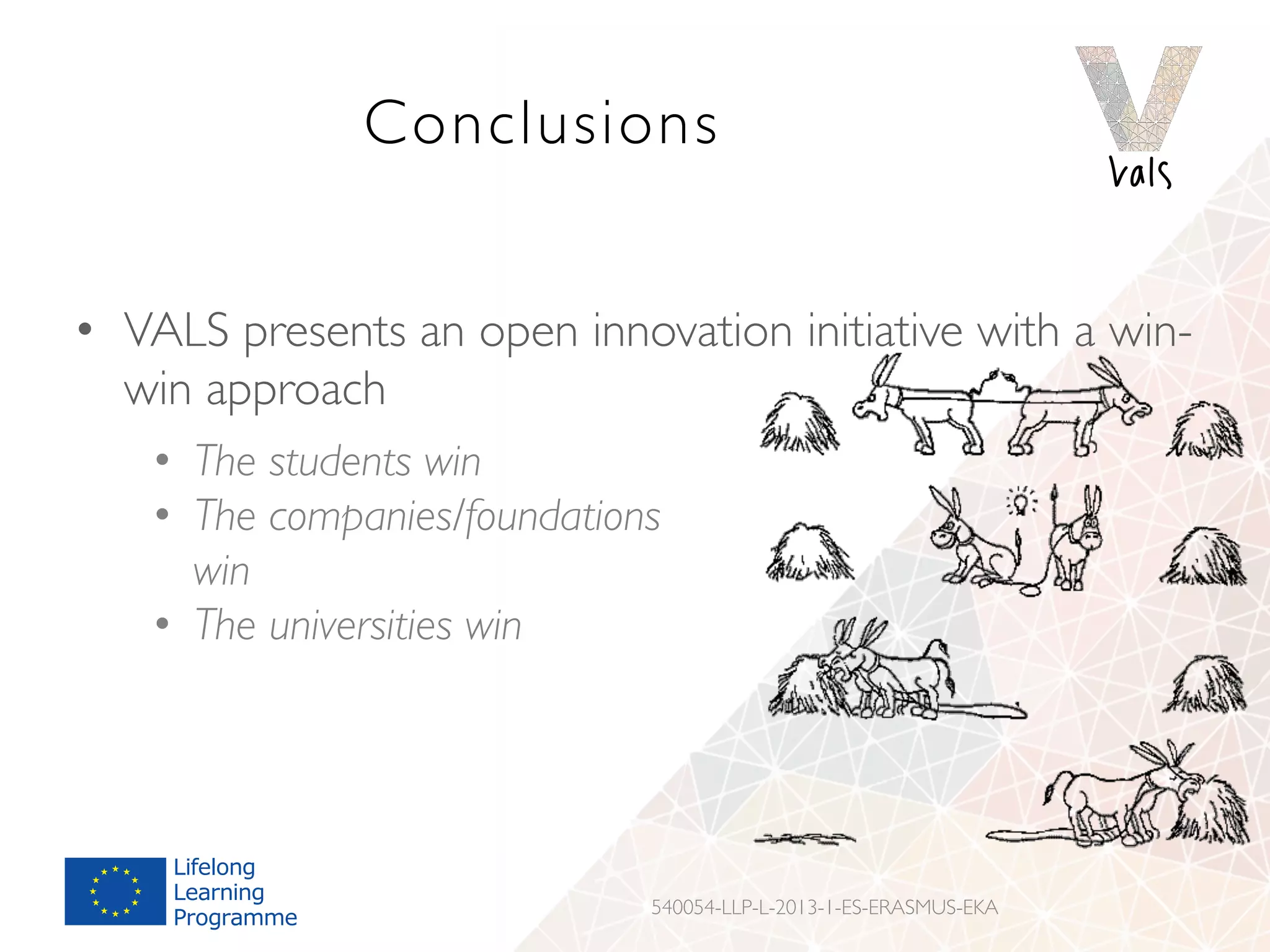
Conclusions
•  VALS presents an open innovation initiative with a win-
win approach
•  The students win
•  The companies/foundations
win
•  The universities win
540054-LLP-L-2013-1-ES-ERASMUS-EKA
Conclusions
•  Students
–  Professional experience in the real business context
–  Contacts in the software industry that can facilitate the start
of their career
–  Personal experience due to operate in an international
context
–  Academic rewards
540054-LLP-L-2013-1-ES-ERASMUS-EKA
Conclusions
•  Business
–  Find talent directly in Universities
–  Knowledge Alliance with the Universities
–  Possibility of transfer knowledge from the University to the
Company
540054-LLP-L-2013-1-ES-ERASMUS-EKA
Conclusions
•  University
–  New methods for teaching and assessment
–  Long-term Knowledge Alliances with the industry in an
international context
–  Possibility of importing successful practices from Business to
the University
–  Offering real innovative possibilities to students with a great
cost / benefit ratio in a crisis
540054-LLP-L-2013-1-ES-ERASMUS-EKA
Conclusions
•  Society
–  Reduction of the gap between University and Business
–  Better professional qualification obtained under equal
opportunities in a time of crisis
540054-LLP-L-2013-1-ES-ERASMUS-EKA
More information
http://virtualalliances.eu/
http://semesterofcode.com/
http://vps2.semesterofcode.com
http://grial.usal.es
This presentation reflects only the author‘s view and that the Agency and the
Commission are not responsible for any use that may be made of the
information it contains 540054-LLP-L-2013-1-ES-ERASMUS-EKA
Dr. Francisco José García Peñalvo
Facultad de Ciencias, Dpto. de Informática y
Automática
Grupo GRIAL
Plaza de los Caídos, S/N
37008 Salamanca (España)
(+34) 923294500 (ext. 1302)
fgarcia@usal.es
D. Juan Cruz Benito
Grupo GRIAL. IUCE
Paseo de Canalejas 169
37008 Salamanca (España)
(+34) 923294500 (ext. 3334)
juancb@usal.es
References
•  García-Peñalvo, F.J., Álvarez Navia, I., García Bermejo, J.R., Conde González, M.Á., García-Holgado,A., Zangrando,
V., Seoane Pardo,A.M., Cruz-Benito, J., Lee, S., Elferink, R.,Veenendaal, E., Zondergeld, S., Griffiths, D., Sharples, P.,
Sherlock, D., DeToni,A., Battistella, C.,Tonizza, G., De Zan, G., Papadopoulos, G., Kapitsaki, G.,Achilleos,A.,
Mettouris, C., Cheung, S., Guerrero, Z., He, E.,Alier Forment, M., Mayol, E., Casany, M.J.,Wilson, S., Wilson, R., 
Johnson, M. (2013).VALS:Virtual Alliances for Learning Society. In F. J. García-Peñalvo,A. García-Holgado  J.
Cruz-Benito (Eds.), Proceedings of the TEEM’13 Track on Knowledge Society Related Projects (pp. 19-26).
Salamanca, Spain: Grupo GRIAL
•  García-Peñalvo, F. J., Cruz-Benito, J., Conde, M. Á.,  Griffiths, D. (2014).Virtual placements for informatics
students in open source business across Europe 2014 IEEE Frontiers in Education Conference Proceedings
(October 22-25, 2014 Madrid, Spain) (pp. 2551-2555). USA: IEEE
•  García-Peñalvo, F. J., Cruz-Benito, J., Conde, M. Á.,  Griffiths, D. (2015). Semester of Code: PilotingVirtual
Placements for Informatics across Europe Proceedings of Global Enginnering Education Conference, EDUCON
2015.Tallinn, Estonia, 18-20 Mach 2015 (pp. 567-576). USA: IEEE
•  García-Peñalvo, F. J., Cruz-Benito, J., Griffiths, D.  Achilleos,A.(2015).Tecnología al servicio de un proceso de
gestión de prácticas virtuales en empresas: Propuesta y primeros resultados del Semester of Code. VAEP RITA
Vol. 3, n. 1. (pp 52-59). Spain. IEEE
•  García-Peñalvo, F.J., Cruz-Benito, J., Griffiths, D., Sharples, P.,Willson, S., Johnson, M., Papadopoulos, G.A.,
Achilleos,A.P.,Alier, M., Galanis, N., Conde, M.Á., Pessot, E., Elferink, R.,Veenendaal, E.,  Lee, S. (2014).
Developing Win-Win Solutions forVirtual Placements in Informatics:TheVALS Case. In F. J. García-Peñalvo
(Ed.), Proceedings of the Second International Conference on Technological Ecosystem for Enhancing Multiculturality
(TEEM’14) (pp. 733-738). NewYork, USA:ACM
540054-LLP-L-2013-1-ES-ERASMUS-EKA
References
•  García-Peñalvo, F.J. (2014).VALS Project – One year after. Presented in
the Thematic Cluster Meeting “Knowledge Alliances” in Brussels at
November 7th, 2014. http://hdl.handle.net/10366/125221
•  García-Peñalvo, F. J. (2015). Executive Presentation ofVALS project.
2015, http://repositorio.grial.eu/handle/grial/374
•  García-Peñalvo, F.J. (2015). IntroducingVALS project and Semester of
Code (English version). http://hdl.handle.net/10366/125227
•  García-Peñalvo, F.J. (2015). Presentación del proyectoVirtual Alliances
for Learning Society (Spanish version).
http://hdl.handle.net/10366/125220
540054-LLP-L-2013-1-ES-ERASMUS-EKA
Presentation of VALS project within
an Erasmus+ mobility framework
ISEP, Porto, Portugal
July 23rd, 2015
540054-LLP-L-2013-1-ES-ERASMUS-EKA
Dr. Francisco José García Peñalvo
fgarcia@usal.es / @frangp
Departament of Computers and Automatics
GRIAL Research Group
University of Salamanca

Presentation of VALS project within an Erasmus+ mobility framework

  • 1.
    Presentation of VALSproject within an Erasmus+ mobility framework ISEP, Porto, Portugal July 23rd, 2015 540054-LLP-L-2013-1-ES-ERASMUS-EKA Dr. Francisco José García Peñalvo fgarcia@usal.es / @frangp Departament of Computers and Automatics GRIAL Research Group University of Salamanca
  • 2.
    Vir tual Alliancesfor Learning Society (VALS) •  European project for building knowledge alliances between Universities and Companies across Europe with the aim of facing real business problems through an open innovation approach based on using and developing open software solutions through virtual placements in worldwide Companies and Foundations. •  Supported by •  European Union. Lifelong Learning Programme (Sub-Programme Erasmus- Knowledge Alliances) •  Duration: November 2013 – October 2015 •  Total amount: 533.337€ 540054-LLP-L-2013-1-ES-ERASMUS-EKA http://virtualalliances.eu/
  • 3.
    VALS Consor tium • University of Salamanca / GRIAL, SIPPE (Spain) •  OpenDirective LLP (United Kingdom) •  RayCom B.V. (Netherlands) •  University of Bolton (United Kingdom) •  University of Udine (Italy) •  University of Cyprus (Cyprus) •  Mindshock S.L. (Spain) •  Oxford University - OSS Watch (United Kingdom) 540054-LLP-L-2013-1-ES-ERASMUS-EKA
  • 4.
    VALS procedures •  Knowledgealliances among the entities (both academic and business) •  The most interestingVALS innovation is about the definition of a system of virtual placements for students in companies •  Entrepreneurship skills promotion •  Definition of new teaching / learning methods •  Development of the Semester of Code 540054-LLP-L-2013-1-ES-ERASMUS-EKA
  • 5.
    Semester of Code Semesterin which one the students have their placements in companies and foundations related to open software Virtual placements (telework) Involved academic tutors (from the universities) and mentors (from the businesses) 540054-LLP-L-2013-1-ES-ERASMUS-EKA
  • 6.
    Some of theFoundations and Institutions that suppor t the Semester of Code http://vps2.semesterofcode.com/projects/browse 540054-LLP-L-2013-1-ES-ERASMUS-EKA
  • 7.
    VALS projects nature • Real problems of the participant companies and foundations •  The student proposes an approach to solve the problem •  The proposed approach will be implemented during the Semester of Code 540054-LLP-L-2013-1-ES-ERASMUS-EKA
  • 8.
    How to participate as student? 540054-LLP-L-2013-1-ES-ERASMUS-EKA 1. Review the projects list in the Semester of Code website (http:// vps2.semesterofcode.com/) 2. Find an academic mentor from your University 3. Sign up and send your application for the proposed projects (competition with other European students) 4. If the application is accepted, the student will develop it
  • 9.
    Students' timeline 540054-LLP-L-2013-1-ES-ERASMUS-EKA The studentdecides to participate between January to March, 2015 The student reviews the projects proposed by the Companies to theVPS website http:// vps2.semesterofcode.com. If the student likes any of them, finds an academic mentor and applies its proposal If the proposal is accepted, the student, the company and the university fix the timeline and other details for the project The student can propose an adaptation of the project in order to be recognized as Final DegreeThesis or MsCThesis The student develops the project between March to July, 2015 (dates and timeline will be fixed with the company) The student submits the project developed within the Semester of Code to its university (if it is necessary)
  • 10.
    Why to participate in the Semester of Code? •  Because the students can recognize the virtual placements like a regular internship in a business, and getting ECTS credits by this way in their university •  Because the project developed within the Semester of Code could be adapted and reused to be presented as Final DegreeThesis or MsCThesis (if the academic supervisor and business mentor agree it) •  Because this experience can be the beginning of the students’ professional career •  Because these experiences help the students to develop generic skills like problem solving, working in industrial contexts, multidisciplinary teamwork, communication with different types of stakeholders, etc. 540054-LLP-L-2013-1-ES-ERASMUS-EKA
  • 11.
  • 12.
  • 13.
  • 14.
    540054-LLP-L-2013-1-ES-ERASMUS-EKA Semester of Codefirsts results •  Participation •  12 universities •  67 companies/foundations •  300 proposed projects •  35 applications from the students •  18 accepted applications are now under development
  • 15.
    Conclusions •  VALS presentsan open innovation initiative with a win- win approach •  The students win •  The companies/foundations win •  The universities win 540054-LLP-L-2013-1-ES-ERASMUS-EKA
  • 16.
    Conclusions •  Students –  Professionalexperience in the real business context –  Contacts in the software industry that can facilitate the start of their career –  Personal experience due to operate in an international context –  Academic rewards 540054-LLP-L-2013-1-ES-ERASMUS-EKA
  • 17.
    Conclusions •  Business –  Findtalent directly in Universities –  Knowledge Alliance with the Universities –  Possibility of transfer knowledge from the University to the Company 540054-LLP-L-2013-1-ES-ERASMUS-EKA
  • 18.
    Conclusions •  University –  Newmethods for teaching and assessment –  Long-term Knowledge Alliances with the industry in an international context –  Possibility of importing successful practices from Business to the University –  Offering real innovative possibilities to students with a great cost / benefit ratio in a crisis 540054-LLP-L-2013-1-ES-ERASMUS-EKA
  • 19.
    Conclusions •  Society –  Reductionof the gap between University and Business –  Better professional qualification obtained under equal opportunities in a time of crisis 540054-LLP-L-2013-1-ES-ERASMUS-EKA
  • 20.
    More information http://virtualalliances.eu/ http://semesterofcode.com/ http://vps2.semesterofcode.com http://grial.usal.es This presentationreflects only the author‘s view and that the Agency and the Commission are not responsible for any use that may be made of the information it contains 540054-LLP-L-2013-1-ES-ERASMUS-EKA Dr. Francisco José García Peñalvo Facultad de Ciencias, Dpto. de Informática y Automática Grupo GRIAL Plaza de los Caídos, S/N 37008 Salamanca (España) (+34) 923294500 (ext. 1302) fgarcia@usal.es D. Juan Cruz Benito Grupo GRIAL. IUCE Paseo de Canalejas 169 37008 Salamanca (España) (+34) 923294500 (ext. 3334) juancb@usal.es
  • 21.
    References •  García-Peñalvo, F.J.,Álvarez Navia, I., García Bermejo, J.R., Conde González, M.Á., García-Holgado,A., Zangrando, V., Seoane Pardo,A.M., Cruz-Benito, J., Lee, S., Elferink, R.,Veenendaal, E., Zondergeld, S., Griffiths, D., Sharples, P., Sherlock, D., DeToni,A., Battistella, C.,Tonizza, G., De Zan, G., Papadopoulos, G., Kapitsaki, G.,Achilleos,A., Mettouris, C., Cheung, S., Guerrero, Z., He, E.,Alier Forment, M., Mayol, E., Casany, M.J.,Wilson, S., Wilson, R., Johnson, M. (2013).VALS:Virtual Alliances for Learning Society. In F. J. García-Peñalvo,A. García-Holgado J. Cruz-Benito (Eds.), Proceedings of the TEEM’13 Track on Knowledge Society Related Projects (pp. 19-26). Salamanca, Spain: Grupo GRIAL •  García-Peñalvo, F. J., Cruz-Benito, J., Conde, M. Á., Griffiths, D. (2014).Virtual placements for informatics students in open source business across Europe 2014 IEEE Frontiers in Education Conference Proceedings (October 22-25, 2014 Madrid, Spain) (pp. 2551-2555). USA: IEEE •  García-Peñalvo, F. J., Cruz-Benito, J., Conde, M. Á., Griffiths, D. (2015). Semester of Code: PilotingVirtual Placements for Informatics across Europe Proceedings of Global Enginnering Education Conference, EDUCON 2015.Tallinn, Estonia, 18-20 Mach 2015 (pp. 567-576). USA: IEEE •  García-Peñalvo, F. J., Cruz-Benito, J., Griffiths, D. Achilleos,A.(2015).Tecnología al servicio de un proceso de gestión de prácticas virtuales en empresas: Propuesta y primeros resultados del Semester of Code. VAEP RITA Vol. 3, n. 1. (pp 52-59). Spain. IEEE •  García-Peñalvo, F.J., Cruz-Benito, J., Griffiths, D., Sharples, P.,Willson, S., Johnson, M., Papadopoulos, G.A., Achilleos,A.P.,Alier, M., Galanis, N., Conde, M.Á., Pessot, E., Elferink, R.,Veenendaal, E., Lee, S. (2014). Developing Win-Win Solutions forVirtual Placements in Informatics:TheVALS Case. In F. J. García-Peñalvo (Ed.), Proceedings of the Second International Conference on Technological Ecosystem for Enhancing Multiculturality (TEEM’14) (pp. 733-738). NewYork, USA:ACM 540054-LLP-L-2013-1-ES-ERASMUS-EKA
  • 22.
    References •  García-Peñalvo, F.J.(2014).VALS Project – One year after. Presented in the Thematic Cluster Meeting “Knowledge Alliances” in Brussels at November 7th, 2014. http://hdl.handle.net/10366/125221 •  García-Peñalvo, F. J. (2015). Executive Presentation ofVALS project. 2015, http://repositorio.grial.eu/handle/grial/374 •  García-Peñalvo, F.J. (2015). IntroducingVALS project and Semester of Code (English version). http://hdl.handle.net/10366/125227 •  García-Peñalvo, F.J. (2015). Presentación del proyectoVirtual Alliances for Learning Society (Spanish version). http://hdl.handle.net/10366/125220 540054-LLP-L-2013-1-ES-ERASMUS-EKA
  • 23.
    Presentation of VALSproject within an Erasmus+ mobility framework ISEP, Porto, Portugal July 23rd, 2015 540054-LLP-L-2013-1-ES-ERASMUS-EKA Dr. Francisco José García Peñalvo fgarcia@usal.es / @frangp Departament of Computers and Automatics GRIAL Research Group University of Salamanca