VALS Project Over view
at the Third Meeting Time
VALS Meeting, Udine, Italy
February 23th and 24th, 2015
540054-LLP-L-2013-1-ES-ERASMUS-EKA
Dr. Francisco José García Peñalvo
fgarcia@usal.es / @frangp
GRIAL Research Group
University of Salamanca
Outline
•  Main administrative issues
•  Issues and challenges after the first year
•  The numbers behind the first round of the Semester
of Code
•  Initial numbers of the second round of the Semester of
Code
•  Meeting objectives
•  Meeting Agenda
•  Conclusions
540054-LLP-L-2013-1-ES-ERASMUS-EKA
Approval of the Progress
Repor t
540054-LLP-L-2013-1-ES-ERASMUS-EKA
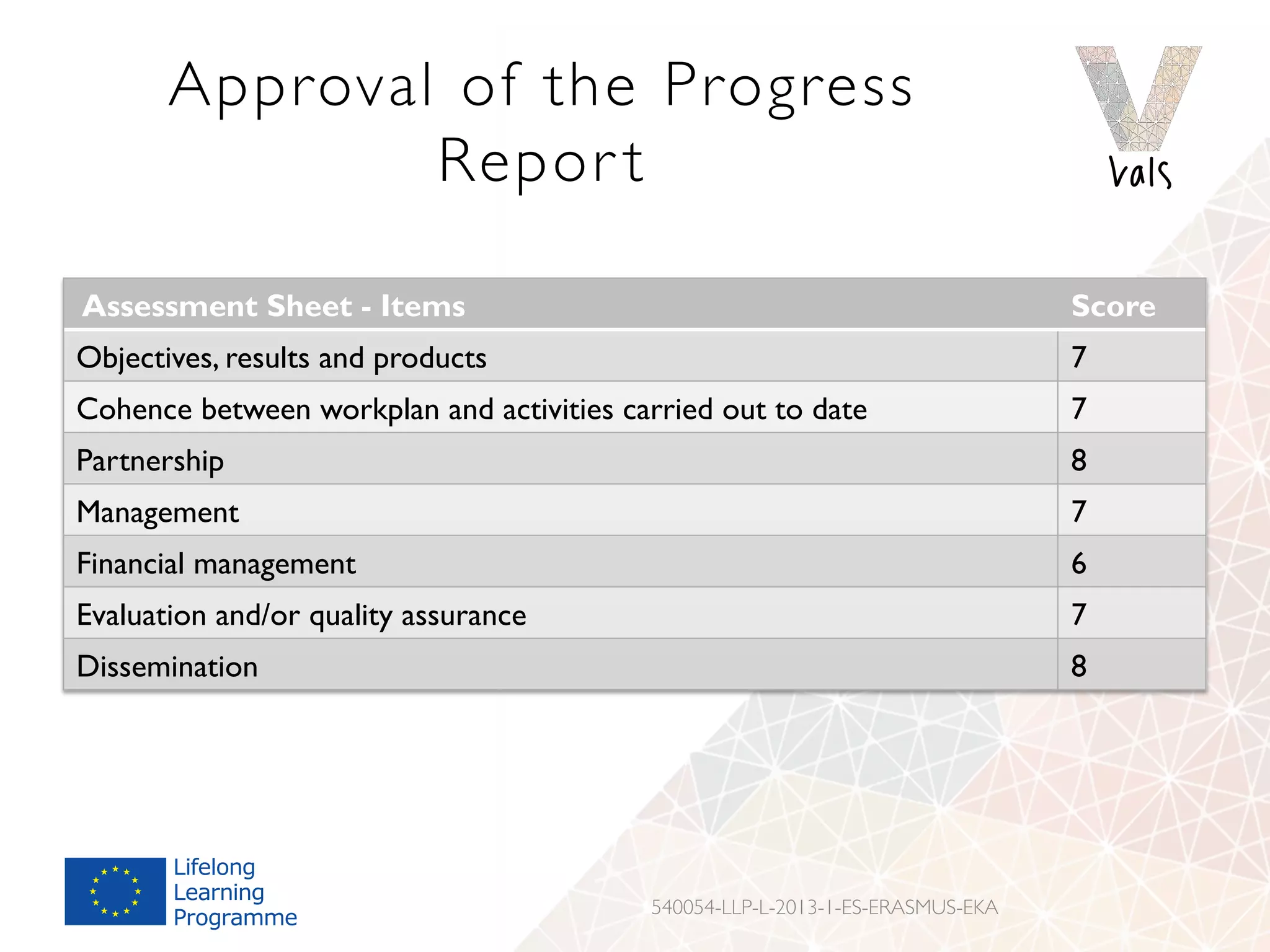
Assessment Sheet - Items Score
Objectives, results and products 7
Cohence between workplan and activities carried out to date 7
Partnership 8
Management 7
Financial management 6
Evaluation and/or quality assurance 7
Dissemination 8
Progress Repor t 
Objectives, results and products
Strong points
•  The activities initially planned have been carried out in
line with what stated in the initial application
•  Key supporting materials confirmed above
•  The assessment is considered satisfactory
Weak points
•  Need of more details in the reports and documents
Progress Repor t
Cohence between workplan and
activities carried out to date
Strong points
•  The activities are coherent with the initial plan
•  Vast majority of 1st year activities have been
completed
•  Delays in WP5 are considered fair
Weak points
•  More details regarding upcoming work
Progress Repor t 
Par tneship
Strong points
•  The partnership is considered to be working
satisfactorily
Weak points
•  Lack of participation of all the partners in the meetings
Progress Repor t 
Management
Strong points
•  The project has been properly managed to date
•  Communication and internal monitoring system are
satisfactory
Weak points
•  Need of more details in the reporting activities
Progress Repor t 
Financial management
Strong points
•  The expenditure are in line with the workplan and
activities
•  The project leader has distributed funds received to
the partners
Weak points
•  Need of clarify the purpose of the travels
•  Respect of subsistence ceilings and days for travel
Progress Repor t 
Evaluation and/or quality
assurance
Strong points
•  Evaluation plan quite well structured.
•  Evaluation report includes recommendations
Weak points
•  It is recommended to make explicit in the final report
the consortium addressed the recommendations
Progress Repor t 
Dissemination
Strong points
•  The activities started on time and complied with what
had been foreseen in the initial application
Recommendation
•  To intensify the activities in the second year
Knowledge retrieved after the
first year
•  University managers likeVALS proposal
•  Companies rely onVALS ideas (62 at least)
•  Students think thatVALS is an amazing opportunity
540054-LLP-L-2013-1-ES-ERASMUS-EKA
BUT
•  University is slow in reaction
•  Companies want having results immediately
•  Students need to internalizeVALS new opportunities
Issues and challenges
•  Administrative processes in the universities are very
strict, especially regarding schedules, and are not shared
by all the universities all over Europe
•  Schedules and workload in companies are not always
compatible with universities ones and students’
planning
–  Ad hoc adapting and making more flexible the administrative
processes in the universities (it depends on each university
and the people involved in)
–  Defining a two-round piloting procedure (inside theVALS
scope)
540054-LLP-L-2013-1-ES-ERASMUS-EKA
Issues and challenges
•  University tutors engagement
–  Personal relationships
–  Altruistic behaviours
540054-LLP-L-2013-1-ES-ERASMUS-EKA
Issues and challenges
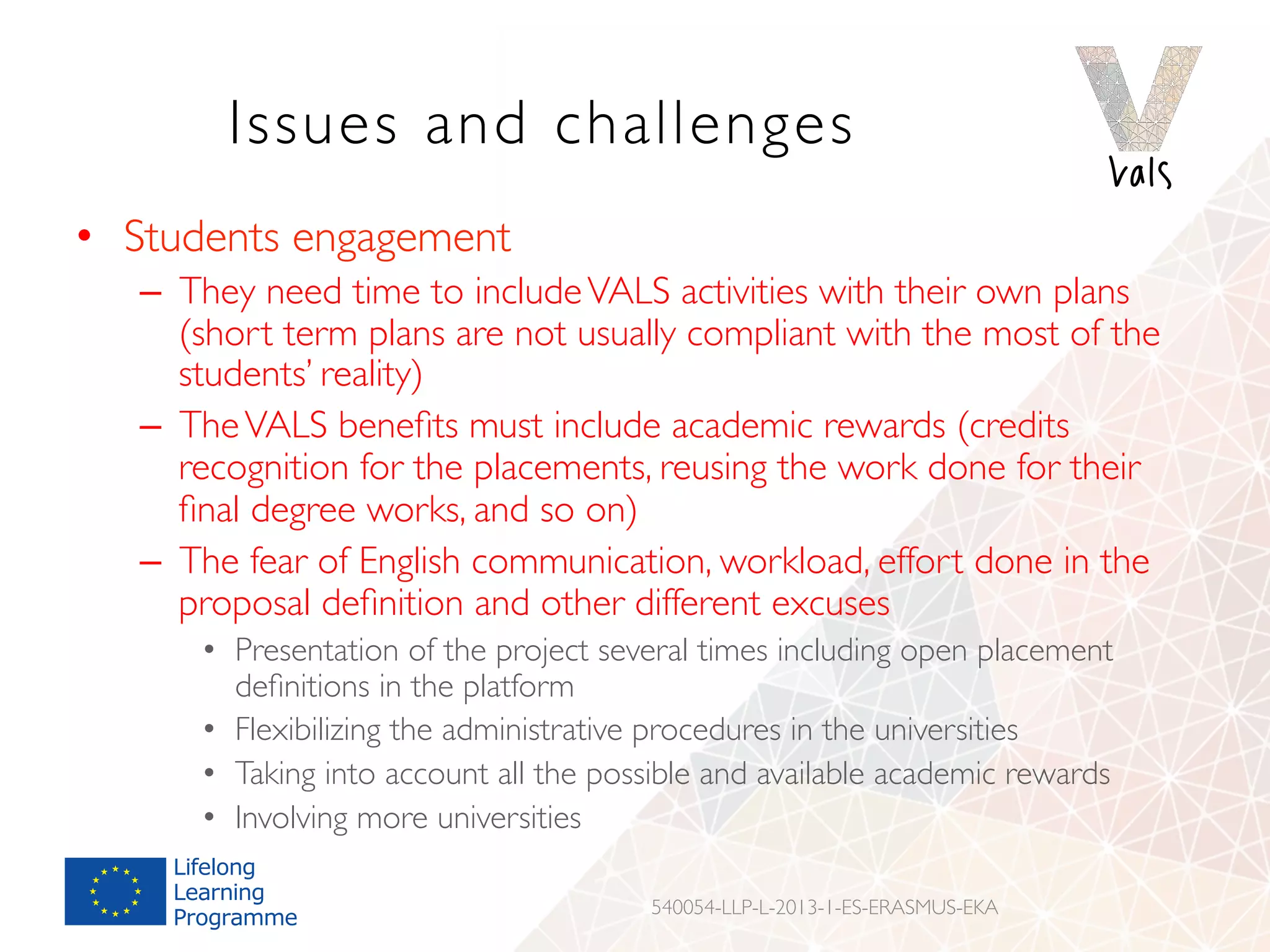
•  Students engagement
–  They need time to includeVALS activities with their own plans
(short term plans are not usually compliant with the most of the
students’ reality)
–  TheVALS benefits must include academic rewards (credits
recognition for the placements, reusing the work done for their
final degree works, and so on)
–  The fear of English communication, workload, effort done in the
proposal definition and other different excuses
•  Presentation of the project several times including open placement
definitions in the platform
•  Flexibilizing the administrative procedures in the universities
•  Taking into account all the possible and available academic rewards
•  Involving more universities
540054-LLP-L-2013-1-ES-ERASMUS-EKA
Effective results of the first
round
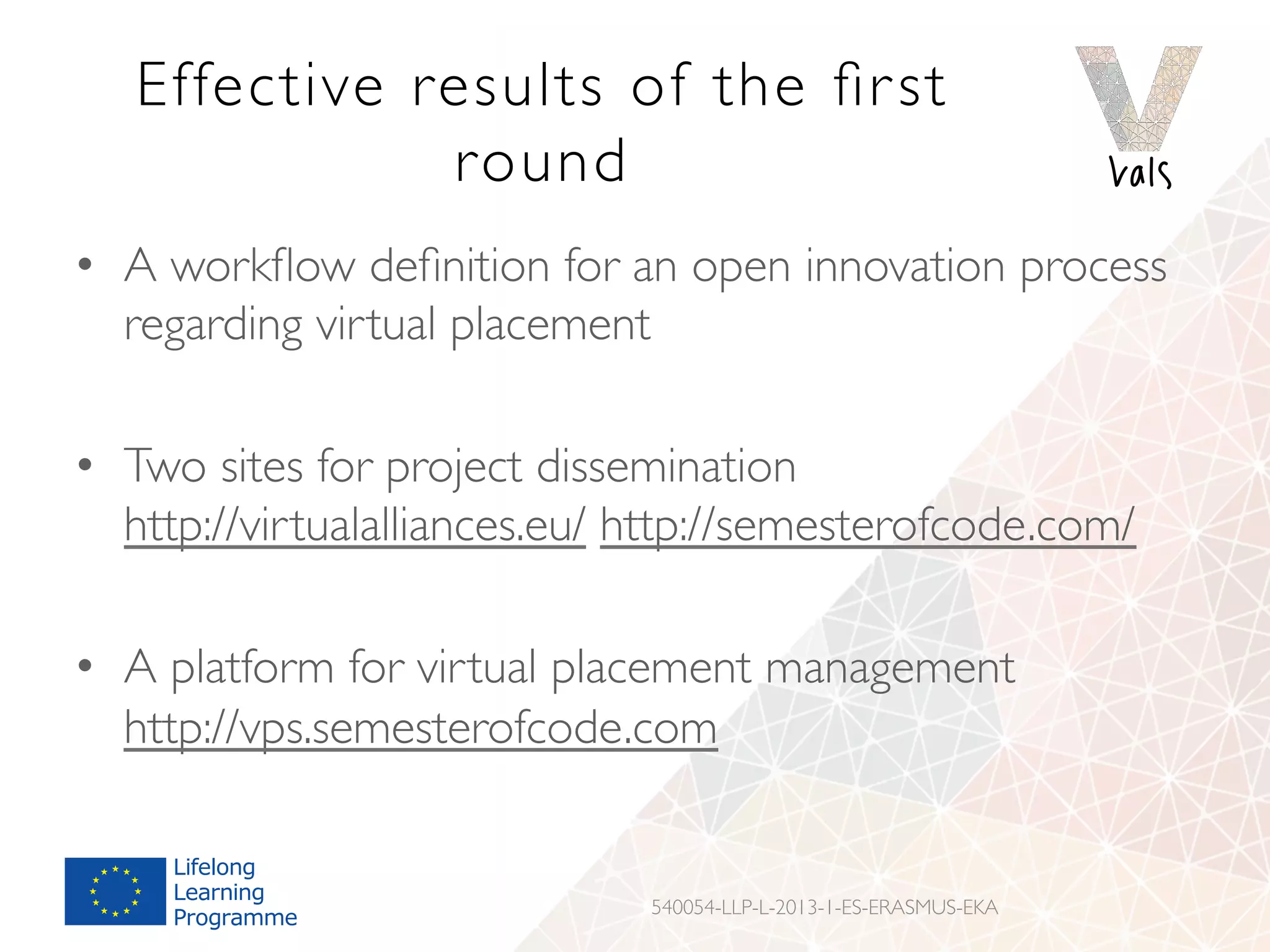
•  A workflow definition for an open innovation process
regarding virtual placement
•  Two sites for project dissemination
http://virtualalliances.eu/ http://semesterofcode.com/
•  A platform for virtual placement management
http://vps.semesterofcode.com
540054-LLP-L-2013-1-ES-ERASMUS-EKA
The numbers behind the first
round of SoC
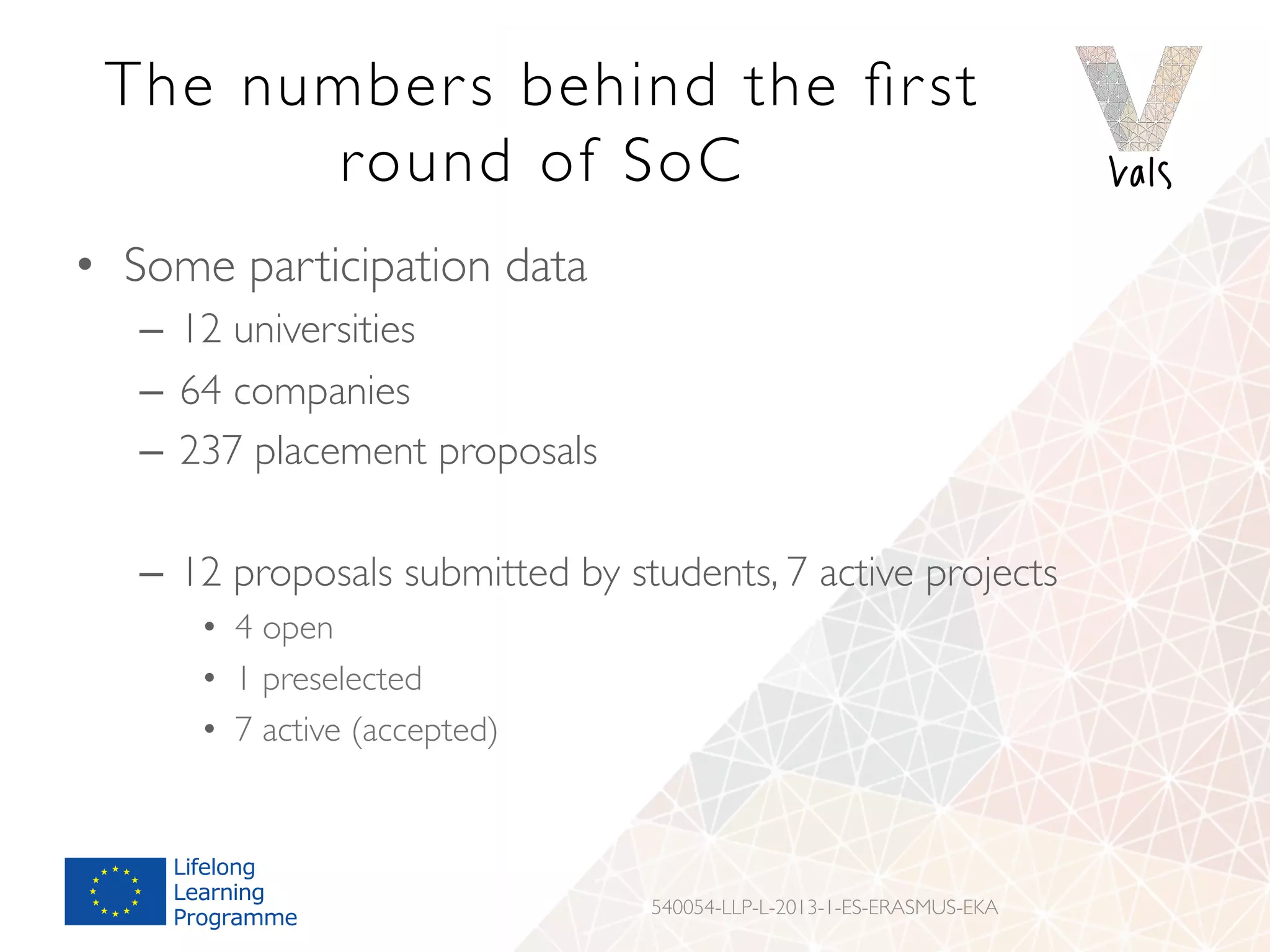
•  Some participation data
–  12 universities
–  64 companies
–  237 placement proposals
–  12 proposals submitted by students, 7 active projects
•  4 open
•  1 preselected
•  7 active (accepted)
540054-LLP-L-2013-1-ES-ERASMUS-EKA
Current state of the second
round
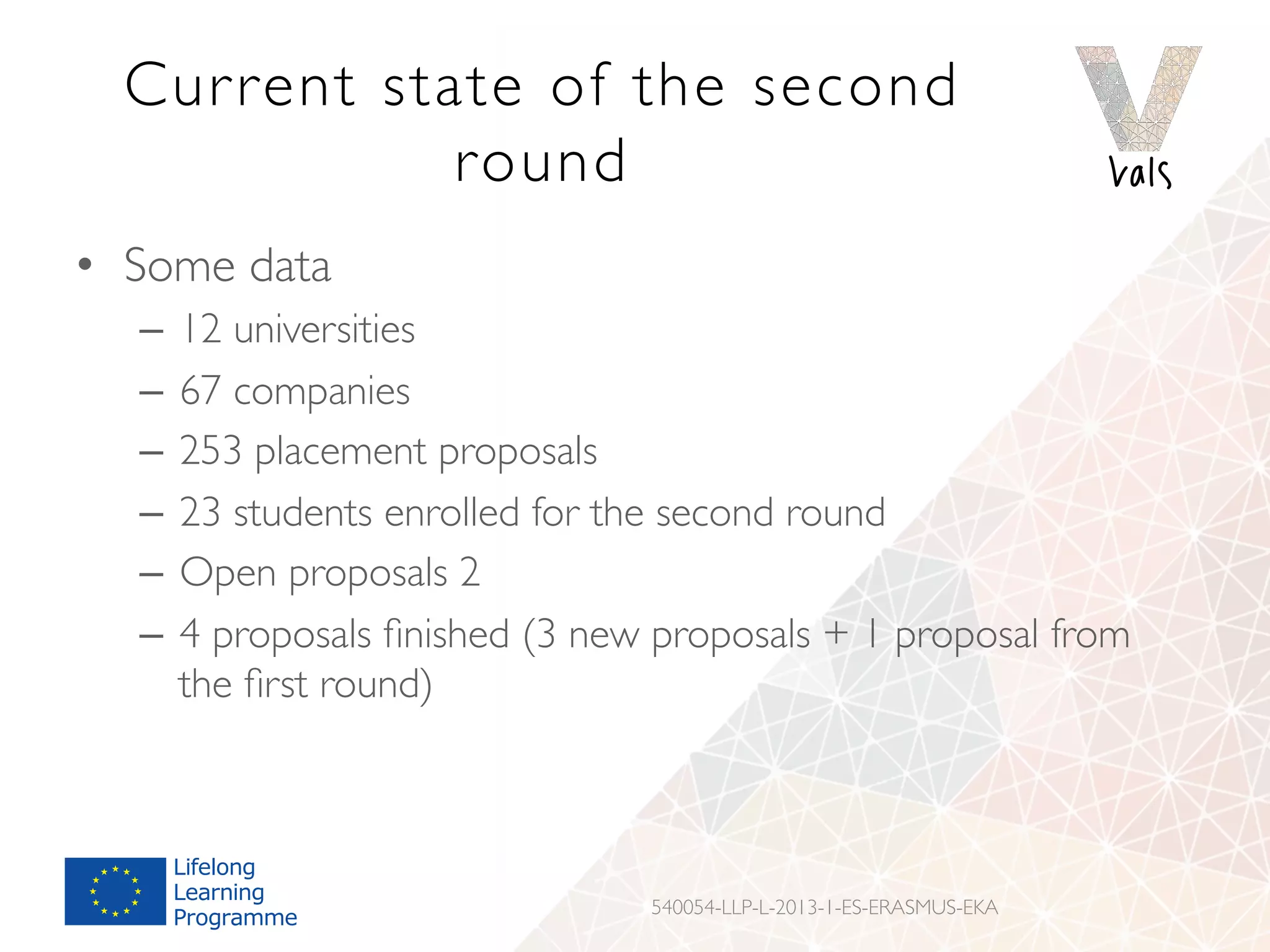
•  Some data
–  12 universities
–  67 companies
–  253 placement proposals
–  23 students enrolled for the second round
–  Open proposals 2
–  4 proposals finished (3 new proposals + 1 proposal from
the first round)
540054-LLP-L-2013-1-ES-ERASMUS-EKA
Meeting Objetives
540054-LLP-L-2013-1-ES-ERASMUS-EKA
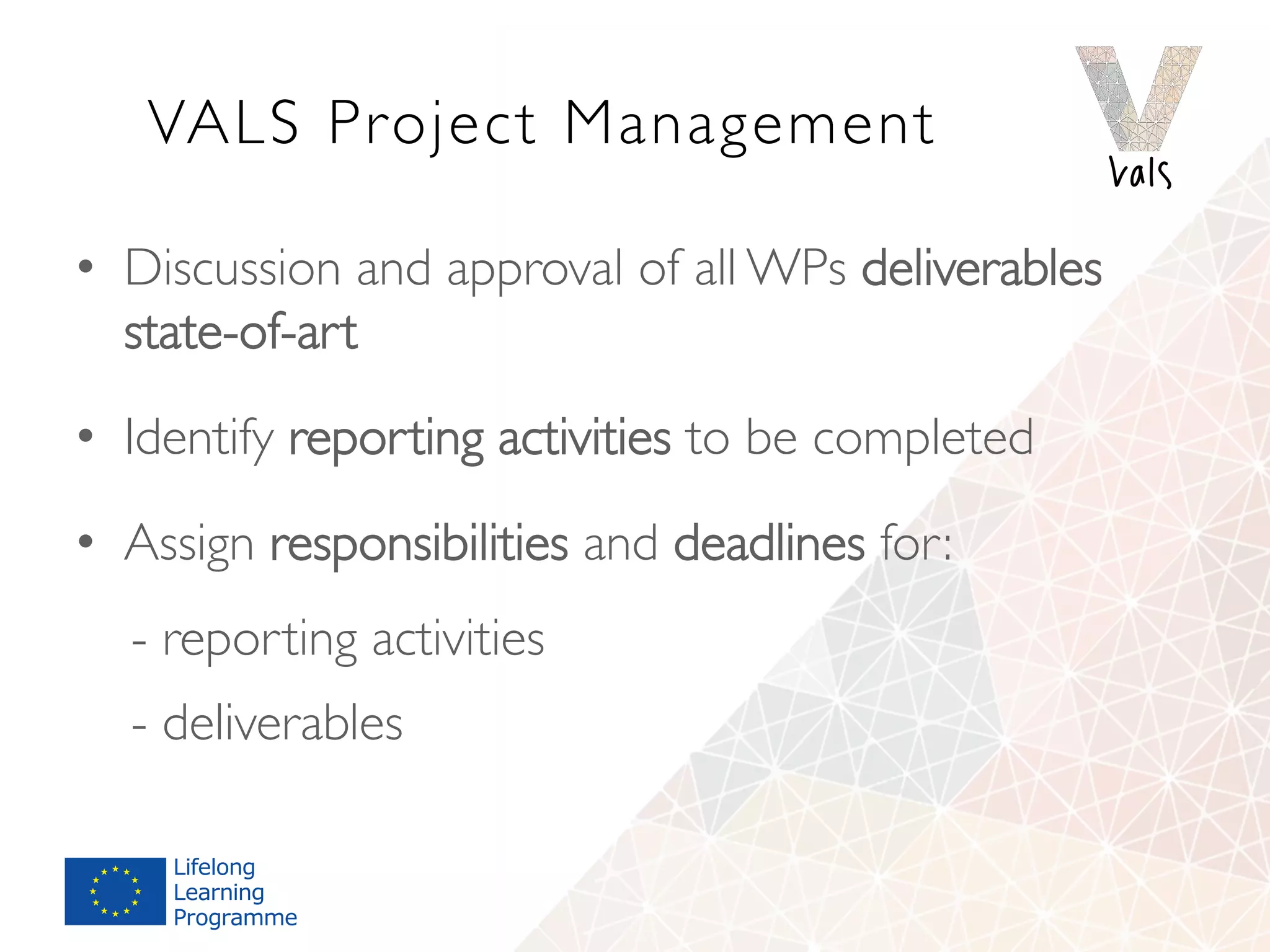
VALS Project Management
•  Discussion and approval of all WPs deliverables
state-of-art
•  Identify reporting activities to be completed
•  Assign responsibilities and deadlines for:
- reporting activities
- deliverables
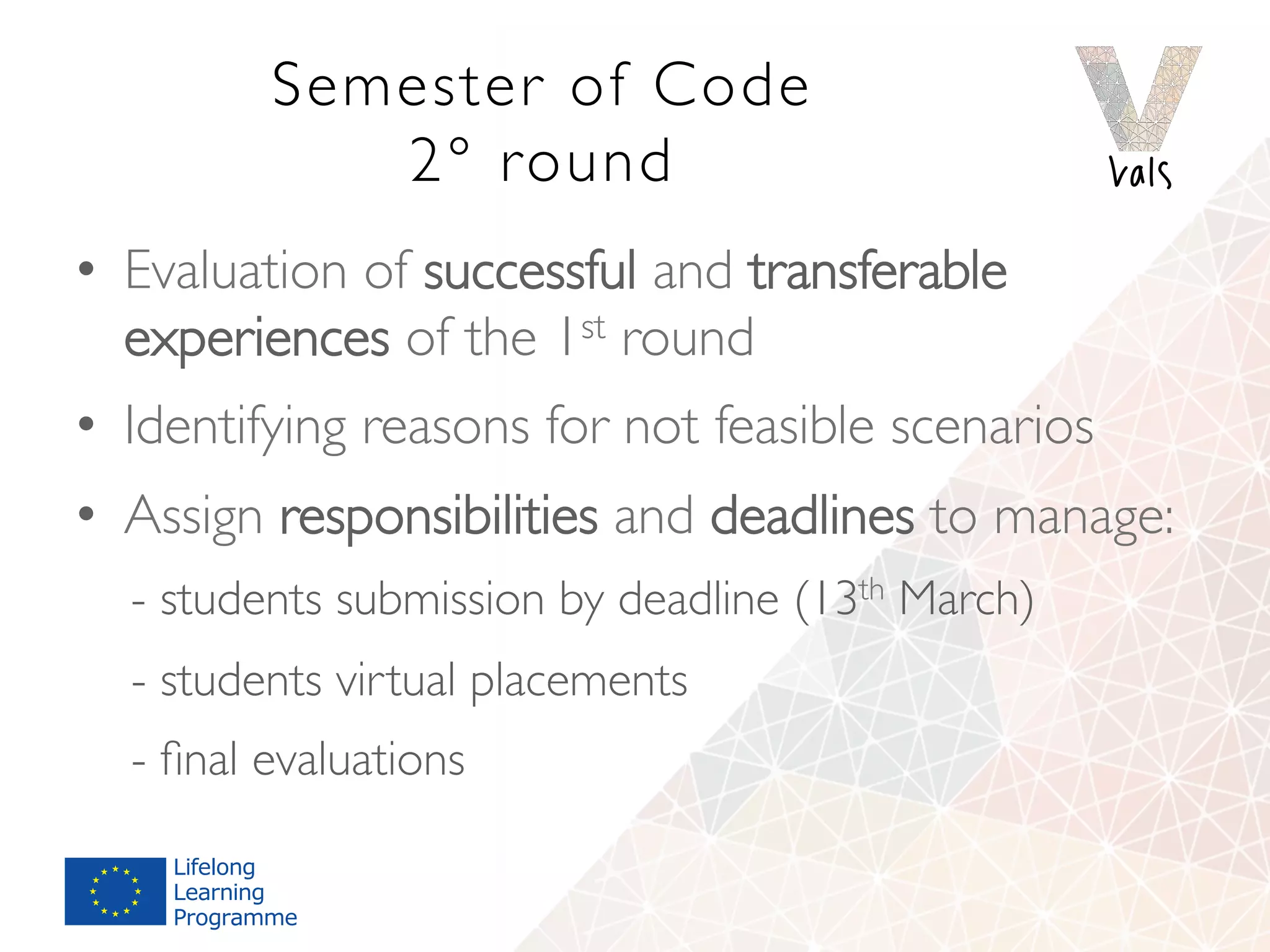
Semester of Code
2° round
•  Evaluation of successful and transferable
experiences of the 1st round
•  Identifying reasons for not feasible scenarios
•  Assign responsibilities and deadlines to manage:
- students submission by deadline (13th March)
- students virtual placements
- final evaluations
Meeting Agenda
540054-LLP-L-2013-1-ES-ERASMUS-EKA
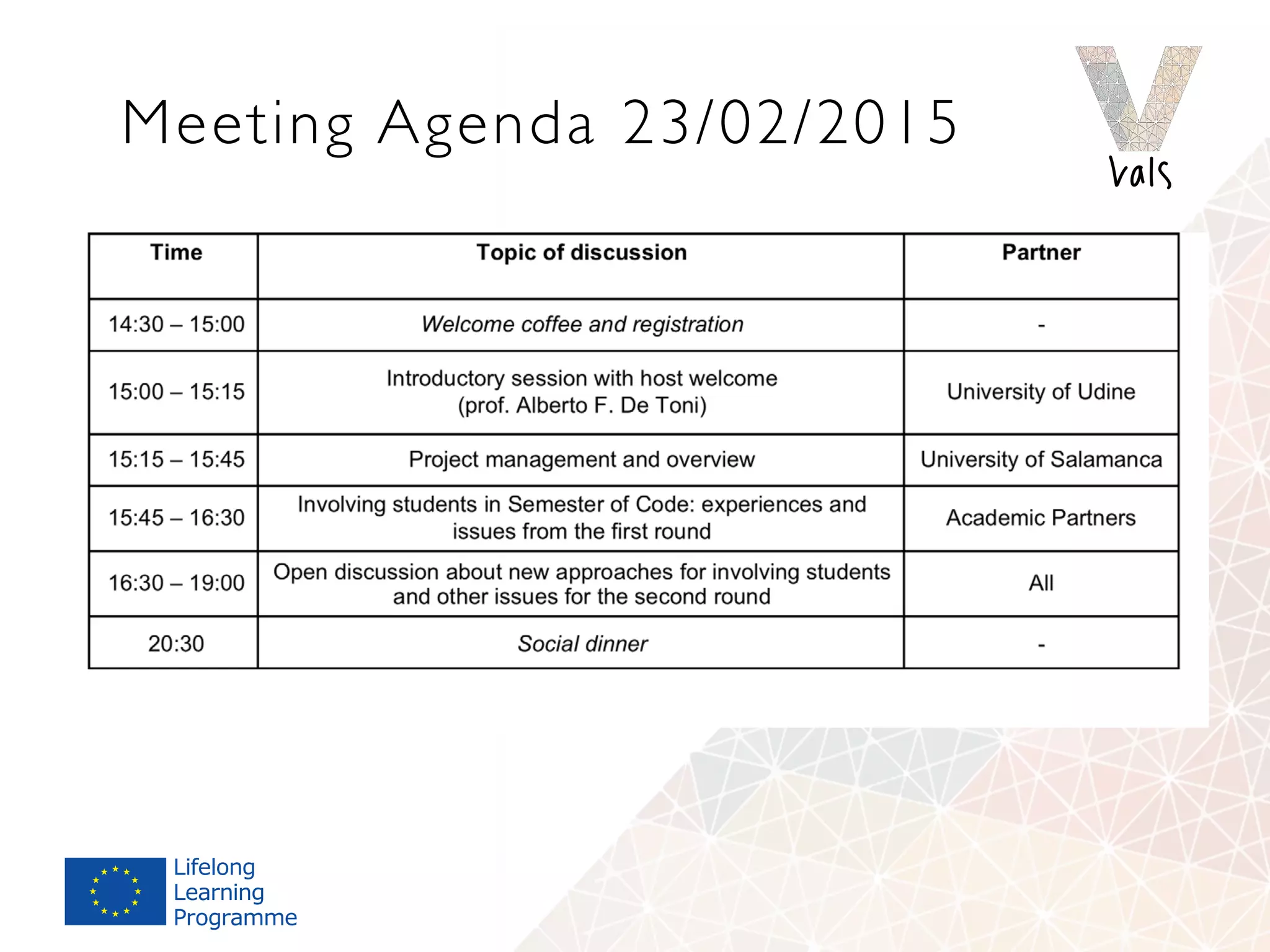
Meeting Agenda 23/02/2015
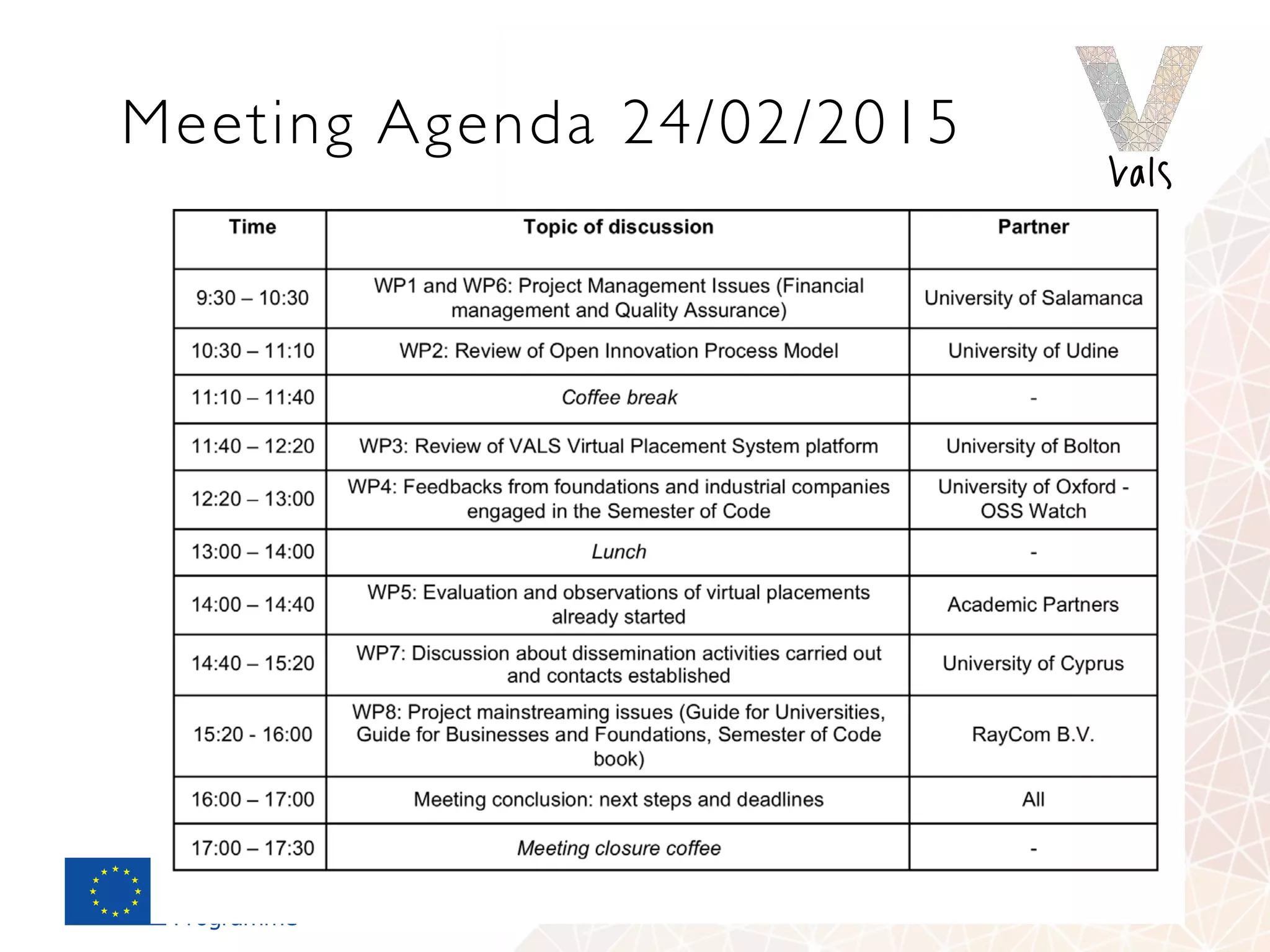
Meeting Agenda 24/02/2015
Conclusions of the meeting and
next steps
540054-LLP-L-2013-1-ES-ERASMUS-EKA
Conclusions
•  Looking for more students’ engagement toVALS
–  MoreVALS presentations
–  Shift the second round deadline to the end of March
–  Try to use the summer also as time to perform the placements
–  Contact with OSS representative academics to disseminateVALS
–  Invite more universities to be involved inVALS
–  Contact with potential supervisors
–  Contact with failed previous students’ proposals
•  Looking for having more insight of theVALS procedure
–  Make an internal report with the full experience of the first piloting round
–  Make a survey to the students that assist to nextVALS presentations
–  Keep statistics from theVPS
–  Make systematic interviews with students and lectures mainly to understand
barriers and opportunities regardingVALS
540054-LLP-L-2013-1-ES-ERASMUS-EKA
Conclusions
•  Regarding the management
–  Request information to the project officer about some
financial issues in order to proceed in the final report
–  Send the originals or signed copies to the coordinator for
the audit process
•  Regarding theVPS
–  Good work done
–  Some improvements have been presented
•  Make visible supervisors’ selection to the students
540054-LLP-L-2013-1-ES-ERASMUS-EKA
Conclusions
•  Regarding the mainstreaming
–  Make the process more flexible in order to
•  Allow universities establishing their own schedules or open
innovation workflow implementation
•  Allow foundations and companies make project proposals including
the timing restrictions associated to every individual proposal instead
of all the procedure
–  In order to support that, theVPS should
•  Be always open for receiving new project proposals from the
foundations and companies and applications from the students
•  Notify to the foundations and companies that a deadline is
approaching and they may decide if extending the deadline or
dropping out the proposal
540054-LLP-L-2013-1-ES-ERASMUS-EKA
Conclusions
•  We need to guarantee three pillars to sustain theVALS
future
–  Commitment of the universities
–  Commitment of the foundations and companies
–  Commitment of theVPS providers
540054-LLP-L-2013-1-ES-ERASMUS-EKA
The other presentations of the
meeting
•  Achilleos,A. P. (2015). Involving students in Semester of Code: Experiences and issues from the first round.
http://repositorio.grial.eu/handle/grial/368
•  Achilleos,A. P. (2015).VALS Dissemination. http://repositorio.grial.eu/handle/grial/369
•  Commisso,A. (2015). Current status of the open innovation process model.
http://repositorio.grial.eu/handle/grial/367
•  Cruz Benito, J. (2015).Virtual placements evaluation. http://repositorio.grial.eu/handle/grial/366
•  Veenendaal, E. (2015). Review ofVALSVirtual Platform. http://repositorio.grial.eu/handle/grial/371
•  Veenendaal, E. (2015).VALS Project Mainstreaming Issues. http://repositorio.grial.eu/handle/grial/372
540054-LLP-L-2013-1-ES-ERASMUS-EKA
Some references
•  García-Peñalvo, F.J., Álvarez Navia, I., García Bermejo, J.R., Conde González, M.Á., García-Holgado,A.,
Zangrando,V., Seoane Pardo,A.M., Cruz-Benito, J., Lee, S., Elferink, R.,Veenendaal, E., Zondergeld, S.,
Griffiths, D., Sharples, P., Sherlock, D., DeToni,A., Battistella, C.,Tonizza, G., De Zan, G., Papadopoulos, G.,
Kapitsaki, G.,Achilleos,A., Mettouris, C., Cheung, S., Guerrero, Z., He, E.,Alier Forment, M., Mayol, E.,
Casany, M.J.,Wilson, S., Wilson, R., and Johnson, M., (2013). VALS: Virtual Alliances for Learning Society.
In Proceedings of the TEEM Conference 2013.Technological Ecosystems for Enhancing
Multiculturality (Salamanca, Spain, 14-16 November 2013), GRIAL Research Group. First International
Conference onTechnological Ecosystems for Enhancing Multiculturality (TEEM'13), 19-26.
•  García-Peñalvo, F. J., Cruz-Benito, J., Griffiths, D., Sharples, P.,Wilson, S., Johnson, M., ...  Lee, S. (2014).
Developing win-win solutions for virtual placements in informatics: theVALS case. In Proceedings of the
Second International Conference on Technological Ecosystems for Enhancing Multiculturality (pp. 733-738).
ACM.
•  García-Peñalvo, F. J., Cruz-Benito, J., Conde, M. Á., Griffiths, D. (2014)Virtual placements for informatics
students in open source business across Europe. In 2014 IEEE Frontiers in Education Conference
Proceedings (October 22-25, 2014 Madrid, Spain). (pp. 2551-2555) IEEE. ISBN: 978-1-4799-3921-3. IEEE
Catalog Number: CFP14FIE-ART. USB version, IEEE Catalog Number: CFP14FIE-USB. 2014
•  García-Peñalvo, F. J., Cruz-Benito, J., Conde, M. Á.,  Griffiths, D. (2015). Semester of Code: Piloting
Virtual Placements for Informatics across Europe Proceedings of Global Enginnering Education
Conference, EDUCON 2015.Tallinn, Estonia, 18-20 Mach 2015. USA: IEEE
540054-LLP-L-2013-1-ES-ERASMUS-EKA
Some references
•  García-Peñalvo, F.J. (2014).VALS Project – One year after. Presented in the Thematic Cluster Meeting “Knowledge
Alliances” in Brussels at November 7th, 2014. http://hdl.handle.net/10366/125221
•  García-Peñalvo, F.J. (2015). Introducing VALS project and Semester of Code (English version).
http://hdl.handle.net/10366/125227
•  García-Peñalvo, F.J. (2015). Presentación del proyecto Virtual Alliances for Learning Society (Spanish version).
http://hdl.handle.net/10366/125220
540054-LLP-L-2013-1-ES-ERASMUS-EKA
More info
•  http://virtualalliances.eu/
•  http://semesterofcode.com/
•  http://vps.semesterofcode.com
•  http://vps2.semesterofcode.com
•  http://grial.usal.es
Contact
Dr. Francisco José García Peñalvo
GRIAL Research Group, Faculty of
Sciences, Department of Computers
and Automatics
Plaza de los Caídos, S/N
37008 Salamanca (España)
(+34) 923294500 (ext. 1302)
fgarcia@usal.es
This presentation reflects only the author‘s view and that the Agency and the
Commission are not responsible for any use that may be made of the
information it contains
540054-LLP-L-2013-1-ES-ERASMUS-EKA
VALS Project Over view
at the Third Meeting Time
VALS Meeting, Udine, Italy
February 23th and 24th, 2015
540054-LLP-L-2013-1-ES-ERASMUS-EKA
Dr. Francisco José García Peñalvo
fgarcia@usal.es / @frangp
GRIAL Research Group
University of Salamanca

VALS Project Overview  at the Third Meeting Time

  • 1.
    VALS Project Overview at the Third Meeting Time VALS Meeting, Udine, Italy February 23th and 24th, 2015 540054-LLP-L-2013-1-ES-ERASMUS-EKA Dr. Francisco José García Peñalvo fgarcia@usal.es / @frangp GRIAL Research Group University of Salamanca
  • 2.
    Outline •  Main administrativeissues •  Issues and challenges after the first year •  The numbers behind the first round of the Semester of Code •  Initial numbers of the second round of the Semester of Code •  Meeting objectives •  Meeting Agenda •  Conclusions 540054-LLP-L-2013-1-ES-ERASMUS-EKA
  • 3.
    Approval of theProgress Repor t 540054-LLP-L-2013-1-ES-ERASMUS-EKA Assessment Sheet - Items Score Objectives, results and products 7 Cohence between workplan and activities carried out to date 7 Partnership 8 Management 7 Financial management 6 Evaluation and/or quality assurance 7 Dissemination 8
  • 4.
    Progress Repor t Objectives, results and products Strong points •  The activities initially planned have been carried out in line with what stated in the initial application •  Key supporting materials confirmed above •  The assessment is considered satisfactory Weak points •  Need of more details in the reports and documents
  • 5.
    Progress Repor t Cohencebetween workplan and activities carried out to date Strong points •  The activities are coherent with the initial plan •  Vast majority of 1st year activities have been completed •  Delays in WP5 are considered fair Weak points •  More details regarding upcoming work
  • 6.
    Progress Repor t Par tneship Strong points •  The partnership is considered to be working satisfactorily Weak points •  Lack of participation of all the partners in the meetings
  • 7.
    Progress Repor t Management Strong points •  The project has been properly managed to date •  Communication and internal monitoring system are satisfactory Weak points •  Need of more details in the reporting activities
  • 8.
    Progress Repor t Financial management Strong points •  The expenditure are in line with the workplan and activities •  The project leader has distributed funds received to the partners Weak points •  Need of clarify the purpose of the travels •  Respect of subsistence ceilings and days for travel
  • 9.
    Progress Repor t Evaluation and/or quality assurance Strong points •  Evaluation plan quite well structured. •  Evaluation report includes recommendations Weak points •  It is recommended to make explicit in the final report the consortium addressed the recommendations
  • 10.
    Progress Repor t Dissemination Strong points •  The activities started on time and complied with what had been foreseen in the initial application Recommendation •  To intensify the activities in the second year
  • 11.
    Knowledge retrieved afterthe first year •  University managers likeVALS proposal •  Companies rely onVALS ideas (62 at least) •  Students think thatVALS is an amazing opportunity 540054-LLP-L-2013-1-ES-ERASMUS-EKA BUT •  University is slow in reaction •  Companies want having results immediately •  Students need to internalizeVALS new opportunities
  • 12.
    Issues and challenges • Administrative processes in the universities are very strict, especially regarding schedules, and are not shared by all the universities all over Europe •  Schedules and workload in companies are not always compatible with universities ones and students’ planning –  Ad hoc adapting and making more flexible the administrative processes in the universities (it depends on each university and the people involved in) –  Defining a two-round piloting procedure (inside theVALS scope) 540054-LLP-L-2013-1-ES-ERASMUS-EKA
  • 13.
    Issues and challenges • University tutors engagement –  Personal relationships –  Altruistic behaviours 540054-LLP-L-2013-1-ES-ERASMUS-EKA
  • 14.
    Issues and challenges • Students engagement –  They need time to includeVALS activities with their own plans (short term plans are not usually compliant with the most of the students’ reality) –  TheVALS benefits must include academic rewards (credits recognition for the placements, reusing the work done for their final degree works, and so on) –  The fear of English communication, workload, effort done in the proposal definition and other different excuses •  Presentation of the project several times including open placement definitions in the platform •  Flexibilizing the administrative procedures in the universities •  Taking into account all the possible and available academic rewards •  Involving more universities 540054-LLP-L-2013-1-ES-ERASMUS-EKA
  • 15.
    Effective results ofthe first round •  A workflow definition for an open innovation process regarding virtual placement •  Two sites for project dissemination http://virtualalliances.eu/ http://semesterofcode.com/ •  A platform for virtual placement management http://vps.semesterofcode.com 540054-LLP-L-2013-1-ES-ERASMUS-EKA
  • 16.
    The numbers behindthe first round of SoC •  Some participation data –  12 universities –  64 companies –  237 placement proposals –  12 proposals submitted by students, 7 active projects •  4 open •  1 preselected •  7 active (accepted) 540054-LLP-L-2013-1-ES-ERASMUS-EKA
  • 17.
    Current state ofthe second round •  Some data –  12 universities –  67 companies –  253 placement proposals –  23 students enrolled for the second round –  Open proposals 2 –  4 proposals finished (3 new proposals + 1 proposal from the first round) 540054-LLP-L-2013-1-ES-ERASMUS-EKA
  • 18.
  • 19.
    VALS Project Management • Discussion and approval of all WPs deliverables state-of-art •  Identify reporting activities to be completed •  Assign responsibilities and deadlines for: - reporting activities - deliverables
  • 20.
    Semester of Code 2°round •  Evaluation of successful and transferable experiences of the 1st round •  Identifying reasons for not feasible scenarios •  Assign responsibilities and deadlines to manage: - students submission by deadline (13th March) - students virtual placements - final evaluations
  • 21.
  • 22.
  • 23.
  • 24.
    Conclusions of themeeting and next steps 540054-LLP-L-2013-1-ES-ERASMUS-EKA
  • 25.
    Conclusions •  Looking formore students’ engagement toVALS –  MoreVALS presentations –  Shift the second round deadline to the end of March –  Try to use the summer also as time to perform the placements –  Contact with OSS representative academics to disseminateVALS –  Invite more universities to be involved inVALS –  Contact with potential supervisors –  Contact with failed previous students’ proposals •  Looking for having more insight of theVALS procedure –  Make an internal report with the full experience of the first piloting round –  Make a survey to the students that assist to nextVALS presentations –  Keep statistics from theVPS –  Make systematic interviews with students and lectures mainly to understand barriers and opportunities regardingVALS 540054-LLP-L-2013-1-ES-ERASMUS-EKA
  • 26.
    Conclusions •  Regarding themanagement –  Request information to the project officer about some financial issues in order to proceed in the final report –  Send the originals or signed copies to the coordinator for the audit process •  Regarding theVPS –  Good work done –  Some improvements have been presented •  Make visible supervisors’ selection to the students 540054-LLP-L-2013-1-ES-ERASMUS-EKA
  • 27.
    Conclusions •  Regarding themainstreaming –  Make the process more flexible in order to •  Allow universities establishing their own schedules or open innovation workflow implementation •  Allow foundations and companies make project proposals including the timing restrictions associated to every individual proposal instead of all the procedure –  In order to support that, theVPS should •  Be always open for receiving new project proposals from the foundations and companies and applications from the students •  Notify to the foundations and companies that a deadline is approaching and they may decide if extending the deadline or dropping out the proposal 540054-LLP-L-2013-1-ES-ERASMUS-EKA
  • 28.
    Conclusions •  We needto guarantee three pillars to sustain theVALS future –  Commitment of the universities –  Commitment of the foundations and companies –  Commitment of theVPS providers 540054-LLP-L-2013-1-ES-ERASMUS-EKA
  • 29.
    The other presentationsof the meeting •  Achilleos,A. P. (2015). Involving students in Semester of Code: Experiences and issues from the first round. http://repositorio.grial.eu/handle/grial/368 •  Achilleos,A. P. (2015).VALS Dissemination. http://repositorio.grial.eu/handle/grial/369 •  Commisso,A. (2015). Current status of the open innovation process model. http://repositorio.grial.eu/handle/grial/367 •  Cruz Benito, J. (2015).Virtual placements evaluation. http://repositorio.grial.eu/handle/grial/366 •  Veenendaal, E. (2015). Review ofVALSVirtual Platform. http://repositorio.grial.eu/handle/grial/371 •  Veenendaal, E. (2015).VALS Project Mainstreaming Issues. http://repositorio.grial.eu/handle/grial/372 540054-LLP-L-2013-1-ES-ERASMUS-EKA
  • 30.
    Some references •  García-Peñalvo,F.J., Álvarez Navia, I., García Bermejo, J.R., Conde González, M.Á., García-Holgado,A., Zangrando,V., Seoane Pardo,A.M., Cruz-Benito, J., Lee, S., Elferink, R.,Veenendaal, E., Zondergeld, S., Griffiths, D., Sharples, P., Sherlock, D., DeToni,A., Battistella, C.,Tonizza, G., De Zan, G., Papadopoulos, G., Kapitsaki, G.,Achilleos,A., Mettouris, C., Cheung, S., Guerrero, Z., He, E.,Alier Forment, M., Mayol, E., Casany, M.J.,Wilson, S., Wilson, R., and Johnson, M., (2013). VALS: Virtual Alliances for Learning Society. In Proceedings of the TEEM Conference 2013.Technological Ecosystems for Enhancing Multiculturality (Salamanca, Spain, 14-16 November 2013), GRIAL Research Group. First International Conference onTechnological Ecosystems for Enhancing Multiculturality (TEEM'13), 19-26. •  García-Peñalvo, F. J., Cruz-Benito, J., Griffiths, D., Sharples, P.,Wilson, S., Johnson, M., ... Lee, S. (2014). Developing win-win solutions for virtual placements in informatics: theVALS case. In Proceedings of the Second International Conference on Technological Ecosystems for Enhancing Multiculturality (pp. 733-738). ACM. •  García-Peñalvo, F. J., Cruz-Benito, J., Conde, M. Á., Griffiths, D. (2014)Virtual placements for informatics students in open source business across Europe. In 2014 IEEE Frontiers in Education Conference Proceedings (October 22-25, 2014 Madrid, Spain). (pp. 2551-2555) IEEE. ISBN: 978-1-4799-3921-3. IEEE Catalog Number: CFP14FIE-ART. USB version, IEEE Catalog Number: CFP14FIE-USB. 2014 •  García-Peñalvo, F. J., Cruz-Benito, J., Conde, M. Á., Griffiths, D. (2015). Semester of Code: Piloting Virtual Placements for Informatics across Europe Proceedings of Global Enginnering Education Conference, EDUCON 2015.Tallinn, Estonia, 18-20 Mach 2015. USA: IEEE 540054-LLP-L-2013-1-ES-ERASMUS-EKA
  • 31.
    Some references •  García-Peñalvo,F.J. (2014).VALS Project – One year after. Presented in the Thematic Cluster Meeting “Knowledge Alliances” in Brussels at November 7th, 2014. http://hdl.handle.net/10366/125221 •  García-Peñalvo, F.J. (2015). Introducing VALS project and Semester of Code (English version). http://hdl.handle.net/10366/125227 •  García-Peñalvo, F.J. (2015). Presentación del proyecto Virtual Alliances for Learning Society (Spanish version). http://hdl.handle.net/10366/125220 540054-LLP-L-2013-1-ES-ERASMUS-EKA
  • 32.
    More info •  http://virtualalliances.eu/ • http://semesterofcode.com/ •  http://vps.semesterofcode.com •  http://vps2.semesterofcode.com •  http://grial.usal.es Contact Dr. Francisco José García Peñalvo GRIAL Research Group, Faculty of Sciences, Department of Computers and Automatics Plaza de los Caídos, S/N 37008 Salamanca (España) (+34) 923294500 (ext. 1302) fgarcia@usal.es This presentation reflects only the author‘s view and that the Agency and the Commission are not responsible for any use that may be made of the information it contains 540054-LLP-L-2013-1-ES-ERASMUS-EKA
  • 33.
    VALS Project Overview at the Third Meeting Time VALS Meeting, Udine, Italy February 23th and 24th, 2015 540054-LLP-L-2013-1-ES-ERASMUS-EKA Dr. Francisco José García Peñalvo fgarcia@usal.es / @frangp GRIAL Research Group University of Salamanca