


Where in the world is e-learning?1
A project update and outreach from Re.ViCaBy Paul BacsichMatic Media Ltd2
Paul BacsichWorked at UK Open University for 24 yearsBrought modern computer conferencing to UKOU in 1992Helped set up Knowledge Media Institute in 1995Joined Sheffield Hallam University – Professor of TelematicsSet up Virtual Campus 1996-99Joined UK e-University 2003 - Director of Special Projectscompetitor analyst then archivist/historianConsultant in e-learning 2004 onwardsBenchmarking e-learning 2005-nowRe.ViCa consortium on virtual campuses 2007-nowICT in Schools then Virtual Schools 2008-now3
Competitor analysis - an abiding interest3-week study tour of US virtual campuses 1995Competitor analysis of rivals to UKOU 1996Competitor analyses of rivals to UKeU 2000-04Updated these analyses during 2004-10Re.ViCa project phase 2007-09Comparative benchmarking of e-learning in universities in UK, Sweden and Canada 2005-now – and links to work in New Zealand4
Competitor analysis - but why?My real interest is in operational e-learning systems, sustainable long-term and at scaleLike at UKOU and other large universitiesI am a manager (but it’s a secret!)Much of the research literature is about experiments and pilots, often with small populations and often optional or not for credit (I sit on many review and conference panels)THUS NOT VERY HELPFUL to my needs Hence I must find out good practice in other ways:These often have to draw on business methodologies (not only IT) – BPR, ABC, MIT90s, BS, KPIs, Change Management  (step-change, etc)Including those adapted for universities – e.g. NCAT, CNL, BenchmarkingMost educational researchers are not comfortable with these...5
Project DescriptionRe.ViCa = Reviewing (Traces of) European Virtual CampusesProject supported by the European Union: Lifelong Learning Programme - Erasmus/Virtual Campus 1 October 2007–30 September 2009But long gestation phaseFrom 1 October 2009 is in maintenance phase6
Consortium PartnershipEuroPACE ivzw (BE) - supported byKatholieke Universiteit Leuven – AVNet (BE) – established 1425ATiT (BE)FernUniversität in Hagen (DE)Helsinki University of Technology - TKK Dipoli (FI) – now part of Aalto UUniversité Louis Pasteur (FR)University of West Hungary - College of Geoinformatics (HU)International Telematic University UNINETTUNO (IT)Matic Media Ltd (UK) 7
A bit of a problem… What is a Virtual Campus Nowadays?8
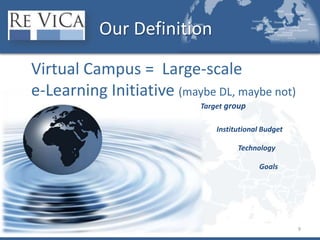
TargetgroupInstitutional BudgetTechnologyGoalsOur DefinitionVirtual Campus =  Large-scale e-Learning Initiative (maybe DL, maybe not)9
MainOutputsWiki – the heart of the project – including 29 refereed country reports (and 219 others)9 in-depth case-studiesInventory of interesting programmes (500+)TaxonomyResourcesThree key meetings with International Advisory Committee (including an OECD delegate)Virtual Campus Manual with guidelines, best practice, recommendations – and Critical Success Factors10
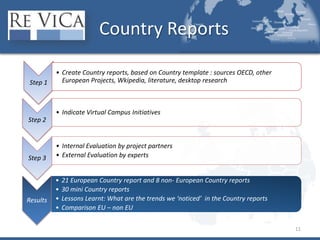
Country Reports11
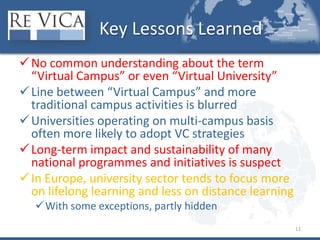
Key Lessons LearnedNo common understanding about the term “Virtual Campus” or even “Virtual University”
Line between “Virtual Campus” and more traditional campus activities is blurred
Universities operating on multi‐campus basis often more likely to adopt VC strategies
Long‐term impact and sustainability of many national programmes and initiatives is suspect
In Europe, university sector tends to focus more on lifelong learning and less on distance learning
With some exceptions, partly hidden12
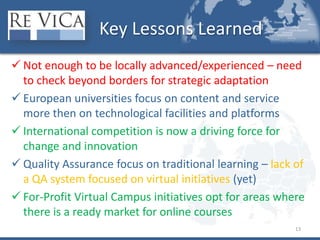
Key Lessons LearnedNot enough to be locally advanced/experienced – need to check beyond borders for strategic adaptation
European universities focus on content and service more then on technological facilities and platforms
International competition is now a driving force for change and innovation
Quality Assurance focus on traditional learning – lack of a QA system focused on virtual initiatives (yet)
For-Profit Virtual Campus initiatives opt for areas where there is a ready market for online courses13
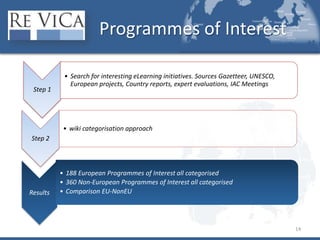
Programmes of Interest14
HandbookRe.ViCa Handbook with best practices, guidelines and recommendations

Virtual campuses - the latest overview

  • 1.
    Where in theworld is e-learning?1
  • 2.
    A project updateand outreach from Re.ViCaBy Paul BacsichMatic Media Ltd2
  • 3.
    Paul BacsichWorked atUK Open University for 24 yearsBrought modern computer conferencing to UKOU in 1992Helped set up Knowledge Media Institute in 1995Joined Sheffield Hallam University – Professor of TelematicsSet up Virtual Campus 1996-99Joined UK e-University 2003 - Director of Special Projectscompetitor analyst then archivist/historianConsultant in e-learning 2004 onwardsBenchmarking e-learning 2005-nowRe.ViCa consortium on virtual campuses 2007-nowICT in Schools then Virtual Schools 2008-now3
  • 4.
    Competitor analysis -an abiding interest3-week study tour of US virtual campuses 1995Competitor analysis of rivals to UKOU 1996Competitor analyses of rivals to UKeU 2000-04Updated these analyses during 2004-10Re.ViCa project phase 2007-09Comparative benchmarking of e-learning in universities in UK, Sweden and Canada 2005-now – and links to work in New Zealand4
  • 5.
    Competitor analysis -but why?My real interest is in operational e-learning systems, sustainable long-term and at scaleLike at UKOU and other large universitiesI am a manager (but it’s a secret!)Much of the research literature is about experiments and pilots, often with small populations and often optional or not for credit (I sit on many review and conference panels)THUS NOT VERY HELPFUL to my needs Hence I must find out good practice in other ways:These often have to draw on business methodologies (not only IT) – BPR, ABC, MIT90s, BS, KPIs, Change Management (step-change, etc)Including those adapted for universities – e.g. NCAT, CNL, BenchmarkingMost educational researchers are not comfortable with these...5
  • 6.
    Project DescriptionRe.ViCa =Reviewing (Traces of) European Virtual CampusesProject supported by the European Union: Lifelong Learning Programme - Erasmus/Virtual Campus 1 October 2007–30 September 2009But long gestation phaseFrom 1 October 2009 is in maintenance phase6
  • 7.
    Consortium PartnershipEuroPACE ivzw(BE) - supported byKatholieke Universiteit Leuven – AVNet (BE) – established 1425ATiT (BE)FernUniversität in Hagen (DE)Helsinki University of Technology - TKK Dipoli (FI) – now part of Aalto UUniversité Louis Pasteur (FR)University of West Hungary - College of Geoinformatics (HU)International Telematic University UNINETTUNO (IT)Matic Media Ltd (UK) 7
  • 8.
    A bit ofa problem… What is a Virtual Campus Nowadays?8
  • 9.
    TargetgroupInstitutional BudgetTechnologyGoalsOur DefinitionVirtualCampus = Large-scale e-Learning Initiative (maybe DL, maybe not)9
  • 10.
    MainOutputsWiki – theheart of the project – including 29 refereed country reports (and 219 others)9 in-depth case-studiesInventory of interesting programmes (500+)TaxonomyResourcesThree key meetings with International Advisory Committee (including an OECD delegate)Virtual Campus Manual with guidelines, best practice, recommendations – and Critical Success Factors10
  • 11.
  • 12.
    Key Lessons LearnedNocommon understanding about the term “Virtual Campus” or even “Virtual University”
  • 13.
    Line between “VirtualCampus” and more traditional campus activities is blurred
  • 14.
    Universities operating onmulti‐campus basis often more likely to adopt VC strategies
  • 15.
    Long‐term impact andsustainability of many national programmes and initiatives is suspect
  • 16.
    In Europe, universitysector tends to focus more on lifelong learning and less on distance learning
  • 17.
    With some exceptions,partly hidden12
  • 18.
    Key Lessons LearnedNotenough to be locally advanced/experienced – need to check beyond borders for strategic adaptation
  • 19.
    European universities focuson content and service more then on technological facilities and platforms
  • 20.
    International competition isnow a driving force for change and innovation
  • 21.
    Quality Assurance focuson traditional learning – lack of a QA system focused on virtual initiatives (yet)
  • 22.
    For-Profit Virtual Campusinitiatives opt for areas where there is a ready market for online courses13
  • 23.
  • 24.
    HandbookRe.ViCa Handbook withbest practices, guidelines and recommendations