BY:
Vinu Arpitha K.S [16DM020]
Nida Khanam[16DM027]
Chandan[16DM028]
Contents
• Introduction
• Validity
• Types of validity
• Reliability
• Methods of reliability
Introduction
• There are two basic goals in questionnaire design.
• To obtain information relevant to the purposes of the survey.
• To collect this information with maximal reliability and validity.
• How can a researcher be sure that the data gathering instrument being
used will measure what it is supposed to measure and will do this in a
consistent manner?
• This can be answered using validity and reliability.
• The process of developing and validating an instrument is in large part
focused on reducing error in the measurement process.
• Reliability estimates evaluate the stability of measures, internal consistency
of measurement instruments.
Validity
• Validity can be defined as the degree to which a test measures what it is
supposed to measure
• Extent to which an empirical measure adequately reflects the real meaning
of the concept under consideration
• Validity is done mainly to answer the following questions:
• Is the research investigation providing answers to the research questions for which it
was undertaken?
• If so, is it providing these answers using appropriate methods and procedures?
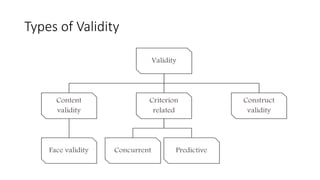
Types of Validity
Content Validity
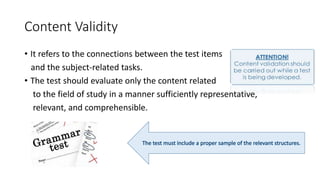
• It refers to the connections between the test items
and the subject-related tasks.
• The test should evaluate only the content related
to the field of study in a manner sufficiently representative,
relevant, and comprehensible.
Construct Validity
• It implies using the construct correctly (concepts, ideas, notions).
• Construct validity seeks agreement between a theoretical concept
and a specific measuring device or procedure.
Criterion Validity
• This approach is concerned with detecting the presence or absence of
one or more criteria considered to represent traits or constructs of
interest.
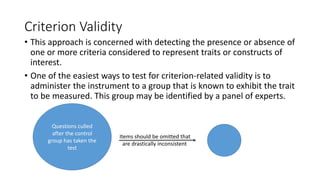
• One of the easiest ways to test for criterion-related validity is to
administer the instrument to a group that is known to exhibit the trait
to be measured. This group may be identified by a panel of experts.
Questions culled
after the control
group has taken the
test
Items should be omitted that
are drastically inconsistent
Validity and Reliability - Research Mangement

Validity and Reliability - Research Mangement

  • 1.
    BY: Vinu Arpitha K.S[16DM020] Nida Khanam[16DM027] Chandan[16DM028]
  • 2.
    Contents • Introduction • Validity •Types of validity • Reliability • Methods of reliability
  • 3.
    Introduction • There aretwo basic goals in questionnaire design. • To obtain information relevant to the purposes of the survey. • To collect this information with maximal reliability and validity. • How can a researcher be sure that the data gathering instrument being used will measure what it is supposed to measure and will do this in a consistent manner? • This can be answered using validity and reliability. • The process of developing and validating an instrument is in large part focused on reducing error in the measurement process. • Reliability estimates evaluate the stability of measures, internal consistency of measurement instruments.
  • 4.
    Validity • Validity canbe defined as the degree to which a test measures what it is supposed to measure • Extent to which an empirical measure adequately reflects the real meaning of the concept under consideration • Validity is done mainly to answer the following questions: • Is the research investigation providing answers to the research questions for which it was undertaken? • If so, is it providing these answers using appropriate methods and procedures?
  • 5.
  • 6.
    Content Validity • Itrefers to the connections between the test items and the subject-related tasks. • The test should evaluate only the content related to the field of study in a manner sufficiently representative, relevant, and comprehensible.
  • 7.
    Construct Validity • Itimplies using the construct correctly (concepts, ideas, notions). • Construct validity seeks agreement between a theoretical concept and a specific measuring device or procedure.
  • 8.
    Criterion Validity • Thisapproach is concerned with detecting the presence or absence of one or more criteria considered to represent traits or constructs of interest. • One of the easiest ways to test for criterion-related validity is to administer the instrument to a group that is known to exhibit the trait to be measured. This group may be identified by a panel of experts. Questions culled after the control group has taken the test Items should be omitted that are drastically inconsistent