Reliability and Validity:
EnsuringMeaningful
Measurement
This presentation will explore the critical concepts of reliability and
validity in research, emphasizing their significance in ensuring data
quality and meaningful interpretations.
by ansari shagufta
2.
Understanding Reliability
Consistency
Reliability refersto the consistency and repeatability of a
measurement tool or instrument. It assesses the extent to
which a measure yields similar results across repeated
applications.
Precision
A reliable measure produces consistent results, reducing
the likelihood of random errors and increasing confidence
in the findings.
3.
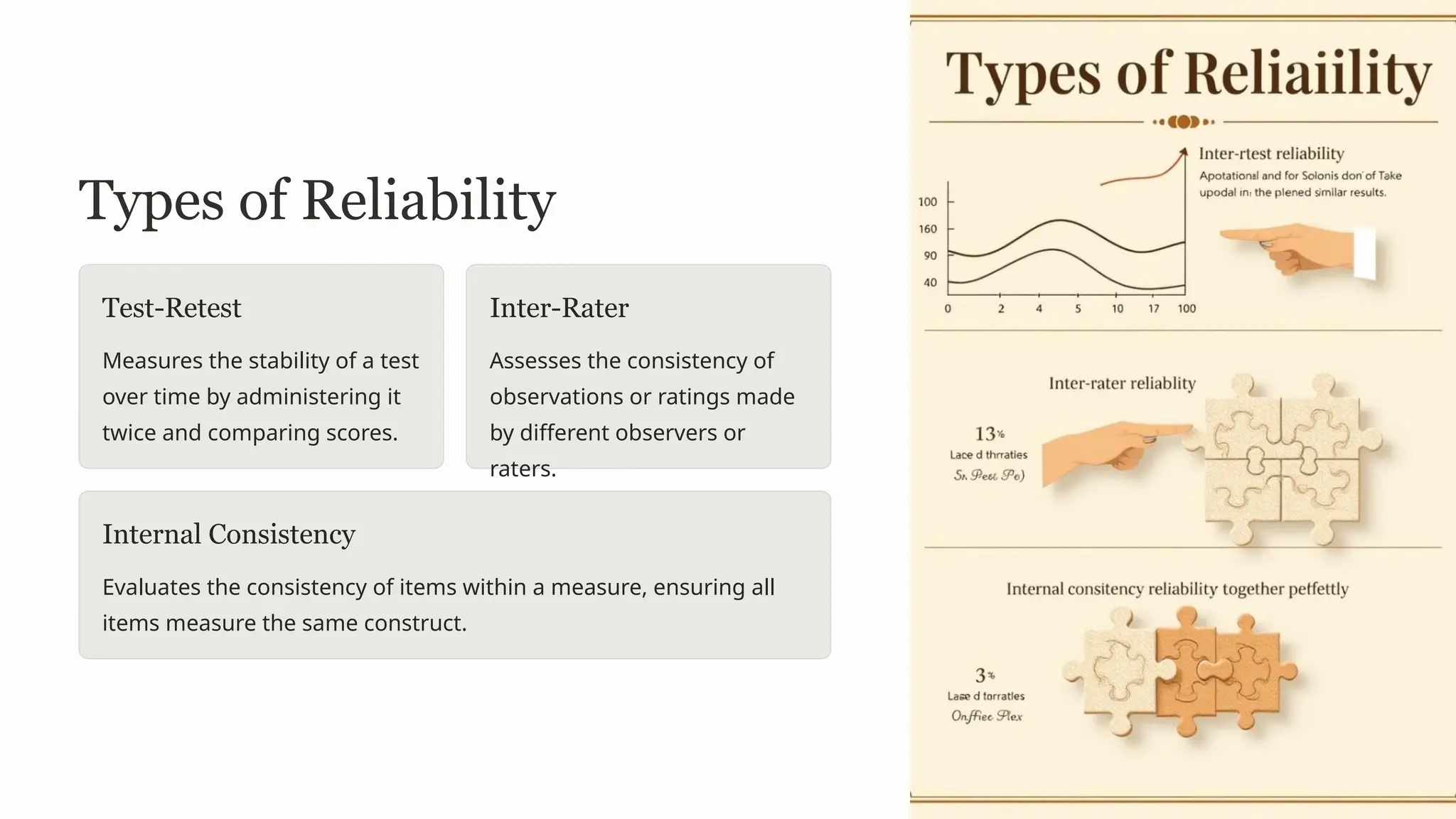
Types of Reliability
Test-Retest
Measuresthe stability of a test
over time by administering it
twice and comparing scores.
Inter-Rater
Assesses the consistency of
observations or ratings made
by different observers or
raters.
Internal Consistency
Evaluates the consistency of items within a measure, ensuring all
items measure the same construct.
4.
Factors Affecting Reliability
1Measurement Error
Random errors, like
variations in instrument
calibration, can reduce
reliability.
2 Sample Characteristics
Differences in participants,
like age or experience, may
influence scores and affect
consistency.
3 Time Interval
Longer time intervals between test administrations may lead to
changes in scores, impacting reliability.
5.
Assessing Reliability:
Reliability Coefficients
Coefficients
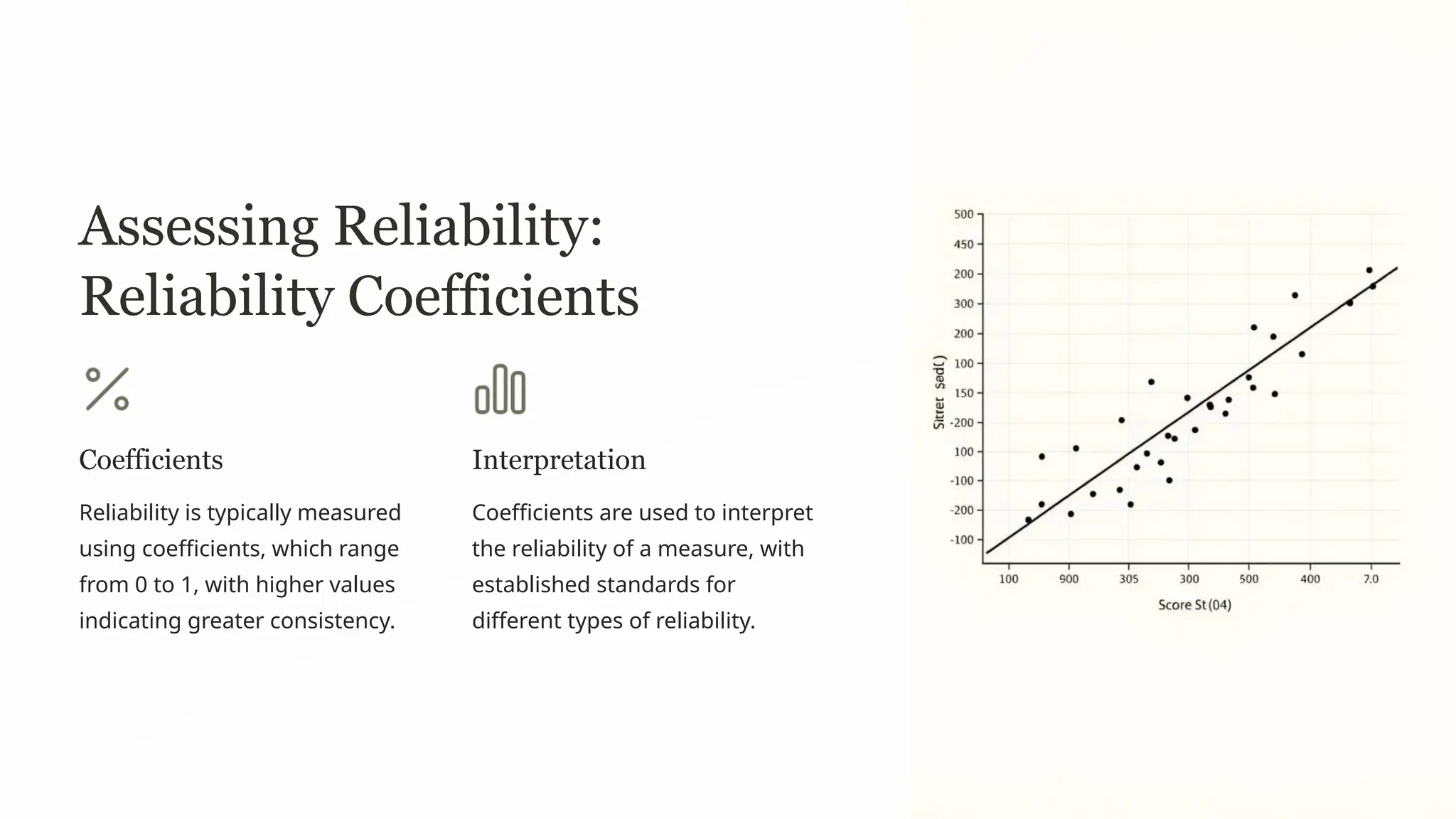
Reliabilityis typically measured
using coefficients, which range
from 0 to 1, with higher values
indicating greater consistency.
Interpretation
Coefficients are used to interpret
the reliability of a measure, with
established standards for
different types of reliability.
6.
Concept of Validity
1
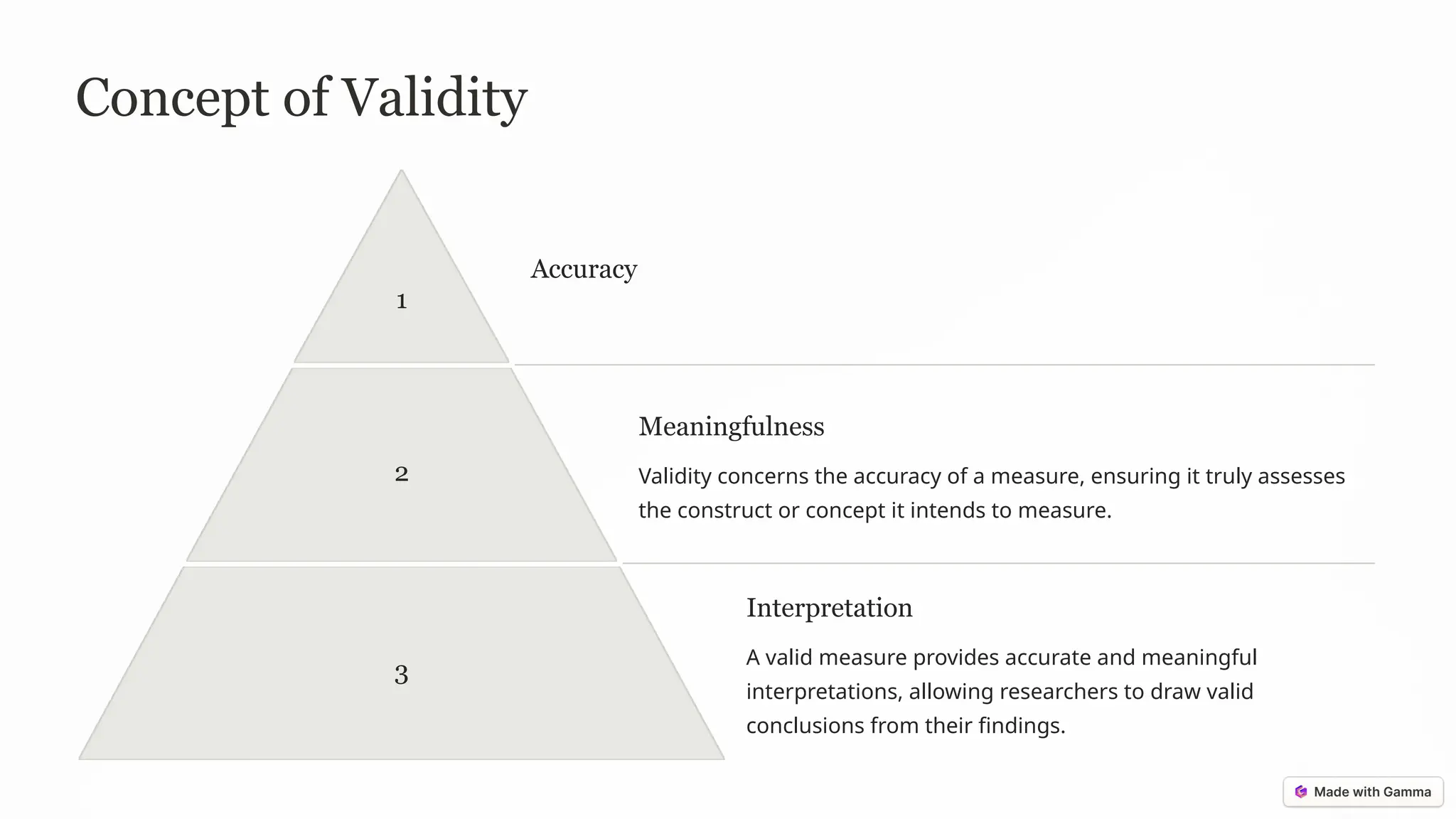
Accuracy
2
Meaningfulness
Validityconcerns the accuracy of a measure, ensuring it truly assesses
the construct or concept it intends to measure.
3
Interpretation
A valid measure provides accurate and meaningful
interpretations, allowing researchers to draw valid
conclusions from their findings.
7.
Types of Validity
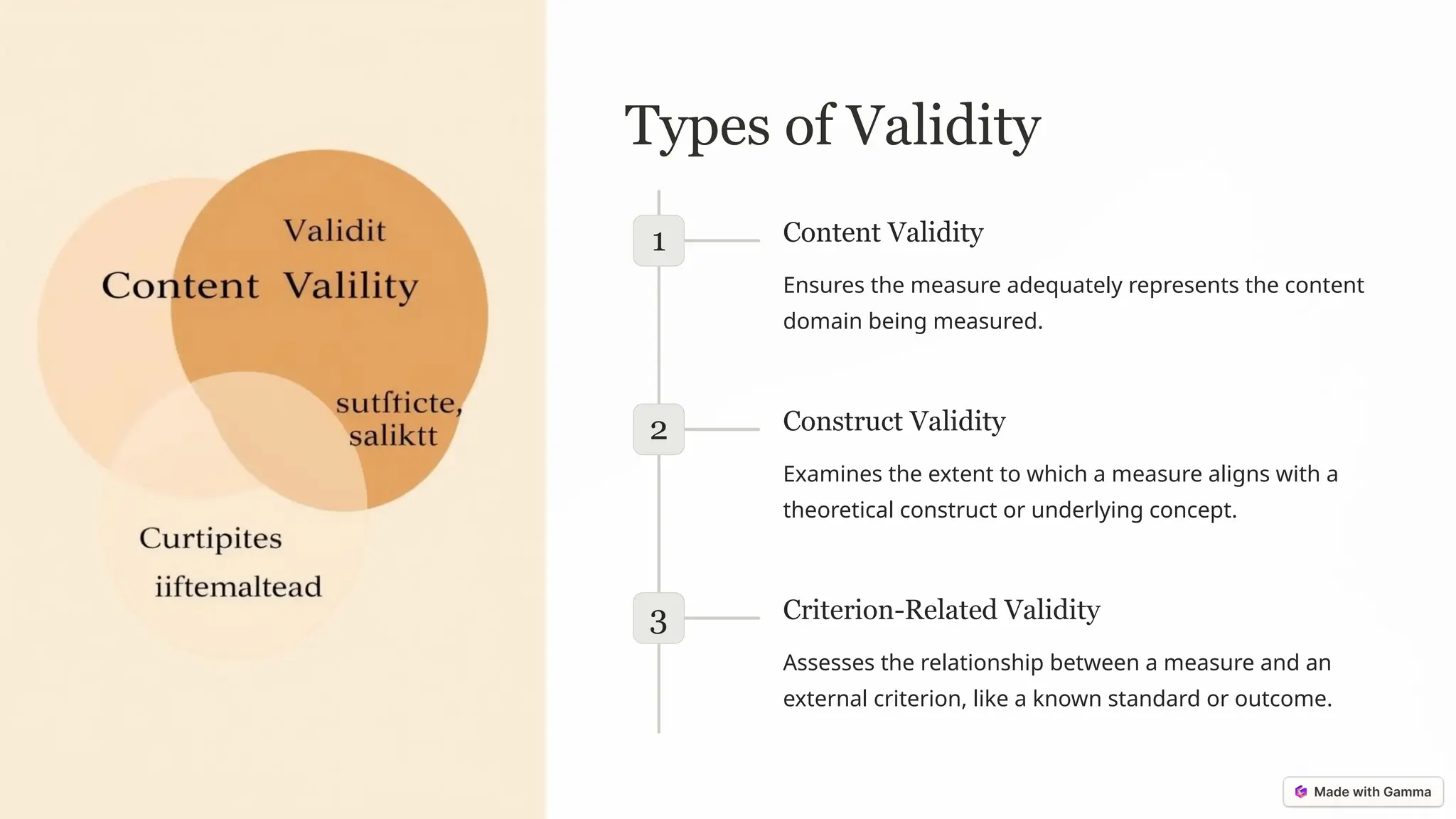
1Content Validity
Ensures the measure adequately represents the content
domain being measured.
2 Construct Validity
Examines the extent to which a measure aligns with a
theoretical construct or underlying concept.
3 Criterion-Related Validity
Assesses the relationship between a measure and an
external criterion, like a known standard or outcome.
8.
Threats to Validity
ConfoundingVariables
Extraneous factors that influence scores and affect the accuracy of the
measure.
Sampling Bias
The sample may not be representative of the population, limiting
generalizability.
Measurement Bias
Systematic errors in the measurement process, such as leading
questions or biased instructions.
History Effects
Events or changes occurring between test administrations that may
influence scores and confound the results.
9.
Establishing Validity: Methods
andConsiderations
1
Expert Reviews
Involve subject matter experts to
assess the content and relevance of
the measure.
2
Statistical Analyses
Employ statistical techniques, such as
factor analysis, to examine the
underlying structure of the measure.
3
Pilot Studies
Conduct preliminary studies to
evaluate the measure's reliability and
validity before large-scale research.
10.
Balancing Reliability andValidity for Effective
Research
Both reliability and validity are essential for conducting meaningful research. Achieving a balance between these concepts
ensures data accuracy and reliable interpretations, leading to sound research findings.