Macro economic Variable and Stock Market
By: Vinu Arpitha KS [16dm020]
Content
• Introduction
• Methodology
• Objectives
• Limitations
• Macro Economic Factors
Introduction
• Movement of stock indices is responsive to changes in macroeconomic fundamentals.
• The objective of this study is to find the relationship between macroeconomic variables
which are considered as the independent variables and stock prices in Bombay Stock
Exchange (SENSEX), India which is the dependent variable.
• The study considers annual data of several macroeconomic variables from 2011 to 2017.
The data taken into consideration was monthly. Several variables taken into
consideration are: Exports, Imports, Bullion Prices, Crude oil Prices, Foreign Exchange
Rate, Index of Industrial Production (IIP), Call Money Market Prices, Foreign Institutional
Investment, Domestic Institutional Investment, Consumer Price Index (CPI) etc. using
statistical techniques like Correlation, Multiple Regression and Error Analysis.
Methodology
Data Description
• The present study uses the time series data obtained from two main sources i.e. Bombay
Stock Exchange official website and Handbook of Statistics on Indian Economy provided
by Reserve Bank of India..
• We limit to select thirteen (14) macro-economic variables. The selection of variables for
the present study is based on the existing theoretical propositions and the empirical
evidences.
• The base period for Sensex is 1978-79 = 100, whereas, the other index series are rebased
as 2012 = 100.
• To accomplish the research objective monthly data ranging from Jan-2011 to August-
2017 are obtained. The choice of study period is based on the availability of data series.
Statistical Method for Data Analysis
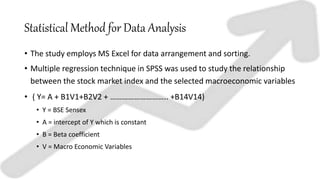
• The study employs MS Excel for data arrangement and sorting.
• Multiple regression technique in SPSS was used to study the relationship
between the stock market index and the selected macroeconomic variables
• ( Y= A + B1V1+B2V2 + ……………………….. +B14V14)
• Y = BSE Sensex
• A = intercept of Y which is constant
• B = Beta coefficient
• V = Macro Economic Variables
Objectives
•To explore the major macro-economic variables.
•To investigate the impact of macroeconomic variables on Indian stock
market performance.
•To study the direction and degree of relationship between selected
macroeconomic factors and stock returns.
•To minimize the error occurring during the study.
Limitations
• The time period of the study is limited only for 6 years data (2011-12,
2012-13, 2013-14, 2014-15, 2015-16, and 2016-17). The variables
taken into consideration are fourteen (14). Our study is limited to the
index of BSE Sensex.
Macro Economic Variables
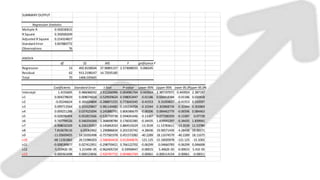
SUMMARY OUTPUT
Regression Statistics
Multiple R 0.592030615
R Square 0.350500249
Adjusted R Square 0.214314817
Standard Error 3.837883772
Observations 76
ANOVA
df SS MS F Significance F
Regression 13 492.8158504 37.90891157 2.573698555 0.006545
Residual 62 913.2198147 14.72935185
Total 75 1406.035665
Coefficients Standard Error t Stat P-value Lower 95% Upper 95% Lower 95.0%
Upper 95.0%
Intercept 1.4155605 0.486068242 2.912266996 0.004981764 0.443924 2.387197071 0.443924 2.387197
v1 0.004278659 0.008074014 0.529929624 0.598053447 -0.01186 0.020418384 -0.01186 0.020418
v2 -0.05246624 0.181624804 -0.288871555 0.773643345 -0.41553 0.31059657 -0.41553 0.310597
v3 0.099713564 0.101629847 0.981144482 0.330334704 -0.10344 0.302868734 -0.10344 0.302869
v4 0.009251288 0.037625094 0.245880791 0.806586679 -0.06596 0.084462779 -0.06596 0.084463
v5 -0.028296454 0.052815566 -0.535759738 0.594041446 -0.13387 0.077280359 -0.13387 0.07728
v6 0.747794526 0.546354344 1.368698784 0.176032385 -0.34435 1.839941297 -0.34435 1.839941
v7 -0.908032329 6.226135957 -0.145842033 0.884519229 -13.3539 11.53783611 -13.3539 11.53784
v8 7.810678116 6.05062962 1.290886834 0.201535742 -4.28436 19.90571439 -4.28436 19.90571
v9 -11.05609455 14.59392498 -0.757581978 0.451571082 -40.2289 18.11674579 -40.2289 18.11675
v10 -68.11261862 26.51984203 -2.568364418 0.012640676 -121.125 -15.10020978 -121.125 -15.1002
v11 -0.008189877 0.027412951 -0.298759421 0.766122702 -0.06299 0.04660783 -0.06299 0.046608
v12 -5.01942E-05 5.21549E-05 -0.962405724 0.33958447 -0.00015 5.4062E-05 -0.00015 5.41E-05
v13 -0.000361698 0.000123836 -2.920787732 0.004863769 -0.00061 -0.000114154 -0.00061 -0.00011
• Index of Industrial Production (IIP) (V4)
• Crude oil Prices ( V5)
• Lending Rates (V6)
• Consumer Price Index (CPI) (V1)
• Foreign Exchange Rate (V10)
• Call Money Market (V9)
• Currency circulation(V14)
• Foreign Exchange Reserves (V11)
• Foreign Institutional Investment (FII) (V12)
• Domestic Institutional Investment(DII) (V13)
• Gold Prices (V2)
• Silver Prices (V3)
• Exports (V7)
• Imports(V8)
Conclusion
• Domestic Institutional Investment(DII) (V13), Foreign Exchange Rate (V10),
Foreign Exchange Reserves (V11). These are the factor which are most
significantly effecting the stock prices.
• Even emotions and market leaders effects the stock market. i.e according to the
semi strong form of EMH : Any release of public information effects the stock
prices.
• There also exists internal Information also affect the Stock Prices hence we
cannot make a right forecast of the price moments
Thank you !!

Macro economic factors

  • 1.
    Macro economic Variableand Stock Market By: Vinu Arpitha KS [16dm020]
  • 2.
    Content • Introduction • Methodology •Objectives • Limitations • Macro Economic Factors
  • 3.
    Introduction • Movement ofstock indices is responsive to changes in macroeconomic fundamentals. • The objective of this study is to find the relationship between macroeconomic variables which are considered as the independent variables and stock prices in Bombay Stock Exchange (SENSEX), India which is the dependent variable. • The study considers annual data of several macroeconomic variables from 2011 to 2017. The data taken into consideration was monthly. Several variables taken into consideration are: Exports, Imports, Bullion Prices, Crude oil Prices, Foreign Exchange Rate, Index of Industrial Production (IIP), Call Money Market Prices, Foreign Institutional Investment, Domestic Institutional Investment, Consumer Price Index (CPI) etc. using statistical techniques like Correlation, Multiple Regression and Error Analysis.
  • 4.
    Methodology Data Description • Thepresent study uses the time series data obtained from two main sources i.e. Bombay Stock Exchange official website and Handbook of Statistics on Indian Economy provided by Reserve Bank of India.. • We limit to select thirteen (14) macro-economic variables. The selection of variables for the present study is based on the existing theoretical propositions and the empirical evidences. • The base period for Sensex is 1978-79 = 100, whereas, the other index series are rebased as 2012 = 100. • To accomplish the research objective monthly data ranging from Jan-2011 to August- 2017 are obtained. The choice of study period is based on the availability of data series.
  • 5.
    Statistical Method forData Analysis • The study employs MS Excel for data arrangement and sorting. • Multiple regression technique in SPSS was used to study the relationship between the stock market index and the selected macroeconomic variables • ( Y= A + B1V1+B2V2 + ……………………….. +B14V14) • Y = BSE Sensex • A = intercept of Y which is constant • B = Beta coefficient • V = Macro Economic Variables
  • 6.
    Objectives •To explore themajor macro-economic variables. •To investigate the impact of macroeconomic variables on Indian stock market performance. •To study the direction and degree of relationship between selected macroeconomic factors and stock returns. •To minimize the error occurring during the study.
  • 7.
    Limitations • The timeperiod of the study is limited only for 6 years data (2011-12, 2012-13, 2013-14, 2014-15, 2015-16, and 2016-17). The variables taken into consideration are fourteen (14). Our study is limited to the index of BSE Sensex.
  • 8.
  • 9.
    SUMMARY OUTPUT Regression Statistics MultipleR 0.592030615 R Square 0.350500249 Adjusted R Square 0.214314817 Standard Error 3.837883772 Observations 76 ANOVA df SS MS F Significance F Regression 13 492.8158504 37.90891157 2.573698555 0.006545 Residual 62 913.2198147 14.72935185 Total 75 1406.035665 Coefficients Standard Error t Stat P-value Lower 95% Upper 95% Lower 95.0% Upper 95.0% Intercept 1.4155605 0.486068242 2.912266996 0.004981764 0.443924 2.387197071 0.443924 2.387197 v1 0.004278659 0.008074014 0.529929624 0.598053447 -0.01186 0.020418384 -0.01186 0.020418 v2 -0.05246624 0.181624804 -0.288871555 0.773643345 -0.41553 0.31059657 -0.41553 0.310597 v3 0.099713564 0.101629847 0.981144482 0.330334704 -0.10344 0.302868734 -0.10344 0.302869 v4 0.009251288 0.037625094 0.245880791 0.806586679 -0.06596 0.084462779 -0.06596 0.084463 v5 -0.028296454 0.052815566 -0.535759738 0.594041446 -0.13387 0.077280359 -0.13387 0.07728 v6 0.747794526 0.546354344 1.368698784 0.176032385 -0.34435 1.839941297 -0.34435 1.839941 v7 -0.908032329 6.226135957 -0.145842033 0.884519229 -13.3539 11.53783611 -13.3539 11.53784 v8 7.810678116 6.05062962 1.290886834 0.201535742 -4.28436 19.90571439 -4.28436 19.90571 v9 -11.05609455 14.59392498 -0.757581978 0.451571082 -40.2289 18.11674579 -40.2289 18.11675 v10 -68.11261862 26.51984203 -2.568364418 0.012640676 -121.125 -15.10020978 -121.125 -15.1002 v11 -0.008189877 0.027412951 -0.298759421 0.766122702 -0.06299 0.04660783 -0.06299 0.046608 v12 -5.01942E-05 5.21549E-05 -0.962405724 0.33958447 -0.00015 5.4062E-05 -0.00015 5.41E-05 v13 -0.000361698 0.000123836 -2.920787732 0.004863769 -0.00061 -0.000114154 -0.00061 -0.00011
  • 10.
    • Index ofIndustrial Production (IIP) (V4) • Crude oil Prices ( V5) • Lending Rates (V6) • Consumer Price Index (CPI) (V1) • Foreign Exchange Rate (V10) • Call Money Market (V9) • Currency circulation(V14) • Foreign Exchange Reserves (V11) • Foreign Institutional Investment (FII) (V12) • Domestic Institutional Investment(DII) (V13) • Gold Prices (V2) • Silver Prices (V3) • Exports (V7) • Imports(V8)
  • 11.
    Conclusion • Domestic InstitutionalInvestment(DII) (V13), Foreign Exchange Rate (V10), Foreign Exchange Reserves (V11). These are the factor which are most significantly effecting the stock prices. • Even emotions and market leaders effects the stock market. i.e according to the semi strong form of EMH : Any release of public information effects the stock prices. • There also exists internal Information also affect the Stock Prices hence we cannot make a right forecast of the price moments
  • 12.