VACUUM DEWATERED
FLOORING
SUBMITTED BY
RAM TOSNIWAL
UNDER THE GUIDANCE OF
Prof. SHASHANK U VANAKUDARI
A seminar on,
JAIN COLLEGE OF ENGINEERING, BELAGAVI
CONTENTS
• Introduction to VDF
• Definition, benefits & History of VDF
• Need & Overview of VDF
• Process & Equipments
• Advantages & Disadvantages of VDF
• Steps Involved in VDF & Precaution
• Applications
• New Techniques for dewatering
• Conclusion & References.
FUNCTIONAL REQUIREMENT OF
INDUSTRIAL FLOORS
• Trouble free movement of Man, Machines & Materials.
• Hygienic/anti-bacterial.
• Highly cleanable.
• Wear (abrasion) resistant.
• Chemical Resistant.
• Resistance from Impact and Static Loading.
• Ease of Maintenance.
• Anti-slip/anti-stain properties
• Flammability and Fire Safety.
• Scratch/scuff resistance
VDF : Definition
A Flooring Technique to achieve
•High Strength,
•Longer Life,
•Better Finish
•Faster Work.
•High abrasion & heavy traffic movement
VDF : Benefits
• Concrete with better workability than what is normally
possible.
• Improvement in wear resistance, compressive strength, less
shrinkage and minimum water permeability.
• Reduction of water content in the concrete by 15-25%.
• Tendency of shrinkage and subsequent cracking is greatly
reduced.
• Concrete of high initial slump can be used while pouring
HISTORY OF VDF
• It was originally invented by Tremix AB, Sweden many years ago.
• Scandinavian firms simplified the equipment enough to make it
practical for almost any builder.
• Vacuum dewatering is used widely throughout Europe today, and in
Sweden the method is used for 40 to 50 percent of all concrete floors.
• This process was introduced in India by Aquarius Technologies in
1987.
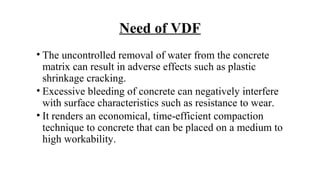
Need of VDF
• The uncontrolled removal of water from the concrete
matrix can result in adverse effects such as plastic
shrinkage cracking.
• Excessive bleeding of concrete can negatively interfere
with surface characteristics such as resistance to wear.
• It renders an economical, time-efficient compaction
technique to concrete that can be placed on a medium to
high workability.
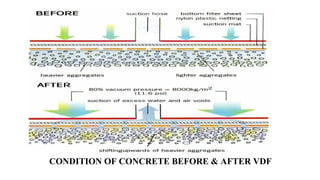
CONDITION OF CONCRETE BEFORE & AFTER VDF
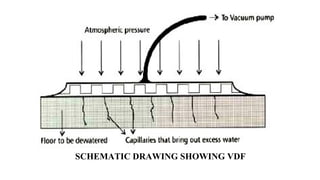
SCHEMATIC DRAWING SHOWING VDF
COMPARISION BETWEEN STRENGTH OF VDF & ORDINARY
CONCRETE
EQUIPMENTS
•Double beam screed vibrator
•Vacuum pump with Hose
•Suction mat
•Power float
•Power trowel
DOUBLE BEAM SCREED VIBRATOR
• Light weight
• Electrically driven.
• Overall length – 4200mm
• Width – 410mm
• Height – 125 mm
• Total weight – 128.5 kg
VACUUM PUMP WITH HOSE
• 7.5 H.P electric motor mounted trolley
• Capable of 35 sqm in one operation.
• Length – 2200 mm
• Width - 660mm
• Height – 880mm
• Weight – 320kg
• Pump capacity- 110 m/Hr
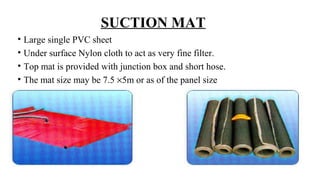
SUCTION MAT
• Large single PVC sheet
• Under surface Nylon cloth to act as very fine filter.
• Top mat is provided with junction box and short hose.
• The mat size may be 7.5 ×5m or as of the panel size
POWER FLOAT
• Surface grinding equipment
• It grinds the surface to make it wear resistance
• Remove surface modulation prior to final finishing
• Overall height – 980mm
• Floating speed – 120RPM
• Equipment weight – 140kg
POWER TROWEL
• Surface finishing equipment,
• Polishes the surface after floating operation.
• Overall height – 980 mm
• Trowelling speed – 120 RPM
• Equipment weight – 145 kg
STEPS INVOLVED IN VDF
• Prepare sound sub-base
• Form work over the base
• Concreting & Vibration
• Double beam screed vibration
• Laying of mat & vacuum suction
• Power troweling & finishing
Filling of Boulder materials in the flooring area. Compaction of the boulder materials.
Filling of Girt in the boulder material. Fixing of Thiyas
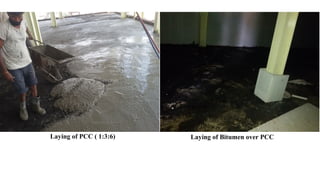
Laying of PCC ( 1:3:6) Laying of Bitumen over PCC
Laying of PVC Sheet & Thermocal
Sheets for Thermal Insulations.
Bar Bending work.
Vaccum Dewatering Proccess
Polishing the surface using power trowel
Completed Cold Storage project at KIADB of KAPPEC, Bijapur.
ADVANTAGES OF VDF
• Early setting and high strength.
• An ideal water cement ration can be achieved
• Increase in compressive strength of concrete by 40-70%.
• The surface hardness of the slab increases by 130%.
• Water absorption is reduced enormously.
• Minimum dusts.
• Level floor, high flatness accuracy.
ADVANTAGES OF VDF
• Minimized crack formation, Shrinkage reduced by 50%.
• Improved wear resistance.
• Elimination or minimization of overtime.
• High and early strength, minimize damage to newly cast
floors.
• Void-free& Denser concrete.
• Elimination of curling
• Reduced maintenance cost
• Earlier utilization of floors
DISADVANTAGE OF VDF METHOD
• High initial cost.
• Need trained labor.
• Need specific equipment.
• Need power consumption.
• The porosity of the concrete allows water, oil and grease to
seep through, consequently weakening the concrete.
DISADVANTAGE OF VDF METHOD
• Joints are a necessity for concrete floors leading to joint
breakage as well as seepage of contaminants.
• Concrete floors generate dust due to abrasive movement of
vehicles.
• Cleanability becomes a problem due to the presence of
imperfections, surface roughness and porosity.
• The best-laid floor (Tremix) can have undulations of above
5mm
APPLICATIONS
• Industrials floor sheds like cold storages, etc.
• Workshops,
• Railway goods, platforms,
• Godowns, warehouses etc.
• Canals
• Hydro power plants
• Bridges ports and Harbor
• Airports runways/ Hangers
• Cooling Towers
NEW TECHNIQUES FOR DEWATERING
• Permeable and absorbing formworks
• Perforated PVC pipes incased in cotton cloth
CONCLUSION
• 200 sqm – 250 sqm of concrete flooring can be done in 8-10 hrs.
• Good quality of floors and pavements can be obtained.
• The compressive Strength can be increased by 25-45%.
• Durability of the floor can be increased.
• 15-25% of water can be extracted out.
References
• Construction of a rigid pavement with vacuum dewatering Indian
concrete journal volume 71 – page 13
• Dahl G., (1975), "Vacuum concrete", CBI Reports, 7: 75, Part 1, 10 pp.
(Swedish Cement and Concrete Research Inst.,).
• Neville A. M., (2011), Properties of Concrete, 5th Edition, Longman
Sc and Tech Publishers.
• Vacuum dewatering system/tremix method from Aquarius
Technologies Private Limited,india www.aquariustech.net
• Vacuum dewatering procedures Publication #C750290 Copyright ©
1975, The Aberdeen Group
• Tanksali Consultants, Bijapur.
Thank You,..
Any Queries ?

Vacuum dewatered flooring

  • 1.
    VACUUM DEWATERED FLOORING SUBMITTED BY RAMTOSNIWAL UNDER THE GUIDANCE OF Prof. SHASHANK U VANAKUDARI A seminar on, JAIN COLLEGE OF ENGINEERING, BELAGAVI
  • 2.
    CONTENTS • Introduction toVDF • Definition, benefits & History of VDF • Need & Overview of VDF • Process & Equipments • Advantages & Disadvantages of VDF • Steps Involved in VDF & Precaution • Applications • New Techniques for dewatering • Conclusion & References.
  • 3.
    FUNCTIONAL REQUIREMENT OF INDUSTRIALFLOORS • Trouble free movement of Man, Machines & Materials. • Hygienic/anti-bacterial. • Highly cleanable. • Wear (abrasion) resistant. • Chemical Resistant. • Resistance from Impact and Static Loading. • Ease of Maintenance. • Anti-slip/anti-stain properties • Flammability and Fire Safety. • Scratch/scuff resistance
  • 4.
    VDF : Definition AFlooring Technique to achieve •High Strength, •Longer Life, •Better Finish •Faster Work. •High abrasion & heavy traffic movement
  • 5.
    VDF : Benefits •Concrete with better workability than what is normally possible. • Improvement in wear resistance, compressive strength, less shrinkage and minimum water permeability. • Reduction of water content in the concrete by 15-25%. • Tendency of shrinkage and subsequent cracking is greatly reduced. • Concrete of high initial slump can be used while pouring
  • 6.
    HISTORY OF VDF •It was originally invented by Tremix AB, Sweden many years ago. • Scandinavian firms simplified the equipment enough to make it practical for almost any builder. • Vacuum dewatering is used widely throughout Europe today, and in Sweden the method is used for 40 to 50 percent of all concrete floors. • This process was introduced in India by Aquarius Technologies in 1987.
  • 7.
    Need of VDF •The uncontrolled removal of water from the concrete matrix can result in adverse effects such as plastic shrinkage cracking. • Excessive bleeding of concrete can negatively interfere with surface characteristics such as resistance to wear. • It renders an economical, time-efficient compaction technique to concrete that can be placed on a medium to high workability.
  • 8.
    CONDITION OF CONCRETEBEFORE & AFTER VDF
  • 9.
  • 10.
    COMPARISION BETWEEN STRENGTHOF VDF & ORDINARY CONCRETE
  • 11.
    EQUIPMENTS •Double beam screedvibrator •Vacuum pump with Hose •Suction mat •Power float •Power trowel
  • 12.
    DOUBLE BEAM SCREEDVIBRATOR • Light weight • Electrically driven. • Overall length – 4200mm • Width – 410mm • Height – 125 mm • Total weight – 128.5 kg
  • 13.
    VACUUM PUMP WITHHOSE • 7.5 H.P electric motor mounted trolley • Capable of 35 sqm in one operation. • Length – 2200 mm • Width - 660mm • Height – 880mm • Weight – 320kg • Pump capacity- 110 m/Hr
  • 14.
    SUCTION MAT • Largesingle PVC sheet • Under surface Nylon cloth to act as very fine filter. • Top mat is provided with junction box and short hose. • The mat size may be 7.5 ×5m or as of the panel size
  • 15.
    POWER FLOAT • Surfacegrinding equipment • It grinds the surface to make it wear resistance • Remove surface modulation prior to final finishing • Overall height – 980mm • Floating speed – 120RPM • Equipment weight – 140kg
  • 16.
    POWER TROWEL • Surfacefinishing equipment, • Polishes the surface after floating operation. • Overall height – 980 mm • Trowelling speed – 120 RPM • Equipment weight – 145 kg
  • 17.
    STEPS INVOLVED INVDF • Prepare sound sub-base • Form work over the base • Concreting & Vibration • Double beam screed vibration • Laying of mat & vacuum suction • Power troweling & finishing
  • 18.
    Filling of Bouldermaterials in the flooring area. Compaction of the boulder materials.
  • 19.
    Filling of Girtin the boulder material. Fixing of Thiyas
  • 20.
    Laying of PCC( 1:3:6) Laying of Bitumen over PCC
  • 21.
    Laying of PVCSheet & Thermocal Sheets for Thermal Insulations. Bar Bending work.
  • 22.
  • 23.
    Polishing the surfaceusing power trowel
  • 24.
    Completed Cold Storageproject at KIADB of KAPPEC, Bijapur.
  • 25.
    ADVANTAGES OF VDF •Early setting and high strength. • An ideal water cement ration can be achieved • Increase in compressive strength of concrete by 40-70%. • The surface hardness of the slab increases by 130%. • Water absorption is reduced enormously. • Minimum dusts. • Level floor, high flatness accuracy.
  • 26.
    ADVANTAGES OF VDF •Minimized crack formation, Shrinkage reduced by 50%. • Improved wear resistance. • Elimination or minimization of overtime. • High and early strength, minimize damage to newly cast floors. • Void-free& Denser concrete. • Elimination of curling • Reduced maintenance cost • Earlier utilization of floors
  • 27.
    DISADVANTAGE OF VDFMETHOD • High initial cost. • Need trained labor. • Need specific equipment. • Need power consumption. • The porosity of the concrete allows water, oil and grease to seep through, consequently weakening the concrete.
  • 28.
    DISADVANTAGE OF VDFMETHOD • Joints are a necessity for concrete floors leading to joint breakage as well as seepage of contaminants. • Concrete floors generate dust due to abrasive movement of vehicles. • Cleanability becomes a problem due to the presence of imperfections, surface roughness and porosity. • The best-laid floor (Tremix) can have undulations of above 5mm
  • 29.
    APPLICATIONS • Industrials floorsheds like cold storages, etc. • Workshops, • Railway goods, platforms, • Godowns, warehouses etc. • Canals • Hydro power plants • Bridges ports and Harbor • Airports runways/ Hangers • Cooling Towers
  • 30.
    NEW TECHNIQUES FORDEWATERING • Permeable and absorbing formworks • Perforated PVC pipes incased in cotton cloth
  • 33.
    CONCLUSION • 200 sqm– 250 sqm of concrete flooring can be done in 8-10 hrs. • Good quality of floors and pavements can be obtained. • The compressive Strength can be increased by 25-45%. • Durability of the floor can be increased. • 15-25% of water can be extracted out.
  • 34.
    References • Construction ofa rigid pavement with vacuum dewatering Indian concrete journal volume 71 – page 13 • Dahl G., (1975), "Vacuum concrete", CBI Reports, 7: 75, Part 1, 10 pp. (Swedish Cement and Concrete Research Inst.,). • Neville A. M., (2011), Properties of Concrete, 5th Edition, Longman Sc and Tech Publishers. • Vacuum dewatering system/tremix method from Aquarius Technologies Private Limited,india www.aquariustech.net • Vacuum dewatering procedures Publication #C750290 Copyright © 1975, The Aberdeen Group • Tanksali Consultants, Bijapur.
  • 35.