The discussion is divided into following
section:
1.Objective of research
2.What is retrofitting
3.What is Ferrocement,Why Ferorocement is suitable for
retrofitting
3.Methodology of ferrocement retrofitting
4.What is FRP ,Why FRP is suitable for retrofitting,Methodology
of FRP retrofitting
5. Comparative study on Ferrocement and FRP …Which process
is more effective and economical??
 Retrofitting of the existing structures has become a large part
of the construction activity. Columns are the most
authoritative structural element in any structure that transfers
the entire loads to the foundation. strengthening of deficient
columns is necessary to increase the load carrying capacity,
ductility and energy absorption capacity that can be achieved
by external confinement of column. External confinement can
be done by retrofitting……
The main objective of the experimental program is to study
the behavior of reinforced concrete short columns subjected
to axial load and flexure strengthened with Ferrocement and
Fiber reinforcement polymer. And to observe which process
is better for our country considering both economical and
seismic strength
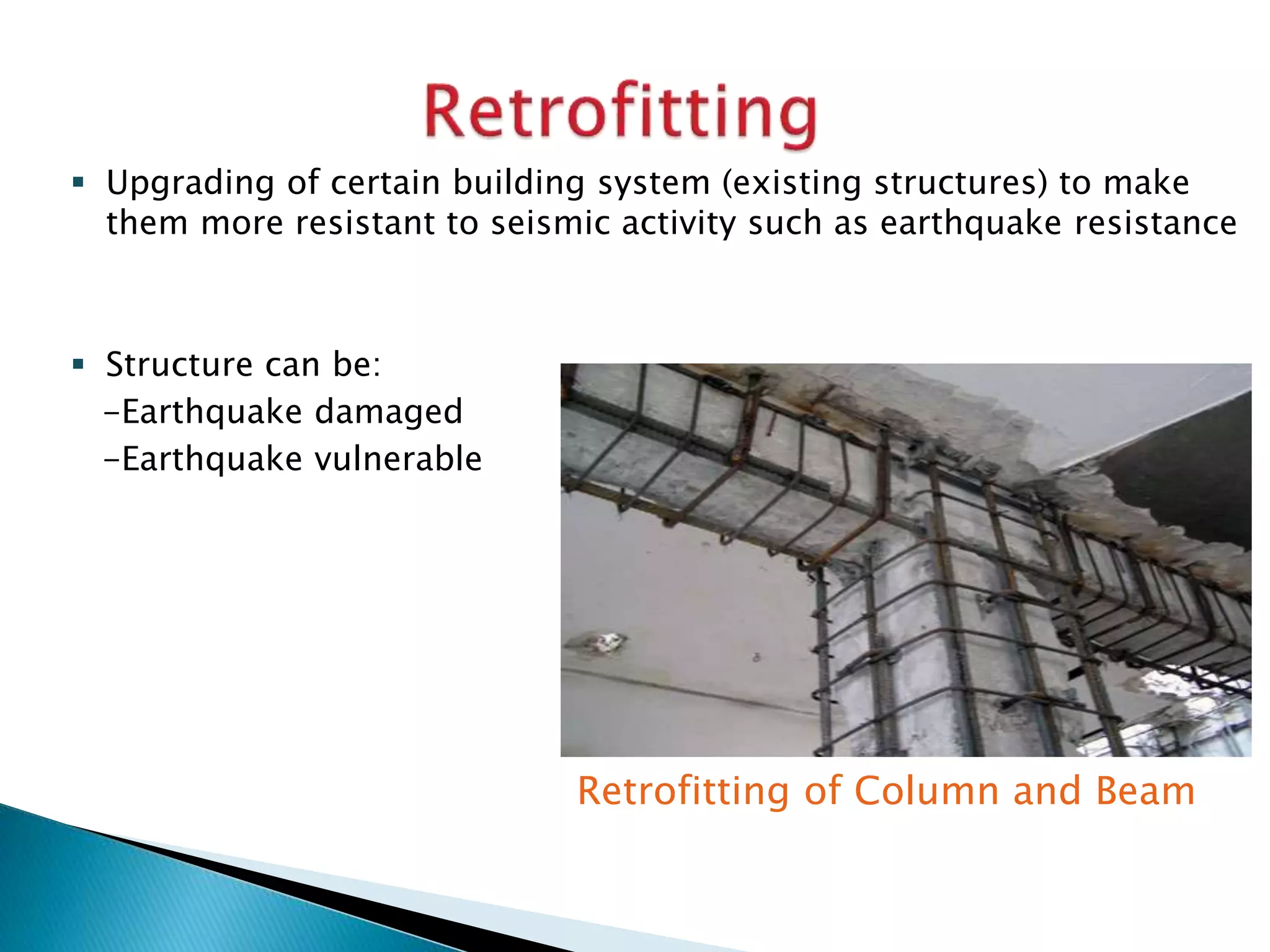
 Upgrading of certain building system (existing structures) to make
them more resistant to seismic activity such as earthquake resistance
 Structure can be:
-Earthquake damaged
-Earthquake vulnerable
Retrofitting of Column and Beam
Due to damages by earthquake, changes in codes, rezoning of
seismic intensity, poor detailing practice, and wrong design et
al, many existing reinforced concrete buildings are seismically
deficient. A large number of existing buildings and bridges
have indicated that the major deficient of reinforced. The lack
of sufficient transverse reinforcement in short columns may
lead to a brittle shear failure due to inadequate shear strength
under earthquake which clearly demonstrated a need for their
retrofit.
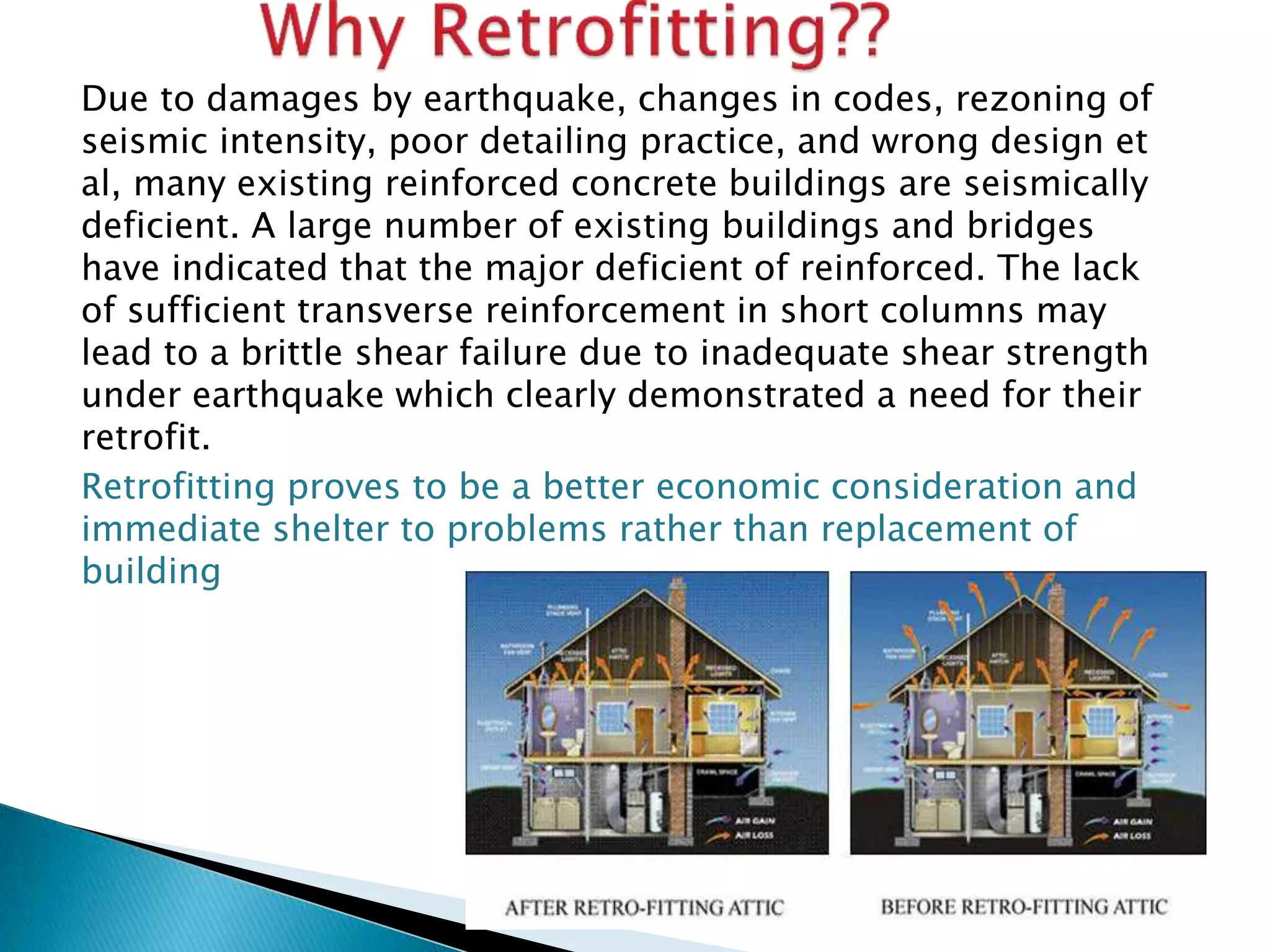
Retrofitting proves to be a better economic consideration and
immediate shelter to problems rather than replacement of
building
 There are considerable number of reinforcement concrete structure
in Bangladesh, which do not meet the correct design standard
because of inadequate design or construction error (such as Rana
Plaza).
 After recent earth quake and Rana plaza disester
the need of structural upgrading specially to meet
seismic design requirement should increase .And
for existing structure of Bangladesh retrofitting is
the best solution.
 And in our country there is a notion that
retrofitting is very expensive and it is not viable for
economy like Bangladesh. But it is totally wrong.
Usually it only costs 10-30 percent of new
construction
 Recently JICA (Japan International Cooperation Agency) start
working in Bangladesh to make earthquake-resistant
structure by systematic retrofitting .And JICA team expert
says The retrofitting works will have a positive impact on
Bangladesh.
An FRP composite is defined as a polymer that is reinforced
with a fiber. The primary function of fiber reinforcement is to
carry load along the length of the fiber and to provide strength
and stiffness in one direction. FRP represents a class of
materials that falls into a category referred to as composite
materials, The fibers are usually glass, carbon, or aramid,
although other fibers such as paper or wood or asbestos have
been sometimes used.
Fiber reinforced polymer (FRP) are used in advanced
civil engineering structure such as Building ,Bridges
etc.
 Strengthening of Columns:
The repair and strengthening of reinforced concrete (RC) columns through FRP
composites includes external FRP wrapping, FRP encasement, and FRP spraying.
Columns can be strengthened to increase the axial, shear, and flexural capacities for
a variety of reasons such as lack of confinement,
eccentric loading, seismic loading, accidental impacts, and corrosion. In the
following sections, these
topics are discussed in further detail.
FRP encasement FRP wrapping FRP spraying
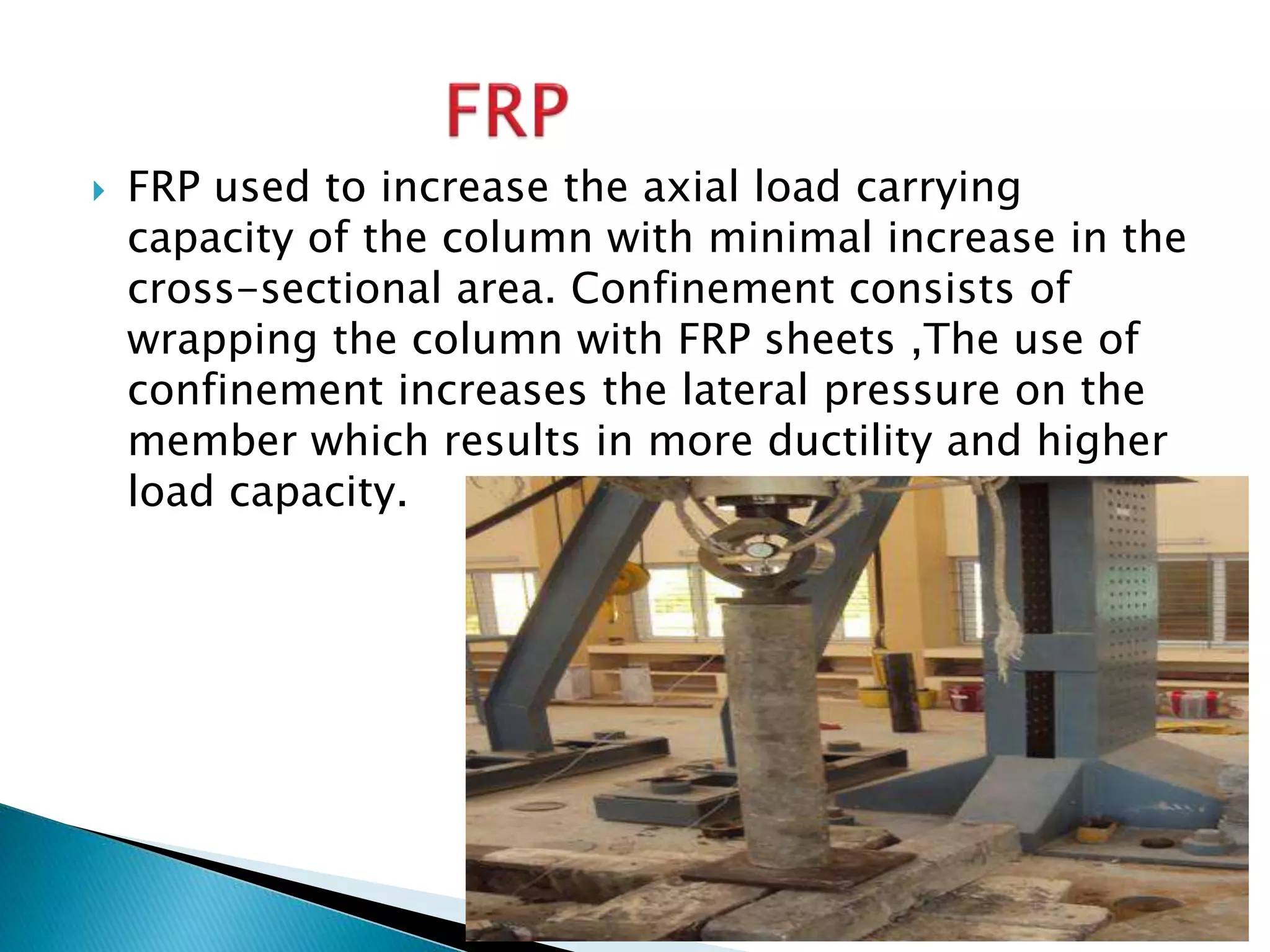
 FRP used to increase the axial load carrying
capacity of the column with minimal increase in the
cross-sectional area. Confinement consists of
wrapping the column with FRP sheets ,The use of
confinement increases the lateral pressure on the
member which results in more ductility and higher
load capacity.
 Carbon fiber has very high tensile strength and is
also very lightweight. When bonded to the exterior
of a concrete column, beam, or slab
Carbon fiber reinforcement polymer
 Carbon fiber reinforcement polymer can add significant
strength without adding weight that would increase the
load on foundations and other structural members.
CFRP wraps are easy to apply and can be used on any
size or shape of structural member.

 CFRP wrapping
Ferro cement jacketing is one of the alternate
method of repair and strengthening of column
which is low cost and easy to apply to existing
column.
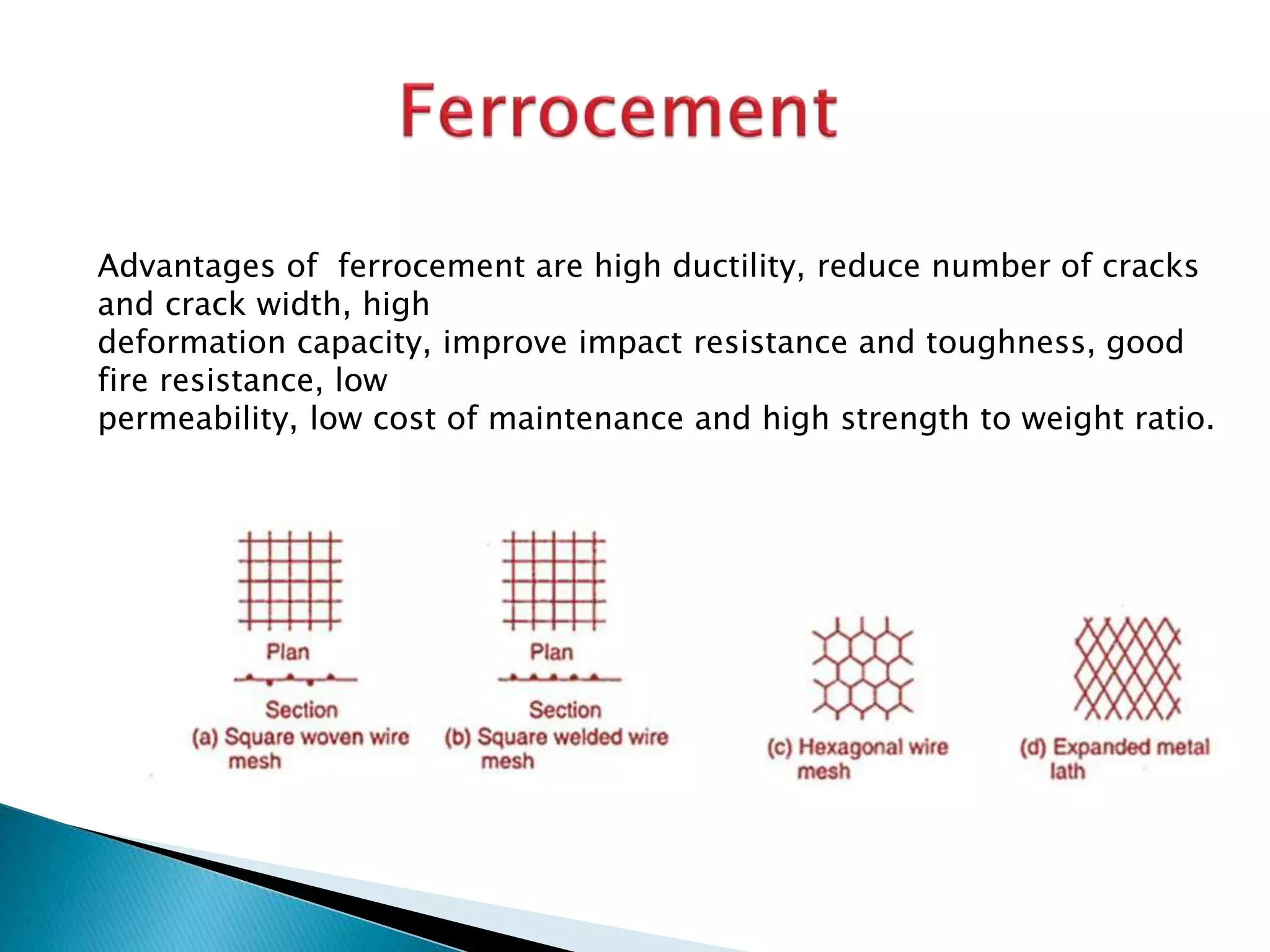
Advantages of ferrocement are high ductility, reduce number of cracks
and crack width, high
deformation capacity, improve impact resistance and toughness, good
fire resistance, low
permeability, low cost of maintenance and high strength to weight ratio.
 Ferrocement confined columns are constructed with
ferrocement as a skin on the periphery surface. These skins
consist of layers of wire mesh. Due to its better crack
arresting property and high ductility this arrangement
increases the resistance to bending moment, shear, and
torsion
 Comparison between Frp and Ferrocement retrofitting:
CFRP is thus not primarily a load carrying member,but its
geometric properties will beneficially affect the elastic
buckling of the section. This is also congruent with the fact
that the CFRP is not extended to the end of the specimens
and is not in contact with the loading platens of the
machine, and is thus not directly carrying axial load.
The study was of Ferrocement able to predict ultimate
flexural capacity and deflections and crack widths
ferrocement beams under loading. The study also observed
the load-deflection curves, crack distribution, and crack
widths for ferrocement beams up to ultimate. From test
measurement of stress-strain curves for mortar in
compression (including the descending portion) and steel
meshes in tension, an analytical model was developed to
generate the nonlinear moment-curvature and load-
deflection curves of ferrocement beams.
 STRUCTURAL

Retrrofitting

  • 2.
    The discussion isdivided into following section: 1.Objective of research 2.What is retrofitting 3.What is Ferrocement,Why Ferorocement is suitable for retrofitting 3.Methodology of ferrocement retrofitting 4.What is FRP ,Why FRP is suitable for retrofitting,Methodology of FRP retrofitting 5. Comparative study on Ferrocement and FRP …Which process is more effective and economical??
  • 3.
     Retrofitting ofthe existing structures has become a large part of the construction activity. Columns are the most authoritative structural element in any structure that transfers the entire loads to the foundation. strengthening of deficient columns is necessary to increase the load carrying capacity, ductility and energy absorption capacity that can be achieved by external confinement of column. External confinement can be done by retrofitting…… The main objective of the experimental program is to study the behavior of reinforced concrete short columns subjected to axial load and flexure strengthened with Ferrocement and Fiber reinforcement polymer. And to observe which process is better for our country considering both economical and seismic strength
  • 4.
     Upgrading ofcertain building system (existing structures) to make them more resistant to seismic activity such as earthquake resistance  Structure can be: -Earthquake damaged -Earthquake vulnerable Retrofitting of Column and Beam
  • 5.
    Due to damagesby earthquake, changes in codes, rezoning of seismic intensity, poor detailing practice, and wrong design et al, many existing reinforced concrete buildings are seismically deficient. A large number of existing buildings and bridges have indicated that the major deficient of reinforced. The lack of sufficient transverse reinforcement in short columns may lead to a brittle shear failure due to inadequate shear strength under earthquake which clearly demonstrated a need for their retrofit. Retrofitting proves to be a better economic consideration and immediate shelter to problems rather than replacement of building
  • 7.
     There areconsiderable number of reinforcement concrete structure in Bangladesh, which do not meet the correct design standard because of inadequate design or construction error (such as Rana Plaza).
  • 8.
     After recentearth quake and Rana plaza disester the need of structural upgrading specially to meet seismic design requirement should increase .And for existing structure of Bangladesh retrofitting is the best solution.  And in our country there is a notion that retrofitting is very expensive and it is not viable for economy like Bangladesh. But it is totally wrong. Usually it only costs 10-30 percent of new construction
  • 9.
     Recently JICA(Japan International Cooperation Agency) start working in Bangladesh to make earthquake-resistant structure by systematic retrofitting .And JICA team expert says The retrofitting works will have a positive impact on Bangladesh.
  • 11.
    An FRP compositeis defined as a polymer that is reinforced with a fiber. The primary function of fiber reinforcement is to carry load along the length of the fiber and to provide strength and stiffness in one direction. FRP represents a class of materials that falls into a category referred to as composite materials, The fibers are usually glass, carbon, or aramid, although other fibers such as paper or wood or asbestos have been sometimes used. Fiber reinforced polymer (FRP) are used in advanced civil engineering structure such as Building ,Bridges etc.
  • 12.
     Strengthening ofColumns: The repair and strengthening of reinforced concrete (RC) columns through FRP composites includes external FRP wrapping, FRP encasement, and FRP spraying. Columns can be strengthened to increase the axial, shear, and flexural capacities for a variety of reasons such as lack of confinement, eccentric loading, seismic loading, accidental impacts, and corrosion. In the following sections, these topics are discussed in further detail. FRP encasement FRP wrapping FRP spraying
  • 13.
     FRP usedto increase the axial load carrying capacity of the column with minimal increase in the cross-sectional area. Confinement consists of wrapping the column with FRP sheets ,The use of confinement increases the lateral pressure on the member which results in more ductility and higher load capacity.
  • 14.
     Carbon fiberhas very high tensile strength and is also very lightweight. When bonded to the exterior of a concrete column, beam, or slab Carbon fiber reinforcement polymer
  • 15.
     Carbon fiberreinforcement polymer can add significant strength without adding weight that would increase the load on foundations and other structural members. CFRP wraps are easy to apply and can be used on any size or shape of structural member.   CFRP wrapping
  • 16.
    Ferro cement jacketingis one of the alternate method of repair and strengthening of column which is low cost and easy to apply to existing column.
  • 17.
    Advantages of ferrocementare high ductility, reduce number of cracks and crack width, high deformation capacity, improve impact resistance and toughness, good fire resistance, low permeability, low cost of maintenance and high strength to weight ratio.
  • 18.
     Ferrocement confinedcolumns are constructed with ferrocement as a skin on the periphery surface. These skins consist of layers of wire mesh. Due to its better crack arresting property and high ductility this arrangement increases the resistance to bending moment, shear, and torsion
  • 19.
     Comparison betweenFrp and Ferrocement retrofitting: CFRP is thus not primarily a load carrying member,but its geometric properties will beneficially affect the elastic buckling of the section. This is also congruent with the fact that the CFRP is not extended to the end of the specimens and is not in contact with the loading platens of the machine, and is thus not directly carrying axial load. The study was of Ferrocement able to predict ultimate flexural capacity and deflections and crack widths ferrocement beams under loading. The study also observed the load-deflection curves, crack distribution, and crack widths for ferrocement beams up to ultimate. From test measurement of stress-strain curves for mortar in compression (including the descending portion) and steel meshes in tension, an analytical model was developed to generate the nonlinear moment-curvature and load- deflection curves of ferrocement beams.
  • 20.