1
MUCOSAL
VACCINE
DELIVERY
SYSTEMS.
CREATED BY :
Mr. Bandgar Akshay S.
M.Pharm
Pharmaceutics.
&
Mr. Janardan V. Khandekar
B. Pharm Student.
GUIDED BY :
Dr. Mrs.Neha Munot
Professor
SKNCOP Pune.
INTRODUCTION
Vaccination against infectious diseases has proven to be an asset
in preventing diseases and has contributed significantly to an
increase in life expectancy. [1]
 It is believed that the first productive interaction among the most
infectious agents and that host is with mucosal surfaces, especially
the agents and the host is with mucosal surfaces, especially the
nasal, oropharyngeal, respiratory, genitourinary and
gastrointestinal mucosa. [2]
2
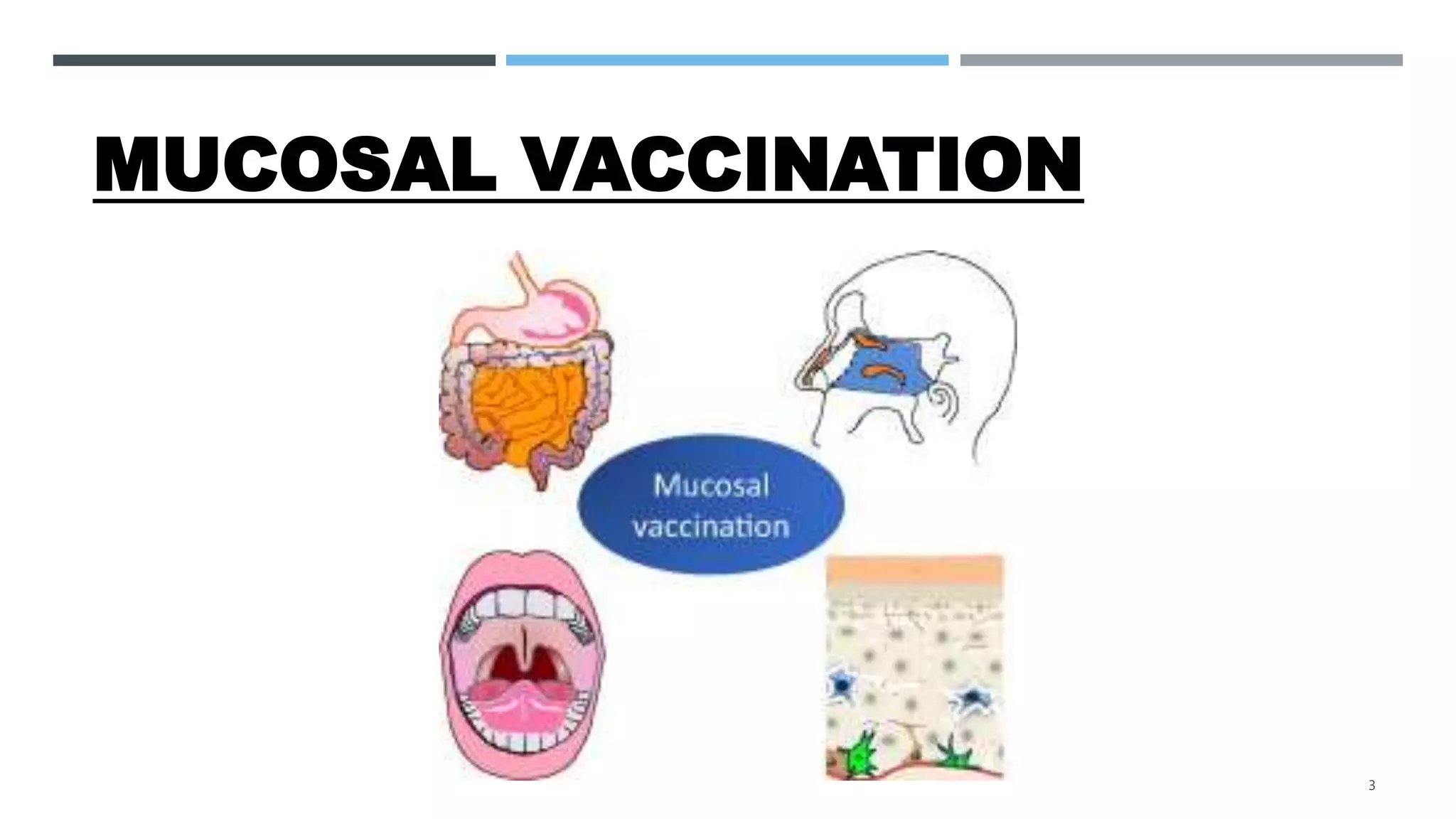
MUCOSAL VACCINATION
3
 MUCOSAL DELIVERY OF VACCINES
Mucosal surfaces area is major portal of entry for many human
pathogens that are the cause of infectious diseases
worldwide.[3]
Immunization by mucosal routes may be more effective at
inducing protective immunity against mucosal pathogens at
their sites of entry.[4]
Efforts have focused on efficient delivery of vaccines antigens to
mucosal sites that facilitate uptake by local antigen-presenting
cells to generate protective mucosal immune responses. [5] 4
5
MUCOSAL TYPE
 The adult human mucosa lines the surfaces of the digestive,
respiratory and genitourinary tracts, covering an immune
surface area that is nearly 200 times greater than that of the
skin. It is estimated that 70% of the infectious agents enter
the host by mucosal routes.
 Mucosal surfaces are typically categorized as type-I and
type-II mucosa.
 Type-I mucosa includes surface area of lungs and gut.[6]
6
 Type-II mucosa include surface area of mouth, esophagus and
cornea.
 The female genital tract has both type-I and type-II mucosa.
 Most mucosal sites have organized lymphoid follicles, such as
NALT, and GALT, which have assembly of scattered antigen-
reactive cells of immune system, such as B cells, T cells, and
professional antigen presenting cells such as dendritic cells(APCs).
 It is widely accepted that mucosal vaccination can induce immune
responses at both systemic and mucosal sites and, prevent the
invasion and colonization of pathogens at mucosal surfaces.[7] 7
CONTINUE……
 LIMITATION OF INJECTIBLE
VACCINES.
High production cost
Low/poor compliance
Fear of needle borne infection
Lack of mucosal immune response
Injection site pain
Local side effects
8
 CONTRIBUTION OF POLYMERS IN
MUCOSAL VDS.
 The concept of polymeric carrier system(s) offers advantage of
delivering drugs/antigens to a specific target site, where it has
to be released from the carrier.
 Polymeric nanoparticles/microparticles can enhance the
immune response to mucosal administered antigens by several
means. [8]
9
 DESIGN AND STRATEGIES FOR
MUCOSAL DELIVERY
DESIGN AND
STRATEGIES FOR
MUCOSAL DELIVERY
EMULSION TYPE
DELIVERY
LIPOSOME BASED
DELIVERY
POLYMERIC NANO
PARICLES
VIROSOMES
MELT IN MOUTH
STRIPS
10
EMULSION TYPE DELIVERY
 Emulsions are heterogeneous liquid systems may be w/o or o/w.
 Antigens are dissolved in a water phase and emulsified in the oil
in the presence of an appropriate emulsifier.
 The controlled release characteristics of an emulsion are
determined by factors such as – Viscosity of oil phase – Oil to
water phase ratio – Emulsion droplet size. [9]
11
 ADVANTAGES AND DISADVANTAGES
 ADVANATGES
 Slow release of antigen
 DISADVANTAGES
 Fever
 Sore arm at injection site
 Access immunogenic response
12
 LIPOSOME BASED DELIVERY
 Liposomes are spherical shape vesicles containing an
aqueous core which is enclosed by a lipid bilayer.
 They are most often composed of phospholipids, especially
phosphatidylcholine, but may also include other lipids, like
Ethanolamine.
13
 ADVANTAGES AND DISADVANTAGES
 ADVANATGES
 Easy surface modification
Synthesized from non toxic material
Wide range of antigen encapsulation
plasticity
 DISADVANTAGES
 Stability problem
 Low antigen loading
14
 POLYMERIC NANO PARTICLES
 Polymeric nano particles are submicron-sized colloidal
particles.
 Polymeric nanoparticles because of their size are
preferentially taken up by the mucosa associated lymphoid
Tissue.
 Limited doses of antigen are sufficient to induce effective
immunization.
 Hence, the use of nanoparticles for oral delivery of antigens
is suitable because of their ability to release proteins and to
15
 VIROSOMES
A Virosome is a a drug or vacine delivery mechanism consisting of
uniflagellar phospholipid membrane vesicle incorporating virus
derived proteins to allow the virosomes to fuse with target cells.
These proteins enable the virosome membranes to fuse with cells
of the immune system and thus deliver the specific antigens
directly to their target cells.
They elicit a specific immune response even with weak
immunogenic antigens.
16
Once they have delivered the antigens, the virosomes are
completely degraded within the cells.
17
CONTINUE……
18
Examples like
 Respiratory Virus Vaccines.
 TB Vaccine Delivery System.
 MELT IN MOUTH STRIPS
 Quick dissolving films containing immunogens.
 Melts into liquid that children and infants will swallow easily.
 These strips stick and dissolves on the tongue in less than a
minute. (useful for newborns who sometimes spit out the liquid)
 EXAMPLE: ROTAVIRUS is a common cause of severe diarrhea
and vomiting in children. ROTAVIRUS VACCINE at present is
available in a liquid or freeze-dried form that must be chilled for
transport and storage, making it very expensive for use in
impoverished areas. 19
20
 Other Examples
 Influenza Virus Vaccines.
 Oral polio Vaccine.
 Salmonella Typhi.
CONTINUE……
 CHALLENGES FOR MUCOSAL DSS
Presence of Physical/ Epithelial Barriers.
Enzymatic Degradation.
Low Permeability.
Wekness the Antigenicity.
Loss of Bioactivity’
Dilution of Antigens by mucosal Secrecion.
21
ADVANTAGES OF MUCOSAL
VACCINE DRUG DELIVERY SYSTEMS.
Induce Primary stage immunity.
Possible mass vaccination.
Systematic- mucosal response.
Needle free.
Non- invase.
22
Don’t require extensive purification.
Easier production.
23
 DISADVANTAGES
 Insufficient uptakes adjuvants use is the remedy.
 Lack of human mucosal adjuvant.
 Rapid clearance.
24
 CASE STUDY (1)
25
26
 PROSPECTS FOR MUCOSAL VACCINE:
shutting the door on SARS-CoV-2.
 AIM :-
This Articles summarizes the approaches to an effective mucosal vaccine formulation which can be a
recording approaches to combat the unprecedently the react posed by this emerging global pandemic.
 OBJECTIVE :-
This PPT summarizes the approaches to an effective mucosal vaccine formulation which can be a
rewarding approach to combat the unprecedented threat posed by this emerging global pandemic.
 REFERENCE :-
Hum Vaccine Immunother. 2020 : 1-11. Published online 2020 Sep 15.
doi 101080/21645515.2020.1805992
PMCID: PMC7544966
PMID: 32931361
Rajat Mudgal, Sanetkumar Nehul, and Shaily Tomer.
27
 METHOD :-
 Design strategies for mucosal vaccine against SARS- COV
• Mucosal Immune System.
• Mucosal Vaccine Platform.
• Antigen Selection.
• Mucosal Adjuvants
• Immunotolearance.
• Immunosenescence.
• Correlates of Protection and testing in animal models.
• Parental vaccines against mucosal pathogens.
• Rapid licensure and production of a mucosal vaccine.
 RESULT :-
• global surveillance and vigilance in the post-pandemic scenario should be practiced to help the
world counter a second wave of COVID-19 or other possible future coronavirus outbreaks.
• Mucosal vaccines offer better patient compliance in terms of the physical and psychological
comfort due to absence of needlestick injury and thus are highly compatible for mass
immunization in a pandemic scenario.
28
 The current COVID-19 pandemic has virtually brought most world economies to a halt and severely
impacted the lives of a large proportion of the world population. Development of a viable SARS-
CoV vaccine is imperative to reduce mortality and morbidity associated with this novel virus
outbreak.
 Vaccine administration using injection involves the cost of injection device, it’s safe disposal, and
the employment of trained medical staff which adds a considerable cost for mass vaccination
especially in developing countries.
 The emergence and rapid global spread of SARS-CoV-2 has provided a very small window for basic
and translational studies that propel the development and evaluation of vaccine against a
pathogen. While the knowledge gained from previous studies on SARS-CoV and MERS-CoV can be
used for SARS-CoV-2 vaccine development, it is yet uncertain as to what extent it will work for
SARS-CoV-2 or whether correlates of protection used will faithfully predict protective efficacy.
Potential ADE and waning of vaccine-induced immune response represent other obstacles in the
development of a mucosal vaccine against SARS-CoV-2.
CONCLUSION OF CASE STUDY
29
 CASE STUDY (2)
30
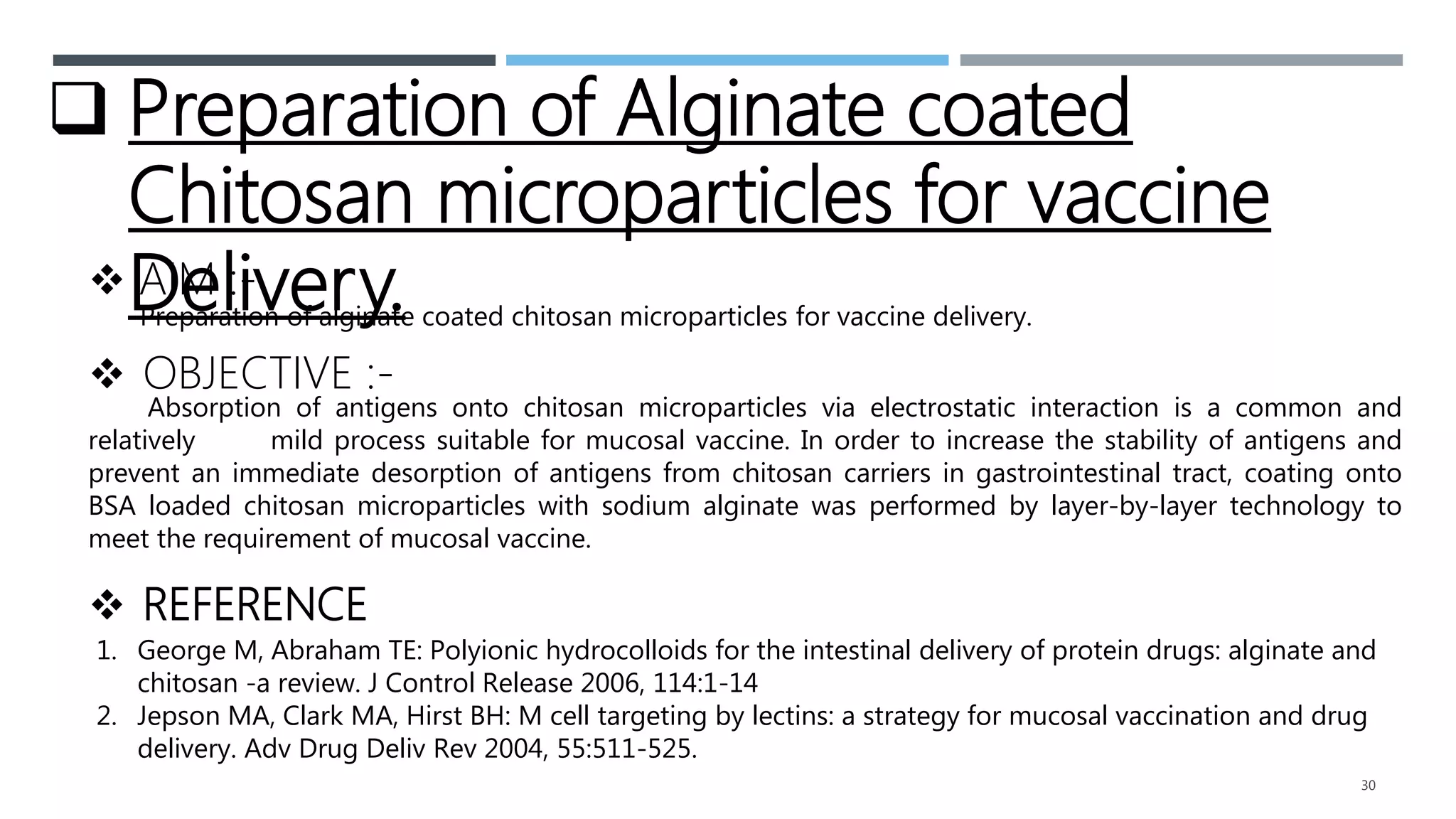
 Preparation of Alginate coated
Chitosan microparticles for vaccine
Delivery.
 AIM :-
Preparation of alginate coated chitosan microparticles for vaccine delivery.
 OBJECTIVE :-
Absorption of antigens onto chitosan microparticles via electrostatic interaction is a common and
relatively mild process suitable for mucosal vaccine. In order to increase the stability of antigens and
prevent an immediate desorption of antigens from chitosan carriers in gastrointestinal tract, coating onto
BSA loaded chitosan microparticles with sodium alginate was performed by layer-by-layer technology to
meet the requirement of mucosal vaccine.
 REFERENCE
1. George M, Abraham TE: Polyionic hydrocolloids for the intestinal delivery of protein drugs: alginate and
chitosan -a review. J Control Release 2006, 114:1-14
2. Jepson MA, Clark MA, Hirst BH: M cell targeting by lectins: a strategy for mucosal vaccination and drug
delivery. Adv Drug Deliv Rev 2004, 55:511-525.
31
 METHOD :-
 Loading bovine serum albumin (BSA) to chitosan microparticles :-
Colloid chitosan microparticles were re-dispersed in 25 ml of distilled water at concentration of 5 mg/ml
under continuous ultrasonication (Benchtop 20L, Medisafe, UK Ltd, UK) to disaggregate the chitosan
microparticles. The loading procedure was performed by incubating different concentrations of BSA with
chitosan microparticles under mild agitation at room temperature for 15 min.
Colloid chitosan microparticles were re-dispersed in 25 ml of distilled water at concentration of 5 mg/ml
under continuous ultrasonication (Benchtop 20L, Medisafe, UK Ltd, UK) to disaggregate the chitosan
microparticles. The loading procedure was performed by incubating different concentrations of BSA with
chitosan microparticles under mild agitation at room temperature for 15 min.
 Preparation of alginate coated chitosan microparticles :-
BSA loaded chitosan microparticles suspensions with pH value at 5.1 were added dropwisely into sodium
alginate solution (pH = 7.2) at concentration of 10 mg/ml under mild agitation for 10 min. Then the
suspension was centrifuged at 3,400 rpm for 5 min, and the supernatant was discarded. Finally, alginate
coated chitosan microparticles were re-dispersed into calcium chloride (CaCl2) aqueous solution (pH = 7.0)
at concentration of 0.524 mmol/L to crosslink the alginate layer presents on the surface of chitosan
microparticles.
32
 RESULT :-
we prepared alginate coated chitosan microparticles by layer-by-layer technology to meet the
requirement of oral administration of antigen for mucosal vaccine. BSA with isoelectric point (PI) of
4.8 was negatively charged when pH>4.8, which could easily absorb cationic chitosan microparticle
at aqueous solution (pH = 7) via electrostatic interaction and was selected as the model protein to
evaluate the properties of alginate coated chitosan microparticles.
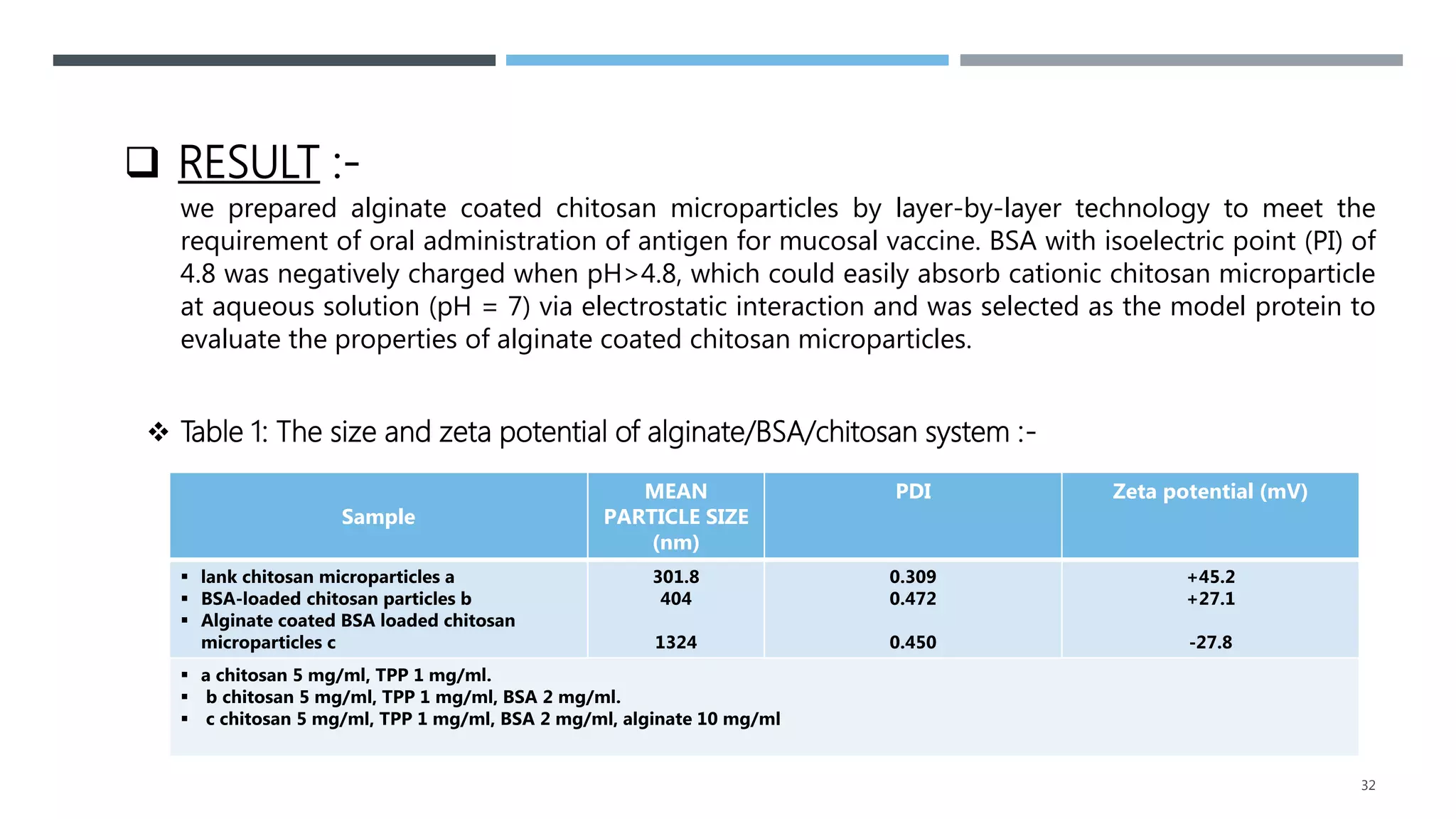
 Table 1: The size and zeta potential of alginate/BSA/chitosan system :-
Sample
MEAN
PARTICLE SIZE
(nm)
PDI Zeta potential (mV)
 lank chitosan microparticles a
 BSA-loaded chitosan particles b
 Alginate coated BSA loaded chitosan
microparticles c
301.8
404
1324
0.309
0.472
0.450
+45.2
+27.1
-27.8
 a chitosan 5 mg/ml, TPP 1 mg/ml.
 b chitosan 5 mg/ml, TPP 1 mg/ml, BSA 2 mg/ml.
 c chitosan 5 mg/ml, TPP 1 mg/ml, BSA 2 mg/ml, alginate 10 mg/ml
33
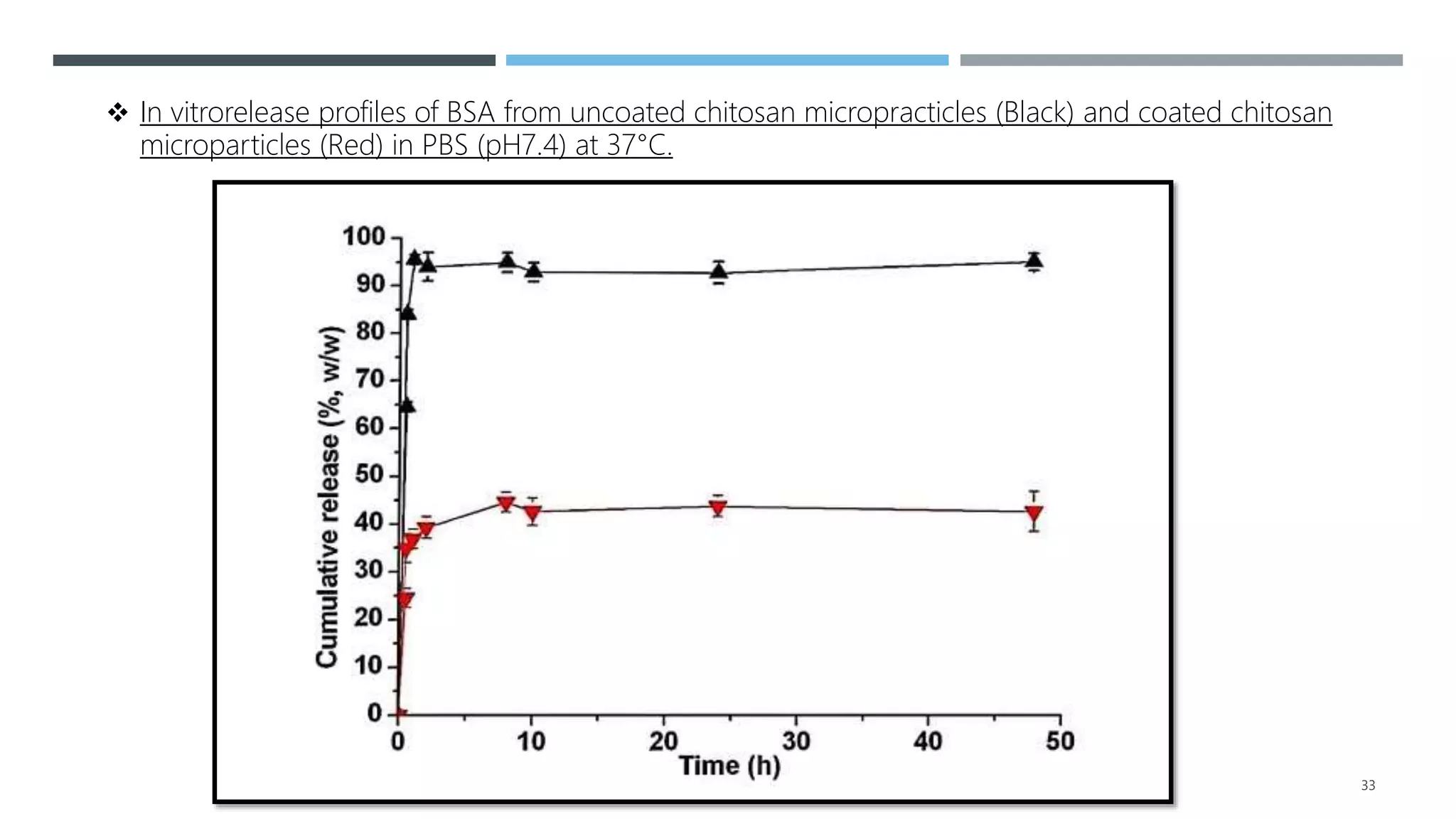
 In vitrorelease profiles of BSA from uncoated chitosan micropracticles (Black) and coated chitosan
microparticles (Red) in PBS (pH7.4) at 37°C.
34
CONCLUSION OF CASE STUDY
 The prepared alginate coated chitosan microparticles, with mean
diameter of about 1 μm, was suitable for oral administration.
 Moreover, alginate coating onto surface of chitosan
microparticles could modulate the release behavior of BSA from
alginate coated chitosan microparticles and could effectively
protect model protein (BSA) from degradation against acidic
medium (pH2) in vitro at least for 2 hours.
 According to FTIR, some alginate on surface of chitosan
microparticles at 24 h of release test has been dissolved into PBS.
Based on the information demonstrated, the prepared alginate
coated chitosan microparticles might be an effective vehicle for
oral administration of antigens.
 CONCLUSION
 mucosal vaccination has many advantages, a very limited
number of mucosal vaccines have been licensed. The most
widely tested vaccination routes are oral and intranasal.
 Future mucosal vaccines should be made with more purified
antigen components, which will require safe and efficacious
adjuvants and delivery systems. Recent developments in
biomaterials and nanotechnology have enabled many innovative
mucosal vaccine trials.
35
36
 Future mucosal vaccine carriers, regardless of administration
routes, should share common characteristics. They should
maintain stability in given environments, be mucoadhesive, and
have targeting ability to specific tissues and cells.
CONTINUE……
 REFERENCES
1. Giteau A, Venier- jullience MC, Aubert-pousered A, Benoit JP, How
to achieve sustained and complete protein release from PLGA –
based microparticles? Int J Pharm 2008,350(1-2):14-26.
2. Di Pasquale A, Presis S, Tavares da silva F, Garcon N. Vaccine
adjuvants; from 1920 to2015 and beyond Vaccines (Basel)
2015;320-43.
3. Garcia A, lema D. an updated review of ISCOMSTM and
ISCOMATRIXM vaccines. Curr pharm des 2016;22(41);6294-9
4. Jakobsen, H., Bjarnarson, S., Del Giudice, G., Moreau, M., Siegrist,
C.A., and Jonsdottir, I. 2002, Infect. Immun., 70, 1443.
37
5. Agger, E.M., Rosenkrands, I., Olsen, A.W., Hatch, G., Williams, A.,
Kritsch, C., Lingnau, K., von Gabain, A., Andersen, C.S., Korsholm,
K.S., and Andersen, P. 2006, Vaccine, 24, 5452.
6. Illum, l., Farraj, N.F., Fisher, A.N., Gill, L., Miglietta, M., and
Benedetti, L. 1994, J. Controlled Release, 29, 133.
7. Putney, S.D., and Burke, P.A. 1998, Nat. Biotechnol., 16 [published
erratum appears in Nat Biotechnol 1998 May;16(5):478], 153.
CONTINUE……
38
39

Mucosal dds

  • 1.
    1 MUCOSAL VACCINE DELIVERY SYSTEMS. CREATED BY : Mr.Bandgar Akshay S. M.Pharm Pharmaceutics. & Mr. Janardan V. Khandekar B. Pharm Student. GUIDED BY : Dr. Mrs.Neha Munot Professor SKNCOP Pune.
  • 2.
    INTRODUCTION Vaccination against infectiousdiseases has proven to be an asset in preventing diseases and has contributed significantly to an increase in life expectancy. [1]  It is believed that the first productive interaction among the most infectious agents and that host is with mucosal surfaces, especially the agents and the host is with mucosal surfaces, especially the nasal, oropharyngeal, respiratory, genitourinary and gastrointestinal mucosa. [2] 2
  • 3.
  • 4.
     MUCOSAL DELIVERYOF VACCINES Mucosal surfaces area is major portal of entry for many human pathogens that are the cause of infectious diseases worldwide.[3] Immunization by mucosal routes may be more effective at inducing protective immunity against mucosal pathogens at their sites of entry.[4] Efforts have focused on efficient delivery of vaccines antigens to mucosal sites that facilitate uptake by local antigen-presenting cells to generate protective mucosal immune responses. [5] 4
  • 5.
  • 6.
    MUCOSAL TYPE  Theadult human mucosa lines the surfaces of the digestive, respiratory and genitourinary tracts, covering an immune surface area that is nearly 200 times greater than that of the skin. It is estimated that 70% of the infectious agents enter the host by mucosal routes.  Mucosal surfaces are typically categorized as type-I and type-II mucosa.  Type-I mucosa includes surface area of lungs and gut.[6] 6
  • 7.
     Type-II mucosainclude surface area of mouth, esophagus and cornea.  The female genital tract has both type-I and type-II mucosa.  Most mucosal sites have organized lymphoid follicles, such as NALT, and GALT, which have assembly of scattered antigen- reactive cells of immune system, such as B cells, T cells, and professional antigen presenting cells such as dendritic cells(APCs).  It is widely accepted that mucosal vaccination can induce immune responses at both systemic and mucosal sites and, prevent the invasion and colonization of pathogens at mucosal surfaces.[7] 7 CONTINUE……
  • 8.
     LIMITATION OFINJECTIBLE VACCINES. High production cost Low/poor compliance Fear of needle borne infection Lack of mucosal immune response Injection site pain Local side effects 8
  • 9.
     CONTRIBUTION OFPOLYMERS IN MUCOSAL VDS.  The concept of polymeric carrier system(s) offers advantage of delivering drugs/antigens to a specific target site, where it has to be released from the carrier.  Polymeric nanoparticles/microparticles can enhance the immune response to mucosal administered antigens by several means. [8] 9
  • 10.
     DESIGN ANDSTRATEGIES FOR MUCOSAL DELIVERY DESIGN AND STRATEGIES FOR MUCOSAL DELIVERY EMULSION TYPE DELIVERY LIPOSOME BASED DELIVERY POLYMERIC NANO PARICLES VIROSOMES MELT IN MOUTH STRIPS 10
  • 11.
    EMULSION TYPE DELIVERY Emulsions are heterogeneous liquid systems may be w/o or o/w.  Antigens are dissolved in a water phase and emulsified in the oil in the presence of an appropriate emulsifier.  The controlled release characteristics of an emulsion are determined by factors such as – Viscosity of oil phase – Oil to water phase ratio – Emulsion droplet size. [9] 11
  • 12.
     ADVANTAGES ANDDISADVANTAGES  ADVANATGES  Slow release of antigen  DISADVANTAGES  Fever  Sore arm at injection site  Access immunogenic response 12
  • 13.
     LIPOSOME BASEDDELIVERY  Liposomes are spherical shape vesicles containing an aqueous core which is enclosed by a lipid bilayer.  They are most often composed of phospholipids, especially phosphatidylcholine, but may also include other lipids, like Ethanolamine. 13
  • 14.
     ADVANTAGES ANDDISADVANTAGES  ADVANATGES  Easy surface modification Synthesized from non toxic material Wide range of antigen encapsulation plasticity  DISADVANTAGES  Stability problem  Low antigen loading 14
  • 15.
     POLYMERIC NANOPARTICLES  Polymeric nano particles are submicron-sized colloidal particles.  Polymeric nanoparticles because of their size are preferentially taken up by the mucosa associated lymphoid Tissue.  Limited doses of antigen are sufficient to induce effective immunization.  Hence, the use of nanoparticles for oral delivery of antigens is suitable because of their ability to release proteins and to 15
  • 16.
     VIROSOMES A Virosomeis a a drug or vacine delivery mechanism consisting of uniflagellar phospholipid membrane vesicle incorporating virus derived proteins to allow the virosomes to fuse with target cells. These proteins enable the virosome membranes to fuse with cells of the immune system and thus deliver the specific antigens directly to their target cells. They elicit a specific immune response even with weak immunogenic antigens. 16
  • 17.
    Once they havedelivered the antigens, the virosomes are completely degraded within the cells. 17 CONTINUE……
  • 18.
    18 Examples like  RespiratoryVirus Vaccines.  TB Vaccine Delivery System.
  • 19.
     MELT INMOUTH STRIPS  Quick dissolving films containing immunogens.  Melts into liquid that children and infants will swallow easily.  These strips stick and dissolves on the tongue in less than a minute. (useful for newborns who sometimes spit out the liquid)  EXAMPLE: ROTAVIRUS is a common cause of severe diarrhea and vomiting in children. ROTAVIRUS VACCINE at present is available in a liquid or freeze-dried form that must be chilled for transport and storage, making it very expensive for use in impoverished areas. 19
  • 20.
    20  Other Examples Influenza Virus Vaccines.  Oral polio Vaccine.  Salmonella Typhi. CONTINUE……
  • 21.
     CHALLENGES FORMUCOSAL DSS Presence of Physical/ Epithelial Barriers. Enzymatic Degradation. Low Permeability. Wekness the Antigenicity. Loss of Bioactivity’ Dilution of Antigens by mucosal Secrecion. 21
  • 22.
    ADVANTAGES OF MUCOSAL VACCINEDRUG DELIVERY SYSTEMS. Induce Primary stage immunity. Possible mass vaccination. Systematic- mucosal response. Needle free. Non- invase. 22
  • 23.
    Don’t require extensivepurification. Easier production. 23
  • 24.
     DISADVANTAGES  Insufficientuptakes adjuvants use is the remedy.  Lack of human mucosal adjuvant.  Rapid clearance. 24
  • 25.
  • 26.
    26  PROSPECTS FORMUCOSAL VACCINE: shutting the door on SARS-CoV-2.  AIM :- This Articles summarizes the approaches to an effective mucosal vaccine formulation which can be a recording approaches to combat the unprecedently the react posed by this emerging global pandemic.  OBJECTIVE :- This PPT summarizes the approaches to an effective mucosal vaccine formulation which can be a rewarding approach to combat the unprecedented threat posed by this emerging global pandemic.  REFERENCE :- Hum Vaccine Immunother. 2020 : 1-11. Published online 2020 Sep 15. doi 101080/21645515.2020.1805992 PMCID: PMC7544966 PMID: 32931361 Rajat Mudgal, Sanetkumar Nehul, and Shaily Tomer.
  • 27.
    27  METHOD :- Design strategies for mucosal vaccine against SARS- COV • Mucosal Immune System. • Mucosal Vaccine Platform. • Antigen Selection. • Mucosal Adjuvants • Immunotolearance. • Immunosenescence. • Correlates of Protection and testing in animal models. • Parental vaccines against mucosal pathogens. • Rapid licensure and production of a mucosal vaccine.  RESULT :- • global surveillance and vigilance in the post-pandemic scenario should be practiced to help the world counter a second wave of COVID-19 or other possible future coronavirus outbreaks. • Mucosal vaccines offer better patient compliance in terms of the physical and psychological comfort due to absence of needlestick injury and thus are highly compatible for mass immunization in a pandemic scenario.
  • 28.
    28  The currentCOVID-19 pandemic has virtually brought most world economies to a halt and severely impacted the lives of a large proportion of the world population. Development of a viable SARS- CoV vaccine is imperative to reduce mortality and morbidity associated with this novel virus outbreak.  Vaccine administration using injection involves the cost of injection device, it’s safe disposal, and the employment of trained medical staff which adds a considerable cost for mass vaccination especially in developing countries.  The emergence and rapid global spread of SARS-CoV-2 has provided a very small window for basic and translational studies that propel the development and evaluation of vaccine against a pathogen. While the knowledge gained from previous studies on SARS-CoV and MERS-CoV can be used for SARS-CoV-2 vaccine development, it is yet uncertain as to what extent it will work for SARS-CoV-2 or whether correlates of protection used will faithfully predict protective efficacy. Potential ADE and waning of vaccine-induced immune response represent other obstacles in the development of a mucosal vaccine against SARS-CoV-2. CONCLUSION OF CASE STUDY
  • 29.
  • 30.
    30  Preparation ofAlginate coated Chitosan microparticles for vaccine Delivery.  AIM :- Preparation of alginate coated chitosan microparticles for vaccine delivery.  OBJECTIVE :- Absorption of antigens onto chitosan microparticles via electrostatic interaction is a common and relatively mild process suitable for mucosal vaccine. In order to increase the stability of antigens and prevent an immediate desorption of antigens from chitosan carriers in gastrointestinal tract, coating onto BSA loaded chitosan microparticles with sodium alginate was performed by layer-by-layer technology to meet the requirement of mucosal vaccine.  REFERENCE 1. George M, Abraham TE: Polyionic hydrocolloids for the intestinal delivery of protein drugs: alginate and chitosan -a review. J Control Release 2006, 114:1-14 2. Jepson MA, Clark MA, Hirst BH: M cell targeting by lectins: a strategy for mucosal vaccination and drug delivery. Adv Drug Deliv Rev 2004, 55:511-525.
  • 31.
    31  METHOD :- Loading bovine serum albumin (BSA) to chitosan microparticles :- Colloid chitosan microparticles were re-dispersed in 25 ml of distilled water at concentration of 5 mg/ml under continuous ultrasonication (Benchtop 20L, Medisafe, UK Ltd, UK) to disaggregate the chitosan microparticles. The loading procedure was performed by incubating different concentrations of BSA with chitosan microparticles under mild agitation at room temperature for 15 min. Colloid chitosan microparticles were re-dispersed in 25 ml of distilled water at concentration of 5 mg/ml under continuous ultrasonication (Benchtop 20L, Medisafe, UK Ltd, UK) to disaggregate the chitosan microparticles. The loading procedure was performed by incubating different concentrations of BSA with chitosan microparticles under mild agitation at room temperature for 15 min.  Preparation of alginate coated chitosan microparticles :- BSA loaded chitosan microparticles suspensions with pH value at 5.1 were added dropwisely into sodium alginate solution (pH = 7.2) at concentration of 10 mg/ml under mild agitation for 10 min. Then the suspension was centrifuged at 3,400 rpm for 5 min, and the supernatant was discarded. Finally, alginate coated chitosan microparticles were re-dispersed into calcium chloride (CaCl2) aqueous solution (pH = 7.0) at concentration of 0.524 mmol/L to crosslink the alginate layer presents on the surface of chitosan microparticles.
  • 32.
    32  RESULT :- weprepared alginate coated chitosan microparticles by layer-by-layer technology to meet the requirement of oral administration of antigen for mucosal vaccine. BSA with isoelectric point (PI) of 4.8 was negatively charged when pH>4.8, which could easily absorb cationic chitosan microparticle at aqueous solution (pH = 7) via electrostatic interaction and was selected as the model protein to evaluate the properties of alginate coated chitosan microparticles.  Table 1: The size and zeta potential of alginate/BSA/chitosan system :- Sample MEAN PARTICLE SIZE (nm) PDI Zeta potential (mV)  lank chitosan microparticles a  BSA-loaded chitosan particles b  Alginate coated BSA loaded chitosan microparticles c 301.8 404 1324 0.309 0.472 0.450 +45.2 +27.1 -27.8  a chitosan 5 mg/ml, TPP 1 mg/ml.  b chitosan 5 mg/ml, TPP 1 mg/ml, BSA 2 mg/ml.  c chitosan 5 mg/ml, TPP 1 mg/ml, BSA 2 mg/ml, alginate 10 mg/ml
  • 33.
    33  In vitroreleaseprofiles of BSA from uncoated chitosan micropracticles (Black) and coated chitosan microparticles (Red) in PBS (pH7.4) at 37°C.
  • 34.
    34 CONCLUSION OF CASESTUDY  The prepared alginate coated chitosan microparticles, with mean diameter of about 1 μm, was suitable for oral administration.  Moreover, alginate coating onto surface of chitosan microparticles could modulate the release behavior of BSA from alginate coated chitosan microparticles and could effectively protect model protein (BSA) from degradation against acidic medium (pH2) in vitro at least for 2 hours.  According to FTIR, some alginate on surface of chitosan microparticles at 24 h of release test has been dissolved into PBS. Based on the information demonstrated, the prepared alginate coated chitosan microparticles might be an effective vehicle for oral administration of antigens.
  • 35.
     CONCLUSION  mucosalvaccination has many advantages, a very limited number of mucosal vaccines have been licensed. The most widely tested vaccination routes are oral and intranasal.  Future mucosal vaccines should be made with more purified antigen components, which will require safe and efficacious adjuvants and delivery systems. Recent developments in biomaterials and nanotechnology have enabled many innovative mucosal vaccine trials. 35
  • 36.
    36  Future mucosalvaccine carriers, regardless of administration routes, should share common characteristics. They should maintain stability in given environments, be mucoadhesive, and have targeting ability to specific tissues and cells. CONTINUE……
  • 37.
     REFERENCES 1. GiteauA, Venier- jullience MC, Aubert-pousered A, Benoit JP, How to achieve sustained and complete protein release from PLGA – based microparticles? Int J Pharm 2008,350(1-2):14-26. 2. Di Pasquale A, Presis S, Tavares da silva F, Garcon N. Vaccine adjuvants; from 1920 to2015 and beyond Vaccines (Basel) 2015;320-43. 3. Garcia A, lema D. an updated review of ISCOMSTM and ISCOMATRIXM vaccines. Curr pharm des 2016;22(41);6294-9 4. Jakobsen, H., Bjarnarson, S., Del Giudice, G., Moreau, M., Siegrist, C.A., and Jonsdottir, I. 2002, Infect. Immun., 70, 1443. 37
  • 38.
    5. Agger, E.M.,Rosenkrands, I., Olsen, A.W., Hatch, G., Williams, A., Kritsch, C., Lingnau, K., von Gabain, A., Andersen, C.S., Korsholm, K.S., and Andersen, P. 2006, Vaccine, 24, 5452. 6. Illum, l., Farraj, N.F., Fisher, A.N., Gill, L., Miglietta, M., and Benedetti, L. 1994, J. Controlled Release, 29, 133. 7. Putney, S.D., and Burke, P.A. 1998, Nat. Biotechnol., 16 [published erratum appears in Nat Biotechnol 1998 May;16(5):478], 153. CONTINUE…… 38
  • 39.