Presentation Topic:
Muhammad Aadil
PhD research Scholar
Session (2017-2020)
DEPARTMENT OF CHEMISTRY
The Islamia University of Bahawalpur
UV-Visible Spectroscopy
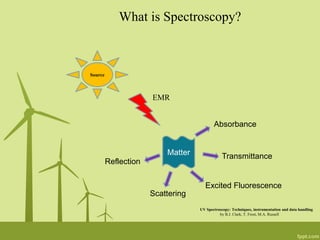
What is Spectroscopy?
Source
Matter
EMR
Absorbance
Transmittance
Excited Fluorescence
Scattering
Reflection
UV Spectroscopy: Techniques, instrumentation and data handling
by B.J. Clark, T. Frost, M.A. Russell
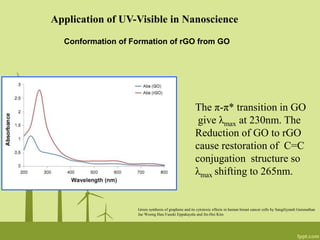
Conformation of Formation of rGO from GO
Green synthesis of graphene and its cytotoxic effects in human breast cancer cells by Sangiliyandi Gurunathan
Jae Woong Han,Vasuki Eppakayala and Jin-Hoi Kim
The π-π* transition in GO
give λmax at 230nm. The
Reduction of GO to rGO
cause restoration of C=C
conjugation structure so
λmax shifting to 265nm.
Application of UV-Visible in Nanoscience
Spectroscopic investigation on graphe ne-copper nanocomposites with strong UV emission and highcatalytic activity
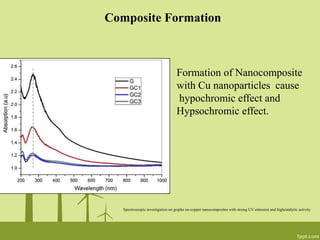
Formation of Nanocomposite
with Cu nanoparticles cause
hypochromic effect and
Hypsochromic effect.
Composite Formation
UV/VIS/IR SPECTROSCOPY ANALYSIS OF NANOPARTICLES
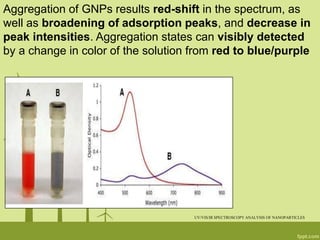
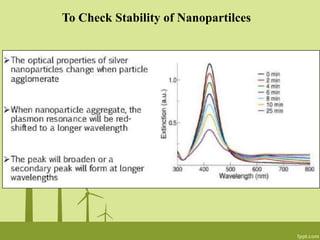
Aggregation of GNPs results red-shift in the spectrum, as
well as broadening of adsorption peaks, and decrease in
peak intensities. Aggregation states can visibly detected
by a change in color of the solution from red to blue/purple
To Check Stability of Nanopartilces
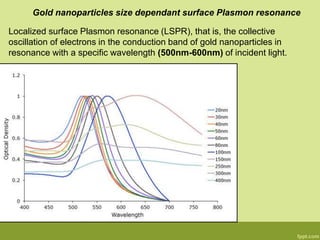
Gold nanoparticles size dependant surface Plasmon resonance
Localized surface Plasmon resonance (LSPR), that is, the collective
oscillation of electrons in the conduction band of gold nanoparticles in
resonance with a specific wavelength (500nm-600nm) of incident light.
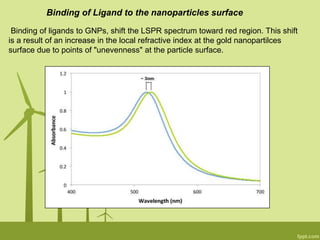
Binding of Ligand to the nanoparticles surface
Binding of ligands to GNPs, shift the LSPR spectrum toward red region. This shift
is a result of an increase in the local refractive index at the gold nanopartilces
surface due to points of "unevenness" at the particle surface.
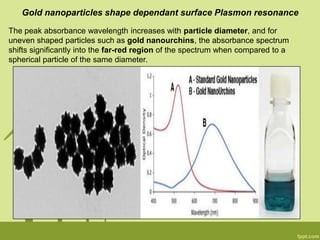
Gold nanoparticles shape dependant surface Plasmon resonance
The peak absorbance wavelength increases with particle diameter, and for
uneven shaped particles such as gold nanourchins, the absorbance spectrum
shifts significantly into the far-red region of the spectrum when compared to a
spherical particle of the same diameter.
Gold nanoparticles shape dependant surface
Plasmon resonance
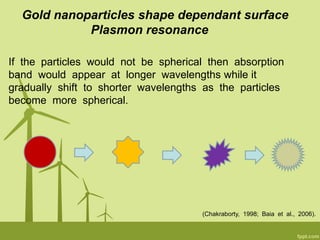
If the particles would not be spherical then absorption
band would appear at longer wavelengths while it
gradually shift to shorter wavelengths as the particles
become more spherical.
(Chakraborty, 1998; Baia et al., 2006).
Verification of full reduction
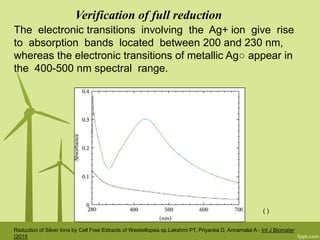
The electronic transitions involving the Ag+ ion give rise
to absorption bands located between 200 and 230 nm,
whereas the electronic transitions of metallic Ag○ appear in
the 400-500 nm spectral range.
( )
Reduction of Silver Ions by Cell Free Extracts of Westiellopsis sp.Lakshmi PT, Priyanka D, Annamalai A - Int J Biomater
(2015
UV-Visible advance by M.Aadil

UV-Visible advance by M.Aadil

  • 2.
    Presentation Topic: Muhammad Aadil PhDresearch Scholar Session (2017-2020) DEPARTMENT OF CHEMISTRY The Islamia University of Bahawalpur UV-Visible Spectroscopy
  • 3.
    What is Spectroscopy? Source Matter EMR Absorbance Transmittance ExcitedFluorescence Scattering Reflection UV Spectroscopy: Techniques, instrumentation and data handling by B.J. Clark, T. Frost, M.A. Russell
  • 4.
    Conformation of Formationof rGO from GO Green synthesis of graphene and its cytotoxic effects in human breast cancer cells by Sangiliyandi Gurunathan Jae Woong Han,Vasuki Eppakayala and Jin-Hoi Kim The π-π* transition in GO give λmax at 230nm. The Reduction of GO to rGO cause restoration of C=C conjugation structure so λmax shifting to 265nm. Application of UV-Visible in Nanoscience
  • 5.
    Spectroscopic investigation ongraphe ne-copper nanocomposites with strong UV emission and highcatalytic activity Formation of Nanocomposite with Cu nanoparticles cause hypochromic effect and Hypsochromic effect. Composite Formation
  • 6.
    UV/VIS/IR SPECTROSCOPY ANALYSISOF NANOPARTICLES Aggregation of GNPs results red-shift in the spectrum, as well as broadening of adsorption peaks, and decrease in peak intensities. Aggregation states can visibly detected by a change in color of the solution from red to blue/purple
  • 7.
    To Check Stabilityof Nanopartilces
  • 8.
    Gold nanoparticles sizedependant surface Plasmon resonance Localized surface Plasmon resonance (LSPR), that is, the collective oscillation of electrons in the conduction band of gold nanoparticles in resonance with a specific wavelength (500nm-600nm) of incident light.
  • 9.
    Binding of Ligandto the nanoparticles surface Binding of ligands to GNPs, shift the LSPR spectrum toward red region. This shift is a result of an increase in the local refractive index at the gold nanopartilces surface due to points of "unevenness" at the particle surface.
  • 10.
    Gold nanoparticles shapedependant surface Plasmon resonance The peak absorbance wavelength increases with particle diameter, and for uneven shaped particles such as gold nanourchins, the absorbance spectrum shifts significantly into the far-red region of the spectrum when compared to a spherical particle of the same diameter.
  • 11.
    Gold nanoparticles shapedependant surface Plasmon resonance If the particles would not be spherical then absorption band would appear at longer wavelengths while it gradually shift to shorter wavelengths as the particles become more spherical. (Chakraborty, 1998; Baia et al., 2006).
  • 12.
    Verification of fullreduction The electronic transitions involving the Ag+ ion give rise to absorption bands located between 200 and 230 nm, whereas the electronic transitions of metallic Ag○ appear in the 400-500 nm spectral range. ( ) Reduction of Silver Ions by Cell Free Extracts of Westiellopsis sp.Lakshmi PT, Priyanka D, Annamalai A - Int J Biomater (2015