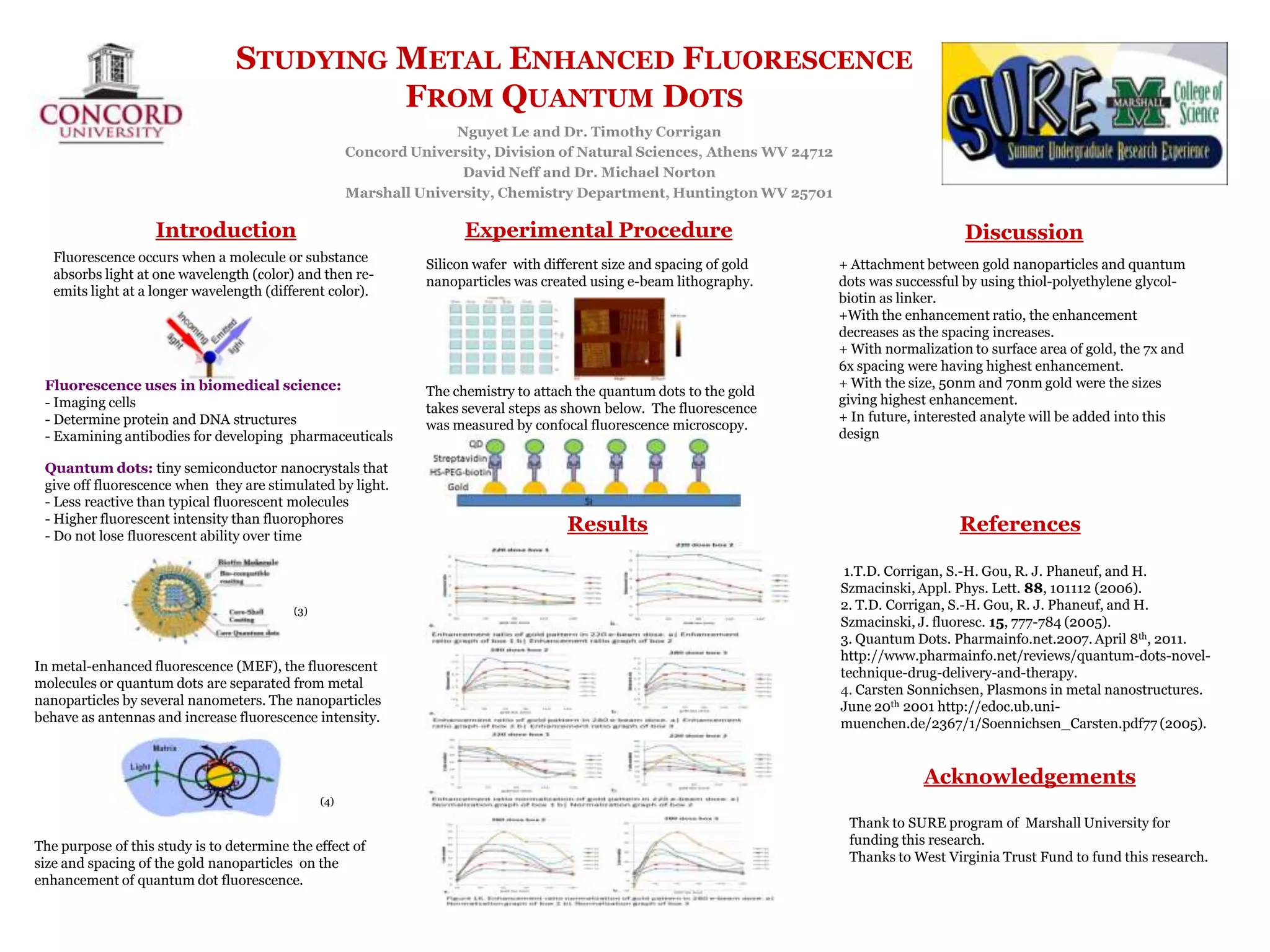
Fluorescence occurs when a molecule or substance
absorbs light at one wavelength (color) and then re-
emits light at a longer wavelength (different color).
Nguyet Le and Dr. Timothy Corrigan
Concord University, Division of Natural Sciences, Athens WV 24712
David Neff and Dr. Michael Norton
Marshall University, Chemistry Department, Huntington WV 25701
Acknowledgements
Thank to SURE program of Marshall University for
funding this research.
Thanks to West Virginia Trust Fund to fund this research.
References
In metal-enhanced fluorescence (MEF), the fluorescent
molecules or quantum dots are separated from metal
nanoparticles by several nanometers. The nanoparticles
behave as antennas and increase fluorescence intensity.
(3)
1.T.D. Corrigan, S.-H. Gou, R. J. Phaneuf, and H.
Szmacinski, Appl. Phys. Lett. 88, 101112 (2006).
2. T.D. Corrigan, S.-H. Gou, R. J. Phaneuf, and H.
Szmacinski, J. fluoresc. 15, 777-784 (2005).
3. Quantum Dots. Pharmainfo.net.2007. April 8th, 2011.
http://www.pharmainfo.net/reviews/quantum-dots-novel-
technique-drug-delivery-and-therapy.
4. Carsten Sonnichsen, Plasmons in metal nanostructures.
June 20th 2001 http://edoc.ub.uni-
muenchen.de/2367/1/Soennichsen_Carsten.pdf77 (2005).
(4)
Fluorescence uses in biomedical science:
- Imaging cells
- Determine protein and DNA structures
- Examining antibodies for developing pharmaceuticals
Quantum dots: tiny semiconductor nanocrystals that
give off fluorescence when they are stimulated by light.
- Less reactive than typical fluorescent molecules
- Higher fluorescent intensity than fluorophores
- Do not lose fluorescent ability over time
Silicon wafer with different size and spacing of gold
nanoparticles was created using e-beam lithography.
The chemistry to attach the quantum dots to the gold
takes several steps as shown below. The fluorescence
was measured by confocal fluorescence microscopy.
+ Attachment between gold nanoparticles and quantum
dots was successful by using thiol-polyethylene glycol-
biotin as linker.
+With the enhancement ratio, the enhancement
decreases as the spacing increases.
+ With normalization to surface area of gold, the 7x and
6x spacing were having highest enhancement.
+ With the size, 50nm and 70nm gold were the sizes
giving highest enhancement.
+ In future, interested analyte will be added into this
design
DiscussionIntroduction Experimental Procedure
STUDYING METAL ENHANCED FLUORESCENCE
FROM QUANTUM DOTS
The purpose of this study is to determine the effect of
size and spacing of the gold nanoparticles on the
enhancement of quantum dot fluorescence.
Results

Nle sure poster

  • 1.
    Fluorescence occurs whena molecule or substance absorbs light at one wavelength (color) and then re- emits light at a longer wavelength (different color). Nguyet Le and Dr. Timothy Corrigan Concord University, Division of Natural Sciences, Athens WV 24712 David Neff and Dr. Michael Norton Marshall University, Chemistry Department, Huntington WV 25701 Acknowledgements Thank to SURE program of Marshall University for funding this research. Thanks to West Virginia Trust Fund to fund this research. References In metal-enhanced fluorescence (MEF), the fluorescent molecules or quantum dots are separated from metal nanoparticles by several nanometers. The nanoparticles behave as antennas and increase fluorescence intensity. (3) 1.T.D. Corrigan, S.-H. Gou, R. J. Phaneuf, and H. Szmacinski, Appl. Phys. Lett. 88, 101112 (2006). 2. T.D. Corrigan, S.-H. Gou, R. J. Phaneuf, and H. Szmacinski, J. fluoresc. 15, 777-784 (2005). 3. Quantum Dots. Pharmainfo.net.2007. April 8th, 2011. http://www.pharmainfo.net/reviews/quantum-dots-novel- technique-drug-delivery-and-therapy. 4. Carsten Sonnichsen, Plasmons in metal nanostructures. June 20th 2001 http://edoc.ub.uni- muenchen.de/2367/1/Soennichsen_Carsten.pdf77 (2005). (4) Fluorescence uses in biomedical science: - Imaging cells - Determine protein and DNA structures - Examining antibodies for developing pharmaceuticals Quantum dots: tiny semiconductor nanocrystals that give off fluorescence when they are stimulated by light. - Less reactive than typical fluorescent molecules - Higher fluorescent intensity than fluorophores - Do not lose fluorescent ability over time Silicon wafer with different size and spacing of gold nanoparticles was created using e-beam lithography. The chemistry to attach the quantum dots to the gold takes several steps as shown below. The fluorescence was measured by confocal fluorescence microscopy. + Attachment between gold nanoparticles and quantum dots was successful by using thiol-polyethylene glycol- biotin as linker. +With the enhancement ratio, the enhancement decreases as the spacing increases. + With normalization to surface area of gold, the 7x and 6x spacing were having highest enhancement. + With the size, 50nm and 70nm gold were the sizes giving highest enhancement. + In future, interested analyte will be added into this design DiscussionIntroduction Experimental Procedure STUDYING METAL ENHANCED FLUORESCENCE FROM QUANTUM DOTS The purpose of this study is to determine the effect of size and spacing of the gold nanoparticles on the enhancement of quantum dot fluorescence. Results