The Consumer
Theory
How Consumers Make Choices under Income Constraints
Some Questions
• What is behind a consumer’s demand curve?
• How do consumers choose from among various consumer
“goods”?
• What determines the value of a consumer good?
Utility
• The value a consumer places on a unit of a good or service
depends on the pleasure or satisfaction he or she expects
to derive form having or consuming it at the point of
making a consumption (consumer) choice.
• In economics the satisfaction or pleasure consumers
derive from the consumption of consumer goods is called
“utility”.
• Consumers, however, cannot have every thing they wish
to have. Consumers’ choices are constrained by their
incomes.
• Within the limits of their incomes, consumers make their
consumption choices by evaluating and comparing
consumer goods with regard to their “utilities.”
Our basic assumptions about a
“rational” consumer:
• Consumers are utility maximizers
• Consumers prefer more of a good (thing) to less of it.
• Facing choices X and Y, a consumer would either prefer
X to Y or Y to X, or would be indifferent between them.
• Transitivity: If a consumer prefers X to Y and Y to Z, we
conclude he/she prefers X to Z
• Diminishing marginal utility: As more and more of good
is consumed by a consumer, ceteris paribus, beyond a
certain point the utility of each additional unit starts to
fall.
How to Measure Utility
Measuring utility in “utils” (Cardinal):
• Jack derives 10 utils from having one slice of pizza but only 5 utils from
having a burger.
• In many introductory microeconomics textbooks this approach to measuring
utility is still considered effective for teaching purposes.
Measuring utility by comparison (Ordinal):
• Jill prefers a burger to a slice of pizza and a slice of pizza to a hotdog.
Often consumers are able to be more precise in expressing their preferences.
For example, we could say:
• Jill is willing to trade a burger for four hotdogs but she will give up only two
hotdogs for a slice of pizza.
• We can infer that to Jill, a burger has twice as much utility as a slice of pizza,
and a slice of pizza has twice as much utility as a hotdog.
Utility and Money
• Because we use money (rather than hotdogs!) in just about
all of our trade transactions, we might as well use it as our
comparative measure of utility.
(Note: This way of measuring utility is not much different
from measuring utility in utils)
• Jill could say: I am willing to pay $4 for a burger, $2 for a
slice of pizza and $1 for a hotdog.
Note: Even though Jill obviously values a burger more (four
times as much) than a hot dog, she may still choose to buy a
hotdog, even if she has enough money to buy a burger, or a
slice of pizza, for that matter. (We will see why and how
shortly.)
Total Utility versus Marginal
Utility
• Marginal utility is the utility a consumer derives from the last
unit of a consumer good she or he consumes (during a given
consumption period), ceteris paribus.
• Total utility is the total utility a consumer derives from the
consumption of all of the units of a good or a combination of
goods over a given consumption period, ceteris paribus.
Total utility = Sum of marginal utilities
The Law of Diminishing Marginal
Utility
• Over a given consumption period, the more of a good a
consumer has, or has consumed, the less marginal
utility an additional unit contributes to his or her
overall satisfaction (total utility).
• Alternatively, we could say: over a given consumption
period, as more and more of a good is consumed by a
consumer, beyond a certain point, the marginal utility
of additional units begins to fall.
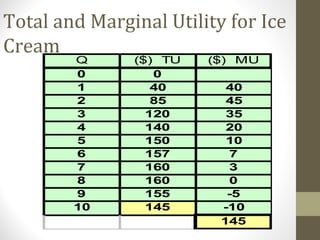
Total and Marginal Utility for Ice
Cream
Q ($) TU ($) MU
0 0
1 40 40
2 85 45
3 120 35
4 140 20
5 150 10
6 157 7
7 160 3
8 160 0
9 155 -5
10 145 -10
145
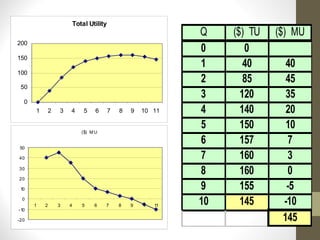
Total Utility
0
50
100
150
200
1 2 3 4 5 6 7 8 9 10 11
($) M U
-20
-10
0
10
20
30
40
50
1 2 3 4 5 6 7 8 9 1 11
Q ($) TU ($) MU
0 0
1 40 40
2 85 45
3 120 35
4 140 20
5 150 10
6 157 7
7 160 3
8 160 0
9 155 -5
10 145 -10
145
How much ice cream does Jill buy in a
month?
Some facts of life:
• Limited income
• Opportunity cost of making a choice:
Buying ice cream leaves Jill less money to
buy other things: each dollar spent on ice cream could be spent
on hamburger.
• In fact, consumers compare the (expected) utility derived from
one additional dollar spent on one good to the utility derived
from one additional dollar spent on another good.
More facts
• The prices of hamburger and ice cream are market-
given; the consumer cannot change the price of a good.
• Jill, like any other rational consumer, wishes to
maximize her utility.
• The opportunity cost of one dollar spent on ice cream is
the forgone utility of one dollar that could be on
hamburger.
• If the utility of one additional dollar of ice cream is
greater than the utility of the last dollar spent on
hamburger, Jill can increase her total utility by spending
one dollar less on hamburger and one dollar more one
ice cream.

Utility theory microeco

  • 1.
    The Consumer Theory How ConsumersMake Choices under Income Constraints
  • 2.
    Some Questions • Whatis behind a consumer’s demand curve? • How do consumers choose from among various consumer “goods”? • What determines the value of a consumer good?
  • 3.
    Utility • The valuea consumer places on a unit of a good or service depends on the pleasure or satisfaction he or she expects to derive form having or consuming it at the point of making a consumption (consumer) choice. • In economics the satisfaction or pleasure consumers derive from the consumption of consumer goods is called “utility”. • Consumers, however, cannot have every thing they wish to have. Consumers’ choices are constrained by their incomes. • Within the limits of their incomes, consumers make their consumption choices by evaluating and comparing consumer goods with regard to their “utilities.”
  • 4.
    Our basic assumptionsabout a “rational” consumer: • Consumers are utility maximizers • Consumers prefer more of a good (thing) to less of it. • Facing choices X and Y, a consumer would either prefer X to Y or Y to X, or would be indifferent between them. • Transitivity: If a consumer prefers X to Y and Y to Z, we conclude he/she prefers X to Z • Diminishing marginal utility: As more and more of good is consumed by a consumer, ceteris paribus, beyond a certain point the utility of each additional unit starts to fall.
  • 5.
    How to MeasureUtility Measuring utility in “utils” (Cardinal): • Jack derives 10 utils from having one slice of pizza but only 5 utils from having a burger. • In many introductory microeconomics textbooks this approach to measuring utility is still considered effective for teaching purposes. Measuring utility by comparison (Ordinal): • Jill prefers a burger to a slice of pizza and a slice of pizza to a hotdog. Often consumers are able to be more precise in expressing their preferences. For example, we could say: • Jill is willing to trade a burger for four hotdogs but she will give up only two hotdogs for a slice of pizza. • We can infer that to Jill, a burger has twice as much utility as a slice of pizza, and a slice of pizza has twice as much utility as a hotdog.
  • 6.
    Utility and Money •Because we use money (rather than hotdogs!) in just about all of our trade transactions, we might as well use it as our comparative measure of utility. (Note: This way of measuring utility is not much different from measuring utility in utils) • Jill could say: I am willing to pay $4 for a burger, $2 for a slice of pizza and $1 for a hotdog. Note: Even though Jill obviously values a burger more (four times as much) than a hot dog, she may still choose to buy a hotdog, even if she has enough money to buy a burger, or a slice of pizza, for that matter. (We will see why and how shortly.)
  • 7.
    Total Utility versusMarginal Utility • Marginal utility is the utility a consumer derives from the last unit of a consumer good she or he consumes (during a given consumption period), ceteris paribus. • Total utility is the total utility a consumer derives from the consumption of all of the units of a good or a combination of goods over a given consumption period, ceteris paribus. Total utility = Sum of marginal utilities
  • 8.
    The Law ofDiminishing Marginal Utility • Over a given consumption period, the more of a good a consumer has, or has consumed, the less marginal utility an additional unit contributes to his or her overall satisfaction (total utility). • Alternatively, we could say: over a given consumption period, as more and more of a good is consumed by a consumer, beyond a certain point, the marginal utility of additional units begins to fall.
  • 9.
    Total and MarginalUtility for Ice Cream Q ($) TU ($) MU 0 0 1 40 40 2 85 45 3 120 35 4 140 20 5 150 10 6 157 7 7 160 3 8 160 0 9 155 -5 10 145 -10 145
  • 10.
    Total Utility 0 50 100 150 200 1 23 4 5 6 7 8 9 10 11 ($) M U -20 -10 0 10 20 30 40 50 1 2 3 4 5 6 7 8 9 1 11 Q ($) TU ($) MU 0 0 1 40 40 2 85 45 3 120 35 4 140 20 5 150 10 6 157 7 7 160 3 8 160 0 9 155 -5 10 145 -10 145
  • 11.
    How much icecream does Jill buy in a month? Some facts of life: • Limited income • Opportunity cost of making a choice: Buying ice cream leaves Jill less money to buy other things: each dollar spent on ice cream could be spent on hamburger. • In fact, consumers compare the (expected) utility derived from one additional dollar spent on one good to the utility derived from one additional dollar spent on another good.
  • 12.
    More facts • Theprices of hamburger and ice cream are market- given; the consumer cannot change the price of a good. • Jill, like any other rational consumer, wishes to maximize her utility. • The opportunity cost of one dollar spent on ice cream is the forgone utility of one dollar that could be on hamburger. • If the utility of one additional dollar of ice cream is greater than the utility of the last dollar spent on hamburger, Jill can increase her total utility by spending one dollar less on hamburger and one dollar more one ice cream.