Topic:
GAAP
(Generally Accepted
Accounting Principles)
Prof. Faisal Azam
 What is G.A.A.P?
 Why these principles are necessary to
follow?
 Third party satisfaction
 Principles
 Conclusion
Outline
What is G.A.A.P?
GAAP (Generally Accepted Accounting
Principles):
• The common set of accounting principles, standards
and procedures.
• Combination of authoritative standards (set by policy boards)
and simply, the commonly accepted ways.
Why these principles are necessary to follow?
These principles are necessary to follow because it helps a lot in
1. making long term decisions
2. financial decisions
3. maintaining records.
4. It makes easy to compare financial statements of different com
panies.
Third Party Satisfaction
Third parties like
1. creditors,
2. banks,
3. share holders
must have to rely on reported financial statements so it must be
free of errors, inconsistency and bias .It could only be possible
by following G.A.A.P.
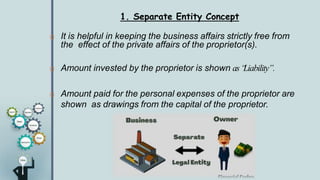
1. Separate Entity Concept
 It is helpful in keeping the business affairs strictly free from
the effect of the private affairs of the proprietor(s).
 Amount invested by the proprietor is shown as“Liability”.
 Amount paid for the personal expenses of the proprietor are
shown as drawings from the capital of the proprietor.
2.Money Measurement Concept
 Only the transactions which can be recorded in ter
ms of money are recorded.
 This is being used so as to provide a common sta
ndard (i.e.money) for measurement.
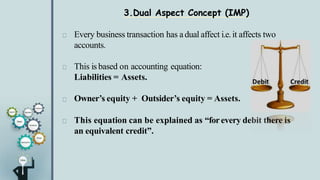
3.Dual Aspect Concept (IMP)
Every business transaction has adual affect i.e.it affects two
accounts.
This isbased on accounting equation:
Liabilities = Assets.
Owner’s equity + Outsider’s equity = Assets.
This equation can be explained as “forevery debit there is
an equivalent credit”.
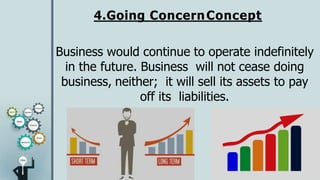
4.Going ConcernConcept
Business would continue to operate indefinitely
in the future. Business will not cease doing
business, neither; it will sell its assets to pay
off its liabilities.
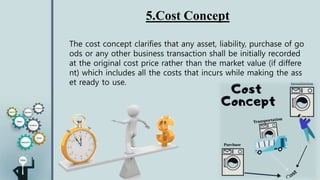
5.Cost Concept
The cost concept clarifies that any asset, liability, purchase of go
ods or any other business transaction shall be initially recorded
at the original cost price rather than the market value (if differe
nt) which includes all the costs that incurs while making the ass
et ready to use.
6.Accounting Period Concept
Accounting period is the period of time, at the end of which financial
statements are prepared to throw light on the results of the operations at
the end of arelevant period and the financial position at the end of a
relevant period.
7.Realization Concept
The realization principle is the concept that revenue can only be recognized
once the original goods or services associated with the revenue have been
delivered or rendered, respectively. Thus, revenue can only be recognized
after it has been earned.
A customer pays $1,000 in advance for a custom-designed product. The
seller does not realize the $1,000 of revenue until its work on the product is
complete.
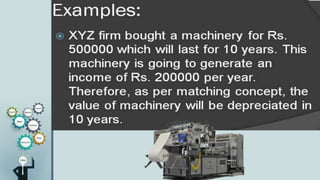
Matching Concept8.
Accounting Convention
What Is an Accounting Convention?
Accounting conventions are guidelines used to help companies determine how
to record certain business transactions that have not yet been fully addressed
by accounting standards. These procedures and principles are not legally
binding but are generally accepted by accounting bodies
In short, accounting conventions serve to fill in the gaps not y
et addressed by accounting standards.
Accounting Conventions
Prudence / Conservatism
Don’t anticipate a profit . But provide for All P
ossible losses,
In other words , it takes in consideration all pr
ospective losses but not prospective profit.
Consistency
A company should apply the same accounting principle
s across different accounting cycles. Once it chooses a
method it is urged to stick with it in the future, unless it
has a good reason to do otherwise. Without this conven
tion, investors' ability to compare and assess how the c
ompany performs from one period to the next is made
much more challenging.
Full Disclosure
Financial statements should be honestly prepared and
sufficiently, disclose information which is of material
interest to proprietors, present and potential creditors
and investors.
Materiality
Only material or significant details are to be recorded
exit the insignificant or small details. This is done
to prevent overburdening of accounts.
Accounting GAAP rules

Accounting GAAP rules

  • 1.
  • 2.
     What isG.A.A.P?  Why these principles are necessary to follow?  Third party satisfaction  Principles  Conclusion Outline
  • 3.
    What is G.A.A.P? GAAP(Generally Accepted Accounting Principles): • The common set of accounting principles, standards and procedures. • Combination of authoritative standards (set by policy boards) and simply, the commonly accepted ways.
  • 4.
    Why these principlesare necessary to follow? These principles are necessary to follow because it helps a lot in 1. making long term decisions 2. financial decisions 3. maintaining records. 4. It makes easy to compare financial statements of different com panies.
  • 5.
    Third Party Satisfaction Thirdparties like 1. creditors, 2. banks, 3. share holders must have to rely on reported financial statements so it must be free of errors, inconsistency and bias .It could only be possible by following G.A.A.P.
  • 6.
    1. Separate EntityConcept  It is helpful in keeping the business affairs strictly free from the effect of the private affairs of the proprietor(s).  Amount invested by the proprietor is shown as“Liability”.  Amount paid for the personal expenses of the proprietor are shown as drawings from the capital of the proprietor.
  • 7.
    2.Money Measurement Concept Only the transactions which can be recorded in ter ms of money are recorded.  This is being used so as to provide a common sta ndard (i.e.money) for measurement.
  • 8.
    3.Dual Aspect Concept(IMP) Every business transaction has adual affect i.e.it affects two accounts. This isbased on accounting equation: Liabilities = Assets. Owner’s equity + Outsider’s equity = Assets. This equation can be explained as “forevery debit there is an equivalent credit”.
  • 9.
    4.Going ConcernConcept Business wouldcontinue to operate indefinitely in the future. Business will not cease doing business, neither; it will sell its assets to pay off its liabilities.
  • 10.
    5.Cost Concept The costconcept clarifies that any asset, liability, purchase of go ods or any other business transaction shall be initially recorded at the original cost price rather than the market value (if differe nt) which includes all the costs that incurs while making the ass et ready to use.
  • 11.
    6.Accounting Period Concept Accountingperiod is the period of time, at the end of which financial statements are prepared to throw light on the results of the operations at the end of arelevant period and the financial position at the end of a relevant period.
  • 12.
    7.Realization Concept The realizationprinciple is the concept that revenue can only be recognized once the original goods or services associated with the revenue have been delivered or rendered, respectively. Thus, revenue can only be recognized after it has been earned. A customer pays $1,000 in advance for a custom-designed product. The seller does not realize the $1,000 of revenue until its work on the product is complete.
  • 13.
  • 15.
  • 16.
    What Is anAccounting Convention? Accounting conventions are guidelines used to help companies determine how to record certain business transactions that have not yet been fully addressed by accounting standards. These procedures and principles are not legally binding but are generally accepted by accounting bodies In short, accounting conventions serve to fill in the gaps not y et addressed by accounting standards.
  • 17.
  • 18.
    Prudence / Conservatism Don’tanticipate a profit . But provide for All P ossible losses, In other words , it takes in consideration all pr ospective losses but not prospective profit.
  • 19.
    Consistency A company shouldapply the same accounting principle s across different accounting cycles. Once it chooses a method it is urged to stick with it in the future, unless it has a good reason to do otherwise. Without this conven tion, investors' ability to compare and assess how the c ompany performs from one period to the next is made much more challenging.
  • 20.
    Full Disclosure Financial statementsshould be honestly prepared and sufficiently, disclose information which is of material interest to proprietors, present and potential creditors and investors.
  • 21.
    Materiality Only material orsignificant details are to be recorded exit the insignificant or small details. This is done to prevent overburdening of accounts.