Economic Utilities Added Value
UTILITY The VALUE producers and marketers add to raw materials when they make them into a product and offer them for sale to the public. There are five types of utility .
FORM UTILITY Involves changing RAW MATERIALS or PUTTING PARTS TOGETHER to make them more useful.  RAW MATERIALS: When you cut down a tree and use the lumber to create pencils, paper, furniture, etc., the tree now  becomes more valuable to the customer.
FORM UTILITY Assembly When a manufacturer assembles parts to make a product, the combined individual parts have more value then when they were separate.
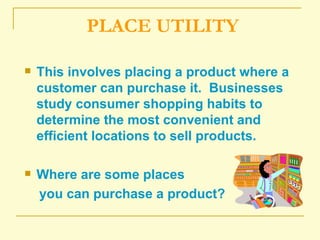
PLACE UTILITY This involves placing a product where a customer can purchase it.  Businesses study consumer shopping habits to determine the most convenient and efficient locations to sell products. Where are some places you can purchase a product?
TIME UTILITY Time utility is having a product available at a certain time of the year or at a convenient time of the day.  Value is added when marketers make them available at the right time. What are some products that sell better during certain hours of the day?  Days or months of the year?
POSSESSION UTILITY The exchange of a product for some monetary value is possession utility.  Purchasing the product has given it added value. What are some ways you can purchase a product?
INFORMATION UTILITY This involves communication with the customer. Sales people, displays, packaging and labeling, advertising, sales brochures… Anything used to encourage sales gives the product added value.

Economic utilities

  • 1.
  • 2.
    UTILITY The VALUEproducers and marketers add to raw materials when they make them into a product and offer them for sale to the public. There are five types of utility .
  • 3.
    FORM UTILITY Involveschanging RAW MATERIALS or PUTTING PARTS TOGETHER to make them more useful. RAW MATERIALS: When you cut down a tree and use the lumber to create pencils, paper, furniture, etc., the tree now becomes more valuable to the customer.
  • 4.
    FORM UTILITY AssemblyWhen a manufacturer assembles parts to make a product, the combined individual parts have more value then when they were separate.
  • 5.
    PLACE UTILITY Thisinvolves placing a product where a customer can purchase it. Businesses study consumer shopping habits to determine the most convenient and efficient locations to sell products. Where are some places you can purchase a product?
  • 6.
    TIME UTILITY Timeutility is having a product available at a certain time of the year or at a convenient time of the day. Value is added when marketers make them available at the right time. What are some products that sell better during certain hours of the day? Days or months of the year?
  • 7.
    POSSESSION UTILITY Theexchange of a product for some monetary value is possession utility. Purchasing the product has given it added value. What are some ways you can purchase a product?
  • 8.
    INFORMATION UTILITY Thisinvolves communication with the customer. Sales people, displays, packaging and labeling, advertising, sales brochures… Anything used to encourage sales gives the product added value.