International Journal of Business Marketing and Management (IJBMM)
Volume 8 Issue 2 Mar-Apr 2023, P.P. 09-16
ISSN: 2456-4559
www.ijbmm.com
International Journal of Business Marketing and Management (IJBMM) Page 9
University Students Learning Styles During Covid-19
1
Urandelger Gantulga PhD, 2
Enkhbold Chuluunbaatar PhD,
NUM. Mongolia, urandelger@num.edu.mn
NUM, Mongolia, enkhbold_ch@num.edu.mn
Abstract: The closures of schools, colleges, and universities in many countries worldwide during the COVID-
19 pandemic have reshaped every aspect of our normal lives and educational experience. As a result of
extended periods of lockdown, whole populations have been advised to stay in their households and
communicate with others through distance electronic communications methods such as Zoom, Teams, Google
meetings etc. More than 1 billion students risk falling behind in their education due to school, college, and
university closures aimed at containing the spread of COVID-19. It is essential to understand how to mitigate
the impact of school closures, address learning losses and adapt education systems, particularly for vulnerable
and disadvantaged communities. The study aims to investigate the relationship between students’ learning styles
and motivation and the demographic characteristics of the students in relation to learning styles in a web-based
learning context. To achieve the research purpose, a survey was conducted on students. Four hundred six
effective questionnaires were collected online, and the data were analyzed by SPSS 23 and Smart PLS 3.3.
Firstly, this study reveals significant learning style differences among students. Secondly, there were significant
differences among students’ age, gender, major and parent education level.
Keywords: COVID-19, learning style, motivation, demographic variables.
I. INTRODUCTION
It is important to understand how to mitigate the impact of school closures, address learning losses and
adapt education systems, particularly for vulnerable and disadvantaged communities. School
closures caused students to adapt to a new educational experience, namely digital learning. With the closure of
educational institutions, the need for a rapid transition from physical learning to digital learning emerged.
The entire instructional design, curriculum components, and teaching and learning methods must be modified to
meet the newly emerged situation. This newly emerged situation is affecting the learning style of students in a
great extent. However, how the COVID-19 lockdown influences students’ learning style with different
demographic characteristics has not yet been comprehensively studied.
The quality and effectiveness of digital learning is closely linked to learning styles. Digital learning styles
depend on a student’s digital literacy and demographic differences. Learning styles refer to the method used by
an individual to focus and obtain new and difficult information. Students use a variety of styles in the process of
learning. A learning style can be defined as the application, within a learning situation, of an individual’s typical
mode of problem-solving, thinking, perceiving and remembering (1). One of the models of learning styles is the
social aspect of how students interact with their instructors and peers.
This research will employ the social interaction learning style theory by Grasha and Riechmann. They consider
learning styles as social interactions and define them as different roles that students have
in their interactions with classmates, teachers and course content (2). A 60-item survey with 6 subscales
representing the learning style dimensions is used—three items for motivation and the remaining 6 questions for
participants’ demographic information.
This study aimed to determine how students' learning styles influence motivation in web-based courses and
flipped classrooms. Therefore, the main research questions are defined as follows.
1. How do students’ different learning styles influence students’ motivation in the Mongolian university
learning context?
2. How differently do the demographic characteristics of the students relate to learning styles?
II. Theoretical Background And Hypotheses Development
Learning styles are considered by some scholars as an influencing factor on the learners’ educational
performance, learning quality, effectiveness and efficiency. Therefore, investigating learning styles is
considered an important determining factor of learning progress. Grasha and Riechmann (1996) consider
University Students Learning Styles During Covid-19
International Journal of Business Marketing and Management (IJBMM) Page 10
learning styles as social interactions, and they define them as different roles that students have in interaction
with classmates, teachers and course content.
They suggest that learning styles can be identified through social and emotional dimensions such as attitudes
toward learning, teachers, classmates and classroom. This study aims to determine the types of learning styles
and intrinsic motivation of Mongolian university students and to the relationship between learning styles and
motivation of students.
1.1 Learning styles
Some scholars consider learning styles as an influencing factor on the learners’ educational performance. It is
important to identify learners’ learning styles for leading teaching and learning activities, because it can help
teachers to teach and treat their students with respect to the students’ certain characteristics and it can make
learning more effective and efficient.
Grasha (3) (2) (4) defined learning style as ―a personal quality that influences a student’s ability to acquire
information, to interact with peers and teachers and otherwise participate in learning experiences.‖ Grasha and
Riechmann classify learning styles into six categories, each of which has its own characteristics.
 Independent - students who learn on their own
 Dependent - students who rely heavily on their teachers to learn
 Collaborative - students who cooperate with others to learn
 Competitive - students who compete with others
 Participant - students who get involved in learning activities
 Avoidant - students who are reserved and apprehensive about learning
1.2 Demographic variables
Demographic information is very important in determining students’ learning styles. (5) (6) Students’ learning
style differs significantly according to the student’s academic background. (7)
Gender differences result in the learning styles of students. Chen and Tsai (8) examined students’ attitudes
toward web learning in Taiwan and found that female students had significantly higher scores on the helpfulness
subscale than male students. Tekinarslan (9) explored Adaptive content creation for personalized e-learning
using web services. Influences of gender on Turkish undergraduate students’ attitudes toward the web as a
learning tool and found that male students possessed more positive attitudes toward self-efficacy than female
students. Due to the COVID-19 pandemic, in flipped online learning, students learn the instruction content
independently, primarily using online resources, such as materials in Microsoft 360, google meeting etc.
Mongolian universities widely closed physical operations and most learning activities were conducted online.
There is a need to examine how the age, gender, major, and education of parents differed among students'
learning styles under the flipped classroom model.
1.3 Flipped classroom
Learning is a complicated process in which personalization is crucial for an improved learning experience (10).
The flipped classroom blends digital and traditional classroom learning, in which students are responsible for
studying course materials, such as video lectures and practice problems as homework, with active, group-based
problem-solving activities targeting higher-order thinking skills occurring in the classroom (11) (12). With the
flipped approach, students can control their learning pace and acquire ownership of the learning process; in this
manner, lower-achieving students can gain a better understanding via class discussions, while higher-performing
students will not become bored in class (13). In addition, this approach increased students’ self-confidence and
participation in class activities because they came to class prepared (14) (15). Similarly, Al-Harbi and
Alshumaimeri (16) (2016) reported that students felt more confident with flipped English classes, which made
learning more productive and engaging. In the flipped classroom, the most salient benefit is its support for
collaborative learning and discussions within the classroom (17). Compared with independent learning, the
flipped approach stresses interdependence through sharing ideas, knowledge, and experiences (18). In particular,
this active student-centred approach has led to deeper learning (19). Adding to this, Ryan and Deci (20) found
that students involved in a learning environment which are supported and valued by others, for example,
instructors and peers, feel an affinity toward their learning. Moreover, the flipped classroom emphasizes
human–technology and human-human interactions. Further, because students often have diverse backgrounds,
for example, different ways of acquiring and processing information, the flipped classroom may be better able to
accommodate them. Be that as it may, King and Piotrowski (12) showed that one particular difficulty associated
with flipped classrooms is students not being adequately prepared for this strategy, which leads them to discount
the value of the flipped classroom.
In this regard, the students’ personalities may play a critical role (21) (22) (Arockiam & Selvaraj, 2013; Chae,
Lee, & Seo, 2016). Accordingly, there is a need to redesign the activities of the flipped classroom and examine
how human factors, such as age, gender and cognitive learning style, interact with the flipped classroom.
University Students Learning Styles During Covid-19
International Journal of Business Marketing and Management (IJBMM) Page 11
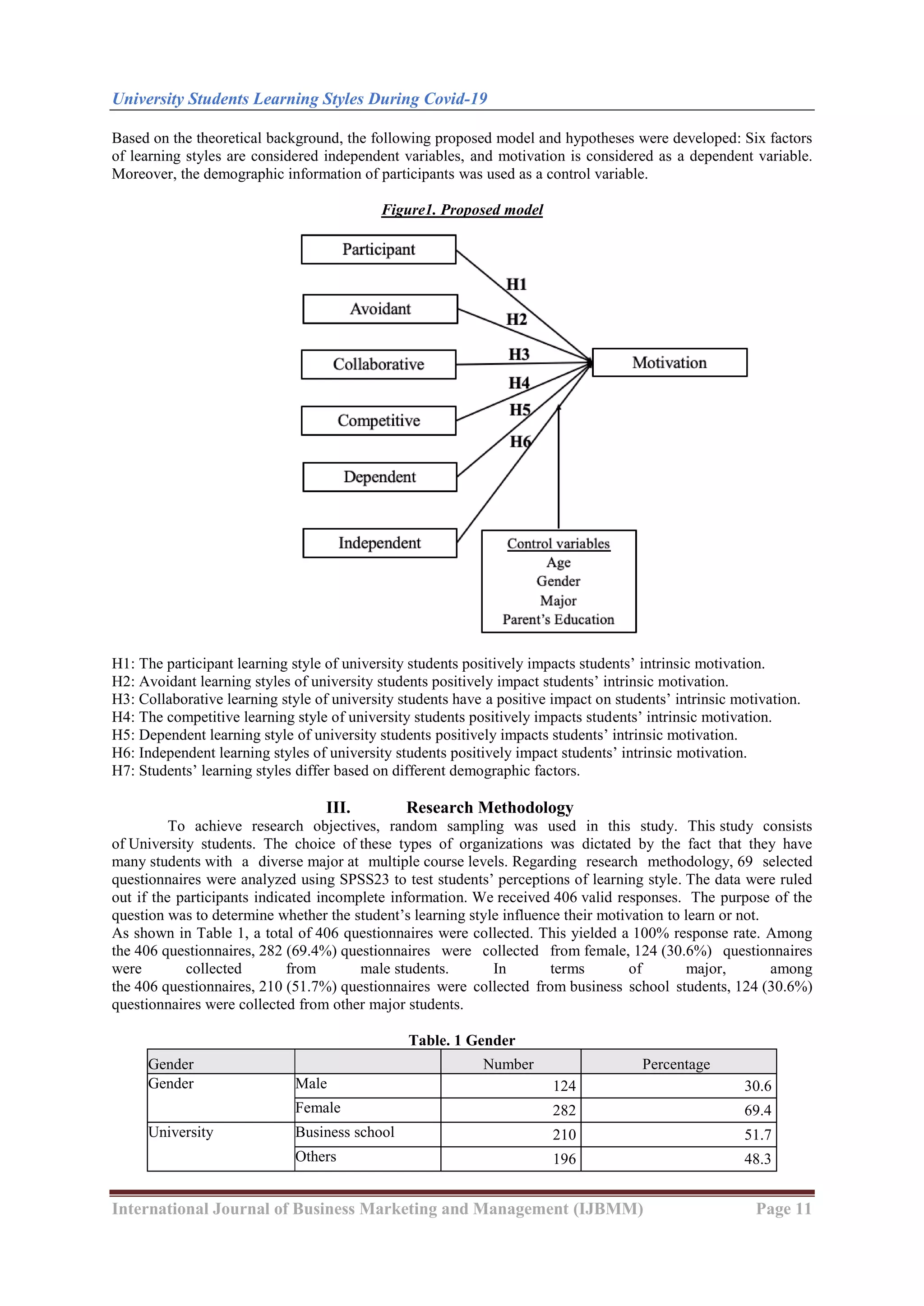
Based on the theoretical background, the following proposed model and hypotheses were developed: Six factors
of learning styles are considered independent variables, and motivation is considered as a dependent variable.
Moreover, the demographic information of participants was used as a control variable.
Figure1. Proposed model
H1: The participant learning style of university students positively impacts students’ intrinsic motivation.
H2: Avoidant learning styles of university students positively impact students’ intrinsic motivation.
H3: Collaborative learning style of university students have a positive impact on students’ intrinsic motivation.
H4: The competitive learning style of university students positively impacts students’ intrinsic motivation.
H5: Dependent learning style of university students positively impacts students’ intrinsic motivation.
H6: Independent learning styles of university students positively impact students’ intrinsic motivation.
H7: Students’ learning styles differ based on different demographic factors.
III. Research Methodology
To achieve research objectives, random sampling was used in this study. This study consists
of University students. The choice of these types of organizations was dictated by the fact that they have
many students with a diverse major at multiple course levels. Regarding research methodology, 69 selected
questionnaires were analyzed using SPSS23 to test students’ perceptions of learning style. The data were ruled
out if the participants indicated incomplete information. We received 406 valid responses. The purpose of the
question was to determine whether the student’s learning style influence their motivation to learn or not.
As shown in Table 1, a total of 406 questionnaires were collected. This yielded a 100% response rate. Among
the 406 questionnaires, 282 (69.4%) questionnaires were collected from female, 124 (30.6%) questionnaires
were collected from male students. In terms of major, among
the 406 questionnaires, 210 (51.7%) questionnaires were collected from business school students, 124 (30.6%)
questionnaires were collected from other major students.
Table. 1 Gender
Gender Number Percentage
Gender Male 124 30.6
Female 282 69.4
University Business school 210 51.7
Others 196 48.3
University Students Learning Styles During Covid-19
International Journal of Business Marketing and Management (IJBMM) Page 12
Age 16-18 46 11.3
19-21 246 60.5
22-25 50 12.3
Over 25 64 15.7
Father’s education Elementary school 64 15.7
High school 186 45.8
Above bachelor 156 38.4
Mother’s education Elementary school 60 14.7
High school 144 35.4
Above bachelor 202 49.7
Total 406 100
In the case of student’s age, 16-18 years old students are 46 (11.3%), 19-21 years old students are
246 (60.5%), 22-25 years old students are 50 (12.3%), over the 25 years old students are 64 (15.7%).
For parent’s education: we separately investigated the influence of educational level of parents on their
children’s learning styles. In the case of father’s education: 64 (15.7) are the obtained elementary school or
below elementary school education, 186 (45.8) are the graduated from high school and college, the remaining
156 (38.5) are the graduated from bachelor and graduate school.
In the case of mother’s education: 60 (14.7) obtained elementary school, or below elementary school education,
144 (35.5) graduated from high school and college, remaining 202 (49.8) the graduated from bachelor and
graduate school.
Measurement
There are 69 items used to measure two constructs. All items were measured on a five-point, Likert scale (1=
strongly disagree and 5= strongly agree) except demographic variables, measured by binary nominal variables.
IV. RESULTS
4.1 Data Analysis Procedure
The data collected through a self-administered survey was entered into the SPSS sheet. The
collected data was analyzed using Statistical Package for Social Sciences 23.0 (SPSS). The
structural equation model (SEM) is mainly adopted to test the hypotheses. In order to avoid an
incorrect decision, the level of significance is determined. A high level of significant value in
this study is determined by p ≤ 0.05 (5%). A correlation with a significance level of p ≤ 0.05 is considered
significant. Independent sample t-test was used to evaluate the influence of demographics of student’s learning
styles on motivation. Partial Least Square (PLS) was employed to test the model and hypotheses. The model
estimation was performed by Smart PLS 3.0 (23). T-values were calculated using a bootstrapping procedure
with 1000 resamples (24). Smart PLS-3 path models have two sets of the linear equation: Inner model
(structural model) and outer model (measurement model). The inner model specifies the relationship between
unobserved or latent variables, and the outer model identifies the relationships between the latent variable and
its observed manifest variable (25).
1.2 Measurement Model
The general approach recommended by Gefen et al. (26) for evaluating validity and reliability was
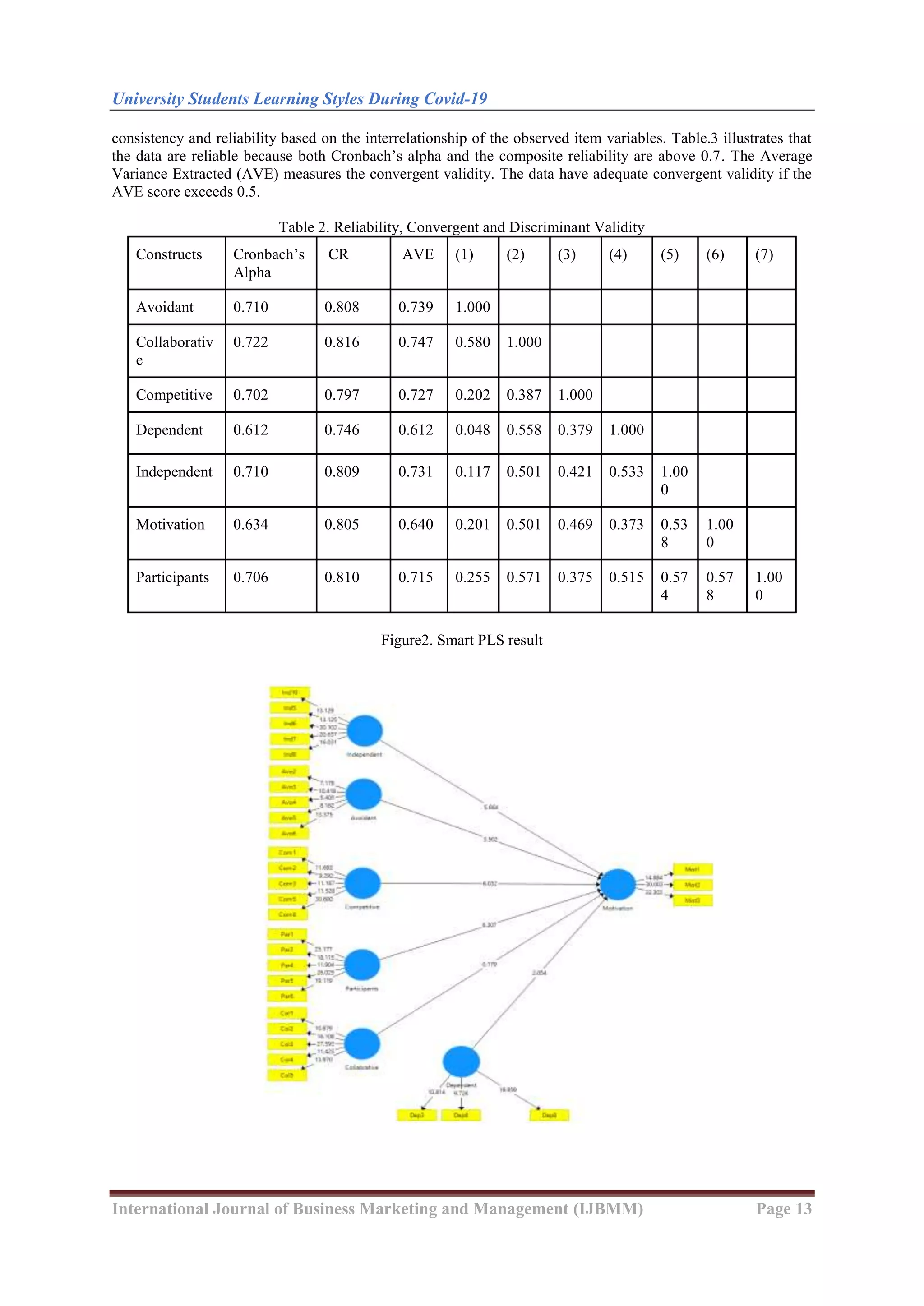
followed. Table. 2 presents the discriminant validity test, which is performed by cross loading the data among
the variables and shows that all items exhibit high loading (>0.7) no item loaded higher on the constructs, which
indicates strong discriminant validity. The aim of the discriminant validity analysis is to provide a clear
assessment of whether the proposed construct has the highest relationship with its indicators compared to the
other construct. Convergent and discriminant validity was examined for the assessment of validity. The average
variance extracted (AVE) is used as a criterion of convergent validity (27). If AVE is more than 0.5, it indicates
that the construct has sufficient convergent validity. To measure internal consistency, composite reliability (CR)
is used. The value of CR must be higher than 0.7. The data shows that CR is more than 0.7 and AVE is more
than 0.5, so all constructs have convergent validity. Furthermore, Fornell and Larcker’s criterion was used to
assess discriminant validity. The AVE of each latent variable should be higher than the squared correlations
with all other latent variables (AVE > φ²). The data indicates that all AVE exceed the squared correlation, so all
constructs have discriminant validity. Cronbach’s alpha and composite reliability are used to measure internal
University Students Learning Styles During Covid-19
International Journal of Business Marketing and Management (IJBMM) Page 13
consistency and reliability based on the interrelationship of the observed item variables. Table.3 illustrates that
the data are reliable because both Cronbach’s alpha and the composite reliability are above 0.7. The Average
Variance Extracted (AVE) measures the convergent validity. The data have adequate convergent validity if the
AVE score exceeds 0.5.
Table 2. Reliability, Convergent and Discriminant Validity
Constructs Cronbach’s
Alpha
CR AVE (1) (2) (3) (4) (5) (6) (7)
Avoidant 0.710 0.808 0.739 1.000
Collaborativ
e
0.722 0.816 0.747 0.580 1.000
Competitive 0.702 0.797 0.727 0.202 0.387 1.000
Dependent 0.612 0.746 0.612 0.048 0.558 0.379 1.000
Independent 0.710 0.809 0.731 0.117 0.501 0.421 0.533 1.00
0
Motivation 0.634 0.805 0.640 0.201 0.501 0.469 0.373 0.53
8
1.00
0
Participants 0.706 0.810 0.715 0.255 0.571 0.375 0.515 0.57
4
0.57
8
1.00
0
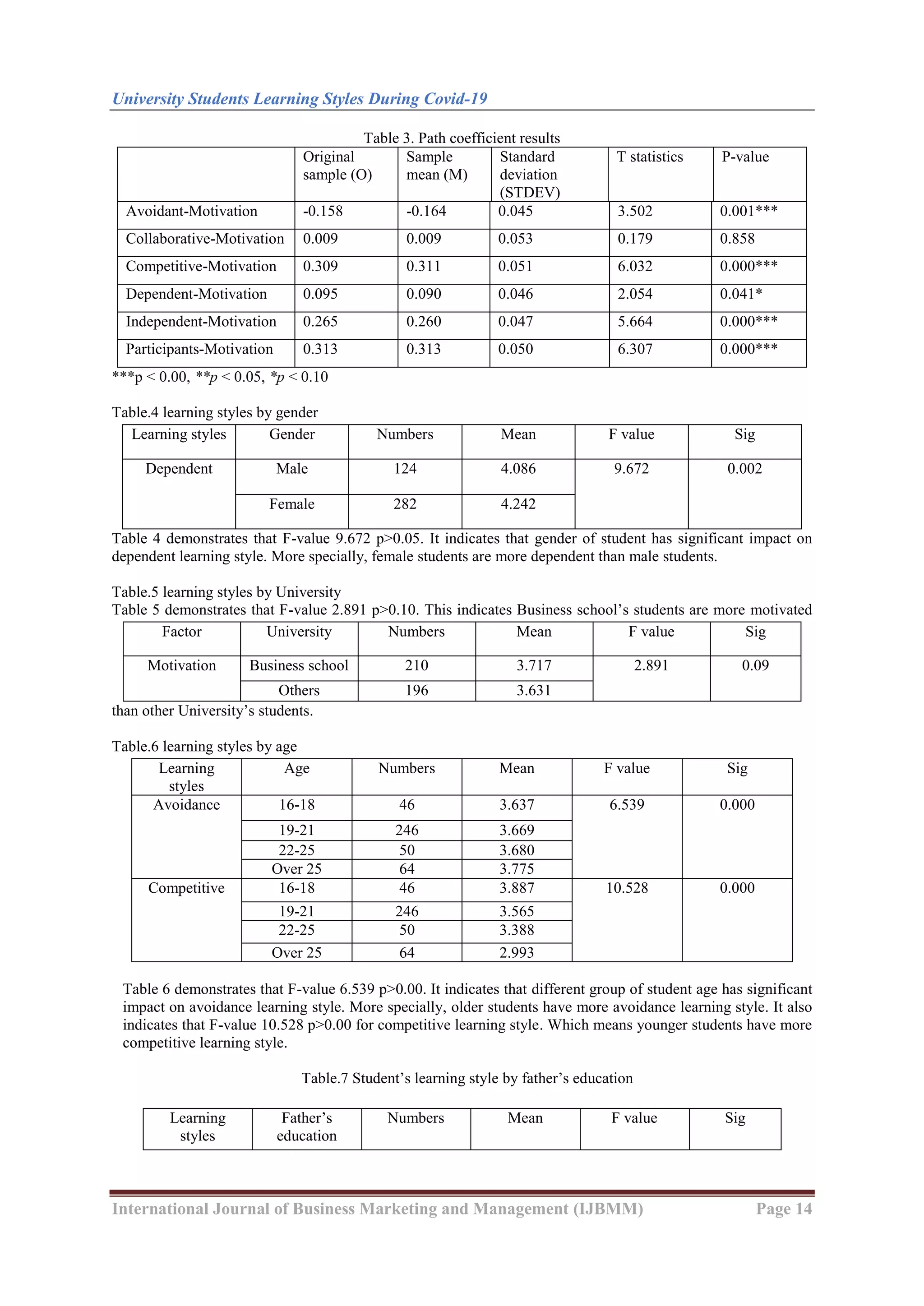
Figure2. Smart PLS result
University Students Learning Styles During Covid-19
International Journal of Business Marketing and Management (IJBMM) Page 14
Table 3. Path coefficient results
Original
sample (O)
Sample
mean (M)
Standard
deviation
(STDEV)
T statistics P-value
Avoidant-Motivation -0.158 -0.164 0.045 3.502 0.001***
Collaborative-Motivation 0.009 0.009 0.053 0.179 0.858
Competitive-Motivation 0.309 0.311 0.051 6.032 0.000***
Dependent-Motivation 0.095 0.090 0.046 2.054 0.041*
Independent-Motivation 0.265 0.260 0.047 5.664 0.000***
Participants-Motivation 0.313 0.313 0.050 6.307 0.000***
***p < 0.00, **p < 0.05, *p < 0.10
Table.4 learning styles by gender
Table 4 demonstrates that F-value 9.672 p>0.05. It indicates that gender of student has significant impact on
dependent learning style. More specially, female students are more dependent than male students.
Table.5 learning styles by University
Table 5 demonstrates that F-value 2.891 p>0.10. This indicates Business school’s students are more motivated
than other University’s students.
Table.6 learning styles by age
Table 6 demonstrates that F-value 6.539 p>0.00. It indicates that different group of student age has significant
impact on avoidance learning style. More specially, older students have more avoidance learning style. It also
indicates that F-value 10.528 p>0.00 for competitive learning style. Which means younger students have more
competitive learning style.
Table.7 Student’s learning style by father’s education
Learning styles Gender Numbers Mean F value Sig
Dependent Male 124 4.086 9.672 0.002
Female 282 4.242
Factor University Numbers Mean F value Sig
Motivation Business school 210 3.717 2.891 0.09
Others 196 3.631
Learning
styles
Age Numbers Mean F value Sig
Avoidance 16-18 46 3.637 6.539 0.000
19-21 246 3.669
22-25 50 3.680
Over 25 64 3.775
Competitive 16-18 46 3.887 10.528 0.000
19-21 246 3.565
22-25 50 3.388
Over 25 64 2.993
Learning
styles
Father’s
education
Numbers Mean F value Sig
University Students Learning Styles During Covid-19
International Journal of Business Marketing and Management (IJBMM) Page 15
Table 7 demonstrates that F-value 2.310 p>0.01. It indicates that a father’s education has a significant impact on
the learning style of his child. More specially, the lower education father has, it tends that a child has more
competitive learning style. In other hand, the higher education father has, it tends that a child has less
competitive learning style.
Table.8 Student’s learning style by mother’s education
Table 8 demonstrates that F-value 3.108 p>0.04, F-value 2.605, p>0.07. It indicates that a mother’s education
has a significant impact on the learning style of her child. More specially, the higher education mother has, a
child tends to have a more competitive learning style. On the other hand, the higher education mother has, it
tends that a child has a less competitive learning style. It surprisingly indicates that the higher education
mother has, tends a child has a more collaborative learning style. On the other hand, the lower education
mother has, it tends that a child has a less collaborative learning style.
V. Discussion
All factors have convergent and discriminant validity. The survey questionnaire could have identified
students’ learning styles in the Covid-19 and Mongolian contexts. The hypothesis states that six learning style
factors have a positive impact on motivation is proved. Especially, competitive, independent and participant
learning styles strongly influence motivation among Mongolian university students. Demographic variables
have shown surprising results in relation to students’ learning styles. First, female students are more dependent
than male students. Second, business school students are more motivated than other University students. Third, a
student’s age significantly impacts avoidance learning style. More specially, older students have a more
avoidance learning style, while younger students have a more competitive learning style. Fourth, the lower
education father has, a child tends to have a more competitive learning style. On the other hand, the higher
education father has, a child tends to have a less competitive learning style. Fifth, the higher education mother
has, a child tends to have a more competitive learning style. On the other hand, the lower education mother has,
it tends that a child has a less competitive learning style. Lastly, it surprisingly indicates that the higher
education mother has, it tends that a child has a more collaborative learning style. On the other hand, the lower
education mother has, it tends that a child has a less collaborative learning style.
REFERENCES
[1]. Cassidy * S. Learning Styles: An overview of theories, models, and measures. Educational Psychology.
2004;24(4):419-44.
[2]. Grasha AF. Teaching with Style: A Practical Guide to Enhancing Learning by Understanding Teaching
and Learning Styles. Pittsburgh, PA: Alliance Publishers; 1996.
Competitive Elementary 64 3.537 2.310 0.01
High school 186 3.500
Above
bachelor
156 3.346
Learning
styles
Mother’s
education
Numbers Mean F value Sig
Competitive Elementary 60 3.510 3.108 0.04
High school 144 3.432
Above
bachelor
202 3.363
Collaborative Elementary 60 3.783 2.605 0.07
High school 144 3.832
Above
bachelor
202 3.983
University Students Learning Styles During Covid-19
International Journal of Business Marketing and Management (IJBMM) Page 16
[3]. Baneshi AR, Dehghan Tezerjani M, Mokhtarpour H. Grasha-Richmann college students' learning
styles of classroom participation: role of gender and major. Journal of advances in medical education &
professionalism. 2014;2(3):103-7.
[4]. Corbin A. Assessing differences in learning styles: Age, gender and academic performance at the
tertiary level in the Caribbean. Caribbean Teaching Scholar. 2017;7(April).
[5]. Felder RM, Brent R. Understanding Student Differences. Journal of Engineering Education.
2005;94:57-72.
[6]. Bahar HH, Y. Özen, Gülacti. F. Study on Pre-service Science Teachers’ Academic Success by Their
Sex and Branch and Their Learning Styles. Ankara University Journal of Educational Sciences 2009;42
(1): 69–86.
[7]. Mezci, Ataseven. Effects of Learning Style and Demographic Factors on Learning Strategies. Journal
of Educational Sciences Research 2016;6(1):211–25.
[8]. Chen r, Tsai C-C. Gender Differences in Taiwan University Students' Attitudes toward Web-Based
Learning. Cyberpsychology & behavior : the impact of the Internet, multimedia and virtual reality on
behavior and society. 2007;10:645-54.
[9]. Tekinarslan E. Turkish University Students’ Perceptions of the World Wide Web as a Learning Tool:
An Investigation Based on Gender, Socio-Economic Background, and Web Experience. International
Review of Research in Open and Distance Learning. 2009;10.
[10]. Thyagharajan KK, Nayak R, editors. Adaptive Content Creation for Personalized e-Learning Using
Web Services. 2007.
[11]. Bishop J, Verleger MA, editors. The Flipped Classroom: A Survey of the Research. ASEE Annual
Conference & Exposition; 2013; Atlanta, Georgia.
[12]. King C, Piotrowski C. E-learning and flipped instruction integration in business education: a proposed
pedagogical model. Journal of Instructional Pedagogies. 2015;16:1-9.
[13]. Fulton KP. 10 Reasons to Flip. Phi Delta Kappan. 2012;94(2):20-4.
[14]. Başal A. The Implementation of A Flipped Classroom in Foreign Language Teaching. Turkish Online
Journal of Distance Education. 2015;16.
[15]. Kang N. The Comparison between Regular and Flipped Classrooms for EFL Korean Adult Learners.
Multimedia-Assisted Language Learning. 2015;18:41-72.
[16]. Al-Harbi S, Alshumaimeri Y. The Flipped Classroom Impact in Grammar Class on EFL Saudi
Secondary School Students’ Performances and Attitudes. English Language Teaching. 2016;9:60.
[17]. Moffett J. Twelve tips for ―flipping‖ the classroom. Medical Teacher. 2015;37(4):331-6.
[18]. Boud D. Using journal writing to enhance reflective practice. New Directions for Adult and Continuing
Education. 2001;2001(90):9-18.
[19]. Balan P, Clark M, Restall G. Preparing students for Flipped or Team-Based Learning methods.
Education + Training. 2015;57.
[20]. Ryan R, Deci E. Self-Determination Theory and the Facilitation of Intrinsic Motivation, Social
Development, and Well-Being. The American psychologist. 2000;55:68-78.
[21]. Lawrence DLA, Selvaraj J. User Interface Design for Effective E-Learning based on Personality Traits.
International Journal of Computer Applications. 2013;61:28-32.
[22]. Chae SW, Lee KC, Seo YW. Exploring the Effect of Avatar Trust on Learners’ Perceived Participation
Intentions in an e-Learning Environment. International Journal of Human–Computer Interaction.
2016;32(5):373-93.
[23]. Ringle CM, Sarstedt M, Schlittgen R, Taylor CR. PLS path modeling and evolutionary segmentation.
Journal of Business Research. 2013;66(9):1318-24.
[24]. Chin WW. The partial least squares approach to structural equation modeling. Modern methods for
business research. 1998;295(2):295-336.
[25]. Henseler J, Ringle CM, Sinkovics RR. The use of partial least squares path modeling in international
marketing. New challenges to international marketing: Emerald Group Publishing Limited; 2009.
[26]. Gefen D, Straub D, Boudreau M. Structural Equation Modeling and Regression: Guidelines for
Research Practice. . Communications of the Association for Information Systems, 4, pp-pp. 2000;4(7).
[27]. Fornell C, Larcker DF. Evaluating Structural Equation Models with Unobservable Variables and
Measurement Error. Journal of Marketing Research. 1981;18(1):39-50.

University Students Learning Styles During Covid-19

  • 1.
    International Journal ofBusiness Marketing and Management (IJBMM) Volume 8 Issue 2 Mar-Apr 2023, P.P. 09-16 ISSN: 2456-4559 www.ijbmm.com International Journal of Business Marketing and Management (IJBMM) Page 9 University Students Learning Styles During Covid-19 1 Urandelger Gantulga PhD, 2 Enkhbold Chuluunbaatar PhD, NUM. Mongolia, urandelger@num.edu.mn NUM, Mongolia, enkhbold_ch@num.edu.mn Abstract: The closures of schools, colleges, and universities in many countries worldwide during the COVID- 19 pandemic have reshaped every aspect of our normal lives and educational experience. As a result of extended periods of lockdown, whole populations have been advised to stay in their households and communicate with others through distance electronic communications methods such as Zoom, Teams, Google meetings etc. More than 1 billion students risk falling behind in their education due to school, college, and university closures aimed at containing the spread of COVID-19. It is essential to understand how to mitigate the impact of school closures, address learning losses and adapt education systems, particularly for vulnerable and disadvantaged communities. The study aims to investigate the relationship between students’ learning styles and motivation and the demographic characteristics of the students in relation to learning styles in a web-based learning context. To achieve the research purpose, a survey was conducted on students. Four hundred six effective questionnaires were collected online, and the data were analyzed by SPSS 23 and Smart PLS 3.3. Firstly, this study reveals significant learning style differences among students. Secondly, there were significant differences among students’ age, gender, major and parent education level. Keywords: COVID-19, learning style, motivation, demographic variables. I. INTRODUCTION It is important to understand how to mitigate the impact of school closures, address learning losses and adapt education systems, particularly for vulnerable and disadvantaged communities. School closures caused students to adapt to a new educational experience, namely digital learning. With the closure of educational institutions, the need for a rapid transition from physical learning to digital learning emerged. The entire instructional design, curriculum components, and teaching and learning methods must be modified to meet the newly emerged situation. This newly emerged situation is affecting the learning style of students in a great extent. However, how the COVID-19 lockdown influences students’ learning style with different demographic characteristics has not yet been comprehensively studied. The quality and effectiveness of digital learning is closely linked to learning styles. Digital learning styles depend on a student’s digital literacy and demographic differences. Learning styles refer to the method used by an individual to focus and obtain new and difficult information. Students use a variety of styles in the process of learning. A learning style can be defined as the application, within a learning situation, of an individual’s typical mode of problem-solving, thinking, perceiving and remembering (1). One of the models of learning styles is the social aspect of how students interact with their instructors and peers. This research will employ the social interaction learning style theory by Grasha and Riechmann. They consider learning styles as social interactions and define them as different roles that students have in their interactions with classmates, teachers and course content (2). A 60-item survey with 6 subscales representing the learning style dimensions is used—three items for motivation and the remaining 6 questions for participants’ demographic information. This study aimed to determine how students' learning styles influence motivation in web-based courses and flipped classrooms. Therefore, the main research questions are defined as follows. 1. How do students’ different learning styles influence students’ motivation in the Mongolian university learning context? 2. How differently do the demographic characteristics of the students relate to learning styles? II. Theoretical Background And Hypotheses Development Learning styles are considered by some scholars as an influencing factor on the learners’ educational performance, learning quality, effectiveness and efficiency. Therefore, investigating learning styles is considered an important determining factor of learning progress. Grasha and Riechmann (1996) consider
  • 2.
    University Students LearningStyles During Covid-19 International Journal of Business Marketing and Management (IJBMM) Page 10 learning styles as social interactions, and they define them as different roles that students have in interaction with classmates, teachers and course content. They suggest that learning styles can be identified through social and emotional dimensions such as attitudes toward learning, teachers, classmates and classroom. This study aims to determine the types of learning styles and intrinsic motivation of Mongolian university students and to the relationship between learning styles and motivation of students. 1.1 Learning styles Some scholars consider learning styles as an influencing factor on the learners’ educational performance. It is important to identify learners’ learning styles for leading teaching and learning activities, because it can help teachers to teach and treat their students with respect to the students’ certain characteristics and it can make learning more effective and efficient. Grasha (3) (2) (4) defined learning style as ―a personal quality that influences a student’s ability to acquire information, to interact with peers and teachers and otherwise participate in learning experiences.‖ Grasha and Riechmann classify learning styles into six categories, each of which has its own characteristics.  Independent - students who learn on their own  Dependent - students who rely heavily on their teachers to learn  Collaborative - students who cooperate with others to learn  Competitive - students who compete with others  Participant - students who get involved in learning activities  Avoidant - students who are reserved and apprehensive about learning 1.2 Demographic variables Demographic information is very important in determining students’ learning styles. (5) (6) Students’ learning style differs significantly according to the student’s academic background. (7) Gender differences result in the learning styles of students. Chen and Tsai (8) examined students’ attitudes toward web learning in Taiwan and found that female students had significantly higher scores on the helpfulness subscale than male students. Tekinarslan (9) explored Adaptive content creation for personalized e-learning using web services. Influences of gender on Turkish undergraduate students’ attitudes toward the web as a learning tool and found that male students possessed more positive attitudes toward self-efficacy than female students. Due to the COVID-19 pandemic, in flipped online learning, students learn the instruction content independently, primarily using online resources, such as materials in Microsoft 360, google meeting etc. Mongolian universities widely closed physical operations and most learning activities were conducted online. There is a need to examine how the age, gender, major, and education of parents differed among students' learning styles under the flipped classroom model. 1.3 Flipped classroom Learning is a complicated process in which personalization is crucial for an improved learning experience (10). The flipped classroom blends digital and traditional classroom learning, in which students are responsible for studying course materials, such as video lectures and practice problems as homework, with active, group-based problem-solving activities targeting higher-order thinking skills occurring in the classroom (11) (12). With the flipped approach, students can control their learning pace and acquire ownership of the learning process; in this manner, lower-achieving students can gain a better understanding via class discussions, while higher-performing students will not become bored in class (13). In addition, this approach increased students’ self-confidence and participation in class activities because they came to class prepared (14) (15). Similarly, Al-Harbi and Alshumaimeri (16) (2016) reported that students felt more confident with flipped English classes, which made learning more productive and engaging. In the flipped classroom, the most salient benefit is its support for collaborative learning and discussions within the classroom (17). Compared with independent learning, the flipped approach stresses interdependence through sharing ideas, knowledge, and experiences (18). In particular, this active student-centred approach has led to deeper learning (19). Adding to this, Ryan and Deci (20) found that students involved in a learning environment which are supported and valued by others, for example, instructors and peers, feel an affinity toward their learning. Moreover, the flipped classroom emphasizes human–technology and human-human interactions. Further, because students often have diverse backgrounds, for example, different ways of acquiring and processing information, the flipped classroom may be better able to accommodate them. Be that as it may, King and Piotrowski (12) showed that one particular difficulty associated with flipped classrooms is students not being adequately prepared for this strategy, which leads them to discount the value of the flipped classroom. In this regard, the students’ personalities may play a critical role (21) (22) (Arockiam & Selvaraj, 2013; Chae, Lee, & Seo, 2016). Accordingly, there is a need to redesign the activities of the flipped classroom and examine how human factors, such as age, gender and cognitive learning style, interact with the flipped classroom.
  • 3.
    University Students LearningStyles During Covid-19 International Journal of Business Marketing and Management (IJBMM) Page 11 Based on the theoretical background, the following proposed model and hypotheses were developed: Six factors of learning styles are considered independent variables, and motivation is considered as a dependent variable. Moreover, the demographic information of participants was used as a control variable. Figure1. Proposed model H1: The participant learning style of university students positively impacts students’ intrinsic motivation. H2: Avoidant learning styles of university students positively impact students’ intrinsic motivation. H3: Collaborative learning style of university students have a positive impact on students’ intrinsic motivation. H4: The competitive learning style of university students positively impacts students’ intrinsic motivation. H5: Dependent learning style of university students positively impacts students’ intrinsic motivation. H6: Independent learning styles of university students positively impact students’ intrinsic motivation. H7: Students’ learning styles differ based on different demographic factors. III. Research Methodology To achieve research objectives, random sampling was used in this study. This study consists of University students. The choice of these types of organizations was dictated by the fact that they have many students with a diverse major at multiple course levels. Regarding research methodology, 69 selected questionnaires were analyzed using SPSS23 to test students’ perceptions of learning style. The data were ruled out if the participants indicated incomplete information. We received 406 valid responses. The purpose of the question was to determine whether the student’s learning style influence their motivation to learn or not. As shown in Table 1, a total of 406 questionnaires were collected. This yielded a 100% response rate. Among the 406 questionnaires, 282 (69.4%) questionnaires were collected from female, 124 (30.6%) questionnaires were collected from male students. In terms of major, among the 406 questionnaires, 210 (51.7%) questionnaires were collected from business school students, 124 (30.6%) questionnaires were collected from other major students. Table. 1 Gender Gender Number Percentage Gender Male 124 30.6 Female 282 69.4 University Business school 210 51.7 Others 196 48.3
  • 4.
    University Students LearningStyles During Covid-19 International Journal of Business Marketing and Management (IJBMM) Page 12 Age 16-18 46 11.3 19-21 246 60.5 22-25 50 12.3 Over 25 64 15.7 Father’s education Elementary school 64 15.7 High school 186 45.8 Above bachelor 156 38.4 Mother’s education Elementary school 60 14.7 High school 144 35.4 Above bachelor 202 49.7 Total 406 100 In the case of student’s age, 16-18 years old students are 46 (11.3%), 19-21 years old students are 246 (60.5%), 22-25 years old students are 50 (12.3%), over the 25 years old students are 64 (15.7%). For parent’s education: we separately investigated the influence of educational level of parents on their children’s learning styles. In the case of father’s education: 64 (15.7) are the obtained elementary school or below elementary school education, 186 (45.8) are the graduated from high school and college, the remaining 156 (38.5) are the graduated from bachelor and graduate school. In the case of mother’s education: 60 (14.7) obtained elementary school, or below elementary school education, 144 (35.5) graduated from high school and college, remaining 202 (49.8) the graduated from bachelor and graduate school. Measurement There are 69 items used to measure two constructs. All items were measured on a five-point, Likert scale (1= strongly disagree and 5= strongly agree) except demographic variables, measured by binary nominal variables. IV. RESULTS 4.1 Data Analysis Procedure The data collected through a self-administered survey was entered into the SPSS sheet. The collected data was analyzed using Statistical Package for Social Sciences 23.0 (SPSS). The structural equation model (SEM) is mainly adopted to test the hypotheses. In order to avoid an incorrect decision, the level of significance is determined. A high level of significant value in this study is determined by p ≤ 0.05 (5%). A correlation with a significance level of p ≤ 0.05 is considered significant. Independent sample t-test was used to evaluate the influence of demographics of student’s learning styles on motivation. Partial Least Square (PLS) was employed to test the model and hypotheses. The model estimation was performed by Smart PLS 3.0 (23). T-values were calculated using a bootstrapping procedure with 1000 resamples (24). Smart PLS-3 path models have two sets of the linear equation: Inner model (structural model) and outer model (measurement model). The inner model specifies the relationship between unobserved or latent variables, and the outer model identifies the relationships between the latent variable and its observed manifest variable (25). 1.2 Measurement Model The general approach recommended by Gefen et al. (26) for evaluating validity and reliability was followed. Table. 2 presents the discriminant validity test, which is performed by cross loading the data among the variables and shows that all items exhibit high loading (>0.7) no item loaded higher on the constructs, which indicates strong discriminant validity. The aim of the discriminant validity analysis is to provide a clear assessment of whether the proposed construct has the highest relationship with its indicators compared to the other construct. Convergent and discriminant validity was examined for the assessment of validity. The average variance extracted (AVE) is used as a criterion of convergent validity (27). If AVE is more than 0.5, it indicates that the construct has sufficient convergent validity. To measure internal consistency, composite reliability (CR) is used. The value of CR must be higher than 0.7. The data shows that CR is more than 0.7 and AVE is more than 0.5, so all constructs have convergent validity. Furthermore, Fornell and Larcker’s criterion was used to assess discriminant validity. The AVE of each latent variable should be higher than the squared correlations with all other latent variables (AVE > φ²). The data indicates that all AVE exceed the squared correlation, so all constructs have discriminant validity. Cronbach’s alpha and composite reliability are used to measure internal
  • 5.
    University Students LearningStyles During Covid-19 International Journal of Business Marketing and Management (IJBMM) Page 13 consistency and reliability based on the interrelationship of the observed item variables. Table.3 illustrates that the data are reliable because both Cronbach’s alpha and the composite reliability are above 0.7. The Average Variance Extracted (AVE) measures the convergent validity. The data have adequate convergent validity if the AVE score exceeds 0.5. Table 2. Reliability, Convergent and Discriminant Validity Constructs Cronbach’s Alpha CR AVE (1) (2) (3) (4) (5) (6) (7) Avoidant 0.710 0.808 0.739 1.000 Collaborativ e 0.722 0.816 0.747 0.580 1.000 Competitive 0.702 0.797 0.727 0.202 0.387 1.000 Dependent 0.612 0.746 0.612 0.048 0.558 0.379 1.000 Independent 0.710 0.809 0.731 0.117 0.501 0.421 0.533 1.00 0 Motivation 0.634 0.805 0.640 0.201 0.501 0.469 0.373 0.53 8 1.00 0 Participants 0.706 0.810 0.715 0.255 0.571 0.375 0.515 0.57 4 0.57 8 1.00 0 Figure2. Smart PLS result
  • 6.
    University Students LearningStyles During Covid-19 International Journal of Business Marketing and Management (IJBMM) Page 14 Table 3. Path coefficient results Original sample (O) Sample mean (M) Standard deviation (STDEV) T statistics P-value Avoidant-Motivation -0.158 -0.164 0.045 3.502 0.001*** Collaborative-Motivation 0.009 0.009 0.053 0.179 0.858 Competitive-Motivation 0.309 0.311 0.051 6.032 0.000*** Dependent-Motivation 0.095 0.090 0.046 2.054 0.041* Independent-Motivation 0.265 0.260 0.047 5.664 0.000*** Participants-Motivation 0.313 0.313 0.050 6.307 0.000*** ***p < 0.00, **p < 0.05, *p < 0.10 Table.4 learning styles by gender Table 4 demonstrates that F-value 9.672 p>0.05. It indicates that gender of student has significant impact on dependent learning style. More specially, female students are more dependent than male students. Table.5 learning styles by University Table 5 demonstrates that F-value 2.891 p>0.10. This indicates Business school’s students are more motivated than other University’s students. Table.6 learning styles by age Table 6 demonstrates that F-value 6.539 p>0.00. It indicates that different group of student age has significant impact on avoidance learning style. More specially, older students have more avoidance learning style. It also indicates that F-value 10.528 p>0.00 for competitive learning style. Which means younger students have more competitive learning style. Table.7 Student’s learning style by father’s education Learning styles Gender Numbers Mean F value Sig Dependent Male 124 4.086 9.672 0.002 Female 282 4.242 Factor University Numbers Mean F value Sig Motivation Business school 210 3.717 2.891 0.09 Others 196 3.631 Learning styles Age Numbers Mean F value Sig Avoidance 16-18 46 3.637 6.539 0.000 19-21 246 3.669 22-25 50 3.680 Over 25 64 3.775 Competitive 16-18 46 3.887 10.528 0.000 19-21 246 3.565 22-25 50 3.388 Over 25 64 2.993 Learning styles Father’s education Numbers Mean F value Sig
  • 7.
    University Students LearningStyles During Covid-19 International Journal of Business Marketing and Management (IJBMM) Page 15 Table 7 demonstrates that F-value 2.310 p>0.01. It indicates that a father’s education has a significant impact on the learning style of his child. More specially, the lower education father has, it tends that a child has more competitive learning style. In other hand, the higher education father has, it tends that a child has less competitive learning style. Table.8 Student’s learning style by mother’s education Table 8 demonstrates that F-value 3.108 p>0.04, F-value 2.605, p>0.07. It indicates that a mother’s education has a significant impact on the learning style of her child. More specially, the higher education mother has, a child tends to have a more competitive learning style. On the other hand, the higher education mother has, it tends that a child has a less competitive learning style. It surprisingly indicates that the higher education mother has, tends a child has a more collaborative learning style. On the other hand, the lower education mother has, it tends that a child has a less collaborative learning style. V. Discussion All factors have convergent and discriminant validity. The survey questionnaire could have identified students’ learning styles in the Covid-19 and Mongolian contexts. The hypothesis states that six learning style factors have a positive impact on motivation is proved. Especially, competitive, independent and participant learning styles strongly influence motivation among Mongolian university students. Demographic variables have shown surprising results in relation to students’ learning styles. First, female students are more dependent than male students. Second, business school students are more motivated than other University students. Third, a student’s age significantly impacts avoidance learning style. More specially, older students have a more avoidance learning style, while younger students have a more competitive learning style. Fourth, the lower education father has, a child tends to have a more competitive learning style. On the other hand, the higher education father has, a child tends to have a less competitive learning style. Fifth, the higher education mother has, a child tends to have a more competitive learning style. On the other hand, the lower education mother has, it tends that a child has a less competitive learning style. Lastly, it surprisingly indicates that the higher education mother has, it tends that a child has a more collaborative learning style. On the other hand, the lower education mother has, it tends that a child has a less collaborative learning style. REFERENCES [1]. Cassidy * S. Learning Styles: An overview of theories, models, and measures. Educational Psychology. 2004;24(4):419-44. [2]. Grasha AF. Teaching with Style: A Practical Guide to Enhancing Learning by Understanding Teaching and Learning Styles. Pittsburgh, PA: Alliance Publishers; 1996. Competitive Elementary 64 3.537 2.310 0.01 High school 186 3.500 Above bachelor 156 3.346 Learning styles Mother’s education Numbers Mean F value Sig Competitive Elementary 60 3.510 3.108 0.04 High school 144 3.432 Above bachelor 202 3.363 Collaborative Elementary 60 3.783 2.605 0.07 High school 144 3.832 Above bachelor 202 3.983
  • 8.
    University Students LearningStyles During Covid-19 International Journal of Business Marketing and Management (IJBMM) Page 16 [3]. Baneshi AR, Dehghan Tezerjani M, Mokhtarpour H. Grasha-Richmann college students' learning styles of classroom participation: role of gender and major. Journal of advances in medical education & professionalism. 2014;2(3):103-7. [4]. Corbin A. Assessing differences in learning styles: Age, gender and academic performance at the tertiary level in the Caribbean. Caribbean Teaching Scholar. 2017;7(April). [5]. Felder RM, Brent R. Understanding Student Differences. Journal of Engineering Education. 2005;94:57-72. [6]. Bahar HH, Y. Özen, Gülacti. F. Study on Pre-service Science Teachers’ Academic Success by Their Sex and Branch and Their Learning Styles. Ankara University Journal of Educational Sciences 2009;42 (1): 69–86. [7]. Mezci, Ataseven. Effects of Learning Style and Demographic Factors on Learning Strategies. Journal of Educational Sciences Research 2016;6(1):211–25. [8]. Chen r, Tsai C-C. Gender Differences in Taiwan University Students' Attitudes toward Web-Based Learning. Cyberpsychology & behavior : the impact of the Internet, multimedia and virtual reality on behavior and society. 2007;10:645-54. [9]. Tekinarslan E. Turkish University Students’ Perceptions of the World Wide Web as a Learning Tool: An Investigation Based on Gender, Socio-Economic Background, and Web Experience. International Review of Research in Open and Distance Learning. 2009;10. [10]. Thyagharajan KK, Nayak R, editors. Adaptive Content Creation for Personalized e-Learning Using Web Services. 2007. [11]. Bishop J, Verleger MA, editors. The Flipped Classroom: A Survey of the Research. ASEE Annual Conference & Exposition; 2013; Atlanta, Georgia. [12]. King C, Piotrowski C. E-learning and flipped instruction integration in business education: a proposed pedagogical model. Journal of Instructional Pedagogies. 2015;16:1-9. [13]. Fulton KP. 10 Reasons to Flip. Phi Delta Kappan. 2012;94(2):20-4. [14]. Başal A. The Implementation of A Flipped Classroom in Foreign Language Teaching. Turkish Online Journal of Distance Education. 2015;16. [15]. Kang N. The Comparison between Regular and Flipped Classrooms for EFL Korean Adult Learners. Multimedia-Assisted Language Learning. 2015;18:41-72. [16]. Al-Harbi S, Alshumaimeri Y. The Flipped Classroom Impact in Grammar Class on EFL Saudi Secondary School Students’ Performances and Attitudes. English Language Teaching. 2016;9:60. [17]. Moffett J. Twelve tips for ―flipping‖ the classroom. Medical Teacher. 2015;37(4):331-6. [18]. Boud D. Using journal writing to enhance reflective practice. New Directions for Adult and Continuing Education. 2001;2001(90):9-18. [19]. Balan P, Clark M, Restall G. Preparing students for Flipped or Team-Based Learning methods. Education + Training. 2015;57. [20]. Ryan R, Deci E. Self-Determination Theory and the Facilitation of Intrinsic Motivation, Social Development, and Well-Being. The American psychologist. 2000;55:68-78. [21]. Lawrence DLA, Selvaraj J. User Interface Design for Effective E-Learning based on Personality Traits. International Journal of Computer Applications. 2013;61:28-32. [22]. Chae SW, Lee KC, Seo YW. Exploring the Effect of Avatar Trust on Learners’ Perceived Participation Intentions in an e-Learning Environment. International Journal of Human–Computer Interaction. 2016;32(5):373-93. [23]. Ringle CM, Sarstedt M, Schlittgen R, Taylor CR. PLS path modeling and evolutionary segmentation. Journal of Business Research. 2013;66(9):1318-24. [24]. Chin WW. The partial least squares approach to structural equation modeling. Modern methods for business research. 1998;295(2):295-336. [25]. Henseler J, Ringle CM, Sinkovics RR. The use of partial least squares path modeling in international marketing. New challenges to international marketing: Emerald Group Publishing Limited; 2009. [26]. Gefen D, Straub D, Boudreau M. Structural Equation Modeling and Regression: Guidelines for Research Practice. . Communications of the Association for Information Systems, 4, pp-pp. 2000;4(7). [27]. Fornell C, Larcker DF. Evaluating Structural Equation Models with Unobservable Variables and Measurement Error. Journal of Marketing Research. 1981;18(1):39-50.