Using IPL in Learning Needs Assessment Shawn Simpson
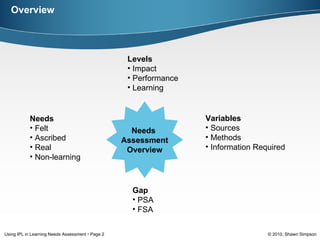
Overview Needs  Assessment Overview Levels Impact Performance Learning Variables Sources Methods Information Required Needs Felt Ascribed Real Non-learning Gap PSA FSA
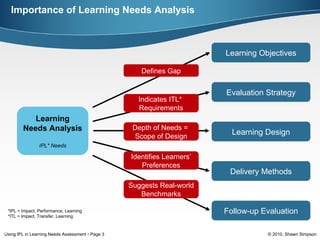
Importance of Learning Needs Analysis Learning Needs Analysis IPL* Needs Defines Gap Indicates ITL*  Requirements Depth of Needs =  Scope of Design Identifies Learners’ Preferences Suggests Real-world Benchmarks Learning Objectives Evaluation Strategy Learning Design Delivery Methods Follow-up Evaluation *IPL = Impact, Performance, Learning *ITL = Impact, Transfer, Learning
Why Assess Needs? To develop short and long range training plans To define training opportunities To help decision makers set training priorities To substantiate decision maker’s choices To develop support for training initiatives
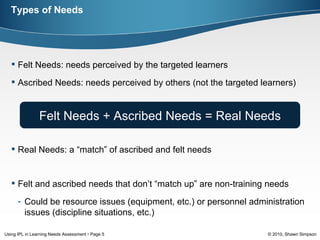
Types of Needs Felt Needs: needs perceived by the targeted learners Ascribed Needs: needs perceived by others (not the targeted learners) Real Needs: a “match” of ascribed and felt needs Felt and ascribed needs that don’t “match up” are non-training needs Could be resource issues (equipment, etc.) or personnel administration issues (discipline situations, etc.) Felt Needs + Ascribed Needs = Real Needs
Preliminary Scans A brief statement of either the presumed problem or the presumed resolution to the problem Presumed problem: presentation at the current situation Also called the “present state of affairs” or PSA Presumed resolution: presentation of the desired outcome Also called the “future state of affairs” or FSA
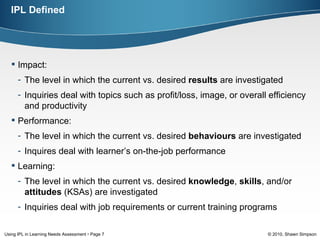
IPL Defined Impact: The level in which the current vs. desired  results  are investigated Inquiries deal with topics such as profit/loss, image, or overall efficiency and productivity Performance: The level in which the current vs. desired  behaviours  are investigated Inquires deal with learner’s on-the-job performance Learning: The level in which the current vs. desired  knowledge ,  skills , and/or  attitudes  (KSAs) are investigated Inquiries deal with job requirements or current training programs
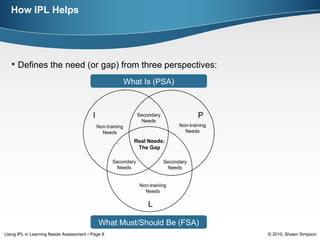
How IPL Helps Defines the need (or gap) from three perspectives: I P L Non-training Needs Non-training Needs Non-training Needs Secondary Needs Secondary Needs Secondary Needs Real Needs: The Gap What Is (PSA) What Must/Should Be (FSA)
Variables in Learning Needs Assessment Three primary variables when conducting the needs assessment: Sources Any individual, group, or document in possession of relevant information Information Required The needs assessment’s topics of investigation Methods Data collection methods Within the three natural divisions of data collection – asking questions, observation, and document review – the options are numerous
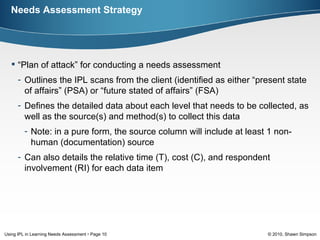
Needs Assessment Strategy “ Plan of attack” for conducting a needs assessment Outlines the IPL scans from the client (identified as either “present state of affairs” (PSA) or “future stated of affairs” (FSA) Defines the detailed data about each level that needs to be collected, as well as the source(s) and method(s) to collect this data Note: in a pure form, the source column will include at least 1 non-human (documentation) source Can also details the relative time (T), cost (C), and respondent involvement (RI) for each data item
Thank you! For more information on how I can help with your organization’s learning needs, or to see other presentations, visit my website: http://www.shawnsimpson.net

Using IPL in Learning Needs Assessment

  • 1.
    Using IPL inLearning Needs Assessment Shawn Simpson
  • 2.
    Overview Needs Assessment Overview Levels Impact Performance Learning Variables Sources Methods Information Required Needs Felt Ascribed Real Non-learning Gap PSA FSA
  • 3.
    Importance of LearningNeeds Analysis Learning Needs Analysis IPL* Needs Defines Gap Indicates ITL* Requirements Depth of Needs = Scope of Design Identifies Learners’ Preferences Suggests Real-world Benchmarks Learning Objectives Evaluation Strategy Learning Design Delivery Methods Follow-up Evaluation *IPL = Impact, Performance, Learning *ITL = Impact, Transfer, Learning
  • 4.
    Why Assess Needs?To develop short and long range training plans To define training opportunities To help decision makers set training priorities To substantiate decision maker’s choices To develop support for training initiatives
  • 5.
    Types of NeedsFelt Needs: needs perceived by the targeted learners Ascribed Needs: needs perceived by others (not the targeted learners) Real Needs: a “match” of ascribed and felt needs Felt and ascribed needs that don’t “match up” are non-training needs Could be resource issues (equipment, etc.) or personnel administration issues (discipline situations, etc.) Felt Needs + Ascribed Needs = Real Needs
  • 6.
    Preliminary Scans Abrief statement of either the presumed problem or the presumed resolution to the problem Presumed problem: presentation at the current situation Also called the “present state of affairs” or PSA Presumed resolution: presentation of the desired outcome Also called the “future state of affairs” or FSA
  • 7.
    IPL Defined Impact:The level in which the current vs. desired results are investigated Inquiries deal with topics such as profit/loss, image, or overall efficiency and productivity Performance: The level in which the current vs. desired behaviours are investigated Inquires deal with learner’s on-the-job performance Learning: The level in which the current vs. desired knowledge , skills , and/or attitudes (KSAs) are investigated Inquiries deal with job requirements or current training programs
  • 8.
    How IPL HelpsDefines the need (or gap) from three perspectives: I P L Non-training Needs Non-training Needs Non-training Needs Secondary Needs Secondary Needs Secondary Needs Real Needs: The Gap What Is (PSA) What Must/Should Be (FSA)
  • 9.
    Variables in LearningNeeds Assessment Three primary variables when conducting the needs assessment: Sources Any individual, group, or document in possession of relevant information Information Required The needs assessment’s topics of investigation Methods Data collection methods Within the three natural divisions of data collection – asking questions, observation, and document review – the options are numerous
  • 10.
    Needs Assessment Strategy“ Plan of attack” for conducting a needs assessment Outlines the IPL scans from the client (identified as either “present state of affairs” (PSA) or “future stated of affairs” (FSA) Defines the detailed data about each level that needs to be collected, as well as the source(s) and method(s) to collect this data Note: in a pure form, the source column will include at least 1 non-human (documentation) source Can also details the relative time (T), cost (C), and respondent involvement (RI) for each data item
  • 11.
    Thank you! Formore information on how I can help with your organization’s learning needs, or to see other presentations, visit my website: http://www.shawnsimpson.net