Professional Development Course on
Ensuring Training Effectiveness
Cascading Workshop
9th April, 2012.
Bahauddin Zakariya University, Multan.

Module: Needs Assessment (TNA)
Resource person:
               Huma Zafar
Learning Objectives
At the end of the session you will be able to:
Familiar with the meaning and importance of TNA
Know what to look for when conducting TNA
Distinguish between Organizational and Training
Need
Use data collection techniques appropriate to a TNA
Session Out line
1.   Organizational Needs Analysis
2.   Training Needs Analysis
3.   Data Gathering Methods
Organizational Need Analysis
   Organizational Need Analysis is a holistic
    approach which involves looking at the entire
    organization. It locates and defines problem
    areas. It explores what is as compared to what
    should be and the gaps between the two.
   Analysis: The study we do in order to figure out
    what to do. - Allison Rossett & Kendra Sheldon
    (2001)
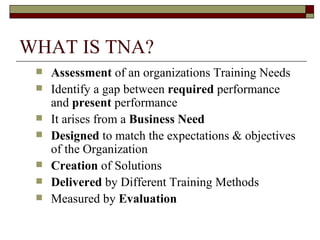
WHAT IS TNA?
    Assessment of an organizations Training Needs
    Identify a gap between required performance
     and present performance
    It arises from a Business Need
    Designed to match the expectations & objectives
     of the Organization
    Creation of Solutions
    Delivered by Different Training Methods
    Measured by Evaluation
Importance of Training Needs Analysis
   Bridging gap b/w required and present
    performance = Improved Performance
   Anticipate introduction of new systems, tasks
    or technology
   Desire to Effect a Change
   Translate Business Need in to a Training
    Need
Important Distinction
An Organizational Needs Analysis is different from a
  Training Needs Analysis:
 While ONA offers a broader perspective more
  conducive to a diagnosis
 TNA offers a specific perspective on organizational
  solutions involving Training
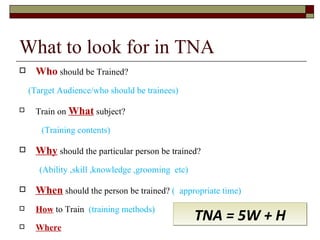
What to look for in TNA
    Who should be Trained?
    (Target Audience/who should be trainees)

    Train on What subject?

       (Training contents)

    Why should the particular person be trained?
      (Ability ,skill ,knowledge ,grooming etc)

    When should the person be trained? ( appropriate time)
     How to Train (training methods)
                                                  TNA = 5W + H


    Where
Activity Time
   Proposed Training
   Formulate a TNA
How do you Identify Training needs
Goldstein (1986, 1991, 1993)
Model of Training Needs Analysis


                                       Stage One
                    Establish organisation’s commitment and support


                                       Stage Two
                                  Organisational Analysis


                                      Stage Three
                                   Requirement Analysis


                                    Stage Four
             ‘Needs Assessment’ - Task & KSA analysis of training needs

                                         Stage Five
                                      ‘Person Analysis’

                                        Stage Six
              Collate data to input to, and design of, training environment
                                 and training evaluation
www.uk.sagepub.com/millward/files/.../Chapter2_slide_2... - United Kingdom
What are data collection methods ?
1-Questionnaire
2-Documentation
3-Interview
4-Observation
5-Review performance
   appraisals
6-Focus Group
   Discussions
Activity
   Objective: Learn & differentiate methods of Data
    gathering.
   Method: Group Discussion
   Five small groups
   Mechanism: A member from each group will
    present the Merits of each Data Gathering Methods.
   Time: 10 Minutes
Method              Pros              Cons
Questionnaire       -per audience     -% return is often less
                    -Ask different    -Takes time and skill to develop well
                    style questions   -Directed-/limited answers
                    -Efficient &      -Should be limited to 10 minute completion time
                    easiest way of    -probing difficult
                    collecting lots   -What people tell you and what they really do may
                    of data           differ

Documentation       Provides       -May be difficult or impossible to obtain desired
review (i.e., job   management/    documents
descriptions,       HR perspective -May require interpretation/ explanation
performance
appraisals


Interview           -Direct Contact - intensive time and resources
managers/           -Good for
supervisors         complex
                    problems
                    -Can modify
Method              Pros                  Cons

Observation         -Direct method of     Resource and time consuming
                    data collection

Review              -Time efficient       Depend upon documentation quality
performance                               honesty in documents
appraisals of
lesser performers

Focus Group         -For complex /        - Scheduling Issue
discussion          undefined issues      -Good number of participants
                    -Ideas can built on   - what people tell you and what they
                    each other            really do may differ
                    -Relatively           - Sometimes important to verify the
                    effective &           results with observations and
                    efficient             document analysis
Thank you

Huma tna

  • 1.
    Professional Development Courseon Ensuring Training Effectiveness Cascading Workshop 9th April, 2012. Bahauddin Zakariya University, Multan. Module: Needs Assessment (TNA) Resource person: Huma Zafar
  • 2.
    Learning Objectives At theend of the session you will be able to: Familiar with the meaning and importance of TNA Know what to look for when conducting TNA Distinguish between Organizational and Training Need Use data collection techniques appropriate to a TNA
  • 3.
    Session Out line 1. Organizational Needs Analysis 2. Training Needs Analysis 3. Data Gathering Methods
  • 4.
    Organizational Need Analysis  Organizational Need Analysis is a holistic approach which involves looking at the entire organization. It locates and defines problem areas. It explores what is as compared to what should be and the gaps between the two.  Analysis: The study we do in order to figure out what to do. - Allison Rossett & Kendra Sheldon (2001)
  • 5.
    WHAT IS TNA?  Assessment of an organizations Training Needs  Identify a gap between required performance and present performance  It arises from a Business Need  Designed to match the expectations & objectives of the Organization  Creation of Solutions  Delivered by Different Training Methods  Measured by Evaluation
  • 6.
    Importance of TrainingNeeds Analysis  Bridging gap b/w required and present performance = Improved Performance  Anticipate introduction of new systems, tasks or technology  Desire to Effect a Change  Translate Business Need in to a Training Need
  • 7.
    Important Distinction An OrganizationalNeeds Analysis is different from a Training Needs Analysis:  While ONA offers a broader perspective more conducive to a diagnosis  TNA offers a specific perspective on organizational solutions involving Training
  • 8.
    What to lookfor in TNA  Who should be Trained? (Target Audience/who should be trainees)  Train on What subject? (Training contents)  Why should the particular person be trained? (Ability ,skill ,knowledge ,grooming etc)  When should the person be trained? ( appropriate time) How to Train (training methods) TNA = 5W + H   Where
  • 9.
    Activity Time  Proposed Training  Formulate a TNA
  • 10.
    How do youIdentify Training needs
  • 11.
    Goldstein (1986, 1991,1993) Model of Training Needs Analysis Stage One Establish organisation’s commitment and support Stage Two Organisational Analysis Stage Three Requirement Analysis Stage Four ‘Needs Assessment’ - Task & KSA analysis of training needs Stage Five ‘Person Analysis’ Stage Six Collate data to input to, and design of, training environment and training evaluation www.uk.sagepub.com/millward/files/.../Chapter2_slide_2... - United Kingdom
  • 12.
    What are datacollection methods ? 1-Questionnaire 2-Documentation 3-Interview 4-Observation 5-Review performance appraisals 6-Focus Group Discussions
  • 13.
    Activity  Objective: Learn & differentiate methods of Data gathering.  Method: Group Discussion  Five small groups  Mechanism: A member from each group will present the Merits of each Data Gathering Methods.  Time: 10 Minutes
  • 14.
    Method Pros Cons Questionnaire -per audience -% return is often less -Ask different -Takes time and skill to develop well style questions -Directed-/limited answers -Efficient & -Should be limited to 10 minute completion time easiest way of -probing difficult collecting lots -What people tell you and what they really do may of data differ Documentation Provides -May be difficult or impossible to obtain desired review (i.e., job management/ documents descriptions, HR perspective -May require interpretation/ explanation performance appraisals Interview -Direct Contact - intensive time and resources managers/ -Good for supervisors complex problems -Can modify
  • 15.
    Method Pros Cons Observation -Direct method of Resource and time consuming data collection Review -Time efficient Depend upon documentation quality performance honesty in documents appraisals of lesser performers Focus Group -For complex / - Scheduling Issue discussion undefined issues -Good number of participants -Ideas can built on - what people tell you and what they each other really do may differ -Relatively - Sometimes important to verify the effective & results with observations and efficient document analysis
  • 16.