ยฉ 2015 - artITians
Slide 1 better business by design
Motivation & Behaviour
Driving the Business to where!
ยฉ 2015 - artITians
Slide 2 better business by design
Contents
โ€ข Motivations and Measures
โ€ข Behavioural Motivators
โ€ข Need to Achieve
โ€ข Fear of Failure
โ€ข The Need for Acceptance
โ€ข Politics and Power
โ€ข Effects of Complacency
โ€ข โ€˜Precrastinatorsโ€™ and Cowboys
โ€ข Choices and Motivations
ยฉ 2015 - artITians
Slide 3 better business by design
Motivations and Measures
โ€ข Identifying key business motivations and measures are two
requisites to building a successful business.
โ€ข Knowing why you are doing what you are doing, why you are
designing the component you are and what will be the
consequence of doing so provides clarity to the business
development process. The measures in particular give you the
opportunity to determine the effect of your design on other
business components.
โ€ข Unfortunately uncertainty seems to be a fact of life when
establishing any business. The risks associated with this
uncertainty however can mitigated to some extent when there is
some understanding and application of the business measures and
motivators. โ€˜Whyโ€™ and โ€˜what is the impactโ€™ are crucial questions in
the decision making process.
ยฉ 2015 - artITians
Slide 4 better business by design
Behavioural Motivators
โ€ข Different behavioural motivators drive or
inhibit the work ethic of an individual.
โ€ข Many of these can be leveraged or
exploited to drive real benefit in the
business world.
ยฉ 2015 - artITians
Slide 5 better business by design
Need to Achieve
โ€ข Achievement behaviour is an interaction between situational variables and the
individual subjectโ€™s motivation to achieve.
โ€ข An individualโ€™s motivation can be either implicit where they are driven by
spontaneous impulses to act through incentives inherent in the tasks they are
undertaking or explicit where their actions are driven by outside influences.
โ€ข Maintaining a working environment where the tasks undertaken by the individual
are in themselves interesting and intrinsically challenging encourages implicit
behaviour.
โ€ข A business, with a culture of rewards and recognition, provides an environment that
strongly encourages the explicit individual to strive for succeed in each of their
endeavours.
โ€ข The desire to achieve can be perverted when the rewards rather than the
achievement become the central focus.
โ€ข Greed, with all of it negative and destructive connotations can become a prime
motivator.
โ€ข Balancing the rewards offered against the personal satisfaction provided by the
achievement itself becomes crucial.
ยฉ 2015 - artITians
Slide 6 better business by design
Fear of failure
โ€ข โ€˜Fear of Failureโ€™ is a potent motivator of individuals.
โ€“ Wishing to avoid the possibility of failing the individual is likely to attempt the identification of all perceived
risks and develop what they hope are appropriate mitigation strategies.
โ€“ The Fear of Failureโ€™ can act as a real spur to assure success.
โ€ข This fear can however become extreme in its nature with the consequence of causing
an apparent complete paralysis of action.
โ€“ Never certain that all risks have been identified the individual can spend significant time searching for all possibilities.
โ€“ Having identified a risk they may seek to eliminate the risk as mitigation by itself assumes that the risk could be realised.
โ€“ As mitigation is not the same as elimination the possibility of failure still exists.
โ€“ It is not enough that the probability of failure is low: to them it must be zero.
โ€ข In the extreme the โ€˜Fear of Failureโ€™ can make the individual โ€˜Risk Averseโ€™.
โ€“ Where there is a risk it must be avoided at all costs.
โ€“ If it cannot be absolutely avoided then no action should be taken.
โ€ข Whilst a โ€˜Fear of Failureโ€™ can have a positive outcome its negative connotation leads
to destructive behaviour.
โ€“ Where a culture of โ€˜blameโ€™ exists within a business the predisposition of the individual who fears failure is likely to be
pushed to its counter-productive extreme.
โ€ข Within a business environment, where there is a culture of support and recognition
this fear can be managed so that more positive results are achieved.
โ€ข Where the outcome of an activity has been less than optimal there may be is some
good that can be taken out of the situation that can reinforce the positive behaviour of
the individual.
Success, no matter how small, can breed Success.
ยฉ 2015 - artITians
Slide 7 better business by design
The Need for Acceptance
โ€ข The need to belong is a basic part of the human condition.
โ€“ The individual within a business will strive to gain acceptance by his or her work colleagues and management. Whilst
this may be desirable to the individual the โ€˜need to be acceptedโ€™ can result in some unfortunate and unacceptable side-
effects if taken to an extreme.
โ€ข When wishing to please everyone, at whatever cost, the inability to say no can rear
its ugly head. Agreeing to undertake every request for service, regardless of oneโ€™s
ability to deliver can lead to significant stress and the achieving of not acceptance
but rejection. NO is a word that should be learned and used wisely.
โ€ข In the pursuit of acceptance the desire to please others can be manifest in a lack of
assertiveness. The individual, in not promoting their opinion, even when strongly
held, not only increases the likelihood of their own frustration but also does not
allow the balance of contrasting opinions to influence the way a business can
operate.
โ€ข Exhibiting the desire to please can also affect some of the baser instincts of others
through their realisation that the โ€˜pleaserโ€™ can be manipulated to suit their own
ends. The individual themselves, exhibiting this behaviour, could again risk rejection
through being thought to be a โ€˜Yes Manโ€™.
โ€ข At an extreme the desire to please and win acceptance can result in self-serving,
sycophantic behaviour. This behaviour is certainly not in the best interest of the
business.
ยฉ 2015 - artITians
Slide 8 better business by design
Politics and Power
โ€ข Competing agendas from multiple individuals within an organisation can be counter-
productive. These often exist as a consequence of the โ€˜politicalโ€™ machinations that
are progress. Some individuals within a business, whether consciously or
unconsciously strive to gain personal power and influence.
โ€ข The activities in which they engage and how they proceed, are frequently designed
to enhance their own standing.
โ€“ When the personal goals of the individual do not align with that of the business, there may be a conflict of
interest which can adversely affect the performance of other individuals and the business itself.
โ€“ Perceived success in this situation is measured from the personal perspective rather than from the
business as a whole.
โ€ข Almost everyone has come across the โ€˜Empire Builderโ€™ within an organisation.
Whilst the way they operate may not be ultimately malignant, the fact that they exist
may cause others within the organisation to attempt to counter their plans with their
own. Focus is subsequently redirected from that of the business to that of the
individual.
โ€ข It is probably inevitable that any given business will have some level of political
power play in progress at any given time. In recognising this, a wise business
manager will attempt to temper the politics by ensuring that all individuals retain a
focus on business goals.
ยฉ 2015 - artITians
Slide 9 better business by design
Effects of Complacency
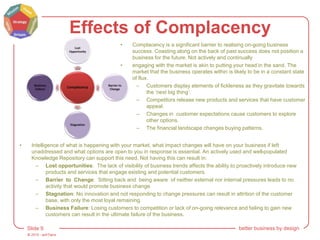
โ€ข Complacency is a significant barrier to realising on-going business
success. Coasting along on the back of past success does not position a
business for the future. Not actively and continually
โ€ข engaging with the market is akin to putting your head in the sand. The
market that the business operates within is likely to be in a constant state
of flux.
โ€“ Customers display elements of fickleness as they gravitate towards
the โ€˜next big thingโ€™.
โ€“ Competitors release new products and services that have customer
appeal.
โ€“ Changes in customer expectations cause customers to explore
other options.
โ€“ The financial landscape changes buying patterns.
โ€ข Intelligence of what is happening with your market, what impact changes will have on your business if left
unaddressed and what options are open to you in response is essential. An actively used and well-populated
Knowledge Repository can support this need. Not having this can result in:
โ€“ Lost opportunities: The lack of visibility of business trends affects the ability to proactively introduce new
products and services that engage existing and potential customers.
โ€“ Barrier to Change: Sitting back and being aware of neither external nor internal pressures leads to no
activity that would promote business change
โ€“ Stagnation: No innovation and not responding to change pressures can result in attrition of the customer
base, with only the most loyal remaining.
โ€“ Business Failure: Losing customers to competition or lack of on-going relevance and failing to gain new
customers can result in the ultimate failure of the business.
ยฉ 2015 - artITians
Slide 10 better business by design
Exposing Procrastination
โ€ข The ability to make accurate, informed and timely decisions is critical if a business is to perform at its best.
โ€ข The decision making process however is affected in some individuals by behavioural characteristics that is
manifest in serial procrastination.
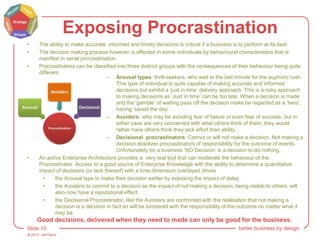
โ€ข Procrastinators can be classified into three distinct groups with the consequences of their behaviour being quite
different.
โ€ข An active Enterprise Architecture provides a very real tool that can moderate the behaviour of the
Procrastinator. Access to a good source of Enterprise Knowledge with the ability to determine a quantitative
impact of decisions (or lack thereof) with a time dimension overlayed drives
โ€ข the Arousal type to make their decision earlier by exposing the impact of delay.
โ€ข the Avoiders to commit to a decision as the impact of not making a decision, being visible to others, will
also now have a reputational effect.
โ€ข the Decisional Procrastinator, like the Avoiders are confronted with the realisation that not making a
decision is a decision in fact so will be lumbered with the responsibility of the outcome no matter what it
may be.
โ€“ Arousal types: thrill-seekers, who wait to the last minute for the euphoric rush.
This type of individual is quite capable of making accurate and informed
decisions but exhibit a โ€˜just in timeโ€™ delivery approach. This is a risky approach
to making decisions as โ€˜Just in timeโ€™ can be too late. When a decision is made
and the โ€˜gambleโ€™ of waiting pays off the decision make be regarded as a โ€˜heroโ€™,
having โ€˜saved the dayโ€™.
โ€“ Avoiders: who may be avoiding fear of failure or even fear of success, but in
either case are very concerned with what others think of them; they would
rather have others think they lack effort than ability.
โ€“ Decisional procrastinators: Cannot or will not make a decision. Not making a
decision absolves procrastinators of responsibility for the outcome of events.
Unfortunately for a business โ€˜NO Decisionโ€™ is a decision to do nothing.
Good decisions, delivered when they need to made can only be good for the business.
ยฉ 2015 - artITians
Slide 11 better business by design
Precrastinators &Cowboys
โ€ข โ€˜Precrastinationโ€™ is a recently coined word, specifically used to describe behaviour which is
characterised by impatiently undertaking tasks, frequently despite having inadequate information
and with careless disregard of the risks.
โ€ข Precrastinators:
โ€“ Exhibit the need for applying speed over rigour,
โ€“ May employ greater trust in gut-feelings over requisite information,
โ€“ Fail to assess risks or ramifications,
โ€“ Often desire to be viewed as confident decision makers,
โ€“ Demonstrate a reluctance to work collaboratively as this may be perceived as counter-
intuitive,
โ€“ May be ego-driven, rather than applying a common sense approach to their work,
โ€“ Rapid delivery causes an โ€˜addictiveโ€™ adrenalin rush that creates misguided confidence.
โ€ข The term โ€˜Cowboyโ€™ within a business setting is often applied to people who are reckless in their
actions. A โ€˜cowboyโ€™ is a type of โ€˜precrastinatorโ€™ who does apply some thought to what they are
doing, but generally insufficient to achieve reliably good business outcomes.
โ€ข Cowboys:
โ€“ Take ill-conceived risks, in order to get the job done faster,
โ€“ Avoid all requisite process rigour,
โ€“ Apply shortcuts where possible.
It may be unkind to say but:
Fools rush in where angels fear to tread
ยฉ 2015 - artITians
Slide 12 better business by design
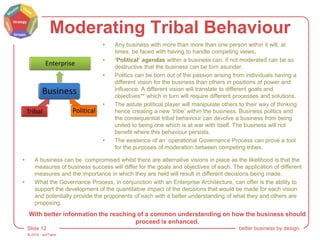
Moderating Tribal Behaviour
โ€ข Any business with more than more than one person within it will, at
times, be faced with having to handle competing views.
โ€ข โ€˜Politicalโ€™ agendas within a business can, if not moderated can be so
destructive that the business can be torn asunder.
โ€ข Politics can be born out of the passion arising from individuals having a
different vision for the business than others in positions of power and
influence. A different vision will translate to different goals and
objectives** which in turn will require different processes and solutions.
โ€ข The astute political player will manipulate others to their way of thinking
hence creating a new โ€˜tribeโ€™ within the business. Business politics and
the consequential tribal behaviour can devolve a business from being
united to being one which is at war with itself. The business will not
benefit where this behaviour persists.
โ€ข The existence of an operational Governance Process can prove a tool
for the purposes of moderation between competing tribes.
โ€ข A business can be compromised whilst there are alternative visions in place as the likelihood is that the
measures of business success will differ for the goals and objectives of each. The application of different
measures and the importance in which they are held will result in different decisions being made.
โ€ข What the Governance Process, in conjunction with an Enterprise Architecture, can offer is the ability to
support the development of the quantitative impact of the decisions that would be made for each vision
and potentially provide the proponents of each with a better understanding of what they and others are
proposing.
With better information the reaching of a common understanding on how the business should
proceed is enhanced.
ยฉ 2015 - artITians
Slide 13 better business by design
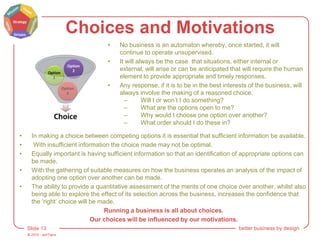
Choices and Motivations
โ€ข No business is an automaton whereby, once started, it will
continue to operate unsupervised.
โ€ข It will always be the case that situations, either internal or
external, will arise or can be anticipated that will require the human
element to provide appropriate and timely responses.
โ€ข Any response, if it is to be in the best interests of the business, will
always involve the making of a reasoned choice.
โ€“ Will I or wonโ€™t I do something?
โ€“ What are the options open to me?
โ€“ Why would I choose one option over another?
โ€“ What order should I do these in?
โ€ข In making a choice between competing options it is essential that sufficient information be available.
โ€ข With insufficient information the choice made may not be optimal.
โ€ข Equally important is having sufficient information so that an identification of appropriate options can
be made.
โ€ข With the gathering of suitable measures on how the business operates an analysis of the impact of
adopting one option over another can be made.
โ€ข The ability to provide a quantitative assessment of the merits of one choice over another, whilst also
being able to explore the effect of its selection across the business, increases the confidence that
the โ€˜rightโ€™ choice will be made.
Running a business is all about choices.
Our choices will be influenced by our motivations.

Motivation and behaviour

  • 1.
    ยฉ 2015 -artITians Slide 1 better business by design Motivation & Behaviour Driving the Business to where!
  • 2.
    ยฉ 2015 -artITians Slide 2 better business by design Contents โ€ข Motivations and Measures โ€ข Behavioural Motivators โ€ข Need to Achieve โ€ข Fear of Failure โ€ข The Need for Acceptance โ€ข Politics and Power โ€ข Effects of Complacency โ€ข โ€˜Precrastinatorsโ€™ and Cowboys โ€ข Choices and Motivations
  • 3.
    ยฉ 2015 -artITians Slide 3 better business by design Motivations and Measures โ€ข Identifying key business motivations and measures are two requisites to building a successful business. โ€ข Knowing why you are doing what you are doing, why you are designing the component you are and what will be the consequence of doing so provides clarity to the business development process. The measures in particular give you the opportunity to determine the effect of your design on other business components. โ€ข Unfortunately uncertainty seems to be a fact of life when establishing any business. The risks associated with this uncertainty however can mitigated to some extent when there is some understanding and application of the business measures and motivators. โ€˜Whyโ€™ and โ€˜what is the impactโ€™ are crucial questions in the decision making process.
  • 4.
    ยฉ 2015 -artITians Slide 4 better business by design Behavioural Motivators โ€ข Different behavioural motivators drive or inhibit the work ethic of an individual. โ€ข Many of these can be leveraged or exploited to drive real benefit in the business world.
  • 5.
    ยฉ 2015 -artITians Slide 5 better business by design Need to Achieve โ€ข Achievement behaviour is an interaction between situational variables and the individual subjectโ€™s motivation to achieve. โ€ข An individualโ€™s motivation can be either implicit where they are driven by spontaneous impulses to act through incentives inherent in the tasks they are undertaking or explicit where their actions are driven by outside influences. โ€ข Maintaining a working environment where the tasks undertaken by the individual are in themselves interesting and intrinsically challenging encourages implicit behaviour. โ€ข A business, with a culture of rewards and recognition, provides an environment that strongly encourages the explicit individual to strive for succeed in each of their endeavours. โ€ข The desire to achieve can be perverted when the rewards rather than the achievement become the central focus. โ€ข Greed, with all of it negative and destructive connotations can become a prime motivator. โ€ข Balancing the rewards offered against the personal satisfaction provided by the achievement itself becomes crucial.
  • 6.
    ยฉ 2015 -artITians Slide 6 better business by design Fear of failure โ€ข โ€˜Fear of Failureโ€™ is a potent motivator of individuals. โ€“ Wishing to avoid the possibility of failing the individual is likely to attempt the identification of all perceived risks and develop what they hope are appropriate mitigation strategies. โ€“ The Fear of Failureโ€™ can act as a real spur to assure success. โ€ข This fear can however become extreme in its nature with the consequence of causing an apparent complete paralysis of action. โ€“ Never certain that all risks have been identified the individual can spend significant time searching for all possibilities. โ€“ Having identified a risk they may seek to eliminate the risk as mitigation by itself assumes that the risk could be realised. โ€“ As mitigation is not the same as elimination the possibility of failure still exists. โ€“ It is not enough that the probability of failure is low: to them it must be zero. โ€ข In the extreme the โ€˜Fear of Failureโ€™ can make the individual โ€˜Risk Averseโ€™. โ€“ Where there is a risk it must be avoided at all costs. โ€“ If it cannot be absolutely avoided then no action should be taken. โ€ข Whilst a โ€˜Fear of Failureโ€™ can have a positive outcome its negative connotation leads to destructive behaviour. โ€“ Where a culture of โ€˜blameโ€™ exists within a business the predisposition of the individual who fears failure is likely to be pushed to its counter-productive extreme. โ€ข Within a business environment, where there is a culture of support and recognition this fear can be managed so that more positive results are achieved. โ€ข Where the outcome of an activity has been less than optimal there may be is some good that can be taken out of the situation that can reinforce the positive behaviour of the individual. Success, no matter how small, can breed Success.
  • 7.
    ยฉ 2015 -artITians Slide 7 better business by design The Need for Acceptance โ€ข The need to belong is a basic part of the human condition. โ€“ The individual within a business will strive to gain acceptance by his or her work colleagues and management. Whilst this may be desirable to the individual the โ€˜need to be acceptedโ€™ can result in some unfortunate and unacceptable side- effects if taken to an extreme. โ€ข When wishing to please everyone, at whatever cost, the inability to say no can rear its ugly head. Agreeing to undertake every request for service, regardless of oneโ€™s ability to deliver can lead to significant stress and the achieving of not acceptance but rejection. NO is a word that should be learned and used wisely. โ€ข In the pursuit of acceptance the desire to please others can be manifest in a lack of assertiveness. The individual, in not promoting their opinion, even when strongly held, not only increases the likelihood of their own frustration but also does not allow the balance of contrasting opinions to influence the way a business can operate. โ€ข Exhibiting the desire to please can also affect some of the baser instincts of others through their realisation that the โ€˜pleaserโ€™ can be manipulated to suit their own ends. The individual themselves, exhibiting this behaviour, could again risk rejection through being thought to be a โ€˜Yes Manโ€™. โ€ข At an extreme the desire to please and win acceptance can result in self-serving, sycophantic behaviour. This behaviour is certainly not in the best interest of the business.
  • 8.
    ยฉ 2015 -artITians Slide 8 better business by design Politics and Power โ€ข Competing agendas from multiple individuals within an organisation can be counter- productive. These often exist as a consequence of the โ€˜politicalโ€™ machinations that are progress. Some individuals within a business, whether consciously or unconsciously strive to gain personal power and influence. โ€ข The activities in which they engage and how they proceed, are frequently designed to enhance their own standing. โ€“ When the personal goals of the individual do not align with that of the business, there may be a conflict of interest which can adversely affect the performance of other individuals and the business itself. โ€“ Perceived success in this situation is measured from the personal perspective rather than from the business as a whole. โ€ข Almost everyone has come across the โ€˜Empire Builderโ€™ within an organisation. Whilst the way they operate may not be ultimately malignant, the fact that they exist may cause others within the organisation to attempt to counter their plans with their own. Focus is subsequently redirected from that of the business to that of the individual. โ€ข It is probably inevitable that any given business will have some level of political power play in progress at any given time. In recognising this, a wise business manager will attempt to temper the politics by ensuring that all individuals retain a focus on business goals.
  • 9.
    ยฉ 2015 -artITians Slide 9 better business by design Effects of Complacency โ€ข Complacency is a significant barrier to realising on-going business success. Coasting along on the back of past success does not position a business for the future. Not actively and continually โ€ข engaging with the market is akin to putting your head in the sand. The market that the business operates within is likely to be in a constant state of flux. โ€“ Customers display elements of fickleness as they gravitate towards the โ€˜next big thingโ€™. โ€“ Competitors release new products and services that have customer appeal. โ€“ Changes in customer expectations cause customers to explore other options. โ€“ The financial landscape changes buying patterns. โ€ข Intelligence of what is happening with your market, what impact changes will have on your business if left unaddressed and what options are open to you in response is essential. An actively used and well-populated Knowledge Repository can support this need. Not having this can result in: โ€“ Lost opportunities: The lack of visibility of business trends affects the ability to proactively introduce new products and services that engage existing and potential customers. โ€“ Barrier to Change: Sitting back and being aware of neither external nor internal pressures leads to no activity that would promote business change โ€“ Stagnation: No innovation and not responding to change pressures can result in attrition of the customer base, with only the most loyal remaining. โ€“ Business Failure: Losing customers to competition or lack of on-going relevance and failing to gain new customers can result in the ultimate failure of the business.
  • 10.
    ยฉ 2015 -artITians Slide 10 better business by design Exposing Procrastination โ€ข The ability to make accurate, informed and timely decisions is critical if a business is to perform at its best. โ€ข The decision making process however is affected in some individuals by behavioural characteristics that is manifest in serial procrastination. โ€ข Procrastinators can be classified into three distinct groups with the consequences of their behaviour being quite different. โ€ข An active Enterprise Architecture provides a very real tool that can moderate the behaviour of the Procrastinator. Access to a good source of Enterprise Knowledge with the ability to determine a quantitative impact of decisions (or lack thereof) with a time dimension overlayed drives โ€ข the Arousal type to make their decision earlier by exposing the impact of delay. โ€ข the Avoiders to commit to a decision as the impact of not making a decision, being visible to others, will also now have a reputational effect. โ€ข the Decisional Procrastinator, like the Avoiders are confronted with the realisation that not making a decision is a decision in fact so will be lumbered with the responsibility of the outcome no matter what it may be. โ€“ Arousal types: thrill-seekers, who wait to the last minute for the euphoric rush. This type of individual is quite capable of making accurate and informed decisions but exhibit a โ€˜just in timeโ€™ delivery approach. This is a risky approach to making decisions as โ€˜Just in timeโ€™ can be too late. When a decision is made and the โ€˜gambleโ€™ of waiting pays off the decision make be regarded as a โ€˜heroโ€™, having โ€˜saved the dayโ€™. โ€“ Avoiders: who may be avoiding fear of failure or even fear of success, but in either case are very concerned with what others think of them; they would rather have others think they lack effort than ability. โ€“ Decisional procrastinators: Cannot or will not make a decision. Not making a decision absolves procrastinators of responsibility for the outcome of events. Unfortunately for a business โ€˜NO Decisionโ€™ is a decision to do nothing. Good decisions, delivered when they need to made can only be good for the business.
  • 11.
    ยฉ 2015 -artITians Slide 11 better business by design Precrastinators &Cowboys โ€ข โ€˜Precrastinationโ€™ is a recently coined word, specifically used to describe behaviour which is characterised by impatiently undertaking tasks, frequently despite having inadequate information and with careless disregard of the risks. โ€ข Precrastinators: โ€“ Exhibit the need for applying speed over rigour, โ€“ May employ greater trust in gut-feelings over requisite information, โ€“ Fail to assess risks or ramifications, โ€“ Often desire to be viewed as confident decision makers, โ€“ Demonstrate a reluctance to work collaboratively as this may be perceived as counter- intuitive, โ€“ May be ego-driven, rather than applying a common sense approach to their work, โ€“ Rapid delivery causes an โ€˜addictiveโ€™ adrenalin rush that creates misguided confidence. โ€ข The term โ€˜Cowboyโ€™ within a business setting is often applied to people who are reckless in their actions. A โ€˜cowboyโ€™ is a type of โ€˜precrastinatorโ€™ who does apply some thought to what they are doing, but generally insufficient to achieve reliably good business outcomes. โ€ข Cowboys: โ€“ Take ill-conceived risks, in order to get the job done faster, โ€“ Avoid all requisite process rigour, โ€“ Apply shortcuts where possible. It may be unkind to say but: Fools rush in where angels fear to tread
  • 12.
    ยฉ 2015 -artITians Slide 12 better business by design Moderating Tribal Behaviour โ€ข Any business with more than more than one person within it will, at times, be faced with having to handle competing views. โ€ข โ€˜Politicalโ€™ agendas within a business can, if not moderated can be so destructive that the business can be torn asunder. โ€ข Politics can be born out of the passion arising from individuals having a different vision for the business than others in positions of power and influence. A different vision will translate to different goals and objectives** which in turn will require different processes and solutions. โ€ข The astute political player will manipulate others to their way of thinking hence creating a new โ€˜tribeโ€™ within the business. Business politics and the consequential tribal behaviour can devolve a business from being united to being one which is at war with itself. The business will not benefit where this behaviour persists. โ€ข The existence of an operational Governance Process can prove a tool for the purposes of moderation between competing tribes. โ€ข A business can be compromised whilst there are alternative visions in place as the likelihood is that the measures of business success will differ for the goals and objectives of each. The application of different measures and the importance in which they are held will result in different decisions being made. โ€ข What the Governance Process, in conjunction with an Enterprise Architecture, can offer is the ability to support the development of the quantitative impact of the decisions that would be made for each vision and potentially provide the proponents of each with a better understanding of what they and others are proposing. With better information the reaching of a common understanding on how the business should proceed is enhanced.
  • 13.
    ยฉ 2015 -artITians Slide 13 better business by design Choices and Motivations โ€ข No business is an automaton whereby, once started, it will continue to operate unsupervised. โ€ข It will always be the case that situations, either internal or external, will arise or can be anticipated that will require the human element to provide appropriate and timely responses. โ€ข Any response, if it is to be in the best interests of the business, will always involve the making of a reasoned choice. โ€“ Will I or wonโ€™t I do something? โ€“ What are the options open to me? โ€“ Why would I choose one option over another? โ€“ What order should I do these in? โ€ข In making a choice between competing options it is essential that sufficient information be available. โ€ข With insufficient information the choice made may not be optimal. โ€ข Equally important is having sufficient information so that an identification of appropriate options can be made. โ€ข With the gathering of suitable measures on how the business operates an analysis of the impact of adopting one option over another can be made. โ€ข The ability to provide a quantitative assessment of the merits of one choice over another, whilst also being able to explore the effect of its selection across the business, increases the confidence that the โ€˜rightโ€™ choice will be made. Running a business is all about choices. Our choices will be influenced by our motivations.