#CLOwebinar
The presentation will begin at the top of the hour.
A dial in number will not be provided.
Listen to today’s webinar using your computer’s
speakers or headphones.
Unleashing the Power of Analytics: Driving
Performance at the Intersection of Learning
and Business
#CLOwebinar


Tools You Can Use
Audio Control
–  A dial in number will not be provided.
–  Adjust the volume by sliding the
indicator in the Media Player box to the
right.
–  Also check your computer’s volume for
external speakers or headsets.
#CLOwebinar
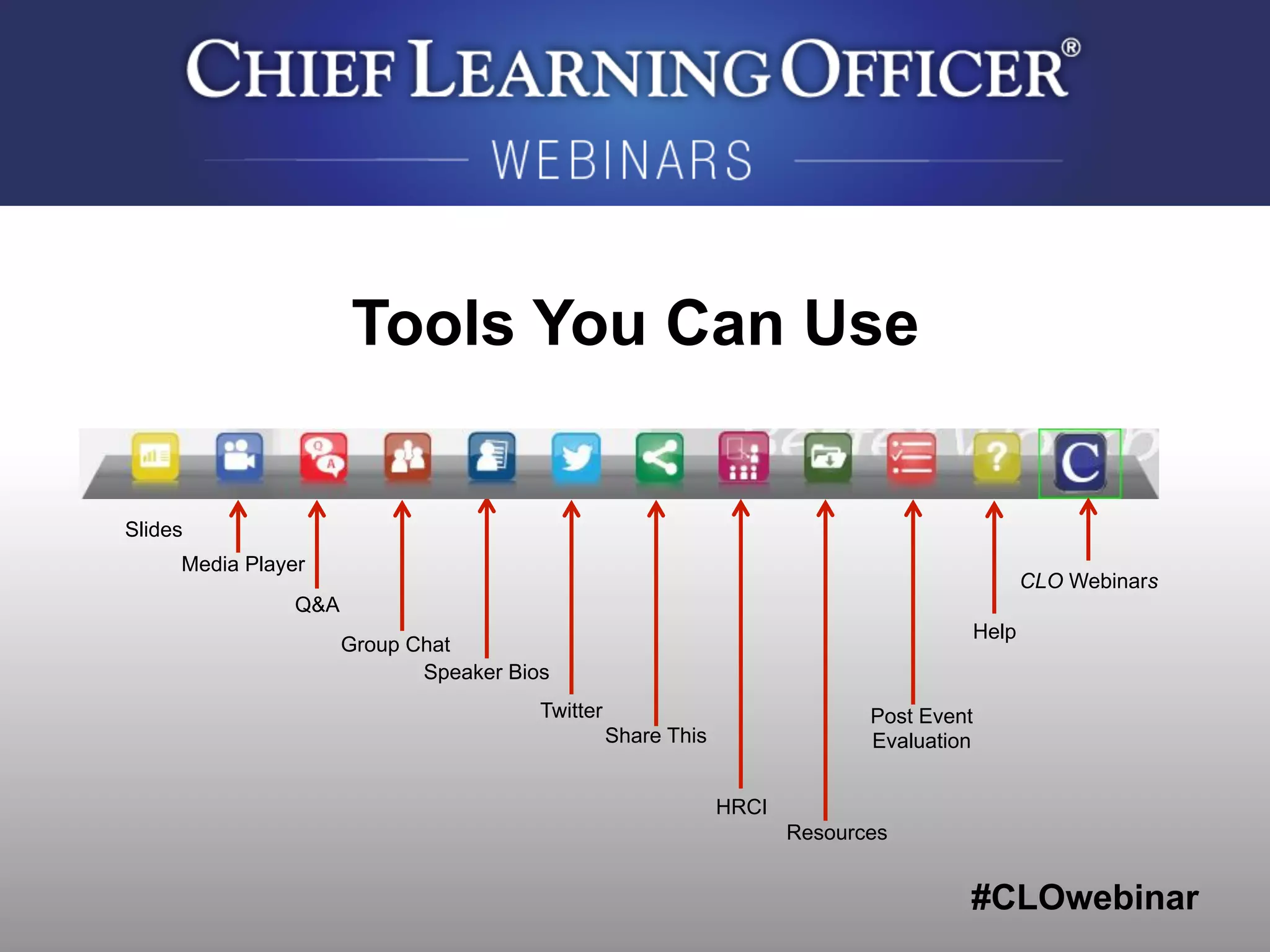
Speaker Bios
Resources
Media Player
Q&A
Slides
Twitter
Help
Post Event
EvaluationShare This
Group Chat
HRCI
CLO Webinars
Tools You Can Use	
  
#CLOwebinar


Tools You Can Use
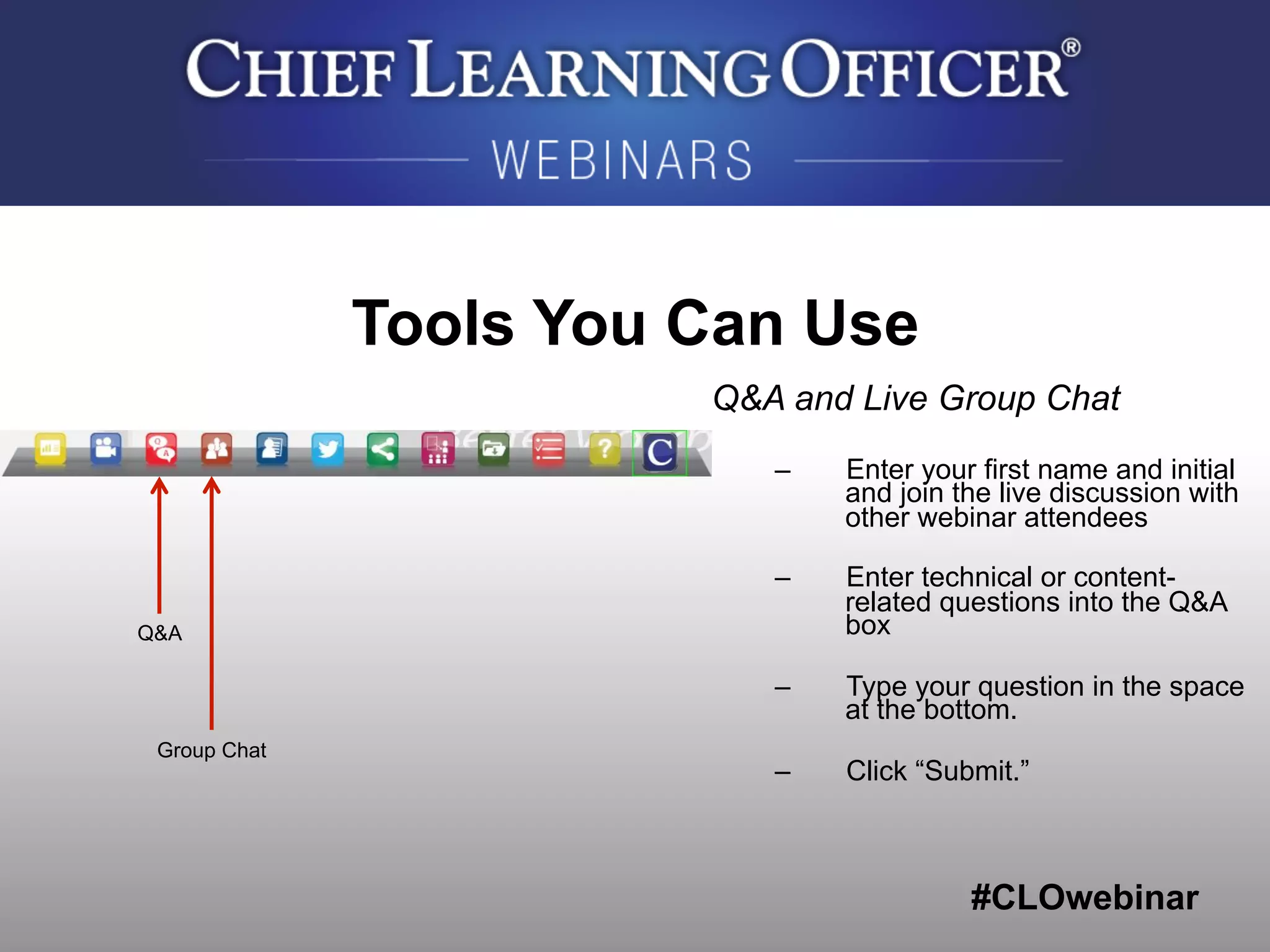
Q&A and Live Group Chat
–  Enter your first name and initial
and join the live discussion with
other webinar attendees
–  Enter technical or content-
related questions into the Q&A
box
–  Type your question in the space
at the bottom.
–  Click “Submit.”
Q&A
Group Chat
#CLOwebinar


Tools You Can Use
Twitter
-  Click “Post” in the Twitter widget.
#CLOwebinar
@CLOmedia
#CLOwebinar


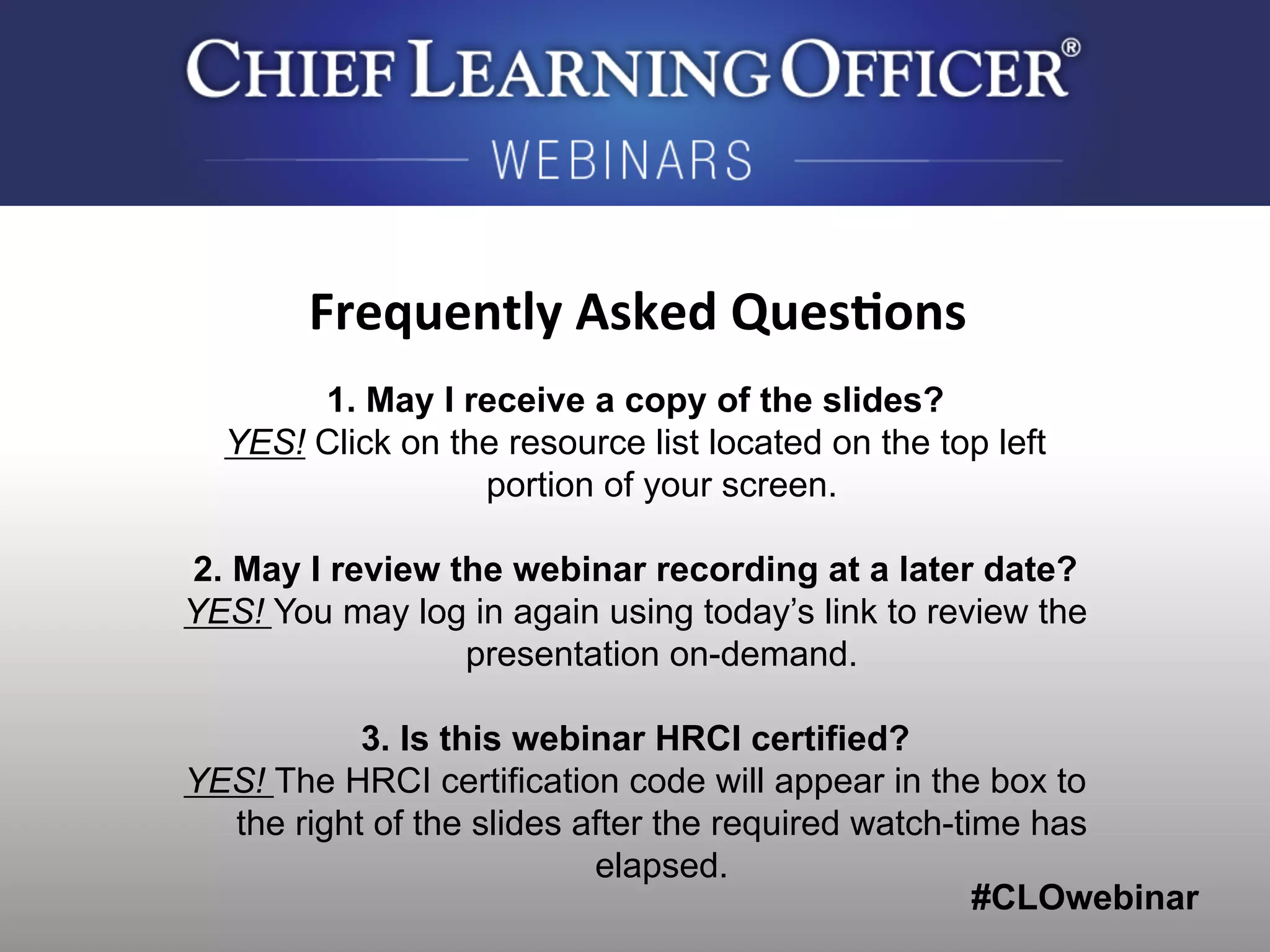
1. May I receive a copy of the slides?
YES! Click on the resource list located on the top left
portion of your screen.
2. May I review the webinar recording at a later date?
YES! You may log in again using today’s link to review the
presentation on-demand.
3. Is this webinar HRCI certified?
YES! The HRCI certification code will appear in the box to
the right of the slides after the required watch-time has
elapsed.
Frequently	
  Asked	
  Ques0ons	
  
Driving Performance at the Intersection of
Learning and Business
Unleashing the Power of
Analytics:
Page 8
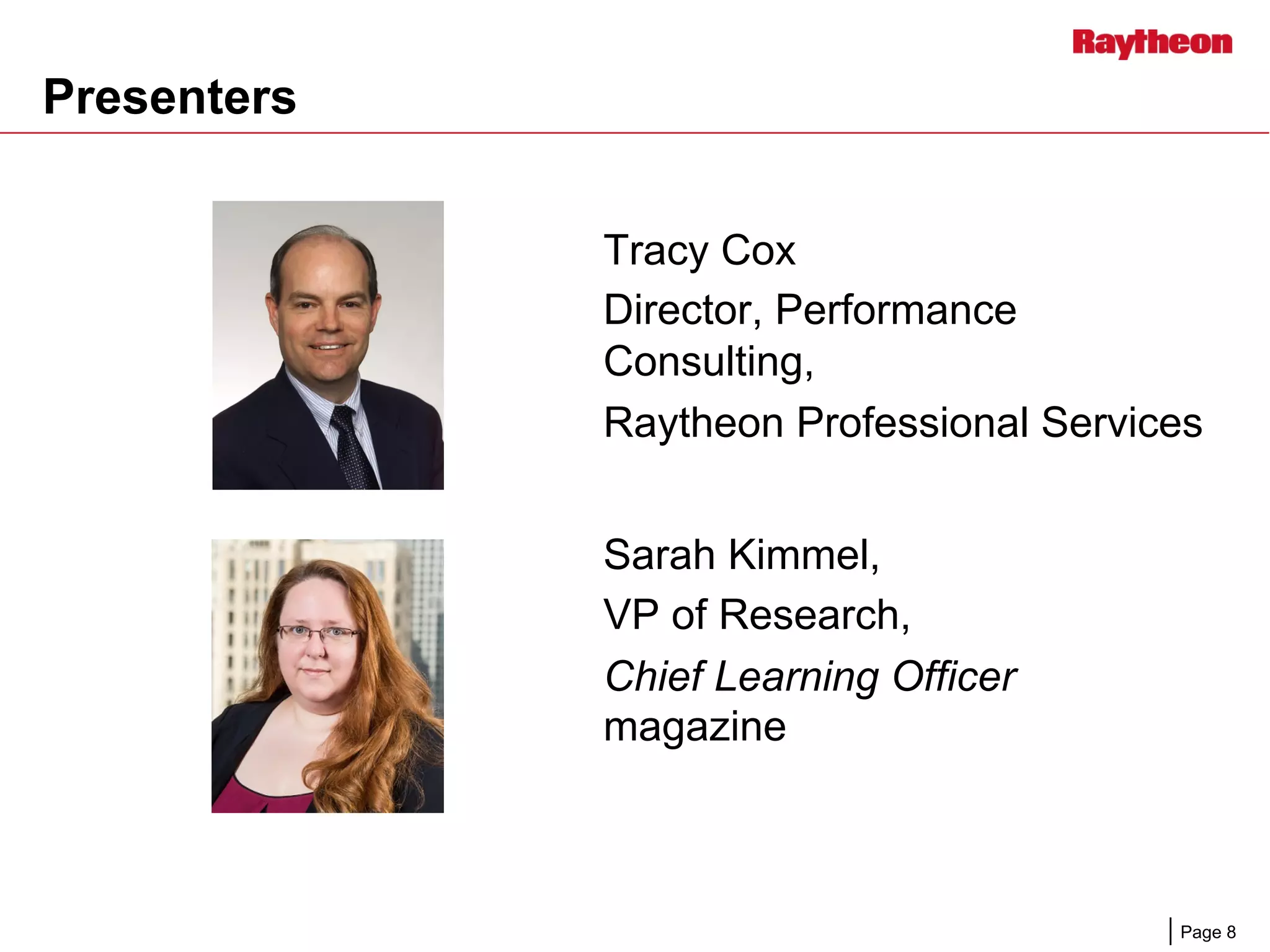
Presenters
Tracy Cox
Director, Performance
Consulting,
Raytheon Professional Services
Sarah Kimmel,
VP of Research,
Chief Learning Officer
magazine
Page 9
Seize the Moment
n  Evolution/challenges of Learning Analytics
– Analytics has a lot of “buzz” right now in business but what is it really?
– In many organizations L&D continues to struggle to have a seat at the
table. But some organizations are ahead of the game here. What are
they doing differently?
– It’s not just about making the business case for learning anymore- in
some organizations, analytics has made it possible to problem solve,
choose between learning investments, and maximize the impact of
L&D. Analytics presents the opportunity to not just prove the value of
learning to the business, but substantially contribute to creating
business value.
Page 10
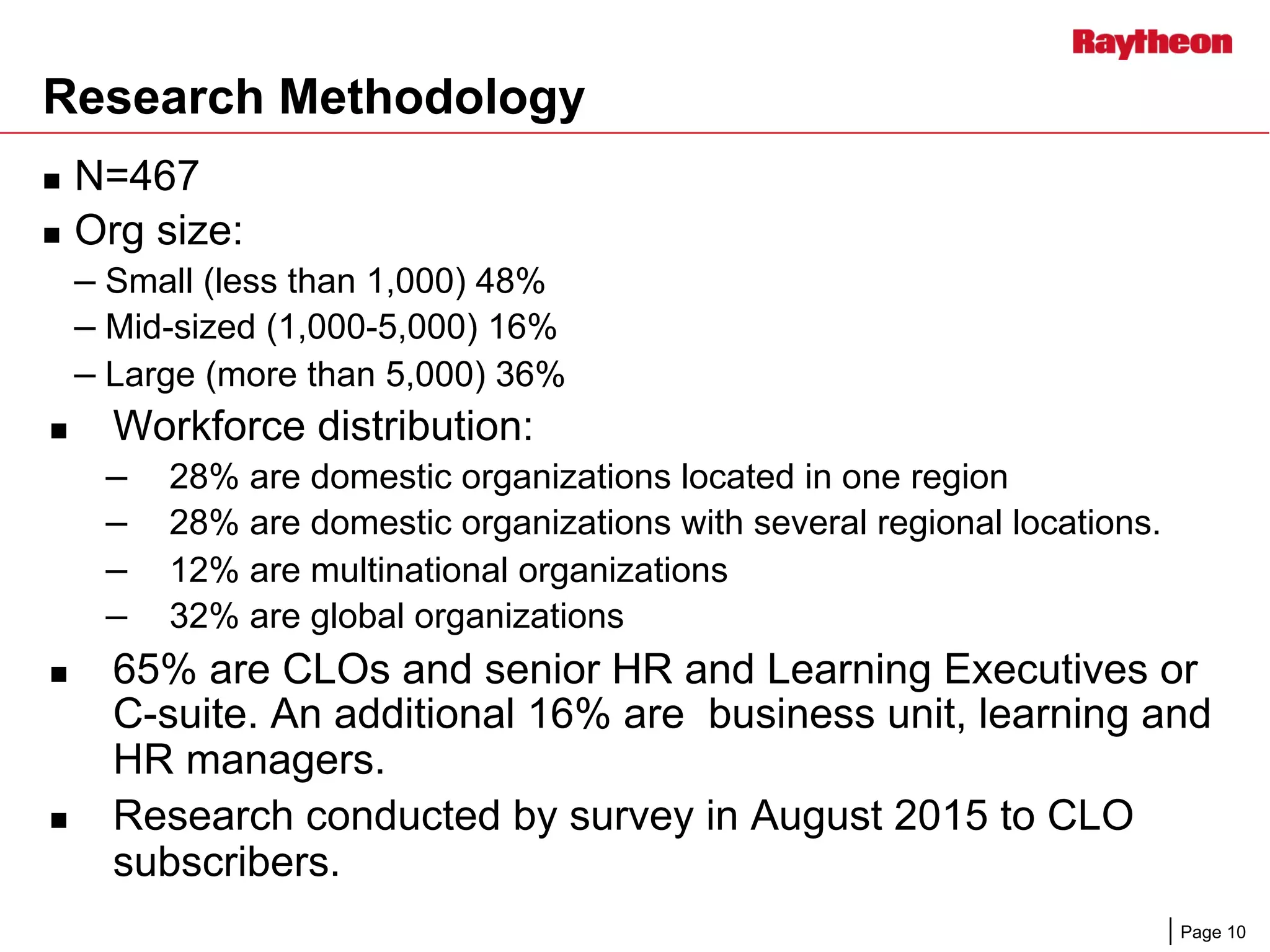
Research Methodology
n  N=467
n  Org size:
– Small (less than 1,000) 48%
– Mid-sized (1,000-5,000) 16%
– Large (more than 5,000) 36%
n  Workforce distribution:
–  28% are domestic organizations located in one region
–  28% are domestic organizations with several regional locations.
–  12% are multinational organizations
–  32% are global organizations
n  65% are CLOs and senior HR and Learning Executives or
C-suite. An additional 16% are business unit, learning and
HR managers.
n  Research conducted by survey in August 2015 to CLO
subscribers.
Page 11
WHAT IS LEARNING
ANALYTICS?
Page 12
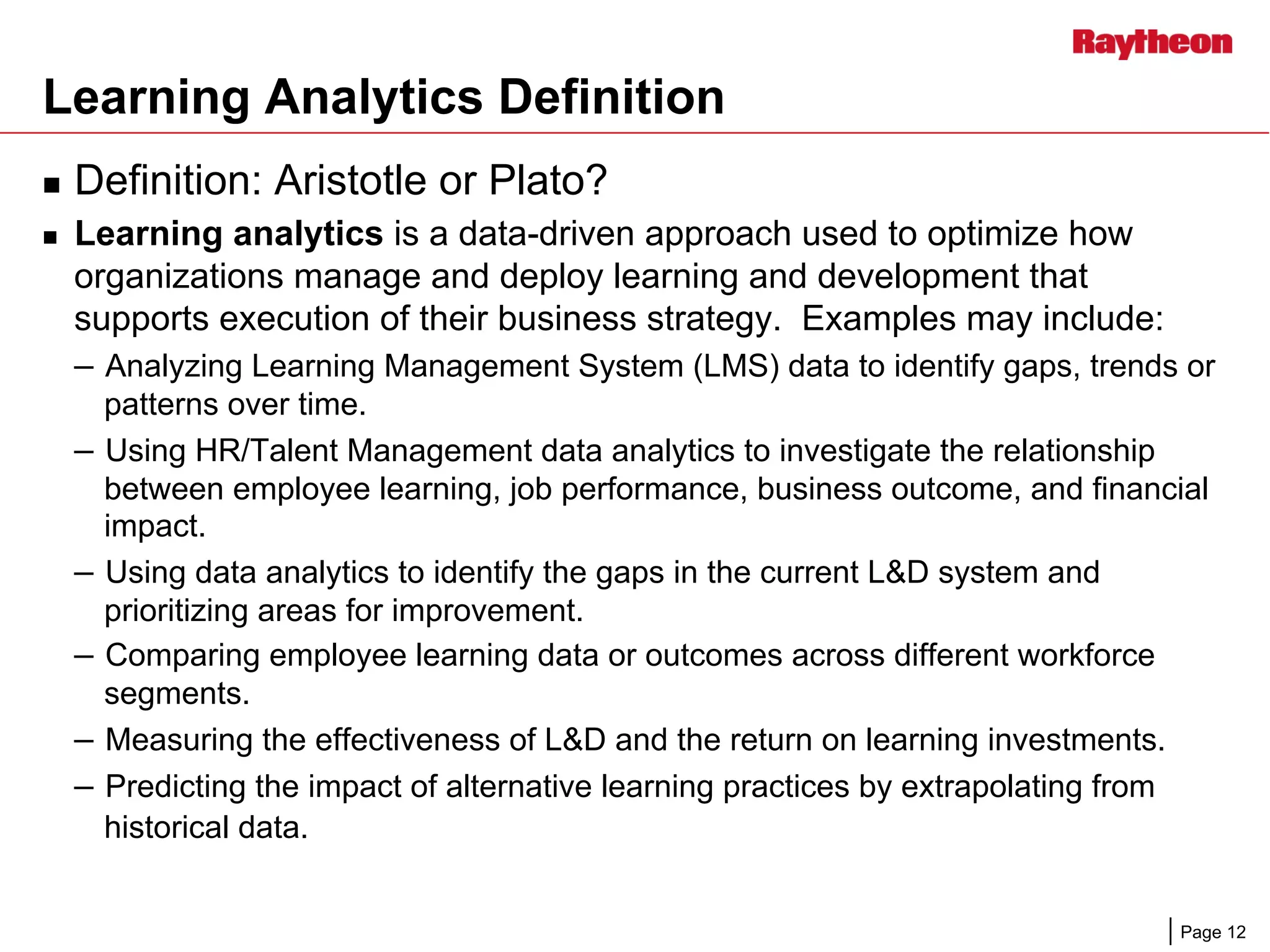
Learning Analytics Definition
n  Definition: Aristotle or Plato?
n  Learning analytics is a data-driven approach used to optimize how
organizations manage and deploy learning and development that
supports execution of their business strategy. Examples may include:
–  Analyzing Learning Management System (LMS) data to identify gaps, trends or
patterns over time.
–  Using HR/Talent Management data analytics to investigate the relationship
between employee learning, job performance, business outcome, and financial
impact.
–  Using data analytics to identify the gaps in the current L&D system and
prioritizing areas for improvement.
–  Comparing employee learning data or outcomes across different workforce
segments.
–  Measuring the effectiveness of L&D and the return on learning investments.
–  Predicting the impact of alternative learning practices by extrapolating from
historical data.
Page 13
Half of all organizations are using HR and
business data in their learning analytics.
71%
54%
48%
11%
0% 20% 40% 60% 80%
Learning analytics (i.e. course and
curriculum completions, certification
level)
Performance analytics (i.e. business
KPIs [descriptive, diagnostics or
predictive])
HR or talent management analytics
(i.e. attrition, loyalty, education level)
None of the above
Sources of Data used by L&D
Page 14
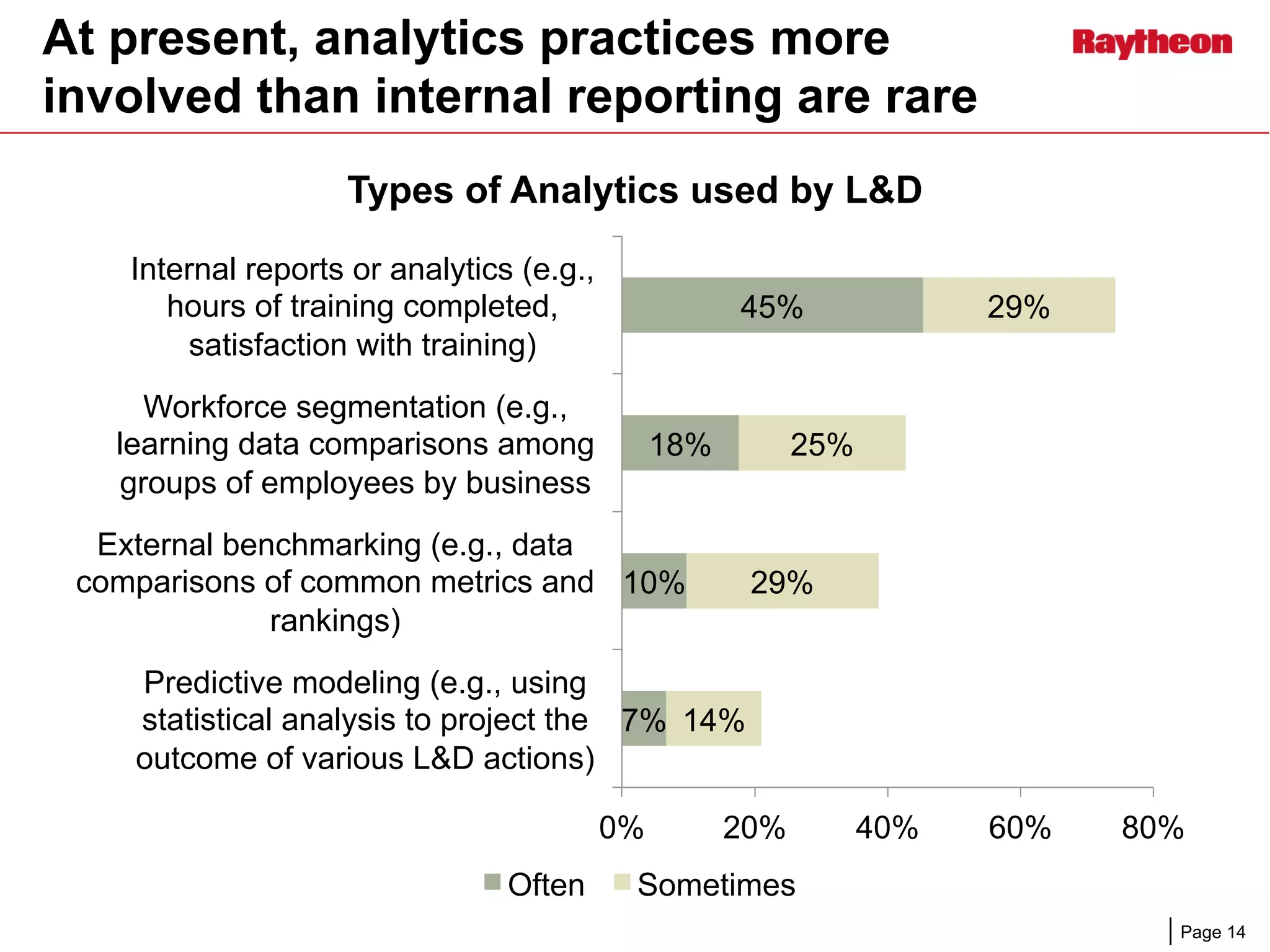
At present, analytics practices more
involved than internal reporting are rare
45%
18%
10%
7%
29%
25%
29%
14%
0% 20% 40% 60% 80%
Internal reports or analytics (e.g.,
hours of training completed,
satisfaction with training)
Workforce segmentation (e.g.,
learning data comparisons among
groups of employees by business
External benchmarking (e.g., data
comparisons of common metrics and
rankings)
Predictive modeling (e.g., using
statistical analysis to project the
outcome of various L&D actions)
Types of Analytics used by L&D
Often Sometimes
Page 15
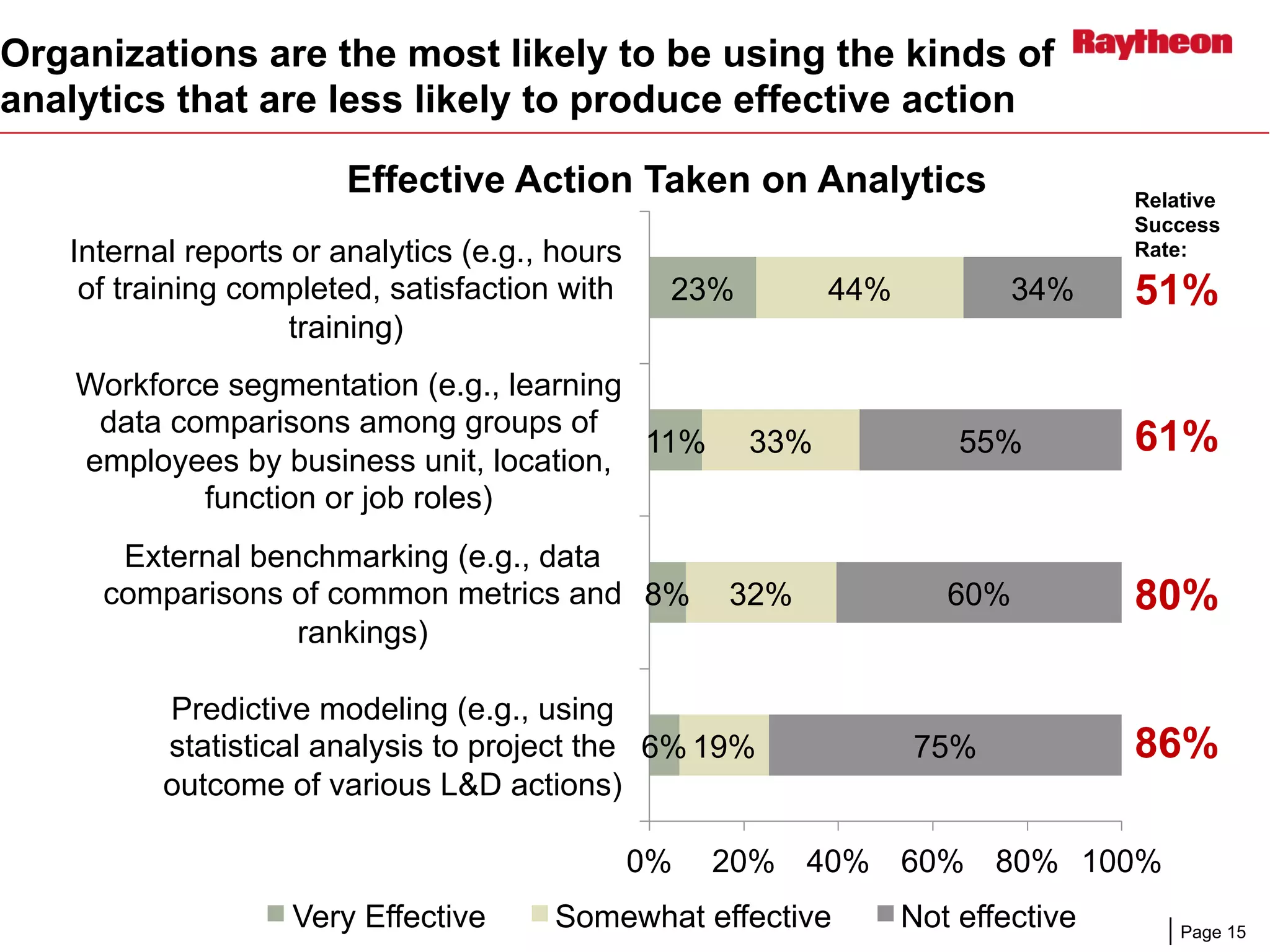
Organizations are the most likely to be using the kinds of
analytics that are less likely to produce effective action
23%
11%
8%
6%
44%
33%
32%
19%
34%
55%
60%
75%
0% 20% 40% 60% 80% 100%
Internal reports or analytics (e.g., hours
of training completed, satisfaction with
training)
Workforce segmentation (e.g., learning
data comparisons among groups of
employees by business unit, location,
function or job roles)
External benchmarking (e.g., data
comparisons of common metrics and
rankings)
Predictive modeling (e.g., using
statistical analysis to project the
outcome of various L&D actions)
Effective Action Taken on Analytics
Very Effective Somewhat effective Not effective
Relative
Success
Rate:
51%
61%
80%
86%
Page 16
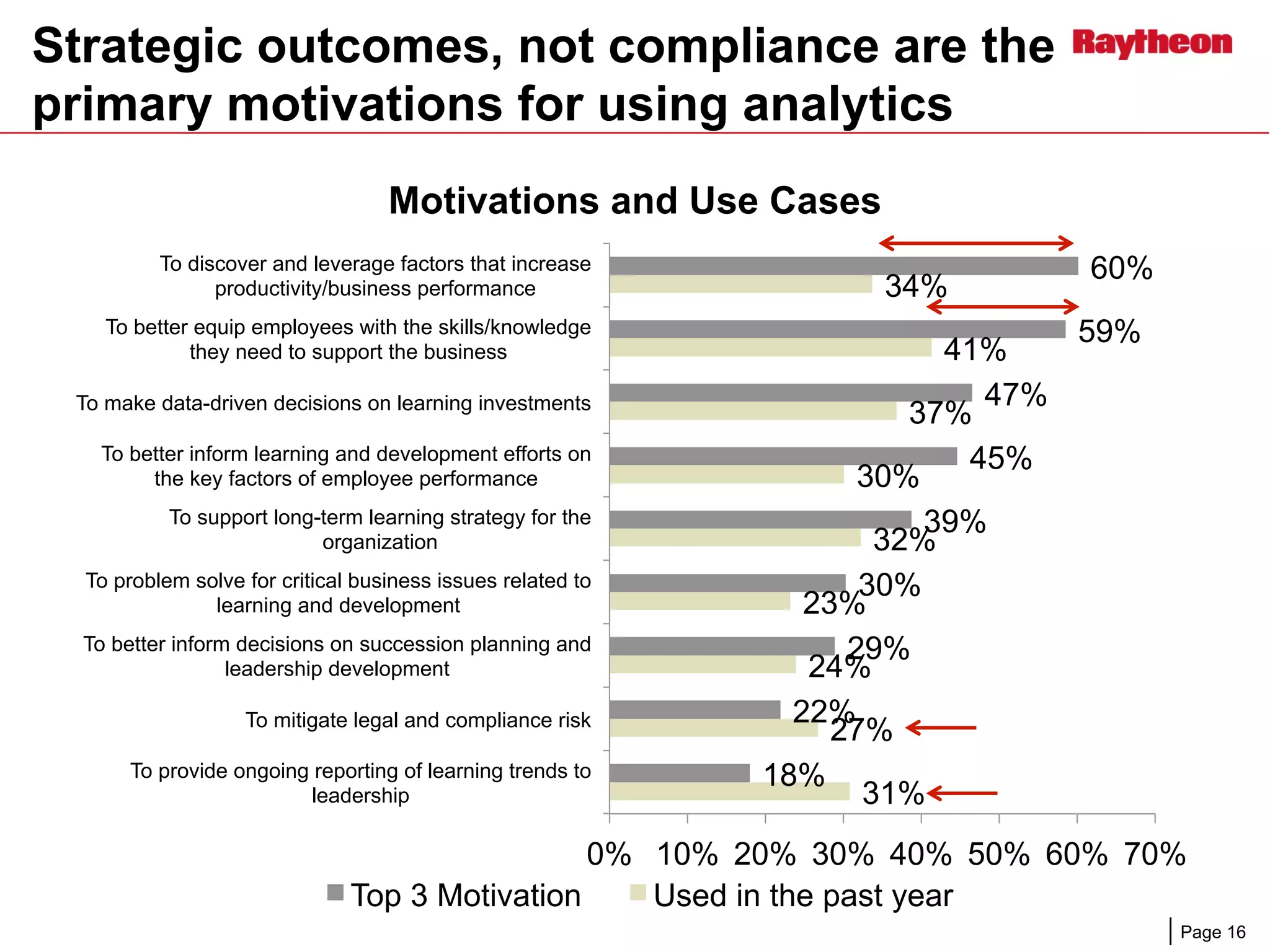
60%
59%
47%
45%
39%
30%
29%
22%
18%
34%
41%
37%
30%
32%
23%
24%
27%
31%
0% 10% 20% 30% 40% 50% 60% 70%
To discover and leverage factors that increase
productivity/business performance
To better equip employees with the skills/knowledge
they need to support the business
To make data-driven decisions on learning investments
To better inform learning and development efforts on
the key factors of employee performance
To support long-term learning strategy for the
organization
To problem solve for critical business issues related to
learning and development
To better inform decisions on succession planning and
leadership development
To mitigate legal and compliance risk
To provide ongoing reporting of learning trends to
leadership
Motivations and Use Cases
Top 3 Motivation Used in the past year
Strategic outcomes, not compliance are the
primary motivations for using analytics
Page 17
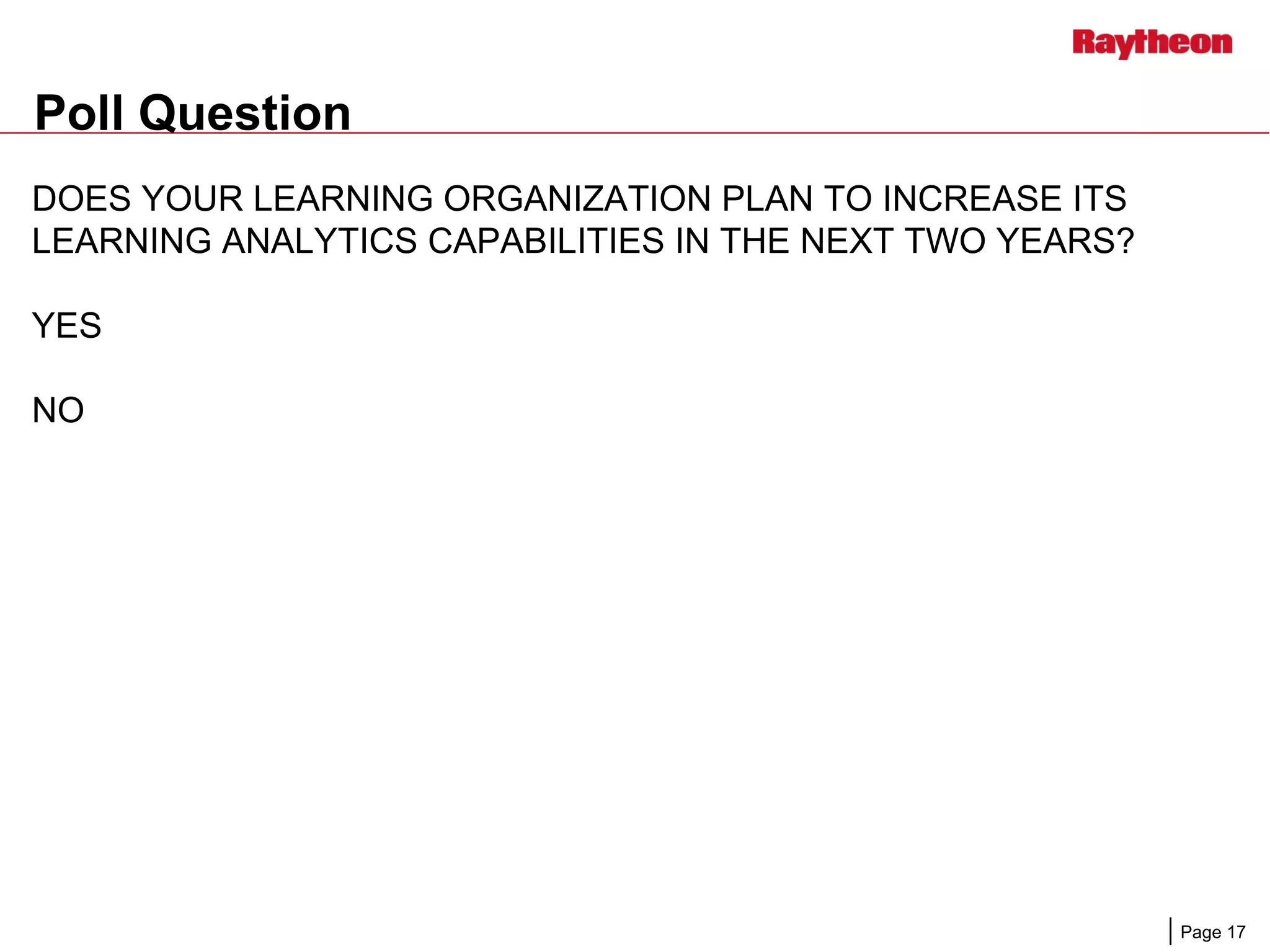
DOES YOUR LEARNING ORGANIZATION PLAN TO INCREASE ITS
LEARNING ANALYTICS CAPABILITIES IN THE NEXT TWO YEARS?
YES
NO
Poll Question
Page 18
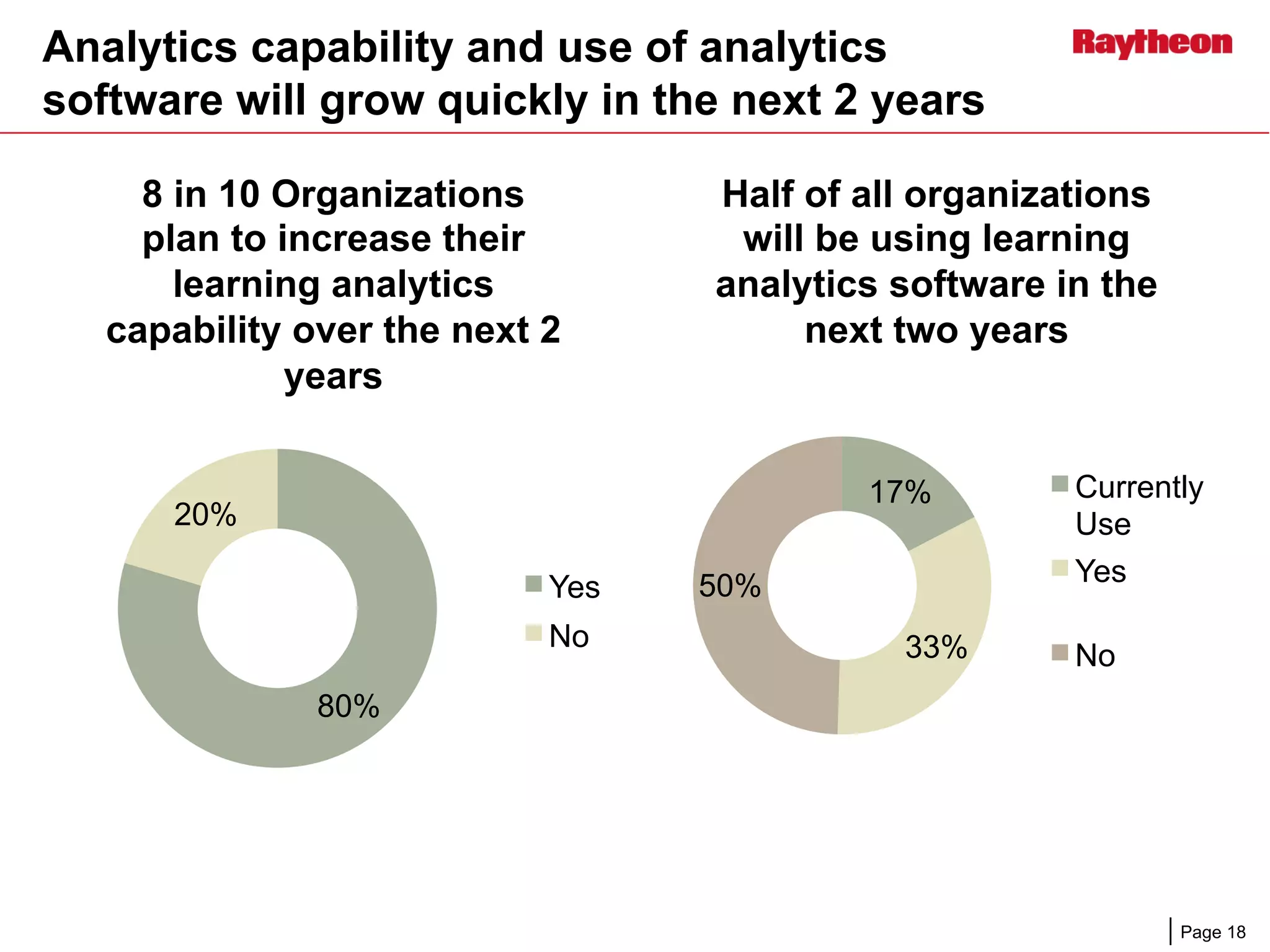
Analytics capability and use of analytics
software will grow quickly in the next 2 years
80%
20%
8 in 10 Organizations
plan to increase their
learning analytics
capability over the next 2
years
Yes
No
17%
33%
50%
Half of all organizations
will be using learning
analytics software in the
next two years
Currently
Use
Yes
No
Page 19
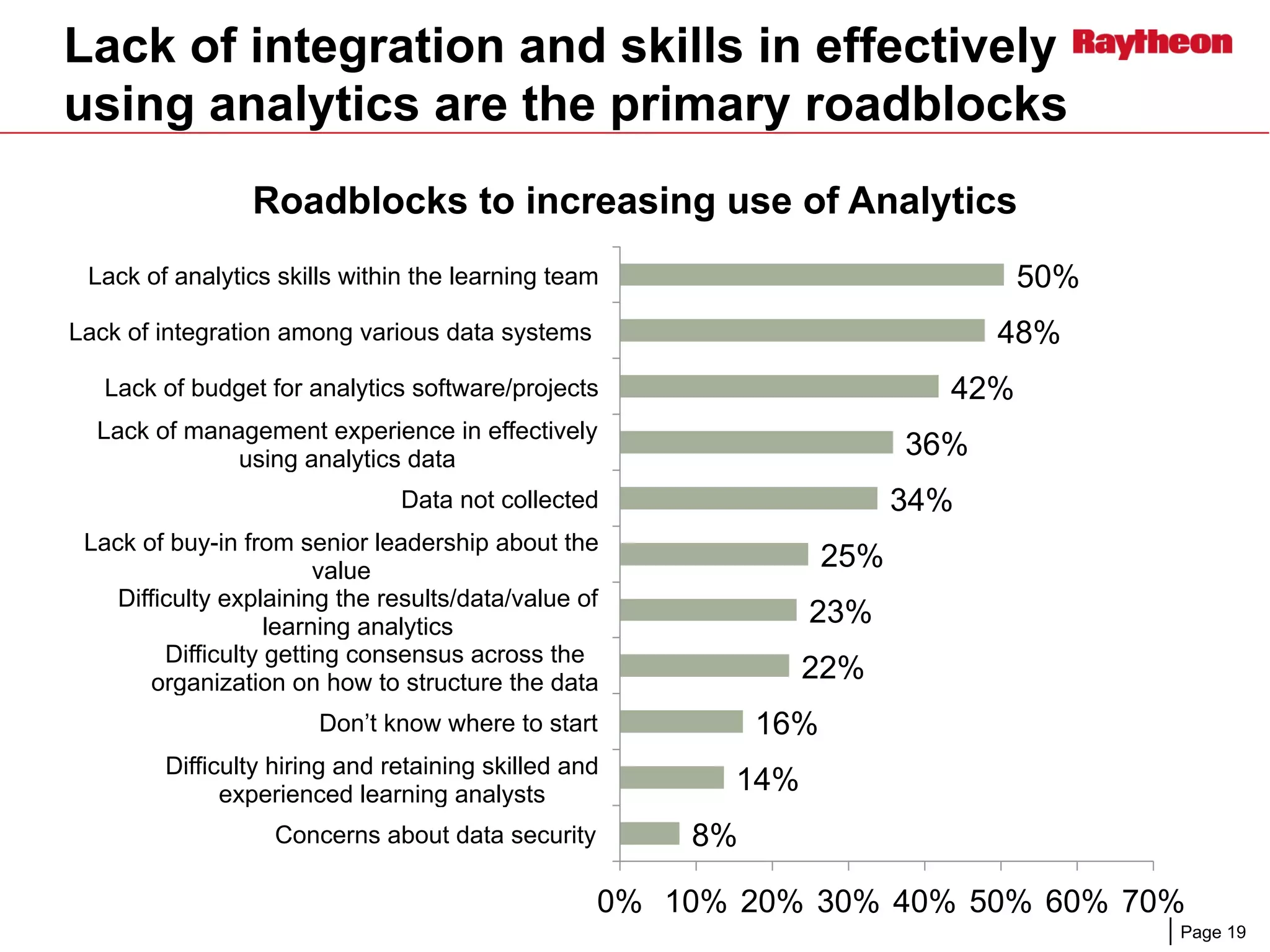
Lack of integration and skills in effectively
using analytics are the primary roadblocks
50%
48%
42%
36%
34%
25%
23%
22%
16%
14%
8%
0% 10% 20% 30% 40% 50% 60% 70%
Lack of analytics skills within the learning team
Lack of integration among various data systems
Lack of budget for analytics software/projects
Lack of management experience in effectively
using analytics data
Data not collected
Lack of buy-in from senior leadership about the
value
Difficulty explaining the results/data/value of
learning analytics
Difficulty getting consensus across the
organization on how to structure the data
Don’t know where to start
Difficulty hiring and retaining skilled and
experienced learning analysts
Concerns about data security
Roadblocks to increasing use of Analytics
Page 20
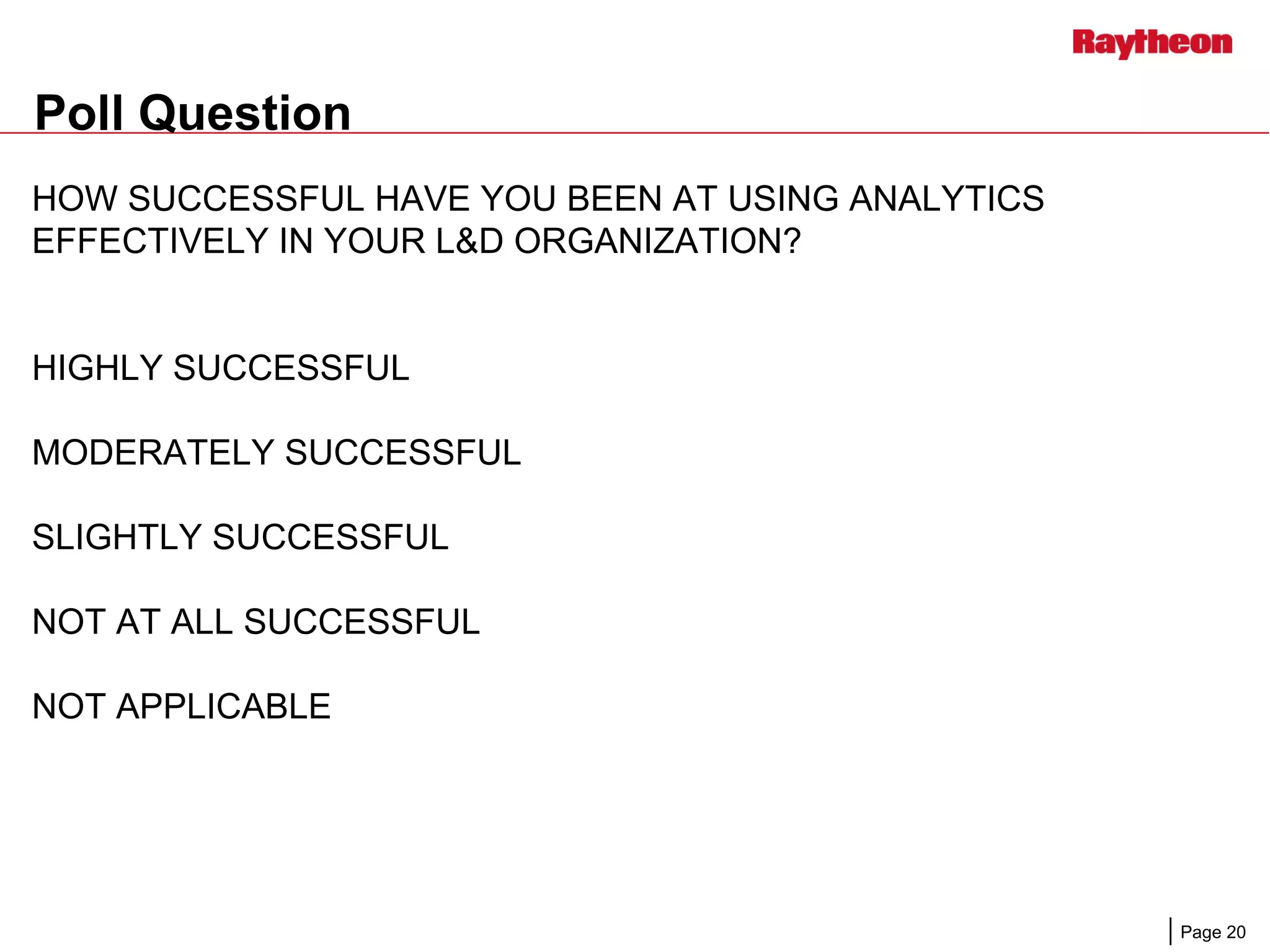
HOW SUCCESSFUL HAVE YOU BEEN AT USING ANALYTICS
EFFECTIVELY IN YOUR L&D ORGANIZATION?
HIGHLY SUCCESSFUL
MODERATELY SUCCESSFUL
SLIGHTLY SUCCESSFUL
NOT AT ALL SUCCESSFUL
NOT APPLICABLE
Poll Question
Page 21
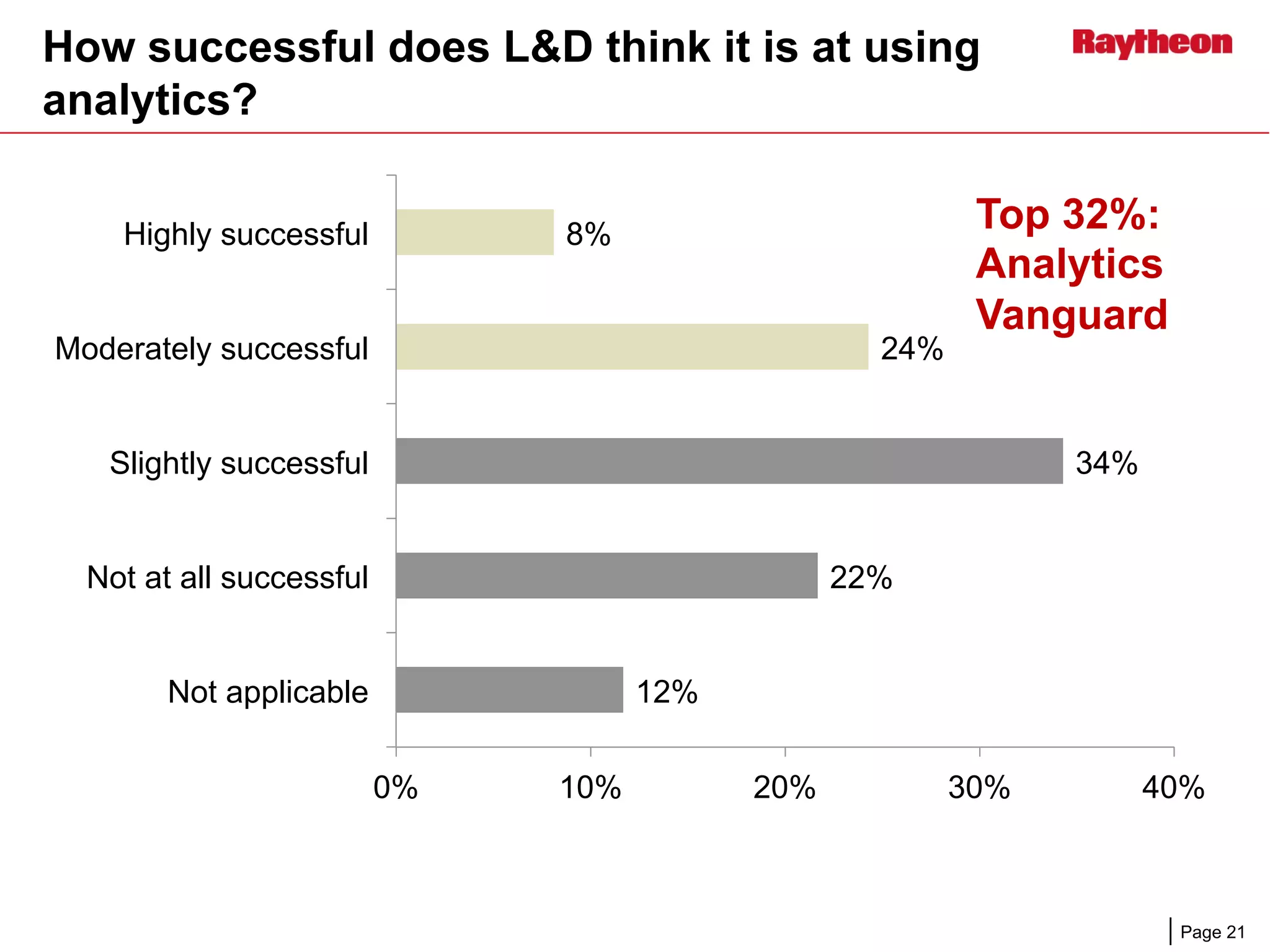
How successful does L&D think it is at using
analytics?
8%
24%
34%
22%
12%
0% 10% 20% 30% 40%
Highly successful
Moderately successful
Slightly successful
Not at all successful
Not applicable
Top 32%:
Analytics
Vanguard
Page 22
WHAT DOES IMPACTFUL
LEARNING ANALYTICS LOOK
LIKE?
Page 23
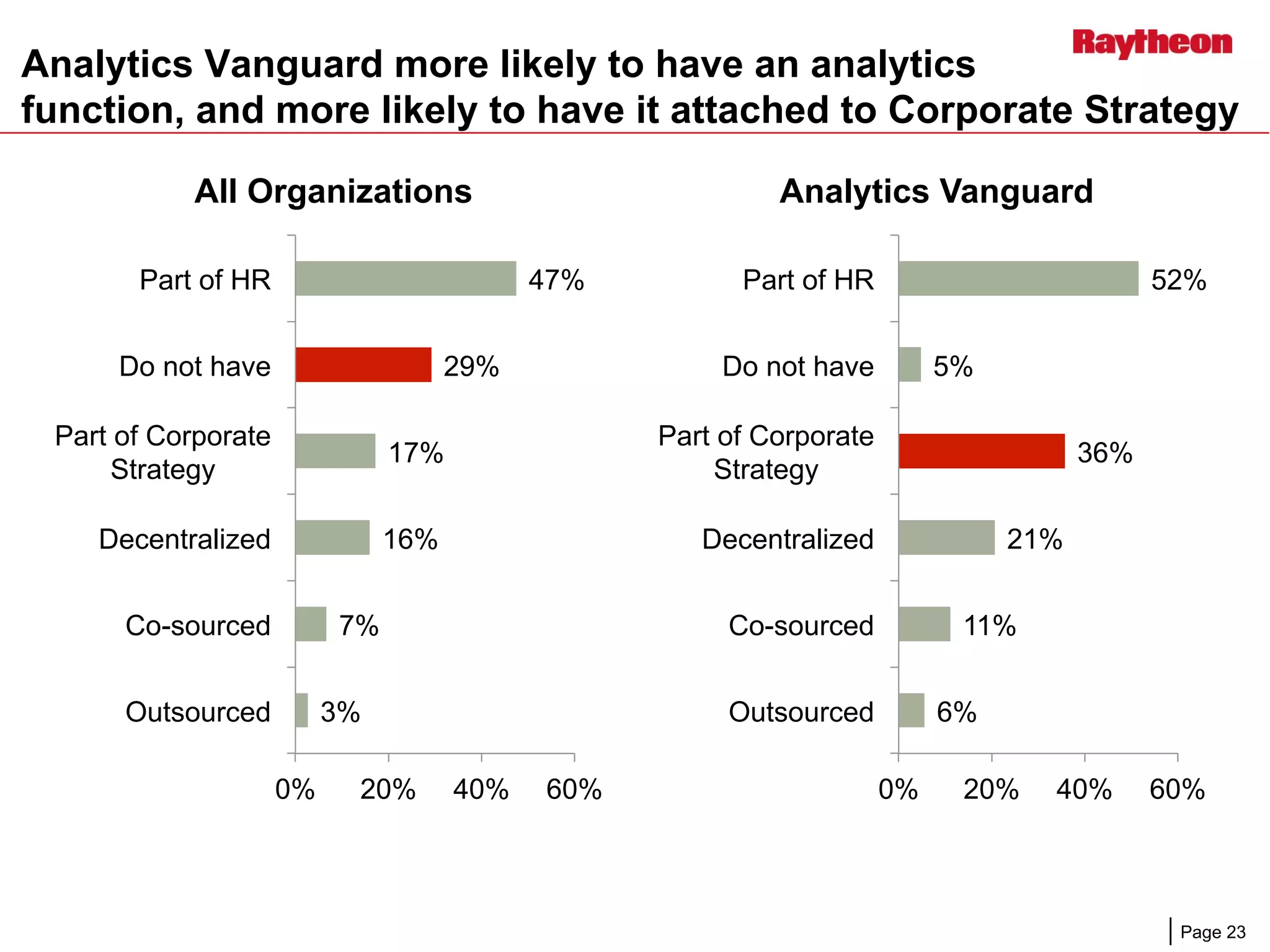
Analytics Vanguard more likely to have an analytics
function, and more likely to have it attached to Corporate Strategy
47%
29%
17%
16%
7%
3%
0% 20% 40% 60%
Part of HR
Do not have
Part of Corporate
Strategy
Decentralized
Co-sourced
Outsourced
All Organizations
52%
5%
36%
21%
11%
6%
0% 20% 40% 60%
Part of HR
Do not have
Part of Corporate
Strategy
Decentralized
Co-sourced
Outsourced
Analytics Vanguard
Page 24
Vanguard use more sources of data and more
business data for analytics
71%
54%
48%
11%
85%
72%
54%
3%
0% 20% 40% 60% 80% 100%
Learning analytics (i.e. course and
curriculum completions, certification
level)
Performance analytics (i.e. business
KPIs [descriptive, diagnostics or
predictive])
HR or talent management analytics
(i.e. attrition, loyalty, education level)
None of the above
Data Sources Used by L&D
All Organizations Analytics Vanguard
Page 25
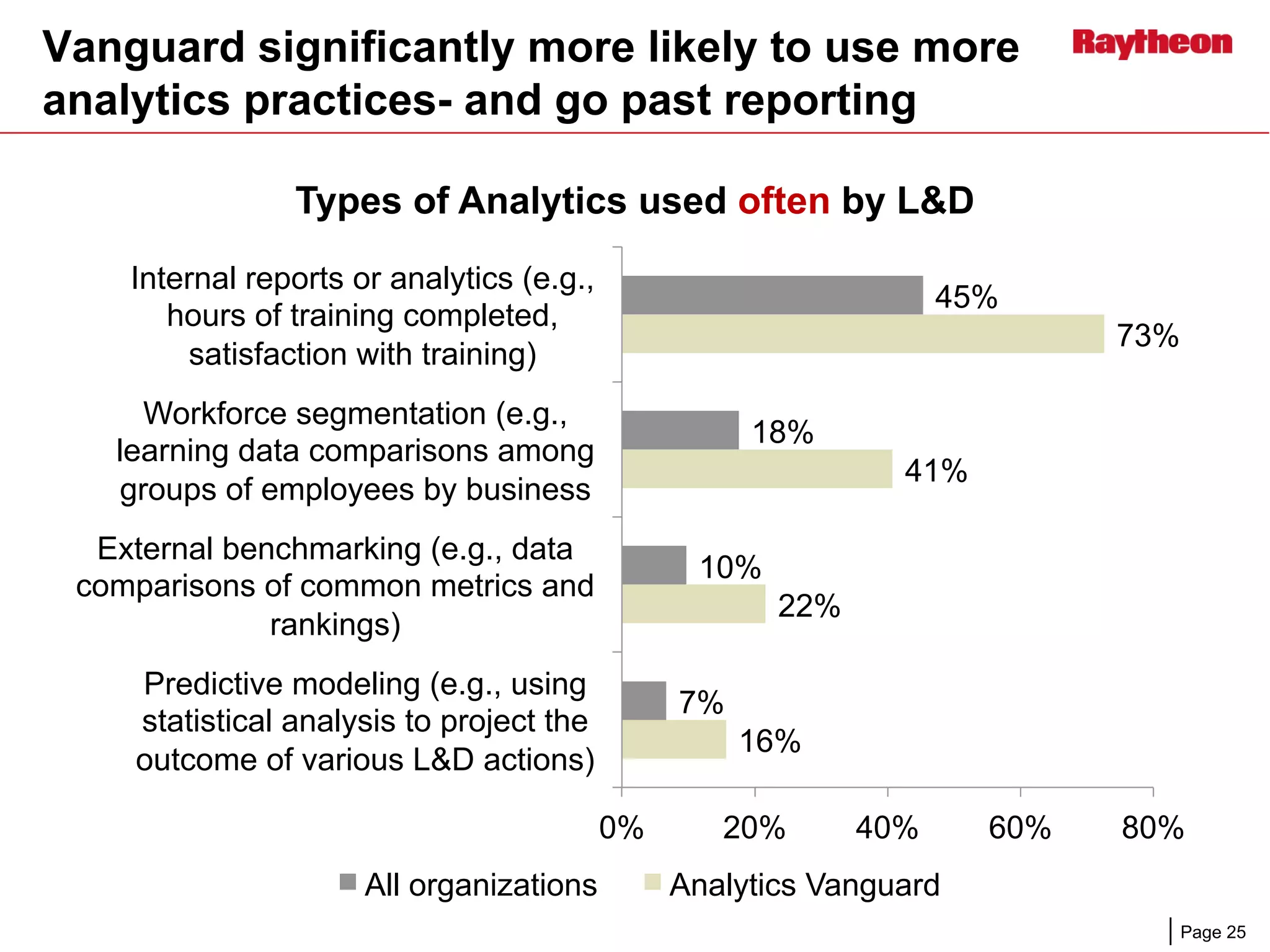
Vanguard significantly more likely to use more
analytics practices- and go past reporting
45%
18%
10%
7%
73%
41%
22%
16%
0% 20% 40% 60% 80%
Internal reports or analytics (e.g.,
hours of training completed,
satisfaction with training)
Workforce segmentation (e.g.,
learning data comparisons among
groups of employees by business
External benchmarking (e.g., data
comparisons of common metrics and
rankings)
Predictive modeling (e.g., using
statistical analysis to project the
outcome of various L&D actions)
Types of Analytics used often by L&D
All organizations Analytics Vanguard
Page 26
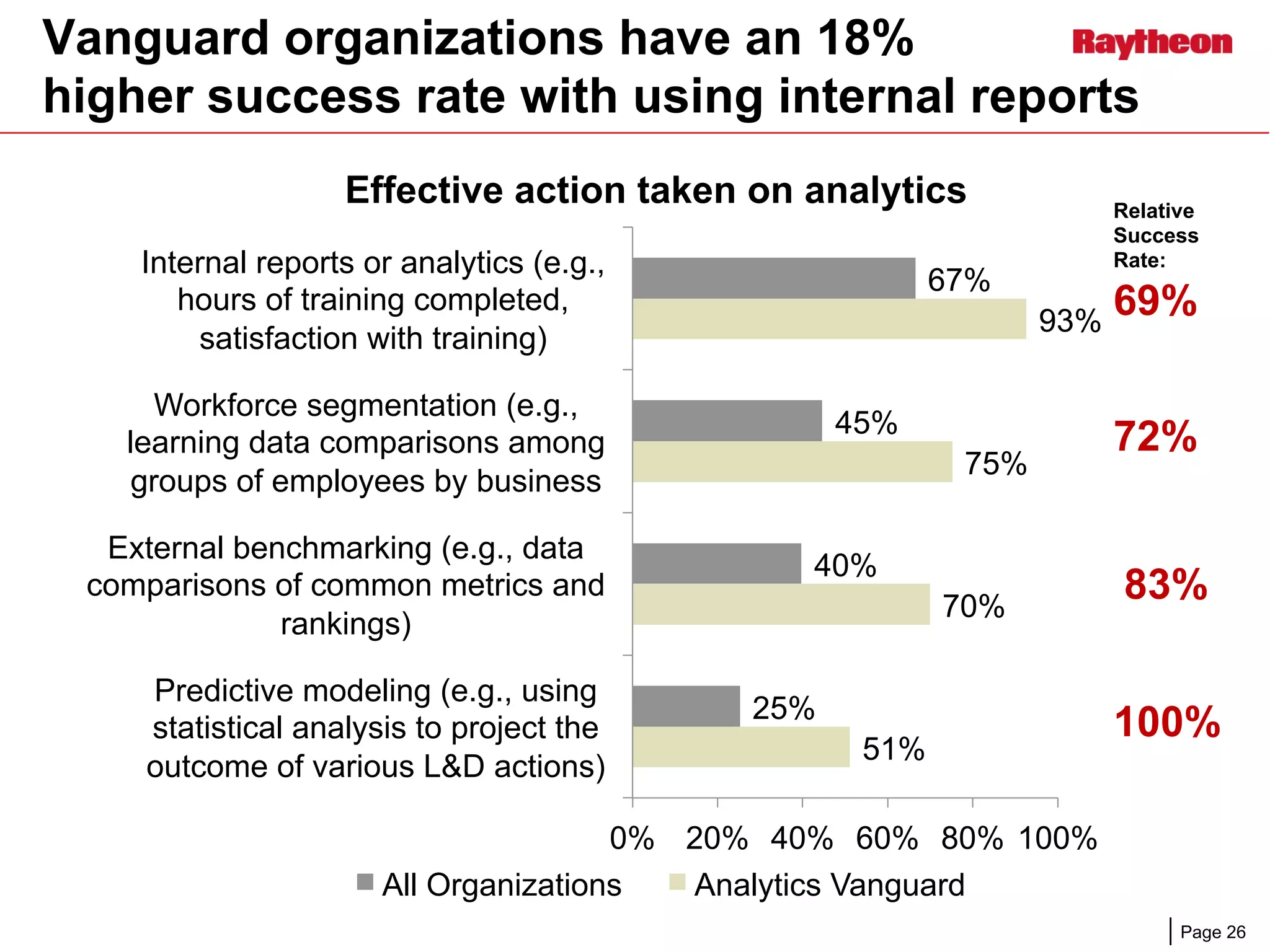
Vanguard organizations have an 18%
higher success rate with using internal reports
67%
45%
40%
25%
93%
75%
70%
51%
0% 20% 40% 60% 80% 100%
Internal reports or analytics (e.g.,
hours of training completed,
satisfaction with training)
Workforce segmentation (e.g.,
learning data comparisons among
groups of employees by business
External benchmarking (e.g., data
comparisons of common metrics and
rankings)
Predictive modeling (e.g., using
statistical analysis to project the
outcome of various L&D actions)
Effective action taken on analytics
All Organizations Analytics Vanguard
Relative
Success
Rate:
69%
72%
83%
100%
Page 27
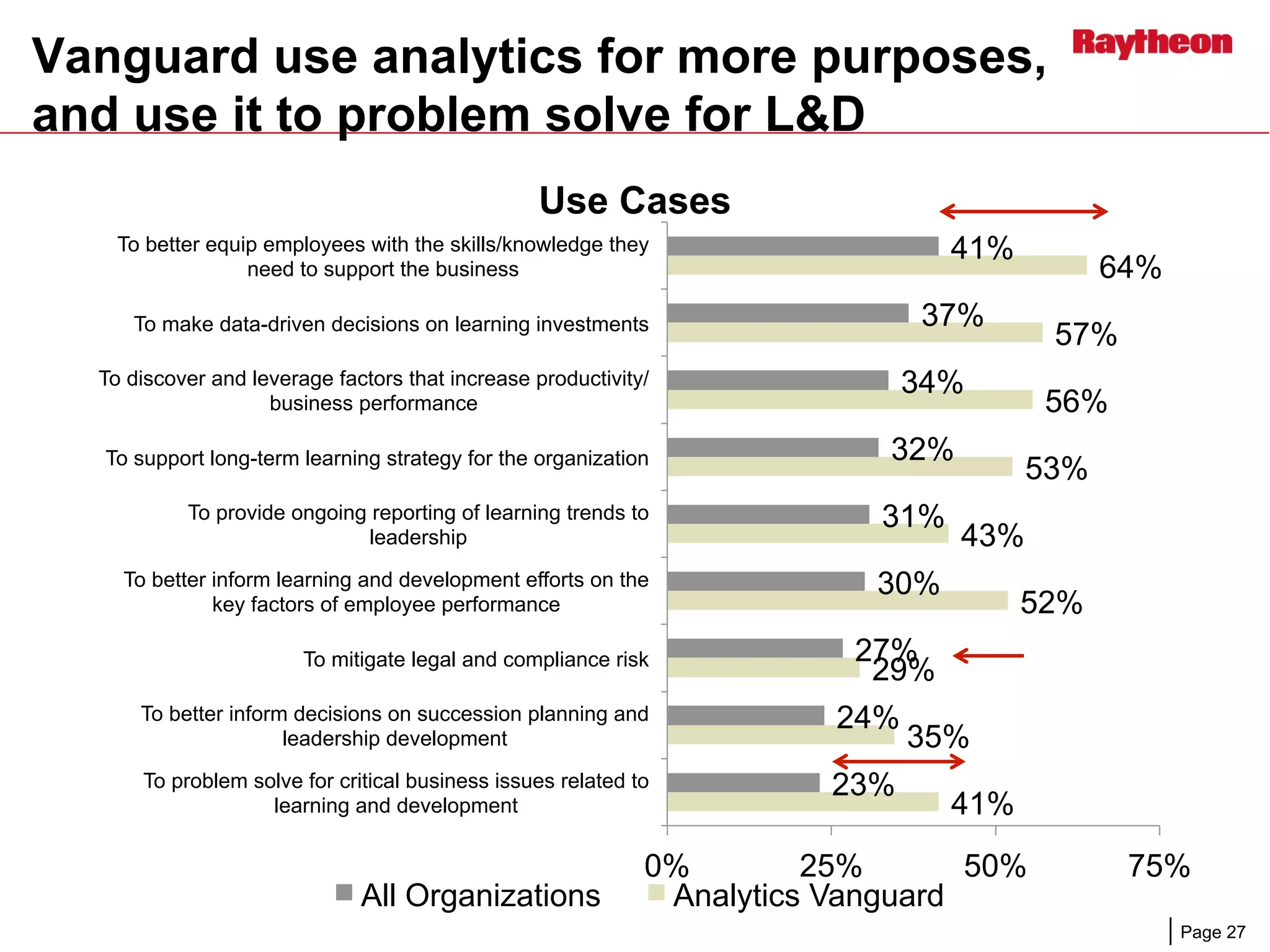
Vanguard use analytics for more purposes,
and use it to problem solve for L&D
41%
37%
34%
32%
31%
30%
27%
24%
23%
64%
57%
56%
53%
43%
52%
29%
35%
41%
0% 25% 50% 75%
To better equip employees with the skills/knowledge they
need to support the business
To make data-driven decisions on learning investments
To discover and leverage factors that increase productivity/
business performance
To support long-term learning strategy for the organization
To provide ongoing reporting of learning trends to
leadership
To better inform learning and development efforts on the
key factors of employee performance
To mitigate legal and compliance risk
To better inform decisions on succession planning and
leadership development
To problem solve for critical business issues related to
learning and development
Use Cases
All Organizations Analytics Vanguard
Page 28
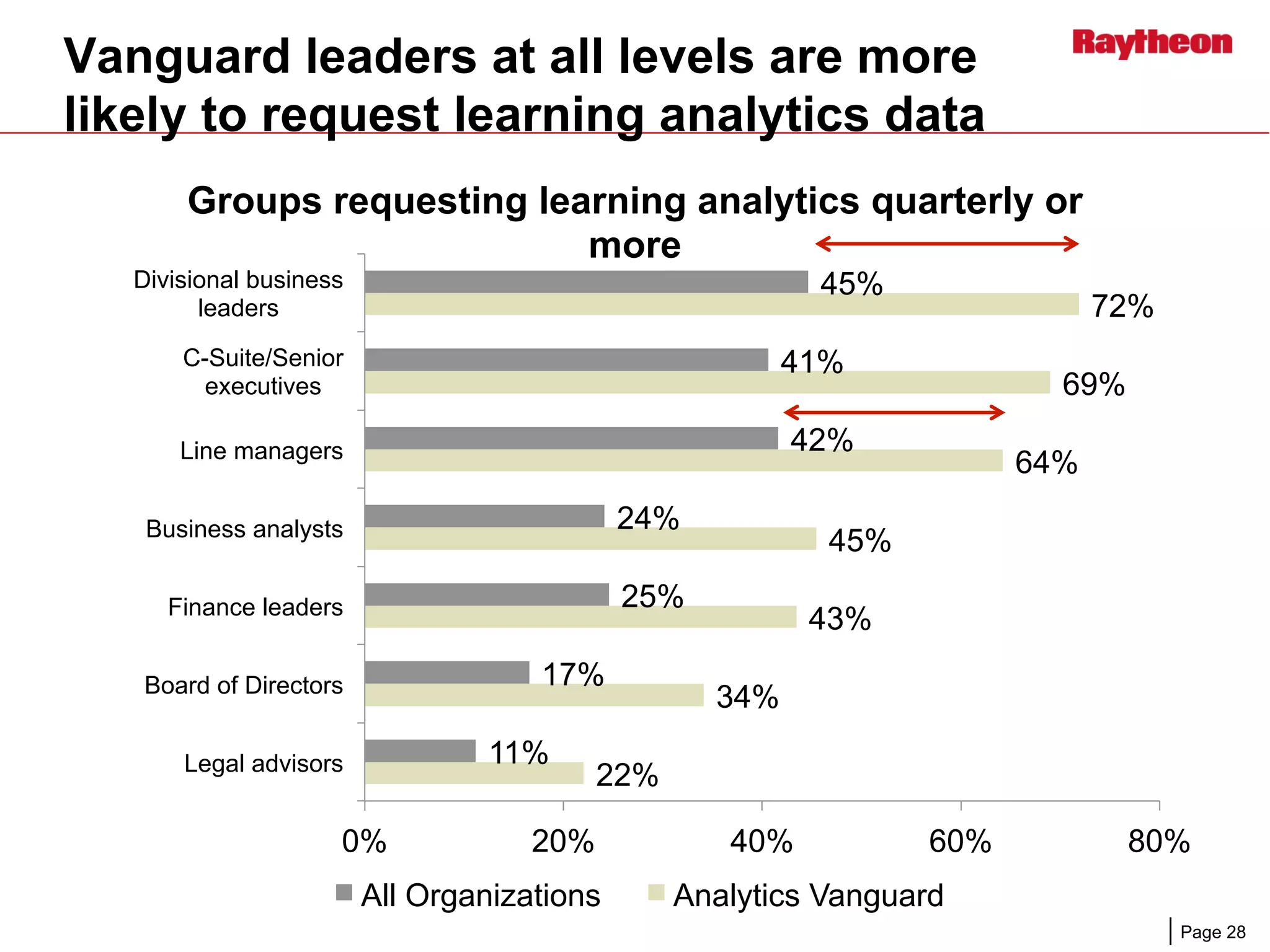
Vanguard leaders at all levels are more
likely to request learning analytics data
45%
41%
42%
24%
25%
17%
11%
72%
69%
64%
45%
43%
34%
22%
0% 20% 40% 60% 80%
Divisional business
leaders
C-Suite/Senior
executives
Line managers
Business analysts
Finance leaders
Board of Directors
Legal advisors
Groups requesting learning analytics quarterly or
more
All Organizations Analytics Vanguard
Page 29
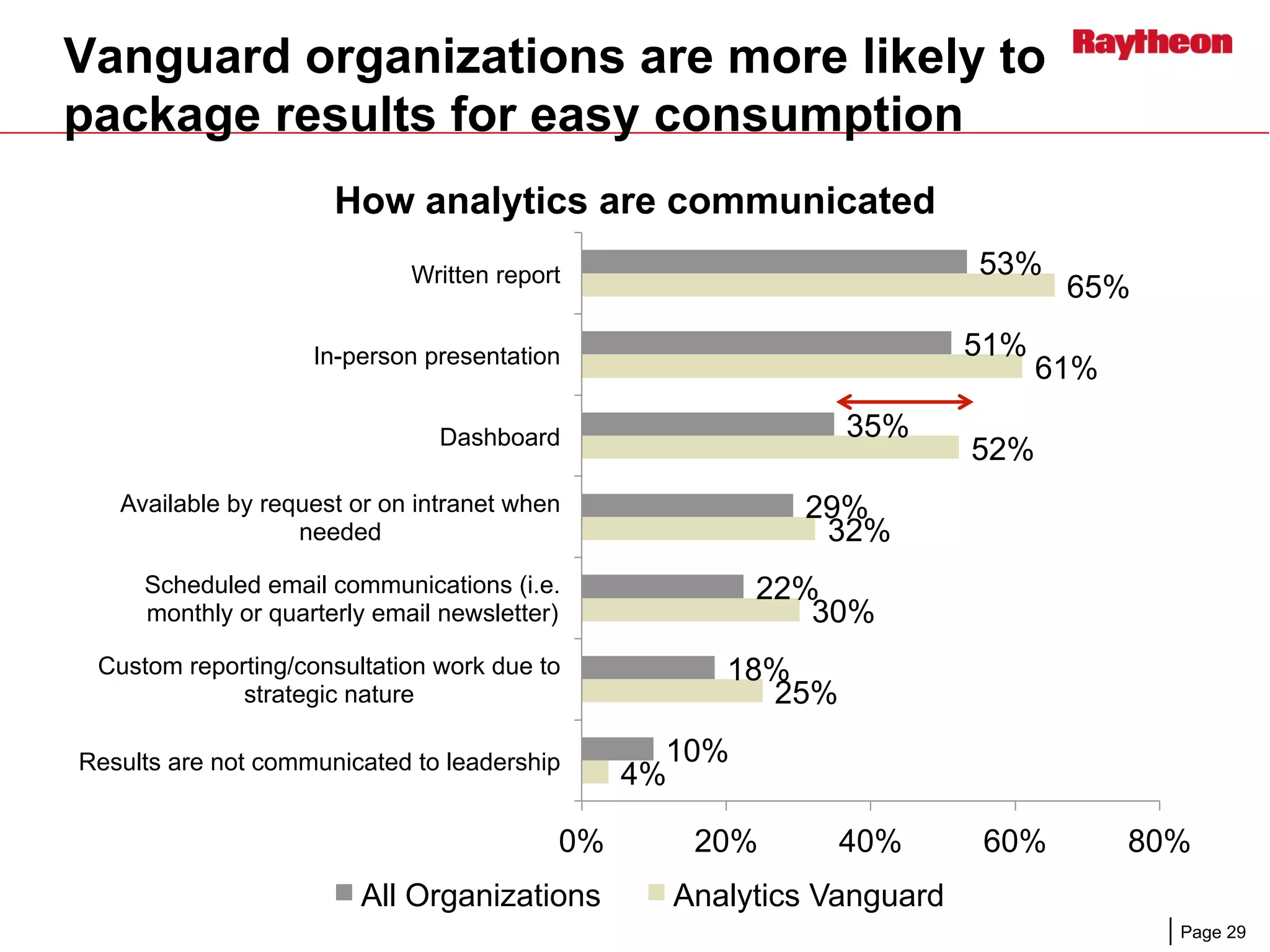
Vanguard organizations are more likely to
package results for easy consumption
53%
51%
35%
29%
22%
18%
10%
65%
61%
52%
32%
30%
25%
4%
0% 20% 40% 60% 80%
Written report
In-person presentation
Dashboard
Available by request or on intranet when
needed
Scheduled email communications (i.e.
monthly or quarterly email newsletter)
Custom reporting/consultation work due to
strategic nature
Results are not communicated to leadership
How analytics are communicated
All Organizations Analytics Vanguard
Page 30
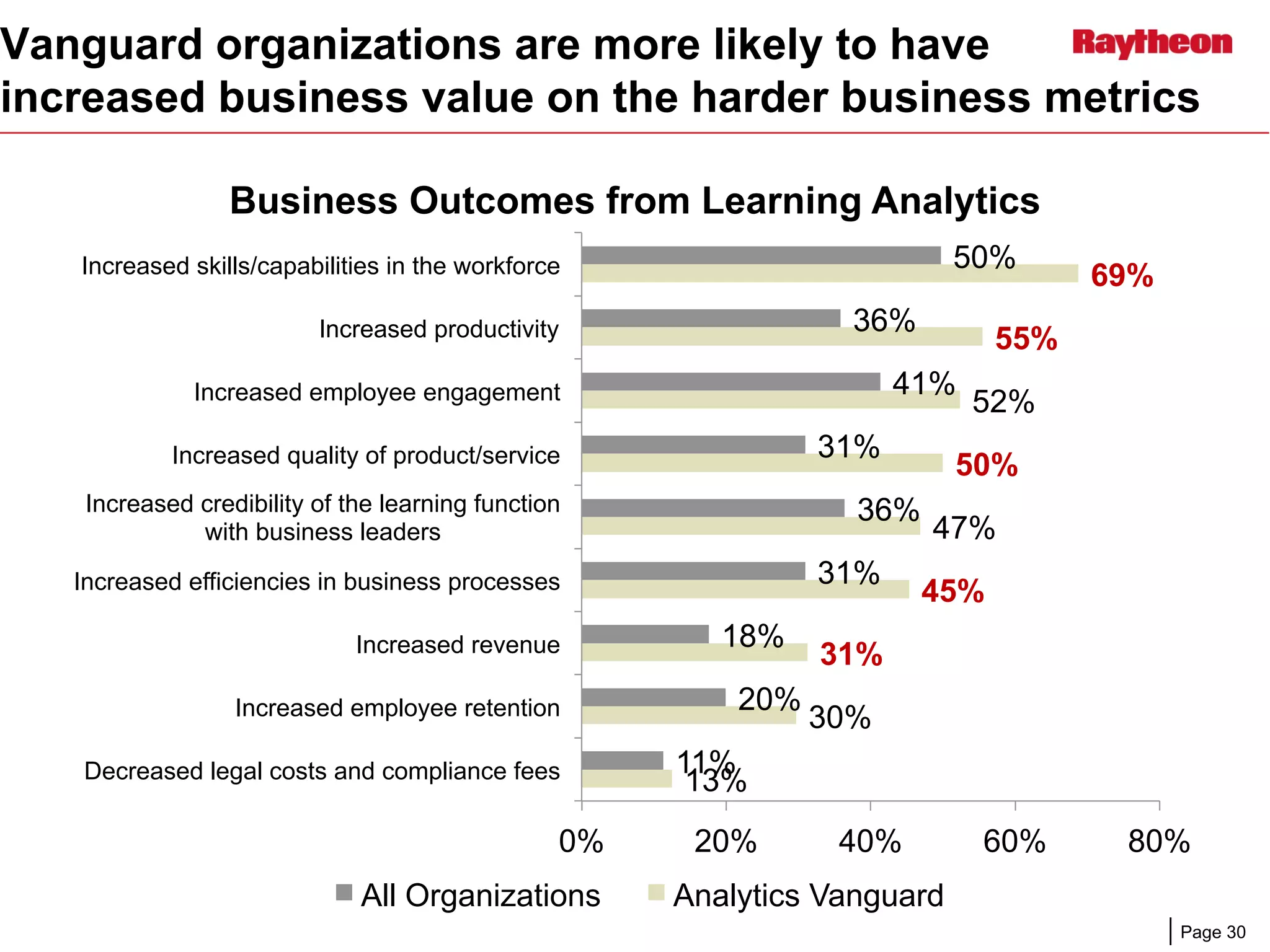
Vanguard organizations are more likely to have
increased business value on the harder business metrics
50%
36%
41%
31%
36%
31%
18%
20%
11%
69%
55%
52%
50%
47%
45%
31%
30%
13%
0% 20% 40% 60% 80%
Increased skills/capabilities in the workforce
Increased productivity
Increased employee engagement
Increased quality of product/service
Increased credibility of the learning function
with business leaders
Increased efficiencies in business processes
Increased revenue
Increased employee retention
Decreased legal costs and compliance fees
Business Outcomes from Learning Analytics
All Organizations Analytics Vanguard
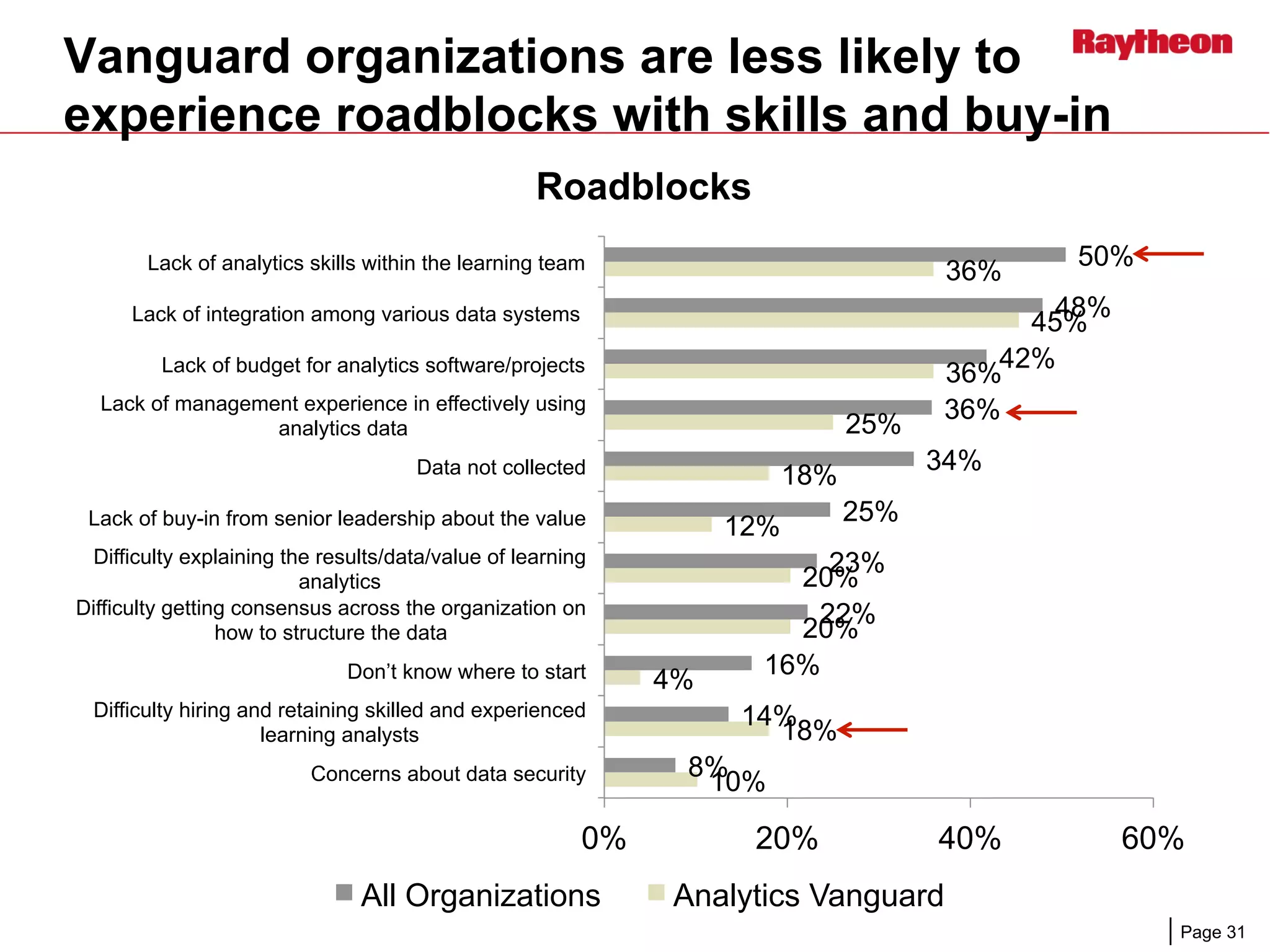
Page 31
Vanguard organizations are less likely to
experience roadblocks with skills and buy-in
50%
48%
42%
36%
34%
25%
23%
22%
16%
14%
8%
36%
45%
36%
25%
18%
12%
20%
20%
4%
18%
10%
0% 20% 40% 60%
Lack of analytics skills within the learning team
Lack of integration among various data systems
Lack of budget for analytics software/projects
Lack of management experience in effectively using
analytics data
Data not collected
Lack of buy-in from senior leadership about the value
Difficulty explaining the results/data/value of learning
analytics
Difficulty getting consensus across the organization on
how to structure the data
Don’t know where to start
Difficulty hiring and retaining skilled and experienced
learning analysts
Concerns about data security
Roadblocks
All Organizations Analytics Vanguard
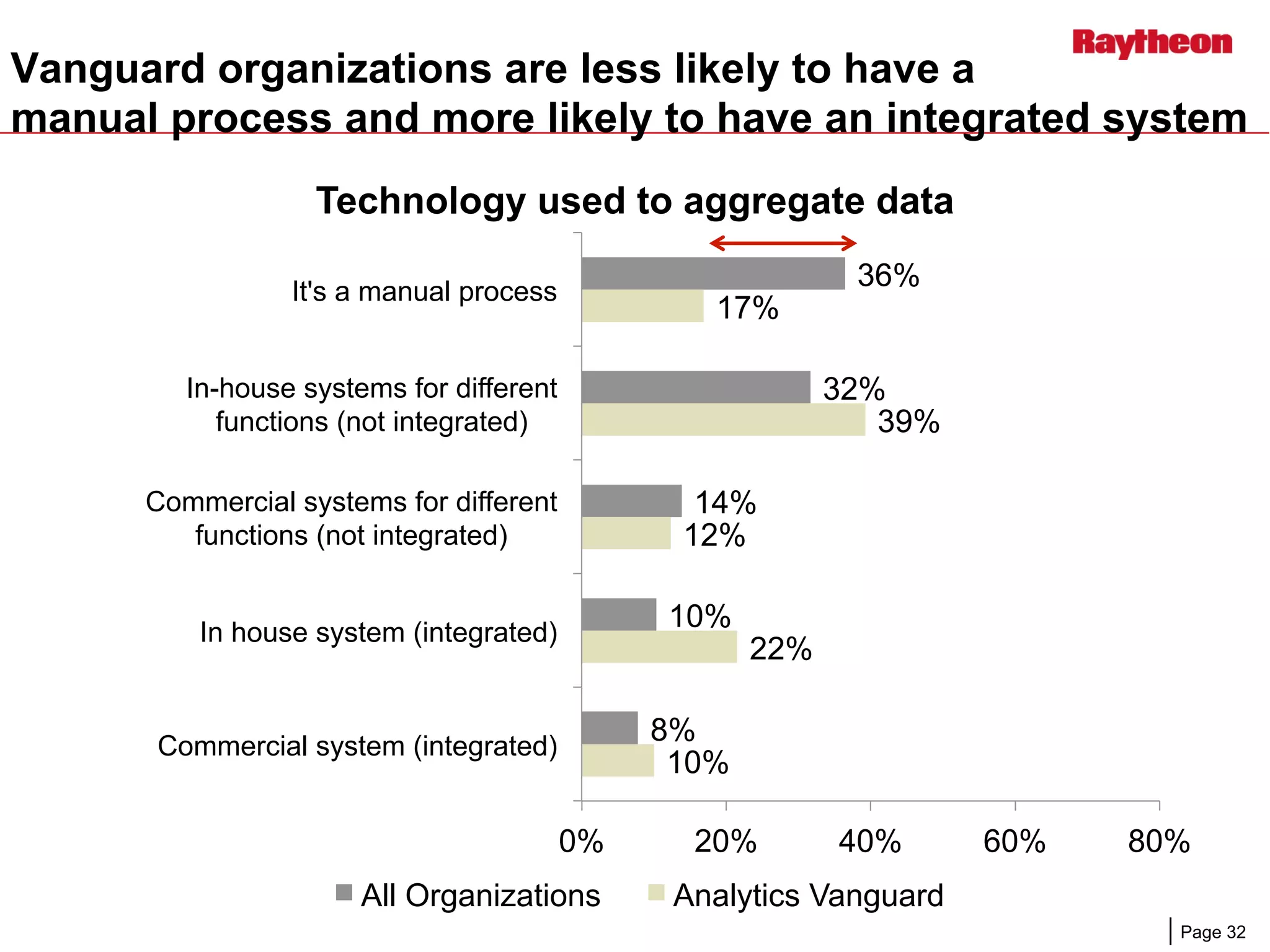
Page 32
Vanguard organizations are less likely to have a
manual process and more likely to have an integrated system
36%
32%
14%
10%
8%
17%
39%
12%
22%
10%
0% 20% 40% 60% 80%
It's a manual process
In-house systems for different
functions (not integrated)
Commercial systems for different
functions (not integrated)
In house system (integrated)
Commercial system (integrated)
Technology used to aggregate data
All Organizations Analytics Vanguard
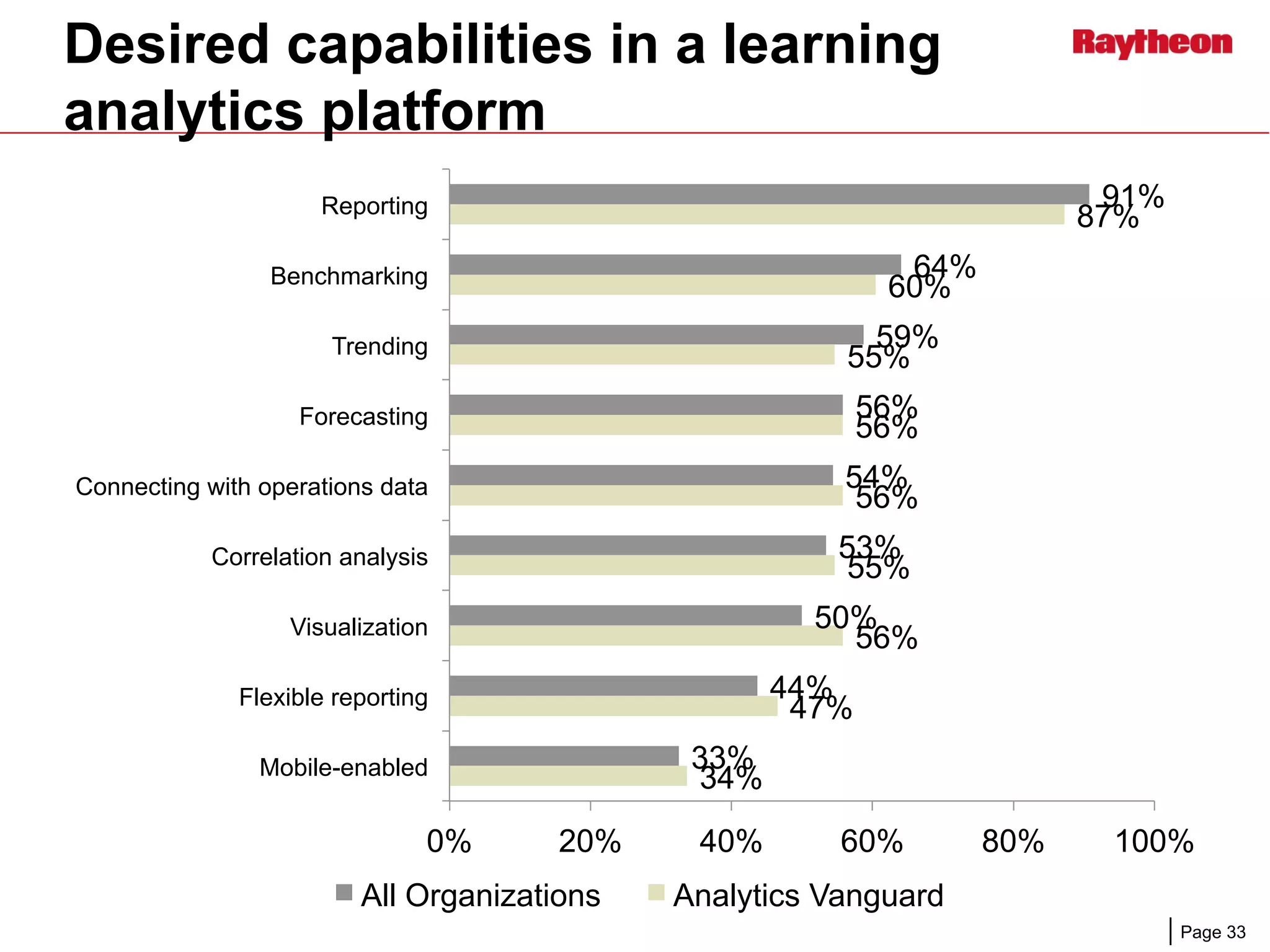
Page 33
Desired capabilities in a learning
analytics platform
91%
64%
59%
56%
54%
53%
50%
44%
33%
87%
60%
55%
56%
56%
55%
56%
47%
34%
0% 20% 40% 60% 80% 100%
Reporting
Benchmarking
Trending
Forecasting
Connecting with operations data
Correlation analysis
Visualization
Flexible reporting
Mobile-enabled
All Organizations Analytics Vanguard
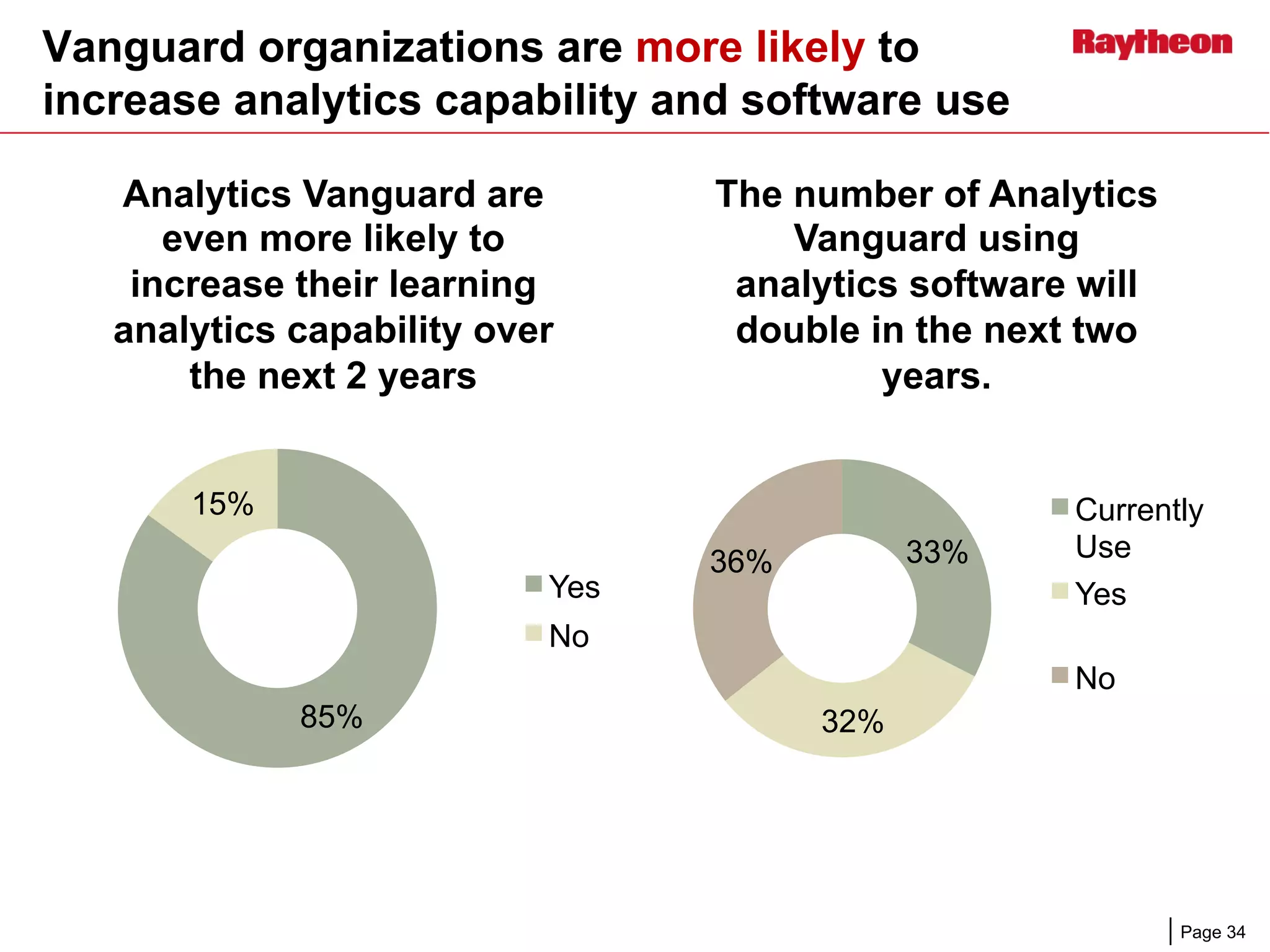
Page 34
Vanguard organizations are more likely to
increase analytics capability and software use
85%
15%
Analytics Vanguard are
even more likely to
increase their learning
analytics capability over
the next 2 years
Yes
No
33%
32%
36%
The number of Analytics
Vanguard using
analytics software will
double in the next two
years.
Currently
Use
Yes
No
Page 35
SUCCESSFUL STRATEGIES
Page 36
Sources of Data Matter:
The LMS does not stand alone
n  Analytics Vanguard are using more sources of data. Highly
successful organizations are nearly 5% more likely to use
HR data, nearly 15% more likely to use learning data and
nearly 20% more likely to use performance data than the
average.
n  Reporting capability does not ensure the success of learning
analytics. To problem solve for pressing issues related to
learning Vanguard organizations are using workforce
segmentation, external benchmarking and predictive
analytics more than the average.
Page 37
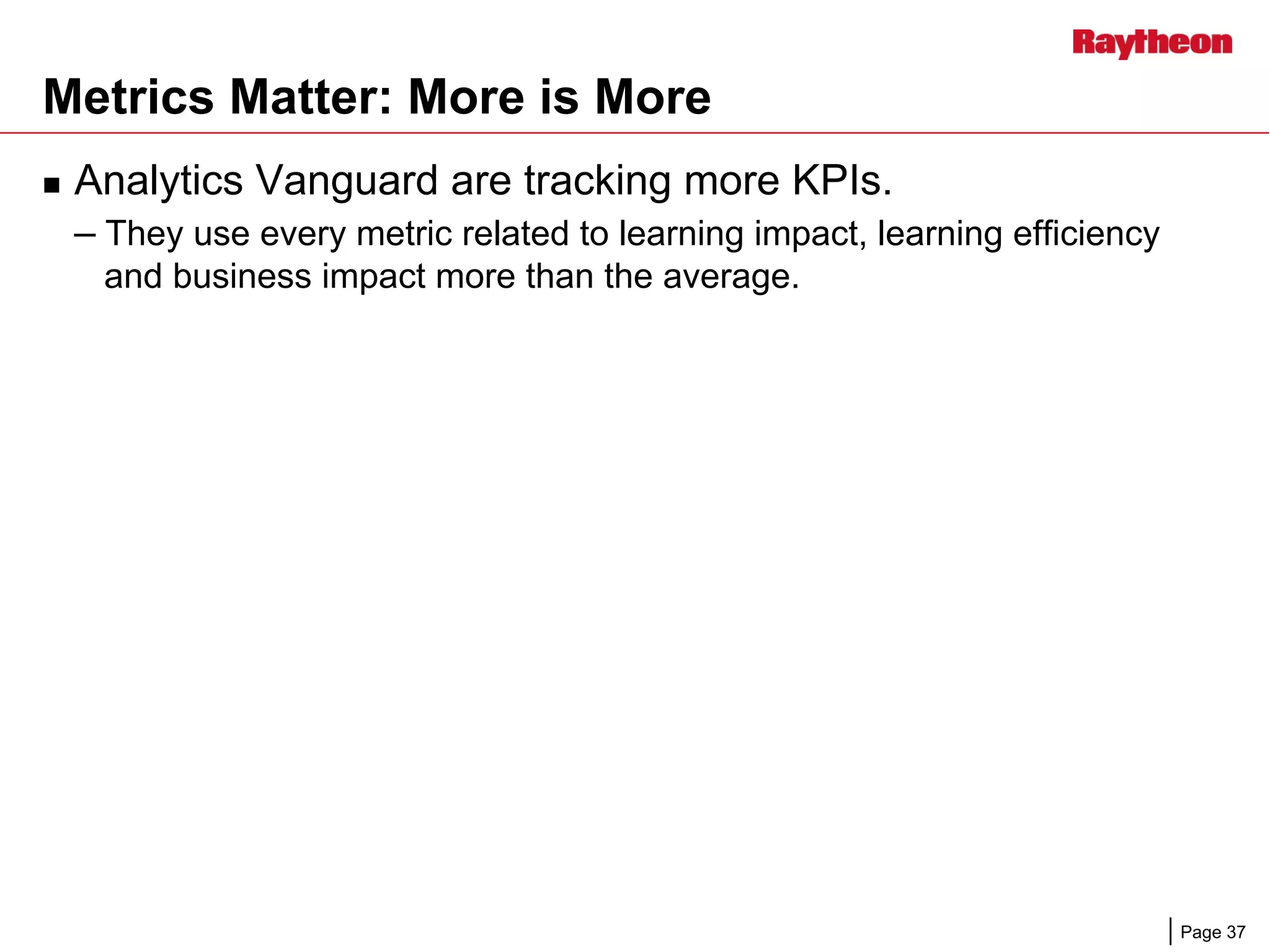
Metrics Matter: More is More
n  Analytics Vanguard are tracking more KPIs.
– They use every metric related to learning impact, learning efficiency
and business impact more than the average.
Page 38
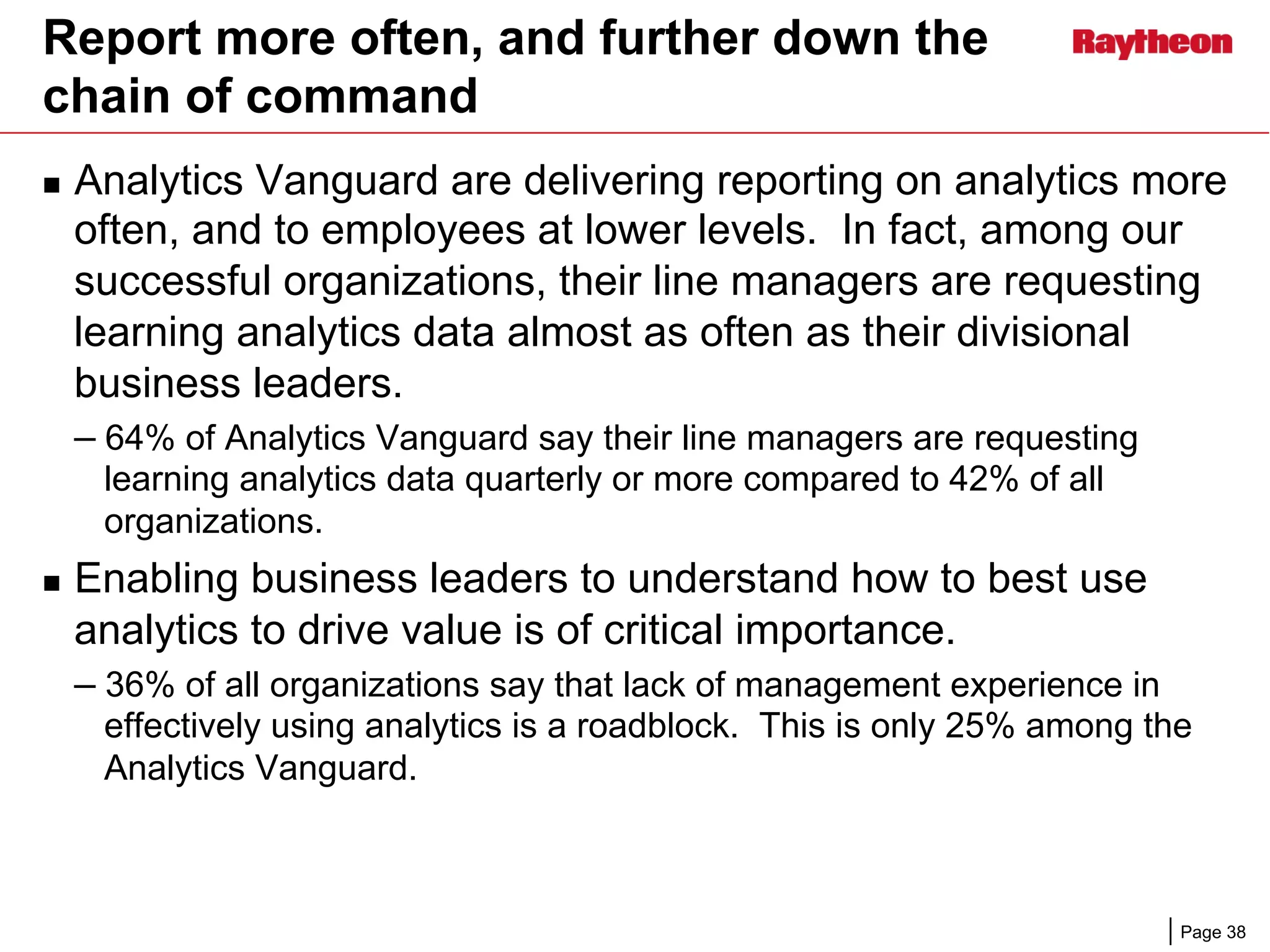
Report more often, and further down the
chain of command
n  Analytics Vanguard are delivering reporting on analytics more
often, and to employees at lower levels. In fact, among our
successful organizations, their line managers are requesting
learning analytics data almost as often as their divisional
business leaders.
– 64% of Analytics Vanguard say their line managers are requesting
learning analytics data quarterly or more compared to 42% of all
organizations.
n  Enabling business leaders to understand how to best use
analytics to drive value is of critical importance.
– 36% of all organizations say that lack of management experience in
effectively using analytics is a roadblock. This is only 25% among the
Analytics Vanguard.
Page 39
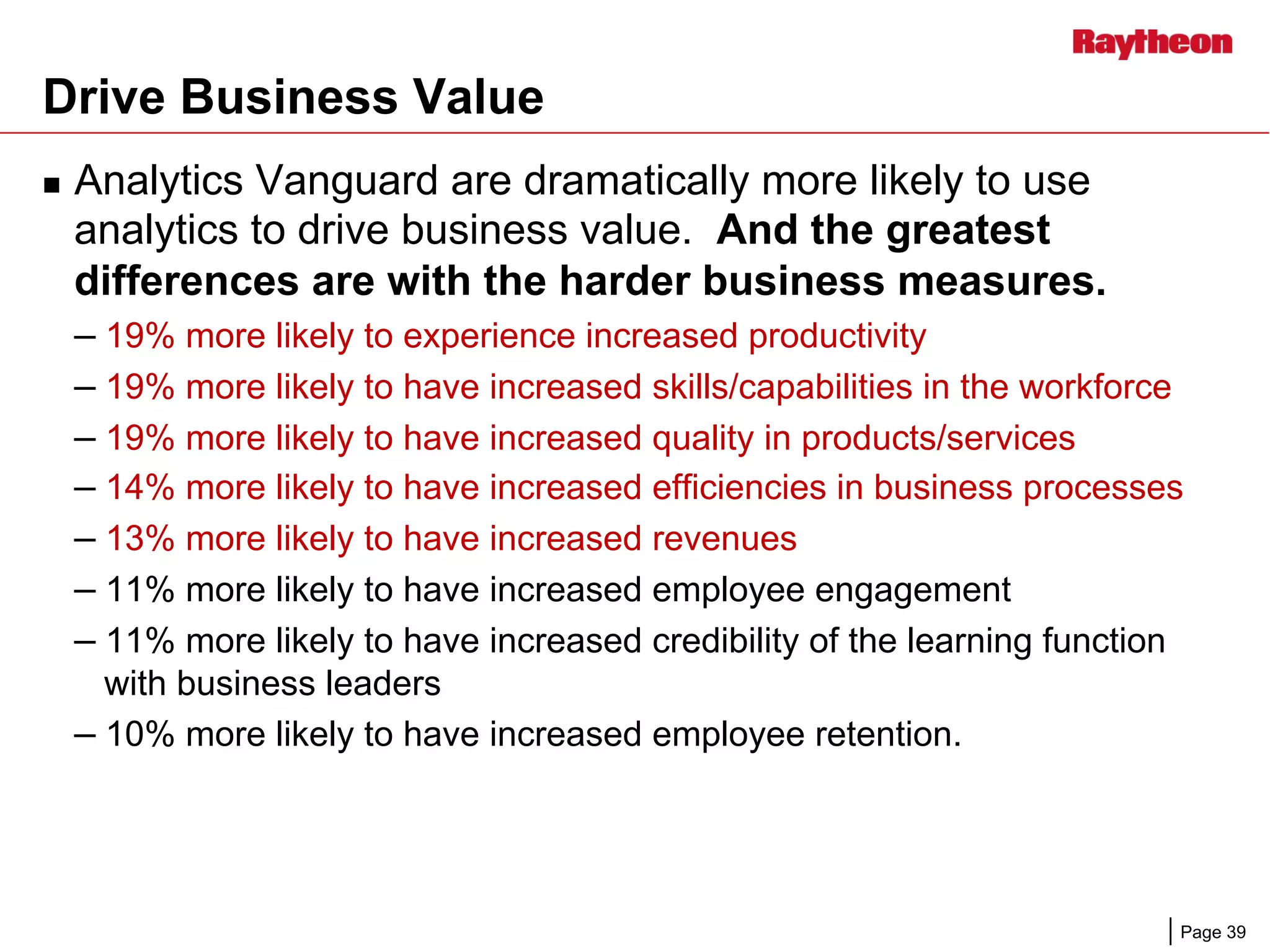
Drive Business Value
n  Analytics Vanguard are dramatically more likely to use
analytics to drive business value. And the greatest
differences are with the harder business measures.
– 19% more likely to experience increased productivity
– 19% more likely to have increased skills/capabilities in the workforce
– 19% more likely to have increased quality in products/services
– 14% more likely to have increased efficiencies in business processes
– 13% more likely to have increased revenues
– 11% more likely to have increased employee engagement
– 11% more likely to have increased credibility of the learning function
with business leaders
– 10% more likely to have increased employee retention.
Driving Performance at the Intersection of
Learning and Business
Unleashing the Power of
Performance Analytics:
#CLOwebinar


Please complete the
webinar evaluation.
#CLOwebinar


Join our next Webinar!
Preparing Development Plans
Worth Looking at Again
Thursday, October 15, 2015
Webinars start at 2 p.m. Eastern / 11 a.m. Pacific
Register for all upcoming Chief Learning Officer
webinars at www.clomedia.com/webinars
OR click the icon on the widget bar!

Unleashing the Power of Analytics: Driving Performance at the Intersection of Learning and Business

  • 1.
    #CLOwebinar The presentation willbegin at the top of the hour. A dial in number will not be provided. Listen to today’s webinar using your computer’s speakers or headphones. Unleashing the Power of Analytics: Driving Performance at the Intersection of Learning and Business
  • 2.
    #CLOwebinar         Tools You Can Use Audio Control –  A dial in number will not be provided. –  Adjust the volume by sliding the indicator in the Media Player box to the right. –  Also check your computer’s volume for external speakers or headsets.
  • 3.
    #CLOwebinar Speaker Bios Resources Media Player Q&A Slides Twitter Help PostEvent EvaluationShare This Group Chat HRCI CLO Webinars Tools You Can Use  
  • 4.
    #CLOwebinar         Tools You Can Use Q&A and Live Group Chat –  Enter your first name and initial and join the live discussion with other webinar attendees –  Enter technical or content- related questions into the Q&A box –  Type your question in the space at the bottom. –  Click “Submit.” Q&A Group Chat
  • 5.
    #CLOwebinar         Tools You Can Use Twitter -  Click “Post” in the Twitter widget. #CLOwebinar @CLOmedia
  • 6.
    #CLOwebinar         1. May I receive a copy of the slides? YES! Click on the resource list located on the top left portion of your screen. 2. May I review the webinar recording at a later date? YES! You may log in again using today’s link to review the presentation on-demand. 3. Is this webinar HRCI certified? YES! The HRCI certification code will appear in the box to the right of the slides after the required watch-time has elapsed. Frequently  Asked  Ques0ons  
  • 7.
    Driving Performance atthe Intersection of Learning and Business Unleashing the Power of Analytics:
  • 8.
    Page 8 Presenters Tracy Cox Director,Performance Consulting, Raytheon Professional Services Sarah Kimmel, VP of Research, Chief Learning Officer magazine
  • 9.
    Page 9 Seize theMoment n  Evolution/challenges of Learning Analytics – Analytics has a lot of “buzz” right now in business but what is it really? – In many organizations L&D continues to struggle to have a seat at the table. But some organizations are ahead of the game here. What are they doing differently? – It’s not just about making the business case for learning anymore- in some organizations, analytics has made it possible to problem solve, choose between learning investments, and maximize the impact of L&D. Analytics presents the opportunity to not just prove the value of learning to the business, but substantially contribute to creating business value.
  • 10.
    Page 10 Research Methodology n N=467 n  Org size: – Small (less than 1,000) 48% – Mid-sized (1,000-5,000) 16% – Large (more than 5,000) 36% n  Workforce distribution: –  28% are domestic organizations located in one region –  28% are domestic organizations with several regional locations. –  12% are multinational organizations –  32% are global organizations n  65% are CLOs and senior HR and Learning Executives or C-suite. An additional 16% are business unit, learning and HR managers. n  Research conducted by survey in August 2015 to CLO subscribers.
  • 11.
    Page 11 WHAT ISLEARNING ANALYTICS?
  • 12.
    Page 12 Learning AnalyticsDefinition n  Definition: Aristotle or Plato? n  Learning analytics is a data-driven approach used to optimize how organizations manage and deploy learning and development that supports execution of their business strategy. Examples may include: –  Analyzing Learning Management System (LMS) data to identify gaps, trends or patterns over time. –  Using HR/Talent Management data analytics to investigate the relationship between employee learning, job performance, business outcome, and financial impact. –  Using data analytics to identify the gaps in the current L&D system and prioritizing areas for improvement. –  Comparing employee learning data or outcomes across different workforce segments. –  Measuring the effectiveness of L&D and the return on learning investments. –  Predicting the impact of alternative learning practices by extrapolating from historical data.
  • 13.
    Page 13 Half ofall organizations are using HR and business data in their learning analytics. 71% 54% 48% 11% 0% 20% 40% 60% 80% Learning analytics (i.e. course and curriculum completions, certification level) Performance analytics (i.e. business KPIs [descriptive, diagnostics or predictive]) HR or talent management analytics (i.e. attrition, loyalty, education level) None of the above Sources of Data used by L&D
  • 14.
    Page 14 At present,analytics practices more involved than internal reporting are rare 45% 18% 10% 7% 29% 25% 29% 14% 0% 20% 40% 60% 80% Internal reports or analytics (e.g., hours of training completed, satisfaction with training) Workforce segmentation (e.g., learning data comparisons among groups of employees by business External benchmarking (e.g., data comparisons of common metrics and rankings) Predictive modeling (e.g., using statistical analysis to project the outcome of various L&D actions) Types of Analytics used by L&D Often Sometimes
  • 15.
    Page 15 Organizations arethe most likely to be using the kinds of analytics that are less likely to produce effective action 23% 11% 8% 6% 44% 33% 32% 19% 34% 55% 60% 75% 0% 20% 40% 60% 80% 100% Internal reports or analytics (e.g., hours of training completed, satisfaction with training) Workforce segmentation (e.g., learning data comparisons among groups of employees by business unit, location, function or job roles) External benchmarking (e.g., data comparisons of common metrics and rankings) Predictive modeling (e.g., using statistical analysis to project the outcome of various L&D actions) Effective Action Taken on Analytics Very Effective Somewhat effective Not effective Relative Success Rate: 51% 61% 80% 86%
  • 16.
    Page 16 60% 59% 47% 45% 39% 30% 29% 22% 18% 34% 41% 37% 30% 32% 23% 24% 27% 31% 0% 10%20% 30% 40% 50% 60% 70% To discover and leverage factors that increase productivity/business performance To better equip employees with the skills/knowledge they need to support the business To make data-driven decisions on learning investments To better inform learning and development efforts on the key factors of employee performance To support long-term learning strategy for the organization To problem solve for critical business issues related to learning and development To better inform decisions on succession planning and leadership development To mitigate legal and compliance risk To provide ongoing reporting of learning trends to leadership Motivations and Use Cases Top 3 Motivation Used in the past year Strategic outcomes, not compliance are the primary motivations for using analytics
  • 17.
    Page 17 DOES YOURLEARNING ORGANIZATION PLAN TO INCREASE ITS LEARNING ANALYTICS CAPABILITIES IN THE NEXT TWO YEARS? YES NO Poll Question
  • 18.
    Page 18 Analytics capabilityand use of analytics software will grow quickly in the next 2 years 80% 20% 8 in 10 Organizations plan to increase their learning analytics capability over the next 2 years Yes No 17% 33% 50% Half of all organizations will be using learning analytics software in the next two years Currently Use Yes No
  • 19.
    Page 19 Lack ofintegration and skills in effectively using analytics are the primary roadblocks 50% 48% 42% 36% 34% 25% 23% 22% 16% 14% 8% 0% 10% 20% 30% 40% 50% 60% 70% Lack of analytics skills within the learning team Lack of integration among various data systems Lack of budget for analytics software/projects Lack of management experience in effectively using analytics data Data not collected Lack of buy-in from senior leadership about the value Difficulty explaining the results/data/value of learning analytics Difficulty getting consensus across the organization on how to structure the data Don’t know where to start Difficulty hiring and retaining skilled and experienced learning analysts Concerns about data security Roadblocks to increasing use of Analytics
  • 20.
    Page 20 HOW SUCCESSFULHAVE YOU BEEN AT USING ANALYTICS EFFECTIVELY IN YOUR L&D ORGANIZATION? HIGHLY SUCCESSFUL MODERATELY SUCCESSFUL SLIGHTLY SUCCESSFUL NOT AT ALL SUCCESSFUL NOT APPLICABLE Poll Question
  • 21.
    Page 21 How successfuldoes L&D think it is at using analytics? 8% 24% 34% 22% 12% 0% 10% 20% 30% 40% Highly successful Moderately successful Slightly successful Not at all successful Not applicable Top 32%: Analytics Vanguard
  • 22.
    Page 22 WHAT DOESIMPACTFUL LEARNING ANALYTICS LOOK LIKE?
  • 23.
    Page 23 Analytics Vanguardmore likely to have an analytics function, and more likely to have it attached to Corporate Strategy 47% 29% 17% 16% 7% 3% 0% 20% 40% 60% Part of HR Do not have Part of Corporate Strategy Decentralized Co-sourced Outsourced All Organizations 52% 5% 36% 21% 11% 6% 0% 20% 40% 60% Part of HR Do not have Part of Corporate Strategy Decentralized Co-sourced Outsourced Analytics Vanguard
  • 24.
    Page 24 Vanguard usemore sources of data and more business data for analytics 71% 54% 48% 11% 85% 72% 54% 3% 0% 20% 40% 60% 80% 100% Learning analytics (i.e. course and curriculum completions, certification level) Performance analytics (i.e. business KPIs [descriptive, diagnostics or predictive]) HR or talent management analytics (i.e. attrition, loyalty, education level) None of the above Data Sources Used by L&D All Organizations Analytics Vanguard
  • 25.
    Page 25 Vanguard significantlymore likely to use more analytics practices- and go past reporting 45% 18% 10% 7% 73% 41% 22% 16% 0% 20% 40% 60% 80% Internal reports or analytics (e.g., hours of training completed, satisfaction with training) Workforce segmentation (e.g., learning data comparisons among groups of employees by business External benchmarking (e.g., data comparisons of common metrics and rankings) Predictive modeling (e.g., using statistical analysis to project the outcome of various L&D actions) Types of Analytics used often by L&D All organizations Analytics Vanguard
  • 26.
    Page 26 Vanguard organizationshave an 18% higher success rate with using internal reports 67% 45% 40% 25% 93% 75% 70% 51% 0% 20% 40% 60% 80% 100% Internal reports or analytics (e.g., hours of training completed, satisfaction with training) Workforce segmentation (e.g., learning data comparisons among groups of employees by business External benchmarking (e.g., data comparisons of common metrics and rankings) Predictive modeling (e.g., using statistical analysis to project the outcome of various L&D actions) Effective action taken on analytics All Organizations Analytics Vanguard Relative Success Rate: 69% 72% 83% 100%
  • 27.
    Page 27 Vanguard useanalytics for more purposes, and use it to problem solve for L&D 41% 37% 34% 32% 31% 30% 27% 24% 23% 64% 57% 56% 53% 43% 52% 29% 35% 41% 0% 25% 50% 75% To better equip employees with the skills/knowledge they need to support the business To make data-driven decisions on learning investments To discover and leverage factors that increase productivity/ business performance To support long-term learning strategy for the organization To provide ongoing reporting of learning trends to leadership To better inform learning and development efforts on the key factors of employee performance To mitigate legal and compliance risk To better inform decisions on succession planning and leadership development To problem solve for critical business issues related to learning and development Use Cases All Organizations Analytics Vanguard
  • 28.
    Page 28 Vanguard leadersat all levels are more likely to request learning analytics data 45% 41% 42% 24% 25% 17% 11% 72% 69% 64% 45% 43% 34% 22% 0% 20% 40% 60% 80% Divisional business leaders C-Suite/Senior executives Line managers Business analysts Finance leaders Board of Directors Legal advisors Groups requesting learning analytics quarterly or more All Organizations Analytics Vanguard
  • 29.
    Page 29 Vanguard organizationsare more likely to package results for easy consumption 53% 51% 35% 29% 22% 18% 10% 65% 61% 52% 32% 30% 25% 4% 0% 20% 40% 60% 80% Written report In-person presentation Dashboard Available by request or on intranet when needed Scheduled email communications (i.e. monthly or quarterly email newsletter) Custom reporting/consultation work due to strategic nature Results are not communicated to leadership How analytics are communicated All Organizations Analytics Vanguard
  • 30.
    Page 30 Vanguard organizationsare more likely to have increased business value on the harder business metrics 50% 36% 41% 31% 36% 31% 18% 20% 11% 69% 55% 52% 50% 47% 45% 31% 30% 13% 0% 20% 40% 60% 80% Increased skills/capabilities in the workforce Increased productivity Increased employee engagement Increased quality of product/service Increased credibility of the learning function with business leaders Increased efficiencies in business processes Increased revenue Increased employee retention Decreased legal costs and compliance fees Business Outcomes from Learning Analytics All Organizations Analytics Vanguard
  • 31.
    Page 31 Vanguard organizationsare less likely to experience roadblocks with skills and buy-in 50% 48% 42% 36% 34% 25% 23% 22% 16% 14% 8% 36% 45% 36% 25% 18% 12% 20% 20% 4% 18% 10% 0% 20% 40% 60% Lack of analytics skills within the learning team Lack of integration among various data systems Lack of budget for analytics software/projects Lack of management experience in effectively using analytics data Data not collected Lack of buy-in from senior leadership about the value Difficulty explaining the results/data/value of learning analytics Difficulty getting consensus across the organization on how to structure the data Don’t know where to start Difficulty hiring and retaining skilled and experienced learning analysts Concerns about data security Roadblocks All Organizations Analytics Vanguard
  • 32.
    Page 32 Vanguard organizationsare less likely to have a manual process and more likely to have an integrated system 36% 32% 14% 10% 8% 17% 39% 12% 22% 10% 0% 20% 40% 60% 80% It's a manual process In-house systems for different functions (not integrated) Commercial systems for different functions (not integrated) In house system (integrated) Commercial system (integrated) Technology used to aggregate data All Organizations Analytics Vanguard
  • 33.
    Page 33 Desired capabilitiesin a learning analytics platform 91% 64% 59% 56% 54% 53% 50% 44% 33% 87% 60% 55% 56% 56% 55% 56% 47% 34% 0% 20% 40% 60% 80% 100% Reporting Benchmarking Trending Forecasting Connecting with operations data Correlation analysis Visualization Flexible reporting Mobile-enabled All Organizations Analytics Vanguard
  • 34.
    Page 34 Vanguard organizationsare more likely to increase analytics capability and software use 85% 15% Analytics Vanguard are even more likely to increase their learning analytics capability over the next 2 years Yes No 33% 32% 36% The number of Analytics Vanguard using analytics software will double in the next two years. Currently Use Yes No
  • 35.
  • 36.
    Page 36 Sources ofData Matter: The LMS does not stand alone n  Analytics Vanguard are using more sources of data. Highly successful organizations are nearly 5% more likely to use HR data, nearly 15% more likely to use learning data and nearly 20% more likely to use performance data than the average. n  Reporting capability does not ensure the success of learning analytics. To problem solve for pressing issues related to learning Vanguard organizations are using workforce segmentation, external benchmarking and predictive analytics more than the average.
  • 37.
    Page 37 Metrics Matter:More is More n  Analytics Vanguard are tracking more KPIs. – They use every metric related to learning impact, learning efficiency and business impact more than the average.
  • 38.
    Page 38 Report moreoften, and further down the chain of command n  Analytics Vanguard are delivering reporting on analytics more often, and to employees at lower levels. In fact, among our successful organizations, their line managers are requesting learning analytics data almost as often as their divisional business leaders. – 64% of Analytics Vanguard say their line managers are requesting learning analytics data quarterly or more compared to 42% of all organizations. n  Enabling business leaders to understand how to best use analytics to drive value is of critical importance. – 36% of all organizations say that lack of management experience in effectively using analytics is a roadblock. This is only 25% among the Analytics Vanguard.
  • 39.
    Page 39 Drive BusinessValue n  Analytics Vanguard are dramatically more likely to use analytics to drive business value. And the greatest differences are with the harder business measures. – 19% more likely to experience increased productivity – 19% more likely to have increased skills/capabilities in the workforce – 19% more likely to have increased quality in products/services – 14% more likely to have increased efficiencies in business processes – 13% more likely to have increased revenues – 11% more likely to have increased employee engagement – 11% more likely to have increased credibility of the learning function with business leaders – 10% more likely to have increased employee retention.
  • 40.
    Driving Performance atthe Intersection of Learning and Business Unleashing the Power of Performance Analytics:
  • 41.
    #CLOwebinar         Please complete the webinar evaluation.
  • 42.
    #CLOwebinar         Join our next Webinar! Preparing Development Plans Worth Looking at Again Thursday, October 15, 2015 Webinars start at 2 p.m. Eastern / 11 a.m. Pacific Register for all upcoming Chief Learning Officer webinars at www.clomedia.com/webinars OR click the icon on the widget bar!