What drives e-ILPs?
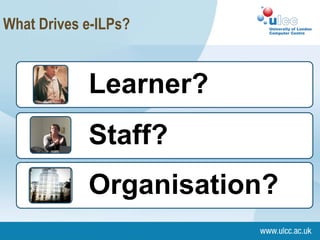
What Drives e-ILPs?


            Learner?
            Staff?
            Organisation?
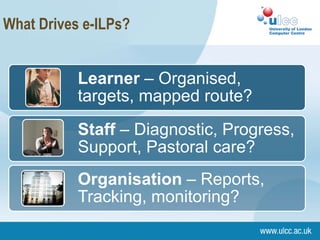
What Drives e-ILPs?


           Learner – Organised,
           targets, mapped route?
           Staff – Diagnostic, Progress,
           Support, Pastoral care?
           Organisation – Reports,
           Tracking, monitoring?
Interest in ILPs

    ‘ILPs remain a central nexus of practice
    –
                                  , are
    highly contentious among practitioners,
    and rhetorically support personalised
    learning opportunities’.
                                 - Hamilton (2009)
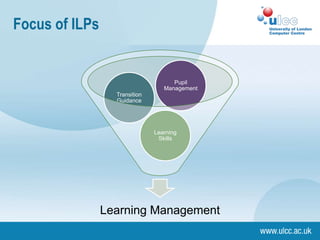
Focus of ILPs


                                     Pupil
                                  Management
                  Transition
                  Guidance


                               Learning
                                Skills


                Learning Management
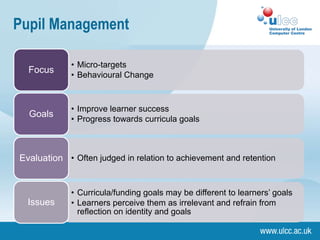
Pupil Management

             • Micro-targets
  Focus
             • Behavioural Change


             • Improve learner success
  Goals
             • Progress towards curricula goals


Evaluation • Often judged in relation to achievement and retention


             • Curricula/funding goals may be different to learners’ goals
  Issues     • Learners perceive them as irrelevant and refrain from
               reflection on identity and goals
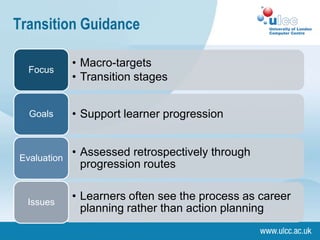
Transition Guidance

             • Macro-targets
  Focus
             • Transition stages


  Goals      • Support learner progression


Evaluation
             • Assessed retrospectively through
               progression routes


  Issues
             • Learners often see the process as career
               planning rather than action planning
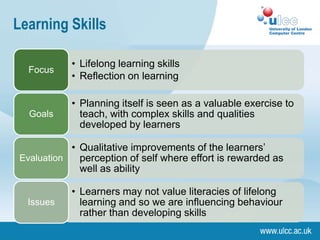
Learning Skills

            • Lifelong learning skills
   Focus
            • Reflection on learning

            • Planning itself is seen as a valuable exercise to
   Goals      teach, with complex skills and qualities
              developed by learners

            • Qualitative improvements of the learners’
 Evaluation   perception of self where effort is rewarded as
              well as ability

            • Learners may not value literacies of lifelong
  Issues      learning and so we are influencing behaviour
              rather than developing skills
Learning Management


    There’s probably a long way to go with
    learners generally


                   ... I think it’s simply that we
    haven’t got far enough down the line yet
    with the whole situation.
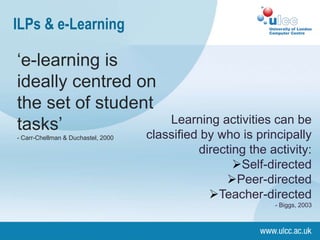
ILPs & e-Learning

‘e-learning is
ideally centred on
the set of student
tasks’               Learning activities can be
                 classified by who is principally
- Carr-Chellman & Duchastel, 2000

                                    directing the activity:
                                           Self-directed
                                         Peer-directed
                                      Teacher-directed
                                                   - Biggs, 2003
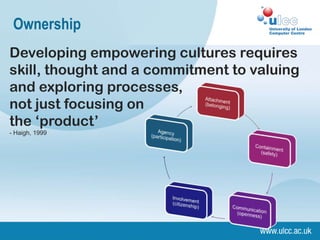
Ownership
Developing empowering cultures requires
skill, thought and a commitment to valuing
and exploring processes,
not just focusing on
the ‘product’
- Haigh, 1999
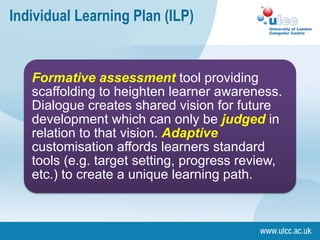
Individual Learning Plan (ILP)


   Formative assessment tool providing
   scaffolding to heighten learner awareness.
   Dialogue creates shared vision for future
   development which can only be judged in
   relation to that vision. Adaptive
   customisation affords learners standard
   tools (e.g. target setting, progress review,
   etc.) to create a unique learning path.
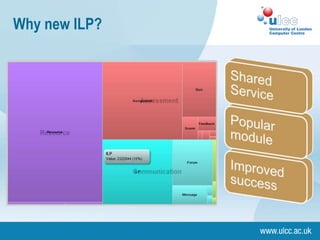
Why new ILP?
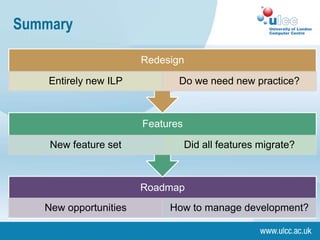
Summary

                       Redesign

    Entirely new ILP          Do we need new practice?


                       Features

    New feature set               Did all features migrate?


                       Roadmap
   New opportunities        How to manage development?

e-ILP

  • 1.
  • 2.
    What Drives e-ILPs? Learner? Staff? Organisation?
  • 3.
    What Drives e-ILPs? Learner – Organised, targets, mapped route? Staff – Diagnostic, Progress, Support, Pastoral care? Organisation – Reports, Tracking, monitoring?
  • 4.
    Interest in ILPs ‘ILPs remain a central nexus of practice – , are highly contentious among practitioners, and rhetorically support personalised learning opportunities’. - Hamilton (2009)
  • 5.
    Focus of ILPs Pupil Management Transition Guidance Learning Skills Learning Management
  • 6.
    Pupil Management • Micro-targets Focus • Behavioural Change • Improve learner success Goals • Progress towards curricula goals Evaluation • Often judged in relation to achievement and retention • Curricula/funding goals may be different to learners’ goals Issues • Learners perceive them as irrelevant and refrain from reflection on identity and goals
  • 7.
    Transition Guidance • Macro-targets Focus • Transition stages Goals • Support learner progression Evaluation • Assessed retrospectively through progression routes Issues • Learners often see the process as career planning rather than action planning
  • 8.
    Learning Skills • Lifelong learning skills Focus • Reflection on learning • Planning itself is seen as a valuable exercise to Goals teach, with complex skills and qualities developed by learners • Qualitative improvements of the learners’ Evaluation perception of self where effort is rewarded as well as ability • Learners may not value literacies of lifelong Issues learning and so we are influencing behaviour rather than developing skills
  • 9.
    Learning Management There’s probably a long way to go with learners generally ... I think it’s simply that we haven’t got far enough down the line yet with the whole situation.
  • 10.
    ILPs & e-Learning ‘e-learningis ideally centred on the set of student tasks’ Learning activities can be classified by who is principally - Carr-Chellman & Duchastel, 2000 directing the activity: Self-directed Peer-directed Teacher-directed - Biggs, 2003
  • 11.
    Ownership Developing empowering culturesrequires skill, thought and a commitment to valuing and exploring processes, not just focusing on the ‘product’ - Haigh, 1999
  • 12.
    Individual Learning Plan(ILP) Formative assessment tool providing scaffolding to heighten learner awareness. Dialogue creates shared vision for future development which can only be judged in relation to that vision. Adaptive customisation affords learners standard tools (e.g. target setting, progress review, etc.) to create a unique learning path.
  • 13.
  • 14.
    Summary Redesign Entirely new ILP Do we need new practice? Features New feature set Did all features migrate? Roadmap New opportunities How to manage development?

Editor's Notes

  • #10 Excellence and Enjoyment – For Vygotksy learning is not always fun, where the government is legitimising continued accumulation through global competitiveness (‘excellence’) in a knowledge-based (‘creative’) society through an appeal to consumerism (‘personalisation’) and the nice emotions (‘enjoyment’) derived from it;Marketisation and Equity - values such as self-motivation, self-regulation, and educational progress, are not equally distributed among different classes and cultures in English society. Personalisation and Choice - choice of institution and learning experience may be mutually contradictory – those that need most help are least likely to seek it.
  • #13 For Vygotsky an independent learner is the result of learning rather than a premise for it.