Using Harvard one-minute papers to improve the first year experienceA Kay Plummer, Warwick Baines, Nick Davis, Kristy Fitzmaurice, DonataMuntean, Nick Pawsey
What is the one-minute paper?Two questions asked at the end of the lesson What is the big point you learned in class today?What is the main, unanswered question you leave class with today?(Cross and Angelo 1988)Students spend one-minute writing the answers and then put the anonymous papers in a box as they leave the class.Before the next class lecturers use the feedback to provide ideas for revision for the next class.
What are the benefits of the one-minute paper at HarvardStudents listen more actively in classImprovement in students writing with more considered answers being provided during the later weeks in the semesterStudents were able to identify where they needed special assistance or where they needed to prepare more effectivelyStudents to realise and document that they had learnt something in their classes (Light p38, 1990)
Are there more benefits of the one-minute paper process?Teacher demonstrates respect for and interest in student opinionInform the revision process at the start of the next classStudents don’t wait until the end of the semester to identify their problem learning areasPossibly have an impact on retention if students don’t get ‘lost’ in their learningEncourages the students active involvement in the learning process
What were we hoping to findStudents recognising an improvement in their learning.Student reflections improving over the semester –suggested by Biggs (2003).Students would use the reflections as a study resource.
How we used the one-minute paperUsed in ACC100 Accounting 1 a subject completed by all business studentsFace-to-face student load - 1hr lecture 2hr tutorialHarvard paper provided in booklet form at end of each tutorialAll student responses collectedProblem areas addressed at start of subsequent lecture and tutorialStudents given back all one-minute papers to aid in exam preparationQuestionnaire on impact of one-minute paper in last class in semester
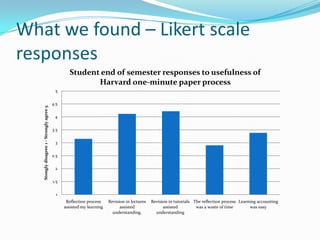
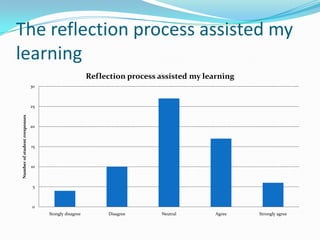
What we found – Likert scale responses
The reflection process assisted my learning
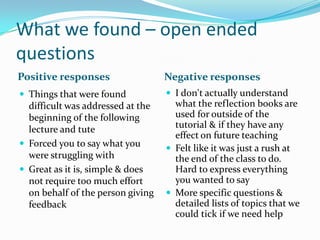
What we found – open ended questionsPositive responsesNegative responsesThings that were found difficult was addressed at the beginning of the following lecture and tuteForced you to say what you were struggling withGreat as it is, simple & does not require too much effort on behalf of the person giving feedbackI don't actually understand what the reflection books are used for outside of the tutorial & if they have any effect on future teachingFelt like it was just a rush at the end of the class to do. Hard to express everything you wanted to sayMore specific questions & detailed lists of topics that we could tick if we need help
What we found – lecturer and tutor feedbackLecturer and tutors would all use the process again.All tutors expressed a view similar to this “…students initially approached the feedback books with a good amount of enthusiasm and positively viewed our willingness to adapt our teaching tasks to reflect their changing needs”Students were tired by the end of the tutorials and just wanted to get away and this may have impacted on the quality of their reflections.Students did not seem to understand that the reflection and writing would help their learning even after being advised that it would.
Development of student reflections over the semesterThere was no obvious reflection development over the semester.Reflections generally more detailed at the start of the semester than at the end
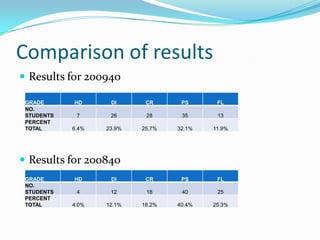
Comparison of resultsResults for 200940Results for 200840
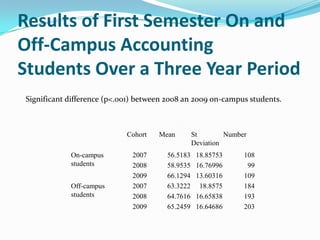
Results of First Semester On and Off-Campus AccountingStudents Over a Three Year PeriodSignificant difference (p<.001) between 2008 an 2009 on-campus students.
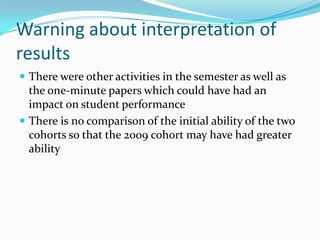
Warning about interpretation of resultsThere were other activities in the semester as well as the one-minute papers which could have had an impact on student performanceThere is no comparison of the initial ability of the two cohorts so that the 2009 cohort may have had greater ability
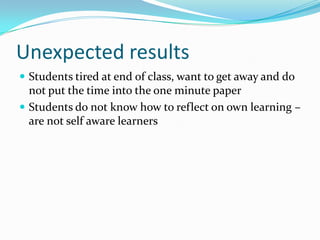
Unexpected resultsStudents tired at end of class, want to get away and do not put the time into the one minute paperStudents do not know how to reflect on own learning – are not self aware learners

Using Hrvard 1 Minute Papers

  • 1.
    Using Harvard one-minutepapers to improve the first year experienceA Kay Plummer, Warwick Baines, Nick Davis, Kristy Fitzmaurice, DonataMuntean, Nick Pawsey
  • 2.
    What is theone-minute paper?Two questions asked at the end of the lesson What is the big point you learned in class today?What is the main, unanswered question you leave class with today?(Cross and Angelo 1988)Students spend one-minute writing the answers and then put the anonymous papers in a box as they leave the class.Before the next class lecturers use the feedback to provide ideas for revision for the next class.
  • 3.
    What are thebenefits of the one-minute paper at HarvardStudents listen more actively in classImprovement in students writing with more considered answers being provided during the later weeks in the semesterStudents were able to identify where they needed special assistance or where they needed to prepare more effectivelyStudents to realise and document that they had learnt something in their classes (Light p38, 1990)
  • 4.
    Are there morebenefits of the one-minute paper process?Teacher demonstrates respect for and interest in student opinionInform the revision process at the start of the next classStudents don’t wait until the end of the semester to identify their problem learning areasPossibly have an impact on retention if students don’t get ‘lost’ in their learningEncourages the students active involvement in the learning process
  • 5.
    What were wehoping to findStudents recognising an improvement in their learning.Student reflections improving over the semester –suggested by Biggs (2003).Students would use the reflections as a study resource.
  • 6.
    How we usedthe one-minute paperUsed in ACC100 Accounting 1 a subject completed by all business studentsFace-to-face student load - 1hr lecture 2hr tutorialHarvard paper provided in booklet form at end of each tutorialAll student responses collectedProblem areas addressed at start of subsequent lecture and tutorialStudents given back all one-minute papers to aid in exam preparationQuestionnaire on impact of one-minute paper in last class in semester
  • 7.
    What we found– Likert scale responses
  • 8.
    The reflection processassisted my learning
  • 9.
    What we found– open ended questionsPositive responsesNegative responsesThings that were found difficult was addressed at the beginning of the following lecture and tuteForced you to say what you were struggling withGreat as it is, simple & does not require too much effort on behalf of the person giving feedbackI don't actually understand what the reflection books are used for outside of the tutorial & if they have any effect on future teachingFelt like it was just a rush at the end of the class to do. Hard to express everything you wanted to sayMore specific questions & detailed lists of topics that we could tick if we need help
  • 10.
    What we found– lecturer and tutor feedbackLecturer and tutors would all use the process again.All tutors expressed a view similar to this “…students initially approached the feedback books with a good amount of enthusiasm and positively viewed our willingness to adapt our teaching tasks to reflect their changing needs”Students were tired by the end of the tutorials and just wanted to get away and this may have impacted on the quality of their reflections.Students did not seem to understand that the reflection and writing would help their learning even after being advised that it would.
  • 11.
    Development of studentreflections over the semesterThere was no obvious reflection development over the semester.Reflections generally more detailed at the start of the semester than at the end
  • 12.
    Comparison of resultsResultsfor 200940Results for 200840
  • 13.
    Results of FirstSemester On and Off-Campus AccountingStudents Over a Three Year PeriodSignificant difference (p<.001) between 2008 an 2009 on-campus students.
  • 14.
    Warning about interpretationof resultsThere were other activities in the semester as well as the one-minute papers which could have had an impact on student performanceThere is no comparison of the initial ability of the two cohorts so that the 2009 cohort may have had greater ability
  • 15.
    Unexpected resultsStudents tiredat end of class, want to get away and do not put the time into the one minute paperStudents do not know how to reflect on own learning – are not self aware learners