Routine Health Information Network
​ Using Data
Visualization to
Make Routine
Health
Information
Meaningful
Amanda Makulec
John Snow Inc.
With forum co-moderators
Michael Edwards
John Snow Inc.
Tiana Jaramillo
University Research Co, LLC
The Routine Health Information
Network (RHINO) connects people
around the world who believe we
can promote better health through
the use of information produced by
high quality, sustainable routine
health information systems.
For decades, health data has been
captured in dense ledgers & reports.
Photo credit: Robin Hammond
Handwritten tables and wall charts
were (and still are) common
monitoring tools.
Today, many systems have
gone digital.
Photo credit: Robin Hammond
Digital HIS expands the opportunities
to develop dashboards and other
visualizations of routine data.
A brief history of
data visualization
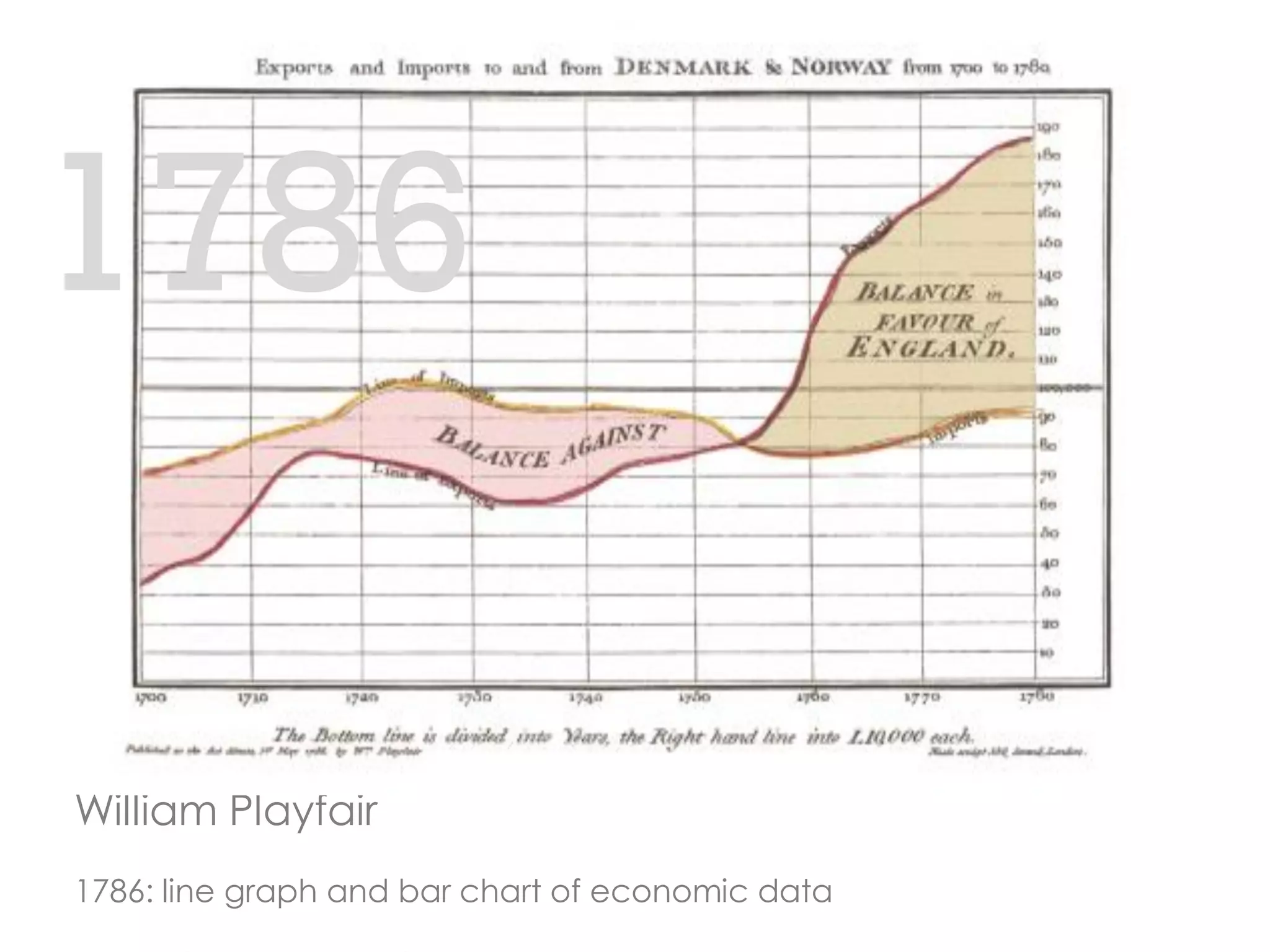
William Playfair
1786: line graph and bar chart of economic data
1786
John Snow
1854: Mapping deaths from a Cholera outbreak in central London
1854
Florence Nightingale
1858: Polar area diagram
1858
Minard
1869: Sankey Diagram (later named)
1869
Decision Support Systems
1998
Decision Support Systems
2000
2017
What do we mean by
data visualization?
What is data visualization?
A way of visually conveying information –
often quantitative in nature – in an
accurate, compelling format.
What is data visualization?
A way of visually conveying information –
often quantitative in nature – in an
accurate, compelling format.
Usually makes relationships more
apparent (e.g. by clustering, color
coding and by putting items in scale).
What is data visualization?
A way of visually conveying information –
often quantitative in nature – in an
accurate, compelling format.
Usually makes relationships more
apparent (e.g. by clustering, color
coding and by putting items in scale).
Can be static or interactive.
conceptual data driven
declarative
exploratory
idea illustration everyday data viz
idea generation visual discovery
Matrix credit: Harvard Business Review’s Good Charts
In RHIS, we talk primarily about
dashboards, but shouldn’t ignore
other forms of visualization.
Who creates
compelling data
visualizations?
HIS / M&E
Developers Program Staff
Designers
Inspired by the diagram from “Building Successful Data Teams”
https://policyviz.com/2017/03/09/building-successful-data-teams/
How can we create
user-centered
dashboards and
visualization tools?
Data
Users
Design
Test
Problem
Data
Users
Design
Test
Problem
Focus on the
BIG QUESTIONS.
Ben Shneiderman’s
Information Seeking Mantra
Overview first.
Zoom and filter.
Then details on demand.
Ben Shneiderman, The Eyes Have It; A task by Data Type Taxonomy for Information Visualizations. In Proceedings o the
IEEESymposium on Visual Languages, pages 336-343, Washington IEEE Computer Society Press, 1996
Data
Users
Design
Test
Problem
Invest (significant)
time in understanding
and exploring your
users’ needs.
Analytical ability
Job function
Education
Programmatic knowledge
Access to tools
Motivations to use data
Pain points
User personas are a tool we can use to understand who
the different users of a dashboard could be.
Sample persona from User Personas https://www.pinterest.com/tovissy/user-personas-ux-sd-cx/
Data
Users
Design
Test
Problem
Map your data flow
Unique identifiers and
demographic data allow for
filters and dissaggregations.
Ensure the right users have
access to the right level of
visualization.
Data
Users
Design
Test
Problem
Design compelling, useful
visualizations that provide insight.
Image from Gapminder.com
Interesting
Function
Form
Integrity
David McCandless, 2012
1. Function: they let you
see trends and patterns
clearly.
2. Form: they are visually
appealing and well
structured to attract
readers and hold their
attention.
3. Integrity: they portray
the data accurately and
honestly.
4. Interesting: they are
relevant and
meaningful, or reveal
new information.
Image from HubSpot + Visage Data Visualization 101 Guide
Pick the right chart
for your purpose.
Trend over time? Comparison?
Distribution?
decluttered
design
Simple big numbers
provide a quick
reference of an
outbreak
0
10
20
30
40
50
Facility 1 Facility 2 Facility 3 Facility 4 Facility 5 Facility 6 Facility 7 Facility 8
Facility 4 showed the highest quality of care.
Despite scoring highest, its overall score was below 50%, indicating there is
work to be done to improve quality of care across facilities.
Decluttered chart
eliminates the “non-
data ink” where
possible to focus on
the data story.
color strategically
Color used thematically for a set of charts representing
data on one topic.
Alert bar features red for indicators performing poorly
where action is required.
Promote accessibility by avoiding red-green maps and
charts that can be challenging for the colorblind.
Dashboard from Tableau Public, designed by Data Ink https://public.tableau.com/en-us/s/gallery/changing-diseases
purposeful title
Charts are titled with the
question they aim to
answer.
Visualization from Tableau Public Gallery https://public.tableau.com/en-us/s/gallery/malaria-africa
Charts are titled with the data presented.
When designing, try sketching first
to develop a rough concept.
The visualization toolbox is
packed with options.
Remember to keep your user
front-of-mind when you pick your
visualization platform.
Data
Users
Design
Test
Problem
Done well, visualizations promote
the use of data for decisions.
Photo credit: Robin Hammond
Michael Edwards,
PhD, MPH
Biostatistician &
Senior HIS Advisor
John Snow Inc.
Tiana Jaramillo
Information Systems and
M&E Specialist
University Research
Council, LLC
Amanda Makulec,
MPH
Visual Analytics Advisor
John Snow Inc.
Meet your Moderators
Now it’s your turn.
Join us on the Forum to share
your examples, experiences,
challenges, and data
visualization tricks.
RHINOnet.org
@RHISNetwork
This presentation was produced with the support of the United States
Agency for International Development (USAID) under the terms of
MEASURE Evaluation cooperative agreement AID-OAA-L-14-00004.
MEASURE Evaluation is implemented by the Carolina Population
Center, University of North Carolina at Chapel Hill in partnership with
ICF International; John Snow, Inc.; Management Sciences for Health;
Palladium; and Tulane University. Views expressed are not necessarily
those of USAID or the United States government.
www.measureevaluation.org

Using Data Visualization to Make Routine Health Information Meaningful