Other Vocabulary Strategies Developmental Reading
 
Aids in discovering meanings of unknown words Clues may be words, phrases, or sentences surrounding the unknown word
1.  SEMANTIC CLUES – are derived from the meaning of the words co-  occurring with the unknown word.  - used together to unlock meaning of unknown words. Kinds: a.  DEFINITION CLUE  – A word may be  directly defined in the context. Ex: The  register  is the book in which the names of the people are kept.
b.  THE APPOSITIVE CLUE  – may offer a synonym or description of the word Ex:  Euthanasia , mercy killing in plain language, is a very controversial issue.
c.  COMPARISON OR CONTRAST CLUE  – may give away the word’s meaning Ex: Like her surprised mother, Mila was  also  taken aback  by the news. She is not lazy to study. On the  contrary, she is very  diligent .
d.  EXPLANATION CLUE Ex:  Lucy’s unusual  timidity  bothered her parents. They wondered why she would not even want to talk to any visitor. She would rather lock herself to her room. In school, her teachers were complaining too, why she was too shy or withdrawn to join any class activity.
2.  SYNTACTIC CLUES  - are contained in the grammar of our language. These clues will help the reader discover that the word is a noun, an action word, etc. Ex: An ogler ogled (looked at  with amorous intentions)  ogledly(flirtatiously).
3. PRESENTATION CLUES  –  refer to the other aids that the author may use such as: Use of footnotes b. Use of types of prints, e.g. boldface, italics c. Use of visuals, e.g. diagrams, tables, graphs, pictures d. Organizational devices, e.g. indention, use of headings and sub-headings, etc.
EXERCISE 1: Determine the meaning of each underlined word by using context clues. 1. The witness gave a wrong statement. The lawyer  refuted  it. a. disapproved  b. changed  c. erased   2. Attempts to solve the problems were  sporadic , not well planned. a. excellent  b. spontaneous  c. scattered  
3. Let us be  inquisitive . Let us ask questions why things are done this way or that way. a. accurate b. smart c. questioning 4. The  meticulous  professor checked the test papers herself. No wonder, there was not a single error in the scoring. a. bright  b. careful c. intelligent
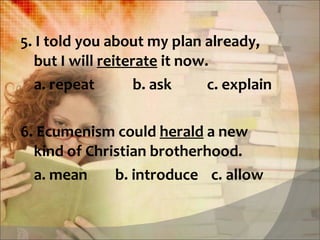
5. I told you about my plan already, but I will  reiterate  it now. a. repeat  b. ask   c. explain 6. Ecumenism could  herald  a new kind of Christian brotherhood. a. mean b. introduce c. allow
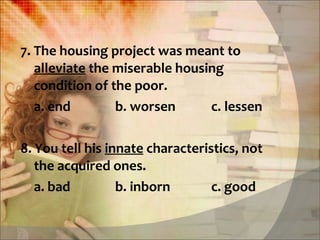
7. The housing project was meant to  alleviate  the miserable housing condition of the poor. a. end b. worsen c. lessen 8. You tell his  innate  characteristics, not the acquired ones. a. bad b. inborn c. good
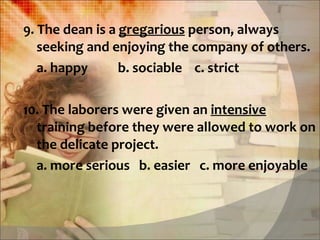
9. The dean is a  gregarious  person, always seeking and enjoying the company of others. a. happy b. sociable  c. strict 10. The laborers were given an  intensive  training before they were allowed to work on the delicate project. a. more serious  b. easier  c. more enjoyable
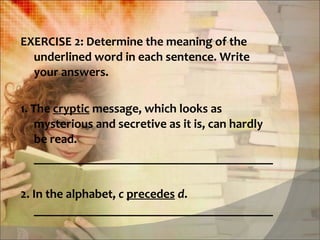
EXERCISE 2: Determine the meaning of the underlined word in each sentence. Write your answers. 1. The  cryptic  message, which looks as mysterious and secretive as it is, can hardly be read. ______________________________________ 2. In the alphabet,  c   precedes   d . ______________________________________
3. I play a  dual  role in the family. I am both father and mother to my sisters. ___________________________________ 4. The manager  revokes  privileges when employees become less efficient. ___________________________________
5. The ugly little girl  perceived  herself as beautiful because her mother told her so. ________________________________ 6. Isn’t it wonderful for parents to produce  siblings  who are very much different from one another? ________________________________
7. After the operation, the basketball player no longer played basketball. He was only allowed to engage in  sedentary  games.  ___________________________________ 8. You may use short quotations but not long  excerpts .  ___________________________________
9. I like to work with sincere people. I abhor  hypocrites . _____________________________ 10. His  feigned  illness made the teacher excuse his absences. _____________________________

Using context clues

  • 1.
    Other Vocabulary StrategiesDevelopmental Reading
  • 2.
  • 3.
    Aids in discoveringmeanings of unknown words Clues may be words, phrases, or sentences surrounding the unknown word
  • 4.
    1. SEMANTICCLUES – are derived from the meaning of the words co- occurring with the unknown word. - used together to unlock meaning of unknown words. Kinds: a. DEFINITION CLUE – A word may be directly defined in the context. Ex: The register is the book in which the names of the people are kept.
  • 5.
    b. THEAPPOSITIVE CLUE – may offer a synonym or description of the word Ex: Euthanasia , mercy killing in plain language, is a very controversial issue.
  • 6.
    c. COMPARISONOR CONTRAST CLUE – may give away the word’s meaning Ex: Like her surprised mother, Mila was also taken aback by the news. She is not lazy to study. On the contrary, she is very diligent .
  • 7.
    d. EXPLANATIONCLUE Ex: Lucy’s unusual timidity bothered her parents. They wondered why she would not even want to talk to any visitor. She would rather lock herself to her room. In school, her teachers were complaining too, why she was too shy or withdrawn to join any class activity.
  • 8.
    2. SYNTACTICCLUES - are contained in the grammar of our language. These clues will help the reader discover that the word is a noun, an action word, etc. Ex: An ogler ogled (looked at with amorous intentions) ogledly(flirtatiously).
  • 9.
    3. PRESENTATION CLUES – refer to the other aids that the author may use such as: Use of footnotes b. Use of types of prints, e.g. boldface, italics c. Use of visuals, e.g. diagrams, tables, graphs, pictures d. Organizational devices, e.g. indention, use of headings and sub-headings, etc.
  • 10.
    EXERCISE 1: Determinethe meaning of each underlined word by using context clues. 1. The witness gave a wrong statement. The lawyer refuted it. a. disapproved b. changed c. erased   2. Attempts to solve the problems were sporadic , not well planned. a. excellent b. spontaneous c. scattered  
  • 11.
    3. Let usbe inquisitive . Let us ask questions why things are done this way or that way. a. accurate b. smart c. questioning 4. The meticulous professor checked the test papers herself. No wonder, there was not a single error in the scoring. a. bright b. careful c. intelligent
  • 12.
    5. I toldyou about my plan already, but I will reiterate it now. a. repeat b. ask c. explain 6. Ecumenism could herald a new kind of Christian brotherhood. a. mean b. introduce c. allow
  • 13.
    7. The housingproject was meant to alleviate the miserable housing condition of the poor. a. end b. worsen c. lessen 8. You tell his innate characteristics, not the acquired ones. a. bad b. inborn c. good
  • 14.
    9. The deanis a gregarious person, always seeking and enjoying the company of others. a. happy b. sociable c. strict 10. The laborers were given an intensive training before they were allowed to work on the delicate project. a. more serious b. easier c. more enjoyable
  • 15.
    EXERCISE 2: Determinethe meaning of the underlined word in each sentence. Write your answers. 1. The cryptic message, which looks as mysterious and secretive as it is, can hardly be read. ______________________________________ 2. In the alphabet, c precedes d . ______________________________________
  • 16.
    3. I playa dual role in the family. I am both father and mother to my sisters. ___________________________________ 4. The manager revokes privileges when employees become less efficient. ___________________________________
  • 17.
    5. The uglylittle girl perceived herself as beautiful because her mother told her so. ________________________________ 6. Isn’t it wonderful for parents to produce siblings who are very much different from one another? ________________________________
  • 18.
    7. After theoperation, the basketball player no longer played basketball. He was only allowed to engage in sedentary games. ___________________________________ 8. You may use short quotations but not long excerpts . ___________________________________
  • 19.
    9. I liketo work with sincere people. I abhor hypocrites . _____________________________ 10. His feigned illness made the teacher excuse his absences. _____________________________