BASIC ELEMENTS
OF A POEM
POETRY
POETRY
is defined as ‘literature in a metrical
form’ or ‘a composition forming
metric lines.’
BASIC ELEMENTS OF A POEM
Stanza is a series of lines grouped
together.
BASIC ELEMENTS OF A POEM
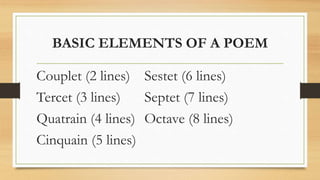
Couplet (2 lines) Sestet (6 lines)
Tercet (3 lines) Septet (7 lines)
Quatrain (4 lines) Octave (8 lines)
Cinquain (5 lines)
BASIC ELEMENTS OF A POEM
Rhyme is the repetition of similar
sound
end rhyme, alternating rhyme, internal
rhyme, freestyle
BASIC ELEMENTS OF A POEM
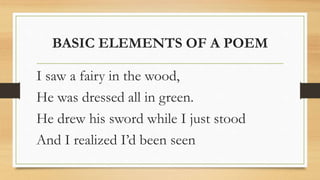
I saw a fairy in the wood,
He was dressed all in green.
He drew his sword while I just stood
And I realized I’d been seen
BASIC ELEMENTS OF A POEM
Rhyme scheme is a continuation of
rhymes
BASIC ELEMENTS OF A POEM
Meter – basic structural makeup of
a poem
BASIC ELEMENTS OF A POEM
Rhythm is the music made by the
stressed and unstressed syllables
BASIC ELEMENTS OF A POEM
Theme is the message of a poem
BASIC ELEMENTS OF A POEM
Symbolisms are composed of
symbols that convey ideas
BASIC ELEMENTS OF A POEM
Imagery – device used for readers
to create an image that
encompasses the five senses.
Vocabulary Check
Use the dictionary to define the
underlined word which will be
found in the poem to be read.
Vocabulary Check
1. He spun himself to
brightest day
Vocabulary Check
2. Who am thy Fountainhead.
Vocabulary Check
3. Of this so regal head.
Vocabulary Check
1. SPUN
Verb: a simple past tense and past participle of spin.
Adjective: formed by or as by spinning.
Vocabulary Check
1. FOUNTAINHEAD
noun
a fountain or spring from which a stream flows; the head
or source of a stream.
a chief source of anything:a fountainhead of information.
Vocabulary Check
1. REGAL
adjective
of or relating to a king; royal:the regal power.
Question:
How would you feel if instead of
appreciating the gifts of the past,
you receive nothing but
ingratitude?
About the Author
• Jose Garcia Villa (August 5, 1908 – February 7, 1997) was
a Filipino poet, literary critic, short story writer, and painter. He
was awarded the National Artist of the Philippines title for
literature in 1973, as well as the Guggenheim Fellowship in creative
writing by Conrad Aiken. He is known to have introduced the
"reversed consonance rhyme scheme" in writing poetry, as well as
the extensive use of punctuation marks—especially commas, which
made him known as the Comma Poet.
About the Author
• He used the penname Doveglion(derived from
"Dove, Eagle, Lion"), based on the characters he derived
from himself. These animals were also explored by
another poet E. E. Cummings in Doveglion, Adventures in
Value, a poem dedicated to Villa.
God said, “I made a Man”
God said, “I made a man
Out of clay” –
But so bright he, he spun
Himself to brightest Day
Till he was all shining gold,
And oh,
He was handsome to behold!
God said, “I made a Man”
But in his hands held he a bow
Aimed at me who created
Him. And I said,
“Wouldn’t thou murder me
“Who am thy Fountainhead”
God said, “I made a Man”
Then spoke he the man of gold:
‘I will not
murder thee! I do but
Measure thee. Hold
Thy peace! And this I did,
God said, “I made a Man”
But I was curious
Of this so regal head.’
‘Give thy name!’ – Sir Genius
Source: Philippine Copyright 2005 Across Culture in Language and Philippine Literature.
Q and A
In your notebooks, answer the following
questions:
1. What is the poem all about?
2. Is the relationship of the past and the
present relevant in the text?
Q and A
3. What attribute of God is being described in the
poem?
4. How did God react to the ingratitude of His
creations?
5. How are the actions of the men in the past
significant to your situation right now?
BIBLICAL EXPLANATION
1 In the beginning was the Word, and the Word was with
God, and the Word was God. 2 He was with God in the
beginning. 3 Through him all things were made; without
him nothing was made that has been made.4 In him was
life, and that life was the light of all mankind. 5 The light
shines in the darkness, and the darkness has not
overcome it.
BIBLICAL EXPLANATION
6 There was a man sent from God whose name
was John. 7 He came as a witness to
testify concerning that light, so that through
him all might believe. 8 He himself was not the
light; he came only as a witness to the light.
BIBLICAL EXPLANATION
9 The true light that gives light to everyone was coming into the
world.10 He was in the world, and though the world was made
through him, the world did not recognize him. 11 He came to
that which was his own, but his own did not receive him. 12 Yet
to all who did receive him, to those who believed in his
name, he gave the right to become children of God—
13 children born not of natural descent, nor of human decision
or a husband’s will, but born of God. John 1.1-13 (NIV)
Question:
How would you feel about the
things given to you?
WRAPPING UP
POETRY WHIZ
Identify the word or phrase
described in each statement.
POETRY WHIZ
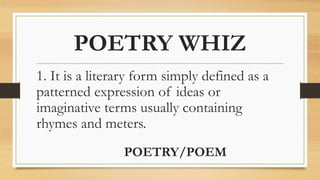
1. It is a literary form simply defined as a
patterned expression of ideas or
imaginative terms usually containing
rhymes and meters.
POETRY/POEM
POETRY WHIZ
2. It is the recurrence or the repetition
of similar sounds in poetry.
RHYME
POETRY WHIZ
3. It is the regular pattern of stressed
and unstressed sounds.
RHYTHM
POETRY WHIZ
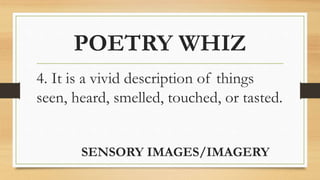
4. It is a vivid description of things
seen, heard, smelled, touched, or tasted.
SENSORY IMAGES/IMAGERY
POETRY WHIZ
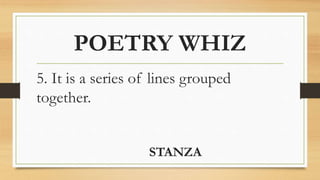
5. It is a series of lines grouped
together.
STANZA
POETRY WHIZ
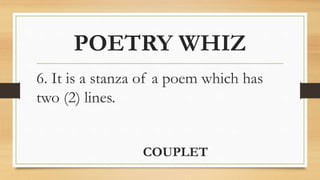
6. It is a stanza of a poem which has
two (2) lines.
COUPLET
POETRY WHIZ
7. It is an object in the poem that
symbolizes a significant idea.
SYMBOL
POETRY WHIZ
8. It is the underlying message of a
poetry.
THEME
POETRY WHIZ
9. “Sally sells sea shells by the sea
shore” is an example of what poetic
device?
ALLITERATION
POETRY WHIZ
10. What do you call a comparison that
uses words “as” and “like”?
SIMILE

Grade 7 Lesson Basic elements of a poem

  • 1.
  • 2.
  • 3.
    POETRY is defined as‘literature in a metrical form’ or ‘a composition forming metric lines.’
  • 4.
    BASIC ELEMENTS OFA POEM Stanza is a series of lines grouped together.
  • 5.
    BASIC ELEMENTS OFA POEM Couplet (2 lines) Sestet (6 lines) Tercet (3 lines) Septet (7 lines) Quatrain (4 lines) Octave (8 lines) Cinquain (5 lines)
  • 6.
    BASIC ELEMENTS OFA POEM Rhyme is the repetition of similar sound end rhyme, alternating rhyme, internal rhyme, freestyle
  • 7.
    BASIC ELEMENTS OFA POEM I saw a fairy in the wood, He was dressed all in green. He drew his sword while I just stood And I realized I’d been seen
  • 8.
    BASIC ELEMENTS OFA POEM Rhyme scheme is a continuation of rhymes
  • 9.
    BASIC ELEMENTS OFA POEM Meter – basic structural makeup of a poem
  • 10.
    BASIC ELEMENTS OFA POEM Rhythm is the music made by the stressed and unstressed syllables
  • 11.
    BASIC ELEMENTS OFA POEM Theme is the message of a poem
  • 12.
    BASIC ELEMENTS OFA POEM Symbolisms are composed of symbols that convey ideas
  • 13.
    BASIC ELEMENTS OFA POEM Imagery – device used for readers to create an image that encompasses the five senses.
  • 14.
    Vocabulary Check Use thedictionary to define the underlined word which will be found in the poem to be read.
  • 15.
    Vocabulary Check 1. Hespun himself to brightest day
  • 16.
    Vocabulary Check 2. Whoam thy Fountainhead.
  • 17.
    Vocabulary Check 3. Ofthis so regal head.
  • 18.
    Vocabulary Check 1. SPUN Verb:a simple past tense and past participle of spin. Adjective: formed by or as by spinning.
  • 19.
    Vocabulary Check 1. FOUNTAINHEAD noun afountain or spring from which a stream flows; the head or source of a stream. a chief source of anything:a fountainhead of information.
  • 20.
    Vocabulary Check 1. REGAL adjective ofor relating to a king; royal:the regal power.
  • 21.
    Question: How would youfeel if instead of appreciating the gifts of the past, you receive nothing but ingratitude?
  • 22.
    About the Author •Jose Garcia Villa (August 5, 1908 – February 7, 1997) was a Filipino poet, literary critic, short story writer, and painter. He was awarded the National Artist of the Philippines title for literature in 1973, as well as the Guggenheim Fellowship in creative writing by Conrad Aiken. He is known to have introduced the "reversed consonance rhyme scheme" in writing poetry, as well as the extensive use of punctuation marks—especially commas, which made him known as the Comma Poet.
  • 23.
    About the Author •He used the penname Doveglion(derived from "Dove, Eagle, Lion"), based on the characters he derived from himself. These animals were also explored by another poet E. E. Cummings in Doveglion, Adventures in Value, a poem dedicated to Villa.
  • 24.
    God said, “Imade a Man” God said, “I made a man Out of clay” – But so bright he, he spun Himself to brightest Day Till he was all shining gold, And oh, He was handsome to behold!
  • 25.
    God said, “Imade a Man” But in his hands held he a bow Aimed at me who created Him. And I said, “Wouldn’t thou murder me “Who am thy Fountainhead”
  • 26.
    God said, “Imade a Man” Then spoke he the man of gold: ‘I will not murder thee! I do but Measure thee. Hold Thy peace! And this I did,
  • 27.
    God said, “Imade a Man” But I was curious Of this so regal head.’ ‘Give thy name!’ – Sir Genius Source: Philippine Copyright 2005 Across Culture in Language and Philippine Literature.
  • 28.
    Q and A Inyour notebooks, answer the following questions: 1. What is the poem all about? 2. Is the relationship of the past and the present relevant in the text?
  • 29.
    Q and A 3.What attribute of God is being described in the poem? 4. How did God react to the ingratitude of His creations? 5. How are the actions of the men in the past significant to your situation right now?
  • 30.
    BIBLICAL EXPLANATION 1 Inthe beginning was the Word, and the Word was with God, and the Word was God. 2 He was with God in the beginning. 3 Through him all things were made; without him nothing was made that has been made.4 In him was life, and that life was the light of all mankind. 5 The light shines in the darkness, and the darkness has not overcome it.
  • 31.
    BIBLICAL EXPLANATION 6 Therewas a man sent from God whose name was John. 7 He came as a witness to testify concerning that light, so that through him all might believe. 8 He himself was not the light; he came only as a witness to the light.
  • 32.
    BIBLICAL EXPLANATION 9 Thetrue light that gives light to everyone was coming into the world.10 He was in the world, and though the world was made through him, the world did not recognize him. 11 He came to that which was his own, but his own did not receive him. 12 Yet to all who did receive him, to those who believed in his name, he gave the right to become children of God— 13 children born not of natural descent, nor of human decision or a husband’s will, but born of God. John 1.1-13 (NIV)
  • 33.
    Question: How would youfeel about the things given to you?
  • 34.
  • 35.
    POETRY WHIZ Identify theword or phrase described in each statement.
  • 36.
    POETRY WHIZ 1. Itis a literary form simply defined as a patterned expression of ideas or imaginative terms usually containing rhymes and meters. POETRY/POEM
  • 37.
    POETRY WHIZ 2. Itis the recurrence or the repetition of similar sounds in poetry. RHYME
  • 38.
    POETRY WHIZ 3. Itis the regular pattern of stressed and unstressed sounds. RHYTHM
  • 39.
    POETRY WHIZ 4. Itis a vivid description of things seen, heard, smelled, touched, or tasted. SENSORY IMAGES/IMAGERY
  • 40.
    POETRY WHIZ 5. Itis a series of lines grouped together. STANZA
  • 41.
    POETRY WHIZ 6. Itis a stanza of a poem which has two (2) lines. COUPLET
  • 42.
    POETRY WHIZ 7. Itis an object in the poem that symbolizes a significant idea. SYMBOL
  • 43.
    POETRY WHIZ 8. Itis the underlying message of a poetry. THEME
  • 44.
    POETRY WHIZ 9. “Sallysells sea shells by the sea shore” is an example of what poetic device? ALLITERATION
  • 45.
    POETRY WHIZ 10. Whatdo you call a comparison that uses words “as” and “like”? SIMILE