


Strategies in
Unlocking
Unfamiliar Words
Questions:
What happens when you came across an
unfamiliar word in your reading?
What did you do in order to find the meaning of
that unfamiliar word?
Example:
Sue’s boss was a callous man. He did not
react to her tears and apologies.
Callous means “hard-hearted” or “insensitive
to emotions”
CONTEXT CLUE
– Refers to the words or sentences before or after a
certain word that helps to clarify what the word(s)
means.
– Hints that the author gives to help define a difficult
or unusual word in a sentence.
Example:
My opponent’s argument is fallacious, misleading
– plain wrong.
TYPES OF CONTEXT CLUE
– Definition
– Synonym/Restatement
– Antonym/Contrast
– Example/Explanation
– Comparison
– Cause and Effect
DEFINITION
– A writer directly defines a word.
– This often happens with technical terms that may
be unfamiliar to the reader.
Example:
Jack’s duplicity – craft dishonesty – enabled
him to steal his co worker’s pension by funneling
their money into an offshore account.
WORD SIGNALS
– which is, that is, or, in other words, also
known as, also called.
SYNONYM
– The sentence uses similar word to help explain
the meaning of the unfamiliar word.
Examples:
My opponent’s argument is fallacious,
misleading – plain wrong.
WORD SIGNALS
– like, as, in the same way, similar to,
resembling, likewise
RESTATEMENT
– A writer restates the meaning of a word, but it is
not expressed as precisely as a dictionary
definition.
Example:
The new music was dissonant, that is, it
sounded harsh and incomplete.
WORD SIGNALS
– which is, that is, or, in other words, also
known as, also called.
ANTONYM /
CONTRAST
– The sentence uses a word with an opposite definition
to give the meaning of the unfamiliar word.
Example:
Maria was lethargic in school, but she was a
bundle of energy at cheer leading practice.
WORD SIGNALS
– but, although, on the contrary, on the other
hand, unlike, in contrast to, instead,
different, however
EXAMPLE
– With this method, the context in which a word
appears will include one or more examples that help
unlock the meaning of an unfamiliar word.
Example:
Celestial bodies, such as the sun, moon, and
stars are govern by predictable laws.
EXPLANATION
– The unfamiliar word is explained within the sentence
or in a sentence immediately preceding.
Example:
The patient is so somnolent, that she requires
medication to help her stay awake for more than a
short time.
WORD SIGNALS
– like, including, such as, for example, for
instance, especially, other, this, these, these
include
COMPARISON
– With this clue the writer compares the word in
questions with other, more familiar words.
Example:
This bike route seems as arduous as the one in
the Rocky Mountains that's called Agony Trail.
WORD SIGNALS
– like, as, in the same way, similar to,
resembling, likewise
CAUSE AND EFFECT
– The cause of an action or event may be stated using
an unfamiliar word. If, however, the effect is stated
in familiar terms, it can help you understand an
unfamiliar word
Example:
Because Marek was a negligent babysitter, his
younger brother wandered off and fell into the river.
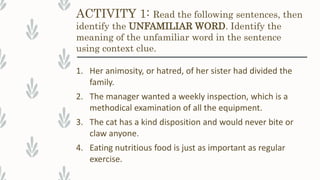
ACTIVITY 1: Read the following sentences, then
identify the UNFAMILIAR WORD. Identify the
meaning of the unfamiliar word in the sentence
using context clue.
1. Her animosity, or hatred, of her sister had divided the
family.
2. The manager wanted a weekly inspection, which is a
methodical examination of all the equipment.
3. The cat has a kind disposition and would never bite or
claw anyone.
4. Eating nutritious food is just as important as regular
exercise.
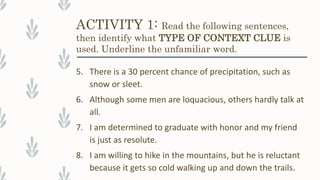
5. There is a 30 percent chance of precipitation, such as
snow or sleet.
6. Although some men are loquacious, others hardly talk at
all.
7. I am determined to graduate with honor and my friend
is just as resolute.
8. I am willing to hike in the mountains, but he is reluctant
because it gets so cold walking up and down the trails.
ACTIVITY 1: Read the following sentences,
then identify what TYPE OF CONTEXT CLUE is
used. Underline the unfamiliar word.
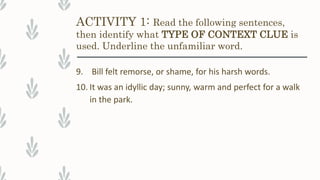
ACTIVITY 1: Read the following sentences,
then identify what TYPE OF CONTEXT CLUE is
used. Underline the unfamiliar word.
9. Bill felt remorse, or shame, for his harsh words.
10. It was an idyllic day; sunny, warm and perfect for a walk
in the park.
ACTIVITY 1: Answers Key
1. Her animosity, or hatred, of her sister had divided the
family. SYNONYM
2. The manager wanted a weekly inspection, which is a
methodical examination of all the equipment.
DEFINITION
3. The cat has a kind disposition and would never bite or
claw anyone. EXPLANATION
4. Eating nutritious food is just as important as regular
exercise. COMPARISON
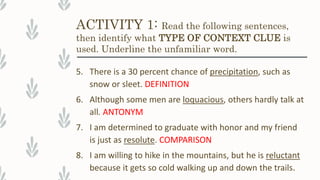
5. There is a 30 percent chance of precipitation, such as
snow or sleet. DEFINITION
6. Although some men are loquacious, others hardly talk at
all. ANTONYM
7. I am determined to graduate with honor and my friend
is just as resolute. COMPARISON
8. I am willing to hike in the mountains, but he is reluctant
because it gets so cold walking up and down the trails.
ACTIVITY 1: Read the following sentences,
then identify what TYPE OF CONTEXT CLUE is
used. Underline the unfamiliar word.
ACTIVITY 1: Read the following sentences, then
identify the UNFAMILIAR WORD. Identify the
meaning of the unfamiliar word in the sentence
using context clue.
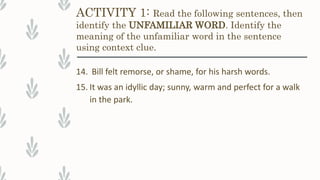
14. Bill felt remorse, or shame, for his harsh words.
15. It was an idyllic day; sunny, warm and perfect for a walk
in the park.
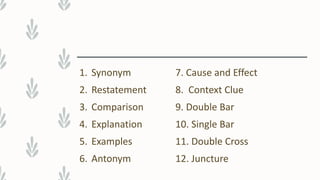
1. Synonym 7. Cause and Effect
2. Restatement 8. Context Clue
3. Comparison 9. Double Bar
4. Explanation 10. Single Bar
5. Examples 11. Double Cross
6. Antonym 12. Juncture
13. Definition

Strategy in unlocking unfamiliar words

  • 1.
  • 2.
    Questions: What happens whenyou came across an unfamiliar word in your reading? What did you do in order to find the meaning of that unfamiliar word?
  • 3.
    Example: Sue’s boss wasa callous man. He did not react to her tears and apologies. Callous means “hard-hearted” or “insensitive to emotions”
  • 4.
    CONTEXT CLUE – Refersto the words or sentences before or after a certain word that helps to clarify what the word(s) means. – Hints that the author gives to help define a difficult or unusual word in a sentence. Example: My opponent’s argument is fallacious, misleading – plain wrong.
  • 5.
    TYPES OF CONTEXTCLUE – Definition – Synonym/Restatement – Antonym/Contrast – Example/Explanation – Comparison – Cause and Effect
  • 6.
    DEFINITION – A writerdirectly defines a word. – This often happens with technical terms that may be unfamiliar to the reader. Example: Jack’s duplicity – craft dishonesty – enabled him to steal his co worker’s pension by funneling their money into an offshore account.
  • 7.
    WORD SIGNALS – whichis, that is, or, in other words, also known as, also called.
  • 8.
    SYNONYM – The sentenceuses similar word to help explain the meaning of the unfamiliar word. Examples: My opponent’s argument is fallacious, misleading – plain wrong.
  • 9.
    WORD SIGNALS – like,as, in the same way, similar to, resembling, likewise
  • 10.
    RESTATEMENT – A writerrestates the meaning of a word, but it is not expressed as precisely as a dictionary definition. Example: The new music was dissonant, that is, it sounded harsh and incomplete.
  • 11.
    WORD SIGNALS – whichis, that is, or, in other words, also known as, also called.
  • 12.
    ANTONYM / CONTRAST – Thesentence uses a word with an opposite definition to give the meaning of the unfamiliar word. Example: Maria was lethargic in school, but she was a bundle of energy at cheer leading practice.
  • 13.
    WORD SIGNALS – but,although, on the contrary, on the other hand, unlike, in contrast to, instead, different, however
  • 14.
    EXAMPLE – With thismethod, the context in which a word appears will include one or more examples that help unlock the meaning of an unfamiliar word. Example: Celestial bodies, such as the sun, moon, and stars are govern by predictable laws.
  • 15.
    EXPLANATION – The unfamiliarword is explained within the sentence or in a sentence immediately preceding. Example: The patient is so somnolent, that she requires medication to help her stay awake for more than a short time.
  • 16.
    WORD SIGNALS – like,including, such as, for example, for instance, especially, other, this, these, these include
  • 17.
    COMPARISON – With thisclue the writer compares the word in questions with other, more familiar words. Example: This bike route seems as arduous as the one in the Rocky Mountains that's called Agony Trail.
  • 18.
    WORD SIGNALS – like,as, in the same way, similar to, resembling, likewise
  • 19.
    CAUSE AND EFFECT –The cause of an action or event may be stated using an unfamiliar word. If, however, the effect is stated in familiar terms, it can help you understand an unfamiliar word Example: Because Marek was a negligent babysitter, his younger brother wandered off and fell into the river.
  • 20.
    ACTIVITY 1: Readthe following sentences, then identify the UNFAMILIAR WORD. Identify the meaning of the unfamiliar word in the sentence using context clue. 1. Her animosity, or hatred, of her sister had divided the family. 2. The manager wanted a weekly inspection, which is a methodical examination of all the equipment. 3. The cat has a kind disposition and would never bite or claw anyone. 4. Eating nutritious food is just as important as regular exercise.
  • 21.
    5. There isa 30 percent chance of precipitation, such as snow or sleet. 6. Although some men are loquacious, others hardly talk at all. 7. I am determined to graduate with honor and my friend is just as resolute. 8. I am willing to hike in the mountains, but he is reluctant because it gets so cold walking up and down the trails. ACTIVITY 1: Read the following sentences, then identify what TYPE OF CONTEXT CLUE is used. Underline the unfamiliar word.
  • 22.
    ACTIVITY 1: Readthe following sentences, then identify what TYPE OF CONTEXT CLUE is used. Underline the unfamiliar word. 9. Bill felt remorse, or shame, for his harsh words. 10. It was an idyllic day; sunny, warm and perfect for a walk in the park.
  • 23.
    ACTIVITY 1: AnswersKey 1. Her animosity, or hatred, of her sister had divided the family. SYNONYM 2. The manager wanted a weekly inspection, which is a methodical examination of all the equipment. DEFINITION 3. The cat has a kind disposition and would never bite or claw anyone. EXPLANATION 4. Eating nutritious food is just as important as regular exercise. COMPARISON
  • 24.
    5. There isa 30 percent chance of precipitation, such as snow or sleet. DEFINITION 6. Although some men are loquacious, others hardly talk at all. ANTONYM 7. I am determined to graduate with honor and my friend is just as resolute. COMPARISON 8. I am willing to hike in the mountains, but he is reluctant because it gets so cold walking up and down the trails. ACTIVITY 1: Read the following sentences, then identify what TYPE OF CONTEXT CLUE is used. Underline the unfamiliar word.
  • 25.
    ACTIVITY 1: Readthe following sentences, then identify the UNFAMILIAR WORD. Identify the meaning of the unfamiliar word in the sentence using context clue. 14. Bill felt remorse, or shame, for his harsh words. 15. It was an idyllic day; sunny, warm and perfect for a walk in the park.
  • 26.
    1. Synonym 7.Cause and Effect 2. Restatement 8. Context Clue 3. Comparison 9. Double Bar 4. Explanation 10. Single Bar 5. Examples 11. Double Cross 6. Antonym 12. Juncture
  • 27.