Discourse
- an extended expression of thoughts or ideas
- utterance, talk, speech, discussion, and
conversation
* The ideas in discourse are not connected or do
not have a particular structure.
Text
- a large unit of written language
- a group of ideas put together to make a point or
one central idea
- has a structure which requires the ideas in the
discourse to be relevant to each other
- an actually connected discourse
Properties of a Well-written Text
1. Organization
- refers to the arrangement of ideas in a text
* Creating an outline of ideas before you start
writing can help your work become organized.
Outline
- provides a format in which ideas can be
arranged in a hierarchy- that is, it distinguishes
the general ideas from the specific or
subordinating ideas
2. Coherence and Cohesion
- refer to the connection of ideas and
connection between sentences and between
paragraphs
* In order for you to assure coherence and
cohesion, you need to use transitional or
cohesive devices.
3. Appropriate Language Use
- refers to the acceptable style of language for a
particular form of text
4. Proper Mechanics
- refers to the conventions of writing which
includes capitalization, punctuation, spelling,
numerals, abbreviations, acronyms and
contractions
Morphology
- the study of words, how they are formed, and
their relationship to other words in the same
language
- analyzes the structure of words and parts of
words, such as root words, prefixes, and
suffixes
Morpheme
Two Types of Morpheme:
1. Free Morpheme
2. Bound Morpheme
- the smallest grammatical unit in a language
1. Free Morpheme
- can function independently as a word
Examples: house, cat, blood
2. Bound Morpheme
- a word element attached to a root word
(the main part of a word) to give it another
meaning
- cannot function independently as a word
Examples: affixes (prefixes and suffixes)
Affix
- a morpheme that is attached to a root word to
form a new word
1. Prefix
2. Suffix
Prefix
- a morpheme that comes before a root word
Examples:
auto- (automobile)
in- (incorrect)
over- (overcharge)
Suffix
- a morpheme that comes after a root word
Examples:
-ful (forgetful)
-ish (childish)
-ive (active)
Two Varieties of Suffixes
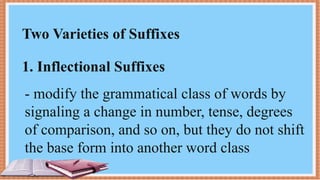
- modify the grammatical class of words by
signaling a change in number, tense, degrees
of comparison, and so on, but they do not shift
the base form into another word class
1. Inflectional Suffixes
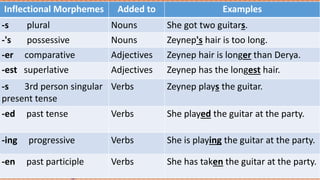
Inflectional Morphemes Added to Examples
-s plural Nouns She got two guitars.
-'s possessive Nouns Zeynep's hair is too long.
-er comparative Adjectives Zeynep hair is longer than Derya.
-est superlative Adjectives Zeynep has the longest hair.
-s 3rd person singular
present tense
Verbs Zeynep plays the guitar.
-ed past tense Verbs She played the guitar at the party.
-ing progressive Verbs She is playing the guitar at the party.
-en past participle Verbs She has taken the guitar at the party.
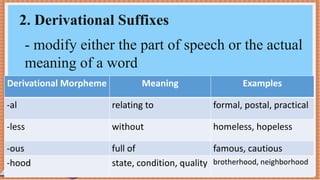
- modify either the part of speech or the actual
meaning of a word
2. Derivational Suffixes
Derivational Morpheme Meaning Examples
-al relating to formal, postal, practical
-less without homeless, hopeless
-ous full of famous, cautious
-hood state, condition, quality brotherhood, neighborhood
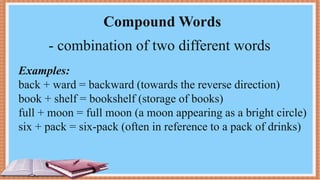
Compound Words
- combination of two different words
Examples:
back + ward = backward (towards the reverse direction)
book + shelf = bookshelf (storage of books)
full + moon = full moon (a moon appearing as a bright circle)
six + pack = six-pack (often in reference to a pack of drinks)
Context Clues
- are words, phrases, and sentences that
surround an unfamiliar word and help you
recognize the meaning of an unknown word
Example:
The narrator in the poem was euphoric at his son's
victory, for he cried out triumphantly when the boy
came home.
- victorious; triumphant; very happy and excited
1. Synonyms - used when the text has words or
phrases that ae similar in meaning to the unknown
word
euphoric
Other Examples:
a. This situation is a conundrum - a puzzle.
conundrum
- a confusing or a difficult situation
b. Humpty Dumpty took great pleasure in
obfuscating the poem's meaning to Alice. His
explanations about the poem were confusing
and complicated.
obfuscating
- making more difficult to understand;
confusing
c. We are planning a picnic for today. It is
sunny and warm outside. It will be an idyllic
day - just perfect for a picnic.
idyllic
- perfect; very peaceful, happy, and enjoyable
Example:
Although Mary was willing to play in the snow,
Jack was reluctant because he was so cold.
- not willing to do something
2. Antonyms - words that reveal the opposite meaning
in relation to the unknown word
reluctant
a. Marty is gregarious, not like his brother
who is quiet and shy.
gregarious
- sociable; outgoing; extrovert
b. The lanky dog was not fat, even though he
ate a lot.
lanky
- skinny
c. The rich woman gave a paltry sum to the
charity even though she was able to give
much more.
paltry
-very small or too small in amount
Example:
Projectiles include those items that are shot forward
such as a cannon shell, bullet, or rocket.
- things (such as bullet or rocket) that are shot from
weapon
3. Examples - are specific details in a text that are
used to clarify the meaning of a word
projectiles
a. Famous conquistadors include Cortes, who
conquered Aztec Mexico and Pizarro, who
conquered Inca Peru.
conquistadors
- conquerors; ones that take control of
(a country or city) through the use of force
b. A sleuth, such as Sherlock Holmes, can be
very helpful in solving crimes.
sleuth
- detective
- someone who looks for information to solve
crimes
c. Precipitation, such as rain and snow, falls
from the sky.
precipitation
- water that falls to the ground (such as rain
and snow)
Example:
The prisoner was in a state of wrath—a feeling of
intense anger.
- extreme anger
4. Definition - is usually signaled by a form of the
verb to be (am, is, are, was, were) or by commas or
dashes
wrath
a. To shun someone is to have nothing to do
with that person.
shun
- to avoid deliberately
b. He seemed to be ill, but it was merely a
ruse, that is, a clever trick to deceive us.
ruse
- a trick or act that is used to fool someone
- a wily subterfuge
- deception
c. Sedentary individuals, people who are not
very active, often have diminished health.
sedentary
- not doing or involving much physical
activity
Example:
An evanescent ring surrounded the moon as it rose.
It was there for a moment, and then it disappeared.
- lasting a very short time; brief; momentary
5. Explanation - words or phrases that explain the
unfamiliar word's meaning
evanescent
a. Elis is a blithe young girl. She always
greets everyone with a smile.
blithe
- cheerful; happy, lighthearted
b. Katie appeared infallible in math class
because she had never gotten a problem
wrong.
infallible
- unerring;
- unfailing
- not capable of being wrong
c. The tornado annihilated the whole town to
the point that nothing was left standing.
annihilated
- destroyed; eradicated; exterminated;
abolished
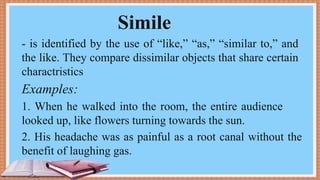
Simile
- is identified by the use of “like,” “as,” “similar to,” and
the like. They compare dissimilar objects that share certain
charactristics
Examples:
1. When he walked into the room, the entire audience
looked up, like flowers turning towards the sun.
2. His headache was as painful as a root canal without the
benefit of laughing gas.
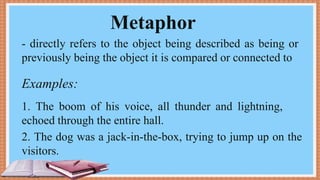
Metaphor
- directly refers to the object being described as being or
previously being the object it is compared or connected to
Examples:
1. The boom of his voice, all thunder and lightning,
echoed through the entire hall.
2. The dog was a jack-in-the-box, trying to jump up on the
visitors.
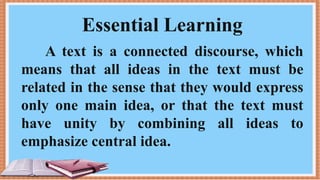
Essential Learning
A text is a connected discourse, which
means that all ideas in the text must be
related in the sense that they would express
only one main idea, or that the text must
have unity by combining all ideas to
emphasize central idea.
lesson2textasconnecteddiscourse-170207031943.pdf

  • 2.
    Discourse - an extendedexpression of thoughts or ideas - utterance, talk, speech, discussion, and conversation * The ideas in discourse are not connected or do not have a particular structure.
  • 3.
    Text - a largeunit of written language - a group of ideas put together to make a point or one central idea - has a structure which requires the ideas in the discourse to be relevant to each other - an actually connected discourse
  • 4.
    Properties of aWell-written Text 1. Organization - refers to the arrangement of ideas in a text * Creating an outline of ideas before you start writing can help your work become organized.
  • 5.
    Outline - provides aformat in which ideas can be arranged in a hierarchy- that is, it distinguishes the general ideas from the specific or subordinating ideas
  • 6.
    2. Coherence andCohesion - refer to the connection of ideas and connection between sentences and between paragraphs * In order for you to assure coherence and cohesion, you need to use transitional or cohesive devices.
  • 7.
    3. Appropriate LanguageUse - refers to the acceptable style of language for a particular form of text
  • 8.
    4. Proper Mechanics -refers to the conventions of writing which includes capitalization, punctuation, spelling, numerals, abbreviations, acronyms and contractions
  • 10.
    Morphology - the studyof words, how they are formed, and their relationship to other words in the same language - analyzes the structure of words and parts of words, such as root words, prefixes, and suffixes
  • 11.
    Morpheme Two Types ofMorpheme: 1. Free Morpheme 2. Bound Morpheme - the smallest grammatical unit in a language
  • 12.
    1. Free Morpheme -can function independently as a word Examples: house, cat, blood
  • 13.
    2. Bound Morpheme -a word element attached to a root word (the main part of a word) to give it another meaning - cannot function independently as a word Examples: affixes (prefixes and suffixes)
  • 14.
    Affix - a morphemethat is attached to a root word to form a new word 1. Prefix 2. Suffix
  • 15.
    Prefix - a morphemethat comes before a root word Examples: auto- (automobile) in- (incorrect) over- (overcharge)
  • 16.
    Suffix - a morphemethat comes after a root word Examples: -ful (forgetful) -ish (childish) -ive (active)
  • 17.
    Two Varieties ofSuffixes - modify the grammatical class of words by signaling a change in number, tense, degrees of comparison, and so on, but they do not shift the base form into another word class 1. Inflectional Suffixes
  • 18.
    Inflectional Morphemes Addedto Examples -s plural Nouns She got two guitars. -'s possessive Nouns Zeynep's hair is too long. -er comparative Adjectives Zeynep hair is longer than Derya. -est superlative Adjectives Zeynep has the longest hair. -s 3rd person singular present tense Verbs Zeynep plays the guitar. -ed past tense Verbs She played the guitar at the party. -ing progressive Verbs She is playing the guitar at the party. -en past participle Verbs She has taken the guitar at the party.
  • 19.
    - modify eitherthe part of speech or the actual meaning of a word 2. Derivational Suffixes Derivational Morpheme Meaning Examples -al relating to formal, postal, practical -less without homeless, hopeless -ous full of famous, cautious -hood state, condition, quality brotherhood, neighborhood
  • 20.
    Compound Words - combinationof two different words Examples: back + ward = backward (towards the reverse direction) book + shelf = bookshelf (storage of books) full + moon = full moon (a moon appearing as a bright circle) six + pack = six-pack (often in reference to a pack of drinks)
  • 22.
    Context Clues - arewords, phrases, and sentences that surround an unfamiliar word and help you recognize the meaning of an unknown word
  • 24.
    Example: The narrator inthe poem was euphoric at his son's victory, for he cried out triumphantly when the boy came home. - victorious; triumphant; very happy and excited 1. Synonyms - used when the text has words or phrases that ae similar in meaning to the unknown word euphoric
  • 25.
    Other Examples: a. Thissituation is a conundrum - a puzzle. conundrum - a confusing or a difficult situation
  • 26.
    b. Humpty Dumptytook great pleasure in obfuscating the poem's meaning to Alice. His explanations about the poem were confusing and complicated. obfuscating - making more difficult to understand; confusing
  • 27.
    c. We areplanning a picnic for today. It is sunny and warm outside. It will be an idyllic day - just perfect for a picnic. idyllic - perfect; very peaceful, happy, and enjoyable
  • 28.
    Example: Although Mary waswilling to play in the snow, Jack was reluctant because he was so cold. - not willing to do something 2. Antonyms - words that reveal the opposite meaning in relation to the unknown word reluctant
  • 29.
    a. Marty isgregarious, not like his brother who is quiet and shy. gregarious - sociable; outgoing; extrovert
  • 30.
    b. The lankydog was not fat, even though he ate a lot. lanky - skinny
  • 31.
    c. The richwoman gave a paltry sum to the charity even though she was able to give much more. paltry -very small or too small in amount
  • 32.
    Example: Projectiles include thoseitems that are shot forward such as a cannon shell, bullet, or rocket. - things (such as bullet or rocket) that are shot from weapon 3. Examples - are specific details in a text that are used to clarify the meaning of a word projectiles
  • 33.
    a. Famous conquistadorsinclude Cortes, who conquered Aztec Mexico and Pizarro, who conquered Inca Peru. conquistadors - conquerors; ones that take control of (a country or city) through the use of force
  • 34.
    b. A sleuth,such as Sherlock Holmes, can be very helpful in solving crimes. sleuth - detective - someone who looks for information to solve crimes
  • 35.
    c. Precipitation, suchas rain and snow, falls from the sky. precipitation - water that falls to the ground (such as rain and snow)
  • 36.
    Example: The prisoner wasin a state of wrath—a feeling of intense anger. - extreme anger 4. Definition - is usually signaled by a form of the verb to be (am, is, are, was, were) or by commas or dashes wrath
  • 37.
    a. To shunsomeone is to have nothing to do with that person. shun - to avoid deliberately
  • 38.
    b. He seemedto be ill, but it was merely a ruse, that is, a clever trick to deceive us. ruse - a trick or act that is used to fool someone - a wily subterfuge - deception
  • 39.
    c. Sedentary individuals,people who are not very active, often have diminished health. sedentary - not doing or involving much physical activity
  • 40.
    Example: An evanescent ringsurrounded the moon as it rose. It was there for a moment, and then it disappeared. - lasting a very short time; brief; momentary 5. Explanation - words or phrases that explain the unfamiliar word's meaning evanescent
  • 41.
    a. Elis isa blithe young girl. She always greets everyone with a smile. blithe - cheerful; happy, lighthearted
  • 42.
    b. Katie appearedinfallible in math class because she had never gotten a problem wrong. infallible - unerring; - unfailing - not capable of being wrong
  • 43.
    c. The tornadoannihilated the whole town to the point that nothing was left standing. annihilated - destroyed; eradicated; exterminated; abolished
  • 45.
    Simile - is identifiedby the use of “like,” “as,” “similar to,” and the like. They compare dissimilar objects that share certain charactristics Examples: 1. When he walked into the room, the entire audience looked up, like flowers turning towards the sun. 2. His headache was as painful as a root canal without the benefit of laughing gas.
  • 46.
    Metaphor - directly refersto the object being described as being or previously being the object it is compared or connected to Examples: 1. The boom of his voice, all thunder and lightning, echoed through the entire hall. 2. The dog was a jack-in-the-box, trying to jump up on the visitors.
  • 47.
    Essential Learning A textis a connected discourse, which means that all ideas in the text must be related in the sense that they would express only one main idea, or that the text must have unity by combining all ideas to emphasize central idea.