USE CONDITIONALS IN
EXPRESSING ARGUMENTS.
WHAT ARE
CONDITIONALS IN
ENGLISH GRAMMAR?
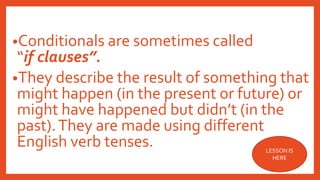
•Conditionals are sometimes called
“if clauses”.
•They describe the result of something that
might happen (in the present or future) or
might have happened but didn’t (in the
past).They are made using different
English verb tenses. LESSON IS
HERE
USE CONDITIONALS IN
EXPRESSING ARGUMENTS
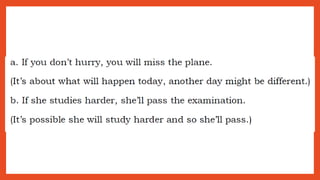
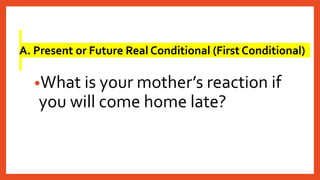
A. Present or Future Real Conditional (First Conditional)
•What is your mother’s reaction if
you will come home late?
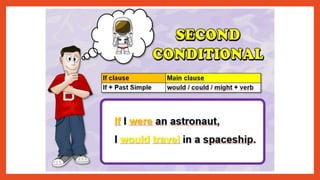
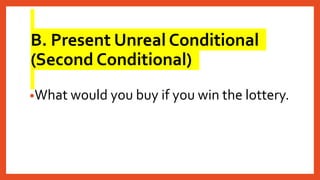
B. Present Unreal Conditional
(Second Conditional)
•What would you buy if you win the lottery.
C. Past Unreal Conditional (Third Conditional)
•What would have happened if you had
worked harder in your examination?
D. Present Real Conditional
(Zero-Type conditional)
•What happens when you heat ice?

G9 Use conditionals in expressing arguments.pptx

Editor's Notes

  • #3 In your previous lesson, you have encountered the use of modals to express permission, prohibition (not allowing something), and obligation or no obligation. You were also taught of the different words to be used in each of the given situations.
  • #7 It’s used to talk about things which might happen in the future. Of course, we can’t know what will happen in the future, but this describes possible things, which could easily come true.
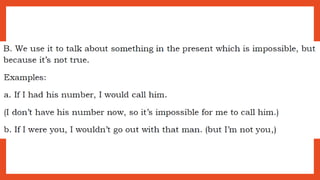
  • #10 We use it to talk about things in the future that are probably not going to be true. We use it to talk about something in the present which is impossible, but because it’s not true.
  • #14 It talks about the past. It is used to describe a situation that didn’t happen, and to imagine the result of this situation.
  • #17 This conditional is used when the result will always happen.