Using Asynchronous Conferences to Support Wiki Skills Training and Development of Distance Learning Lessons   Sanjaya Mishra,  PhD Indira Gandhi  National Open University, India
Structure of the Presentation Introduction Objectives Review of Related Literature Methodology Results and Discussions Conclusions
Introduction Three types of e-learning: supplement to f2f situation, mixed-mode or blended approach, online distance mode Interaction is important: learner-learner, learner-content and learner-instructor Different technologies used including LMS, common applications include use of discussion groups and email (often referred as CMC)‏
Computer Conferences Synchronous and asynchronous Asynchronous conferences help to encourage reflection, allow participation in discussion, help tutors to provide support and observe student progress Creation of a community of learning/ community of practice Requires high degree of learner maturity, motivation and proficiency in use of both English language and technology
Significance and Objectives Asian learners participate less in discussions in classrooms Online scenario reduces this, but power distance (social inequality and relationship to authority) may influence online communications In this backdrop, the objectives of the study were to: Examine the degree of participation in CMC; Analyse the nature of 'online support' in asynchronous conferences; Assess the wiki skills development amongst participant trainees; and Evaluate the online support through trainee feedback.
Review of Related Literature Most studies agree that interaction is key to learning Various ways of looking at interactions in CMC: social constructivist model, transcript analysis, community of inquiry, etc. Less emphasis on “Learner Support”, but there are references to support through scaffolding techniques, mentoring, etc. Development of critical thinking and knowledge construction were major focus in majority of studies.
Methodology Context: One Asian Open University Primary Task: SLM writing skills  Participants: Open University teachers and NGO workers involved in SLM writing for school level Female (07), Male (23)‏ Five stage approach to training Technology used: WikiEducator, Google Group, Email Instruments used: TAPOS developed by the author and questionnaire feedback
Results and Discussions
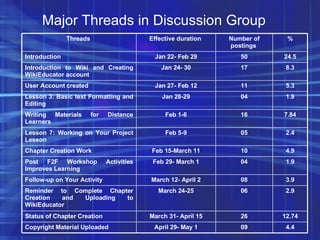
Major Threads in Discussion Group 4.4 09 April 29- May 1 Copyright Material Uploaded 12.74 26 March 31- April 15 Status of Chapter Creation 2.9 06 March 24-25 Reminder to Complete Chapter Creation and Uploading to WikiEducator 3.9 08 March 12- April 2 Follow-up on Your Activity 1.9 04 Feb 29- March 1 Post F2F Workshop Activities Improves Learning 4.9 10 Feb 15-March 11 Chapter Creation Work 2.4 05 Feb 5-9 Lesson 7: Working on Your Project Lesson 7.84 16 Feb 1-6 Writing Materials for Distance Learners 1.9 04 Jan 28-29 Lesson 3: Basic text Formatting and Editing 5.3 11 Jan 27- Feb 12 User Account created 8.3 17 Jan 24- 30 Introduction to Wiki and Creating WikiEducator account 24.5 50 Jan 22- Feb 29 Introduction % Number of postings   Effective duration   Threads
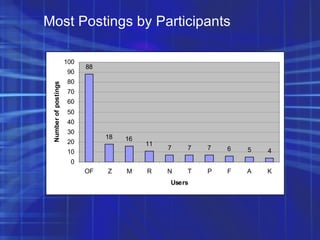
Most Postings by Participants
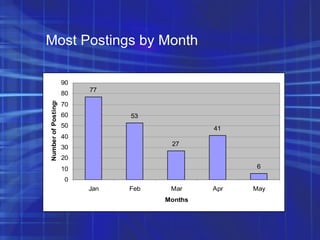
Most Postings by Month
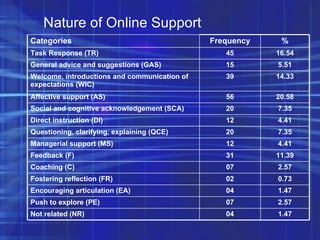
Nature of Online Support 1.47 04 Not related (NR)‏ 2.57 07 Push to explore (PE)‏ 1.47 04 Encouraging articulation (EA)‏ 0.73 02 Fostering reflection (FR)‏ 2.57 07 Coaching (C)‏ 11.39 31 Feedback (F)‏ 4.41 12 Managerial support (MS)‏ 7.35 20 Questioning, clarifying, explaining (QCE)‏ 4.41 12 Direct instruction (DI)‏ 7.35 20 Social and cognitive acknowledgement (SCA)‏ 20.58 56 Affective support (AS)‏ 14.33 39 Welcome, introductions and communication of expectations (WIC)‏ 5.51 15 General advice and suggestions (GAS)‏ 16.54 45 Task Response (TR)‏ % Frequency Categories
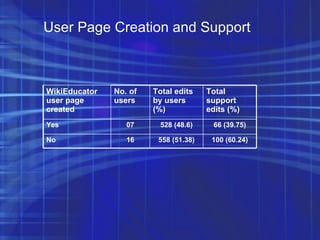
User Page Creation and Support 100 (60.24)‏ 558 (51.38)‏ 16 No 66 (39.75)‏ 528 (48.6)‏ 07 Yes Total support edits (%)‏ Total edits by users (%)‏ No. of users WikiEducator user page created
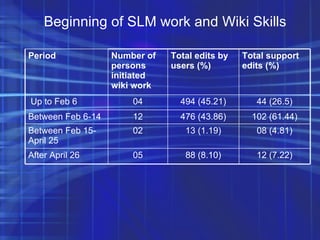
Beginning of SLM work and Wiki Skills 12 (7.22)‏ 88 (8.10)‏ 05 After April 26  08 (4.81)‏ 13 (1.19)‏ 02 Between Feb 15-April 25 102 (61.44)‏ 476 (43.86)‏ 12 Between Feb 6-14 44 (26.5)‏ 494 (45.21)‏ 04 Up to Feb 6 Total support edits (%)‏ Total edits by users (%)‏ Number of persons initiated wiki work Period
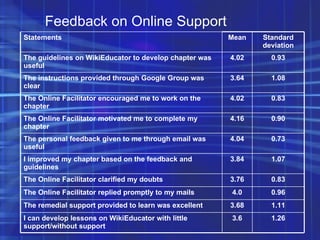
Feedback on Online Support 1.26 3.6 I can develop lessons on WikiEducator with little support/without support 1.11 3.68 The remedial support provided to learn was excellent 0.96 4.0 The Online Facilitator replied promptly to my mails 0.83 3.76 The Online Facilitator clarified my doubts 1.07 3.84 I improved my chapter based on the feedback and guidelines 0.73 4.04 The personal feedback given to me through email was useful 0.90 4.16 The Online Facilitator motivated me to complete my chapter 0.83 4.02 The Online Facilitator encouraged me to work on the chapter 1.08 3.64 The instructions provided through Google Group was clear 0.93 4.02 The guidelines on WikiEducator to develop chapter was useful Standard deviation Mean Statements
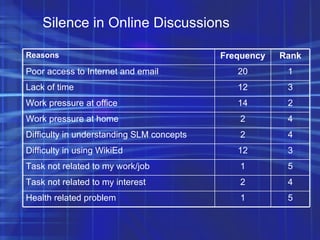
Silence in Online Discussions Rank Frequency Reasons 1 20 Poor access to Internet and email 5 1 Health related problem 4 2 Task not related to my interest 5 1 Task not related to my work/job 3 12 Difficulty in using WikiEd 4 2 Difficulty in understanding SLM concepts 4 2 Work pressure at home 2 14 Work pressure at office 3 12 Lack of time
Conclusions Twenty three participants developed SLM on WikiEducator Google Group used like a task reporting tool Access to Internet promote more use and mastery of Wiki skills Template driven approach more suitable Poor access situation demands f2f training Need for self-regulation in online learning  TAPOS useful to support online tutor training

Using asynchronous conference to support wiki skills training and SLM development

  • 1.
    Using Asynchronous Conferencesto Support Wiki Skills Training and Development of Distance Learning Lessons Sanjaya Mishra, PhD Indira Gandhi National Open University, India
  • 2.
    Structure of thePresentation Introduction Objectives Review of Related Literature Methodology Results and Discussions Conclusions
  • 3.
    Introduction Three typesof e-learning: supplement to f2f situation, mixed-mode or blended approach, online distance mode Interaction is important: learner-learner, learner-content and learner-instructor Different technologies used including LMS, common applications include use of discussion groups and email (often referred as CMC)‏
  • 4.
    Computer Conferences Synchronousand asynchronous Asynchronous conferences help to encourage reflection, allow participation in discussion, help tutors to provide support and observe student progress Creation of a community of learning/ community of practice Requires high degree of learner maturity, motivation and proficiency in use of both English language and technology
  • 5.
    Significance and ObjectivesAsian learners participate less in discussions in classrooms Online scenario reduces this, but power distance (social inequality and relationship to authority) may influence online communications In this backdrop, the objectives of the study were to: Examine the degree of participation in CMC; Analyse the nature of 'online support' in asynchronous conferences; Assess the wiki skills development amongst participant trainees; and Evaluate the online support through trainee feedback.
  • 6.
    Review of RelatedLiterature Most studies agree that interaction is key to learning Various ways of looking at interactions in CMC: social constructivist model, transcript analysis, community of inquiry, etc. Less emphasis on “Learner Support”, but there are references to support through scaffolding techniques, mentoring, etc. Development of critical thinking and knowledge construction were major focus in majority of studies.
  • 7.
    Methodology Context: OneAsian Open University Primary Task: SLM writing skills Participants: Open University teachers and NGO workers involved in SLM writing for school level Female (07), Male (23)‏ Five stage approach to training Technology used: WikiEducator, Google Group, Email Instruments used: TAPOS developed by the author and questionnaire feedback
  • 8.
  • 9.
    Major Threads inDiscussion Group 4.4 09 April 29- May 1 Copyright Material Uploaded 12.74 26 March 31- April 15 Status of Chapter Creation 2.9 06 March 24-25 Reminder to Complete Chapter Creation and Uploading to WikiEducator 3.9 08 March 12- April 2 Follow-up on Your Activity 1.9 04 Feb 29- March 1 Post F2F Workshop Activities Improves Learning 4.9 10 Feb 15-March 11 Chapter Creation Work 2.4 05 Feb 5-9 Lesson 7: Working on Your Project Lesson 7.84 16 Feb 1-6 Writing Materials for Distance Learners 1.9 04 Jan 28-29 Lesson 3: Basic text Formatting and Editing 5.3 11 Jan 27- Feb 12 User Account created 8.3 17 Jan 24- 30 Introduction to Wiki and Creating WikiEducator account 24.5 50 Jan 22- Feb 29 Introduction % Number of postings Effective duration Threads
  • 10.
    Most Postings byParticipants
  • 11.
  • 12.
    Nature of OnlineSupport 1.47 04 Not related (NR)‏ 2.57 07 Push to explore (PE)‏ 1.47 04 Encouraging articulation (EA)‏ 0.73 02 Fostering reflection (FR)‏ 2.57 07 Coaching (C)‏ 11.39 31 Feedback (F)‏ 4.41 12 Managerial support (MS)‏ 7.35 20 Questioning, clarifying, explaining (QCE)‏ 4.41 12 Direct instruction (DI)‏ 7.35 20 Social and cognitive acknowledgement (SCA)‏ 20.58 56 Affective support (AS)‏ 14.33 39 Welcome, introductions and communication of expectations (WIC)‏ 5.51 15 General advice and suggestions (GAS)‏ 16.54 45 Task Response (TR)‏ % Frequency Categories
  • 13.
    User Page Creationand Support 100 (60.24)‏ 558 (51.38)‏ 16 No 66 (39.75)‏ 528 (48.6)‏ 07 Yes Total support edits (%)‏ Total edits by users (%)‏ No. of users WikiEducator user page created
  • 14.
    Beginning of SLMwork and Wiki Skills 12 (7.22)‏ 88 (8.10)‏ 05 After April 26 08 (4.81)‏ 13 (1.19)‏ 02 Between Feb 15-April 25 102 (61.44)‏ 476 (43.86)‏ 12 Between Feb 6-14 44 (26.5)‏ 494 (45.21)‏ 04 Up to Feb 6 Total support edits (%)‏ Total edits by users (%)‏ Number of persons initiated wiki work Period
  • 15.
    Feedback on OnlineSupport 1.26 3.6 I can develop lessons on WikiEducator with little support/without support 1.11 3.68 The remedial support provided to learn was excellent 0.96 4.0 The Online Facilitator replied promptly to my mails 0.83 3.76 The Online Facilitator clarified my doubts 1.07 3.84 I improved my chapter based on the feedback and guidelines 0.73 4.04 The personal feedback given to me through email was useful 0.90 4.16 The Online Facilitator motivated me to complete my chapter 0.83 4.02 The Online Facilitator encouraged me to work on the chapter 1.08 3.64 The instructions provided through Google Group was clear 0.93 4.02 The guidelines on WikiEducator to develop chapter was useful Standard deviation Mean Statements
  • 16.
    Silence in OnlineDiscussions Rank Frequency Reasons 1 20 Poor access to Internet and email 5 1 Health related problem 4 2 Task not related to my interest 5 1 Task not related to my work/job 3 12 Difficulty in using WikiEd 4 2 Difficulty in understanding SLM concepts 4 2 Work pressure at home 2 14 Work pressure at office 3 12 Lack of time
  • 17.
    Conclusions Twenty threeparticipants developed SLM on WikiEducator Google Group used like a task reporting tool Access to Internet promote more use and mastery of Wiki skills Template driven approach more suitable Poor access situation demands f2f training Need for self-regulation in online learning TAPOS useful to support online tutor training